
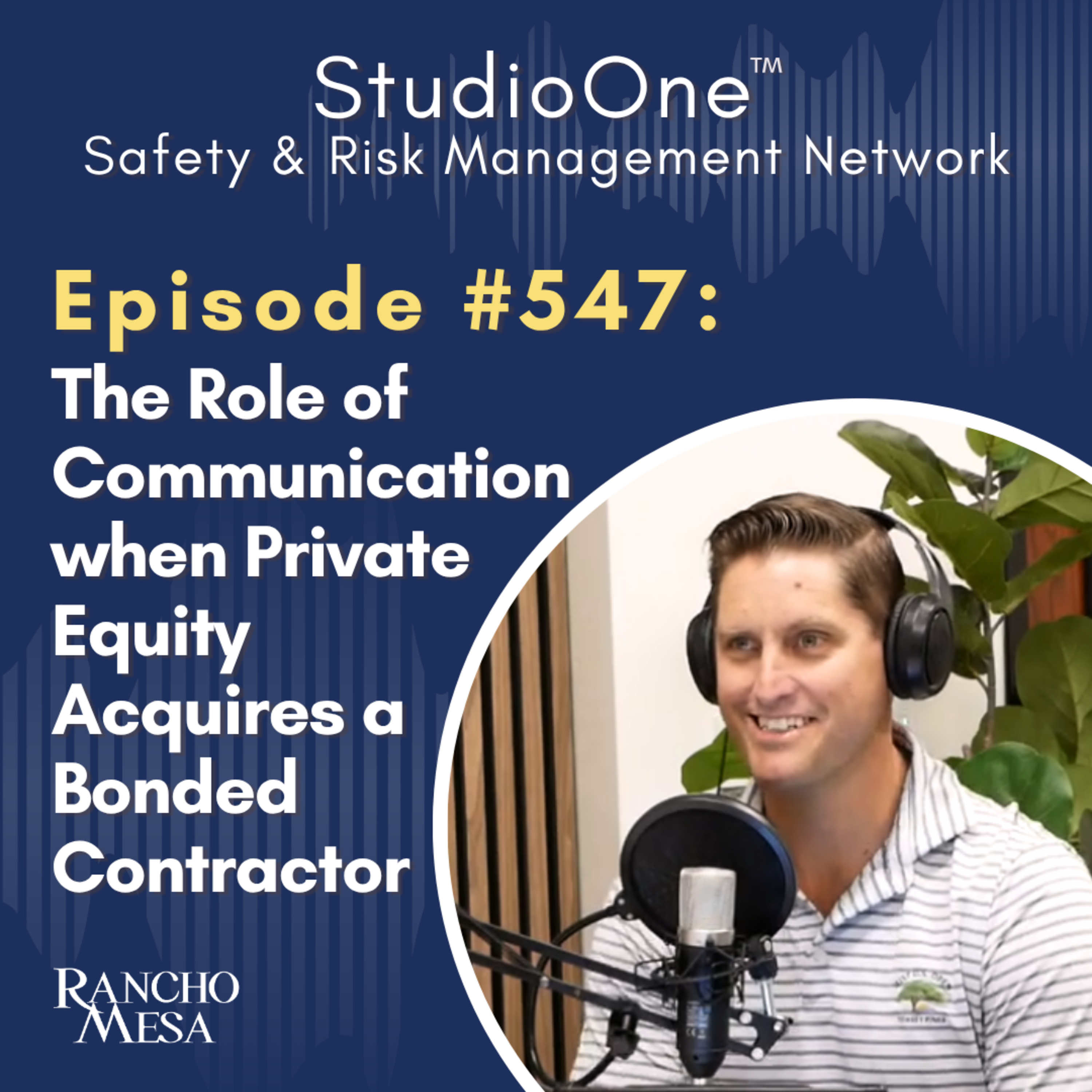
This episode is brought to you by C&E Insurance Company, a leading insurance company that provides a broad range of standard and specialized property and casualty, insurance products and services for businesses and professionals throughout the US, Canada, and Europe, and is backed by more than 120 years of experience and approximately $45 billion in invested assets. You're listening to Rancio Mesa's Studio One Podcast, where each week we break down complex insurance and safety topics to help your business thrive. I'm your host, Megan Lockhart, and I'm joined by Andy Roberts, Shreddy Group Leader with Rancio Mesa. And today we're going to talk about the important role communication plays when private equity acquires a bonded contractor.
So Andy, welcome to the show. Thank you for having me. We're happy to have you. Now, you recently wrote an article addressing this topic.
So what are some of the key differences between how Shreddy companies underwrite standard construction bond programs versus those owned by private equity? So on the standard side, we really look at a standard net worth and the net worth of the company when we're establishing those limits and what they would qualify for a bond program. So we look at the retention of the capital, they're keeping money in the company, they're looking at their cash balances, what their net profits look like at year end. But when you're looking at these private equity deals, the big issue you run into is that they carry a lot of debt on their balance sheet.
And the interest payments on those debt often lead to them showing a negative net income on their financials, which on the standard side, that's not a good thing. We don't like to see that you're losing money. So it's important on this where we find Shreddy companies that understand PI because you want to look at their cash balances, making sure that their cash flow is good, they have a bank line, another working capital items outside of the standard stuff that we look for. Okay, that makes sense.
So why is it so important for private equity firms to involve their Shreddy agent and company early in the acquisitions or due diligence process? So if you're looking to acquire a company that relies heavily on bonded work for other revenue stores, it's going to be important that company can still get that kind of work after the acquisition. And so oftentimes when they're bringing on a company, there's a big capital expenditure to make the acquisition, which has a negative impact on the balance sheet. And so if we're going back to the Shreddy company and it has a detrimental impact to the balance sheet, that affects their program limits and this could affect that company getting the bonds that they need.
And therefore making the investment in that company, maybe not the best for the long term for the equity firm. Right. How do the financials of private equity owned companies, especially higher debt and potential net losses impact their ability to secure bonds after an acquisition? Well, as the debt goes up, depending on the interest on that too, that can hamper their limits and make their program smaller because the Shreddy company is entertaining up.
They're looking at all these other obligations that this money is earmarked for. And so it's really important that they're keeping an eye on their cash flow, their bank line. These are all key markers we look at. If they're heavy into their bank line or cash flow purposes, that's not usually a good sign and might be a sign of having some struggles.
And that's going to cause a Shreddy company to kind of step back and not want to support as big a program that they might need. Right. So in your article, you mentioned the role of the current management team post acquisition. So why does their continued involvement matter so much to Shreddy companies during the transition?
So this is a really important thing because these PEE firms, every PEE deal is different. And depending on what market sector they're in, the PEE company might be back east and they're buying a company that might fit the mold that they're doing for, like their electrical contractors or landscapers or something. But they might be in a territory that they're completely not familiar with. So keeping that management in place, at least for a while, keeps the operation continuity in place, the knowledge transfer, the relationship transfers, keeps all that kind of stuff in place to keep the business running.
Hopefully it was profitable and running well prior to that and it keeps that trend going. So the private equity company has a good investment on their hands. Right. Well Andy, thank you for this important information.
If listeners have questions about their Shreddy program, what's the best way to get in touch with you? So you can reach me at 619-937-0166 or at arobertsatranchomacel.com. Great. Well Andy, thanks for joining me in Studio One.
Always a pleasure. Thank you for having me. Thanks for tuning in to our latest episode produced by Studio One. If you enjoyed what you heard, please share this episode and subscribe.
For more insights like this, visit us at ranchomacel.com and subscribe to our weekly newsletter.