
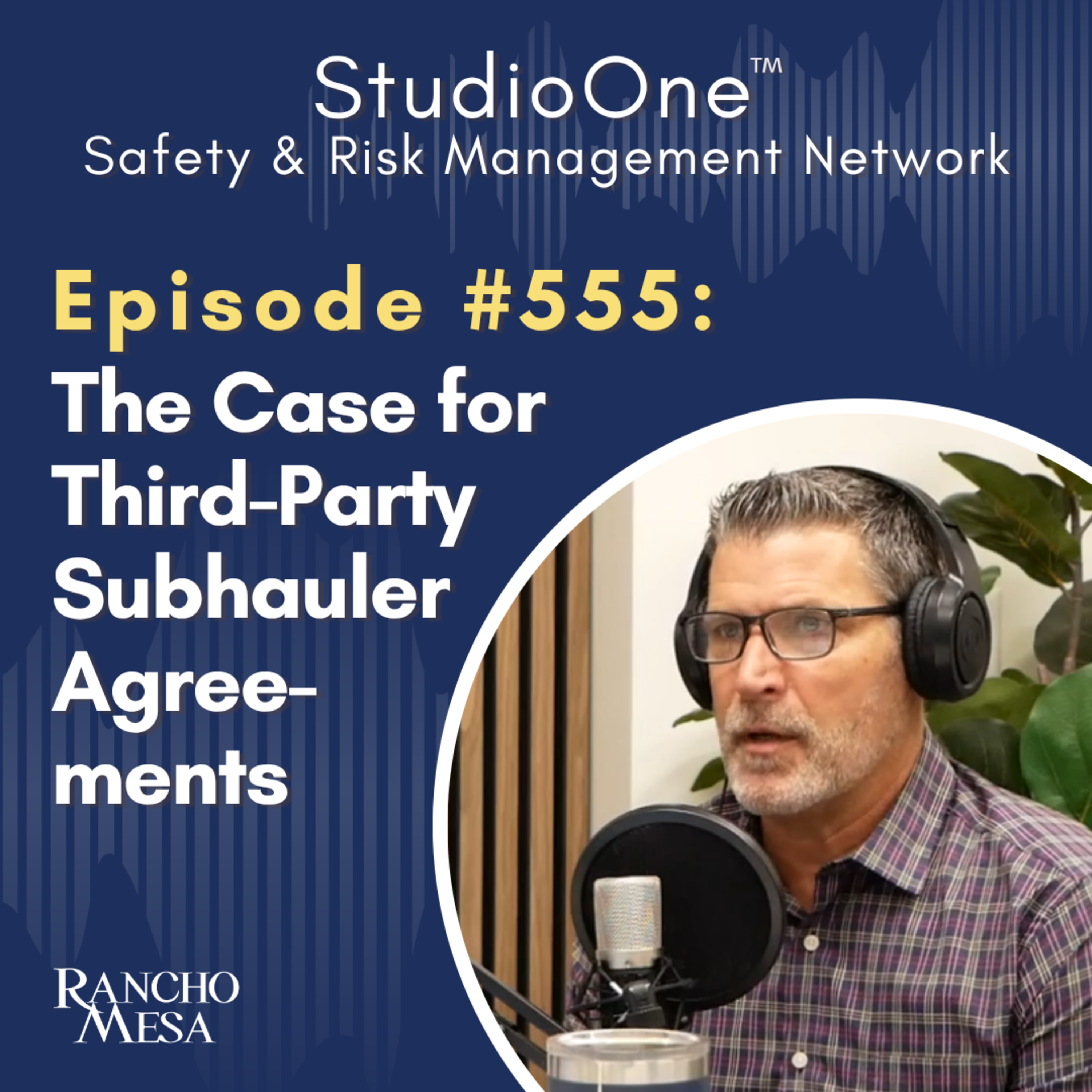
This episode is brought to you by C&E Insurance Company, a leading insurance company that provides a broad range of standard and specialized property and casualty, insurance products and services for businesses and professionals throughout the US, Canada, and Europe, and is backed by more than 120 years of experience and approximately $45 billion in invested assets. You're listening to Rancio Mesa Studio One Podcast, where each week we break down complex insurance and safety topics to help your business thrive. I'm your host, Alyssa Early, and today I'm joined by Sam Clayton, Vice President of the Construction Group with Rancio Mesa. And we're going to talk about third-party sub-holler agreements.
Sam, welcome to the show. Good morning, Alyssa. Glad to be back in Studio One. Well, we're happy to have you.
Now, you recently wrote an article where you made the case where sub-holler agreements. Will you explain the key differences between a subcontract agreement and a sub-holler agreement, and why contractors often overlook the latter? Sure. So, Street and Road, General Engineering, and Trade Contractors understand the importance of having a written and executed sub-contract agreement in place when using subcontractors to complete a project.
And this agreement serves to protect both parties by clarifying the responsibilities, managing risk, and providing legal protections in the event of a dispute. However, many of these same subcontractors will overlook having a subcontract agreement in place for third-party sub-hollers, or what is called a sub-holler agreement. So this really applies if you hire a third party to move a piece of heavy equipment from one project to another, or use someone to import or export material from a project. We recommend implementing a sub-holler agreement.
All right. So walk us through a real-world scenario where a sub-holler accidentally injured someone on the job site. What are the legal and insurance consequences contractors might face without a sub-holler agreement in place? Great question.
For example, if a street and road contractor needs to import or export material, they typically contact a sub-holl to let them know they'll need at least two dump trucks running eight hours a day for one week. On the first day, the sub-holler enters the job site and accidentally hits a pedestrian because they're unfamiliar with the project site. That individual will more than likely obtain legal representation and file suit against the sub-holler who caused the bodily injury, but more than likely name the street and road contractor in the suit as well. In order to protect and transfer the risk in this scenario, we would recommend you working in conjunction with your legal counsel to establish a written sub-holl agreement.
Alright, so how can implementing a sub-holler agreement improve a contractor's risk profile and potentially lower insurance costs? On today's legal environment, it's imperative the companies understand their potential exposure to risk. Those that can successfully implement and manage both their sub-contractor and sub-holler agreements will not only protect the assets of their companies, but also will receive more favorable insurance pricing and improve their risk profile. Alright, so Sam, if listeners have questions about their sub-holler risk, what's the best way to get in touch with you?
You can reach me at S Clayton at Rancho Mesa, or my direct line is 619-937-0167. Alright, well Sam, thank you for joining me in Studio One. Thanks for tuning in to our latest episode produced by Studio One. If you enjoyed what you heard, please share this episode and subscribe.
For more insights like this, visit us at Rancho Mesa.com and subscribe to our weekly newsletter.