Ep#6: FP3: A 3D Foundation Policy for Robotic Manipulation
from RoboPapers Hosted by Chris Paxton
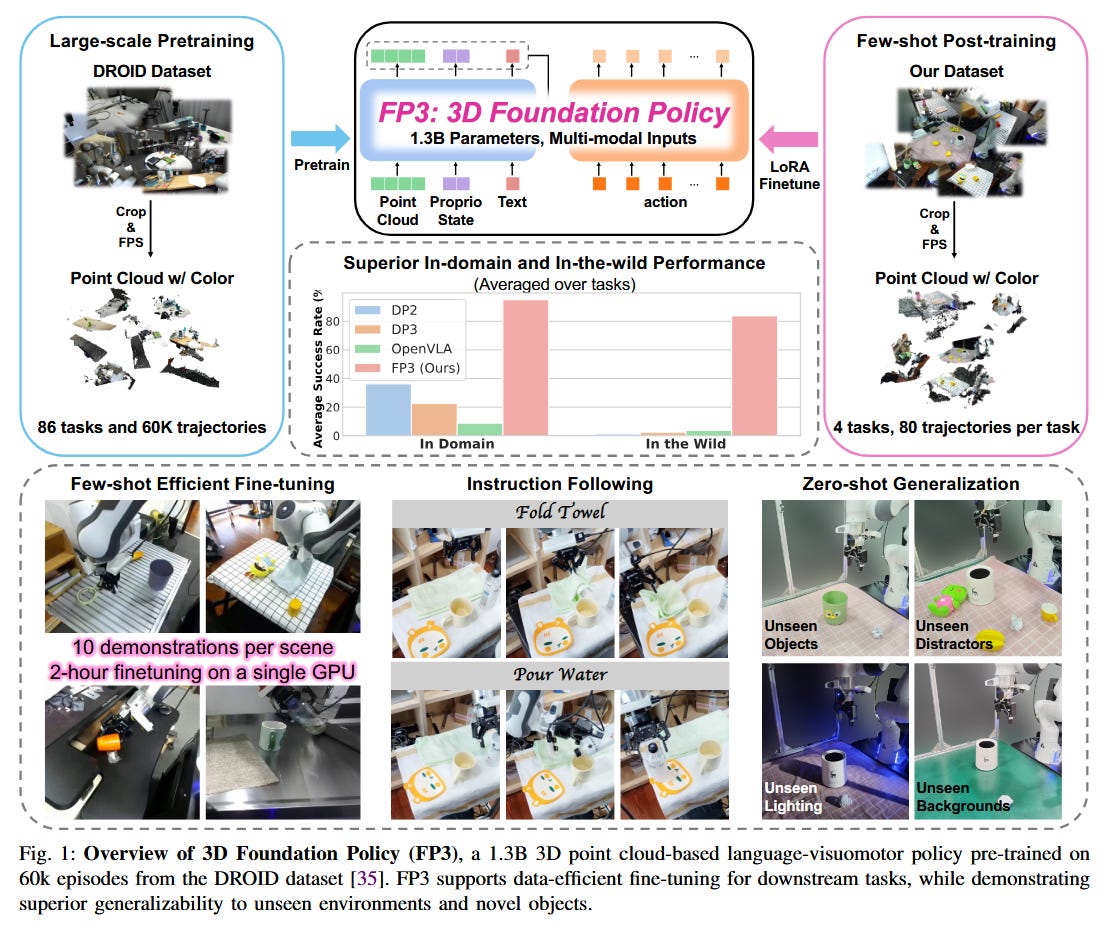
3D features are uniquely better at generalizing than 2D image features, given less data. Learn about how we can use them to train generalizable robot manipulation policies with Yang Gao. Following its success in natural language processing and computer vision, foundation models that are pre-trained on large-scale multi-task datasets have also shown great potential in robotics. However, most existing robot foundation models rely solely on 2D image observations, ignoring 3D geometric information, which is essential for robots to perceive and reason about the 3D world. In this paper, we introduce FP3, a first large-scale 3D foundation policy model for robotic manipulation. FP3 builds on a scalable diffusion transformer architecture and is pre-trained on 60k trajectories with point cloud observations. With the model design and diverse pre-training data, FP3 can be efficiently fine-tuned for downstream tasks while exhibiting strong generalization capabilities. Experiments on real robots demonstrate that with only 80 demonstrations, FP3 is able to learn a new task with over 90% success rates in novel environments with unseen objects, significantly surpassing existing robot foundation models. Paper on ArXiV This is a public episode. If you would like to discuss this with other subscribers or get access to bonus episodes, visit robopapers.substack.com
Embed this episode
No transcript yet.