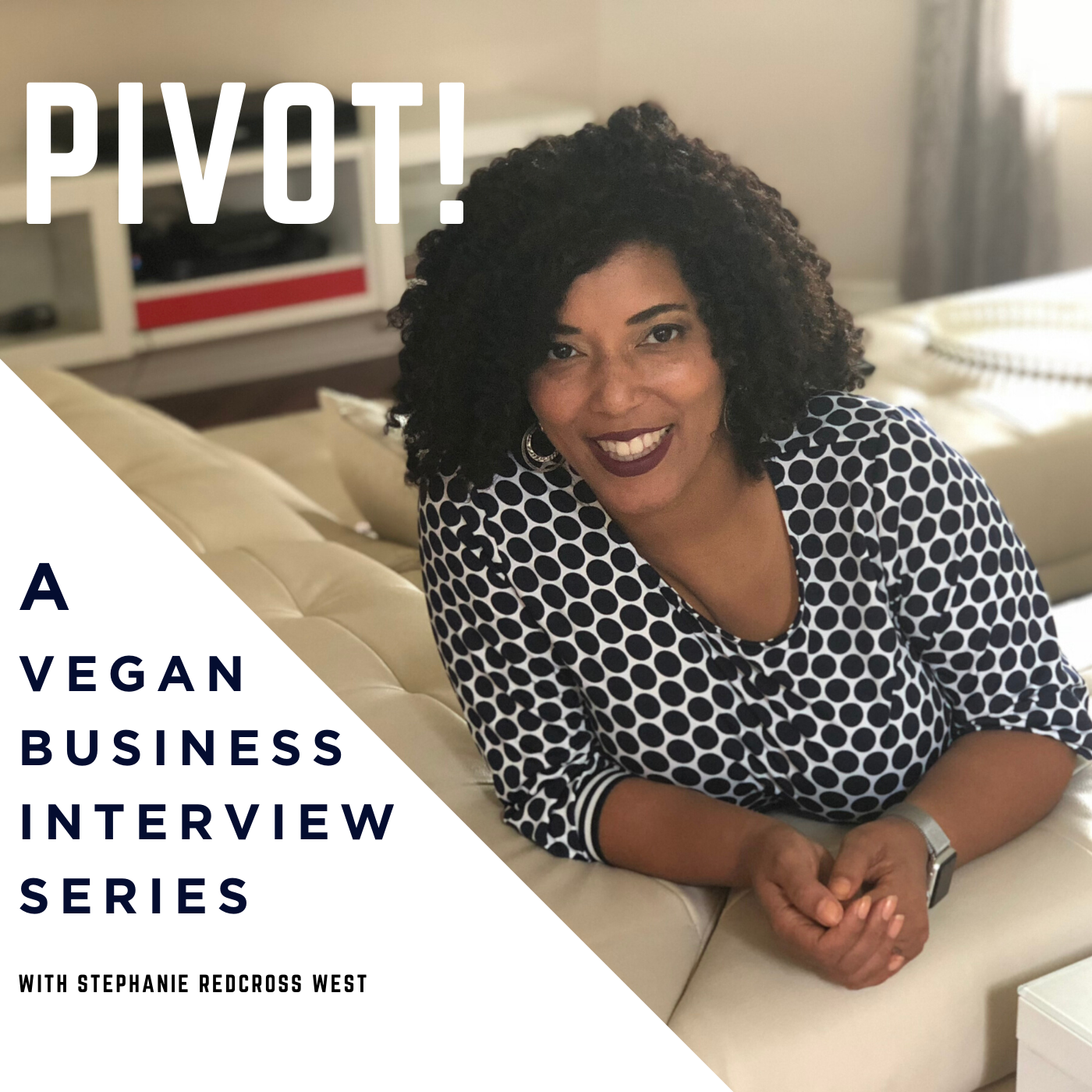
As vegan and plant-based business owners and entrepreneurs, we're often adapting to a new reality. This new podcast series from Vegan Mainstream is an opportunity to help you when it's time to pivot. These interviews will come from inside and outside of our community, and I hope as your host, Stephanie Red Cross West, I can inspire you and give you the tools that you need to move forward. Hello everyone, and welcome to our next interview.
I'm excited about talking with our guests today, not only because we're gonna be talking about pivoting, we're gonna be talking about the changes that they went through as we all have been navigating this pandemic world that we live in, but I'm also excited of hearing a little bit about their story, their passion, the reason they started bread, this award-winning bakery, vegan and plant-based bakery, and I want people to not only take away the idea that we all have to pivot and navigate these waters that we're in, but it's also important to build a business that is truly kind of guided by your mission, understanding what your mission is, why you serve your community, why you do what you do, is such an important driving force for businesses and such an important thing to have when you do have to navigate rough waters. So I'm really excited of really diving into the vision of bread and also talking with our guests today, Natasha and Ed Tatton. So welcome, welcome, so glad you're here today. Hello, Stephanie, thank you for having us.
Hey, Stephanie, nice to be here, and the customers would pre-order send me a message or order for the following week, they'd pick up and then pre-order for the following week, and it started at 30 loads a week, and over the 18 months that we ran it at the restaurant, I was souschef at, it was averaging 150 loads a week, and it was the customer that were asking us to open a bakery. We kind of did it just for a little extra money to help with our wedding, and it just grew naturally. So it was really exciting project and really sort of made us think, okay, maybe this is a business that we can really thrive and achieve some great things. He did so great, though, because it started, he would make bread for our yoga teacher, Tina James, and take it to the studio just as a gift, and then all the yogis would smell the bread, and they'd go, oh, this smells pretty good.
When can we get some of this bread? Are you gonna be selling this bread? And that's why he started selling bread. Nice thing, it was literally like, maybe I can sell it to all the people at the yoga studio and friends and people that work at the restaurant, and long before, so they started all the telling their friends about it, and then it just grew like that, didn't it?
That is wonderful. I really love it when people build businesses based on demand, but also on feedback. I think a lot of times, we kind of go in our corners and think we're gonna build this amazing business in the corner, but it's such, I think, an amazing place to be when you have customers that are looking for it, when customers are getting that since in their nose, and they're like, what am I'm gonna get? My bread delivered, I think, is so inspiring.
And also, I love your story of going from 30 loads to 150. I almost had to sit down from that because that's a huge demand. That's a pretty big challenge in the business, where you kind of surprised or set back from that demand, or were you expecting it just because, you've been in being a chef, being in food services, you knew that things would ramp up over time, or were you kind of surprised by how quickly you were able to grow. Yeah, I think it took everyone by surprise, really, because even the owner of the restaurant, how to be strove, I worked there for almost six years, as a sous chef, and it was kind of like, he was like, oh, we won't really even charge her anything.
He was very given me like, it almost for either kitchen, because we were like, let's just review it in three months, maybe it would just die off. There was no expectations, and I think that's why it worked so well. It was kind of like, as I said, it was word of mouth, it was almost like an underground break club, almost like Fight Club, like all the mums would like tell each other, and they'd like bumped into each other when they were picking up on a Thursday morning. Oh, you're here.
How do you know about it sort of thing? And they almost didn't want to tell their friends eventually, because they were like, oh, we might miss out and not be able to get our breath for the following week. So yeah, it was a nice organic sort of growing, and it was good as well, because I had all the equipment that I needed there. Even though eventually we did grow out of that equipment, I kind of thrived, I'd like to be busy, I'm a bit of a work wallet.
So the fact that I was making the bread on the Wednesday, putting it in the fridge to ferment overnight, and then doing my full shift. Wednesday, Thursday, I was working about 18 hours each day, back to back, but it was just getting that direct feedback from the customers that sort of drove me to keep going. Now, how did you know you were ready to open a business? Because you know, it's one thing when you have customers, it's one thing when you start selling product, but knowing that you're going to take on all the other responsibility that comes with running a business, how did you know you were ready?
Did you just kind of take a little bit of a little bit of it? Well, the restaurant started getting more known for Ed's bread than their restaurant food, and they sort of said to him, you know, they wanted to absorb it into their restaurants and up, and then he could potentially become a partner, and you know, maybe they'd start a sandwich shop on the side and this kind of thing, and Ed was vegan, so he said, well, yeah, that would be cool if it was all vegan, and they were like, yeah, vegan, and maybe some ham and some cheese, and it was kind of like, at that point, it was basically go along with their vision, and become part of the restaurant, or start something separate, and I think we were both at a point where we wanted to be working in alignment without values, not just. And also for, I think we were ready to start our own thing, where we had full control, so we knew that we would have to close down bread for an amount of time, while we looked for brick and mortar, you know, placed up to open a bakery, and it was, it ended up taking us, I think, about a year and a half from closing it at the restaurant, to reopening bread as it is now, you know, obviously finding a place and then renovating it and getting all the equipment, but we definitely felt ready, we're both sort of very driven, and we knew it had to be 100% vegan as we were both vegan, and there was nothing like that in Whistler. There's a few bakeries, but no one that specializes in sourdough, and no one that's 100% plant-based.
That's great, I love it that you found your market, your niche, and also, I love that you're sharing the story of the idea that you almost had to shut down what you were doing to grow. You know, a lot of times when we read stories, we hear about businesses, we think it's just, you know, when the growth lever is pulled, it's all steam ahead, but the reality is to really get where you want to be, sometimes it is in a business, you have to make some shifts, you have to maybe stop doing certain things so you can grow, and that can be a little bit tough for a lot of business owners because, you know, they're afraid to let go of one thing, realizing that they need that time to grow. Did you ever feel that push and pull, or did you really feel like this was the right thing to do, we felt confident in it, and so forth, or did you ever feel any of that? Oh, maybe we should have, maybe we shouldn't have thing, because I know for many of us, you know, that can be a hard time in a business.
Yeah, I think the more that you know about veganism and animal cruelty and all these sort of things, the harder it was for me to work at a restaurant, because they weren't vegan, I was drinking meat and fish and everything like that, and eventually, I didn't lose my passion for food, I lost my passion for cooking that sort of food, and that was a real driving force, if I want to do this, this is the road that we should go down. And for me, I've been teaching English for 15 years, and the onset of us talking about starting a business together, I really thought that I would be more in the background and continue teaching, and very quickly, when we started writing business plans and realizing what was involved, I had the realization that I was going to let go of my teaching career, and just go full throttle into running the bakery with it. And it was a little bit of a wake up, but at the same point, I'm so glad I did, because teaching English to second language students has totally dried up as an industry in English-speaking countries, because of COVID, the international flights were canceled, people weren't moving around, and all the school shut down, so you'll find all over the world that the language industry is totally dried up, so actually just going with your gut, and taking a leap of faith into another industry was a great choice for me. I'm glad to hear that, because it can be hard sometimes to give up something you've done for years, sometimes hard to go into that unknown, so I'm really, really happy to hear that, you know what I mean?
You kind of had to wrestle with that decision, but I'm really glad to hear that you made the leap, and obviously from all the amazing things I've been hearing about your breadth on the internet, it seems like your community is very excited and happy that you've made that decision as well. So let's talk a little about the pandemic, let's talk about the impact it had, because I'm assuming once you got everything up and running, and things were moving along, you really kind of had a little bit of a established platform, how did the pandemic hit you, and how did you pivot or how did you manage through that? It was definitely a sort of came out of nowhere in a way, like we knew that COVID was going on and everything like that, but it was a very memorable day for us, because it was my birthday, March 15th. We were one week away from our first birthday at the bakery, as well.
So it was kind of like, okay, it's my birthday, I think we're gonna have to close now, I'm about the whistle back home, the ski mountain closed, the day before, and then everyone was just leaving Whistler. So obviously, we've made all this out, we're like, right, let's make like bake everything, sell out, and close the door, and then work out what we're gonna do. And within 24 hours, we launch our online shop, and we had to lay off all our stuff, they all flew back to Australia and Ireland and the UK. So Whistler back home is one of the largest, if not the largest ski resort in North America, and it's comprised of two mountains, Whistler Mountain and back home mountain, and the main village is nestled between the two, and the mountains are also connected with the gondola that goes between the two peaks.
But we are actually on the backside of Whistler Mountain, we are in the original village called Kriegside, and we have a gondola that goes straight up to Whistler Peak as well. And for many years, this village kind of sat empty, and everyone just went to the main village. And all the locals, so the local population is about 10 to 12,000, that's permanent residents, and we have about three million visitors a year. And so when we're in peak season, like in the middle of winter, the population of workers doubles, at least the permanent population.
So we have like 20 to 30,000 workers in the winter servicing three million tourists that come up per year. So it is definitely a lot of tourism, and we probably take three times or four times as much money on peak days compared to off peak days. But the locals are the ones that keep the resort going year round. There are lots of year-round positions, and there are lots of restaurants and grocery stores that stay open.
We have a big bike park in the summer. And so we have a lot of hiking, a lot of wildlife watching. We live in harmony with black bears. People love coming to Whistler to see the animals, to jump in the lake in the summer.
It's a year-round resort, really. So it's a lot better. Yeah, so it was weird, the Kriegside village was empty. Once the main village was built in the 90s, the Kriegside village sat empty.
We moved to Whistler in 2013, and we saw this kind of empty ghost town at the bottom of the mountain, and for us, and a lot of other people, it didn't make sense. Why isn't this village going? And so when we saw in the paper that a new landlord had bought the Kriegside village trail and wanted to reinstate local businesses, we were really excited. We got in touch and we managed to secure a lease on one of the spots.
And because we already had a following from Edseling Bread at the restaurant in the main village, those people were willing to travel down to Kriegside wherever they lived in Whistler and come and get the bread. So I feel like we've become quite an anchor to the revival of the Kriegside village, and now there are other businesses. There's actually a vegan hairdresser that's opened opposite us that we're really excited about. And there are some other businesses that, some of them are in a bit of a transition period, but there's new things coming and going, but there's stuff basically in almost every spot now, which is great.
So that's how we established ourselves. But yeah, definitely the visitors, second homeowners, we have a lot of people in the States that have second homes up in Whistler. It makes great ski vacation for you guys, because your dollar to dollar trends, you get a good rate. So come and see us in Canada when you can.
The board is gonna open soon, and we're looking forward to welcoming all of our American friends back. That is great. I love that sense of not just business community that you're talking about that's kind of being built and how you're even one of the first businesses to really jump in there. But as a vegan myself, I get so excited when we can share our veganism through our businesses.
When people get introduced to veganism, sometimes not only by products and services, but also by us being members of the community. People interacting with us, getting to know us, and so forth, that kind of vegan message. And a lot of times our vegan kind of perspective can spread that it really gets me excited. And that's why I was asking about the population, because not only is it interesting to see how you can bring veganism to your local community, but with that many tourists.
It's really exciting, the idea that you could introduce them to vegan options, vegan bread, and really getting them to understand that there's great quality in it, that it's something that not only should they be munching on, there should be something that turns into their standard kind of staple, or maybe something they even look forward to every year when they come back. Folks, I think for us it's educating our customers that there's no compromise, that there really is, it can taste just as good or better. And for myself coming from a fine dining background, I really strive to make it as good or better than it's all counterpart or what it's compared to, because people are very critical when they see they're 100% plant-based, you know, they're like, oh, I'm not sure if this is gonna be as good, or my grandma makes cinnamon buns, they're pretty good at all the sort of things. I mean, it's else with us using the best product, so we can, we strive to be as organic as we can be.
So we're moving to increase that more and more at the moment, we're about 35% organic. Well, certified. Certified, yeah, so difficult. There's some farms that are not certified, so we can't really count them in.
And then you have like the non-GMO as well. It's different to organic. It's still better than GMO. But it's, so we were always working towards increasing the amounts of organic that we use, but there's other factors to consider as well, like how local ingredients come, you know, supporting like female businesses.
We're very passionate about any sort of empowerment to people that need lifting up in any way. We look to do that as well. We look to have some kind of social impact, environmental impact, but always focused on saving animals at the heart of it by being vegan. I love that.
I think that's so important. And I think it's, we can lead the way as business owners, when we make these things important in our business. Yes, we need to grow our businesses. Yes, we need bottom lines and all that great stuff.
But we also need to make sure that we're building strong communities that we're supporting other businesses that share our ethics. And also, maybe the same challenge here in the US with certified organic versus organic, because some of the farms or some of the businesses, you know, it's pretty expensive to get that organic certification. So while they may be organic in their practices, they're not able to get to that certification and the ideas that we should support them. Because by supporting them, they can ultimately get to that certification level if they choose.
So I really love hearing that those are at the heart of what you're doing and obviously saving the animals is something that we all strive to do daily in as much as we can. Let's talk a little bit about what you've learned. Let's talk about what's something that maybe, because of the shift that you've had to make, that it changed your business in a way that maybe surprised you, especially now that the world's opening up a little bit more, you know, now that you're doing online and still, you know, people are coming in the store, what is some of those things that maybe transitioned or thinking or transitioned the way you ran your business that you learned, kind of, when we were in these, like, left out in very uncertain moments last year? Well, I think there was a lot of emphasis before COVID on planning, and I remember, like, starting to, like, get hold of an external person that could help us with strategic planning and bringing the team in to make these, like, three-year, five-year plans.
And it seemed like quite a burden to have to do something like that, but then COVID came along and it threw a spanner in the works for everyone. And I think it's just shown us that planning, long-term, especially, is really a waste of time. What you need to do is have a concept or have an idea, test it, see if it works and react. And for me, that's very reassuring because I can't think barely beyond a year ahead in the future.
So making three and five-year plans, that's why I was getting somebody to come and help us because I couldn't really think like that. But now it's kind of, I've almost been told by the universe, yeah, that's the wrong way. Just you don't know what's going to happen. You don't know what's going to come along.
So all you can do is be reactive. And so that's kind of the main lesson that I've learned from what's been going on in the last year and a half. You can't really, you can't really like, test it like with staff and things like that. People, their situations change.
So we have to just learn to go with the flow. Yeah, I agree that a lot of us haven't until last year learned how to be nimble enough, how to make changes and make decisions quickly. I think a lot of people were used to the idea that they could think about it for a while and then decide on what they're going to do in their business. And I think last year has really taught us that as business owners, we have to make decisions.
Even if sometimes we don't have all the information, even if sometimes we don't know exactly what the outcome is going to be, the idea is delaying that decision can delay and sometimes hurt businesses. I'm with you, I go a little bit back and forth one, three to five year plans, especially for new businesses or small businesses. I do think there's some value in it in a sense of like, where do you want to be like destination wise? But I agree that sometimes we get a little too focused on this five year plan.
And when I talk to a lot of people, they really don't know what they're going to do two months from now or three months from now. So, you know, it's one thing to, you know, be like 2020 such and such, you know, knowing that's going to be. But I still think for most businesses, even having a 12 month plan can be amazing. Not so much I'm only going to do this and do that, but making sure that you really know where you're going to be at year from now.
Because a year from now, most of us can visualize. Most of us can get a sense of what it could be. So, I agree that sometimes we're going a little too far out when we're planning our businesses because we need to know what's really going to drive, you know, our business in the near future. And lots of our business need.
Anything else that you guys learned? Did you learn anything about it? I heard that you were doing hummus, you were doing different things, you do expansion menu because of it. Did you expand it and then shrink it or change it?
Cause I know, even for me and a lot of the clients that I work with, you know, we found that people were almost using it a little bit as a testing ground to see what might work. And it made more people comfortable with testing and realizing that it's okay to do that in your business. You don't have to exactly know. You're like customers like, you know.
Totally. Yeah. I mean, the hummus was kind of like a bit of an accident. Like we had a, we were trying to have fun with the menu before COVID and we were like, what are vegans known to eat?
And they love hummus. So I came out with the hummus cookie, which confused quite a lot of people, but I was like, it's chickpeas, it's tahini, it's lemon, there's no garlic in there. But it was, it was quite, it took about three days to make this cookie. You had to make the mix and then let it set.
It was good. And then we rolled it in sesame seeds. So it was like coated in these sesame seeds. And it was delicious.
I am gluten free. But it took a lot of, you know, labor to make it. So when we closed down for, because of COVID I moved online and it was just myself, I was like, there's no way that I can spend all this time making this cookie. But I had all these organic dryers chickpeas.
So I was like, well, I might as well just make it good hummus. You know, people were at home, you know, they're buying the bread. And then we also had the olives that we were using for olive breads and sourdoughs and things. So we were like, well, we could just marinate those and put them in, in touch as well.
So it kind of just came from, okay, what do we have on the dry store and part of our inventory? And how can we use that? Like, is this going to go on for six months or is this going to go on for a year? This is money that we're just sitting on.
And if we can turn that into, you know, profit, then that's only a good thing. Customers had asked us when they had the focaccia, oh, do you guys sell these olives? And we were like, no, no, no, no. We were just kind of like, well, we said it's so much focaccia.
Well, we didn't bother to start marinating olives to sale. But then obviously as Ed said, when you have to pivot, you rethink, oh yeah, like all those people are asking for olives. That's not selling olives because that's like hardly any prep at all. You're just topping up olives and off they go.
And now that the joke is, it's kind of saved up business because every time somebody buys a loaf of sourdough, we do the old upsell. Any commissary olives for that today? And then you can get a purchase that's, you know, $10 for a loaf of bread, add to them as an olives, and you're looking at, you know, over $20. So it doubled the spend per head in the shop.
And so that alone is growth. It may not be opening more days or having more staff or more locations. It may not be a fancy kind of growth, but it's the bottom line growth. It's doubling the spend per head, which is massive.
So that has actually been a saviour. Pumbus olives has saved us. I love that. And I think sometimes people think of that, like you said, that fancy growth.
Like, oh, I need another location and everything. I really think it's smart growth to be able to give your existing customers more of what they want. You know, and like you said, it's more of what they even asked for. You know, I can imagine if I pick up some bread, I'm probably going to open up that hummus on the way home and just grab a couple of pieces.
That's so good. That is really, I think, such a great way to build your business and also keep your customers happy. Because I don't always believe that growing a business means it has to expand the time that we work on our business. Growing a business has to stress us.
The idea is that growth to really be able to come from making happy customers and also finding solutions that allow you to better serve your customers. So I think it's just brilliant. And I love what you're doing. Laura just stopped by and said hello.
Laura said she's looking forward to coming up from Bellingham. So it looks like she's going to be seeing Laura probably really soon. As we wrap up today's session, I always like to wrap up with two things. Number one, I want to make sure that people can get in touch with you.
So let's give them the website, social media. Let's let them know. I assume you're not shipping to the US yet. Are you?
No, we have people. We had a gentleman out in the first year. He come on holiday from Miami. And he was like, told me.
And he says, I just need the cinnamon buns. He's like, I need 12 cinnamon buns. I can't stop thinking about them. Please ship them by me.
And I was like, I'm really sorry. Like, obviously you had them fresh. They were probably still warm. I don't want to send them to you.
And they'd be like three days old or something. I was like, we'll just sit on them for a week. Yeah, we'll go welcome you back. Hopefully that's enough of a draw to bring you back to Whistler.
But yeah, our website is edspread.com. So EDSBRED because it's edspread. Even though that should be a big part of that as well. And then you can also follow us on Instagram.
It's edseds. Underscorebred. B-R-E-D. And I try and post lots of sort of tutorials that people are interested in.
Sowadow, making sourdow techniques. Photos and specials, so that's kind of handy. And then if any of you listeners have any questions, like they're intervegan baking and sourdow, they can always send us a message. And I always try and reply to everyone through Instagram.
And then for Laura in Bellingham and anyone else that's going to be coming up, well, from all over, I'm sure Stephanie has a very international audience. So if anyone's coming to Whistler wants to order online to guarantee that they'll get their cinnamon buns, they'll get their sourdow bread, and their humousan olives, if they wish, we will add a discount code to our online shop. So edspread.com, edsbred.com, and just type in vegan mainstream, and we'll give you 10% off your order. So that's a little something.
And we'll make sure that it doesn't expire because we don't know when you're all going to come and visit. But when you do, it's going to be there for you. Oh, that is so wonderful. Thank you so much for doing that.
I really appreciate it. It's wonderful. And people can not only get a little bit of discount, but what I'm really excited about is that they can order online and pick it up. I'm a really big fan of that because that way, you know you have your order, you have your favorites.
And then also, it's a great way to continue to pick up and get the items that you love. So thank you so much for doing that. Cupine will make sure that we share it as well, and let everyone know. And we'll continue to share it over time.
Like I said, as the world starts to open up, hopefully, we can get some more folks coming up from the States coming to check you out. So as we wrap up today, if you have any final words of wisdom, if you have any final words or recommendations for any of my folks out there that are maybe struggling, maybe that feeling a little bit frustrated or just maybe have a bad day, you know, because sometimes we have bad days. If you just have any recommendations for them to kind of inspire them to keep going, to inspire them to keep moving forward because I really do feel like we need so many vegan and plant-based businesses out there. We need vegan starting businesses and staying with them.
So if you have any words of wisdom that each of you would like to share, I'd love to share it with our audience. I would say, you know, meet other vegan business owners, and you'll find it all going through similar struggles and challenges. So for me, being part of things like veavers or the women's vegan leadership network, run by Katrina Fox, that's a great group of vegan women leaders that you can join. There's Vegan Business Tribe, which is run by David and Lisa in the UK.
These are two international business vegan groups. And then you'll often find that there are more localised ones to your area. We have one based in Vancouver. It's a group of vegan business owners that meet up online and have little webinars and kind of informal chats.
You can meet people and then connect with them on LinkedIn. And this is kind of how Stephanie and us kind of met is through being part of these organisations, meeting people that then refer to other people. And just find the like-minded people. They may not be in your small town, like in Whistler, we're in a ski resort.
My friend said ski resorts mean fondue and hot chocolate, not the vegan type. She's right. But there's us waving our little vegan flag. And if there are no vegans with us waving flags on the mountains, then we'll go find them around the world with the internet all connected.
So COVID has brought us closer in that way. So that's the great thing. And I would say just believe in the cause, I believe in what you're doing. We've seen a massive growth before people coming in.
So, you know, you don't have real milk, you know, you don't have any dairy and month or month. We've seen more the demands people are asking, what's vegan? Is everything vegan? You know, the demand is definitely increasing.
And if you just believe in that and know what you're doing as a vegan business owner is changing the world, people are making more sustainable environmental choices with where they spend their money. They might not call themselves vegan, but they're trying to do better, you know, with where they spend their money. So I think it's just sometimes like you said, it's hard days, but just believe and keep going. It's worth it.
Well, thank you for sharing that. It's I agree so much, so important to have community around you. It's been amazing the work, at Lisa, David, and Katrina have been doing. And I agree that we really all have to, you know, stay inspired, understand what we're doing because we're really trying to change the world here and the demand is coming.
People are waking up seeing more and more the benefits of going vegan and also understand that the amazing quality of foods that are coming out and products just like your bread, you know, there isn't a sacrifice you could still love, you know, sourdough, you could still love these items and also save animals at the same time. So I think that is amazing. Oh, sometimes just ask if you do vegan fun, do, I think that fun, do motherfolds. Interesting.
Not yet, not yet, not yet. Not yet, not yet on the boot vegan fun, do, but you never know. So thank you. I just wanted to say thank you for joining.
We went a little bit longer, but I really appreciate you sharing your story, sharing what you went through, and also just giving a kind of our audience a little bit of words of wisdom through all the amazing work that you've been doing. So thank you so much for joining me today. Thanks for having us. You're great.
Thanks, definitely. Absolutely. And thank you everyone else who's joined us live, everyone who's participated with comments, with our thumbs up. We appreciate it when you enjoy these interviews.
And if you have any questions for Natasha or Ed, please, please, please use the comments. We'll make sure that they are passed along. But we also want to make sure that we encourage you to support bread, even if it's just going and following them on social media, and just making sure the world knows about this amazing business and these amazing two people behind it. So thank you everyone.
Thanks again, Natasha and Ed. And everyone, have a wonderful day. Thank you. Right.