
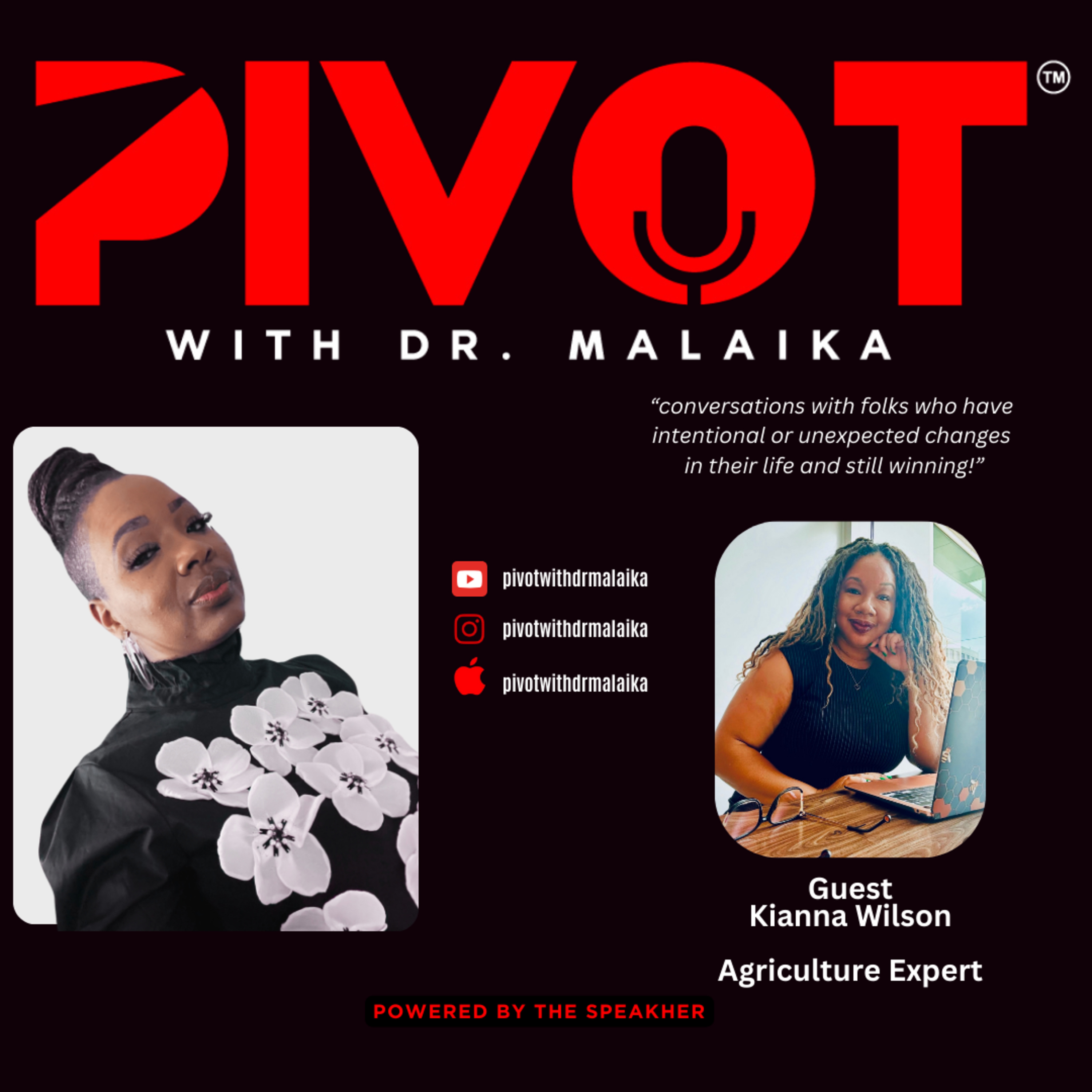
hey y'all it's your girl dr malika on pivot with dr malika and i'm so glad to be with you today listen pivot family we've had some great guests so far on season six and this episode will not disappoint today i have with me kiana wilson okay now i have coined her the agriculture expert she's so much more than that she's also a mother of two beautiful children she's a wife she's a businesswoman she is intelligent she is everything that i love my sisters to be she is also the graduate of the howard university um home of the bisons now i have never attended howard went to a graduation got some family ties but have much respect for howard university and love it when i come to contact with their graduates so i am excited to bring you to the family at kiana wilson who's going to talk about an industry that we don't normally hear about but because of what's happening in the world today come on here in politics we are hearing a little bit more about our farming agriculture the whole nine and how they're being impacted which will then trickle down and impact us so i am excited to bring to you kiana wilson hello hello kiana thank you thank you so much for having me today listen the world is better because you are here talking about what you do and just who you are as you know with pivot y'all we like to talk to folks who have had intentional or unexpected changes in their life but we say what they're still winning and so i am glad that you could be here with us kiana to share with us about you about who you are and this whole idea of agriculture what it means how it's being impacted um by what we see today with our current administration um what you've seen some of the trends and maybe some some things about um how we can strategize and get ourselves prepared so but first before we get into all that who is kiana wilson and girl how did your path take you to agriculture first thank you for having me and this is an honor um i'm not one that talks about myself on a regular basis if not ever um but i do think it's important to share my story and so i'm glad that you came to me and we can sit down and do this yes i'm just a girl from louisiana that's where i'm from i'm from louisiana i was born in baton louisiana i was raised in new orleans um but from a very young age i always felt like um god was preserving me for something like there was a purpose for my life and i say this because i didn't really have a typical uh normal i guess you would say upbringing um when i was young um i was exposed to things that children just really shouldn't be exposed to all the time i had a lot of hardships in my life i'm raised by a single mother um and my brother and i we um literally they say when life picks you up and moved you that's exactly what it did um so for us um we moved from louisiana all the way up the east coast and ended up in maryland and through that process um there was a lot of hardships um we were exposed to poverty um we were dealt homelessness um and when i tell you homelessness is real and there's a lot more people than you think that have lived that life of living in their cars or in a friend's home just periodically until you can find a place of your own but they're never really having that stability so when i was being raised um it's true i had my people i had my mother and i had my my brother my father was um was was there um but he didn't live with us um so we were just being raised by our mom who had to sacrifice a lot of her own and she had her own hardships she had a lot of things that she was wanted personally but one thing i know is that she always kept her children in mind and so she always did things to put us into a better place so so as we moved up um through we stopped in virginia uh we ended up in maryland when we got to maryland and um i graduated from high school my mother said um she bought my mother when i got a job at howard university and when she got a job at howard university she saw a door that opened for me and uh she brought me an application and said fill this out and um i filled out the application although we didn't have a lot although we didn't have nice i literally wore tennis shoes that my mother got out of a giveaway bag i used to have have things but i had books and i had school and i love to read and i just love to absorb information and i think that because of that um which i do believe is part of that's perfect plan because he made sure that i had those specific things but because of that not only did i get into howard university which is a very difficult school to get into i know i had a full scholarship wow full scholarship a full scholarship so for someone who could never afford that kind of opportunity that door opened for me that could have been any opportunity i could have gone to any school but god saw it fit for me to attend howard university which i didn't even know at that time was as big as as important in our culture as it is today right well so i went to howard i got my education this is where i learned about um who i was able to really truly tap into who kiana is yes i learned who i am i learned who my people are um i learned about some leadership um and as a result i was an idealist i was always been an idealist i always wanted to get back i knew that whatever it was that i was going to obtain in this role i wanted to get back in my community yes so i knew i wanted to be a teacher so after i graduated from the school of business at howard university i said i'm going to be a teacher and i became a math teacher oh wow i did not know that you were a math teacher math is your thing math is um math is my thing um i went to school for accounting um i uh i love numbers um uh you know that about me can i just say okay let me interrupt you just a second i am on a committee with kiana okay and the kind of things that she does with numbers the organization the excel the added subtracted all of the things all of the things that she does i'm like okay i admire that because it really numbers tell a story someone taught me that years ago numbers tell a story when i was working on my dissertation right so it was like yeah but i would just focus on the qualitative let me just tell the story in a different way but numbers tell the story and they make the difference so i appreciate that skill that you have and that love for numbers in just a second for me for all this you'll probably be able to understand what i'm about to say but numbers tell a story but for for children that truly love math you see numbers literally floating in the sky around you it's hard life i see everywhere it's about putting puzzles together and making them make sense it's literally about balance and um and so that's why i've always loved numbers as um as you and as a young girl um that's why when i first attended howard actually was an architecture major because i love art i like design but also love numbers and i love making things make sense and make it to scale um that wasn't for me um so i decided to shift and pivot and um and that's when i uh i changed my major into accounting because i think although i didn't know what i wanted to be i knew that i love numbers and i was a little and i love to see what people actually do with their numbers right what do you do with your money so um so yeah i became a math teacher and i wanted to i did it because i wanted to get back um and i wanted to be able to be a vessel to pour out everything that has been put into me so i spent about four years four or five years being a teacher and then an opportunity came along uh for me to do sales because you know let's be honest teachers don't make a lot of money right um teachers don't make a lot of money and so i was going to do a sales travel on the side now when i was younger um i was a dancer um pom-poms um dancing in college i was on the dance team um so the local um uniform lady knew me she was about to retire and she said why don't you start doing this part time so i i did it and i caught the sales bug it was something about selling and uh customer service and provide services to people that i also like so i started to tap into this new passion that i had and i said you know what i'm gonna go back to school and get my mba okay so i did so i went and i got my mba and when i finished with my mba now mind you i said i'm pretty smart cookie there's not anything that i have there's one thing that you don't have to worry about using money to buy is an education go to the library you can read books and i'm all about that i love reading i have a library in that room i've got a library upstairs my children have libraries we love to read yeah so i had good grades um and when i graduated with my mba i looked amazing on paper but i did not get one job interview wow what a feeling though what a feeling to be equipped with the tools that the world says that you need and the world says this is what's going to push you forward and this is what's going to make you successful it's not until god opens those doors i mean you can have it all and i've seen that you do every you do all the work but until god opens the doors that needs to be open in your life listen you can go and do all of that working and all of that education and nothing i have seen that um you think you have a plan but we all know how that works right right for your life and for me i'm a planner okay i know what we're gonna have for the next three days i'm a planner but that's it right so you did all that planning and then what and i put out probably 70 applications and not one call that not one not mba with an mba and a uh and a degree from harvard university so um so what ended up happening was uh a friend of mine reached out to me and she was talking about her job in agriculture and she says to me well you ever thought about working in agriculture and i said no um i do not i've never thought about working in agriculture i do not know what that means right then hold on i'll be right back so literally like fast forward um in the next two weeks i was on an airplane headed to indiana i was headed to indiana to go interview with a dow a company of dow chemical about agrisciences and uh and i have to give them credit because they're the ones who put me into this position and there was a lady there who saw something in me and uh i interviewed and she said to me what do you think about uh working in agriculture but with farmers okay i guess i'm open to anything at this point um literally uh the week before had an eviction notice on my apartment my car broke down and i was taking the bus and i live in north carolina there are not a lot of buses so i was getting up at 5 a.m to be at work by 9 o'clock so so i said you know what i feel like i'm being pushed by something that's bigger than me to consider something that's i would have never thought for for myself yes yes i stepped out and i stepped into an area that was completely uncomfortable for me and i moved myself in a u-haul from north carolina to the state of indiana wow that's where my life changed um now we can get the air coach you want to talk about my i do but i just wanted to stop right there because this is what we say those unexpected changes in our life and and i don't of course it's the theme of the show it's the tagline if you will but it's also the thought that unexpected means i you still could have a plan i had a plan it's not that i didn't have a plan sometimes things happen suddenly right there's like those sudden changes those things that happen right my job situation wasn't suddenly you know what i mean but when you have a plan things are lined up and ready to go and life just does not respond doors just don't open okay not the ones you planned to open and then all of a sudden it's like how do we do this which totally takes you out of your comfort zone totally out of your comfort zone okay not in your wheelhouse not something you're it's not even taking it's not even taking you know there's a real estate here about you know agriculture so sitting right here today nothing you know what i'm saying and it's like how does that happen and those are the kind of pivots that i think is so important for us to talk about so i'm just i'm thinking for those of you out there who have experienced homelessness um lack some level of security because of life you know things are shifting and moving um doors are not opening right understand that god still has a plan for you and maybe we just need to surrender our plans and say okay you know be open when since the soldier comes to you and says how about this you know instead of shutting the door out say you know what let me try it so i'm loving this whole thing and you know as i think about agriculture you said that the person you spoke with said what about farming so that says to me that there are other aspects of agriculture so can you just what like list some of those parts of agriculture give us a little of an understanding of what what areas and and now you work in farming and how what do you do so great question one that i don't get often and i think it's very educational to understand agriculture agriculture involves everything that we need to feed fuel and clothe ourselves okay so when you think about the aspect of feeding that's farming um it is uh culinary agriculture it it can stand from farm to fork is what we like to call it so farm to fork anything that has to do with putting a seed in the ground to grow it you actually consume it okay that is and it is a a large chain it's a large channel of different activities that go into getting that seed in the ground to that fork in your mouth okay that's one aspect of it we think about fueling uh well in your car you put fuel okay no that component of that fuel is corn or soy and a lot of people don't know that people don't know that right right so we talk about fueling it's not just putting fuel in your car but it's about energy overall okay that's what we do you hear that in the news there were some terrors that went into play for energy with canada and there's a lot of craze that goes into all of that and we've not one person can do anything themselves you think about your community or you think about your neighbor that someone might be good at baking and someone might be good at meats cutting meats and someone might be good at cleaning houses someone might be good at putting clothes together but it takes a community of diverse people in all these different aspects maybe this air trading or whatever it takes right to keep it going if you think about that on a macro level on a larger level with the world we're all sharing all of these different resources that we have within our parts of the world that another part of the world might need so we'll get into trade a little bit later but that's just your your your open door look take a look at it look right so we have feed we have feed we have feed or food and then we have fuel and that's the closer it's the chair that i'm sitting in it's the house if when i think about my home my home was built in 1912 and they use this type of material in the walls it's like a horse material along with plaster and that's how the house is able to be as strong and sturdy as it is all of that is agriculture we're talking about livestock we're talking about food we're talking about um turf and soil everything all of that is agriculture believe it or not um even those who don't think they understand agriculture you live agriculture every single day that's what you take to the water that you drink um in college we used to think that cucumbers came from the grocery store right right there's a seed but there's seeds in it right but they don't come to the grocery store there's someone who is up at 5 a.m to make sure that you have that cucumber in the grocery store when you need it and at your convenience and that's warming wow and that's that was your focus in the agricultural industry so so here's here's what i do but first i just want to kind of take a pause because i want to acknowledge um something there's a bible verse um that i love um it's jeremiah 29 11 uh for i know the plans that i have for you declares the lord um plans to prosper you um and not to harm you plans to give you hope in the future um if i can encourage anybody in this moment right now even before i start to shift to agriculture truly spend some time with yourself understand who you are and trust the process because what happens to you tomorrow may not be what you planned today but just know there's a greater purpose and a greater plan and there are steps that have specifically been ordained for your particular life you don't have to work out because your lane is going to be full of activity right trust and believe that everything is going to work out the way that it's supposed to be for your good and if you start to feel like you're having some issues or things aren't working right you have anxiety could it be that you're just working into a lane that you're not supposed to be in i wanted to just pause with that because the plan the next part of my story is not the lane that i thought i was going to be in resistance there and because there was some resistance there i was held back but until i actually understood and knew who i was and my part that i need to play then things start working out for it's good yeah yeah all right so i just want to share that i felt like i like it somebody's listening they need to hear that like it yes yes so here i am i get this job offer and it's double the salary that i made before okay it's a teacher job well well when i finished my b i was an accountant for it okay okay it was not a lot of money at all so the double is not a big thing but the double is also like wow i can't believe i just did this it's awesome so here i am on my first day at my job i am on a bus headed to a big show called farm progress okay but they have it in iowa one year the next year they have it it's a big farm um show that they have it lasts for a full week and all these different companies they come and they share information about farming just to keep farmers updated so we're traveling to the show and i look outside the window and i'm sitting next to my mentor because i've been assigned a mentor which is also very important um and i said what's that and he says to me well that's corn he said my we have a long way to go but he told me in that moment he said don't worry he said one day you're gonna be my boss he said you're gonna be my boss and the reason why i say that is because you can teach anything you can teach someone to do anything you cannot teach likability you cannot teach respect and you cannot teach relationship oh as long as you have that you can learn anything so i took that very seriously and i started my career as a seed salesman i sold corn and soybean seeds to farmers and what that meant boys and girls is i went barn to barn um farmhouse to farmhouse and sat in the kitchen of farmers talking about what type of seed they're planting on growing next year it is not elegant yeah i wore uh farm boots i wore khakis that got dusty every day because i was out planting seed as well um and it was hot and um and i'm a little black girl out here selling um seed to and you know i i believe everything that i've read or have seen said that farmers are up when we are sleeping and snoring they are up at four o'clock in the morning starting their day so i was up early so i was in my pickup truck driving across the stadium in the end yeah i did that so um so i did that job and um and i really enjoyed it but here i am this little girl natural hair i had a little short acro at the time um and i'm out there doing this job and i personally at the time didn't see uh anything wrong with me doing it um now we look at the state of race relations and everyone is talking about the hires and all this stuff i didn't see anything wrong with what i was doing i was just out there trying to learn right right i was just creating the carbon space for myself to be more educated so i would do that i built these relationships i met these amazing farmers um and and we just had a really good time right and then um i got a promotion um and i moved from fort way indiana to indianapolis and indianapolis i got to look at different parts of the business um i looked at the distribution um chain and i got to work within the distribution chain understanding who all the different partners are who buy products and who sell products and so it was a little bit less farming a little bit more business okay very for my improvement and my um and my evolution and today um during that period of time i met my husband so it was wonderful so it was all right um and so after that i started so i went from selling seed the next shift was selling crop protection so okay like insurance well no no so that's okay so there's crop protection and that what that is is pesticides so it is the herbicides that keeps the plant free weeds it is pesticides that keep the plant free of insects um that can burrow into it and cause disease or cause breakage or take it right or it is the fungicides that keep the plants free of disease and so um i lived in virginia and back in north carolina um where i sold crop protection for about four years i think that was some time and then someone saw it within me and said you've really kind of gotten the business aspect of this i think you understand a lot um what do you think about marketing and so i think they moved back to indianapolis and i became a marketer um i work in communications and i helped to set prices and forecast how much product was needed because there's a bigger monster when it comes to not just farming but there's a bigger monster when it comes to manufacturing and getting product and being able to move that it's called supply chain so i had to learn about branding um at the time of that my company um did some merging with another company down dupont merged together became this big company um and then i my role started to increase so then i became a product manager um and i managed row crop fungicides so i just focused in one aspect of the business one small little um area um that um that has i mean there's lots of other areas but i just like one area and then another company came knocking because they were interested in what i could do for them and they came with a wonderful offer for me to not just manage one portion of their fungicide business but the entire thing so um i got i got an offer to go to fnc corporation which is what i work for now in um in philadelphia and manage their entire fungicide portfolio and so i did that um i did that for a number of years um i launched three one two three game changing products that are still being used today um i uh i had a lot of fun doing that um and then i became a district sales manager because since i have already sold right to lead a team and i became a sales manager but that was only for a short short while because an opportunity came um that i'm doing today which is to work in external affairs and manage industry relations because what it does it takes all of the experiences that i'm happy for okay from sitting at the farmer's table yes to branding and understanding what it is that they like and what they don't like and what is going to get their attention yes protection aspect of it um to launching new products um and sales it sales everything it puts me in a seat today to be able to go around and i work specifically with trade organizations and growing organizations so any associations that their members are growers i work with them and i partner with them i sponsor them i hold their hands we walk through life together literally um i'm there trying to understand what are the issues that farmers are having today so if it's a cotton group what's the issue that a cotton farmer is having or if it's a strawberry group what are the opportunities that strawberry farmers have in the future so i work across all crops now one might ask how many different farmers are there out there are farming specific you know you said strawberry you said cotton i know we talked about corn i mean you know again when you're uneducated you're just thinking a blanket farmer is a farmer right but how many different just approximately different farm farmers are there cows hundreds thousands yes hundreds of thousands of farmers if i if i did my homework before i would bring you an exact number from the usda of how many farmers are actually your homework to go and to go to my friends the usda's website and just you can look and you can see how many farmers there are out there across how many crops now i'm gonna ask you a question what is your favorite thing to eat for breakfast eggs and what like you're still gonna be just the eggs what else would be um probably at this age horrible egg um it's probably a juice um some sort of a drink um maybe toast but mostly eggs and fruit eggs and fruit so let's take that plate so we have eggs we have toast we have fruit and we have a pressed juice okay so let's think about that and we ask the question about how many farmers there are so we talk about eggs there's a poultry farmer the last time and they're producing your eggs every day then we have the toast there is a wheat farmer or cereals farmer that is out there that is helping to produce the cereals or the wheat the grain that's going to go into that that toast not to mention when you break down the recipe for toast you've got sugar so there's a sugar cane farmer out there um there there's just so many different components depending on what type of bread you like um take the butter it goes right back to the dairy farmer okay and then we have so you can go down florida there's a watermelon farmer there's a citrus farmer you go to california there's a strawberry farmer the blueberries are there's a huge um um amount of blueberries that are grown in the northeast not to mention your cranberries if you like cranberry juice you get that from there apples are everywhere um then you start to think about just the other components that come into just everything else you like you like spinach there it is you have uh you have you guys california mushrooms onions and my eggs by the amount of produce that's out there and every farmer has a specialty because there is regulation my friends you cannot grow everything on your farm especially for class production so there's a farmer that specializes in peaches there's a farmer that specializes in almonds there's a farmer that specializes in tobacco okay it's all being grown here in the united states that so you know fast forward then when we think about farming hundreds of thousands of farmers let me tell you this right here is good information i'm telling you uh so when you think about the hundreds of thousands of farmers and i wrote this down every farmer has a specialty right we can't grow strawberries almonds and apples all in the same ground right um but so fast forward we see our current administration some different changes that are taking place that are creating challenges uh for the agricultural industry right for our specifically our farmers i read here in early months of 2025 there were the u.s administration implemented significant tariffs affecting key trading partners so when we think about no man being an island which is a quote no man is an island you said it earlier we all sort of depend on each other right to make this thing work food fiber fuel and so we see where china there was a 10 percent tariff on all chinese imports um canada and mexico and they had had a profound effect on the agricultural community and so all of that trickles down to us right and so what are you seeing what are some of the trends out there i would imagine there's a level of anxiety uh for farmers what they're seeing and then i've also seen you in dc i've also seen you've had to go where does that put you in the work that you do um to advocate for farmers or advocate for to advocate for them in some way so talk a little bit about what you're seeing how this is trickling down to us but then what is some of the work that you have to do during this time uh well i'll start um by honoring the corporation that i work for and saying that all of the thoughts and ideas and the words that come out of my mouth or mind and not my organizations um and i say that because i don't belong to my organization i have lived this life and i've had so many different experiences um from my youth up to where i am right now that there's no way that fmc can take ownership of the thoughts that i have and know what they want to um but that's why they love me so much is because i think of them like this um so i do want to say that these are my thoughts um i um i i so in my role that i have right now my role is to advocate for u.s farmers okay i can advocate for other farmers in other countries but that would change my job but my job specifically is united states farmers and so um so with that said um i hope i literally i'm there i'm your friend and um and so one thing i do when i go into these spaces with farmers is i want to know what are you concerned about i want to know what are you hopeful for um i want to know what do you see as an opportunity what is something that we can do um together and the reason i say that is because yes i work for this organization this organization has sent me out to do this job but it's so that the organization can continue to evolve and together okay so i go and i receive this information and i bring it back to my organization and say this is what we need to do to help make the livelihoods of american farmers better this is the job okay so it's a cycle of information and it's all about trying to make my company better so that we can do better because we've got to eat yeah maybe two years ago i'm not sure if the numbers change but in the past couple years it says um that we have 10 billion miles to feed and it just continues to grow because it needs to grow um and our appetite continues to change um that puts a lot of pressure on a limited resource which is what we call the land um with housing and we're developing new things every day we're taking away space from farmers so we start talking about the anxiety and the pain points that farmers have one of those is you give me this job to grow food for the world but you keep taking away my land yes okay so there's one anxiety that you have is the limitation of land not to mention that the reuse of land over and over and over again you've got to be very intentional about how you keep up the land yes sustainable about how you keep up the land we cannot tear down our land we cannot damage our land because it's the only one that we have right to grow off of that land so that's a level of anxiety that i think us in the city um and i'm just being i'm being very cautious about how i say that but we don't consider these things very well another thing that that we don't consider is the um the generational um longevity or of your particular business all they know okay and this is the job and they like this job to to go for generation to generation to be able to pass it on to someone else and it has and many farmers have been able to pass their business you know down from one generation to another and you know is that something that's becoming a challenge it is a challenge and i'll say also because i want to also acknowledge um minority farmers as well a lot of their land is taken from them or a lot of their um a lot of their land is shrinking as well so yeah you've been passing on land from generation to generation generation there's so many different like it's not a moment like there's so many different farms there's so many different situations um but the sustainability of the american farmer is one that we need to be concerned about um like that you know they're not making money you think that they are but the margins are getting shorter and shorter and shorter you know it kind of evolves into the conversation that we're having today we're talking about trade we're talking about tariffs okay um if you growing soybean. And you know that you sell a portion of your soybean to your local economy to use for whatever. But another portion of that shipped overseas. But they stopped doing that because now it's a fight.
Or now we don't agree. So now you don't have that income. Or if there's a tariff put on top of that, when you already have your margins are here and now there's a tariff that's hitting you, and what it's causing is for you to make that much money. That's less money if you have to feed your family.
You have to put back into your business. And so that's the issue right now. And it does not cover the amount of work and the amount of money you probably put into ensuring that you have product. Let me not even go there.
We'll talk about labor as well. But I think you were talking about the amount of equity and sweat equity that you put into your own business. But then you also have people that come and work on your farms. Because farming is not a job that people are like, oh, I cannot wait to wake up and go farm today.
So it's really difficult to find people to come and work the land. And now that is an issue as well. Let me tell you something. I think I've been prepared for this interview.
I mean, I didn't know at the time I was going to interview you for the show. But Yellowstone. Have you seen Yellowstone? I have.
I love that show. Love it. And I know it's a script. These are actors.
But I like to believe that some of that is real. The greed, the desire for land, land stolen, the desire to pass it out, one generation to another, but it wasn't going to land in the first place. It makes great TV. It makes great drama on Paramount.
But these are the kinds of I mean, we think about corporate America, but the same components in corporate America are happening in agriculture or specifically farming. And again, I keep saying this. This has a profound impact on American people who aren't thinking about it. You know, they're going about their business.
And that's why I really someone recommended. You need to talk to Keanu. I think it was just Leo. I think she did say it.
And I forgot about it. But then this came up. The tariffs. Farmers.
What we're hearing on CNN and MSNBC. And it's like we need to know so that we can respond appropriately. How do we help farmers in our own way? What are some things?
Keanu, I'm asking you. What are some things that we can do in the privacy of my home, but with the resources that I have? What can I do? Now, I will say this.
I'll tell you what I do. I try my best to get eggs from a very few small farmers here in town. They're very small farmers. I know that there are eggs on the market, but there are folks who are, you know, growing chickens and growing eggs.
And I try to support that. Or those businesses, you know, there used to be a time we could go into Whole Foods and get and there were different small businesses who had a space there to sell their products. Yes. Let's just say that we see a little bit of change in that.
So I like to go to those small stores where you have small businesses, farms who are selling their products. In my mind, I think I'm contributing, but you know what are ways that we can help in whatever way possible. Our farmers supporting products, what can we do? That's a loaded question.
We're your best. Operation. But one thing that I would commend you on, which is what I would tell people to do, is get to know your community and know who's in your community. Because being able to support a local farmer can change lives.
It not only just puts a couple dollars in their pocket, but it's marketing. We start to think about it. One of the favorite things to talk about. We talk about marketing and branding.
You go get something from that farmer, and you just did it just now. And you clearly had a positive experience with that cycle of buying or procurement. Right. What you just did was you shared it.
And you go, oh, how about my eggs from a local farmer? If you didn't have a positive experience, you wouldn't have just shared that. Right. It's about that influence, and it's about broadening that influence and broadening that experience.
A lot of people still need to know, oh, it's safe to do that. I think that, I mean, today, politics has played such a role in creating a divide of people that sometimes we are afraid to even talk to people that are not like us. And we can't do that. We can't afford to be like that anymore.
We have to do our best to bridge and live in community. So I would encourage everyone here to get to know what's around you. Even outside of your towns, what farms are near me? Okay, because you never know.
Somebody might be selling eggs. Somebody's selling pumpkins when it's time for harvest. Someone is doing pictures on their farms. Go and pour into your local community, because that's how you're going to build up your local community.
Right. The economics behind that are going to be light-changing in a small sphere of things. However, if more people did it, then it would be more impact. Right.
Realize your community, pour in, and invest in your local community. That's good. Invest. And that is critical, right, for their success, so that they can continue to produce, to really begin to invest, invest in the community.
Can I offer another one? Absolutely. Restaurants. Okay.
Love chain restaurants, they're great. They're great. They're consistent, you know, safe. But there are a lot of local restaurants, small businesses, people who are really good at burning something in the kitchen.
Okay, I would absolutely support their businesses, because they're also local, and they also impact your local community. So, you know, you could go to the big restaurants on Saturday, but maybe on Tuesday, venture out in your local area and go to someone's small business or their food truck or something like that, because you want to make sure you're building up your community. We value all that. I like that, too.
You said restaurants and food trucks, because we see there's a rise of food trucks. You know, folks are figuring out, I think COVID, the pandemic has really sparked that entrepreneurial, got to get out there and be with the people. And so support your local, you know, restaurants, food trucks. These are the kinds of ways that we can really support our local farmers.
You know, living in Western Pennsylvania, I think I've been exposed to more farming than when I, I'm originally from the Philadelphia area. So not that I wasn't exposed, but more here, you know, there's more farming to meet where we live now. And so I get excited now, like when the farmer's market starts back up and here, you know, where we are, just the idea of being able to go and get some fresh produce and I don't like looking more, but fresh produce and meat even, things that support the local businesses in the area. And even, you know, folks who build, builders.
Yes. You know, it's just a wonderful thing. And so that's why I felt it important to ask the question, how can we support our farmers? It makes a difference.
It really makes a difference. So let me ask you, would you, you know, you've had a lot of different opportunities, career, work areas, sales, marketing, you were a teacher, accounting, and you know that numbers was your jam. You know, that was your thing. Do you feel like you found your passion?
You feel like this is more than just a nine to five. Is it something that you're very passionate about? You know, I heard you say earlier, you felt like you were becoming a part of something bigger than you. I think this is a part of the story.
I'm not sure that this is a story. And I say that because as I move about and I evolve, I realize, I've realized my part that I play in the plan. For example, right now, for the past number of years, it's been about education and outreach. I'm sharing what I see on this side of the world with the people that I grew up with.
So we talk about those cucumbers coming from the grocery store. I'm able to share with my friends and they can see through my life experiences and my pictures on social media, that there's much more to it. So I'm quite speeding in a way. Do I see what right now what I'm doing as a passion?
I say that I really enjoy what I do. I love what I do and I love the impact that I'm making, but I'm not quite sure that I'm making the impact that I'm supposed to. I feel like there's so much more that God wants me to do in this world. And so I'm prepared for it.
I'm excited for it. But I do feel like these are all bricks in that foundation to really be able to do something major. I'm just really excited for the future, whatever that leads me to. But I want to live in a world where I am contributing to my community, my origin, my people, but also serving the community and helping to bridge gaps with people.
And I can't stop. Gotta keep going. Gotta keep going. I love it.
I love what you're doing. Listen, I'm gonna ask you one more question. What is the one thing that you would tell someone right now who says, I feel like God has this unique thing for me to do, but it just doesn't line up with what everyone is telling me I should be doing. Like it's too different for me.
It's too, I'm gonna push myself out of my comfort zone and I'm just not sure. What do you tell somebody who's, they're like right there, but they're unsure. It just doesn't look familiar to them. What would you say to them?
Your gifts will make room for you. Proverbs 18, 16, 16, 16. I just wanted to look it up. Your gifts will make room for you.
Know who you are. Know who you are. Start a journal. Something of maybe gratitude every day.
That, that, so you can pour into yourself so that you can start to pour into other people and really your gifts for other things that are not just you. Let's not be selfish with our gifts. And I say that because those doors are not gonna open. Right, right, right.
They're not gonna open for you until you're ready for it, okay? And so you need to make sure you're happy. You need to make sure you're ready. It's gonna happen at the drop of the down.
You're not gonna be ready. The pivot is gonna be real, okay? But you have got to be self-sustainable and you've got to be able to embrace yourself in order to make other people happy, okay? So I will absolutely say that.
And don't worry so much about what's gonna happen around the corner because your gifts are going to make room for you. And I know that it's on my heart right now. And if you don't mind, I do wanna say one other thing. And I am in my big old age and I have my children and I have my husband that I love and I support with all my heart.
And a lot of times us career women can deal with mom guilt of living our lives and being excited about what we want to do. But then we feel like, oh, maybe I shouldn't be because I need to be home or I need to be close by. So you don't, you kind of forego your passions and the things that you like just so that you can, I guess, make other people happy. But you're not really fulfilling yourself.
And I suffer from a lot of mom guilt because I travel a lot because I'm at the Capitol Hill. It's supposed to be at the drum. Dance recital. But when I share with my son, when he says, oh mom, I don't want you to go.
Why are you always traveling? I say, nope, don't do that. I say, because when you want to go outside and play soccer or when you want to go do this or go swimming or whatever, I don't stop you and say, why can't you be in a living room with me watching a TV show? Oh, that's good.
And explore and grow and have fun. Whatever makes you happy, makes you happy. So I ask you to do the same for me. When I go get on the airplane and when I travel out to California or to Florida or to Texas or Nevada, I'm doing what I love and I just need you to be happy for me.
And that relieves that guilt because I know we're sharing our experiences and they're allowing me to be great. They'll be great. You're going to go be great. I'm allowing them to be great.
You know what I'm saying? I say, go great. That's a whole nother show. I might have a panel on my show.
But let me read something. And we talked about it. You just mentioned it here a few minutes ago. But Proverbs 18.6 and the end.
Oh, 18.6. 18.6. A man's or woman's gift given in love or courtesy makes room for him or her and brings him or her before great men and women. And I never saw that translation, but it's like, and it will bring you before great people, right?
And so let me just say, I appreciate you, Kiana, being here to share your pivot experiences with us and really letting us in and then helping our pivot family with some questions that they may have that I myself could not answer. But you just, this is the right time for someone to hear your story and to really pull from what you have to share today. So I don't want you to go anywhere, but I want to say thank you. The pivot family, thank you.
And so hold tight, okay? Hold tight. Y'all, listen, we have the agriculture expert, Kiana Wilson, here to share with us her knowledge, nuggets of wisdom, her story, everything that she could possibly share in this timeframe. And listen, I want you to share this with everyone.
We need to know how we can help contribute to the success of our agriculture, specifically our farmers. And we can, we have the power to do it and we can be very intentional about how we buy, who we buy from, what we eat, what we take in. And I'm just, I'm just delighted about learning more and now doing better, right? If you know better, you do better.
So thank you so much for joining us, Pivot family, on Pivot with Dr. Malika where we talk to folks who have intentional or unexpected changes in their life but they're still winning.