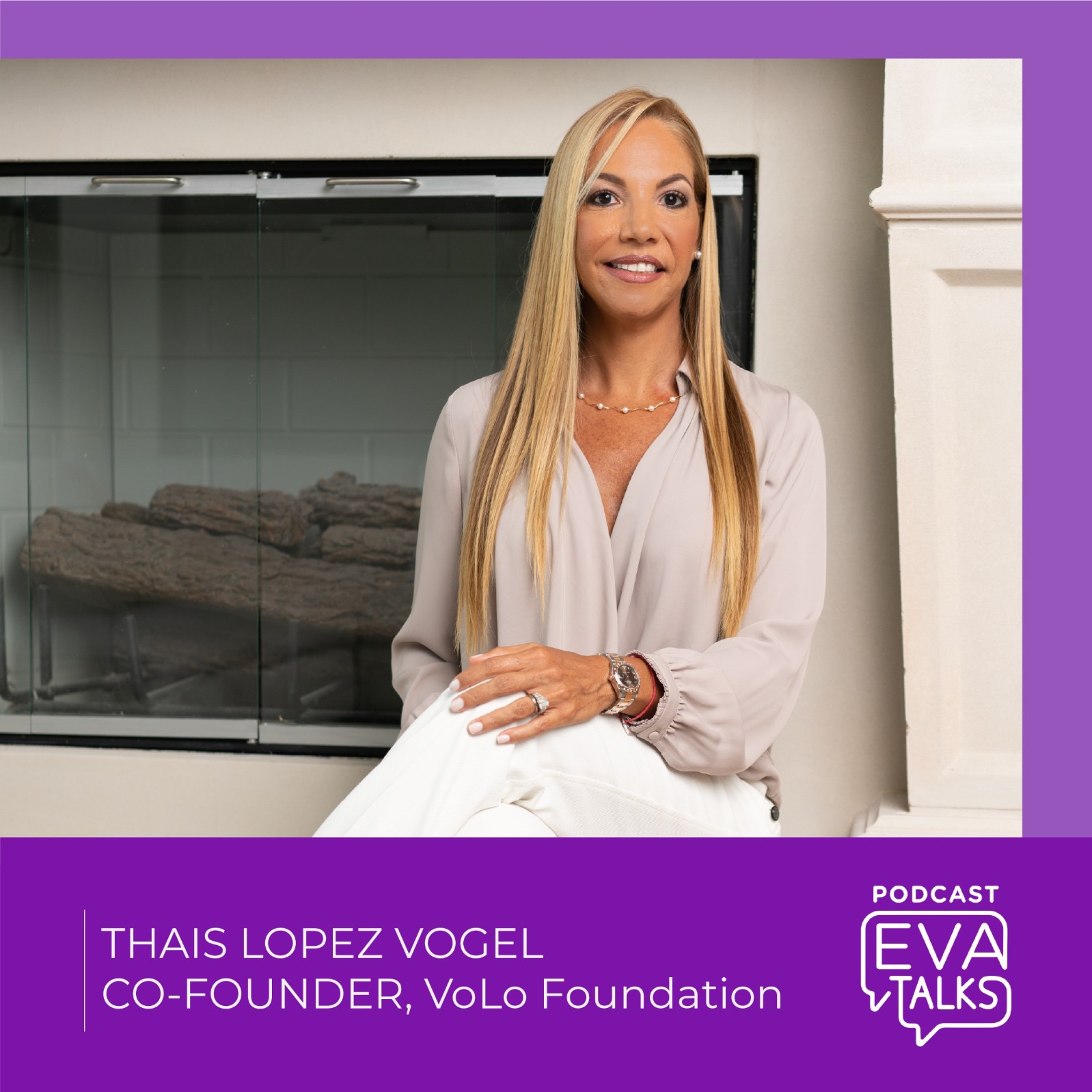
Today, more than ever, we must respond to a changing world. My guest today is Thais Lopeth Bogel, climate change advocate and co-founder of all the Foundation, a private family foundation with a mission to educate the public to create a sustainable and secure planet for generations to come. Thais, welcome to Eva Talks. Thank you Eva, it's an honour and a pleasure to be here with you.
Mine as well. Thais, let's start by the beginning. You were born in Caracas, Venezuela. When and why were you inspired to become a philanthropist?
He was born in Caracas, Venezuela in a free country then. Nobody was even thinking about rewriting or leaving the country for good. I don't think philanthropy is something that you decide to do, but I remember with the ads on TV for San Jude and the kids with cancer. I was already at that time inspired.
I was pledging $10 a month since I was like 12 years old. I think children and cancer are two words that should never go together. I was moved by that. I remember at the beginning, back in Venezuela, just giving the little I had, say $10 a month.
That's nice because those were like your first steps. Right? As making your gift and you kind of do it because that's how your parents teach you in terms of helping other people. Yes, definitely.
It comes from home. I think my father was my figure, my teacher, my leader. He always told me to help others. If you are in a fortunate, we are in a situation where we can help others and we can, I think the pleasure of giving, the feeling is amazing.
The way you do something for someone is very rewarding. Absolutely. I think that's a beautiful feeling. And what steps do you take to become a philanthropist?
Or maybe more than a philanthropist, somebody who was going to dedicate her life to helping other people? Well, I think, like I said, I have always given a portion of what I made to the charities that align with my values, with my personal beliefs. My husband's data, he's a data-driven person. He graduated at MIT.
And he showed without a doubt that the climate was warming and the human emissions causing the warming was going to be the most devastating future for our kids. That is going to be the most devastating problem that our kids were going to be affected by. So we decided to put everything in that bucket and start supporting climate change programs. Our foundation also has education and health.
But I think 70% of what we do goes to climate change. So it's you and your husband, David. If you created this organization, not for profit, you're based in Florida. And that's how you're really making a difference to accelerate the change and the global impact supporting science-based climate solutions.
And like you're saying, enhancing education and improving health. So tell me how does it work? How does the organization work? And what are the needs of the organization?
We're a family foundation. So we, like you said, we don't do foreign rights. We were created in 2014, but it was in November 2014. So we really started functioning in 2015.
The intention was to create a secure future for our children. I have six kids. Don't try that at home. I say, no, no, no, no.
That's where you stop me. Like six kids. I mean, I'm sorry. Please say that again.
I always say my kids are my life. They're my priority. And when we noticed that on top of all problems in society, climate change was the most important. We decided to help solve the problem.
I'm a person that believes in solutions and the solutions exist. So we have to do this act. Education and health, I think the logo of the foundation, when you go into the foundation dot org, the logo is a circle. And it's two people kind of like trying to help the world.
And I think that Dave and I trying to do something for the world. And I think education, health, and environment are all together. It's just a big circle. And when people connect the dots and they realize that all the things they see as priorities, when you talk about the elections coming up, people have economy, immigration, terrorism, all these issues at the top of their chart and they don't realize they are all affected by climate change.
When people connect the dots and they realize that climate change drives the economy in your country just with a hurricane in the area for it is by $5 billion. Billions. And they come out of our pockets. So just trying to fix everything that was devastated by the hurricane.
Agriculture is affected. Or health, one out of 10 kids in Florida suffer from asthma. It is because of the contamination, air pollution. And immigration, all those little islands, the big hurricane last year in the Bahamas, it made people leave their islands and they have to go somewhere.
So that's immigration. I think we have to connect the dots. And that's one we're going to prioritize climate. It's so beautiful what you're doing.
Tell us a little bit more about your role in the organization. Well, my husband David and I are the trustees. He's a very busy developing and analyzing the data. And I manage the team.
We started with a team of four people and we have grown to 10. We have people in communication. We try to share our knowledge and our science through Instagram and Facebook. And now it's Twitter and definitely a team of all women, but my husband, no.
I'm trying to empower women here. Now we have one or two men around there, but now it's 10 women. I think as mothers, we feel this is personal. So I think we work with passion.
And every time you enjoy what you do, you're going to do it right. Right. Absolutely. It really sounds simple.
No, no, no, no. I don't think it's simple. I think you're making it sound very easy. But it's not easy.
It's challenging. And that would be kind of my follow-up question because when you're thinking about getting this organization, this foundation up and running, and now you're looking backwards and you're seeing, okay, you know, those early stages of developing this foundation and there are many people out there that want to do something similar and they want to help. They want to create a foundation. They want to do this.
What would be the most important piece of advice that you will share with them based on what you experienced with the Voila foundation? I think the most important thing is partner with highly, in our case, better scientific humanitarian and educational nonprofits because that was our mission. So you have to clarify your mission first and then partner with these NGOs and you can find them on our website. And I always direct people to the NGOs website because they have the unbiased, correct data that we feel comfortable with sharing.
So we're very careful to stay away from media bias or programs with hidden agendas. Most people equate climate change and global warming with a political agenda. So it's very important to us that we're sharing what the numbers in the mat says versus what people say. People can embellish a little bit but numbers are not.
So we try to be very objective on that. I think that's a strength. So when people want to put something together, they have to be very coherent with the numbers, with the data that is really backing up what they're saying I'm doing. It's incredible because last year you were named one of the 100 most influential Latinos committed to climate action by such a mama.
This is an organization that I'm part of the board and I love all of them and I think that's incredible that you were recognized for your work and such a mama for people that's that no, it's a nonprofit organization building support for 100% in energy economy for also sustainable attitudes, behaviors and lifestyles within that community. You're also a member of the Tiffany Circle at the American Red Cross, a board member for water people here in Chicago. You participate in several local community focused community groups in the Palm Beach area. I'm already tired.
But I think it's phenomenal and I say tired in a good way because it means that you've earned all the positions you hold and that all these positions that sound very accomplished come with a lot of good work to help communities. So tell us a little bit more about these efforts that you're doing as a Latina working to mitigate climate change. Well, I think like I said before when you do things with passions, you don't get tired. You just keep going and as Latino, I tell everybody we're super women.
We're resilient, we're dedicated and we do what satisfies absolutely anything for our kids. When I see the future of my kids in danger, we have to adapt. The hurricanes are going to be more devastating. The heat is going to be, we have one of our programs or one of the research says that we're going to have over 100 days in Florida with temperatures higher than 100 degrees.
They're not going to have the quality of life that we did. I feel responsible and I feel like I have to live a better life for them and not a worse one. So when you work with someone in your mind with a clear mission, it's easy to do. You don't get tired.
You keep going. Tell us a little bit about the objectives short term that you're working on at the Volo Foundation to be able to prevent that this situation happens to our climate. I think the objective is to let people know that right now we have an amazing initiative that we are launching. Actually today we launched, is these touches that melt in five days.
The statue is, for example, is going to be a grandfather in a kid sitting on a bench with an ice cream and the statue is going to be melting in five days because we're going to have it at the Museum of Science in Orlando in Tampa. We just want to face the reality with people of how climate is changing and how harmful that can be. We want to create awareness, but most important we want to tell people Latinos, it doesn't matter. Climate change is not going to discriminate.
Climate change, just like COVID, it's going to hit us all. It's not going to see your color, your social status. It doesn't matter. We're all going to be affected by it.
So you have to create awareness and you have to tell people that we hear you, that your voice counts, that you have to talk about it. You have to vote not only on the presidential elections, every election in your community. In the A, HOA is in the PTA at school, you have to get involved and you have to talk and you have to not see the climate as a political issue. Climate is not right or blue like I said, it's green.
It's going to affect us all. I'm always surprised by people that I know, I mean, these are close runs, not many fortunately, but there are a couple that have been very direct in telling me climate change does not exist. What would be your suggestion in terms of educating people because I don't think confrontation really works? It's kind of educating them, what would be your advice?
What would be the talking points that you would suggest to somebody like me when I'm talking to a friend and someone who really believes wholeheartedly that there's nothing wrong and it's an invention and everybody's exaggerating? I think like, first of all, we have to believe in science. Scientists already agree that what we're putting on the atmosphere, the CO2, the fossil fuel is causing the heat to go higher, therefore the sea level is rising, therefore the air is, the seasons are changing, therefore the allergy season is longer, people are having more asthma. I was confronted with the reality.
Do you remember years ago? I remember when I moved to Orlando in 1994 and for years for Halloween, all our customs and my kids' customs were long-sleeved customs. Nowadays, you can barely be dressed for Halloween and trick-or-trend because it's hot. I remember Christmas where I had to wear gloves.
So if you put it in front of them, I think they go back and they say that's true. It's harder now. It is harder. It's a reality.
It's a reality. No, no, no, no. I've been living in Miami on and off 30 years and absolutely 100%. It's harder.
We have more aggressive hurricanes. I remember back then before Andrew hit us, hurricanes for us was an excuse not to go to school and have barbecues. Definitely. And so then Andrew came and we were like, oh well, here is reality.
But after Andrew, I think we've seen how aggressive and you see that the beach. I mean, I even on island where there's a beach and I've seen the erosion of the beach. I mean, there's some things you just can't really avoid, right? And I think that we all have to be conscious of what's the world that we're leading to future generations.
So tell me more about yourself in the terms of what do you love the most about what you do. I mean, you sound like such a passionate and fun, loving person. But what is it that you would say you love the most? Well, the fact that I wake up every day with a purpose to leave the world better than how I found it.
I'm doing this. I'm also showing my children they can use their voice for something bigger in the world. I think teaching my children and I teach them, not telling them because let me tell you kids do as they see, not as you tell them. I feel like going toward my little ones are 60 or 20 in my daughter when I tell her baby, I have to go to work.
She tells me, you have to say the environment. So you're raising me as a superhero because I'm saying the environment. But I think my role as a mother, I love it. I love having kids that for I am.
But in I have dogs and I think we, my generation, our generation focused too much in having far of our students, MIT kids, driven, driven, driven academy and we forget humanity, we forget kindness, we forget helping each other. And that's what I want to change too. At my age, after everything I've learned, I think that nothing is more important than being kind than helping others in the reward that you feel it's invaluable. I go in every more with you.
I think that we're leaving for a crisis of human values. We have to go back to the basics. But I just got stuck on the six kids and the dogs and going to work. And I had to say this because of course you're laughing, you have high spirits and sometimes it's hard.
I mean, and not everybody has the capacity to get organized and they feel awkward and they hear somebody like you speak and they're like, okay, so what am I doing wrong? I mean, maybe I don't even have a child or I have one. What would be your suggestions and not only to women too? I mean, single parents out there, two people that are trying to manage and how to balance everything.
I always say don't look, the grass is not going around the other side. As long as you love yourself, as you love your family, as you put everything on what you're doing, you're going to be fine. It doesn't matter if you have kids, if you have six, if you have 12 or if you have none. You have to be okay with yourself in order to do okay to society and out there and work and get organized.
So I think mental health is important nowadays in the days of COVID and the things that we never expected to have. And I think unfortunately the pandemics are not going to stop. I think that at the end of the day nature say, you know, stop right there. You're going too fast.
You're not seeing what's important in life. You have to spend more time in your house with your family. You have to prioritize. Now we realize that we can work from afar.
Now we realize that riding a bike and enjoying a part is good. And we have more time for that. And I think as bad as I feel for the life's loss for COVID, nowadays the Venice Canal can see clear waters because they haven't had that many chores. People in India can see the top of the Himalayans because contamination and pollution for the aircraft is not as much.
We can see Miami, the Sierra fish, which we thought it was an extension. And now we can see them. So I feel like nature gave us a wake up all. And I always say the COVID is just a rehearsal for climate change.
And we have to come out of these better human beings. Definitely. And curious, what persona has had the most influence on you and your life? I'm going to talk like a little girl but my father.
And he's not with us anymore. But what he left and what he left me is a legacy of responsibility. Work hard for what you want. Always give your head up.
And it's just a big good. It's simple. A lot simpler than we make it. And just do that right thing.
I don't know. Like that was a lover of animals. He was a very humble person. And he was tough.
But he was full of love. And that's how we remember him. And that's beautiful. That you had a parent that had so much influence.
And as an influence that you're living with your kids at the end of the day with all the work that you're doing. And just being the definition of a good person is so bizarre because somebody feels that they are good. But what they're doing might not be good. But if you have empathy, you have love.
And you have the humility to even admit your mistakes. Which I think we all have to recognize what mistakes have made. And like you say, the COVID and this pandemic has really grounded a lot of people. And hopefully we have learned to slow down and to take things at a different step.
What is your personal and professional life philosophy? Don't bring me the problems. Bring me the solution. I say it at home.
And I say it at work. You know what the past is? We're going to start from here. And I say it at home when the kids are fighting.
And he did it. And I'm like, I don't care. How are we going to solve it? So you already broke the plate.
How are we going to solve it? How are we going to stop this fighting? And I worry the same. I don't want to hear what we did wrong.
How are we going to fix it? And that's why I'm so optimistic when we talk about climate. Because I see we have these solutions. I always we have the climate correction.
I think that was a big conference. I think that was a turning point from Golo being the leader of Golo and becoming big. It's a conference that we did in Orlando. And we have speakers nationwide.
And it became the big thing. But it was about solutions. And I think this law was something like we're not talking about denying climate change anymore. That has been solved.
Now we're going to talk about solutions because the problem is here and we have to solve it. And the good news is that we have the technology. The tools. Everything is out there.
We just have to act. We have to talk about the government and everybody has to speak up and try to do what's best for the community, for the nation, for the global, for the whole world. Right. If people are now listening to us and they want to know more or they want to see how they can help, what would be your suggestion?
What would you ask of them? Speak up. Talk about it. You start talking at your dinner table with your family.
What can we do about climate change? Why don't we change the live orbs? Why don't we stop using plastic? We use the reusable.
And talk about climate change as a topic, as a crisis and as a problem. Just like you talk about everything that you see on TV. I ask the journalists, the media, to talk about climate as the crisis that it is. Put it on TV as they put so many other crises.
And if we talk at home, then we're going to start talking with our community. Then we're going to start talking nationwide. And there's going to be global. We're going to create the awareness that is needed for climate to be this problem to be solved.
Do you remember the ozone hole that was? Yes. Yes. So you don't hear about it anymore.
In RDC, a great foundation. We have the technology. We advance every day. I believe in the smart people that we graduate from.
It's great universities. They have the tools. So let's do something about it. Well, hopefully we can do it.
And like you say, bring their solutions to the table and that people cooperate. And they understand that this is a reality. What do you think that it's stopping, you know, because we have all the resources to make it a change? What is it that doesn't allow it to happen?
I think when you have a problem that is intangible, I mean, you don't see climate change. Maybe I won't see the solutions in my lifetime. But you, so you freeze. You kind of like, okay, this is such a big problem that I'm not going to be able to do anything.
And I think that people tend to loop away because like you said, it's a big problem. But like I said, if you participate, if you talk, if you investigate, if you go on our web page, if you look at the videos, if you educate yourself, it's not that far. It's a very simple problem. And we just have to transition to renewables as a society.
It's going to be good for the economy. It's going to be good for health, for the modern nature. So we don't have to live like this. For every degree of warming waters, the hurricanes that are coming are going to be higher in category.
If for the wildfires in California, the drought in the insects. So we need to really come together as a human being and do what's right for the earth. Definitely. You have such a passion and drive.
And I always end up all the podcasts with a message of yes, yes, you can. And we can do everything that we want. I think my life story has been a reflection of that. And you can achieve anything you want.
If you put in just a dedication and I think you have that energy and that mission in your heart, I think when your heart drives decisions and drives a mission, then everything works out very well. So tell me what does yes, you can mean for you. I like yes, we can. I think when we are integrated, we are better than the whole is better than the sum of the parts like Aristotle one says, but that's metaphysic and you don't want to go there.
Yes, we can. We as inclusion, we as together, we as collaboration, it means volume. We approach education, health, and climate change with passion and dedication. Yes, we can correct climate and create a better world.
Well, that's so beautiful. Thanks. Thank you so much for your time and for sharing the story and for working day and day out on making sure that there is more things to be done to correct and safe our climate and our planet. It is where we live and it's our future.
So thank you so much. Congratulations. Thank you.