
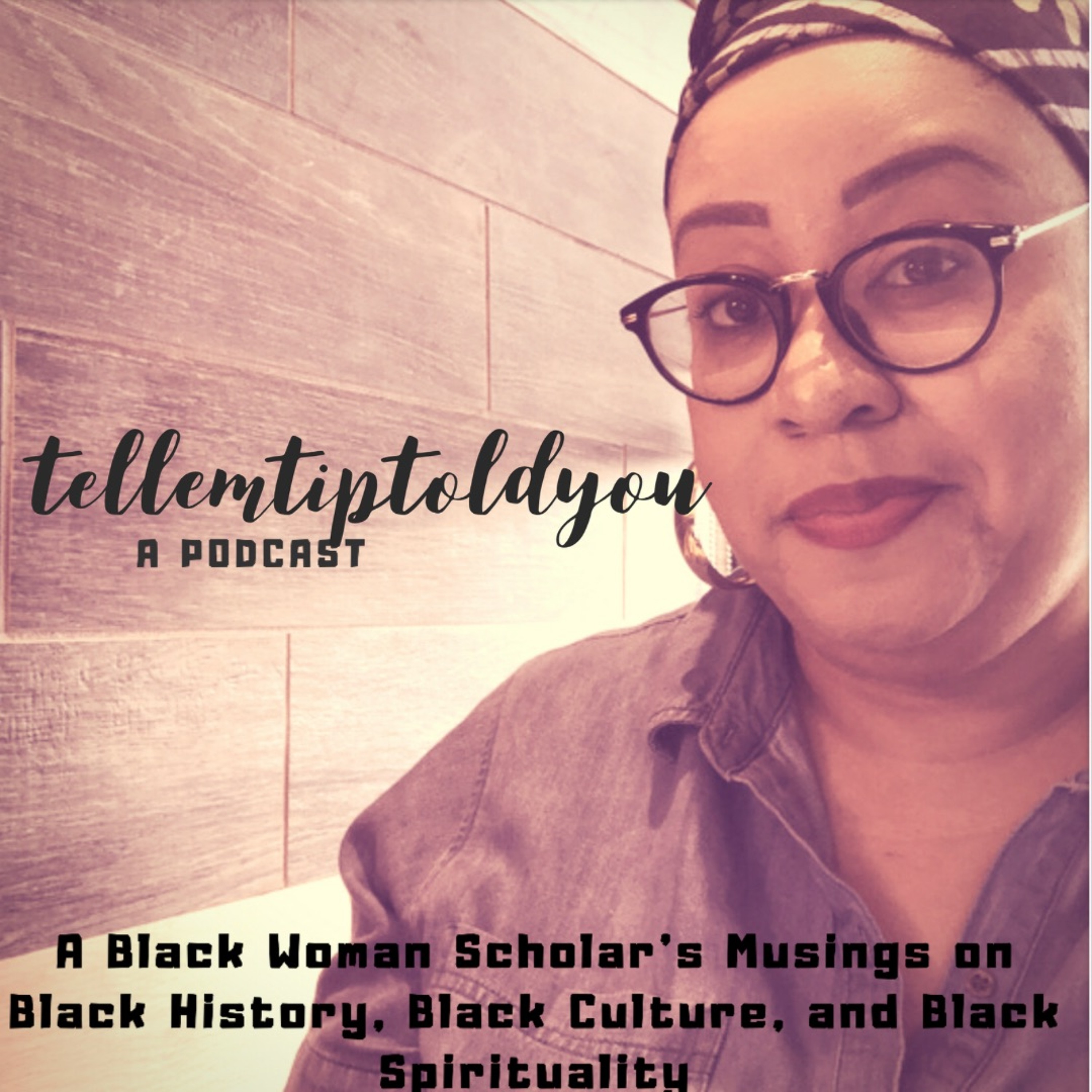
Tell em to tell you. .com. The podcast about pop culture, black history and spirituality. It's about to be a great vibe.
Doctor Till, go and take it away. Tell em to tell you. Hey y'all, here's your girl Till. Thank you for joining me for another edition of Tell em to tell you.
The podcast where I share with you all my musings about black history, black culture and black spirituality. Thanks for joining me today. I know it's been a minute. I dropped a ball y'all.
And I know I say this like every time I come back from getting missing, I tell you I'm going to get back on it. Let me just go and tell it again. My goal for May. Y'all hold me accountable now.
My goal for May is you will get a podcast every Tuesday of the month. All right. It might be a short one. I can't guarantee that you're going to get a whole thing.
I'm doing baby steps. You know, there's an African proverb that says actually in Yodoba proverb that says it's bit by bit. We eat the head of the rat. Listen, it's going to be bit by bit.
I'm going to get you there, baby. We're going to do this. So I'm happy to start off May with you today. It's the first day of May.
So by the time you're listening to this will be the second day of May, I'm glad we're entering it together. May is also also Mental Health Awareness Month. And so one of the things I want to talk about with you throughout the month is our mental health. Many of you know I'm an educator.
Right now I work primarily with first year students at an HBCU and I am finding that mental health issues crises among our students are on the rise. So I want us to be as a community prepared to address those issues, but also to recognize the need for support in this area, not just for our students, but for ourselves. Also, we model for them what it looks like to take care of self. Right?
And one of the things that I'm noticing with my students, and then I'm going to tell you what we talked about today, I didn't give you the agenda. I'm all out of order. That made me think about Eric May's. But anyway, I'm going to get back to the regular podcast, but I do want to say, you know, please address taboos around mental health care in our communities.
I can't tell you the number of students who need help, but our condition to believe that it is weakness to ask for help. And that's just not the case. It's not the case at all. In fact, although we know and I recognize that in our community for the last several 20 something years, right?
It's becoming increasingly more acceptable to seek out therapy. But there was a point where if you thought if you saw out mental health care, then folks labeled you crazy and ostracized, you whisper behind your bed. That thank God that's no longer the case, but we have to share with our young people that is okay. And in fact, historically, you know, we had elders that we went to now.
They may not have been trained professionals, but the seeking out of counseling is certainly not new for our communities and our culture. So we have to really help our young people know that it's okay to ask for help. We also have to let them know not to make excuses for their laziness and bad decisions. Right when there's nothing wrong.
Okay. Don't let them lie on it either though. So again, I thank you for joining me for the first podcast of May. So listen, here's what I want to talk about today.
I just hit one with you. I wanted to just introduce the month to you what my primary thing for the month is going to be. The other thing I want to talk about today is what we need to what we how we need to be thinking about the growing threats facing US public education. And I also want to talk to you about how you're personally defining success, what that looks like and how it's shaped by what's going on in our world.
Alright, so let's just jump right in. So as I said, make this mental health awareness month. And one of the things I want to do this month with the podcast is just to cover a little something with you each week. So today I want to talk to you about the power of no being able to say no, you know, Shonda Rhimes had that book, The Power of Yes was that name of it.
It's not about the year of the year of yes, right. But this month, I want you to focus on being able to say no. Now, here's what that looks like for me. For years, years, if you asked me to do something related to education, I don't care if I have 50 items in the pot in the fire.
Excuse me, 50 items in the pot 50 items in the fire. I was going to find a way to say yes to you, even if it meant that I was going to be stressed out, not getting rest, not eating overly taxed, coming out of my pocket, you know, things like that. And I realized that the quality of my work was suffering. So not only was I personally suffering, but what I was contributing, what I was giving to the people asking for things was some power definitely lesser than I am capable of doing.
And that the consequences see, here's what happens if you're raised as the quote unquote smart kid, then any mistakes you make are devastating to you personally, even if you know how to hide it will you feel like such a failure if somebody finds a typo or if somebody, you know, you miss a deadline, you feel like such it can cause existential crisis. If you know one of these children, please don't put that kind of pressure on them because I'm telling you we grow up and we got issues. But I found out that I could prevent myself from having those kinds of moments. If I just said no to things that were over and beyond what I'm capable of doing well.
Right. So I think it's important for black folk in general and black women specifically to fight the ways we have been socialized to put everyone else's needs above our own. Now, I know I'm preaching to the choir. I noticed there's a common social media theme and idea right now.
I just want to add my voice to the choir because it's so important. I was having a conversation with a girlfriend of mine once and I was lamenting how what my to do list look like and she said why is it like that? You know, I had never stopped to think well, Tiffany, you could say no, you're the one growing the to do list is not multiplied by itself. And she said to me, you know, we have defined work as excessively hard labor and we've inherited that from our ancestors.
They didn't have a choice. We have a choice and we're still identifying excessively hard work as quality life. Right. We all know it's not.
But for me, all I can hear somebody saying so lazy in my ear. If I'm laying across the sofa with a cup of good tea and a book, I feel like, dang, I need to be reading for class or I dang, I need to be writing this article. Dang, let me go out here and see if it's a grant call open right now. You know, you feel obligated to be doing something all the time because we've been socialized, particularly as black women to always be in labor.
Right. No pun intended. What we have to do is to recondition ourselves to understand that rest is also productive. That rest means that the quality of my labor is improved.
As I was having a conversation with a friend of mine earlier today, I want to also say to you that while I understand that we need to do this, we also need to be aware that it's difficult to make the decision to do this because I'm telling you as someone who has made the conscious choice to say no more often. It is still hard to say no. It's so hard. Somebody says, can you speak to such and such and I look on my calendar and it's like something else going on that day.
I got deadlines two weeks before that so I wouldn't be able to do some quality thinking about what those kinds of things. I'm still going to probably want to say yes. And if I say no, I'm going to feel really, really guilty about it for a few days. We have to be willing to do the hard work of being okay with the guilt until we're until we have taught ourselves that there is nothing wrong with saying no.
So that's all I wanted to tell you about mental health awareness this month is to practice the no, get good with the no say no to things that won't make you feel guilty so that you have practicing when it's the big stuff. All right. All right. So I told you I wanted to talk about speaking of mental health.
These people are driving great. Do you have to be under a rock and not to be paying attention to what is happening to us public education books are being banned. I think it was Missouri voted the Missouri House of Representatives put forth a bill and voted to close all public libraries because they couldn't keep up with the banning of the books, right? The community couldn't keep up with going, pulling the books, the process was becoming too hard.
Speaking of which, I'm going to be putting out probably in next week's newsletter a list of all the banned books as of the date that I pulled it because you know they're adding books every day. But I want to send you that list because I am convinced that if books are being banned, then we need to be reading those books and having conversations about those books with our young people. So I'll be doing that. If you're on the newsletter list, if you're on my email list, you'll be getting that.
If you're not on the email list, there'll be a link in the show notes to take you there and to sign up. But you can always go to www.telumftop.com and make sure you're on that list. And let me get back to what I wanted to talk about. So we see, we have heard and we've been talking about for over a year now, so-called anti-critical race theory legislation.
It's passed in Florida. It's passed here in Georgia and Georgia. We have House Bill 1084, where we can't talk about any quote, quote, quote topics that may make students uncomfortable. We've got in Florida the anti-woke bill and things like that.
Previously, I've talked to you about ALEC and other legislation mills like that, the American Legislative Exchange Council, where there are a group of people who need to meet the public. group of people who meet in secret, who write these bills and then distribute them to right-wing politicians to put forth in their states. This is why the bills look almost identical when they come out in different states, although the people aren't working together, they're working together. There is something that we need to learn from this.
The anti-critical race theory rhetoric really was started by one man. Okay, one man. And he got in the right people's ears, he had the right rhetoric, he packaged it the right way, and it spread like wildfire amongst these Republican leaning voters, constituents, and politicians. It's a means of control, right?
I think we have spent so much time being pulled into the argument because if you remember at the very beginning of this, I was like, why are we arguing with them? They're not even talking about critical race theory. So if someone wants to argue with you, just tell them, yeah, K-12 doesn't teach critical race theory, and you ignore the conversation. We lent fire to their argument.
We gave validity to their conversations because we injured them. You know, the old people say, when two people are arguing, you can't tell who the fool is. You don't argue with fools. And that was our mistake.
That was, and it's still our mistake when we're trying to have these conversations with people. I am so glad that more and more reporters, particularly black people, are just laying it on the carpet. What do you mean by that? Right?
Because I have to tell that, if you listen to any of these critical race theory folk, they don't even understand what critical race theory is. To them, it's any black history, any history that makes white folks look problematic to them is critical race theory. So we should not be debating about critical race theory because it's not even what they're talking about. All right, let me get off that so about to get to my point.
We are allowing untrained people, uneducated people, in many cases, to control what is happening in US public schools. Now, another thing I've been preaching for years is to pay attention to your local politics, particularly school boards. School boards have a whole lot of power, y'all. Public school, generally, although it's provided for by the federal government through the Department of Education, it really is a state thing.
So if you ever look at federal grants, proposals for grants and things like that, they are very careful to say that the federal government provides oversight and funding and things like that. But the state is primarily responsible for public education in that particular state. All right, now the state legislation creates through its state Department of Education, policies, procedures, rules of certification, so on and so forth. That information is filtered down to your local school districts.
Now within the school district, your superintendent, the school board are the primary forces responsible for interpreting the state's mandates. All right, so if you had something like here in Georgia, we have House Bill 1084 that threatens diversity, and inclusion language in US public schools, then if you had a learned equity minded, justice oriented school board, then the way they interpret that could still protect the freedom of education that students receive. All right, however, if you have a school board in place that aligns with these problematic legislative movements, then you're in trouble. All right, so one of the organizations that's growing in popularity in terms of us paying attention to the moves that are being made, our moms for Liberty.
It's a white female group, largely not teachers. These are women who I would argue have to wait too much time on the hands. Okay, just think Alice Walker when you think it is. If you know Alice Walker's work with women, as you know what I'm talking about, they got too much time on the hand.
They're very much like the daughters of Confederacy. They are part of a lineage. Y'all go read Out of the House of Bondage by the Lovia Glimph, and you're gonna know who I'm talking about. There's a lineage in place among these particular kinds of women to control and to support the patriarchal white supremacy we live under through schooling.
All right, now as much as I don't like these folks, we have got to pay attention to their strategies. We can learn something from it. They have not departed from their lineage's mission. I think we have these women always on code, even when you see their their wheels turning and realizing that what they say and sounds foolish, they on code, they not gonna break code.
If you don't know what code is you already off code. If you if you wonder what I'm talking about right now, you are already off code. Ask an older black person, what does it mean to be on code? These women don't break code.
They go on your school board meetings, they might look like Will and Luck, Foolishness coming out their mouths. They don't break code. They share information. As I said, the strategies, the flyers, I got my hands on a paper copy of a pamphlet that they have out on how to how to take over your school, your school board.
You know, things like that they disseminate information well in their communities of supporters. They disseminate information. They make it popular. They package it well, but they are informed on what their agenda is.
Now, I'm not saying we need to learn anything else from them, but how to organize and disseminate information in our communities. Because what tends to happen for black folk, let me say this, this is from my perspective and what I've seen. What tends to happen when we don't like what's happening in US public schools is we individually snatch our kids at homeschooling. We individually snatch our kids out, put them in a homeschooling network of other privileged black folk and leave behind most of our kids, right?
That is not how we protect our community. I am all for independent black institutions. I'm all for independent black homeschool networks. I'm all for independent black homeschoolers.
What I'm not for is giving up US public schools. And the reason I will never give up US public schools is because number one, they are the birth child of my people. I'll talk more about that on another podcast. They're the birth child of my people.
Yes, public schooling is black folk stuff. All right. Number two, most of our babies are there. We can't turn our backs on the schools.
See, if we are moving, let me let me let me know I jumped. I was on a panel one time with Baba Ajayakoto, E-bye. And he was the founder of one of the oldest continuously operating independent black schools in the country, the nation house. And he said that we have to be careful that we do not turn into our oppressors.
Okay. As someone who studies traditional African culture and cosmology and how it's disseminated in the diaspora through literacy, let me tell you something. I am afraid. I have written about black cultural ethos in other places and how I'm a family rattling.
If you're a Humphreys, you know what we were talking about, how black folks culturally act, how we're culturally moored and grounded. What I'm afraid of is that we're moving away from that and we're becoming more Western than we are African. That troubles me. It troubles me that when we're talking about US public schools, people who have the privilege of being able to pull their children out of these places tend to do so without working to ensure the children that are left behind are also cared for.
Like I'm not blaming you if you pull your kids, you pull your kids. But I am blaming you if you pull your kids and you don't look behind to find out where the other children are. Your children won't live in. Let me say this.
Vanessa the Walker says this all the time. Your children can't live in a vacuum. So you may protect them from the immediacy of oppression that is encountered in US public schools. And I'm not saying that they won't be encountered by your children in US public schools.
I'm saying that it probably will. But if you protect your children from that immediacy, they're still going to live in the world that is impacted by it. Are they going to know how to negotiate it? Are they going to be in community with the children who have been upfront and personal with it?
Right? They got to share the world with people. They can't be isolated from the realities. All right.
Let me let me just give you a prime example of what we have to pay attention to. This happened in the state of Alabama a couple of weeks ago. Governor K Ivy denounced quote unquote woke preschool training and got rid of Barbara Cooper who was the head who was excuse me the head of the Alabama Department of Early Childhood Education. Now you may be wondering what Barbara Cooper did or wrote that caused her to lose her child.
Well, she didn't actually write it. All right. Here's what's problematic. K Ivy targeted the fourth edition of the National Association for the Education of Young Children's Development, excuse me, developmentally appropriate practice book.
Now, if you are a teacher and administrator somewhere close to schools, you've heard of NAC the National Association for the Education of Young Children. These are professionals. It's a national organization. And NAC has a handbook on developmentally appropriate practice as a training resource as a professional development resource for early childhood educators.
That's what was in question that Barbara Cooper introduced. Yeah, I mean for you to hear how ridiculous this is. This is a professional organization with trained professional certified educators, people who have devoted their entire careers to making sure the experiences that children have in early childhood are developmentally appropriate. Do you hear me?
And this woman lost her job. It's not funny, but I'm trying to let I'm laughing to keep my head together. This woman lost her job for having those training materials in the state of Alabama. From NAC y'all, y'all not worried about this.
They already letting anybody that's got breath and a degree teach. And on top of that, now we can even train the people that you're bringing into the schools. I have said before, I'll say again, if you go back and listen to my first season, my first year of the podcast, I believe we will see the death of public education in our lifetimes. I've been saying that.
But I don't want it to go. We can't let it go willingly into that good night. Easily, y'all just gonna give it away. Again, I tell you public schools are the birth child of our people.
Are you gonna give it away? We gotta fight back. Take back some of these school boards. It doesn't make sense to me.
You and all Black District and the school board don't look like you. School boards are open meetings for the most part. They sometimes have some closed sessions where they're trying to do some finagling. But for the most part, because these are elected officials, the meetings are open.
Go listen, go watch, be informed about who you're voting on. We gotta pay attention. We gotta pay attention, which brings me to my last point for this episode of the podcast. I want to talk about how we define success.
And this may be because I turned 50 this year, y'all. So November is gonna be a month of parties here. But I'm thinking more deeply. Y'all know I've always talked about we have to define holistic success for ourselves.
I just want to gently remind you of when we're thinking about what's happening with schools, when we're thinking about growing censorship of ideas, when we're thinking about economic and other food and food insecurities, when we're thinking about threats on US democracy, if there ever was a thing, when we're thinking about these things, we have to determine what success looks like. Let me tell you one of the reasons why I dropped out a fan for a bunch of, there was a lot going on, let me say like that. There's a lot going on with me when I was 16, 17, 18 years old that caused me to drop out of family and not graduate from a sexual assault to just being too young and not being mature enough to be in school, partying a lot. I think now looking back some depression.
But one of the reasons that I was not successful, the first time around in school was that I had no plan. I've always liked to argue, I've always liked to talk about ideas and I read widely and deeply even as a young child. So my father and my mother would always say, you should be an attorney, you should be an attorney. And the Cosby show came out and I loved Claire and she was an attorney, so the attitude I want to be an attorney.
And then I thought about sports, I loved basketball at the time, I wanted to be a sports agent, I thought. So when I got to FEMU, I majored in public relations and I took my first couple of classes and I realized this ain't what I thought it was. Which is why I speak of education, which is why I think we need to push for students to have flexibility in their exploration during their first and second years with their college. I felt locked in to something that I wasn't interested in, wasn't necessarily good at.
Because I'm an introvert at Nature and the idea at FEMU then the J-School was primarily about news and so it was a lot of speaking, a lot of things that as a shy person it just really didn't work for me. But I didn't have focus. So anything that came along distracted me because I wanted to explore, I wanted to experiment, I wanted to see what ideas were out there, what I could experience. And because I had no plan, I was easily swayed from one idea to the next.
I took a lot of psychology courses. That's why I ended up with psychology as my undergraduate degree because I actually took more courses in that than in my actual major because I enjoyed it. I'm saying all that to say, we don't necessarily as a community have a good working definition of what liberation is going to look like. Our imagination hasn't been tweaked, hasn't been teased enough.
I don't know that our artists are doing everything that they're supposed to do. Now that, I shouldn't have said that that way because I consider myself an artist. I mean, I ain't doing what I was supposed to do. I'm not putting all the blame on artists.
I'm putting the blame on all of us. We have not taken time as a collective to determine what success is going to be. For example, in California when there was an opportunity to begin serious discussions about reparations, the NAACP was like no cash payouts. Well, who told y'all that?
Right? Where was this conference on what, how are we as a community, as a collective defining who gets these things or not? How they're paid out? What we do with the pay out?
There aren't many things like in the early 20th century, the late 19th century, you had pan-African congresses, you had the colored conventions in the south, you have all of these things where black folk are coming together to collectively talk about what future they imagined and the strategies that they could use to get there. I told y'all before when I'm in the archives reading about black educators historically and their notes and their records, their meetings, minutes from their meetings, they're imagining a future that doesn't exist yet and they're creating it through their strategies. But I don't know that we're talking deeply enough as a collective about the success, how we will measure our success, how will we know when we get there? What does freedom even look like?
What does it feel like? What does it taste like? What does it dress like? What does it smell like?
What is it doing? We've got to fall back into some brainstorming. We've got to fall back into some dreaming. We've got to fall back into some literature.
We've got to fall back into some jazz. We've got to fall back into the things that have fed our spirits so that we can think critically, deeply and strategically about freedom. I don't know that we spend enough time even unpacking what the word means. No wonder we can't get there.
You think the minds for liberty are unclear about their goals? Do you think Ron DeSantis is unclear about his goals? We can't afford to be unclear and unready. That's all I got to say about that.
We can't afford to do that. So get in community with some people, rally around some people, share ideas with people, build some institutions with people. Y'all, listen, the month of me, I'm going to be talking about that as part of my mental health awareness because I got to get some stuff out so I can be sane. We're going to be talking about that together throughout this month.
I also want to tell you that just like the podcast is going to be back on Tuesday's during the month of May. So too is the blog. If you, again, are on my newsletter or you are just subscribed to the website, then you received May's the first blog post of the month and the first newsletter for the month. So both of those things, if you're subscribed to the website, you got the blog, if you're on my email list, you got the newsletter, if you're on both, you got both of those things, and now you got a podcast, baby.
I'm also going to be looking for podcasts. Guests, there is a link on the website. So visit www.towelomtotoldyou.com and click the link called Be on the Podcast. And let me know that you want to come on and talk about some things.
I really want us to get serious about how we are building community and sharing information about social organizations, political organizations, professional organizations that we need to be feeding, feeding membership to, feeding finances to, feeding ideas to, so on and so forth, right? We're not just pulling from places anymore. We are contributing to institutional building and liberation. I hope you have a beautiful, beautiful rest of your day.
Talam Tuttold you.