Hello and welcome to WNC Original Music Episode 95. You know the N95 mask is called the N95 mask because it only filters 95% of airborne particles. So if you have been around 100 people this week, 5 of them gave you COVID. That's just math.
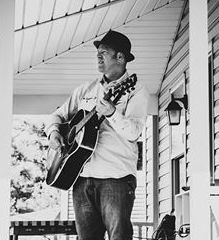
Very happy to have on the show this week Taylor Maxson. Taylor and I go way back. We actually used to be in a band together. He is an incredibly gifted songwriter and singer and musician.
Taylor has lived all over the country and you can hear that. You can hear the influence of the different areas in a lot of the songs. But you can also hear that he is rooted in Western North Carolina. You can find him at taylormaxson.vancamp.com and you can search for him on Facebook and Instagram as well.
And we'll have links to that in the show notes. And now here is Taylor Maxson. I discovered was that my attempt to write a cinematic song. So to the Shoto Tell principle.
And right? Like so I wanted to drop the listener reader into the scene like you're watching a movie basically. I think the rhythm of it is supposed to be like you're traveling a car at West and there's stuff flying by the window. Each stands as another thing flies by.
It's sort of repetitive and a little drony. The song doesn't have a lot of changes. A lot of songs you may notice do have a lot of changes and weird stuff. Forget all the time.
But this was an attempt to drone Americana cinematic. Something that might show up in a Western TV show. You know these days. Like a Westworld.
Can you get that Westworld? I know you're connected. I'll get on Westworld. Okay.
Westworld for Taylor. Got it. I also like the idea of. You want your music on it because I could get you a little part.
You can get on a fruit and a little candy. Can you have a robot? No, no, no. They're robots.
You can barely. I like the... And also there's a female protagonist in the song. It's sort of rooting for a woman.
Like the idea would be like a... Maybe not migrant, but like a New Mexican woman. New Mexican or maybe like a Pueblo woman who knows. But like a non-white non-Angle woman basically is the protagonist of the song.
And this is one of your older songs? No, actually it's a newer one. That's a newer one. That's interesting that like you said you have a lot of chord changes.
I mean if you're in a band with you it's kind of annoying. But yeah, so it's interesting to have that kind of like let me go back to... It's not like this is the first song you ever wrote and so you only knew three chords. It's like you're intentionally saying...
And that's where those kind of songs sound the best. It's like you're not your limitation. It's your intention to write a song like that. Yes.
Yeah. Now you say that in your own words. I do. I do notice a lot of the songs that I played today are actually reworkings of early songs or relatively recent songs that I wrote in out tunings and they were so complicated.
I couldn't remember them. And it gets ridiculous when I have to have like seven guitars to keep the right tunings and have to remember what they are. So I finally just started writing and figuring out how to translate the songs I used to write into standards. So there's probably four or five that were in weird tunings that I figured out anyway.
So yeah, but notice cover was definitely an attempt to keep it really simple. I'm tired of the journey. I wandered off into the unknown. Rest in bold without hearing the search from.
At the same time. Go to the last life. I said it'll end up in value. The river in the desert went dry.
Went to war with our rifles we've gone. But maybe we'll live on in the story. Maybe all is vanquished with time. Maybe we'll rise from the flames under the dark sky.
Go to the last life. And there's so much that we love. So much here to do. So much that we want.
So much that means true. And I got on the couch here to do this last slide. Yeah, so that's a song that was a rewrite of an original song. I don't remember the name of it.
But it was like a song that actually originally wrote the song. It came from the Exxon Deep Horizon spill about 10 years ago. And it was like that unprecedented underwater. It was 2010.
I'm thinking of another Exxon. Okay, Laura. Oh, right. It was a spill every fact.
Yeah, it's probably still right now. Probably spilling coronavirus into the other side. But so the song's mood came from this sort of modeling depressed response to the fact that I participated in the industrial system and can't really avoid it. So it was a preachy song.
I hate to preachy too direct. So over time, I tossed out those lyrics and I rewrote it as a kind of a love song. I can't even really explain. A lot of times the songs that I write and I know a lot of songs are just talking about this tend to be just a meditation on it.
I don't know if a lot of songs are just talking about this. They tend to be a meditation on an image. So I was picturing the carrying of the fire, like Neanderthal people. And a tree is struck.
And there's an ember and the carrying of the ember as a... Keep her the flame, type of thing. Keep her the flame carrying the torch kind of idea. And I guess it was the idea was to then I crossed it with keeping love alive, basically.
It's a love song. And it just came out kind of one sitting as a rewrite. More from Taylor in just a few moments. I want to remind you to check the show notes for where to find them.
Mainly, you can find them at TaylorMaxin.bankamp.com and Maxin is spelled M-A-X-S-O-N. I know that me spelling people's names is the best part of the show for a lot of people. And I don't blame you. I am getting really good at it.
Don't forget to subscribe to the podcast. Wherever you get your podcast, you just search WNC Original Music. Also, you can find the podcast on Pandora. You can find it on most smart speakers.
And you can find it just by searching or typing WNCOriginalMusic.com in your favorite web browser. If you don't already follow the podcast on Facebook. It's just facebook.com slash WNC Original Music. And also search for our group, which is Western NC Original Music.
And you can see all kinds of music from Western North Carolina. You don't have to wait for the podcast. There are people posting there every day. Just really good stuff.
And I think you will be quite impressed with how much great music comes from that small area of one state. Hi, this is Stephen Evans. You listen to WNC Original Music. I see you have found me with every step.
At the gaslands and light shadows, wood, smoke and streets on your eye. And dance with me closely when I see you. Found me with every step. That was one of those almost one sitting songs.
Again, originally written in some strange out tuning that I had to translate ultimately into a standard tuning. And that was written around the time I met my wife who I've been married with two for 15 years. But I wrote that about 17 or 18 years ago, just within a couple months of having met her. And it was just a meditation on early love.
It's again more scenic than it is talking about me. I tend to be interested in, I know early on I hated, or that's strong, but I really was aware of. I was very aware of saying I this, I that and songs. I didn't like the first person.
Yes, yes. I have a thing about that where I've known so many songs that are the first word is I. Yes. First word is always I and a lot of the lines, a lot of the verses start a lot of lines start with that.
And I try not to do that. I mean it's a natural thing when people are talking. Especially if it's a personal song you're talking about yourself, but once you hear it and get that in your head, it's hard to not feel weird about it. Yes, I agree.
I don't think there's anything wrong with it. I have no rules. There's no rules. It's just you don't want to do it too much.
And you want to mix in second person and you want to mix in third person. And just different perspectives. I think I early on equated it with sort of schmulty songwriting to say too much about myself. It was like no, the artist is supposed to, you know, the artist was just out of the world.
So I think I was in that mode in that song of like I'm going to avoid me, but still it's sort of my obviously my impressions. And still very much a me song. So that's one of my favorites. I really like that song actually.
And it's part of because it does capture a time and a place and a feeling. I think this is the first song I ever heard you play. Yes. Yes.
And it's definitely very different. What is the re-written it? What are the pros and cons of rewriting songs like 15 years later? Yeah.
One of the pros is I'm my range has changed. I'm on the stately edge of 47. I wrote that one. I was like 25.
And so roughly maybe 26. And I just had a high range. Or either that I was just the worst judge of whether I should be singing in that register. I don't know.
But I was saying in a really high register. And again, that was a product of like probably some weird out-tuning where I was playing around and like that was the key. And it was way higher. So I had to shift it down.
I shifted it to E from, I don't know what, I might have been in G maybe two or three steps up. So I shifted it down so that I can, I like to sing more in the low range of my voice. Though I do sort of, I think I also kind of get up in the tenor. So I like to feel more comfortable in the lower register.
So some of the pros is I'm more comfortable singing it now. Con is, it might have been a more emotive song in that register. One of the things I was able to sing that properly. Other than that, I mean, you know, it's, I guess I enjoy working and reworking things.
Like I don't ever really see a song as finished. Which maybe isn't always to my benefit. Because I think it's having a complete thing. I guess if you're going to like, if you're packaging it and you're streaming it and you're giving it to other people, like people can then take that and they kind of own it.
And if you're shifting the work all the time, it's probably pretty odd. Not that I have like some giant fan base. But if I did, I would be one of those. I mean, there's also a benefit to that for the listener to have two versions of the same song that they love.
That's true. Of course, I can't think of anything right now. But I know there are songs by bands that there are two versions that I like totally totally love these versions. One that is not, but a lot of people say this is I shot the sheriff.
Yeah. Because there's a traditional version and then there's like a super reggae. I think he wrote it kind of as a reggae song. But a lot of people say that's a good song.
So what's the doing song off Planet Waves? Right at the first, it's one of his classic songs. He's a fast version. Like he was in the studio here.
I don't know. I was out. Yeah. It's like one of his.
It wasn't a Shelby release, but it's a song, one of his anthemic songs. He has a really fast version. It's with the band. He has a really fast version and a slow version.
I love him both. He hated the slow version. He felt like it was too schmaltzy. He felt like it was too lovey-w-w-w.
But so many other people said, no, this is great. He's like, I'll keep it. And then he did the one he liked, which is fast. It's just interesting.
He gets revolution by the Beatles with the maybe revolution. For sure. Well-known version. I'll talk about that.
Where they just almost simultaneously put up both versions. I'm a big fan of Will Oldham, Bonnie Prince Billy, who's like a, the songs have been sung by Johnny Cash, but a lot of people don't know about him. But he's one of those writers who like the, you never step in the same river twice. Every single time he does something, it's different.
You got the recorded version that when he plays it live, he does, he's always doing, and it's really beautiful. It tends to be really improvisational. I don't know that I don't think I'm great at that. My intention is to come out.
I get an idea. I'm going to do something at home and I just sort of spend time doing it. But I do. I appreciate that.
I like the idea that, and the record is complete. You can't change it. You know, but I like the idea of, um, of art being in flux. Things are never solidified into a final identity.
That's another one that's from a really early period that I translated from weird tunings into a standard tuning. So I was like 25 or something when I wrote that, and I think I was talking to myself. You notice it's second person right off the bat. You haven't seen yourself since you let your body melt in puddles of cold rain.
You walked down the streets you gave up. I was talking to myself in a period in that 20s, being in my 40s, things are pretty stable all in all. That's a song that was talking to myself at a time when my life was really unstable. Still not really, didn't really have a great love in my life.
I wasn't really rooted into place yet, which you just mentioned. I think a lot of my songs are the word is parapetetic. They range. They're ranging in place in theme and feel.
So that distance is closing. I think it was a calling out for like a soulmate kind of song. And so in speaking to myself, I don't want to close the distance. I think that's the idea of that song.
Okay, I want to thank Taylor for being on the show. Should have a couple more episodes with Taylor from these recordings. Don't forget to find him on taylormaxin.bancamp.com. That's M-A-X-S-O-N.
Also check the show notes to follow him on Facebook and Instagram. Remember to subscribe to the podcast, WNC Original Music, wherever you get your podcasts, or visit wncoriginalmusic.com. Questions, comments, and submissions, just email wncoriginalmusic at gmail.com. This week's closing song is from a singer-songwriter known as Witchcatcher.
I chose this song, especially because Taylor and I both are big fans of Wilco, and this song has a really big Wilco vibe. We'll put links to Witchcatcher's music in these show notes, and make sure to go and listen to more of this catchy, uptempo Americana music. Here's Witchcatcher. Have a good week.