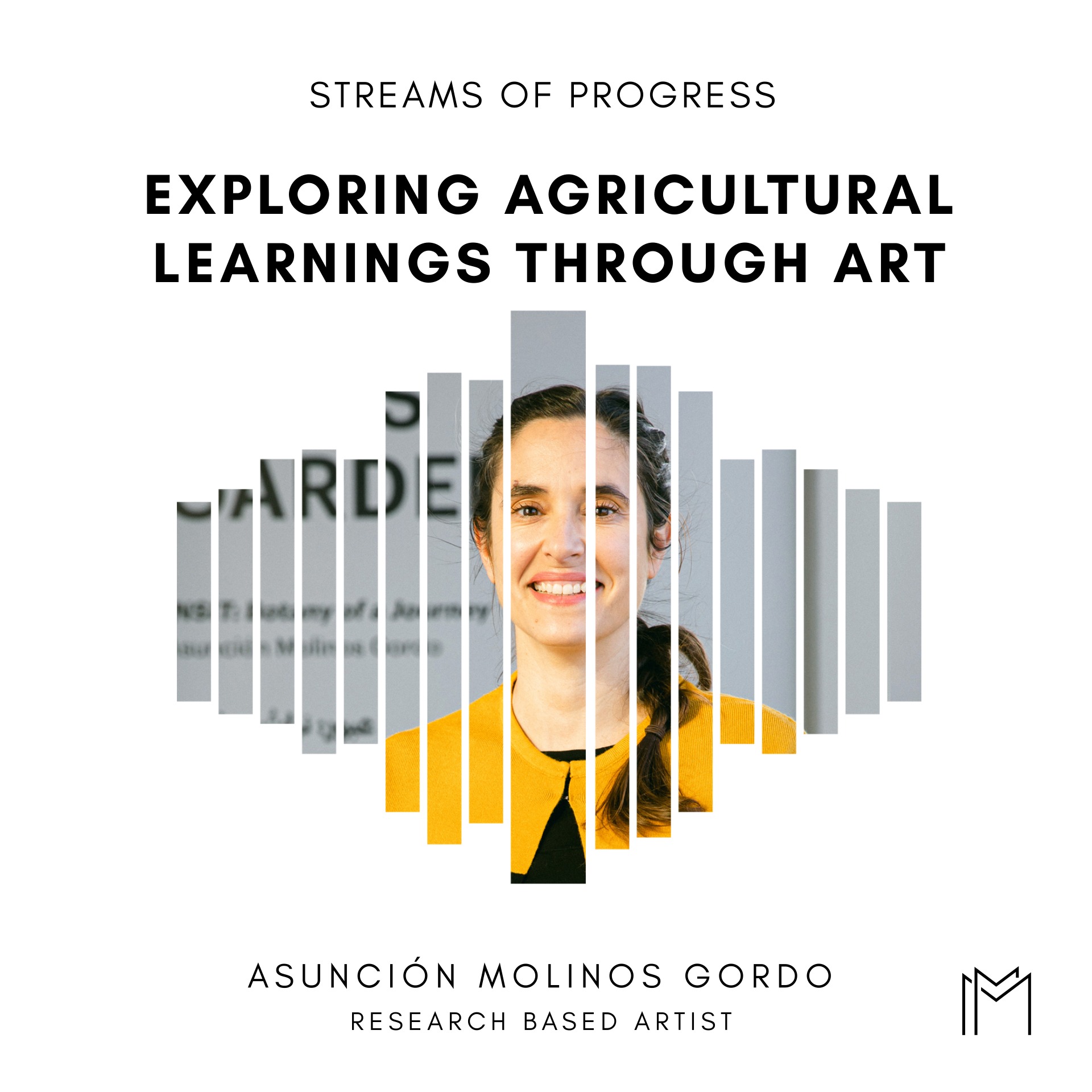
Ep035 - Asunción Molinos Gordo, Research-Based Artist episode artwork

EPISODE · Feb 15, 2020 · 55 MIN

Ep035 - Asunción Molinos Gordo, Research-Based Artist

from Streams of Progress

Asunción Molinos Gordo is a research-based artist strongly influenced by disciplines such as anthropology, sociology and cultural studies. In her practice she questions the categories that define ‘innovation’ in mainstream discourses today, working to generate a less urban-centric way of understanding progress.Her latest work, In Transit: Botany of a Journey, is on display at the Jameel Arts Centre's Artist's Garden until May 2020. It consists of a garden grown from seeds that have travelled in the intestines of people that either live in or visit the city of Dubai. Most of the seeds we eat in our daily meals pass unnoticed and survive the process of human digestion, leaving our bodies undamaged and remaining germinable. Dubai as a global city and the business hub of the Middle East receives an average of 90 million travellers a year, coming from 270 destinations, across six continents. The culinary habits of such a heterogeneous population is incomparable; all of the seeds ingested by Dubai’s fluid and transient population make their way to the same location — the city’s main sewage treatment plant in Al-Aweer. If given the appropriate conditions, the seeds contained in the plant’s final, clean ‘sludge’ will germinate and grow into adult plants.Asunción's Artist’s Garden is grown from the seeds that survive. The project reflects on ideas around globality, interconnectivity, mobility and cohabitation, and challenges the nature-culture divide that places human activity as a separate category from other natural phenomena; through the artist’s long-term research and the germination of the seeds, Asuncion redraws a way back to human/nature interconnectedness.The main focus of her work is contemporary peasantry. Her understating of the figure of the small or medium farmer is not merely as food producer but as cultural agent, responsible for both perpetuating traditional knowledge and for generating new expertise. She employs installation, photography, video, sound and other media to examine the rural realm driven by a strong desire to understand the value and complexity of its cultural production, as well as the burdens that keep it invisible and marginalised.She has produced work reflecting on land usage, nomad architecture, farmers’ strikes, bureaucracy on territory, transformation of rural labour, biotechnology and global food trade.Molinos Gordo won the Sharjah Biennial Prize 2015 with her project WAM (World Agriculture Museum) and represented Spain official section at the 13th Havana Biennial 2019. Her work has been exhibited at venues including V&A Museum (London), Delfina Foundation (London), ARNOLFINI (Bristol), The Townhouse Gallery (Cairo), Darat Al Funun (Amman), Tranzit (Prague), ART BASEL Miami Beach (US), Cappadox Festival (Uchisar-Turkey), The Finnish Museum of Photography (Helsinki), Museo Carrillo Gil (Mexico), MAZ Museo de Arte de Zapopan (Mexico), MUSAC (León, Spain), CA2M (Madrid, Spain), CAB de Burgos (Spain), Matadero (Madrid, Spain) and La Casa Encendida (Madrid, Spain), among others.She obtained her B.F.A. from the Universidad Complutense de Madrid, where she also pursued her Master in Contemporary Art Theory and Practice. She is currently studying Anthropology and Ethnography at UNED (Spain).Molinos Gordo is represented by Travesia Cuatro gallery and lives between Spain and Egypt.Enjoy the show!Show Notes:01:15 - Growing up in a small rural village in Spain.01:45 - What is International Peasantry?3:45 - Communication without language, but through commonalities.4:15 - Her background in fine arts5:00 - The diversity of professions in small rural villages5:45 - Moving to Egypt for a research residency.6:30 - The rural theme she explores in her works.7:15 - The ongoing research and artworks.8:30 - Being part of the Sharjah Bienniale with her work, the World Agriculture Museum10:45 - On representing Spain at the Havana Biennale, campesino campesino (from Peasant to Peasant)13:30 - The knowledge sharing aspect of the project.14:30 - Taking part in the V&A exhibition, “food bigger than the plate”.16:15 - Crafting the CVs of farmers through hyperboles.18:00 - In Transit: Botany of a Journey22:30 - On working with collaborators to bring her idea to life: Dawn Ross and Nadine23:45 - What they did with 2 cubic meters of fecal matter to grow a garden.28:15 - Bacteria & the Star Wars Cantina.29:30 - The reason why the first batch is not recommended / suitable for human consumption.31:00 - Why the UAE is an ideal location for such an art installation project.32:15 - Being inspired by the works of Timothy Morton.35:30 - The way she learns about things is through hands-on experiences.36:20 - “Each individual renders information differently”37:30 - The things she has the tendency to do.40:00 - The idea of nature-culture divide; interdependence and mutual recognition44:30 - Documenting Darwin’s Nightmare.48:15 - Companion planting in the terrace garden. Hosted on Acast. See acast.com/privacy for more information.

Asunción Molinos Gordo is a research-based artist strongly influenced by disciplines such as anthropology, sociology and cultural studies. In her practice she questions the categories that define ‘innovation’ in mainstream discourses today, working to generate a less urban-centric way of understanding progress.Her latest work, In Transit: Botany of a Journey, is on display at the Jameel Arts Centre's Artist's Garden until May 2020. It consists of a garden grown from seeds that have travelled in the intestines of people that either live in or visit the city of Dubai. Most of the seeds we eat in our daily meals pass unnoticed and survive the process of human digestion, leaving our bodies undamaged and remaining germinable. Dubai as a global city and the business hub of the Middle East receives an average of 90 million travellers a year, coming from 270 destinations, across six continents. The culinary habits of such a heterogeneous population is incomparable; all of the seeds ingested by Dubai’s fluid and transient population make their way to the same location — the city’s main sewage treatment plant in Al-Aweer. If given the appropriate conditions, the seeds contained in the plant’s final, clean ‘sludge’ will germinate and grow into adult plants.Asunción's Artist’s Garden is grown from the seeds that survive. The project reflects on ideas around globality, interconnectivity, mobility and cohabitation, and challenges the nature-culture divide that places human activity as a separate category from other natural phenomena; through the artist’s long-term research and the germination of the seeds, Asuncion redraws a way back to human/nature interconnectedness.The main focus of her work is contemporary peasantry. Her understating of the figure of the small or medium farmer is not merely as food producer but as cultural agent, responsible for both perpetuating traditional knowledge and for generating new expertise. She employs installation, photography, video, sound and other media to examine the rural realm driven by a strong desire to understand the value and complexity of its cultural production, as well as the burdens that keep it invisible and marginalised.She has produced work reflecting on land usage, nomad architecture, farmers’ strikes, bureaucracy on territory, transformation of rural labour, biotechnology and global food trade.Molinos Gordo won the Sharjah Biennial Prize 2015 with her project WAM (World Agriculture Museum) and represented Spain official section at the 13th Havana Biennial 2019. Her work has been exhibited at venues including V&A Museum (London), Delfina Foundation (London), ARNOLFINI (Bristol), The Townhouse Gallery (Cairo), Darat Al Funun (Amman), Tranzit (Prague), ART BASEL Miami Beach (US), Cappadox Festival (Uchisar-Turkey), The Finnish Museum of Photography (Helsinki), Museo Carrillo Gil (Mexico), MAZ Museo de Arte de Zapopan (Mexico), MUSAC (León, Spain), CA2M (Madrid, Spain), CAB de Burgos (Spain), Matadero (Madrid, Spain) and La Casa Encendida (Madrid, Spain), among others.She obtained her B.F.A. from the Universidad Complutense de Madrid, where she also pursued her Master in Contemporary Art Theory and Practice. She is currently studying Anthropology and Ethnography at UNED (Spain).Molinos Gordo is represented by Travesia Cuatro gallery and lives between Spain and Egypt.Enjoy the show!Show Notes:01:15 - Growing up in a small rural village in Spain.01:45 - What is International Peasantry?3:45 - Communication without language, but through commonalities.4:15 - Her background in fine arts5:00 - The diversity of professions in small rural villages5:45 - Moving to Egypt for a research residency.6:30 - The rural theme she explores in her works.7:15 - The ongoing research and artworks.8:30 - Being part of the Sharjah Bienniale with her work, the World Agriculture Museum10:45 - On representing Spain at the Havana Biennale, campesino campesino (from Peasant to Peasant)13:30 - The knowledge sharing aspect of the project.14:30 - Taking part in the V&A exhibition, “food bigger than the plate”.16:15 - Crafting the CVs of farmers through hyperboles.18:00 - In Transit: Botany of a Journey22:30 - On working with collaborators to bring her idea to life: Dawn Ross and Nadine23:45 - What they did with 2 cubic meters of fecal matter to grow a garden.28:15 - Bacteria & the Star Wars Cantina.29:30 - The reason why the first batch is not recommended / suitable for human consumption.31:00 - Why the UAE is an ideal location for such an art installation project.32:15 - Being inspired by the works of Timothy Morton.35:30 - The way she learns about things is through hands-on experiences.36:20 - “Each individual renders information differently”37:30 - The things she has the tendency to do.40:00 - The idea of nature-culture divide; interdependence and mutual recognition44:30 - Documenting Darwin’s Nightmare.48:15 - Companion planting in the terrace garden. Hosted on Acast. See acast.com/privacy for more information.

NOW PLAYING

Ep035 - Asunción Molinos Gordo, Research-Based Artist

0:00 55:50

No transcript for this episode yet

We transcribe on demand. Request one and we'll notify you when it's ready — usually under 10 minutes.

Ask A Spaceman Archives - 365 Days of Astronomy Ask A Spaceman Archives - 365 Days of Astronomy Podcasting Astronomy Every Day of the Year Eat to Live Jenna Fuhrman, Dr. Fuhrman Our health is our most precious gift and smart nutrition can change your life. Each month, join Dr. Fuhrman and his daughter, Jenna Fuhrman as they discuss important topics in the world of nutrition. Eat to Live will change the way you eat and think about food. French Your Way Jessica: Native French teacher founder of French Your Way Boost your French listening skills and test your comprehension with this one of a kind series of podcasts. Get the chance to listen to a real conversation between native speakers talking at normal speed AND customise your learning experience through carefully designed sets of questions (2 levels of difficulty) available for download at www.frenchvoicespodcast.com. All interviews also come with the transcript. French teacher Jessica interviews native speakers of French from around the world who share a bit of their life and passion. Where else would you meet in one same place a French yoga teacher based in Melbourne, a soap manufacturer from Provence, or a couple cycling around the world? That Hoarder: Overcome Compulsive Hoarding That Hoarder Hoarding disorder is stigmatised and people who hoard feel vast amounts of shame. This podcast began life as an audio diary, an anonymous outlet for somebody with this weird condition. That Hoarder speaks about her experiences living with compulsive hoarding, she interviews therapists, academics, researchers, children of hoarders, professional organisers and influencers, and she shares insight and tips for others with the problem. Listened to by people who hoard as well as those who love them and those who work with them, Overcome Compulsive Hoarding with That Hoarder aims to shatter the stigma, share the truth and speak openly and honestly to improve lives.

Frequently Asked Questions

How long is this episode of Streams of Progress?

This episode is 55 minutes long.

When was this Streams of Progress episode published?

This episode was published on February 15, 2020.

What is this episode about?

Asunción Molinos Gordo is a research-based artist strongly influenced by disciplines such as anthropology, sociology and cultural studies. In her practice she questions the categories that define ‘innovation’ in mainstream discourses today, working...

Can I download this Streams of Progress episode?

Yes, you can download this episode by clicking the download button on the episode player, or subscribe to the podcast in your preferred podcast app for automatic downloads.
URL copied to clipboard!