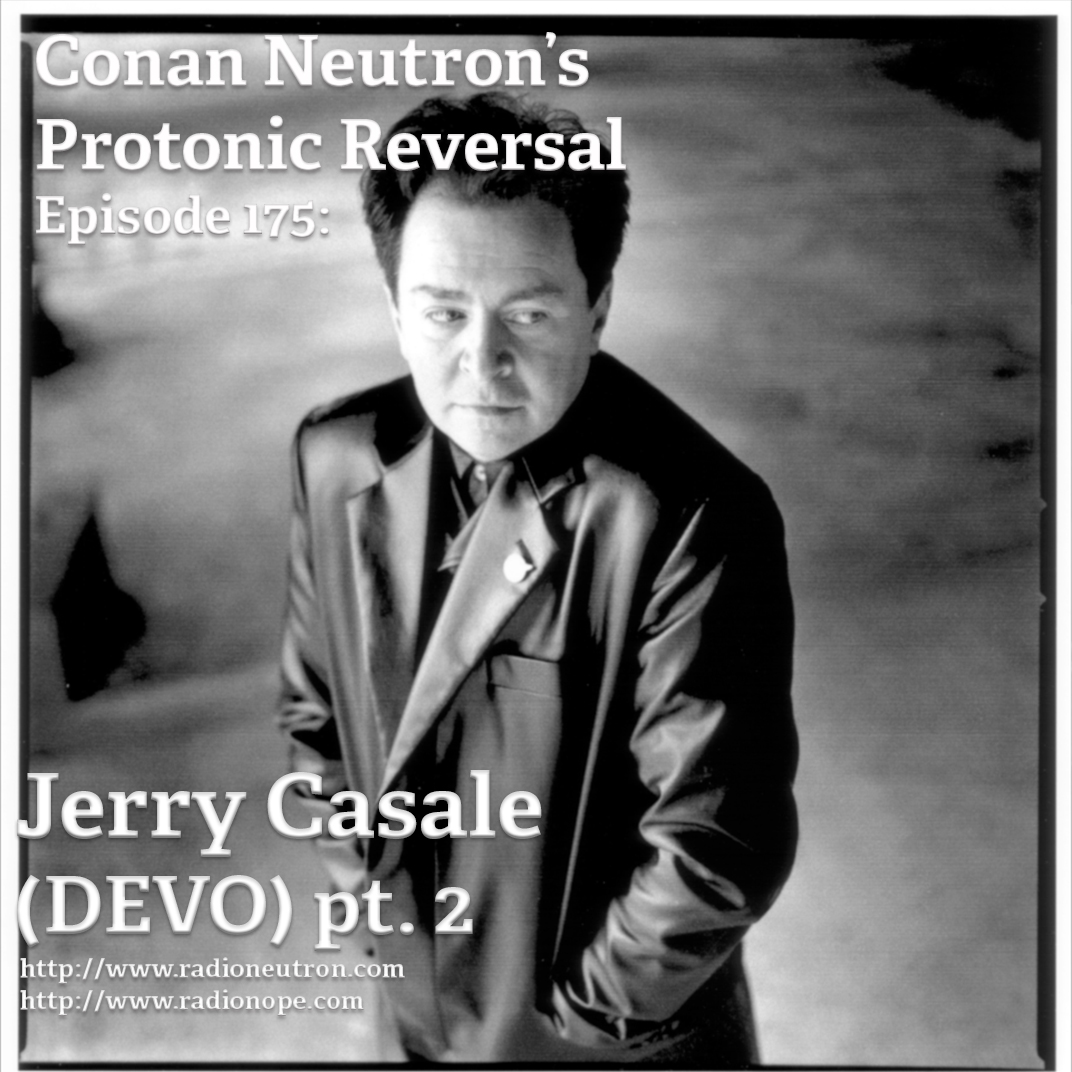
It's all I want! That's like a science thing, right? Indeed, indeed, indeed. It is a science thing. It is a science place. It is a scientific fact that we are all up in your face. It is time once again for the one, the only, Protonic Reversal. Total break in format today. We're just going to dig right into it. This is a supplementary episode with Mr. Jerry Casale of...
Goddamn Devo. We missed some stuff in the episode before. We're coming back to get it. So, RadioNewTown.com for the archives. Patreon.com slash ProtonicReversal. If you want these shows sooner, you know what Devo sounds like. I don't need to play it for you right now, right? Okay, good. And we are live once again with none other than the man, the mythologist, Mr. Jerry Casale. Jerry, welcome back to the show, man.
How are you? I'm doing well getting by in these crazy quarantine times. The better question is, how are you? I don't know if you want to get into it or not, but I know there was a bit of a bummer yesterday. You were originally meant to be on the show yesterday, but... Well, my poor dog. It's a 70-pound Labradoodle, and she tore her ACL. Too many deadlifts? Is that what it was? You know, those breeds are just, you know, hell-bent on exercise of retrieving, jumping, running. They love it, and unfortunately, they will do that to their own detriment.
Right. Well, we very much appreciate your time. The reason why, why do we do anything in life? The reason why we're talking to you right now is, and I'm using the royal we, I hope you'll note. Because we left some things unattended. We left some things on the table. And there were some things where, specifically, you even gave me an opening on some of them, and we just went another direction. And I really appreciated you saying, hey, you know, well, I'm totally fine doing a follow-up. One of the biggest, most egregious ones to me, because I just find the whole thing so compelling, is I was hoping you might be able to tell me about Human Highway. All right. Sure.
Yeah, I mean, that is worth a chapter in a book, at least. The way that came about was so kind of strange, and it was a long process. But it's because Tony Basil and Dean Stockwell, the actor, came to see Devo at the Starwood when we were showcasing there in the summer of 77, and they brought Iggy Pop. And Iggy had already heard a tape that we had left when he was doing the... uh idiot tour was it idiot tour with david bowie playing keyboards that sounds that sounds right yeah the timeline's that seems about right yeah that was that was it was one of the iconic 77 and you just think these cassettes are going to be thrown away because you know every aspiring artist in the world comes up to a successful act it you know beseeches them and bothers them and i had no illusions about that you know i thought it was kind of a kind of a futile act
Right, you didn't think like, hey, everybody, here's the big break. It was just more like, all right, whatever. Not at all. And of course, until Iggy comes backstage at Starwood, we have no knowledge that anything ever happened, right? So he's like, you know, I love you guys' tape, man. You guys are crazy. And, you know, we liked Iggy Pop, and it was just amazing that he was backstage. And Dean had been involved with Dennis Hopper, and they were fashioning this movie with Neil Young, and they were going up to San Francisco and working on it.
And so Dean took a cassette, he asked for a cassette of the demo that Iggy heard, and he took it to Neil. And Neil... And the Neil in this question is, of course, Neil Young, just to be clear. Neil Young. And he flipped out when he heard Mongoloid. Right. And so... It's a great tune. So what happened was we're...
You know, we're expanding our footprint in the culture, and suddenly we're playing a lot of clubs, and Mabuhi Gardens asks us to come up there. And that would be punk, new wave scene venue. And we play, and Neil comes to see us, because he's in Cap Moon Bay. Which is pretty exciting. I mean, definitely someone who...
marches to the beat of his own drummer, has his own ideas, and, you know, even if big swings, big misses sometimes, and, you know, an artist. You know, and as much as I liked Neil Young, because I remember after the killings at Kent State, which are the 50th anniversary this weekend, and I was supposed to be there. Which I want to talk about as well, but I figured we'd start off with something a little lighter. Yeah, nothing lighter than that, right? I would have been there at the 50th weekend long ceremonies and I'm supposed to speak. It's all canceled, as you know. So what I've been doing and I'm going to do more of is I've been doing what we're doing right now and phone interviews. And a good friend of mine who's a director here in Los Angeles, Alexander Durbin, shot a 10-minute piece with my kind of recollections of that day and did a beautiful collage directed 10-minute piece. I saw a thing on YouTube that I presume was a piece of that. Yeah, I saw a project called Order to Shoot. Order to Shoot.
So anyway, that's all been going on. And all these crazy interviews with the fact that this is the 40th anniversary of the release of Freedom of Choice, which came out May 18th, 1980. A much better celebration, to be sure. Well, except that, as the song said, freedom of choice is what you got. Freedom from choice is what you want. That's where we are now. Freedom from choice. Under the cover of COVID-19, now this right-wing ideologue, dictatorship that we live under has moved vast amounts of power and wealth.
while everybody's looking the other way like a shell game and they pretty much nailed the last nail in the coffin of rule of law and democracy and i'm not being hyper violent i'm not being dramatic it's happened what we were warning about then it took them 40 years but these right-wing tyrannical motherfuckers they don't give up and they do their job you just have to ask why did you want to bring bring it down why did you want to do it how does that help you and the only answer is These people only care about power. It's just about power. That's where we're at. I mean, you know, what they say is, you know, what's the scorpion and the turtle crossing the river? It's their nature. It really is. Yeah, it really is. The scorpion uses the turtle, then it kills him. Absolutely. That's the world I know.
That sounds like the music business I grew up in. So speaking of which, we were talking about Human Highway. We'll come back to Kent State. We'll cheer everyone up with some Kent State stories. But first, let's talk about Neil Young and the craziness of Human Highway. He comes to see us, and we hang out after the show and talk. And he tells us about his movie, and he wants us to be in it. And so that was the beginning. And over the next six months, things happened. First, we came back to San Francisco in 78. And after we saw the Sex Pistols last show at either Winterland or Cow Palace. I can't remember. We were there when they melted down.
They broke up. Yeah, of course. Yeah, they broke up on stage. It was a big... Saw it off. Yeah. And then we stayed and we shot some scenes that made no sense to us, but Neil was shooting some banquet scene on Sutter Street next to some famous theater up there where, you know, like, you know, because plays were a big deal up there. And Neil was, you know, king of the town.
And we shot in this big banquet hall with this feast where, you know, they bring in a full roasted pig on spits. Bacchanalia sort of scene, yeah. It's like Dennis Hopper and Dean are stoned out of their minds on probably a cocktail of drugs. And it's all these friends of theirs from, you know, the music scene in Laurel Canyon and in Northern California. And Dean Stockwell's actor friends and people that would end up working with David Lynch on Eraserhead.
The original, the thing they just brought, Twin Peaks. Twin Peaks, yeah. And I met all these people when they were young, and there they are. And they just go, okay, you and Mark are at this table, and they're going to bring in this big pig, and everybody's like feasting and going nuts. Right, right. Now feast. Here's the stage direction. Feast. So, of course, what Mark and I do is we steal the pig's head. As one does, yes. And start marching around doing Lord of the Rings. I mean, Lord of the Flies. Right, right. Different Lord, different literary work, yes. Okay.
That's the one that we like, Lord of the Pan. The one that shows the systemic vulgarity of natural human behavior with a breakdown of civilization. Yeah, you give them an inch and they take a mile. You poke them and they turn into the animals they are, not good animals. So yeah, Lord of the Flies was part of our trilogy. We liked Animal Farm, Brave New World, and Lord of the Flies, right?
So those were our references. Well, and I feel like Brave New World was more prescient than 1984, which I enjoyed, but I felt like I applied the wrong approach. Because the thing with Soma is the idea that, oh, no, everybody's addicted to these things that they look at. Right. Which is like, that's much more prescient than like a big government oppression. Right. And they're controllable because they're on this drug.
The manifestation of that, I think, is much closer to reality than... Well, if you mix that up with Animal Farm, you have where we're at right now, where they dumbed down the population, they destroyed the will of the people, people don't even know what the principles of democratic rule of law are anymore. So they're like the sheep in Animal Farm that look at the barn, and there's the rules on the side of the barn, and then they change. Right, then the rules change, and then they know that's the way it's always been. And the force goes, it didn't say that last week, and the sheep goes, yes it did. Four legs bad, two legs better.
Oh, yeah. Every day now is Animal Farm. Just bold-faced lies, gaslighting. I like his new press secretary girl. They keep finding the greatest people. You know, he said he'd find the best people and drain the swamp. He drained the swamp and took what was in the bottom and gave them jobs in every department. That's where we're at.
It's true. And it's ubiquitous. And to be fair, I found that woman incredibly obnoxious when she was just a quote-unquote analyst on CNN, which is just a talking points viewer. But that's neither here nor there. We're back to... I'm impressed. It's diabolical. I watch it. It's demonic. And it frightens and sickens me. It's like, there's a lot of her, though. This is the thing. It's like they breed them somewhere in a hangar. Or it's like the pod people in... Identical blonde women that... No, but what's the movie where... Invasion of the Body Snatchers. Thank you. We are in it.
These people are invasion of the body centers. They will point and scream. They point and scream every day, right? Especially if you're not one of them, they'll point at you. So that's what's happening. You can't exaggerate this. You can't. I mean, I'm reduced to callous humor because we are now powerless. We made ourselves powerless. The lack of outrage, the lack of organization to fight back and resist, let them completely run rampant like rapists in the street. And they've done it. They've done it.
It's over. So we were talking about Human Highway. Yeah. So you had the pig, the pig head. You're running around. You're making it entertaining for yourself in a very, very weird situation. But here's what's funny. There's some kind of, you know, there was some kind of entitled, successful hippie code that we didn't understand. And we transgressed that code. It's like they were. They didn't care for it. They're shenanigans. Yeah, they were put off. They were shocked. Like we took it too far. You know, it was all fun, but we took it too far.
Of course. Anyway, none of that stuff ever made it into the movie because then Neil changed his whole idea about what this movie would be and started to write a scripted movie that was like a satire of Allison, I mean, I'm sorry, Wizard Box. Right. With a nuclear apocalypse, you know. Or the finale. Dystopia and Alice in Wonderland. More so than that abysmal Tim Burton movie, which was just... Anyway, I don't want to get into this movie critiques. So once they decided that, then he came and he had seen the early videos that I directed, the Devo videos I directed. He goes, I want you to direct a scene in my movie. I'll give you my crew and my technical people and my DP. But I want you guys...
to do a scene that's pretty devo. And he had told us this plot about the Valley and where the nuclear waste plants were. I said, well, Neil, what if we're disgruntled nuclear waste workers? And he goes, ah, he's laughing. He thought that was well, huh? We had this guy totally wrong. I mean, we thought he was Grandpa Granola, and then we meet him, and he's like this enthusiastic, way-out guy, very smart, and really creative, you know, really interesting guy, you know? Not boring in any way, shape, or form. No.
No. So he was like up for it. It's like, OK, you're nuclear waste workers. I go, yeah. So we're thinking we're going to do this cover of the Kingston Trio song, Takes a Worried Man. And he starts laughing because he can't wait to hear Devo's. What's that going to sound like? Yeah. And I go, we're just gruntled workers and we're loading barrels of nuclear waste onto a truck from a loading dock. Right. He puts me together with his whole production crew and they create a three door loading dock.
You know, and Neil gives me this this fantastic vintage open rail truck from the 40s that he owned because he was a collector. It's an incredible looking truck. They just put some logos on the doors. And other than that, it's what the truck was. And, you know, I showed him the outfits we wanted to wear. And I said, you know, we'd have to be breathing from breathing tubes. I appreciate the attention to detail with that, where it's like, if you were actually transporting this material, you would have to have some sort of breathing apparatus. And, you know, what they created looked right. But it was it was so painful. It was.
It was cutting up the inside of our nostrils. Oh, no. That's terrible. Yeah, every take was more painful. And we started using Vaseline. I heard you're suffering for your heart, but this is ridiculous. Yeah, the clamps that they had that would fit up in the nose and used to fold the holes. We're just digging into the flesh.
And so, but Debo, you know, we were masochistic. We definitely suffered for our art. I mean, our yellow suits, you know, we'd lose four pounds a night on stage in those. And, you know, we were used to wearing things that were totally uncomfortable. Yeah, but they fit the aesthetic and they fit the visual that you were trying to present, which made it a sacrifice you're willing to make. So, you know, we did this piece and the piece was a piece. In other words, it was a segment. It had a beginning, middle and end. And, you know, I worked hard on it and their people storyboarded it for me.
I was getting to work with 35 millimeter film, a set, good lighting. Because this is like not a small affair. I mean, as much as thinking of scope and scale and the... Spent millions of his own money. Yeah, exactly. And you have to understand, and I do this sometimes just for the younger listeners, that...
pre-Robert Rodriguez school of film, you couldn't make a movie as cheaply as you can, certainly not now or even 15, 20 years ago. So this is a good investment of money. This was classic movie making. There was no technology like you're having today. C.C. DeMille style almost. There really wasn't that much difference technology-wise from the classic era of filmmaking to this era. So I just want to set that stage that this is a big deal. This is a big deal. Again, 35-millimeter film. Yeah, lots of money being spent. And I felt it was a big deal.
As a fledgling filmmaker, I was like, I can't believe this. I can't believe I'm using 35mm film and I have a crew. Like, this is what you dreamed of, right? But, of course... They weren't as diligent as me because they're just doing things on the fly. They're winging it all the time. Was that part of the aesthetic and the appeal for Neil Ward? It came down from on high. Here's where Neil is, making it up as he goes. And here's all his cronies, right? And they're all part of the cult and they believe in Neil, so they're running with it. Even though I'm working with technicians who know what they're doing, right? But they're not used to being told, no, no, that angle's too wide. No, you've got to bring the dolly down quicker on the camera.
rig you know like sure because they're figuring out blocking on the fly like lighting is being determined you know by phases of the moon who knows i mean so they think who is this guy who the fuck does he think he is right guy with short hair this new wave hair and you know wearing black so but but we shot great stuff and there was an original cut where the whole piece was cut together everybody seemed to love it right everybody was laughing well then just Fast forward to what happened, which is this movie's never coming out, it's never coming out, it's never coming out, it keeps working and changing. Neo's cutting it, he's cutting it, he's cutting it.
And finally, his producer, Larry Johnson, says, we have a cut for you to look at. You know, this is now 1982, right? We shoot at 79. So three years later, we're looking at this cut. And what they've done is they've taken what we did and made it like a jokey through-up in the movie, like where you're seeing little bits of it. And then it goes away to their plot. Then it comes back, and we're still on the loading dock a little bit further. And then we're in the... And so we appear like five times over like a 20-minute segment of the movie. It's completely incomprehensible at that point. I saw it one time, and that was...
That was about my takeaway. Wow, that looked cool. I have no idea what was going on, and I didn't realize D.Va was in this, was one of the three things I had in that order. And you know what? Two years ago, Neil does a fourth director's cut. Because the world's demanded it. And played in some art theaters in the major cities, you know, in the blue state cities. And I have to say, and this is something that never happens, right? It's like, you can't polish a turd, and once you make a misstep up front and then you start trying to fix it, it usually just gets worse. Yeah, it's not going to get any better. But you know what? Not true. This one is the best.
Really? Okay, so it did improve it. I liked it the most, and so did the audience. Because it had more cohesion, it was shorter, and mercifully moving forward as you watched it, where more of the kind of ideas and jokes came out. I was impressed that after all these years he could go back and have the energy to do this. Right, right. For someone that maintains a relatively busy schedule and a lot of different art and things and activism and whatnot, it's astounding that he would take the time to...
to revisit what many would probably just be like, well, that didn't work. Yeah, if I had something like that that I did where, you know, something had gone wrong and left a bad taste in your mouth and, you know... I wouldn't have the discipline or the energy to go back and get back into it. Because if I did, I'd relive it. Right, exactly. And you're going to turn something that was a traumatic or at least a bit of a bummer thing in the past, and you're going to bring it into your present, which just sounds awful. That's what doing these interviews about the 50th anniversary of the killings Ken Stato. It's like that was a traumatic experience. The fork in the road changed my life. And being forced to talk about it over and over and see the original archival footage and talk about...
two of the four students who were killed who were my friends, Jeffrey Miller and Alison Krauss, it's horrible. And it's also one of the definitional moments that sort of molded your personality and your worldview that led to Devo and all the rest of the art going forward. I mean, I was hesitant to bring it up last time, A, because it's just, it's a fucking drag, but also because I feel like it's been covered a lot, but I didn't even realize at the time, I was like, oh, no, there's like an anniversary of that coming up, and that's definitely, you know, a not joking around, never forget, that's a moment we need to never forget, because it was sort of the... Well, again, the significance should not be lost on anyone. We were protesting the expansion of the war into Cambodia from Vietnam by Richard Nixon without an act of Congress. Richard Nixon at that point had been accused, righteously so, of thumbing his nose at the Constitution and the separation of powers between the three branches of the government and doing things without the consent of Congress. Now, if that sounds familiar— I was going to say you need this ringing a bell. Yeah, and we thought, but at the time, that that year of 70 and then leading up to his impeachment would be the worst time—
of American history we ever could live through, because it was, you know, you were dealing with thugs and tyrannical right-wing ideologues, right? And it felt so bad. But it ended up in an impeachment, and it felt like there was some resolution and some modicum of justice. What's happening today makes that episode in history look like kindergarten. That's like the great society compared to what we're dealing with now. Oh, yeah. Oh, now we're into fist-fucking. I was going to say a harsh joke, but that's even more of an evocative issue. That's what's going on here.
Yeah. And that's a, there's no, there's no getting around that. So, and I read, I don't want to blame her too much, but I read in the, in the book, you know, a lot of your experiences put forward and it really just seemed like that was where any pretense of there being an adult in the room for any other reason, other than to put their boot on your face. That's the future is the boot coming down in the face of Liberty of mankind. Yes. And that's what we're seeing now. And so when you think about,
Your art, and again, as we discussed last time, and as you discussed that now as I mentioned before, Devo was meant to be like an art movement. And then it became known as a band because they were all sort of... It was a collaboration. It was a multimedia art movement. It was experimental. And, you know, you do what you can, right? You don't have 64 crayons. You have eight crayons. And you don't have any money. You can only do something in a club, right? Which is great what musicians can do with very little, right? They can create a world with very little. And so we were putting out there...
And the best way we could, any way we could, fragments of our ideas using music, costumes, movements, writings. And what happens is we get subsumed into that pump new wave funnel, right? And we're just defined as part of it. And it's a train that's left a station. You're not going to set anybody straight. It's like, okay, okay, we're pump. Okay, we're new wave, whatever. Because they want to commodify and trivialize it to make it something that's...
salary, right? And it's something they've done over and over again. Look at the early 90s with the bands that broke through. It took them a minute or two to figure out the formula, so the weirdos were again let in while they tried to figure it out. And then once the Borg from Star Trek adapted to the threat, then they found a way to manufacture their own alternative bands. But the thing is, Devo was actually Devo. There was substance there. You had your own compass, you had your own ethos. And it shows. And it was one of the reasons why, as you mentioned last time, I'm...
I certainly don't want to go over everything we went last time, but I think that when you, the, the video compilation, when you watch all of the videos together, just as like a series, I mean, you see, it's like there from the beginning. That's right. You see that, you know, the beginning was the end. You see it from the beginning. It's on a shoestring budget. It's kids in a garage, but like if you just were to, would it give.
those young men like million-dollar budgets, then, you know, it wouldn't really necessarily look that much different. It would just be a more adult version articulated. If we expressed ourselves bigger. Right, exactly. It would have been a bigger production, for sure. Well, I mean, there should have been a Devo feature film. There should have been a Devo Broadway play. You know, there should be a Devo documentary. And the documentary, the fact that it's not out, is something I can't even talk about because it's got nothing to do with me. Okay, I did want to ask about that because I realized that was something we missed talking about last time. It's not the director's fault. He kept submitting things. It's a long story, but I think I should just, you know, defer.
to say anybody that has a question should ask Mark, you know, his explanation of why there's no Devo doc. So we'll consider it an in-progress concern. Well, it's there. Everything you need is there. Okay. All the archival footage, all the interviews, all the cultural contextualization where you're showing what was going on at the time, socially, politically, culturally, it's all there. All there.
Gotcha. So everyone can draw their own conclusions. I trust in the audience to be a little smarter than the average bear. So go figure that out. You know, on that and talking about archival footage, when talking about Human Highway, there's that footage of Neil Young and Devo doing a Hey, Hey, My, My that was posted. Well, it's made the rounds on YouTube many times. It's been taken down many times also. It would be up for a while. It would be taken down. Some would be up for a while. It'd be taken down. But what I love is the definitive version is posted by the AARP, which is an incredible Devo moment.
So how did that come to pass? I mean, was that something where it was a Neil's idea? Was it like, you know, was it just... What happened is that point is, you know, this movie went on over many, many, many months. And for some of the people involved years, we came back from recording our album in Germany. And we came out to L.A. in April of 78. And we weren't happy with one of the songs that we had recorded in Germany, which was Come Back Johnny.
This guy, Patrick Gleason, who owned Different Four Studios, who had worked with Neil, had also come to Mabuhay Gardens and seen us. And he came on like just a really good guy, really altruistic, like, hey, if you ever want to use my studio, blah, blah, blah. And so Mark goes, we'd like to re-record this song, give it a second shot. Oh, yeah, come on over. And we told Neil that's what we were doing. And so he got this idea to come over, too, and bring his camera crew, and we'd do stuff as well, right? So we re-recorded Come Back Johnny. And then...
Neil started jamming with us live in the live room with Patrick Wilson there at the board with his engineer, and two camera guys from Neil's crew shooting. And he went and he showed us the progression to Hey, Hey, My, My. So we started mutating. Because it does sound like it sounds, the arrangement is very Devo, and it's a very primitive, evolved caveman take on it. And, you know, then he just starts getting into this, like, jam with Boogie Boy. He's sitting in the crib, right, yeah. Yeah, but he's acting like as if it's David Bowie and Mick Ronson where they pretended to blow each other on stage, right? This is like a guitar battle where he's the only guy with the guitar and he's shoving it at Mark. Yeah, yeah. Boogie Boy playing the Moog and it just turns into noise and it went on and on and on and Neil loved it so much we shot it off, right? Like whatever you see that ends up in the movie, that's a snippet. It seemed like it was the kind of thing that went on for quite some time. Oh my God.
But it's such a, I mean, it definitely existed as a clip, as a what am I looking at sort of moment as its own, if you have no context. We then went back and we did a finished mix of Come Back Johnny. And we liked it a lot. And Patrick Gleason hits us with a... A huge studio bill and Juan's producer on it was a big problem for us, right? Right, right. Comeback Johnny on our record was from Germany with Brian Eno because we were getting screwed otherwise. Well, and so that's interesting because Comeback Johnny, isn't that, I might be off base here, but wasn't that about JFK, like the JFK assassination and the whole culture behind that? Well, you know, it's one of those loose expressionistic things, yeah. Yeah.
It's about like multiple layers of things, right? It depends on who's asking, right, exactly. Snowball is like a sad love story based on the Sisyphean myth of rolling the ball up the hill. Yeah, Sisyphean, right? But it's also a story about scoring coke in an eagle. Right, so it depends on who asked the question where you could give the answer for it, right, sure. Yeah. So talk to me about, of the many things, well, first of all, oh, I wish I did. I've done a little more on this.
I feel like there was some common cause with Devo and the cars as much as the cars was a very different entity. And it was very interesting to me that I can't remember that some of the later records, it kind of seems like they were almost sort of doing their version of what you were doing. And we talked about this briefly without mentioning names before, but I mean, am I off base here? I mean, what was, what relationship was there? One second. Sure. We're talking to Mr. Jerry Casali in front of his wall of vaginas, which are very fetching the vaginas. You of course listen to Protonic Reversal and we thank you for that. Welcome folks on the Instagram live stream, Instagram TV, of course folks on radio. Nope.
I had to let Beta in. She was limping. Oh, no. Yeah, you got to be kind to the puppers. She's on drugs now. Is that sad or hilarious or both? Well, actually, it seems to be alleviating the immediate pain. Functional. Oh, good. The best possible outcome. Wonderful. That's right. You know, the cars are like...
They were all style. That's what they were. They were cool and all style. They were the cool guys, right? Devo were like the embarrassing nerd cousins, right? Like, I don't want to bring these guys to the party because the girls will think I'm not happening. I mean, you know, we hung out with them. And I became very friendly with Rick and Ben. And I went socializing with Ben in Boston when we were shooting. You know, I directed videos for them.
And that guy, that guy, he's like, he was out of a film, right? Ben, what were you talking about? There were so many girls around him all the time. And so one of the nights we were in town, they played locally. And watching cars play was like the old cliche of watching paint dry. Not a dynamic live show, huh? I mean, it sounded perfect as if you were playing a record. Right. You know, and everything was mixed right, and everything was precise and in tune, and all the little hip, like, 60s guitar things.
voices mixed right, just like automatons, dolls, right? They moved about as much as Kraftwerk, but of course, there wasn't the concept of Kraftwerk. So you're thinking there should be energy here or some added, value-added element of seeing them live, and there wasn't. There wasn't. It was just pretty much, here's the record, and here's like a stylish and cool-looking live show, and that's about the extent of it. Like, every moment was like, we're cool. Right, well, yeah, yeah, and that was, which is amazing, because for a man like Rico Kasich, who will go and charitably say, has a face made for radio, you know, it's, hey, good for him, man, that's awesome.
He definitely married up. Ben was the chick magnet. Yeah, I mean, Ben was certainly the handsome one of the bunch. So we go backstage into the green room, and I'm watching this whole scene, and there's two girls that are really most aggressive hanging around him, and they're both cute. And I'm watching, and he's looking over at me every so often and smirking and rolling his eyes. And then he says to them, he goes, so.
What are we going to do tonight? And the girls look at each other and it's like, we? And he goes, yeah, you and you and me, right? I don't know. He goes, well, if you want to come with me, you've got to show me a little bit about what's about to happen. Wow. Yeah. And then he kind of got his sleepy eyes and he looks over at me. And so, of course, these two girls kiss each other. And then he puts his arms around him like, okay, let's go.
So when we saw him the next day in the studio, you know, I go, how do you do that? Like, what's going on here? Right. I'm like dumb shit. Like, oh, man, that works. Right, right. God, I'd like to try that sometime. Like the Podunk Ohio guy. Yeah. And he goes, you just got to know what you want and you just got to let them know what you want. And then I always use the line, show me a little bit of what's about to happen.
I put that in the song, Peekaboo. Wow, that's awesome. I took his line and I put it in Peekaboo. Benjamin Orr, everybody. Benjamin Orr. Wow. Yeah, that's a very important line within Peekaboo. That's awesome to notice that came from there. Also, another important line in Peekaboo was, if you cannot see it, you think it's not there. I remember. Yeah. And that's where we are with coronavirus. Oh, yeah, yeah, yeah. Well, that's certainly...
preview of the times for sure uh question from from the peanut gallery here yeah uh back to the early story i wasn't paying the slightest bit of attention to it there's a story and this is a good one there's a story slash rumor that neil originally saw russ never sleeps on a bougie's diaper or something along those lines is there any truth relevance or kernel of truth to any part of that uh you know i'm trying to get your i'm trying to get the screen back but i'm listening um I don't know what happened here. I can still see you, so you're good for it. There we are. All you're missing is me talking at the microphone at you. Yes, we gave him that title. Really? Russ Never Sleeps? Okay. Yeah, because we worked on a campaign for Rust-Oleum back in Akron, Ohio. I knew this and I forgot about it. Yeah, fantastic. And we wore the t-shirts out to L.A., and he saw a mark in one. And he goes, Russ Never Sleeps? What's that? And we told him, and he loved it. He just ripped it off. The rest is history. That's awesome. I mean, obviously, he made a creative unlike use, so there was no problem. Yeah, yeah, for sure.
So there's another story, and I want to be mindful of your time, but I also want to, there's other stuff I want to get into, but I would like, if you can, just a retelling of the artwork for Are We Not Men, which I know it's a crazy story. It was a Chichi Rodriguez originally, and there was like a copy. Can you please? Have you seen that documentary? I have, and it's freaking nuts is the best way that I can put it. That's what happened.
I know. It's like I never knew. I never even conceived that that whole thing could be as insane as all that. Well, everything with D-Vogue is convoluted. And not because we orchestrated it. Because we had this image we loved, and we had used it on B-Stiff, the independent single that we put out with Stiff Records in England. And then we told Warner Brothers when we signed with them, we want this to be our album cover for the first record.
And Rick Serrini, the head of the art department, loved it. He got the whole joke. Couldn't believe how cool it was. And, of course, what happens is it gets passed by the suits, and the manager of business affairs goes, you can't use this. That's Chi Chi Rodriguez, and I'm a golfer. Sir, first of all, how dare you? I respect Chi Chi, and you're not going to make fun of Chi Chi. We'll get sued, right? So I go, well, why don't we just ask Chi Chi if it's okay? What's he going to do? Yeah, he's like, well.
All right, and they let legal affairs people find Chi-Chi's people and write them a letter and say, this band wants to do this. But of course, there's no internet. There's no direct communication. It gets lost in space, in the U.S. mail. And meanwhile, they're going, hey, if we don't get an answer and you guys are insisting on this, we're going to have to delay this record another month. Like it hasn't been delayed enough already because I remember that too much this time. It's fun to have my earbrush guy change Chi-Chi. So it's not Chi-Chi.
And, of course, Mark and I are concerned about what that's going to turn into. So we show him this, you know, we collected all this whack shit. We show him this thing we collected from a newspaper in Africa earlier where some airbrush artist showed the world what would happen if you combined the last four presidents, which were Kennedy and Nixon and Carter and Johnson, right? And so here's this horrid mutant-looking guy. This abomination that should not be, yeah. The four presidents, right? So we go, why don't you do this then? But leave Chi-Chi's hat.
which is, you know, a famous hat because of his hat band, but his wife, I knew it was Hawaiian, and leave the golf ball. And so they mocked it up. And now you got, you're looking at... True Devo, a mutant. You're looking at a fucking mutant, but you know he's a golfer and there's some Chi-Chi elements in there, but it's not Chi-Chi Rodriguez anymore. But now the manager of business affairs of Orange, David Berman, says, no way, because that's Chi-Chi's hat band. It's a golf ball and we still know it's Chi-Chi. Personally, he takes white out and tape and ruby-less red. He mocks up what's going to be acceptable. Which is in the process of it, making it more Devo than anything you possibly could have planned for. The first thing he did was, you know, he'd seen enough punk records that he blocked out Chi-Chi's eyes.
Like it's porno and it's like XXX. So the eyes were blocked out. The hat band was solid, not Madras. And then the golf ball, he took the striations out of the golf ball so you didn't know it was a golf ball. It was almost quasi-religious or something. We had to send our manager earlier at Roberts up. They had a big fight. And we had to sign an indemnification that if anything happened, we'd be paying the millions of dollars. Anyway, so it goes to press. They print it up.
Then we get a letter from Chi-Chi. He's really into the idea. And his only request is, when you use my image, I want you to send me 50 records for my friends and family. That's how it's Christmas time, right? Well, Warner's chickens out doesn't tell him, well, it's not you anymore, right? Right. It's like this mutated sort of like human version of you. They send him the licensing money, 2,500 bucks. And then the album comes out. And that comes out in August. And in November, Warner ships him two cases.
And, of course, he calls his people and goes, this doesn't look like Chi Chi Rodriguez. Because, actually, Chi Chi's quite handsome in a very good way. And this guy, you know, that was on our cover now, was a dork, like something on a Mad Max. It looks like a caricature. Yeah, it's a caricature by proxy, almost. And so, because Devo has this reputation of punking businessmen and corporations and playing with the culture, everybody assumes that this was a setup.
that we did this on purpose to Gigi, right? Just to be a jerk to Gigi Rodriguez. And of course, it's useless in that world. You could never make it right, and it went away, and Devo was unfairly characterized. And so that documentary last year was the first time the truth came out. It's a crazy story, like an insane story. And it's the kind of thing that...
you know the whole time like no really no that's just that's one i have five more of those and of course the next one you're just gonna have to do this again because i gotta go but i was gonna say the next one will be about john hinckley jr okay so and that's um which was the uh on um uh we call it um yeah it has to do with with uh the famous actors so uh yeah so so a couple things first of all uh i want to Well, I want to thank you for your time again and for coming back, and this is delightful and great. But also, I realized...
last time that we did not get the chance to discuss the winery. And I am enjoying it. You had some, right? I am literally in a... This is my rosé. This is the rosé. I have it for those who are watching on Instagram. I have it in a flammable liquid beaker. It is the rosé of Pinot Noir. I thought that was an appropriate decanter for this. And it's lovely. It really came out well. It really came out well. The 50 by 50 rosé of Pinot Noir from Carneros. And it's really good.
And I'm throwing that in the... Here's the Pinot Noir itself. There's the real Pinot Noir. Which is great, and that's what I cracked open when I thought we were talking yesterday, and that didn't last long enough for the show, which maybe that says more about me than anything else, but hey, hey, man. But can you just real quickly speak a little bit to the winery? Of course, if fans want to... You do mail order. You ship the wine. Oh, sorry, go ahead.
Well, now my only sales are direct sales because all my accounts, my bars and restaurants, they're not buying wine. They're trying to sell every bit of inventory they have left and stay in business. Sure. Right? Under this lockdown, safer at home stuff. And it's destroyed millions of people's jobs and lives, as you know. And the first hit were the restaurant business, the hospitality business, the airlines, the touring business. We were supposed to do four shows this year. All gone, folks. You know.
So a lot of my friends, they can't do their recording sessions. They can't tour. It's it's all you can do is stay home and drink 50 by 50, which is right. And it is great wine. And I got to say, as someone that it really is, I was so amazed because I heard tell of it from a mutual friend, Matt. And I was like, oh, you know, cool. And I kind of had an idea of what it probably was. And I'm just kind of picky with wines. The only one I like is Pinot Noir. And I was like, holy crap, it's the kind I like. And then I was like, oh, it's a rosé of Pinot Noir, too. OK, that's interesting. That's fascinating. I work hard on it. I have a I have a place on Silverado Trail that I make the wine in this barn.
with the collaborator, Eric Lyman. He's like the technical eonologist, chemical guy. You know, you need the chemistry guy. And I sourced the grapes from a single vineyard for the rosé, and I sourced the grapes, the organic grapes, for the actual Pinot Noir from a single vineyard in Sonoma Coast. So the rosé grape I use is perfect because it's soft, and you want soft when you do the rosé. And that's the Pinot Noir clone. It's called 667. That comes from Rinty Vineyards in Carneros. And then the big boy wine, the big red wine, I use Hamard and 667, but it's from Sonoma Coast.
about 700 feet high on slope with lots of nighttime air and cold and hot in the day. That's what you want, stress vines. And it's all one block. So, you know, it's single vineyard wine and it's very seriously made in the French style. Yeah, and as I said, I thought the perfect decanter was this beaker that says flamboyant liquid that was given to me. I believe it was meant as a gag gift, and it was something that has long sat on the shelf, and I'm like, I've got to remember to bust that loose and have some wine next time. I only use acrochemistry decanters. Right, exactly. Because of the best. They work well for the cause as well. They have the shape that you really want to use, yeah. So, Jerry, I want to thank you so much for your time. Let me know. I'll be back. Yeah, it's great having you. Let's do it again sometime. I'm fully down.
Best speedy recovery to the pup. Yeah. It's only a neutron. We love the neutron bomb because it leaves buildings intact. Absolutely. It's functional. Thanks so much, Jerry. Bye-bye. And there he goes, Mr. Jerry Casale. Once more, the man, the myth, the legend. Cool guy. So we had the Neil Young-enabled, mutated, hey, hey, my, my, Neil Young and Devo that we discussed this episode. We had Comeback Journey from Human Highway, which we also discussed.
And we had a Smart Patrol Mr. Dene. Those are all songs by Devo. If you're here, you'll probably know that. If not, welcome aboard. Right then. There we go. I hope you guys enjoyed that. I sure did. Name of the show. It's going to be a transport on a commercial. Thank you for listening to it. This show broadcasts on air. RadioNope.com. Say yes to me. Tonight's episode was the first one broadcast on both Instagram Live TV. Instagram Live, Instagram TV, and YouTube. So if you came aboard in those formats, welcome, welcome. RadioNope.com is the mother ship.
RadioNeutron.com for the archives. You can get them all, including episode 159. 50,000 watts of power. What was the first part of this? It's meant to be an addendum, but we've talked about enough stuff I can think to qualify as its own episode. Take it out what you will. If you like the show, please share it around. Thank you to everyone who's been doing that. Tell a friend, tell an enemy, tell a frenemy. It helps grow the show. It helps. It helps.
And of course, as always, stay safe out there. I'll take it easy. I got my radio on. Can you hear me now? Can you hear me now? My top ten. I'd like to thank our sponsor. We haven't got a sponsor. Casting if there's no one there to receive. Radio. On to the close. Broadcast done. Got my radio.