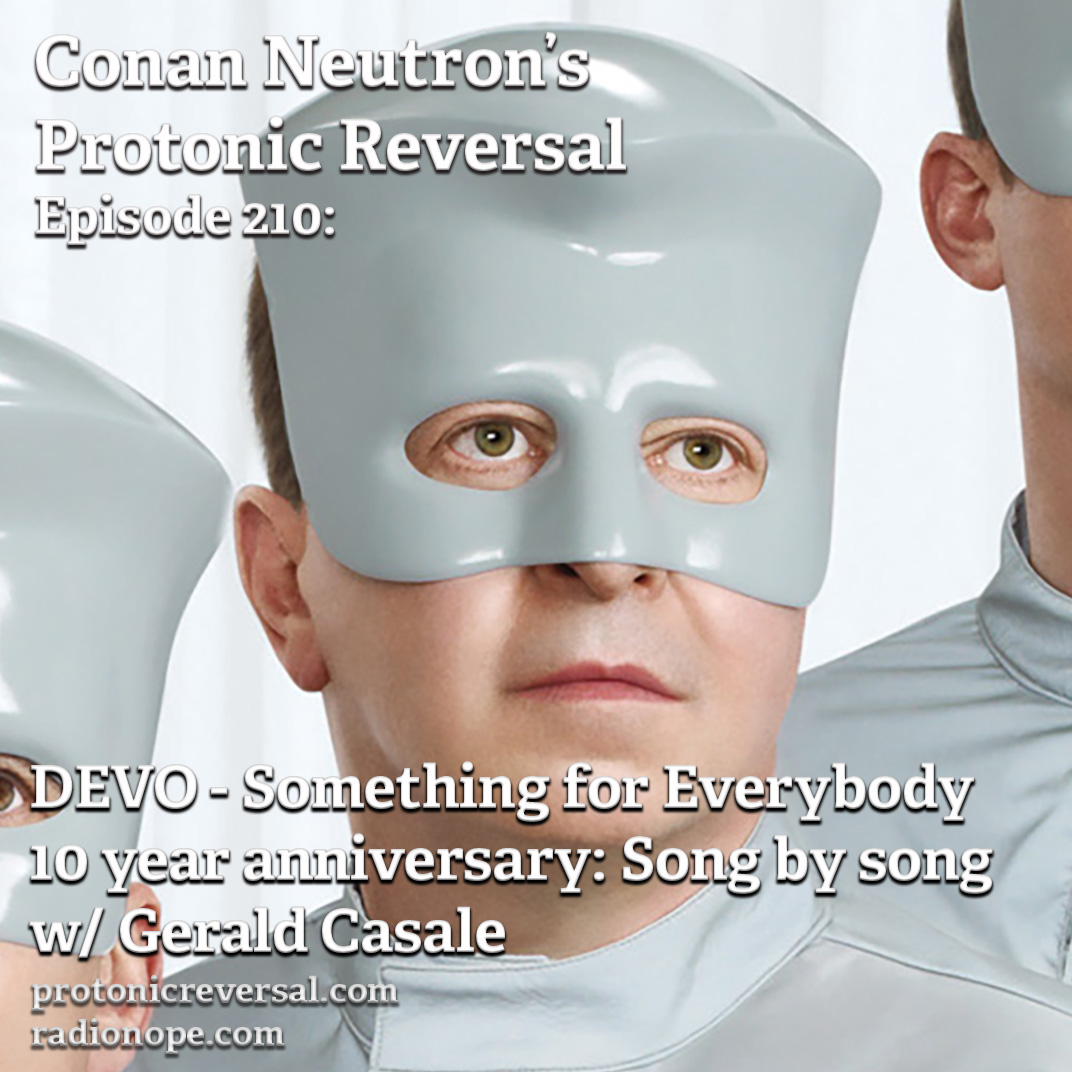
Indeed, indeed. Ten years fresh, some might say. It is the ten-year anniversary of the record something for everybody. And we decided to do something real special here at ProtonConversal and invite our friend, a friend of the show, Jerry Casali, back to talk with us about it. Thanks so much for joining us, man. Thank you for having the interest. Ten years. That went quickly. It sure did. And talk about de-evolution. If we think back ten years, what we thought.
was bad. Turns out they'd be nostalgia. Turns out those were the good old days. Yeah, the good old days. Yeah. Yeah, and even, amazingly, even since we've talked last, D-Evolution has gone even further in some more comical ways, in many ways far less comical, without getting too much into it, the irony of the person in the White House contracting the COVID was not lost on me in any way, shape, or form, other than the fact that, oh, this would be a bit of a hacky script if I would have watched it on a television show. But it wasn't to be. It wasn't to be.
He was a super spreader, but he was Superman with a $2 million drug treatment that nobody else could get. Yeah, yeah. Turns out all you need is the best medical care literally in the entire planet. And then, yeah, it's great for you. Oh, that is true. That's true. And he proves exactly how American health care works. If you're rich, you can live. Yeah. Congratulations. Yeah, you've earned the right. You've earned the right because you were rich. But this is not Crossfire or The Firing Line or any other political show with the word fire in it. We're here to talk about this awesome record that I feel is very underrated in the pantheon of Devo.
And it's a personal favorite of mine. I want to give a shout out to devotee and friend of the show, Sam Hunt, who suggested this in the first place. And I was like, that's a great idea. Credit where credit is due. That's the first song on that record. And there's a lot of things I love about Something for Everybody. I love all the things around it. The reality show element that didn't quite do what it was necessarily supposed to do. The artwork, the airbrushed imagery, the brick wall mastering. All just small things to really kind of hit home where we were 10 years ago that I think if it had come out...
five years later, maybe, it would have hit in a completely different way. And I think you say that a lot of things. What are your thoughts on that record? Well, it was just, you know, it was the album that never was, unfortunately, because just frankly, Warner's failed to bring it to market. We gave them everything. And once again, Vivo were the pioneers who got scalped. We went to Warner Brothers and said, listen, we all know the record companies now are basically...
relegated to trying to pretend to be ad agencies. That's what you're doing. But you didn't grow up doing that. In other words, you didn't go to school for that. You don't have experience at agencies doing that. So listen, you're giving us this production deal. One million of it is for marketing. So let us take that money and give it to Mother New York, a real agency, and they will put a whole campaign together for you and they will give you everything you need and all you have to do is launch it.
Well, what do you think happened? They were like, they took a dog in his bone position. They acted like we were trying to pull a wool over their eyes and that Mother was making fun of them and dissing them. None of that was true. In fact, in the spirit of Devo, Mother was dissing Devo and themselves in the campaign. It was an equal opportunity to diss campaign, yeah. It was, on purpose. And they hired actors to play record company people. They hired actors to play them. Exactly. It went several layers deep. And the only thing I can think of close to it was there was a...
kind of, that run in the 70s of the immersive theater, like Jack Nance and folks along those lines, where it would blur the lines of reality and fiction. Well, I was excited. Everybody was excited. And we were playing ourselves, and we were doing what you would expect from Devo. We were having our cake and eating it, too, by sending up modern marketing, the end-all, be-all of everything now is marketing, and using all the techniques of an agency, focus groups, studies, the whole thing, but doing them as parody. Yeah. But we were doing it. But actually doing it, but being self-aware of the fact that you were doing it and engaging it that way. We got into it.
That's when Warners, you know, they did a turnaround. They screwed the pooch. By the second reality installment of the five-part reality show, they pulled the plug. They said, okay, enough of this shit. We don't get it, and I don't know what you think you're doing here. But it was great, and they just imploded it. They never went to radio. They go, we don't have any power at radio anymore. Your record company is telling you this. That's astounding. I mean, it's indicative of times, I guess. One guy at A&R whose job it was to go to radio in the past said,
hey, would you mind if I went to a station that I really like and gave them No Place Like Home because I love that song and I think they might play it. We're going, why would we mind? First of all, how dare you? What? Your heart goes into your gut and you're like, oh no. Yeah, that's not a sign. No.
He's supposed to be in charge, and he's asking if it would be okay. Yeah, do you think it might be okay? Wow. So can you give us a quick kind of just reading of where the world was at the time, just for people that, again, sometimes it seems like 10 years ago. As we wrote the album, Americans had sunk into a huge recession.
like one of the most serious financial crisis since the Great Depression. And again, that was all manipulated by big banks and the irresponsible policies of George Bush and the Republican Party. They took a surplus and created a deficit. And everything was in the toilet. So by 2010, we decided to wait to release it to see how things were going to go. So by 2010, America started to pull out of it.
And of course, the tongue-in-cheek title, Something for Everybody, is if Devo is doing something for everybody. It's like, clearly not. It's Devo. But it was Devo returning to form. And we thought...
We had a really cool kind of... We did a nod to contemporary production and contemporary radio on the level of how we recorded and produced the record. But those songs were uncompromised Devo songs. They were in return to form. They folded right into our live show with songs that were 20 years older. So you could play a song like That's Good, and then you could play Fresh.
one after another live, and it seemed totally of a piece. It seemed totally seamless. And that's maybe a bad thing, I don't know. But the only other thing we could have done is something so radical that we would have been as radical for right then as Devo was radical in 1978. But, of course, that's a tall order when you're a legacy act and you have this expectation in the past, right? It would be as bad as if we started trying to sound like Nine Inch Nails. It would have been a joke. That's what a lot of bands will do. They'll come back and they'll try to get it.
you know, relevant. It sounds like something that's a hit. Yeah, suddenly there's rappers on it. So to set the scene, this is about when there was like that vanilla ice house flipping show that just started up as well. So people were kind of exploring the idea of, hey, you know this quote unquote one hit wonder in this way and here's like this in a different context. So it wasn't like this was completely as left field as some Devo ideas maybe. There was beginning to be like the Naskin sort of like, hey, let's re-contextualize this stuff mindset. And we're not trying to put people off.
We were trying to find a way to deliver Devo in a way that was digestible. Just like the girl swallowing the blue-red hat. Yeah, absolutely, which is both suggestive and doubly hilarious when it's like, okay, the pill is the hat, but it's, you know, the blue was considered a more pleasing color by the focus group, right, if I remember correctly? Yeah, it was completely made up. Yeah, of course. But it was such an all-encompassing package that it seemed like it would have been a no-brainer to have the reality show element to it, to have that be part of the overall picture, but there was this hesitation to buy into full scale with the idea?
There was more than hesitation. At a certain point, Warners pushed back and things got hostile, us and them. And that's not what we wanted. And we were kind of shocked that they were, after all these years, didn't get it again. But in a different way this time. Yeah, exactly. And that's, I mean, in a way, I suppose that's something to be proud of. I don't necessarily know. And I can tell you this, when we heard, and not that this happened very often, but when we heard several of these songs on the radio.
They sounded tremendous over the radio. Yeah. One of the reasons why is because even the presentation, the mastering, it was mastered like a modern record. It was mastered... Well, Greg Hurtsman, he went on to be, you know, a mega millionaire hit producer. Yeah. You know, he produced, God, what's her name? Adele. Oh, wow. Really? Well, okay. Yeah. Good for him. That's awesome. And so songs like Fresh, you know, and What We Do. God, what's the other one I heard on the radio that sounded so good? Oh, Don't Shoot, I'm a Man. Yeah. That was timely. Great. Yeah. Well, geez. A little bit too timely these days. Yeah.
Well, there just kept being more and more shoes. Yeah, it turns out those haven't stopped, yeah. Right. So talk about fresher a little bit. We started off with that one, and he kind of promised a song-by-song breakdown instead of just Conan and Jerry ramble on about cool things, but that's the kickoff song, and it seems like that's very much a statement of intent. Right, and you can imagine that being used in many packaged food commercials. Exactly, exactly. The fresh is so, well, and that's one of the things I like so much about the record is the lyricism.
You know, people talk about, when they talk about song replacement and things along those lines, they talk about, oh, write about general concepts. Like, don't be too specific, because if you're too specific, then, you know, the ad company won't want to use it. And it astounded me. It's like, wow, it's like, literally, yeah, I could imagine this being like saran wrap or, you know, whole foods. I was doing something there with the lyrics. Yeah, I was doing something there with the lyrics on purpose, kind of a bit tongue-in-cheek, trying to sound like Devo was getting transcendent. We were transcending the moment. I was thinking about Jack Bruce on the first Cream record. Oh, yeah, yeah.
and how he would deliver those lyrics. So I wrote the lyrics, and I sang a demo, and it turned different when Mark started singing it. You know, there was no Jack Bruce in it. Mark has many things, but a Jack Bruce stand-in, definitely not. That's what was going on there. It was supposed to sound like lifting and transcendental and excited and sound fresh. You know, not like Devo was world-weary and cynical. Right, exactly. And it's, again, just vague enough that you could picture it being in some Household Goods commercial as well as your finer radio stations. Right. So did you think that, I mean, was it pretty clear that's going to be the song that we're going to start the record with? Did you have that in mind or did it just be in that way? No, no, but it became obvious that we should start the record off with that.
How much did the song study or the kiddie listening party do? How much did that actually influence the decision? How much was it just perceived choice? Well, we actually wanted it to be real. And we wanted to find out the information. We were really interested in real feedback. But once again, the record company truncated that process. They just wanted to get the damn record out there. And they didn't like what we were doing. So we never got to really find out what people thought. We really didn't.
I don't know what songs they really liked more than other songs. I don't know what instrumentation they wished it was different or who was going to sing or how they were going to sing. That's what we wanted to hear. Right, right. Well, because no matter what the answers are, you know, it's going to be part of the process. So it's like no matter what, it's going to feed the thing. And the reason why I bring it up is because within the, you know, us spuds just kind of along for the ride, there was a concerted effort for folks to watch us work it.
on the record, which did not end up making it on the record. I think it sounded like the Japanese version. I think it got put on, yeah, it got put on the, there was a version that had extra cuts, and then there was a version called Something Else for Everybody that was a whole other record of rejects, of the songs that Warners didn't even want us to pursue, and said, we don't want these on the record, and we said, okay, that's fine, because then they're not part of the, whatever you call that, the 360 deal became the popular form for a deal, right? So they weren't part of that deal, so we owned them. Something else for everybody. I mean, that's a lot of songs. And that's almost like in the grand tradition of Elvis Costello writing songs in the office after hours and having just books and books of them. Was it just a backlog because it had been quite a while since you guys had really been Devo? I mean, there was a G.I. Jerry record, of course. Right. It had been a long time since we had been allowed to be Devo. And so there was this explosion of writing because it was finally a concerted, conscious, agreed effort that we were going to do a record.
We had enough for three. Because there was enough material that... Exploded, yeah. Mark had his priorities for scoring, composing, and at the time he was doing a big... push for his rugs and but but he would still you know even though he couldn't be relied on to be here at a given place in time together in a room he would just fire off files to us you know constantly and Bob Casali and I set up a studio in the downstairs of Mutato and he and I would go there every day for about six or eight hours together and start sifting through things and finding fragments here and there and I you know make some suggestions and compositional changes and you know add to the progression or Mark would send me fragments of lyrics and I'd send him mine, and we'd combine them. So Bob and I were developing the songs every day, Bob, Sally and I, and moving them towards some kind of actual, you know, critical mass as a song. And that's what happened with my favorite ones. Even though the process wasn't the same as my wonderful memories of real collaboration, you know, in the early Devo days, there was collaboration. And so about 90% of this record is Mark and I combining things and having a 50-50 songwriting split on songs.
Well, and it's interesting you say that because it does kind of have the same feel as, you know, like an Are We Not Man or Freedom of Choice or those records where... It's got that feel, you know, but it has its own feel as well. And it's something where... Alan Myers died like... He died in 2014. When you did the B-sides. Not B-sides, but the something else for everybody. I mean, would you consider something for everybody kind of like the last Devo record at this point? Or, you know, am I trotting weird ground here? No, I mean, it sure looks that way. It sure does. And again, it's very disheartening and, you know, what's the word? Disheartening's a good one. I was crestfallen by Warner's ineptitude.
And bad attitude and failure to bring it to market because we thought we had really good songs. And when we played four of those songs off the record live in an hour and a half set, the energy didn't go down. People didn't go away. They were just as good as the song before and after. I saw that tour and it sat very nicely together. Like it was seamless, yeah. People cheered. I love the video work that I did with Davey Force on video backgrounds for the new songs, especially What We Do and Don't Shoot, I'm a Man.
I love those videos. They're great videos, and again, modern production techniques, but very much of the Devo sensibility. Yeah, the imagery was there. So talk to me a little bit about what we do, which is, of course, the second song on the record. That one stands along with everything else, like the top upper echelon, if you will, of Devo's catalog. I have a friend who's a restoration architect, but he's also an amazing bass player, and his partner...
is a guitar player and quite the lyricist in his own way. And I've known these guys for like 15 years, and he showed me some lyrics one day, like, what do you think of this? The music he was singing them to was very consciously mid-tempo hip-hop, and I thought, well, you know, Tevo's not going to try to do that. It would be embarrassing, because nobody's going to start moving right. It would have to be more like Butter Beauty's style. And then that could be misconstrued as racist. Right, right, right, exactly. So I took the lyrics, and I changed a verse, and I changed some cadence, and Mark had this...
like kind of a funky electronic line. It didn't have any changes in it or anything, but I liked it. And Bob and I took that down in the basement and I put those lyrics over Mark's line and created some variations in the line and added a bass. And Mark liked it, you know, and so we developed it. And then we did what you would expect from Devo. We took turns singing the different parts, which worked, you know. And I just really like that. So I love playing it live. It was fun. It kills live. And again, it kills alongside some of your best stuff. So it's something that I always...
When I find that there are fans of Devo that are less familiar with that record or they don't know it at all in some cases, I feel happy for them. Oh, you're about to experience something cool. This is like the lost great Devo record that you didn't know that you needed. And also that one's got some awesome weird hooks in the grand Devo tradition. That's always nice. What's next? A favorite of mine on that record is Please Baby Please, which is the third song. That was inspired...
by the monks. There's a 60s band called the Monks, really eccentric whack band. It was doing some really interesting stuff early on. They were in West Germany because they were kids who did military service or their fathers were doing military service. They got together, obviously influenced by what they saw in England going on with the Beatles and the Kinks, and they shaved their heads so they looked like monks. Committing to the biz. Yeah, I mean, we kind of like their masochism because they were decent looking young guys, thin and, you know, pretty normal looking. They had a signature song called the Monk Song.
And I've always loved it, and I just stole the beat. That beat. Which is Please Baby Please. Okay, all right. Yeah, it became Please Baby Please. And I just completely lifted the beat, the whole pattern, the drum sounds, everything, from the Monk song. And then Bob and I, Bob Casale and I, basically, you know, we arranged that song, and I sang it, he produced it. So that wasn't a Mark's collaboration. That was Bob Casale and I.
Do those dudes, the monks, are they still around at all? I think they're living. I think at least three of them are living. I mean, obviously, they didn't have a good career arc. Well, they might be stoked that something of theirs made it into something. Yeah, it's a cool record. So we referenced it earlier, and it's unfortunately all too timely, but Don't Shoot, I'm a Man is up next.
Well, you know, there was plenty of police shootings going on back in 2008, 2009, 2010. You mean Donald Trump didn't invent that? No, he just fomented it. He just perfected it. Yeah, he just raised it up to the next level. So, yeah, I mean, that song just becomes more and more prescient. I mean, look, you probably have seen our in-concert interstitial music video bits, right, our transition bits. Yeah, yeah. Do you remember Jazz Attack wearing a vest that said, don't shoot, I'm a man? I do remember that, yes.
Yeah, we were dealing with that stuff then, but we never forgot about that vest. And Mark had written down in his notebooks, like a verse in Don't Shoot I'm a Man as a refrain, right? And I always loved that, right? I always wanted to do something with it, but we never did. So I added a couple verses, and he one day started playing that riff that's in Don't Shoot I'm a Man. He just had a...
He had a sequencer going, and he started going. And that's all he was doing. That was an easy sell, because as soon as we started chanting, don't shoot, I'm a man over. That's Devo. That is Devo. Absolutely. And live people love that. And when did the bro-tasing make its way into the lyrics? Because I remember being like, wow, they integrated a meme, was the first thing I thought of. But, you know, it may be the grand traditional sense of the meme.
I mean, from the first time I heard that audio clip of him in court going, don't tase me, bro. Don't tase me, bro. I mean, you're laughing because it's so horrible. I was laughing. And we all shared it. And Josh Brees would send it to me over and over. It had to go in that song because that song's about living in a violent...
paranoid culture where you never know what's going to happen next, you know, and where your life is not a good free life. You know, I jump into my hybrid car, you know, just as fast as I can and I search the rooftops, right? It's like just getting to work becomes, you know, an adventure. Evocative because security concerns, you know, notwithstanding, it's sort of like the idea of being this very middle class existence, but then also, you know, not feeling safe in any way, shape or form too. Right. And the middle class, you know, was clearly even to us back then, clearly decimated, virtually gone. And now it is. And that, that has always been.
a manifest plot of the right wing is to gouge the middle class, get rid of them. So you just have a bunch of basically slave labor, and then you got the people in the castle. So you have the one percenters, and everybody else is in a gig economy just happy to pay the rent and live hand to mouth, and do not complain or you lose your job. And if you're lucky, the king will let you inside the castle to do some special stuff, and maybe you'll walk away with a leg of lamb or something. But the rest of everybody else is out there. Yeah, that's right, the drop ridge goes up.
Campfire's the start, and then there's the gnashing of teeth, and, you know, no health care. In the chat box, we have a shout-out to the Don't Roof Rack Me Bro, the Seamus from liberal hero Mitt Romney's theme song. Yeah. I told you so. The brown was coming down. So then, well, and, yeah, and also Don't Shoot My Man, I think is another classic song, classic Devo song from that record, and it's great to hear about that. Mind Games. Underrated song. Mind Games. It is. That's another one you think would be.
a theme song on a game show on television, or at least in a commercial. Maybe a dating game show, perhaps? Yeah, that was, again, like with Don't Shoot, I'm a Man, where it's some of Mark's lyrics, some of my lyrics, some of his music, some of my music. Mind Games was a true collaboration like that. Although, in that one, he did more of the music. But we collaborated on the lyrics, and I did add some things to the music, change to the music. And I liked it. I liked the way it came out.
Well, it also did the thing where it rang a certain bell. You know, I remember specifically there's the, I'm going to try to get it right, but it's, you know, let's see, what is it? Well, she waits until it's time to bed to question what's inside your head. I was like, God, someone finally, finally has a song. Yeah, we do tend to tell the truth. Because without getting into it, and it's okay because of the time that record came out, I was not married to the woman I'm married to now. But yeah, let's put it that way. I found that very relatable.
Well, yeah, that's an easy one because anyone that's ever been in a relationship can understand that song. Yeah. How about Human Rocket? That was all Mark. That was all Mark. He worked on that over and over and over and over. And, you know, he'd be better at answering. I mean, I think you get it from, okay, he's a human rocket. It's like Planet of the Apes in the title, yeah. Yeah, exactly. Right. In other words, it was the testosterone coming out there, I think.
I like it before it goes into that kind of punk hillbilly beat. I like it before. I would have liked to have taken that song and never let it go into that punky. Yeah, because then the way he starts singing over it, there's not much of a vocal melody. It just sounds kind of like a monotonous voice, like a whiny. I know he did it on purpose, but it becomes a monotonous song that's too long. But I loved it before it goes into that.
There's a lot of words. There's a lot of words getting out there. So maybe that has something to do with it. Variations on a theme, yeah. But I do like the sounds. He puts good sounds in it. They're very good sounds. So next up is the sort of pseudo-titular track, which is something. It's not a title track, but it's S-U-M something. Right. Now, was that just a commentary on title tracks in general, or was that something, you know? Yeah. And it was also the story of, like,
Obama's attempt to compromise with both sides of the aisle. And he'd always get reamed for it. It never worked when he was trying to be a nice guy. So that's him being a kind of a wishy-washy liberal salesman saying he's got something for everybody. But then he's complaining that he gets lambasted for trying to go down the middle road. But that's what happens when you try to go down the middle. That's the worst. The middle pleases no. Yeah, what's that one book, There's Nothing in the Middle Road Except Dead Armadillos?
There you go. I can't remember, it's that Texas guy, High Water. Jim Hightower, that's what, High Water. It's funny you mention that because for me, I had an epiphany listening to that like 10, 11 times. I was like, oh, is this about Barack Obama? It just kind of hit me because I started thinking about the lyrics. And sort of like a well-intentioned person attempting to do good, but then also being caught between the actor trying to do good and reality. And people have no interest in helping. Right, we get the opposite result.
Yeah, and always like a bougie boy in the White House sort of situation, perhaps. And that started with a day that Mark was in the studio with us, and he picked up a guitar, and he played... It's almost like a kinksy kind of hook to it. Yeah. And so then we all tried to play in that vein that that guitar line suggested. Step up. I love that song. It's a good one. It's a sleeper. Yeah.
Mark had this, you know, he's pretty good at just putting together several sequencer lines, you know, programming something. firing it off. And it had some good sounds in it. But typical of how he does things, everything's playing at once. There's a lot of stuff going on. Really busy. So Bob, Sally and I, we stripped things out of it and relegated them to all coming in on certain sections in a certain way. And then I added the break. Like when the beat breaks down, it's like, you know, and the beat goes half the time. I added that, wrote the lyrics.
in one day down in the basement. And Mark didn't really like it. He didn't hate it. It didn't speak to him, though, maybe. No, I don't think it did. For some reason, he said, well, I thought what I had done was do something like suicide would have done, where all it is is this drone. The one thing all the way through, and then, okay, I see what you're saying. Yeah.
And that's the one that starts up with the listen up, y'all. It has like the MC talk up, but it's... Yeah, let's go through this again. Yeah, exactly. Or like those old instructional records that you would have to tell you how to do a dance or something along those lines. It's a very dry sounding instructor. Well, you know, Drake just did that six months ago and had another big hit where we had a dance. Still works. Did you ever think about the fact that the Monster Mash is actually not about the Monster Mash? It's about the observance of having seen the Monster Mash?
You know, it took me years to listen close enough to find that out. Yeah, somebody brought that up last week, and I'm going to say I've been thinking about it probably a little more than I should admit. But it's a very clever song. You're a deep guy. I do my part. Cameo. Cameo's the next one. Yeah. Well, you know, that was just goofing. I was inspired by the real Cameo. I loved the band Cameo. And I loved Word Up. Word Up's a great tune, yeah. I loved that song. I loved dancing to that. Anyway.
When Mark had this riff. That would be the nasty funk style retro in the song then, I guess. Yeah. Yeah. He sent down to the basement. Right, you know. And I just went, okay, maybe I can use these cameo lyrics I've had around forever. And I tried him out on there. And the engineer at the time, who was Mark's head engineer for composing, the guy named Van Kovak.
he came down and was, what's that? I love that. I love cameo. And he was, I think he was the only one that you taught him who loved cameo. Well, and it's funny too, because then if you think about like the lyrical content is almost like a, like a Quentin Tarantino movie or something along those lines, like it's a, you know, not so subtle revenge hail. Right. He's, it's, it's like, he's a character out of no country for old men, you know, cameo. And, and, and, and he's, he's a nice guy until the moment you crossed him and then he goes apeshit and it's over. Yeah. No, it's in the, the usage of the,
detuned vocal, I guess? I don't know what we call this. The scary horror movie vocal? I don't know exactly what you would refer to it. Yeah, in the breakdown where you find out what he's going to do to you. Yeah, exactly. It's incredibly ominous for such a fun, fun record. It's super ominous. Yeah, well, he is kind of a scary guy with his tan and his open leather jacket and the chains. He's kind of...
Somewhere between, you know, American Indian and gay disco. Yeah, and not in the village people sort of way, necessarily. No, no, hardcore. Hardcore. Yeah, exactly. This Indian would not dance out his aggression at all. Did you feel like that one, did you feel like that one, like, fit nicely with everything else? Or was there a thought, like, you know, hey, maybe this one's gonna be too, like, heavy or, like, misunderstood or something?
You know, I probably should have thought more about that. I just liked it so much that I didn't really care, to be honest. But in the end, it just wasn't even misunderstood. It was just ignored. You know, you have a feeling if it was vinyl, that's where the kid picks up the needle and goes to the next product. Well, and part of that sequencing, right? Like we don't, you know, the way things work and people's natural attention spans and things along those lines, it's, you can't always predict exactly how it's going to land. Yeah. Later is now.
See, I love that song. I'm disappointed that we never got to play it live. It was a little difficult to play live, more difficult than it should have been to make it sound really good, because that song has to sound like a big, anthemic rock and roll song. Yeah, it almost seemed like a stadium rocker kind of vibe, but your version of that, if you will. Yeah, and it had to have great sustain on guitar chords.
Anyway, I guess it wasn't to be but the inspiration for that song was an article I read in 2007 where the byline was later is now. It was a famous climate scientist. And it was in the New York Times, and it was about how the tipping point would come about sooner than people thought with global warming, and that at that point, even if you wanted to put the genie back in the bottle, you really couldn't. And I realized that nobody believes these guys keep telling everybody this, right? But they're going to find out the hard way, like all human sheep. Whoops. Turns out they were right. Like Mr. Wizard. But there won't be any Mr. Wizard going, time for this one to come home. There won't be any home. That's the point.
So we're shooting in our own backyard, and that was just a poetic way of telling about that. And we're still saying, I'll deal with it later, you know? Oh, we're getting more. It's even worse, and it's like, I still, I'll deal with it later, I'll deal with it later. Even the pathetic regulations that we had in place, which were puny, well, guess who took those away? So, I mean, you know, it's exponential now.
And it's like, and you have the alleged good guys talking about the green new dream where it's like, well, first of all, that's a better title. And I don't think that has hit exactly the way you think it has, but like to apply that with derision and mockery when it's like, wow, no. Personally, I feel like instead of it being about conservation at this point, we need to talk about terraforming, but terraforming this planet, not Mars. Don't worry about Mars. Let's terraform this one. Well, yeah, because we're turning this one into Mars. Right, exactly. It's going to be looking up. We're going. Total favorite on the record. No place like home.
Right. Right. That was Devo showing their age. We took off the masks. You know, we took off the yellow suits, took off the masks, and it's pretty naked, honest humans answering the question, are we not men? And the answer there is, yes, we are. And here's something that I'm not hiding behind any artifice or any mask. I'm singing like a mature man. And Mark wrote music that's worthy of a title track in a film.
It sweeps. There's a lot of sweeping kind of movement to it, but not in a cloying way. There's definitely a line that it's on the right side of. He's showing his talent. He's showing what he has learned from composing and what he's capable of if he isn't doing cartoons. Right, right. And I just couldn't believe what I was hearing, that he did that. I was like, wow, Mark, that's good music. That's real. And I thought it demanded real lyrics. So that was a bookend to Beautiful World. I was just going to say, it's in a small...
category of Devo songs that I would put with Beautiful World because it has that same sort of like, oh, no, like, this kind of sounds one way, but it's presenting something that is, you know, a harsh truth. It's harsh invective if you choose to actually stop and think about it. Right. And it's sad. Yeah. Certainly. And it's something where, I mean, where there are thoughts of it being like, hey, we could just end the record on this and then be like, oh, that'd be a bummer. Yeah. But that seems like the right thing to do. Yes. I mean, it almost seems like it'd be kind of more dystopian.
In a bad way. Not the fun kind of dystopia. You can imagine a music video where there's early pioneers on Mars confined in these hideous little capsules with a raging radioactive dust storm outside. And a dust storm when it clears past the window now and then you're looking back at planet Earth. Planet Earth isn't blue and green and white anymore. So they're looking back at home and home's gone. And they're thinking about their idea of home, but it's not there anymore. It's not what you thought it was.
Yeah, that would have been a bummer way to end the record. It's a beautiful song, though. And the record did not end that way. It ended with March On. Can you talk about that song? Yeah. It was a little bit autobiographical. I mean, I channeled a part of me from the past when I had a real active chip on my shoulder and when I loved my cocaine.
And when my stridency, because I was, you know, I was just so serious about the Devo enterprise and the Devo art, you know, I lived and breathed it 24 hours a day. And I didn't pay enough attention to my relationship with my girl of seven years and managed to blow it. In retrospect, I blew it. So I channeled that piece of my life. And it's a song about just what it says about, you know, marching on, like having the...
the manhood to not cry in your beer and keep it going. And also that we live in this culture that expects that. A capitalist culture, and you see it now more than ever with all the Trumpsters, they go to these rallies, they're willing to put their lives in danger for this leader. They're willing to maybe risk dying of COVID for him. Just to see the guy trigger the ribs. And that's what the true definition of fascism is when you live for the state. You don't live for the quality of your life. You sacrifice your life for the state.
So it was also about that with, you know, when the end comes, until the end comes, it's on with the show, right? The whole thing is a performance at a certain point. Life becomes a performance. And if your life becomes a performance, it's no longer real. There were a lot of other things with the record, like the masks. How did the masks come to be? Well, I was, you know, a fan of the opera. It was like, okay, you know, what can we do that we haven't done that also then...
reinstates this all-for-one, one-for-all kind of like, you know, Devo unified presence, now that we're less unified than ever. But what can we do to curtail and rein in the growing physical differences between us, right, as we aged? And I thought that might do it, something that covers the top of your head and over the nose and eyes, but leaves the mouth and jaw. for, you know, expression and singing. Right. And, you know, then you'd only see age in the neck. You get the crepey neck. Yeah, the crepe neck, yeah. Nick in the chat box said Phantom of Devo, which I thought was pretty good. Yeah, exactly. Solid, solid. And that's the end of the record, song by song. Is there anything that you really wanted to have on the record that didn't make it on there? Like whether just the other guys weren't into it or just didn't work out?
I'm trying to think, and I have to say that, um, no, uh, no, there was, out of all the songs that Warner, you know, rejected, none of them were stronger than the ones on this record. There's some I like as much had they been developed further and recorded better. But no, I do think that... You know, I was disappointed that Watch Us Work It was getting this pushback from Warner. That wasn't the band. It wasn't the band that said, no, we don't want to put Watch Us Work It on the record because that's been in a Dell commercial two years ago, right? We didn't say that. They did. That was the Watch Us Work It, right? That was the one that was in the Dell commercial, if I remember. Yeah. Yeah. Yeah. And it was written specifically for the new, quote, engine that they were putting in this new Dell computer. Right. And, you know, the video was directed by, you know, the famous Swiss director.
He did all the huge, huge videos. I know what you're talking about. I'm going to remember the second we're done talking. It's fine. He's got a strange name. He's got a strange name. Yeah, and so that's something where that's kind of a demo moment. You're getting asked to do like a Dell computer commercial. Think about when the band started, right? You know, well, Paul Malmstrom, the CEO of Mother, he came to me because we'd become friends because I directed.
nine spots for him over the years as a commercial director. And he said, hey, Dale wants to use Whippet. And I go, again, using Whippet again? As if that's the only song that you guys had. I know. I go, Paul, what if he wrote a song for this since it's a new computer and there's a technical engine in it that's supposedly new technology? Right. You know.
And you've got, what's his name, you know, the Swiss music video director with a huge budget. Jonas Ackerland, right? Right, he's kind of doing, yeah, he's kind of doing Robert Palmer, right? The girls from Robert Palmer. Yeah, yeah, yeah. He's doing like an 80s cheeseball sexy girl video where they're putting the computer together. Yeah. So, yeah. Which is funny because it's a very Devo concept, but, you know, applied towards, you know, this is how this is actually done now. This is what you've got to do to actually catch people's attention to buy a freaking computer. Right.
So I thought about just singing about the girls asking us to watch them work it. Yeah. Watch them go to work. You know, watch them work. There's another question in the chat box. This is a pretty good one. There was a song that you played at the Devo devotional that didn't make it to the record that the solo for Monster Man, I guess, was taken. Oh, yeah. Yeah. Yeah. It's called Moving On. Oh, okay, that one. Yeah, yeah, okay. It's called Moving On. Any thoughts to that song? Well, that's like...
What is it? That's like a sketch before you get to the huge office of No Place Like Home. Moving on is basically a, what's the word? It's a dirge. It's a dirge. It's a dirty, fuzzy dirge. And it's over. In other words, the party's over and we're moving on. And that was written at the height of the recession.
Gotcha. When no one was paying their bills. Right, exactly. Which is sort of like, okay, in a way that's indicative of those times, you know, and it's back in vogue, but also it's not that something for everybody has a party vibe necessarily, but it's certainly mid to upbeat, kind of as a construct being, what I talk about sometimes is commitment to a vision being the overall whole, not the original thing. Like there isn't a nudge, nudge, wink, wink, a la Monty Python all over the place. No, no. No, this was like whether you like it or not, you're being forced.
to make a change and move on you lost your house right you lost your house it's over johnny it's like yeah you're packing up and hey be brave that's what it says be brave stick your finger to the wind so you find out which way the wind is going and then head that way Jerry, this has been great. Thank you so much for doing this. One of the only regrets I ever had with both of our episodes is that we barely talked about this record. So the fact that we got to talk about this in depth is a real treat for me. So thanks for doing that. A lot of other folks seem to be into it as well, so that's always nice. Is there anything, any minutiae around something for everybody that we didn't get into that you think folks might enjoy? Oh, there probably is. I don't know what's wrong with me today that I'm not thinking of the dirt and the minutiae or the forbidden behind the scenes.
I think, you know, there was a certain intensity about the writing and a certain get down to business and let's see what we can do that went on. And yet it wasn't again like people were all... Three Musketeers, brothers in arms, in a room, working every day, eight, ten hours. This was, you know, this was file swapping. This is modern demo, yeah. So that's about as dirty as it gets. Think of cum swapping without the fun. No! And on that note, thank you so much, as always. I appreciate your time, sir, and appreciate the music, and please be well in these crazy, insane times. Let's hopefully...
something less diva will happen soon. And like, we'll, uh, people hang on person. You ain't seen nothing yet. I think so. All right. Well, all right. Three weeks from now, all the shit will hit the fans for real. Well,
We still have a good soundtrack for it. At least I have my Glock. Well, I guess there's that too, sure. Jerry Casale. All these militias with all their damn guns. You know, us supposed snowflake liberals, we need some guns too. That is true. I look forward to talking to you about that the next time we talk, Jerry Casale. Really appreciate it. Take care, man. Bye-bye. All right. And there he goes. That was your song-by-song breakdown. Something for everybody. Protonic Reversal here on Radio Note. Thanks so much, guys, for hanging out, sticking with it. Yeah, that was great.
Protonicoversal.com for the archives.