Try to imagine all life as you know it's stopping instantaneously and every molecule in your body exploding at the speed of light. Total Protonic Reversal. Protonic Reversal. Protonic Reversal. With your host, Cullen Neutron. Broadcasting from a secret underground lair in Milwaukee, Wisconsin. A gigantic middle finger. Do everything that is rock. About music, rock and roll, and corporate power. The thing is, though, if you don't laugh, you can do it on a killing screen shot. Confidence. A hero or four doesn't make a certain wish. Could not be more professional.
That's like a science thing, right? Indeed, indeed, indeed. It is a science place. It is a scientific fact that we are all up in your face. It is now for the one, the only, Protonic Reversal. Welcome to it. Welcome to it. Welcome to it. Back on a somewhat regular schedule now. Probably even through the holidays.
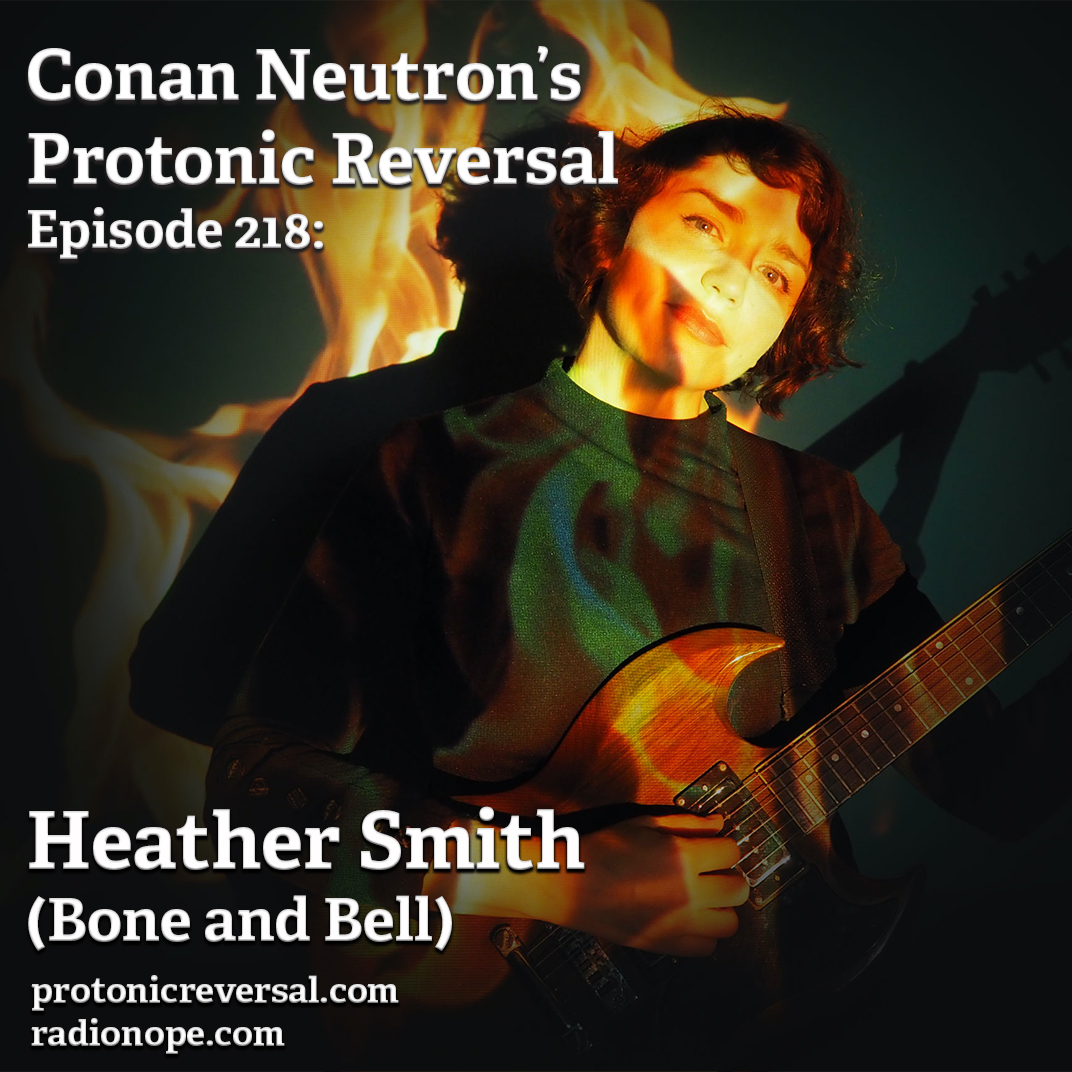
So anybody that's been missing the constant onslaught of Protonic, there's a bunch more coming. This is one of them. I've been waiting to do this for a while and waiting? No, I've been wanting to do this for a while. Heather Smith, Bone & Bell. Bone & Bell is a very interesting band slash artist from Portland, Oregon, Chicago. It's from before that. But really great record, To Ascender, came out this year. I like it a lot. And I've been meaning to have her on for forever. And...
If quarantine is good for one thing, it's getting around to all kinds of stuff. So if you're not familiar, she's awesome. You need to check it out. Very thoughtful artist, musician. She works in augmented reality as well. Great visual artist as well. But yeah, that's going to be coming up. Just quick thanks to everyone for sharing the shows around. The nice feedback on recent episodes. It's always nice to hear. It's always nice to know the folks who are listening out there. Just really appreciate it. That's it. Nothing else. Protonicoversal.com for the archives. There's been significant catch-ups, so the advanced feed isn't as advanced as it used to be, but that's okay.
Don't worry. For folks that subscribe to the Patreon for the advanced stuff, there's a lot coming, so stay tuned for any of that. Anyway, Heather Smith, phone a bell. Okay, let's dive into it. Heather, thanks so much for joining. It's great to talk to you. I've been meaning to do this for a very long time, so I really appreciate you making the time to do the show. You have an awesome, awesome, awesome, awesome new record, and it's awesome just on the face of it, meaning that the songs themselves are good and it's an excellent listen, but there's a lot of backstory to the path to it and how you got there, and it's...
you know somewhat documented in the record if you know how to listen to it or you know that's there but it's not a prerequisite would you mind telling us a little bit to how you how you got yeah so it's been about um it's been about six years since i released an album and part of the reason for that was that i got hurt about five years ago which you know people in the prf and like our friends all know but basically the tragic thing is that i was like carrying a box of like my own vinyl records It's so like ironic. But anyway, so I'm taking my records from the garage to the basement because I'm worried about like warping and like the heat and all that sort of stuff. And we have like an old janky house that's from like 1925. And we have the staircase that leads to the basement that's like curved and it's got like triangular steps on it. And so I'm like rushing because it's too heavy for me. And so I can't actually see my feet and I miss the step. And when you miss the step, you miss like three steps. Yeah.
Rather than just tossing this 50-pound box of records the way I should have, I actually cradled it towards me. You're looking like a baby-heared child. Yeah, it's all like slow-mo in my brain, of course. In the movie, it would be as well. Totally. Anyway, the corner of the box basically pins my wrist to the concrete stair, and it ends up fracturing it and dislocating it at the same time. Unfortunately, they missed it in the x-rays for about five months, and they couldn't figure out why I couldn't rotate my wrist. I was basically just stuck in the palm-up position, which I don't know.
Probably very few people have had that experience, but learning to chop things like this is actually upside down. Yeah, so your one hand is stuck almost as if you're presenting a platter. Exactly, I'm just like, here, hors d'oeuvres, anyone? Yeah, constantly. Yeah, because it's almost as if you just don't have use of that hand at all for some activities. Yeah, I think you have 1.75 hands, or 1.25 hands, something like that. But that said, if you have a dinner party and you need to serve some hors d'oeuvres, you're sorted. Yeah, I mean, I was a waitress for a few years, so I've already got some experience in that.
um yeah anyway i got an mri eventually because no one could figure out why i couldn't rotate it and the doctor came out like in the middle of it and was like have you not had an x-ray and i was like yeah of course i've had like three x-rays he's like well it's broken and dislocated so that's what's going on so i was like okay good good to know uh what do we do now because it's already healed uh you know in the locked position yeah yeah it's already yeah horses has left the barn at this point yeah for sure so um the first doctor that i talked to was actually kind of an apparently surgeons are kind of like notorious like uh egotists um sort of God complex people. And I don't know if this guy actually had that going on because I only met with him like one time, but the reviews of him sort of indicate that. But anyway, he told me that like right then and there that I needed surgery and that I needed to choose to either be palm up or palm down for the rest of my life probably. So I needed to choose an instrument, like either piano or guitar. And I was like, and this was all news to me because he's like the first one I talked to him. So I was like, okay. And then I went out to the car in the parking garage and just like cried my eyes out and was like, well, I'm going to get a second opinion.
And I ended up getting like seven. Yeah. I mean, that's a huge decision, right? Yeah. Well, that's the game, guys. I mean, that's. Yeah, exactly. Well, OK, I guess I have to choose. And because I was, you know, I was going to if I had to choose, I was going to choose down because that's just a much more functional, you know, position. Right. Like how you do everything in the world. And I work in computers and I kind of need to type like regular. So anyway, long story short, I got surgery. And after I found a more optimistic daughter, not daughter, doctor, he's not my daughter. And I'm not sure where that came from.
And I didn't really get my rotation back and they couldn't figure that out either. And so I started doing PT and they got me a brace, which looks like this like ancient torture device. Basically, it's like a full arm thing with like these metal pieces that connected to my body. I had to wear that all the time while I worked, while I slept, everything. We're basically manually rotating my wrist as well as doing PT. Long story short, we got to a point where they were like, okay, you got about 50% rotation and that's the best we can do without just replacing your wrist with a robot wrist. And you're too young for that because that stuff wears out over time. Basically, if that route was explored, that'd be something that in 15 years or whatever, you'd have to have it redone basically. Hey, here's another painful and expensive surgery while we swap in a new robot part for you.
Exactly. So, anyway, after I heard that from enough people, I basically just decided to roll with it. And, like, I had enough rotation, I'd learned to play again. I had to play things differently. Yeah, you basically had to relearn how to do what you normally did, right? Yeah, do it in a new way. Do it in a different way, right, exactly. Right, because I don't have the rotation, I don't have the strength that I used to, you know, like, there's just some weird stuff. So I just learned to fret things differently and play piano differently, because I used to do a lot of, like, sort of stuff, you know, bass, bass lines, where I alternated between, like, the pinky and the thumb, you know, like, rocking my board, stuff like that.
Anyway, just had to change up how I did things. But I honestly, it turned out to be a really good thing. I think it actually makes my work even more unique just by kind of like leaning into the constraints of it. I found things that people wouldn't find otherwise, you know? Well, totally. So I'm thinking of, you know, Tony Iommi from Black Sabbath, his pinky finger, you know, it got like chopped off at like the place he worked. I can't remember the exact rationale behind it. Because of that, the way that he plays is kind of unique and idiosyncratic and often imitated, but it never is quite exactly the same because people don't have that.
that same disability. Django Reinhardt, you know, examples of people who have just made, you know, made their music because they didn't have any other choice. And anyway, I think constraints and creativity are really good things. So, well, it does show through because even from, you know, being familiar with the earlier albums and this one, like it may be sort of ineffable, but there is a difference compositionally and just the way things fit together. And I think it's something that if maybe, you know, somebody is more astute.
with a music theory or whatever that myself could point out, they get a, they get out like, well, actually Conan, it's, but what I can just say from perspective as, as a, you know, just a fan and a listener is it does, it does hit a little differently and kind of gets to maybe similar places you would have before, but in a kind of different way. Sure. Yeah. I mean, my, my aesthetic, like my ear is still there. I've always played by ear anyway. And so, yeah, I mean, I think also it's just like, you know, it's been six years, so I've kind of evolved as a person too. Well, exactly. How much do you attribute to this or how much do you attribute to just wanting to explore different things and the music, the writing process being different for you because you're trying different stuff?
Well, for one thing, I mean, this album was very cathartic for me. A lot of the songs were kind of written, you know, in a very tender spot. And I think that that kind of emotionality comes through, which most of my stuff is kind of from from that location anyway, or a lot of it. So I guess that's not surprising. But yeah, it was it was a really healing album for me to do. It was also the first one that I engineered mostly and and mixed and produced and stuff. It's a big move. And also a big move to do that with your own stuff because you're already so close to it. Yeah, totally. That was actually really nice, though, because I although, you know, my.
My husband, Jason, has been my engineer and mixer for the most part, like, on the rest of my work. So we already have a pretty tight, you know, he kind of knows what I'm going for for the most part. But there's also been things that I wanted to try, like experimental stuff, more gritty textures, that sort of stuff that I just wanted to play around with. Like, I kind of think of composition, like, creating the compositions of songs like I do my visual artwork. Like, they're really similar. Like, composition to me in both mediums is, like, basically the same thing. You're creating these, like, arcs of tension and release and, you know, these, like, storytelling arcs.
and so anyway it was fun to kind of come at the production part of it like a painter um thinking about like like like the texture and um all that sort of stuff which i have done in previous albums but i just had more control this time so it's like being a painter if you also are constructing the easel and the and every other piece of it as well right sure yeah the whole ship so um oh go ahead go ahead no that was it that's that's basically how that album came to be so when you're when you're talking about you know, approaching that and doing like every piece of that yourself, do you have, do you feel like you have to set constraints for yourself to like goals and things like that to, to accomplish it? Because it's sort of like something that I found is that it's the mental discipline that's required to work on your own stuff is different than when you're in a larger collaborative exercise or something that has deadlines that are, you know, you're, you're being a jerk if you don't get it to somebody by a certain time or something along those lines. So how did you, how did you keep yourself honest with this? Knowing also that you were, you know, in some cases I, you know, going through PT, going through physical therapy, life is happening.
The world is the world. Yeah, I mean, to be honest, I've made enough things at this point that I have already kind of dealt with the monster of, like, overly refining something or, like, knowing when to, like, draw the finish line to say, this is done, this is done enough, like, there is no perfect, so don't overwork it. Like, I feel like I've already learned a lot of those lessons, hopefully, my fingers crossed. And so it wasn't that hard for me to walk away at a certain point. Like, the way that I make typically is I'll write a song, I'll record it, I'll start layering things, but I have to step away from it, like, periodically so that I can hear with fresh ears.
And at a certain point after I've been working on a song, I can just say, you know, like, I think this captures the thing that I was looking for. So let's just go ahead and call it because, you know, there's no point in sitting on something until it's like a perfectly polished turd. It'll like lose all the life out of it. You know, like, look at my beautiful turd. It's ineffable and perfect. Yeah, yeah, exactly. Well, and it's, there's a lot of scenes that kind of gel with that. But, you know, the one that kind of comes to mind is, you know, our project is ever truly completed, just abandoned.
Once the music leaves your head, it's already compromised, et cetera, et cetera. There's plenty of aphorisms to back that. Of just the wanting to know when something is done and have that process for yourself to know when something is completed. Or at bare minimum, that additional work to it will not improve. It will only postpone.
I think it's kind of a trust thing, like a trust in the process, a trust in yourself and your own intuition to be able to tell when something is done. And also kind of just trusting the work because it has its own life outside of you. Once it's been made and sort of put into the world, you kind of just have to be like, okay, little baby, I've cared for you, you know, for so long. And now take the sailboat, you know, into the horizon and have interactions with all these other people. Yeah. And you're just not there to do that. So you've already done your part. Well, and so your music kind of first came to my attention right about when you did Organ Fantasies. And that's something that was immediately...
noticeable to me was that you know there's a lot of there's a lot of space uh in the music but it's like deliberate space it's something where like that's that's as much a part of the composition as anything else and so it's almost to me it almost seems like it would be just as important to know when it's time to take something out or or not oh yeah that's base oh yes yeah i all of my music for the most part is pretty um minimal I guess is a way to put it but like I'm a big fan of like just putting in like like the absolute necessary essence so that what's there can have breathing room and and I think it's actually you know again it's I feel like some of that might come from my visual art background where like negative space is like a huge portion of the composition but but also just for the for the storytelling stuff and for the being able to perform it in such a way that like I have time to feel the things or I don't know like breathing room to perform it well so anyway all those things sort of combined to create like a very not stark, but minimal sort of thing.
Right. It's kind of the wrong word, honestly, because a lot of the stuff that in Oregon fantasies I wouldn't necessarily define as, like, minimal. No, it's not minimal so much as one's spacious is even the wrong word. Just deliberate in its usage of what happens where. And that's, you know, you like to think that's something that is more common, but it's definitely, if you're someone that listens for those kinds of things and hears for it, it's definitely apparent that that's almost like a compositional tool in that way. I mean, don't get me wrong, I like maximalism, too. But it's not even that it's... Oh, yeah, me too. Yeah, totally. But it's something where, and what I'm going at with all this...
Because when you're approaching something where space is so important, there's almost the necessity that the things that are there do exactly what they're needed to do at that moment in time. And when you're in a position of kind of relearning how to do all of the things, did you ever find that to be a challenge as far as getting the desired goal of what you had in your head versus what was on the record? To be honest, no, because my process for this whole thing was one of allowing where I would and discovery where I would go a place and then sort of see where I was and then make a decision based on that and then move forward versus like having something in my head that I was trying to articulate and then and then creating it with my body. It was more like I was allowing my body to kind of lead the way. And I kind of find that that like I mean, sometimes I write the other way, like I hear something and I'll create it. But like a lot of the time, it's just it's discovery and just like listening, seeing what happens. Did you have?
any arc or like mood in mind for it. And specifically I say that because it's almost, it's not like it's explicitly a concept record necessarily, but there's, again, if you're willing to look, you can find certain repeated themes within there. Sure. To be honest, that wasn't something I set out for. That was just that manifested from the work itself. And when I put it together, it was sort of like, oh, okay. You know, like, I'm sure this probably happens for you, too. Like, you make something and then you don't even fully understand it until you step away from it for a second. You're like, oh, shit. Okay. I see what my, like, subconscious was doing there. Like, great. You know, other things have, like, you know, more sort of explicit themes from the beginning, like organ fantasies. But, like, with this album, it wasn't, again, it was sort of discovery versus, like, pre-planning.
I wish I could give credit to who said it, but I heard somebody say the album telling you what it is. And I thought that was a good way to put it. Yeah. So there's, you know, there's a lot of interesting stuff within the songs. I was wondering if we could just go through song by song on it. You could just kind of tell me a little bit about, you know, lyrical themes, anything with recording arrangement, et cetera, on everyone to Ascender. So we'll just, we'll just like, like any good story, we'll start from the beginning. So My Little Anchor is the first song.
Yeah. So my little anchor, like when I wrote that, I knew that it had the potential to be kind of like a big poppy anthem-y sort of thing that had like a huge crescendo. And I was thinking about like Phil Spector and sort of in my own way. And so I was trying to create that vibe, like the girl group sort of vibe for that particular song. And I feel like the addition of the horns was like really instrumental in creating sort of like the overall vibe of that song, which was all Jason. He wrote those and created them.
But yeah, I like to start songs. I mean, a lot of my songs have a lot of dynamic range in them. That's one of the things that I try to do. So sometimes like I have a few songs on this album that start really small and spare and then just get cute. They kind of bloom almost, yeah. Yeah, right. It's that storytelling arc, both like, you know, in the audio as well as like the lyrical content and that sort of stuff. But yeah, I mean, that song is just sort of about like the challenges of like a long term relationship, like being in love with a human being that is like imperfect and, you know, and still loving them and that sort of stuff.
Yeah, it's interesting you mentioned the Phil Spector thing because the first thought that occurred to me is it's a song that you could almost teleport back to like, you know, the early 60s or something and have like one of those groups do and it wouldn't, you know, obviously it would be different, but it would still work and it wouldn't seem like it was time traveler music in that way. I love retro stuff. I mean, I think there's like probably a unconscious sort of retro vibe to a lot of the stuff that I do, but that's just because that's what I've listened to like since I was little. So it's just sort of found its way into what I do. When did you first discover the Omnicord, too? That's an interesting instrument. I bought that for myself a few birthdays ago. And it was actually in response to the wrist arm stuff, too, because I knew that I could kind of play that one-handed-ish, you know. And I just love the sound of it. I love auto-harps. I love that sort of just like chimey, like all of this, the big swell of almost drone that can happen with those sometimes. And yeah, so I found one on eBay a few years ago. And it's really fun to play. Ours, unfortunately, has like...
something going on where there's this like high pitch frequency that like plays all of the time that's like really loud so i have to like you know i gotta use it in just the right way and sometimes use some like you know like take out some frequency or whatever like like in the recording but um yeah it's a it's a lovely lush um kind of uh you know slightly synthetic analog sound it's kind of hard to describe well yeah they're very unique it's uh you know you'd be you'd be uh understood if when you're looking at it you would be like oh that's a cool toy you know it just doesn't have it doesn't have a look that looks like it's built to last necessarily but they're you know these bizarre instruments that are really very interesting and in its i think the designers desire to try to create something that was an analog or something they made something truly unique and to this day i'm surprised somebody hasn't kind of latched on to that and like done like a modern version you know that musicians could actually utilize that you didn't have to baby because I know that there are I know a few other musicians who do use them Jeff Byron from the Meishi and Turbo Lightning and whatnot he's a huge fan has more of them than anyone I've ever seen but it's also it's kind of a weird thing that yeah you gotta like go on eBay you gotta go to a thrift store or something to find them and even then there's no guarantee they've been well maintained can't take anywhere to get fixed necessarily so it's this interesting
kind of instrument from that that early 80s age of hey let's everything should be digital and electronic yeah let's make something cool and then you know some of those ideas were continued on and some of them were not and omnicore is almost like a dead end in that way but it's such a cool sound it's so unique but if you know it you're like oh i know what that is if you don't yeah that's a weird synth what is that right yeah they're very interesting i mean i have a thing for weird instruments i like um i don't necessarily want like like I don't have an idealized version of a guitar or anything that I want, or piano even. I like the discovery of finding a weird vintage organ in an alley. I mean, that's what organ fantasies was all about. We kept rescuing organs from the Chicago alleys. I was going to say, it sounds like a theme you should make a record on. Oh, wait. Oops, I already have. Yeah, I like the personality of the imperfect. And yeah, I almost feel like there's songs waiting to be discovered inside of instruments that if you just play them long enough, something will kind of emerge from them.
I don't know. I don't really believe that because I'm not like super woo-woo or anything, but it does feel that way a little bit when just like, give me enough time on an instrument and I'll discover kind of like a song that, you know, was kind of waiting to be found. Right, yeah, that's, you know, that isn't woo-woo necessarily, as you say, isn't necessarily the thing. It's more just knowing that, you know, just like you have creative prompts, things that drive creativity for you. Right, creativity. Yeah, exactly. The instrument itself could be a creative prompt in that way. Right. So Down and Below is the second song. Can you say a little bit about that?
Yeah, Down Below was kind of about, it's about the reoccurring theme of depression and anxiety in my life. And just kind of like, you know, recognizing the cyclical nature of it and kind of like coming to terms with that. Because, I mean, I don't know, I think that... I'm pretty good. I mean, honestly, like I've been a little rollercoaster in my life, but like my entire family deals with like depression and anxiety. And so it's just always kind of been something that's been around. And I've had to learn how to have really good like mental hygiene in order to kind of avoid, you know, plunging too far. So anyway, that's what that song was about. And the picking pattern was just something I've been playing with for a really long time. And yeah, just kind of about some of my time in Chicago and like a big, a big depressive dip that I had when when I was like 26 that happened again when I was 36 after after I got hurt.
Seems to happen in like 10-year cycles or something. Cyclical, yeah. Watch out when you're 46, I guess. I know, I guess so. I'm a little worried. Well, yeah, and it's, I definitely, you know, picked up on themes for that, you know, like being location-based, like tied to location and time. But yeah, it's interesting to kind of see, I don't know if it's a trend so much as just I become aware of it, but to see people kind of bring in some of the stuff out into the light to kind of talk about a little more explicitly, I think that's a good thing.
Yeah, I mean, I'm choosing to do it. I think I kind of felt embarrassed about it for a really long time, but I found that if I talked about it with people, like I actually wasn't met with ridicule. I was often met with like more closeness and compassion on people. And so it was actually like by showing, you know, this quote unquote weakness that I had, I was actually creating like like bonds with people. And also, you know, like like airing it out, like making it like less taboo to like say that you'd like had like mental health problems so that so we can finally deal with them and stop pretending like they don't exist and we're all fine all the time. Right. Exactly. There's no honor or glory to it.
trying to pretend that things are fine when they're not you know and it's the fact that it's so stigmatized in our culture speaks more to our culture than anything else but it is interesting to see you know everything's a little smaller when it's out so it can be a unifying thing in that way Yeah, I grew up with my aunt Helen was developmentally disabled and no one ever actually got her No one ever actually took her to a doctor to confirm exactly what was going on with her She was kind of just treated as like I mean I grew up in the south and stuff and so we kind of there's a culture of like like hiding your familial secrets and I feel like Helen was almost treated like that way in some in some sense and I so I think from a young age I sort of realized like how uh how impactful that can be and how negative that can be uh for all of us to to just pretend that we're all alike and we're all okay it's like it's like middle class pretense or something which i grew up working class so i i think i haven't adopted a lot of that anyway but um but it's like taking on an additional burden you don't need to take on in a certain way right i mean but other than the fact that like there's this implicit cultural thing that says oh yeah don't don't go talking about that you know don't don't flaunt that that's not for anyone else to know right okay it doesn't mean it's not there though it's still there right yeah i'm not interested in like pretending to be
fine all the time. But yeah, luckily, I mean, I think people, people, I feel like there's a sea change, you know, in regard to that sort of stuff. So hopefully within the next 10 years, we'll see, we'll see more support and yeah, and less stigmatization. But anyway, let's see. The only hammer I have is the next one. Okay, thanks. I was like, what's this order again? Yeah, the only hammer I have is kind of a... That's when it starts with the, it starts with those beach sounds and... Yeah, that's, that's actually taken from a 1940s movie set, like a, that I found.
on yeah on freesound.org there's a lot of like free sort of like field sounds and that sort of stuff which i like i like to incorporate sometimes um and yeah i think about non-traditional uh sounds as like musical sounds and so anyway that song in particular for whatever reason i just always felt like it was beachy there was something about like the little lick that i that i'd written that felt like kind of like lime and a coconutty but like not that there's something about it that was like touching on that um i like exotic stuff and like um uh some kind of islandy themes and and so anyway i think some of that was kind of seeping through but um But yeah, I mean, lyrically, that one, you would never know it unless you really pay attention to the lyrics, but it's about suicidal ideation. It's such a happy song, though. Yeah, but the tone of it is not depressing sounding, but I mean, I think there's certainly clues within there. There's that, you know, if there's something going on out there, I don't care. It sets the mood in a certain way if you're listening for it, you know. Yeah.
I mean, I kind of like to do stuff like that sometimes where like, you know, there's this juxtaposition between sort of the tone of something and like the content. And so it creates this sort of like tension, which I think can be really good. But it was kind of about like so luckily, like amazingly, I've actually never really like had suicidal tendencies. I've had lots of friends that have like family members and all sorts of stuff. But I have had and I think most people have probably had this like where you're in a situation where you're like, you know, oh, I could step.
You know, I could take two steps this way and I would be off of this cliff. Just this sort of like recognizing like how close we are to our own mortality and sort of the fragility of like the human body and that sort of stuff. So, yeah, I was just thinking about like sometimes when I'm in a car, like I'll be like, oh, you know, I could just go like this. That's it. Yeah. Quarter turn to the left. It's that simple. Yeah. Yeah. So anyway, it was kind of about that. And.
But yeah, the song itself, like, I just really like that kind of retro-y island vibe coupled with some pretty, like, antagonistic, like, synth lines that kind of are, like, peppered throughout, which is kind of fun. It creates that, again, like, attention sort of thing. And then, of course, like, string swells and... And lots of, you know, layering. I mean, a lot of my songs sort of are dependent on these sort of like vocal layers that I kind of weave together. And yeah, so that's that song. It was pretty fun. Yeah, and the dichotomy definitely works. Because, again, it depends on if you're not a, you know, somebody referred to as a lyrics person. What is lyrics person? What does that mean? But I guess they mean some people only are really paying attention to the musicality, the music elements of it, and not so much lyrics on their own. Then maybe you wouldn't notice or would only, hey, wait a second. Is that, you know, kind of like notice it like far later or something like those ones.
Snake Skin Teeth is the next one. Oh, sorry, I didn't mean to do that. Oh, no, no. I just had a little story, like, a little attached to that, which was, I got hired to do this, to be part of this, like, group that was performing in Chicago, and I was playing one of my songs called Flying, Falling, Crawling, which is about, like, this, like, series of nightmares I had about, like, serial killers and stuff, but anyway, but it's a very beautiful, like, pretty song, and this was kind of a buttoned up, like, affair a little bit, and so I performed, like, three or four times, like, in these big, like, you know huge theaters and that sort of stuff for this kind of like buttoned up group and suddenly like one of the producers of the group actually listened to the lyrical content of the song and was like was like whoa like uh wow that's um that's a lot darker than i thought it was and i was like yeah i mean that's what y'all hired me to do so um anyway take the ride yeah um yeah anyway uh snake skin teeth um was is kind of a fun gritty one i was playing a lot with like distortion and stuff on this record i feel like my voice is so tonally it's almost like a sine wave like it's very
it can be very very clear like no vibrato like very like just tone sometimes and I think that adding a little bit of distortion or a little bit of texture to it can be really helpful to create well just to create texture and to create sort of like again a juxtaposition or contrast to the sort of like smoothness of my voice sometimes so anyway yeah that song is is just kind of a weirdo honestly like I think that I'm not even really sure what it's about, to be honest. I think it's about the lessons that I was going through, like learning how to play again and just learning how to like live my life on top of this, like these huge stressors that I was going through. And the fact that like these lessons, although I could tell that they were making me stronger and a better person and I was growing, they just stung, you know, like just the growing pains of going through hardship. So, yeah, that's kind of what that was about.
Do you ever think about things in terms of like cinematic aspects of stuff? And the reason why I say that is like with the Foley design, you know, sometimes changing the articulation of spoken phrases by using like a filter or using some kind of effect on it. Like that's, that's something that's used to evoke mood. Sure. Yeah. A hundred percent. Yeah. I mean, again, to compare it to like, like, you know, visual art stuff, it's like, you got to pick your colors and your textures, you know, all that sort of stuff. Yeah. It's, it's the same thing for me. Whiskey Sea, I guess is the next, the next one on the album. This is kind of an older song that had been around for a long time, which is,
I was noticing a lot of addiction amongst my friends, and I was thinking about... Self-medication. Yes. Yeah, totally. And myself included, honestly. There have been some periods where I've clearly been self-medicating. But also I was thinking about how that's integrated into class structures and the ways that different classes express themselves. And I was thinking about how working class folks and addiction go hand in hand because of just the ways that the working class have been pushed to the limits of their bodies, made to abuse their lives and their bodies.
like like through their work for this like higher up and in order to do that day after day there's sort of a culture of intoxication has kind of erupted around that just to like be able to fucking do that every day right which starts off as the have a drink after work and then it turns into a few drinks and that turns into okay that's the evening and then back at it yeah yeah and i just noticed these people um being really unhappy uh you know working for the man like like being put through these like stressful grinds and and dealing with it through through alcohol and how common that is too common yeah and that's You know, again, that's real stuff. Yeah. That's very real. So vibe-wise, what I was trying to get with that one versus the other songs was I wanted it to sound more like a live band, like in a bar. I wanted to get that. Yeah, yeah. The more like full expression of that song. I wanted it to feel like you were in like a working class bar, like hearing a band kind of rip it up a little bit.
which which it does get that vibe i also gotta say as as being a lyrics guy i love the phrase wobbling tower of meat by the way i think that that caught my ear immediately that's awesome thank you um yeah i've definitely had that feeling before um uh yeah i i think anyone that uh has has dealt with a drink has probably had that at some point or another so it's a mortal moment yeah mortal moment um was about trying to um trying to be present, trying to, you know, be fully aware of this life and take all of its lessons and, you know, disregard fears and all that sort of stuff. It's almost like a little prayer for myself. Like I don't actively pray. I'm not religious or anything, but I sometimes write myself little notes through song, things that like lessons that I wish I could like take to heart. And so that's what that song is kind of about. And I wanted to create like a...
you know, again, I'm not religious, but I wanted to create that kind of like church choir vibe of that's why some of the organs and stuff. Yeah, exactly. And the layers of, you know, choirs kind of in the background as it like builds. And yeah, to create sort of, you know, a moment that could reverberate in that particular sort of spiritual way, maybe. Is there anything that have you in your own life kind of Led yourself to the I need to be more in the moment vibes just because you've noticed that you have not been Oh, yeah, I remember well a few things I remember like when I was a kid basically noticing that I wasn't noticing like And so taking a moment, I was in the backseat of a car and I really, I took all of my attention and I paid attention to like every single aspect of everything that was happening to me. And I remember that moment like, you know, perfectly. But yeah, I've had some things happen that made me sort of like disassociate like physically. Like I don't necessarily like feel part of my body sometimes. I was attacked by a dog when I was like five. It was like a big deal and there was a lot of healing involved and like I had to live on my stomach for like a couple of months. And anyway, all that sort of stuff. I think that like as a survival like tactic, I sort of learned how to like.
be outside of my body yeah be in your mind and kind of right right and so anyway i've noticed that like peppered throughout my life um but uh so yeah i've been a struggling meditator for for many years now and it does it does really help um i'm much more consistent now than than i was for several years but um yeah i struggling meditator is the second great phrase for a song title the other one was an optimistic daughter that came up Yeah, so presence is a big deal. It's something I'm like constantly striving for. I don't know. Do you meditate? Do you relate to any of that? Yeah, I mean, so I used to be able to and kind of explored it a little bit when I was much younger, like in my very early 20s. And then for whatever reason, I find it extraordinarily difficult now. It's very hard for me. I've got an unquiet mind.
Yeah, monkey mind. In that way. And so because of that, I just, I find it very, very difficult. And I guess I should keep trying, but it's been, it's been hard for me. I think I've, I think my brain is constantly wired to go 7,000 directions at once. And even though that's in a multi-track way, the whole point of meditation is to sort of quiet yourself down. And I think that used to be easier for me for whatever reason.
Yeah, it's hard. The struggle is real. I've quit for years before because I felt like I could never do it right. Is there really a doing it right with meditation? No, there's not. That's a false belief. Whatever you're doing is totally perfect. We're still goal-oriented in our culture, and there's not an in-point of meditation. There's actually no enlightenment in my book.
So it's all about the journey and yeah, there's no doing it right. But when COVID hit, like a bunch of other stuff happened. I got like some, some great opportunities, like artistically, I got like an art residency and like, but at the same time, my mom got diagnosed with breast cancer and was like dealing with all this stuff and then COVID and the racial uprising and the, you know, I live in Portland and like, that was kind of crazy. And it's like, yeah, the police conflicts. And so I just had to start meditating. I was like mandatory. I was just like, all right.
I'm freaking out. There's so much going on. It's literally just for your own sanity at that point, right? Yeah, that's exactly what it was. That and yoga, the two things I think have helped me get through the past nine months. But yeah, hopefully my consistency will continue in less tumultuous times. We'll see. Well, that's the key, right? Those that advocate for it say that it's almost just as important when you don't feel oppressed by the world necessarily. You just got to keep it up as a habit because you're training your mind to...
like listen to itself and then also not to listen at the same time and it's something where that's we put a focus on it like oh stuff's so crazy right now i need to need to be centered but it's like no the idea is if you're going to be centered you should be centered all the time and that needs to be a practice because it's like anything like singing or playing an instrument or something if you don't practice it That's what happens. Or, like, lifting weights, you know? Yeah, exactly. You can't, like, wait once and, like, be strong all of a sudden. Like, it's a consistent, like, overtime sort of deal. Yeah, like, I have these 30-pound weights. Why do they seem heavy to me now? They didn't used to it. It's like, well, you haven't been doing this. That's why. If you did it every day, it'd be fine. Yep. Having nothing to do with weightlifting, and let's talk about little pieces. Sure. That was born out of a lot of things. I mean, that song...
I was kind of inspired by when I perform it, people always think that it's like about me, which a lot of my songs really aren't like at all. They're fictions that are sort of like cobbled together of like a bunch of different things that I've seen. But in particular, that song is about sexism and the way that it can integrate itself into relationships. And the women that I've seen that have sort of sacrificed themselves for horrible men. And it's about the...
It's about the evolution of the, like, here, you can do anything you want with me. Like, I want you. I adore you. Like, I hate you. I can't get away from you. Like, please don't leave me. Like, that kind of weird arc that can happen in dysfunctional relationships. And, yeah, I've seen a few of those, unfortunately. Thankfully, not personally, but I've had friends go through that stuff. Why do you think there is that cultural bias to assume that a song with material like that would be autobiographical?
Well, for one, when I perform, it's pretty emotional. I think that's one of the things I can do is like carry people into that emotional moment. And I think there's like an assumption that it's personal because because I'm clearly like feeling it. Yeah. But I have, you know, but that's that's just not empathy. Yeah. Yeah. I'm like a deeply sensitive, empathetic person. And I was also a theater kid. So I'm used to performing in that particular way, you know, like dialing into whatever, whatever the emotion is. And I mean, it's real. I'm.
you know, I'm not like, like pretending to feel a certain way, but, but yeah, it's just not, it's not about me, but I've had a lot of people like be like, are you okay? Or, or, well, that was interesting, you know? Well, and, and, you know, the vibe wise with the song, like it almost fits in that grand tradition. You know, I guess it's most associated with country, right? But there's, as you know, when you're, when you're dealing with like relatable concepts like that, I think, you know, more people than are likely to admit can find some truth and not for themselves and for someone close to them or someone they know.
you know a parent or something along those lines who knows but it's something where it's it's always been weird to me that it does seem like the guy sings a song like that it isn't immediately assumed it's about that guy's lived experience but when a woman sings a song like that for some reason there's always that assumption i never think that but i also come from a very i love allegory right so that's where i'm coming from but i've never understood that i've never i mean i just assume it's cultural sexism of some kind i don't know like is it Well, you know, there's, like, the falsehoods that, like, women are more emotional than men. There's, like, you know, women don't lie. Like, you know, there are these, like, cristine little vessels of whatever. But also, but I do, just to give you a counterpoint, I do have male friends who have been accused of, like, having autobiographical songs that are, like, I have one friend, Adam Fawcett, who's, like, a great singer-songwriter. And he has one song about sort of an abusive relationship. And he's had people, like, come up to him after performances and be like, man, I'm gonna kick your butt. You know, like, why are you kicking women? Like, that whole thing.
But he does sort of strip down stuff too. So I wonder if it's like, maybe that like partly like, I find it hard to believe that like, like a loud, like super loud, like rock band or something like that. The, the, the lead singer would be, you know, sort of targeted for like writing autobiographically. Maybe, I don't know. Yeah. But then people just aren't paying attention to the lyrics. So. Right. It's hard to hear, you know, like much more about the vibes and about like the lyrical storytelling content. But yeah, anyway, I don't know. It's in everything. It sucks. Yeah. You know, I think being aware of it.
Helps in some case, but I don't have a specific answer for that other than cut it out. Well, yeah. I mean, we all have to look at how we learned all that stuff. It's not like this stuff happened in a vacuum or that it was born out of people being bad. It was out of seeing the oppression act out and then replicating it because we're like little kids and we're trying on the things that we see. You know, it's societal. It is. And it's not something we're probably going to sort out during the course of this episode, unfortunately. Probably not. Yeah, we can go on. Reason for the Beast is next.
Yeah. So I was when we moved to Portland, our first place was this like little apartment, very cute, like 1960s kind of apartment. And we had a friend in town and we were just hanging out about, you know, 11, maybe midnight, something like that in the living room. And I suddenly heard this like loud pop sound like we were like, what was that? And it sounded like a dresser being like knocked over or something, which is like a weird thing to compare it to. But that's what it sounded like. And then I went to the back window of our kitchen was like washing something. And I watched all of these like police officers just like running through alley. I'm like.
What's going on? This is really weird. But I was hanging out with a friend, you know, whatever. So we went to bed and then the next morning I woke up to discover that one of our neighbors in a drug rage had basically shot his wife and then walked out from our courtyard and had walked around our courtyard telling everyone that he loved them. And then he went upstairs and shot himself. So I guess, I think I heard the first gunshot. And the woman who was shot, his partner was also named Heather. She was like one year older than me.
I don't know, it just really, it really shook me. And thinking about domestic violence, like when we moved from Chicago, I mean, in Chicago, we were around a lot of violence. You know, we lived next to parts of town that had like gang violence and all sorts of stuff. But when we moved to Portland, I was noticing an increase in domestic violence. And I don't know if it's just because there was less of the other violence to like talk about or like what the shift was, but I just kept hearing every single day was like a new story about a woman being beaten or murdered by her partner. And so it just hit me really hard. And writing this song was like part of my processing, like trying to figure out like how
you know how people are brought to the point of murdering other people like this gun violence that we keep seeing manifest in our country like where the fuck does that come from like how does a person find themselves able to shoot their lover you know like and the fact that all of us have like maybe a little seed of like monster waiting inside of us like that can be expressed depending on you know depending on drugs depending on like what happens in our life like stressors like emotional breakdowns all sorts of stuff so it's just sort of reckoning with um the darkness you know that we all have like a little bit um and that's uh you know there's the line that gets me on that too is that there's one of his eyes in a sense of deep relief yeah i've given a lot of thought on that because you think about you know motivation and you think about you know why people do what they do which that all those you know what investigation discovery or whatever the murder murder murder shows they've commodified that and turned it into like an easily digestible trope but you know people don't arrive to that place from nothing they you know there's motivation behind all of it and I think I was trying to empathize with him, too, a little bit. Maybe not empathize, but I guess, yeah, attempting to empathize. Try to figure out how he ended up there. It's really easy to dehumanize people who act in monstrous ways, but they're still human beings. Well, that comes back to the theater thing, right? Villains rarely consider themselves the villains. They're the misunderstood heroes of their own story. Sure.
Yeah. So anyway, with that song, the vibe, I recorded an initial demo version of that just in my bedroom the day after it happened. And there was a quality to it that was so fragile and so caught in the middle of the night or something. And I wanted to preserve that quality, which honestly, I don't know if I nailed it on the album. I think I did get part of the vibe there. But I just wanted to create a sense of intimacy and dealing with something really complex, like one-on-one with a person or something. That was sort of the fact I was trying to go for.
But yeah, heavy stuff. I mean, the next one's not lighter. Old Friend, yeah. It's a heavy record. I mean, honestly, I think I was just trying to heal and like art and music are like cathartic for me. And so some of that came out. But yeah, I mean, God. Old Friend is...
Just about the fact that I know pretty much every woman I know has like a story of like sexual assault or abuse or something of some sort of various levels. And how tragic that is and how often those offenses are from people that we know and trust. And it's again, it's sort of like the insidious nature that's kind of lurking around the corner, like in all of us or in someone close to us. And so anyway, it's again about that kind of darkness. Yeah, and so I tried to create, it's sort of, it's got this water theme to it, which I think there's something about drowning that, or being underwater or something that's like, you're like carried by these like waves that like you can't even really see underwater. And there's something about that that ran parallel to some of these other themes that I'm talking about. So anyway, I incorporated like sounds of like water and dripping and dirt, like gritty dirt water.
Earthy isn't the right word, but it's got, yeah, it's got the, it's elemental in that way. You should feel a little grimy, like listening to it was kind of one of the, I don't know, slight motivations. But the next one was Cant. Which is actually my favorite one in the entire record. Oh, thank you. I like it too, to be honest. It's really fun to play. And that was born out of a combination of things, but it's kind of about, it's about like going from being sort of like
I don't know, being vulnerable and sort of blaming your problems like on the world, like to like disempowerment all the way to empowerment, which is like the end of the song where it like it's big and bold and it's like, no, you can't, you know. Turning it around, yeah. Yes, exactly. So it's, I tried to capture that in the dynamics of the song. So it just starts out really spare and gritty a little bit and then builds up to this like big, crunchy, fuzzy wall of sound sort of stuff. Yeah, it's got this gradual build that kind of goes, you know, from a more.
low-key might be the wrong word, but from a more intimate place over to this big... kind of more beastly presentation. Yeah. I just wanted it to be like cacophonous and, um, yeah. And, and pull someone along for the ride with that. So, um, yeah, it's a, it's a fun song and I hope it's, uh, I hope it's the right song for certain people in certain times. I hope it's the sort of song that you can like blast in your car when you really need it. Totally. Yeah. Yeah. Like it can, like in its way in the telling of the story in and of itself could be, you know, motivational to have that turn around. I try to keep the language really simple and, and generic in a way that like generically specific.
open enough that other people could identify with it really clearly and kind of use it, like try it on or wear it in whatever way is appropriate to them. Like it could fit other situations that weren't maybe necessarily ones in mind when writing it. Right. Like it's an empowerment hat that I could like hand to people and be like, you wear, you know, you need to like feel this way, wear this and yes, cream your guts out or whatever. So yeah. And then after that big, big lab one, the last one is Counting Pennies. Which is the last song on the record. Yeah. And did you, I guess we'll start with that one. Also just why was that one a closer? Like why did you say that? That's the one that should be the very end.
You know, picking an order is hard, as you well know. Picking an order for an album is really challenging. But after the big crescendo of Kant, I wanted to return to something that was a little bit more spare and intimate, and also that was a little different than all the other songs on the album. So it's the only one that is only piano-driven. There's a little bit of electric guitar that's been run through various processes to create sort of this choral effect that happens in the background.
But it's pretty stripped down. It's just my voice and a piano and everything sounds a million miles away That was actually one of the first songs that I wrote on piano So it's actually really old song that I've been meaning to put on an album for forever and I performed it with bands and it's like a totally different song with bands. It's much more girl group sort of thing or zombie prom is what we end up calling it sounds kind of like a zombie prom yeah yeah yeah that's evocative I like it yeah but this this version of the song for this album was kind of just a new way of doing it that was just very stripped back and yeah and themes wise it's you know it's sort of about it's again sort of about like long-term relationships i feel like a lot i don't write about like love a lot i feel like that ground is like well worn for good reason yeah adequately covered by yeah an artist or two yeah love is love is lovely um and it's all of most of the songs that were about that like that early love right like the love of infatuation and desire and like
I just met you and oh my god my heart's beating out of my chest that sort of stuff but like fewer songs are about the like the like the old love the love that's been around the ringer like a few times and wasn't perfect and still somehow less of a uh topic that is it's not low hanging fruit it's higher hanging fruit It's not as shiny, right? Because it's not idealized. But it's the real thing. And if you have any sort of long-term relationship, you'll see that. Like, you have to come to terms with the fact that, like, you're not constantly desiring this person all of the time or agreeing with everything they say or, you know, are completely pleased with everything they do. That's just, like, not life. So, yeah, it's kind of about that and how...
I don't know like how you can spend your whole time in a relationship feeling like you want out of it but ultimately it's the thing that like made you whole and sort of like you know was the most important thing even if you couldn't recognize it in the moment. I feel like there's that sort of like hindsight element that I'm kind of touching on but. But, you know, I sort of wanted to start and end the album with those two themes of this like long-term complicated love. That was sort of a mistake, but when I saw it, I was like, okay, that makes sense. And yeah, and vibe-wise, I just wanted it to feel, I got like a new pack of Arturia plugins for pianos and synths and all sorts of stuff. And I discovered this like gray.
American piano that just sounds like it's just full of ghosts. I just feel like if you like lift it up, you know, like the top of the Yeah, it was just recorded like like on a foggy hill or something like there's just something really atmospheric about it that I liked. So yeah, so I took that vibe and then ran with it and then Jason came up with the sort of choral guitar thingy that's on there that kind of sounds like my background vocals. We actually originally had background vocals on there as well. And I felt like they they were competing. I needed again about the minimalism or just making sure that the elements that are there all like have a specific purpose. I just felt like that was too much. So we edited those out and just kept the, the guitar and it kind of did the same role. And I think it's like a little, yeah, a little different. So anyway, that's the album. So that's Tua Cinder. And I don't think I mentioned earlier, but boneandbell.bandcamp.com. Yeah. For that. It's also on the other thing. It's also on the other stuff. I do want to talk, you know, we've alluded to it because I could pronounce it, but the, the visual art element, I love the, you know, as a, for instance,
you can get like the print with the VR experience, which is very unique. That's not something the augmented reality world is not something that a lot of bands are taking advantage of. And you're in a unique position to do so. Was that just a, you know, how did you approach that? Was that just something you had in mind the whole time? Was it because you also work?
with that art form and you're just like hey why don't I just do this for my own stuff as well as engineering it and writing it and yeah exactly I have that pattern yeah yeah it's true so I work in mixed reality or I have for the last year I tried to get into it about five years ago when I was working in like mobile games and that sort of stuff and interactive design which is what I've done for the dollar bills for many years and Anyway, I got into mixed reality about a year ago and have just been really excited because it's the birth of a new medium. Nobody knows what it is yet, what it's good at, what kind of storytelling it will be especially good at doing. It's wild west still, yeah. It is. It's totally wild west. And I like that. I kind of like being on the bleeding edge a little bit. It makes for a lot of technical headaches. I mean, to be honest, there's so many of those hurdles that I'm constantly having to kind of overcome. But I'm just trying to remain flexible. And again, working with constraints can be a really good thing. So as long as I can keep my attitude good about that stuff, it makes it easier.
So I hadn't really planned on doing an AR accompaniment to the album, but I, you know, I make visual art, you know, I'm an illustrator, and I knew I was going to illustrate the album cover, which I did, which is like kind of a combination of a volcano and vocal cords. I've had other people say that it looks like a uterus, which I totally get. I wasn't thinking about that, but now that I'm looking at it, having heard that, I can see that. Yeah, I can see that. Yeah, that's basically what I felt as well.
I felt like there was, you know, as I was making that, I knew there was a little bit of a narrative there, like in the illustrated piece. And I also knew that in my other work, one of the things that I'm trying to kind of discover is like how music or how audio can be integrated into AR and VR, how you can actually like, like, what would be like, what would a song in augmented reality be? And how can you, how can you create a piece that leaves enough space and modulation for the participant to actually make an impactful? um you know to make impact on the song to actually change the song or the experience of the song like in an authentic way like giving them agency and sort of allowing for rather than having like like a song that is just a monologue like a one one way here is the song your ears interpret it you know and do whatever you're going to do on the inside rather than doing that doing presenting with a bunch of options and then the other person responds to it and it creates a dialogue that's the whole idea yeah how do you make it a how do you make it a choose your own adventure rather than a strict narrative arc and deeper than that too though like not just like choosing from a list of like a b or c but like like actually having greater agency
Yeah, yeah. And there's no guidebook for that that I'm aware of. I mean, if there is, I'm not aware of it. Yeah, no. It's not, as far as I know, it hasn't really been a made thing yet. And so I'm just kind of exploring that. And I wanted to explore that for this album, but the software that I was using to create this stuff was not that advanced. And so it morphed from this big idea of like, oh, I'm going to do an AR song that's going to be fully adaptive. And this huge, big idea to being like, well, I'm going to include a secret song, like an extra song on the album on this additional sort of path that you can only discover.
you know, through this AR experience and then create like some behind the scenes stuff. And so it sort of became the like the extras, you know, like the DVD extras of the album. And it comes with an art print that you can like frame because art prints are what I do in my regular life. So. Well, totally. And that seems like that's something where.
You don't need to be someone who's experimenting around augmented reality or honestly even know what augmented reality is to, you know, you can still appreciate the fact, oh, there's this awesome piece of art that comes with this. Yeah, that was the hope. Which if you look at the larger construct of, you know, most people that buy vinyl, you know, the sort of open secret is that a lot of people still listen to it digitally, but they have it as like the, you know, the physical keepsake. So it's like, what does that mean if not buy an art object? Yeah, yeah, absolutely. I mean, that's what I love about buying vinyl or buying the extras for a band. I like finding out more about the process, and I like getting something extra. If you're going to make the additional gesture of purchasing this thing, I feel like that should be met by the artist by providing something special. Well, it's definitely special. It's definitely interesting. I was very happy to pick that up because it's something where it's like, oh, this is just on its own, just having the print of that. That's just a nice piece of art, but also to know that there's this other thing that maybe even I understand but have not fully immersed myself into.
uh admittedly like it's it's nice to have that as an available as available thing pretty much well it's probably going to be like a weird artifact like in a few years right it's going to be like like a way above its time and be like oh my god one of the first whatever or like oh yeah remember back when you know like cd-rom right like the first ipod yeah yeah exactly like i think back to like the poster children cds that had like the oh it's got games in it and stuff like there's all this other content and then now it's like Hey, there were these things called CDs. And within those, you could have this other stuff that, because you put it in your computer to listen to. And if you didn't put it in your computer, you wouldn't necessarily be, but like the idea of that is, you know, it'd be a cultural dead end because that format fell out of favor, but you never know what's going to.
what people are going to latch on to i mean i still recall to this day like somebody talking about how streaming would never be effective or popular right right like an impassioned and you know well-reasoned if even if i didn't agree rant sure about how like it wasn't possible and i was like well it's possible i'm telling you it's possible it's just it's not something we put a priority into we buy in from the people making and distributing the stuff which obviously we have now and now it's well of course it is streaming everybody knows that but yeah there were some people that passionately argued against it so turning all the back around you know i could see augmented reality becoming something that catches on. I could see it being something that's a niche interest and I could see it just being a dead end. I'm really excited that you did it for this because it's an extra thing that other than just an awesome record you can get out of this which I think is really cool.
I was trying really hard to make it more than just a cherry, like a sparkly novelty sort of thing. And I hope that as the technology gets better and better, I'll be able to really lean into that. I don't feel like I quite achieved what I wanted to, to be honest, with the AR experience for this. But having been in the world for about a year, I will say that I think AR is probably going to land in a more ubiquitous way within the next 10 years. A big part of the hurdle is hardware. So anyway, I think within 10 years,
we're probably going to see some sort of device that allows us to experience AR more fluidly and not looking like a big dork with Google glasses or whatever. Right, like you're in some 80s sci-fi movie or something. Yeah, and with the Internet of Things and the continued digitization of our world, the virtual world and the real world are just going to blend more and more and more. And probably full-scale adoption for VR will be a little bit later, actually. Everyone thought that VR was going to be the big dog initially, and there was a whole lot of hype and a whole lot of money thrown around in Silicon Valley and all sorts of stuff around Magic Leap and a bunch of other companies. But yeah, I think AR is actually going to be more ubiquitous earlier.
But we'll see. It's early days. It's super early days. I went to a convention at MIT earlier this year before COVID hit with some of the top people in the industry. And even those guys are like, oh, it's super early days. And we don't really know what's going to happen.
I'm just hanging out out there on the frontier, basically, seeing what I can do. Well, Heather, I really appreciate you spending all the time and talking to me about the record. I think it's a great record, and people should check it out. Again, it's to ascender, boneandbell.bandcamp.com. It's also on Spotify and YouTube and whatever. However you listen to stuff. All the places, yeah. Whether you're Friendster and download it, you know, any of that stuff. Friendster, damn. MP3.com? Sure, let's take it all the way back. So last thing before we go is I have just the one can question I ever ask people, and that's just why do you do what you do? Oh, man.
I have to. I mean, if I didn't, I think I'd be so sad. I think I'd be so sad all the time. Actually, an indicator for me, if I'm feeling bad, is I can actually be like, okay, have I made anything? And often I haven't. And it's like, oh, okay. Now I just have to go make something and I'll feel better. But yeah, I mean, I grew up in a household of musicians and artists, and it was just such an integrated part of life that I can't imagine not doing it. I mean, it's...
it's what I spend all of my time doing other than loving people and like petting my dog, like exercising every once in a while. Like, like making stuff is, is what gets me up in the morning and, um, gives me things to look forward to. And, uh, yeah, it's just who I am. So can't, can't extract it from me. It's just the way it goes. Awesome. Thanks so much. This has been a blast. Thanks for having me. I appreciate it. Good to talk to you. Good to talk to you. Yeah. Have a good weekend. All right. There she goes. Have a Samantha Bone and Bell. Let's listen to a Bone and Bell song right now. This is Cant. The only hammer I have.
And Cant, before that. Those are both songs off of the excellent record To Ascender by Bone and Bell, with my guest for today, Heather Smith. Find that anywhere you get your music. Bandcamp is where I favor. It's also on Spotify and all the other things. As are all the excellent Bone and Bell records, Oregon Fantasies, which we didn't really talk about. Morning Broom, which we didn't talk about at all, but it's all there. Heather's awesome. That was great. You've been listening to Kona Neutron's Protonical Conversal. Thank you so much for doing that. The show airs live.
Radio Note, usually Thursdays, 8 Eastern, 7 Central, 6 Mountain, 5 Pacific. Podcasted later everywhere. Protonicoversal.com. Patreon.com slash Protonicoversal if you're looking to hear an episode earlier. One dollar a month gets you early access. Otherwise, you just gotta wait. I wanted to give a huge thanks to everyone for...
sharing episodes of the show around that they like and say nice things. That means a lot to me, and it means a lot to the continued health and vitality of the show. So, thank you. Reviews are kind of dumb, but it helps people find it as well. So if you feel so inclined to navigate the maze, an iTunes review on your listing platform of choice helps people find it. That's the only reason why I didn't talk about it. I think it's dumb. No, that's no sponsors. No kidding. Stay safe out there.
Take it easy. I got my radio on. Can you hear me now? Can you hear me now? Welcome to my top ten. I'd like to thank our sponsor. We haven't got a sponsor. Not if you were the last. She was prepared to prove it. This one goes out to a special girl. This record leaves a transmitter in the church of a listener. Casting if there's no one there to receive. And radio. Come to the close of broadcasting. I got my radio on.
Can you hear it now?