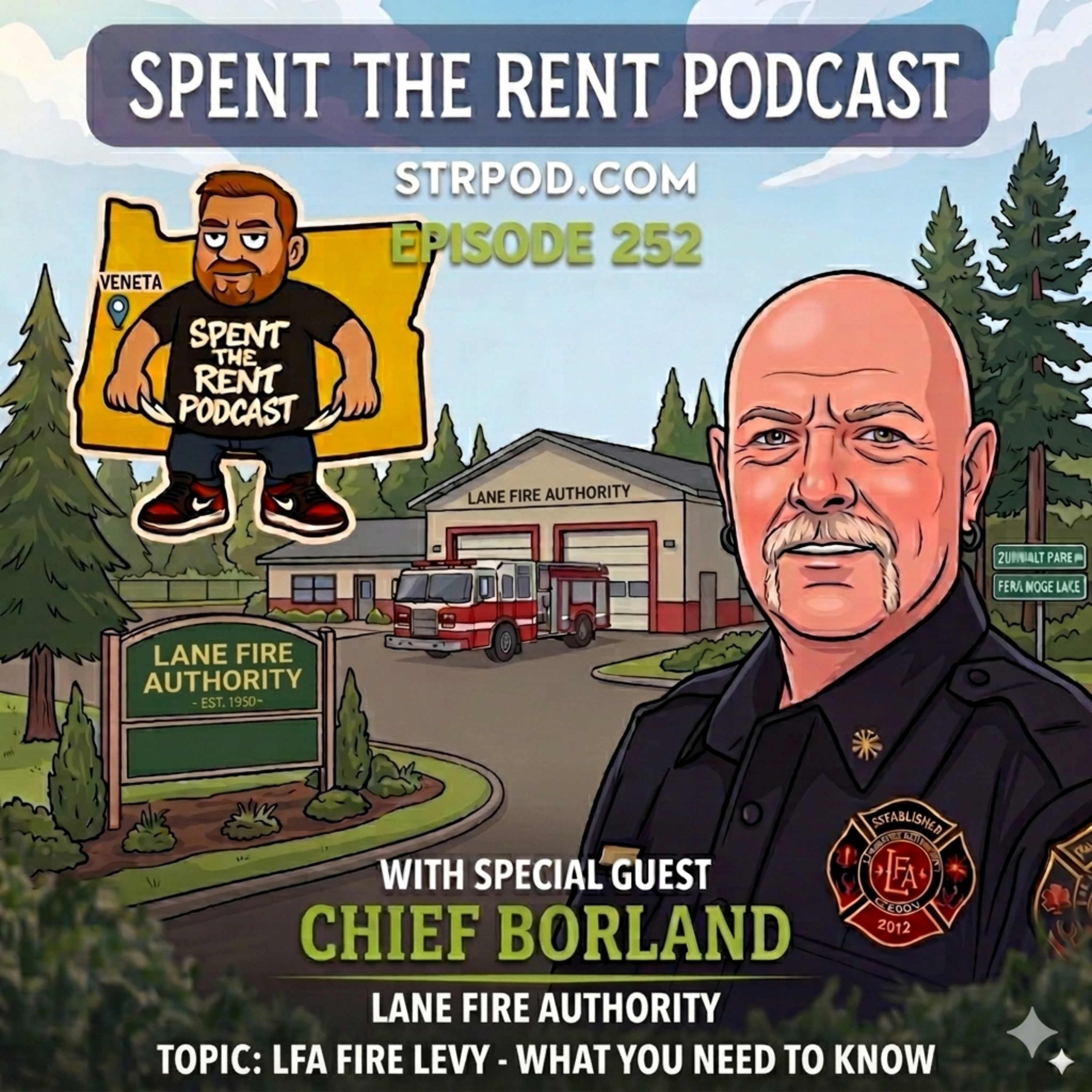
Eugene Springfield Lane County, Oregon. Support our work. Make a donation at strpod.com. Thank you for listening to Spend the Rent Podcast.
Now, here's your host, Ted Rose. We're in different, my term of, you know, the last fashion of 911, you call, we show up. And, like I said, never thought I'd see my career, but the strain of that is just becoming too great. And that's one thing that we watch out for.
This very, this film doesn't matter. This movie doesn't pass, you know. So, the next thing would be, Angel, it's coverage you mentioned about having to take a lot of commissions. So 80% of your calls are medical emergency.
So, you're already taking one ambulance out of service and produce hours for another. Yeah. Or someone in Benita or some of the other surrounding real areas. What does that mean if you're having a heart attack or a stroke?
Well, it does. It can mean an impact to that response time. Obviously, that ambulance in Benita is not there Monday, Thursday, during the daytime hours when it normally ran. And so, you know, one of our units from either a Franklin Station or Irving Station, which are our main houses for our full-time ALS transport units, you know, they're going to have travel a little further.
Right now, we're still getting first response there as soon as we can. So, as I talked about before, increasing call volume, and especially across our district, we get so many back-to-back calls. And so, obviously, we're going to pick the priority call to run to. So, if it's high-accuity, like, you know, delta, what we call delta-echo-level call, heart attack, stroke, that kind of thing.
And we'll even have instances now where, you know, let's say the engine in Benita, for example, gets dispatched to an alpha-level call, a low-accuity call, non-emergent, really. And then, before they even get out the door, they get dispatched to a, you know, a heart problem, a delta, an echo, a cardiac arrest, a stroke and the engine will divert and take the high-priority call first. And then, if we can, we'll back-fill something else. If day staff is there, weekends are the toughest because, obviously, there's no day staff around.
Most of us, like me, I'm a Monday-to-Friday guy. Yep. And so, we'll fill those. Sometimes, if we got an extra person or two, whether it's usually a volunteer or out of district volunteer at station, they can staff another unit and run a call.
But it's a cap scramble to keep up with the demand. It's literally, you have to make those decisions. So, let's talk about response down reality. People here longer response times, but that's kind of abstract.
Can you kind of picture how just a few minutes can change the outcome of fire or medical emergency? Yeah. And I think, I mean, for years in the EMS service, you know, to talk about the golden hour. And so, you know, someone from cardiac arrest, their survival rate, it ticks down by the second, basically.
And so, it's that golden hour. It's getting them first response help, you know, at intermediate or paramedic level and getting them transported to definitive care, a hospital. And so, really, you look at that golden hour. I don't have a number, but I can tell you, definitely, with our call volume.
And if the levy fails, it is going to impact response to that. So, I was a little bit, you know, I read some different numbers, but I don't want to get in this back in my house this time because that's not how it is. It's going to have to be adapted to you in the time. Yes.
And I think there are so many variables in that. Is the engine out on the current call? Where is that current call? Is it a block away from the next one?
Or are they, you know, 10 miles or 12 miles out of the highway? Yeah. Are they 20 miles away when that next call comes in? So, there are a lot of variables that can impact that.
So, I want to say, I'm going to back out before we move on. I'll zoom out a little bit and then I want to talk about somebody who's known so far by basketball sometimes. But your friend of mine is Thomas here. He's running for Lane County Board of Commissioners, currently a seat home currently by Ryan Seneca.
That position represents District 1 in Western Lane County covering Florence on the coast, Benita, Junction City, and a lot of rural communities that rely heavily on Lane Fire 40. Thomas is someone I respect a lot and personally would thank you a great job. For those of you who sit at this fire chief, how do you, how much does the county leadership affect the stability of rural fire and EMS services? It's an interesting question.
I think just to clarify, you know, for us as a word, we are called a special district in the state of Oregon. We are our own unit of government. And so we are not part of the county. We're not part of a city, whether it's Eugene Springfield city of Anita.
We are not part of this. You're in the vice one. No, you guys are doing things that were not predictive. You know, just like that went on pop.
You have to work with the county commissioners, right? Normally working with a Lane County emergency manager in those situations, you know, they'll open up and you'll see an overall area coordination. But as far as commissioners, we have interactions with commissioners and. They are they have always been supportive.
I think when you talk about the county, you talk about a special district. We're a special fire district. There are many. There are hundreds, if not thousands of special districts across state of Oregon, their library districts, water districts, irrigation, cemetery, you name it.
And so once again, Lane County commissioners have always been supportive of us. And likewise, we are supportive of them. They're always willing to be at the table, collaborate, have those discussions about the impacts to county, the impacts of the district. And we've all got to find the happy balance.
Oftentimes, I think both of us, whether you're a fire chief or a special district here in Lane County. For sure. Yeah. Yeah.
I'm doing for eight only, but. Sure. Yeah. We have never been.
To be our horn or painting the picture for public out there. We're firefighters. We're doing works for pictures. Right.
We don't care. We show up. Right. And I think it even goes back.
So the late seventies or eight. Because I was around. Yeah. And when EMS started to become a thing, granted, you know, a fire district, a city department, we were the logical provider of service.
Right. We really emergency response. So responding to the next calls became the thing. And.
Right. We're not. Yeah. Sure.
Right. And so we had a big good about painting the picture for public out there. We just keep our head down. We stretch a little thinner.
Which is honorable, but it does in times like this. It's really important for the non-senic significance. Mm. We're not the only special district that is suffering.
Yeah. Any districts across the state right now, they're trying to renew them with increases. There are many districts that are, that are contemplating levies, uh, we just put out for a survey through special district Association, Oregon. And starting your responses back and just collecting data across the state of, you know, what districts currently have the levy, who's renewing, you know, and finding that out and there's responses coming back already and it's significant.
Yeah. Yeah. It's we are not going to fix the problem. I say we need that fired for it.
Sure. We're going to fix the financial troubles. I think it's something that's going to be happening at the state level. I think there are those conversations over the foot up there, State Art Marshal's Office, on this commission legislature.
They have an active special district funding task force going right now at the state level. It's just becoming systemic. We're not in a lonely boat and it is an absolute crucial service to many many many many. Totally and I'm a big I mean I just want to touch on that.
I know you guys are not a political organization at all but as far as doing the podcast and for me doing the reason I like to support these things is because I do support local government. You know because it's the local government. I mean first of all the local government is not the federal government in the way that first of all you get paid your staff gets paid then you pay taxes so the money that we're investing is taxpayers goes right back into our own economy you know and so it's just really important that those dollars stay here. So it's kind of like this thing where I didn't understand that when I was young you know that that I pay all this money for these Lane County workers and all these different kinds of workers but now I understand I'm like yeah but those people are able to come into my barber shop you know and stuff because they have money so it does go around and I just think that you know you mentioned about the state level and some of the decisions that get made at that level which is helpful that it kind of gets kicked up the road and talking to Sean Van Gorder in Mary Springfield he kind of explained to me during the ice storm just how I'm like you're not answering questions you know and he was like yeah because you have to make sure that you get it to the right people because if I answer it wrong then the person that then is doing a press conference spends 20 minutes on my my flow up you know and so he I mean that's a calculated thing that I just really that's why I do the show is I want people to understand that there's like and there's a real value to local government we can do less federal government and that's the one that pays the most you know that we're a tax dollars goes the most but and that's a whole different argument too because the funding source is you know like one thing that has shocked me and this is off topic but when the Department of Education was on the federal level it's being threatened to be eliminated it was only 11% of the money that was coming into Oregon was from the federal government so it's like you know that's not like a huge I mean it's still big you know but it's like people just need to understand what's happening at each level you know city, county, state and then federal you know and so I've been kind of trying to drill that home these last couple episodes so last question if somebody is sitting at their kitchen tables with their ballot I'm sure how to vote what do you want them to picture when they're thinking about 911 coverage five years from now with this levy passing or without it?
Probably the best answer for me is think about that local service in your community it is direct impact to you your money stays in your community it doesn't go out to the state as good as the county that that money goes directly back into a service that's provided for you was taxed there yeah yeah one thing I guess that was my last question I lied but when have you were you alive during a time where it wasn't covered by taxes where people would just be charged because I mean that's probably been decades right like okay so most of the subscription districts are gone yeah I mean I started in 17 hours to your lane rule yeah and that would be kind of a rural thing right because it's like when there's like 200 homes and it's covering 700 miles or whatever you know and it has always been informational but yeah it's wild to think that it's like yeah your house burns down you better not burn your neighbor so I was you know like but it's just that concept and I think that if we again kind of goes back to what else trying to drill home it's like if we don't support local government it could look like that at one point you know like I mean the funding would just be too low well hey chief Portland thank you so much if there's anything you want to add before we get out of here just you know the main 19th is on the ballot make sure that that that you guys vote they're sitting right underneath your your uh people magazine or whatever you get but yeah anything you want to add before you get out of here you're welcome thank you and this is we're recording this live right at the at the you know union hall and it's really neat and thank you guys for having me in here the fire truck is amazing we're gonna do it outside in front of the truck but there's a train that comes by every 10 minutes and so it's like basically that's I don't know how anyone lives on this part of town I mean that's pretty it's pretty good sounding here but that's what we love again you know when our voters get that ballot in the manual if they have questions our headquarters is in vadina they can contact the office 5.01.9.3.5.226 they can talk to me directly or they'll be a voicemail I will get back to them so they can email me at dayable.net fire.org who's voting one thing real quick sorry but who's voting so this is gonna be a vote for who would be voting on this like what what it really is it just kind of the vinita the role areas that would be voting on this uh wow that's a big question yeah um it is all the way from basically Gillespie quarters down on Turquoise Highway 12 that's what we put up in the Department of Protection District all the way north up to all of us to Cheshire yeah we get the option city there west on highway 36 all the way to little community called to a pass the top of a pass the country at 126 for the west anybody who drives the orange passes can't blame yeah that's our pass address at the question right there and we come all the way up against one ridge and we trade around the old lane rule area right right up to where around actually ended early on city we got a good neighborhood four star meets yeah that's kind of why I wanted to mention that question about the county leadership and it's cool you kind of explain that nuance and how that all works but you know because that's their district one is that's their whole I mean it's like they cover everything it's like all the way to the coast you know and so north of the end of the coast and I mean my Thomas here is a really good friend of mine and I think he would do a great job and he's gonna be on the podcast on Wednesday I supposed to do it the other day and I slept in so well Chief Portland thank you so much it's been a pleasure thank you you're welcome