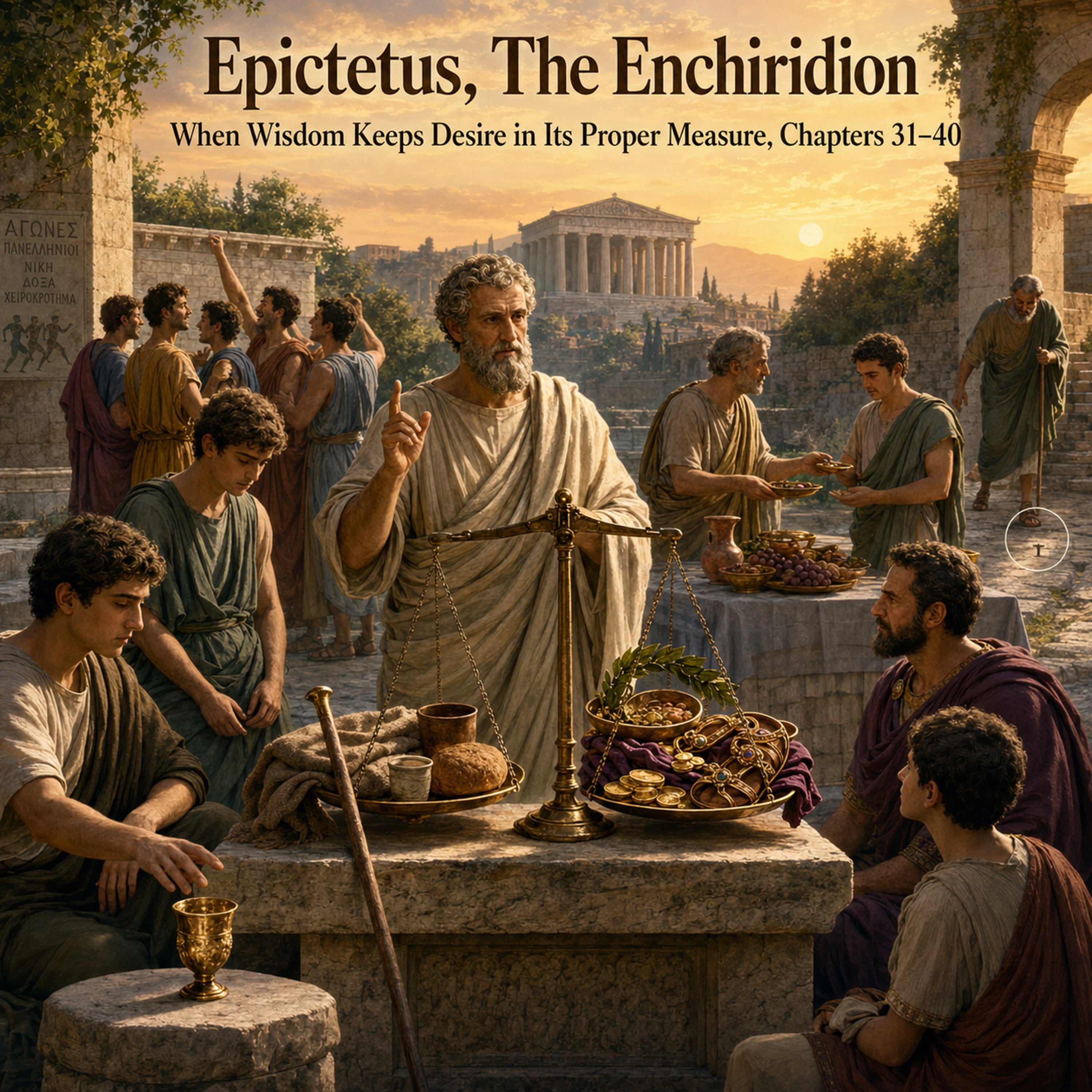
Epictetus, The Enchiridion - 04 - Chapters 31-40
from Wisdom for the Present: Western Wisdom Literature Hosted by Kanu Emeruwa
Imagine sitting in your car or at your desk, watching a stock chart plummet, waiting for a dreaded email from your boss, or endlessly refreshing an anxious news feed. Your chest tightens, your breathing becomes shallow, and a visceral wave of dread washes over you. Though our surroundings have changed, this physiological panic is identical to what an ancient farmer felt waiting outside a stone temple for a priestess's oracle. Epictetus’s ancient Stoic handbook, the Enchiridion, was written specifically to diagnose and cure this universal human dread. By looking into chapters 31 through 40 of this timeless work, we find a powerful mirror reflecting our 21st-century anxieties and offering a direct path to psychological freedom. The text begins by radically redefining piety, stripping away empty theological rituals and framing it instead as our fundamental relationship with reality itself. The core conflict of human suffering lies in our constant warfare with circumstance—our refusal to accept things we cannot control. We get angry, bitter, and resentful because we naturally hate what hurts us and love what benefits us, mistakenly attaching our definitions of "good" and "evil" to external occurrences. But as long as we demand that the universe conform to our personal preferences, we remain victims of circumstance, cursing the weather, the economy, or the politicians for our own internal unrest. In our digital age, this struggle is amplified by algorithms that feed our ego and flatter us into equating self-worth with external status—the ancient equivalent of polishing gilded, purple, and jeweled shoes. We are trained to curate an impressive online image, adopting a modern "fake it till you make it" mentality. However, the Enchiridion warns that assuming a character beyond our strength only demeans us, ensuring misery and giving rise to what we now call impostor syndrome. By trying to maintain a false, idealized facade for the public gaze, we abandon our authentic self—the very foundation from which we could actually grow and succeed. When faced with life's chaotic storms, our logic often breaks down as we suffer from "analysis paralysis," obsessively seeking more data, predictive models, and algorithms to shield ourselves from moral action. We treat data like modern divination, hoping a favorable prediction will make our difficult choices risk-free. The text warns that while we can use reason to solve data problems, we must not let the pursuit of information delay our moral duty. When we blindly walk into toxic environments, online arguments, or office gossip, we are walking barefoot through a construction site, driving a rusty nail directly into our "ruling faculty"—our ability to stay calm, rational, and composed. To reclaim our psychological agency, we must actively build our social armor and cultivate the "ruling faculty" of our minds. This requires radical authenticity, accepting our limits, and introducing physical friction to slow down our impulsive desires. Through mental exercises like the "time travel trick," we can contrast the fleeting, dopamine-driven pleasure of immediate gratification with the enduring, long-term satisfaction of self-respect. Ultimately, navigating the feast of life is a continuous balancing act: we must acknowledge our physical appetites while steadfastly honoring our social duties and moral integrity, ensuring we never let external chaos break our internal peace. In This Episode * Redefining Piety as Reality-Alignment: True inner peace comes from forming right opinions about the universe and ceasing our exhausting, futile war against external circumstances beyond our control. * The Paradox of Modern Divination: While we are flooded with predictive models and algorithms, our obsession with forecasting the future only amplifies our anxiety and leads to severe analysis paralysis. * Defending the Ruling Faculty: Our mind's capacity to reason and remain calm is our most precious asset; we must protect it from the "emotional contagion" of toxic social environments and digital gossip. * The Psychological Judo of Insults: Rather than fighting to defend our ego against criticism, we regain control by humorously acknowledging our flaws and letting go of the need for public validation. * The Danger of Gilded Shoes: Lifestyle creep and status seeking are infinite traps; once we decouple our possessions from basic utility, our desires and subsequent dissatisfactions become boundless. * The Trap of False Characters: Projecting an idealized persona beyond our true strength fosters deep impostor syndrome; radical authenticity and accepting our limits is the only path to true confidence. * Inserting Friction into Desire: To resist immediate temptations in an optimized, frictionless world, we must artificially design physical friction to give our rational mind time to reboot. Practical Reflection 1. In what areas of your life are you using the pursuit of more information or research as a "shield" to avoid taking a necessary, courageous action? 2. Where have you allowed social media algorithms or the expectations of others to "gild your shoes," driving you to seek status over utility and character? 3. The next time you find yourself in a toxic online or offline environment, how can you practice "psychological judo" or silence to protect your ruling faculty from stepping on a nail? Suggested Substack Excerpt Discover how Epictetus’s ancient Stoic handbook, the Enchiridion, provides a powerful psychological toolkit to cure modern anxiety, conquer digital distraction, and reclaim your internal peace in a chaotic world. AI Disclosure This episode was created using Google NotebookLM Audio Overview, based on human-curated source material, structured guidance, and editorial review. AI is used as a tool for clarity and delivery, not as a replacement for thoughtful study or engagement with the original texts. Copyright © 2026 Wisdom for the Present / Kamashcu Production Studios. All rights reserved. This is a public episode. If you would like to discuss this with other subscribers or get access to bonus episodes, visit wisdomforthepresent.substack.com
Embed this episode
No transcript yet.