
EPISODE · Aug 16, 2024 · 14 MIN
Episode 0.5: United States of America 1822-3
from History of Elections Podcast · host Mathew Nicolson
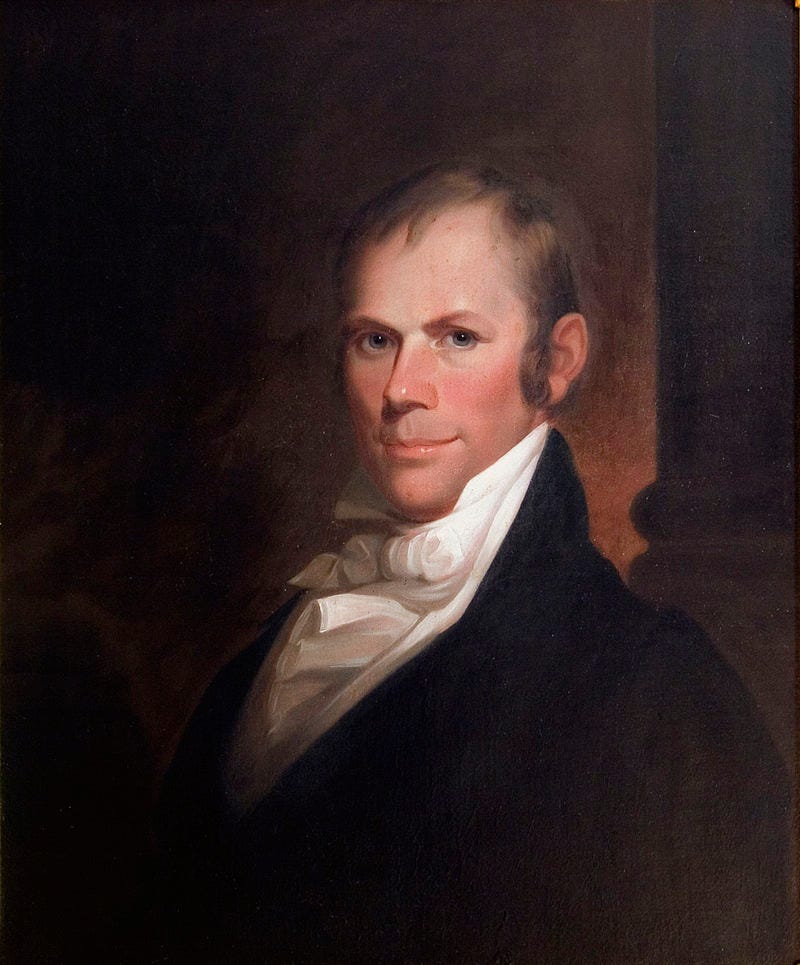
The 1822-3 United States House of Representatives election has hardly been remembered as the most exciting election in the country’s history. However, it represented an important moment in the transition between the first and second US party systems at the tail-end of the ‘Era of Good Feelings,’ and the representatives elected in these years would assume unexpected importance as kingmakers in the 1824 presidential election.Transcript:Mid-1822. Brazil formally declared independence from Portugal, which would itself in September adopt its first constitution; Greece won a number of victories on land and at sea in its independence war against the Ottoman Empire; King George IV became the first British King to visit Scotland for 171 years; Jean-François Champollion announced his success in using the Rosetta Stone to translate ancient Egyptian hieroglyphics; Charles Babbage published a proposal for creating a ‘difference engine,’ a predecessor to modern computers; and voters in the United States of America began the year-long process of electing the next House of Representatives.Despite the wishes of several of the United States’ founding fathers, it did not take long for political partisanship to enter the new constitutional structures established after the American Revolution. From the very beginning the House of Representatives divided itself into pro- and anti-administration groupings, which by the middle of the 1790s began to coalesce into more formal political factions. The Democratic-Republican Party – no direct relation to either the modern Democratic or Republican Party, although often known contemporaneously as simply the Republican Party – was initially led by Thomas Jefferson and grew out of the opposition to inaugural president George Washington. The Democratic-Republicans advocated a decentralised form of agrarian democracy held up by ongoing western expansion. In opposition to the Democratic-Republicans was the Federalist Party, led by Alexander Hamilton (of hit musical fame), which campaigned for a centralised banking system and closer relations with former colonial power Great Britain. With most support in the north-east, the Federalist Party tended towards a more anti-slavery position than their Democratic-Republican opponents.During the United States’ first decades these two factions traded control of the Presidency, House of Representatives and the Senate – the legislature’s upper house. However, after Thomas Jefferson’s election victory in 1800, defeating incumbent Federalist President John Adams, the Federalist Party entered into a period of sustained decline. The Federalist Party would never win another election from this point onward, and while its decline was not a linear downward slope – it enjoyed brief recoveries in the 1808-09 and 1812-13 House elections – the party remained a marginalised opposition force for the rest of its existence, holding on to power only in its Massachusetts base. It contested its last presidential election in 1816 and allowed Democratic-Republican President James Monroe to win re-election effectively unopposed in 1820.This period of political dominance by the Democratic-Republican Party, only strengthened after the War of 1812 against Britain, has become known as the ‘Era of Good Feelings.’ The Federalist Party became further discredited in public opinion across much of the US for its opposition to the war. James Monroe’s presidency between 1817 and 1825 was also marked by attempts to bridge the past partisan divides and promote national unity, although he refused appeals to appoint Federalist members to his cabinet. Monroe openly called for an end to partisan politics, including his own party, and so actively strove to weaken the Federalist Party’s remaining areas of influence. However it would be naïve to view this ‘Era of Good Feelings’ as devoid of political conflict: questions over the extent of federal government power, an economic crisis in 1819 precipitated by a collapse in cotton prices and the expansion of slavery in new western states all continued to draw out political divisions. The latter issue in particular, brought to the fore by the question of Missouri’s admission to the union, exacerbated sectional conflict between the north and south, a warning sign of the republic’s key faultline that would result in civil war 40 years later. The question was temporarily resolved by the Missouri Compromise of 1820 which maintained an equal balance between free and slave states and drew a horizontal line down the western frontier to divide future states between those permitted to practice slavery and those required to be kept free.Former President Thomas Jefferson accused the Federalist Party of using the issue of slavery as a means of dividing the Democratic-Republican Party, but the division remained more strongly between northern and southern politicians than between the two parties. This coincided with a general demographic and political loss of power for southern states, which had played a dominant role in US politics from independence; by 1820 New York had surpassed Virginia as the state with the largest population. As the ‘Era of Good Feelings’ culminated in the early 1820s, these political cleavages therefore remained distinctly non-partisan, as the midterm elections to the House of Representatives in 1822 and 1823 demonstrated. The elections took place across a period of over 13 months, with each state determining its own electoral calendar. Louisiana went first, electing its three representatives in July 1822, while voters in Alabama, Tennessee and North Carolina had to wait until August 1823, with all other states falling inbetween. Six states would not even hold their elections until after the beginning of the congressional term in March 1823.The 1822-23 election was also the first to be held after the 1820 census, which led to a substantial increase in the House of Representatives’ size, growing from 187 members to 213, an increase of 26, much of which came from the western states. Northern states also benefitted, New York alone gaining an additional 7 representatives. The new state of Missouri also participated in an election for the first time since its admission to the union the previous year, electing one member of the House.While less autocratic than many of its European counterparts, United States could not be described as a fully democratic state in the early 19th century. The majority of residents did not have the right to vote, most notably women and enslaved people. Specific suffrage rules were decided state by state and, although there had been some expansion to the franchise since American independence, by 1822 many states still based voter eligibility on property or taxation requirements.This focus on wealth or property meant that upon independence a small number of free African American men held the right to vote, although an increasing number of states began introducing explicit racial as well as gender bars on the right to vote by the beginning of the 19th century. As Native Americans were considered citizens of their tribes rather than the United States, none had the right to vote in US elections in this period. In this regard the United States fell behind many of the newly-independent Latin American states, which were less inclined to implement racialised voting restrictions.The result was entirely unsurprising: another landslide victory for the Democratic-Republicans, who secured their twelfth successive majority in the House of Representatives, picking up 34 additional seats to win 189 in total. The Federalists dropped by eight seats, falling to 24, or just over ten percent of the chamber. The Democratic-Republicans gained additional seats across the entire country and asserted particular control over the new western seats, winning every district west of North Carolina. Federalist support, such as it was, remained confined to isolated pockets concentrated in the north-eastern states of Maryland, Delaware, Pennsylvania and Massachusetts. Though unsurprising, the scale of the Federalist defeat was nevertheless remarkable. With almost 90% control over the House of Representatives, the Democratic-Republican Party enjoyed a political dominance unprecedented for any party or faction at any other point in American history. The party’s net gain of 34 seats remains a record for any governing party during a midterm election. The Democratic-Republican leader in the House, Henry Clay, was easily elected as the House Speaker, a position he had previously held on two past occasions.1822-3 was also the last midterm election held during a President’s sixth year in office before the advent of a phenomenon referred to by political scientists as the ‘six-year itch.’ From 1834, the President’s sixth-year midterms consistently produced a net loss of seats in the House for the governing party, a trend subsequently only broken once in 1998, when Bill Clinton was able to avoid a midterm setback in his sixth year as President. This trend was repeated in the Senate, at this time elected indirectly by state legislatures. The chamber had grown from 46 seats to 48 with the addition of two senators from Missouri. As in the House, this addition benefitted the Democratic-Republicans, who grew their delegation from 38 seats in 1821 to 44 seats by the end of the electoral cycle in 1823. The Federalists were reduced to just three Senators, all from the north-east. Among the incoming Democratic-Republican Senators was Andrew Jackson, a renowned general who had previously held Tennessee’s Senate seat for a brief period in the late 18th century and who intended to use the federal office as a springboard to campaign for the presidency.The Federalist Party would never contest another election at the federal level, although neither would the party immediately die. It remained active in Delaware and Massachusetts politics, periodically controlling legislative chambers in the two states and successfully electing one of its members as Boston mayor in 1829. Nevertheless, the Federalist Party, once the party of government in the United States, became increasingly irrelevant and would formally disband in 1835, most of its remaining members joining the newly-formed Whig Party.In addition to witnessing this historic political dominance by the Democratic-Republicans, the Congress elected in 1822 and 1823 would come to have unexpected political significance for the United States. It was the Congress which received President Monroe’s state of the union address in 1823 outlining the United States’ opposition to efforts by European powers to regain influence in the Western hemisphere, having given diplomatic recognition to the newly independent Latin American states. This major tenet of American foreign policy in the coming century would become known as the Monroe Doctrine. More directly, the House of Representatives would end up playing a key role in the 1824 presidential election. With the Federalist Party in a state of disintegration, competition in this election came entirely from within the Democratic-Republican Party. For the first time more than two major candidates contested the election, with four candidates running credible campaigns. They included John Quincy Adams, son of former Federalist Party president John Adams and incumbent Secretary of State; Andrew Jackson, Senator and renowned general; Henry Clay, incumbent Speaker of the House; and William Crawford, incumbent Treasury Secretary.As a result of this multi-cornered contest, no candidate won a majority of the popular vote or, more importantly, the electoral college. Andrew Jackson emerged with a plurality of both but with just 99 electoral college votes fell short of the 131 required for a majority, only slightly ahead of his main competitor John Quincy Adams, who won 84 electoral college votes.In the event that no candidate could secure an electoral college majority, the US constitution mandates the House of Representatives to hold a contingent election among the three highest-ranking candidates to choose the next President, while the Senate votes to elect the Vice-President. A contingent election had previously taken place in 1801 as a result of an electoral college tie. In an additional constitutional quirk, the House does not vote in contingent elections using a simple majority system but instead through state delegations voting en bloc, thereby equalising the voting power of each state.The contingent election was held in February 1825, one of the final acts of the House delegation elected in 1822 and 1823. Representatives chose between Jackson, Adams and Crawford, Clay having been eliminated after finishing in fourth place. Clay strongly encouraged his supporters to back Adams and as incumbent Speaker made use of his institutional knowledge of the House, helping to swing the vote away from Jackson. As a result, Adams received 13 votes on the first ballot, against seven for Jackson and four for Crawford, a majority of one state delegation. Notably, Adams picked up significant support in the north-eastern states and in New England, former Federalist strongholds which had ensured victory for his father 28 years earlier. He also gained votes from representatives in the west, including states like Kentucky where he hadn’t even appeared on the ballot during the popular vote, thanks to support from Clay and his backers.John Quincy Adams was thereby elected President as a result of his support in the House of Representatives. Vice-Presidential candidate John Calhoun, incumbent Secretary of War, had been backed by both Adams and Jackson and so easily gained an electoral college majority, preventing the need for a contingent election in the Senate.The House’s decision briefly threatened to trigger civil conflict. Jackson condemned the ‘corrupt bargain’ between Adams and Clay and could have utilised his support from militias and within the military to force his position, although he ultimately made a more populist appeal to ‘the people’ to ‘correct any outrage upon political purity by Congress,’ lest they become ‘the slaves of Congress and its political corruption.’ However, there were no significant protests or revolts against the House’s decision, and Jackson soon focused his attention onto the next presidential election scheduled for 1828.1824 would be the second of three contingent elections conducted in US history, the third taking place in 1837 to determine the Vice-President. 1824 is also to date the only presidential election in which the candidate who won the most electoral college votes did not become President. Andrew Jackson’s bitterness at his defeat in the House of Representatives and determination to continue his political campaign would split the Democratic-Republican Party, forming the contours of a new emerging party system divided between Jackson’s supporters and opponents, ultimately propelling him to the presidency four years later.Hardly remembered as a standout election in US history, the 1822-3 congressional midterms were perhaps surprisingly significant. The final election of the increasingly non-partisan ‘Era of Good Feelings,’ voters granted the Democratic-Republican Party the largest federal landslide for any party or faction in American history. The House of Representatives elected throughout these 14 months then developed extraordinary influence during the 1824 presidential election, assuming a kingmaker role for the second and to date final time. Its decision to deprive Jackson of the presidency would have drastic results for the republic’s future political development. The elections of 1822-3 can be seen then as part of a bridge between what historians have identified as two separate party systems. They comprised one of the final federal elections of the first party systems while contributing to the birth of the second party system, which would last until the years preceding the American Civil War in the 1850s.And the Speaker elected to preside over the House of Representatives in 1823, Henry Clay, would continue to have a full and varied political career. After losing out on the presidency in 1824 he served four years as John Quincy Adams’ Secretary of State – the ‘corrupt bargain,’ as Andrew Jackson famously and influentially described. He then returned to the Senate, representing Kentucky between 1831 and 1842 before contesting a second presidential election in 1844, once again losing out on the top position, this time to James Polk. Clay would then return to the Senate yet again for a final stint from 1849 until his death in 1852, playing a key role in political compromises surrounding slavery, rounding off a career in which Speaker of the House formed just one of many political accomplishments.Reading listFoner, Eric, Give Me Liberty! An American History (New York, 2014).Kensmind, ‘Mid-Term Elections: 1822,’ Presidential History Geeks (21 January 2022), accessed on 27 December 2022 at https://potus-geeks.livejournal.com/1403047.html. Nester, William, Age of Jackson and the Art of American Power, 1815-1848: the Art of American Power During the Early Republic (Sterling, 2013).Music: Immerse by Monument_Music, licenced under Pixabay Content Licence. This is a public episode. If you would like to discuss this with other subscribers or get access to bonus episodes, visit historyofelections.substack.com
NOW PLAYING
Episode 0.5: United States of America 1822-3
No transcript for this episode yet
Similar Episodes
Mar 26, 2026 ·1m
Mar 19, 2026 ·34m
Feb 18, 2026 ·11m
Feb 11, 2026 ·45m