
EPISODE · Jun 4, 2026 · 46 MIN
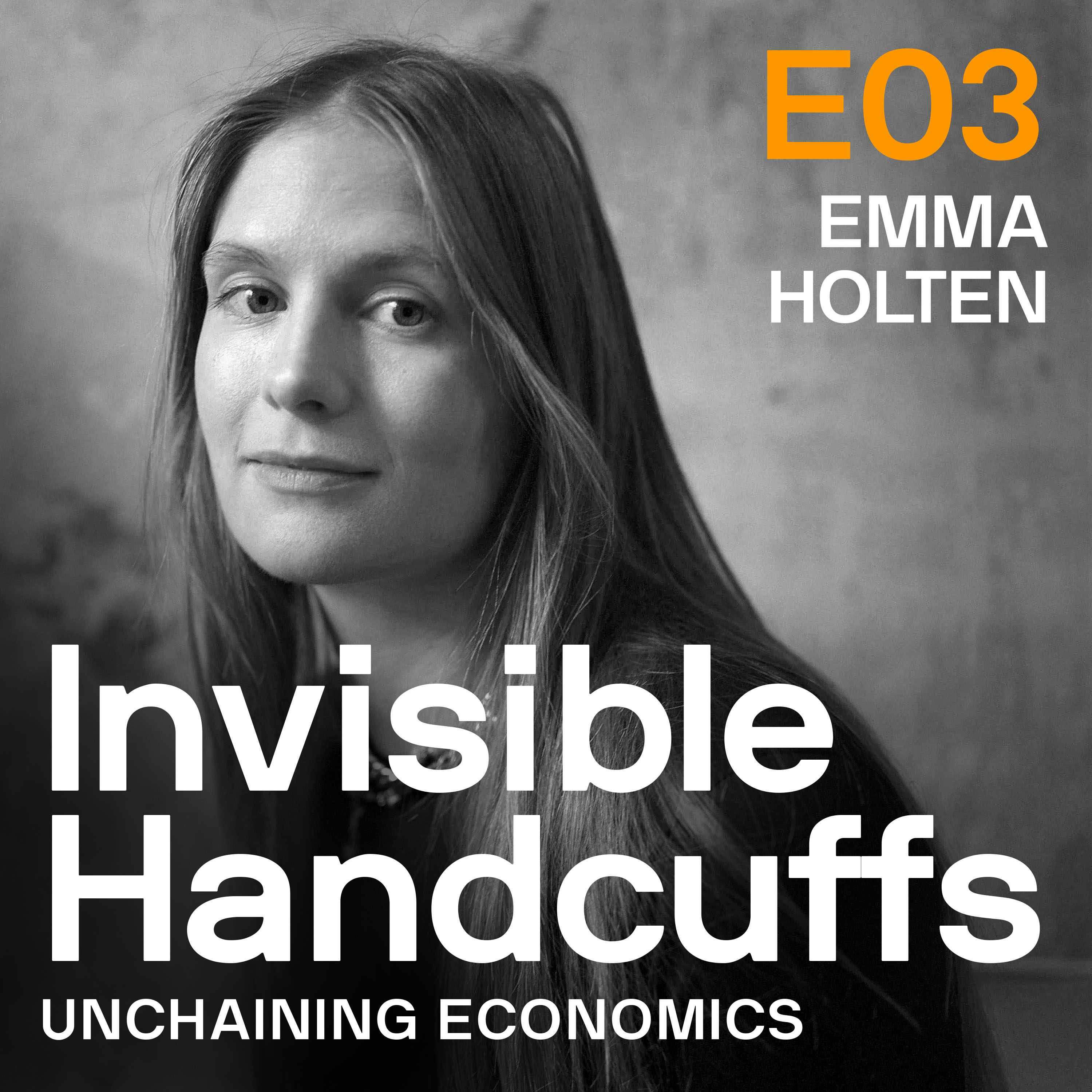
Episode 03: Why the fight to reclaim economics needs feminist economists with Emma Holten
from Invisible Handcuffs: Unchaining Economics · host Katy Shields
My guest this week is Emma Holten. Emma is a feminist economist from Denmark and the author of a best-selling book, Deficit. Feminist economics, as Emma explains, is the study of the unhidden but vital work of ‘reproduction’ - that textured, often unquantifiable work that goes into making everything else in life, including economic life, possible: care, repair, love, friendship, compassion. But, that which doesn’t lend itself to being monetised and moulded into the kinds of models used by economists today, which have to prove their contribution to economic growth, but without which, no economic growth would be possible. Emma was motivated to become a feminist economist after a life-saving stay in hospital made her acutely aware of the value of care that is so fundamental to human survival, let alone economic survival, but often missing from economic models. As she put it, every euro she earned and contributed to economic growth following that week is directly attributed to the care she received, often from nurses on close to minimum wage. In this interview we talk about the ‘origin story’ of modern economics, starting in the enlightenment era and how early (male) economists wanted to be able to make clean and neat rational models just like the Newtonian physics. The messy work of care, mostly done by women, didn’t make the cut. More intriguing - and importantly - though is how this is upheld today, how we have arguably gone backwards in the past decades, as neoliberal ideology has captured mainstream economics. Models like cost-benefit analyses, used across government departments, are predicated on being able to prove the short-term, upfront ‘return on investment’, not the longer-term, often hard-to-measure but crucial benefits of reproduction. Even where care work is paid, thanks further injustices hidden in our economic systems and models, it is often underpaid. This is possible partly because, enabling more (white) women to ‘join the professional workforce’ has required a hidden army of unpaid or underpaid (black, brown, migrant) women taking on the work of care. As such, the very ‘liberal’ movement that was meant also to liberate women and minorities, ends up reinforcing these very injustices. We end by discussing reactions by the economic mainstream. How, thanks to a generation of economists who have been schooled only in the orthodoxy, such economists are not used to have their assumptions challenged - leading to quite wild reactions to Emma’s book. Challenging these assumptions, Emma says, requires all hands on deck - within and outside of the heterodox economics movement. Find out more about Emma’s work here: https://www.emmaholten.com/ You can listen to our first two episodes and find out more about our project here: https://www.invisiblehandcuffs.com/
Embed this episode
Ready to play
Episode 03: Why the fight to reclaim economics needs feminist economists with Emma Holten
No transcript for this episode yet
Similar Episodes
No similar episodes found.