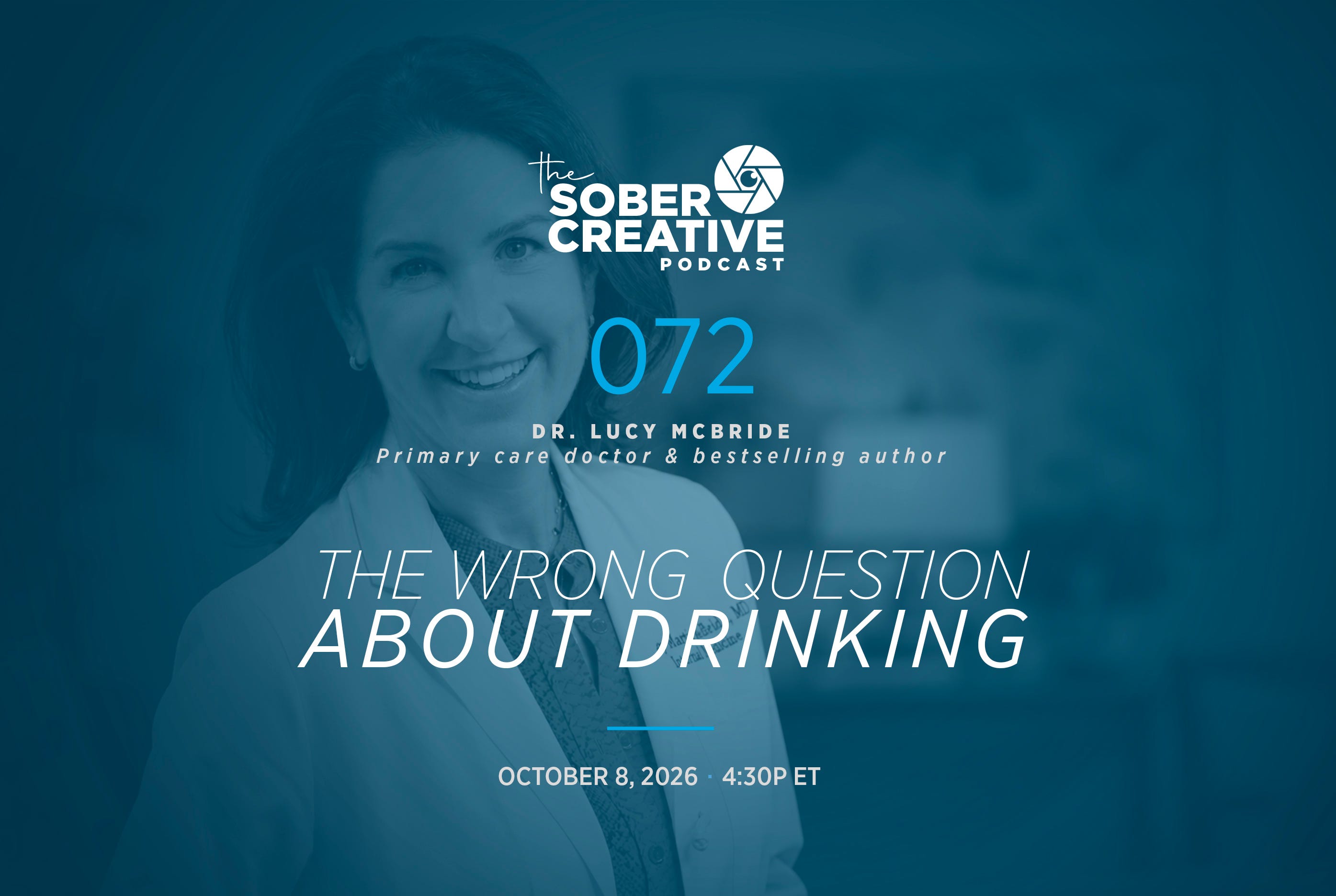
Episode 072 - The Wrong Question About Drinking With Dr. Lucy McBride
from The Sober Creative Podcast Hosted by Josh Woll and Dr. Lucy McBride
Most of us know the moment. You’re at your annual checkup and the doctor asks how many drinks you have a week. You give a number, they type it in, and the appointment moves on. Dr. Lucy McBride has spent 25 years as a primary care physician in Washington, D.C., and she thinks that question barely scratches the surface. Alcohol has been part of her life from many angles. Her dad has been sober since he was 50. Her husband has struggled with his relationship with alcohol. Her late brother struggled with it at various times in his life. She also knows her own pull toward a drink at the end of a hard day. In this conversation, Lucy explains why normal lab work can hide a relationship with alcohol that’s causing harm. She talks about why some of her patients find out their drinking was never a willpower problem, and why she once wrote “self-compassion” on a prescription pad. She also opens up about her creative side: a lifelong journaling habit, a love of clothes she picked up from her mom, and a neighborhood consignment shop where everyone knows her name. Show Notes [0:00] A Book for People Who Don’t Know Who to Trust * Lucy’s first book, Beyond the Prescription, came out in August with Simon & Schuster and has done better than she ever expected. * She wrote it for the person who feels let down by the medical system and drawn in by the wellness industry, and who doesn’t know how to make sense of it all. * With the publicity rush winding down, she’s sleeping well, back at yoga and feeling calmer and more present. Key Insights: “It’s not a do as I say book. It’s a here’s how to think about your health book in a nuanced way.” [4:12] A Family Shaped by Alcohol * Lucy’s dad was a highly functional drinker who went to work every day but “had a real problem.” He has now been sober for more than 30 years. * She doesn’t drink much by “a doctor standard.” Even so, every time she has taken a break from alcohol, she has noticed its effects on her digestion, clear thinking and patience with people. * She doesn’t count her own lack of struggle as a moral win or a sign of better willpower. * Her patients cover the whole range, from people for whom one drink a week is one too many to social drinkers who wonder why she’s asking at all. Key Insights: “the key for anyone who’s thinking about their alcohol use, as I know everybody here on this call knows, is radical self-awareness of what it does for you and what it doesn’t for you.” [9:04] What “How Much Do You Drink?” Misses * The insurance system pays for transactions instead of conversations. Doctors get about 15 minutes per patient and, according to the data, interrupt patients within 11 seconds. * Lucy says your relationship with alcohol matters as much as the amount. If you drink five times a week to cope with uncomfortable feelings, or the drinking affects your sleep, blood pressure or relationships, that’s worth talking about. * Shame, blame and absolutism are the reasons many people don’t tell their doctors how much they drink. * Some lab markers can point to alcohol, like a high MCV (red blood cell size). But liver tests can be completely normal in a heavy drinker. * Legal and socially acceptable doesn’t mean safe. Lucy points out that alcohol carries a far greater breast cancer risk than hormone replacement therapy ever did. Key Insights: “Is it possible that the alcohol you’re consuming is contributing to your, you know, blank, blank, blank, GI distress, migraine headaches, sleeplessness?” [16:44] Addiction, Biology and GLP-1s * Lucy sees addiction as one big continuum. She separates it from dependence, which is when you need the substance to function. * She uses the biopsychosocial model: addiction can have biological, psychological and social roots, and the mix is different for each person. Knowing the roots helps you pick the right intervention. * She prescribes GLP-1 medications off-label to five or six patients to reduce alcohol cravings. They don’t work for everyone, and they aren’t FDA approved for alcohol use disorder. * For people who do respond, the medication shows them their struggle was biological. Patients using GLP-1s for food describe finally feeling like they’re not walking around “with a tiger on a leash.” Key Insights: “What it shows people is that their alcohol overuse, dependence, tolerance, addiction, before the GLP one, wasn’t a willpower problem to begin with. It was biology, right?” [24:08] Slowing Down the Reach for a Drink * Many people who drink more than they’d like haven’t looked closely at the feelings underneath, often because the alcohol gave those feelings a handy place to park. * Lucy asks patients to slow down the moment between feeling like they need a drink and grabbing it, and to notice what’s happening in their body and mind. * Some patients find the question strange. Others say they’ve never thought about it. Either way, she says, “That’s where the insight is born.” * She describes health as bringing together the conscious and unconscious mind. Doing that work is where agency comes from. Key Insights: “I mean, our thoughts and our feelings drive our behaviors. Our behaviors drive our health.” [28:44] Coping Tools That Help * Self-compassion first. Lucy told a patient who was caring for her elderly mother, drinking more and blaming herself to “give yourself a break, my friend.” * Exercise doesn’t have to be fancy. “The best exercise program for you is the one that you will actually do.” * Community matters. Lucy believes loneliness and alcohol feed each other, and she encourages even introverts to build routines around social time. * She also strongly supports therapy, AA and Al-Anon, which have helped many of her patients and members of her own family. Key Insights: “I said, what you need first and foremost is self-compassion.” [34:57] Writing, Clothes and Creativity * Lucy has kept a journal since she was a kid. Writing things down made her thoughts less overwhelming and kept them from “pinging around like a ping pong wall.” * She loves clothes as self-expression and an art form. Her mom made the family’s clothes and ran a small clothing business. * She never shops with a list: “I’m like a canvas that I’m always like painting on.” * She grew up around creative people, majored in art history, and sees art and music as ways to be in the present moment. Key Insights: “Writing is my way of taking the noise in my brain and all the subconscious noise that bubbles up and processing it and thinking it through.” [38:48] Better Questions for Yourself and Your Doctor * Lucy calls her book “a library of questions” to ask yourself and your doctor, so you get more out of a short appointment. * It helps you take stock of your own story, including the things you’re embarrassed to say out loud, and bring a more honest picture of yourself to the doctor’s office. * Her biggest hope is a healthcare system where everyone has a primary care provider “who knows their name, not just their diagnosis codes.” Key Insights: “But it starts with asking yourself the right questions and asking the right questions to the people responsible for your care.” Key Quotes “There’s no moral prize for being sober.” - Dr. Lucy McBride “But I am very aware of the gravitational pull of alcohol when you’re feeling exhausted or stressed or anxious.” - Dr. Lucy McBride “You can be completely normal in lab work and have a relationship with alcohol that is problematic, wobbly, causing harm.” - Dr. Lucy McBride “I think loneliness drives alcohol overuse. Alcohol use drives loneliness.” - Dr. Lucy McBride “So my argument really is that health isn’t about having all the answers.” - Dr. Lucy McBride Resources Mentioned * Beyond the Prescription: A Doctor’s Guide to Taking Charge of Your Health by Dr. Lucy McBride * Are You Okay?, Lucy’s free weekly Substack newsletter * Beyond the Prescription podcast * The biopsychosocial model, a way of looking at the biological, psychological and social roots of a health issue * GLP-1 medications (Ozempic and Zepbound) * Dr. Vivek Murthy, former U.S. Surgeon General, and his work on the loneliness epidemic (also on S… This is a public episode. If you'd like to discuss this with other subscribers or get access to bonus episodes, visit newsletter.thesobercreative.com/subscribe
Embed this episode
No transcript yet.