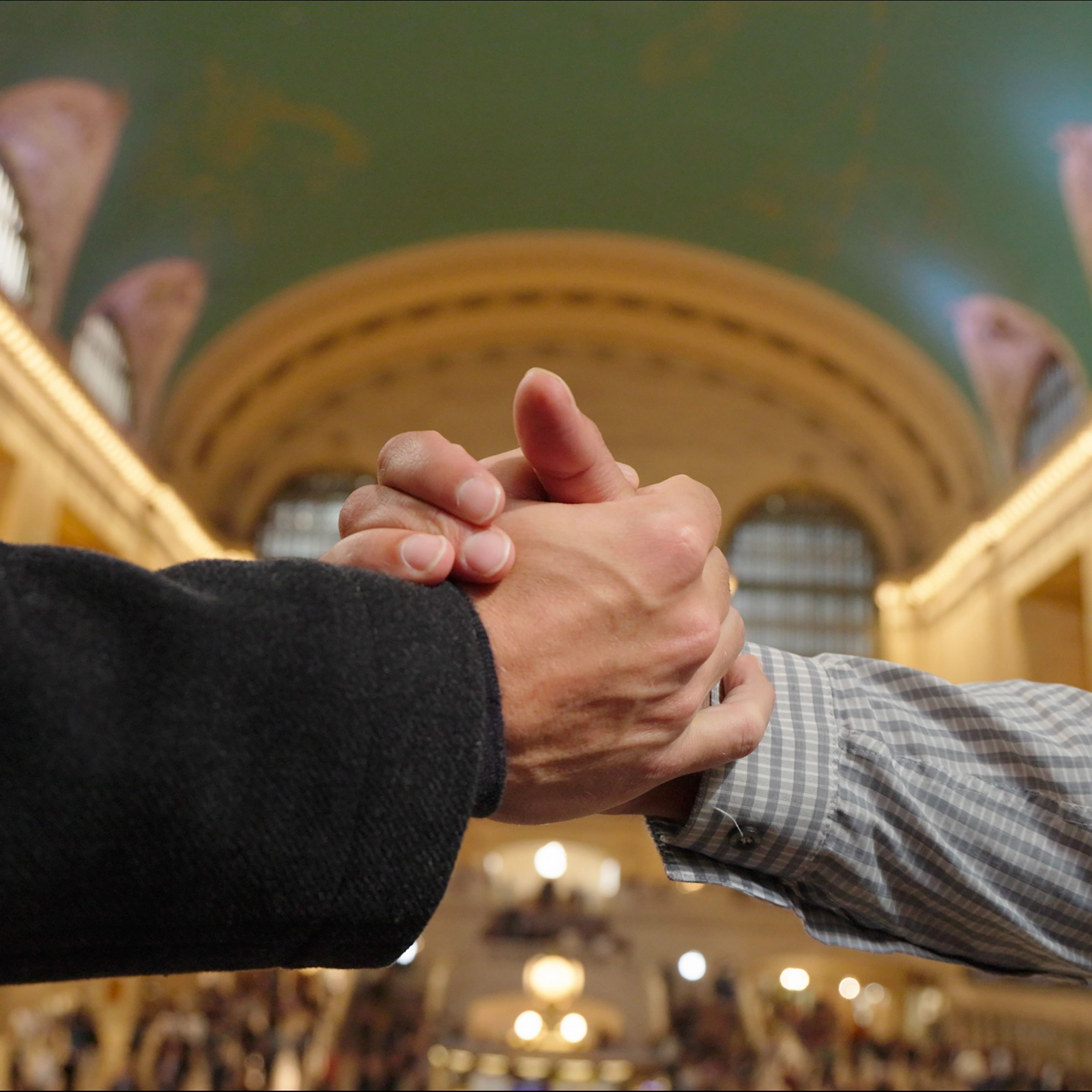
New York is a monster of a city, the tallest, the biggest, the best, the worst, the most, as if it's constructed from superlatives. New York's power for better or worse has always rumbled across the country, across the oceans. Just the idea of it can be intimidating. But then you start talking to New Yorkers, and you realize their lives, their concerns, are regular-sized, human-scale. Like this guy I'm at, Christopher Santana.
He works at Grand Central. Either you've been to Grand Central or you've seen it in the movies. It's a huge train station with the glorious painted ceiling of zodiac constellations and a lot of brass everywhere. I'd gone there with a photographer who's doing a project for the New York Times about the jobs that only exist in New York City. Chris Santana's job is to polish the brass at Grand Central.
A job that's unfinishable, because the polish doesn't last. A brass handrail, forget it. Fingerprints. Are you going to kill the next person who puts their hand on this rail? Oh, God.
I try not to look at the areas I did the next day, because then I'm going to be really upset. Is that true? Yeah, I don't. I try not to. But Chris likes this work.
It's relaxing, he said. Gives him time to think. Because let's face it, polishing brass is kind of boring. Only slightly less boring than explaining how to polish brass. It's like a lot of rubbing.
It's a lot of, you know, it's cleaning. So it's a lot of rubbing and a lot of, well, we could say polishing. It's a lot of polishing. I mean, what was I expecting? Though, I will say, as someone who's polished a lot of brass myself, I used to work in an antique store, one thing did interest me, which is that he doesn't use a rag or anything to put the polish on the brass.
He wears one of those thin surgical gloves and then rubs the polish on the brass directly. It's about you're using your hand. Yeah, yeah. Yeah. I got really strong hands, but funny enough, my handshake sucks.
What do you mean your handshake sucks? I have a strong grip, but I don't have a good handshake. Why not? I don't know. This is Santana, a son of Brooklyn, caretaker of one of New York City's grand Pacific monuments.
This is what he's wearing about while polishing brass at Grand Central. I don't know what it is. Oh, maybe I just don't want to. Sometimes somebody will catch me with garden. I have small hands so maybe that?
That could be it. What? I don't make any sounds like this industrial phenomenal. No. What it is, if you got a guy with bigger hands, it's going to swallow your small hand.
So, yeah, you know what it sounds like? You have feelings about your hands and that's making your head set. So I'm hoping you'll ensure about your handshakes? Yeah, so I developed a little workout where I grab a broomstick and turn it like this. And what it does is strengthens the areas around the wrist so when you give me a handshake and I can get you before you get me.
I think of a handshake as a gesture of goodwill toward my fellow man. Chris thinks of it as a quick draw contest, Mano Amano. You've got to get to the grip before the other guy does. If you don't get to the grip, you're screwed. Like, you want to just show some type of, like, I don't know if you've ever seen President Trump the way he shakes somebody's hand.
He's a huge guy, but he pulls you right in. Like he'll pull you in. Yeah. Chris mentions this a few more times as he works on the handrail along a side staircase. His little hands, his wrong handshake.
Well maybe the forearm workout he gets polishing the brass will improve the handshake. There's another guy who polishes the crand central. Alvin, great guy, big forearms. His forearms are huge. His handshake?
Solid. Once Chris is done with the handrail, we practice. Hi, I'm Sarah. Yeah, but no, you're doing that on purpose. You're doing what on purpose?
Shake me. Let my body shake. No. Wait, what? Do we get it?
Oh my God, how you paying? How's everything? Okay. Yeah, I know my handshake is firm. It's his handshake that's the problem.
Next he tries putting both his hands on my hand. Overly intimate. That's weird. We try a third time. Alright, so if you're just like, hi, I'm Sarah.
And he does the Trumpy thing of trying to pull me toward him. No, but you wouldn't do that. No, but I'm doing normal. I'm saying do normal. Hi, maybe it's the finger.
That's what's weird. Okay, there you go. He's extending his index finger along the bottom of my wrist instead of tucking it into the shake. It's the finger because I'm always shaking. Guys, men.
You do that with your finger? Yes. No, don't do that. Nice to meet you. Where's your finger?
Oh, that's better. What happened? I got the grip and now I can show you like, hey, I'm the man, I'm gonna hire you. I'm boss. Maybe you relate to Chris's testosterone and handshake problem.
Maybe you don't. But if you don't, I guarantee there's some New Yorker and Grand Central right now who's worries you can relate to. Mathematically, that's gotta be true. It's what I love most about New York. And it's why we're making this new show called Metro, all about New York City.
The sheer size of New York City means that every kind of person is here. Every kind of American weirdness. Every kind of American conflict. Every concern. Check out the things New Yorkers talk about in bars, for instance.
In Bedside, Brooklyn, at the Tip Top Barn Grill, the longtime manager is worried about the cost of living. The final point is in 20 years, if you ain't rich, you ain't gonna be in New York. I'm gonna go in the whole other way. At an Irish pub on the Upper West Side, the worry is crying. That's my big issue.
Safety. New York, Manhattanites, your targets. Every day you read about something going wrong on the subway. Somebody getting pushed. Somebody getting attacked.
Somebody getting slashed. She pushes me one more time. I'm gonna punch her. He's talking about a waitress who's trying to keep the aisle clear. Downtown in the West Village at Johnny's Bar, the owner is worried about the city changing around him.
His customers seem younger, corporate. They talk about golf. Nobody even comes in until after 5 o'clock. It's been weird in the daytime. Empty.
He tells my colleague Janelle Pfeiffer, the day drinker is vanished. But it's a dying breed, you know. Is that bad that day drinking is happening, Liz? Um, gently he sidesteps Janelle's question. Some people were just lonely, he says.
You know how lonely New York can be. Yeah, Janelle says. Right now, I would like to have more sex than I want. At an ad hoc meetup in Tribeca, people are worried about how much sex they're having. But in truth, I'm not really feeling like I want that much.
So in reality, I am content with the amount of sex I'm having right now. However, I'm not content with the desire that I'm not having. Or I guess they're worried about not being worried about how much sex they're having. We want to want to want to. Exactly.
Yes. I recently read Jonathan Mahler's book, The Gods of New York, about how a series of crises in the late 80s melted what he calls the city's civic glue. During the era that launched Spike Lee and Larry Kramer, Al Sharpton, Rudy Giuliani, Donald Trump, the city's common identity cracked apart. Quote, the promise of New York had always been the promise of America. It was, in aspiration, if not always in reality, the place that proved the value of the American experiment, a place where anyone belonged and could succeed.
In the span of one generation, you could rise from tenement war to park avenue rich. After the late 80s, Mahler writes, that version of New York withered. Quote, a city that had once aspired to provide a safety net and foothold to all of its residents became a gladiatorial arena for those with the biggest appetites, the loudest voices, and the most outsized ambitions. Mahler, who writes for the New York Times magazine, argues that what happened to New York in the late 80s foreshadowed the transformation of the broader nation. New York saw it all first.
I'd argue that New York is again at a crossroads. It feels like something is happening here. The Knicks won the NBA Championship after 53 years. Murders and shootings are at their lowest numbers in recorded history. The town that brought you junk bonds and Donald Trump has now elected a socialist mayor.
I'm very honored. I'm mayor. I'm mayor. Sorry. I'm not here.
Who wants to make buses free and housing cheaper? The watch word of his campaign was affordability, a term that pinballed across national politics once it landed in New York. Over the next decade, city government will build 200,000 new affordable mensory. Are you famous, mayor? I don't hate them.
Whether the new mayor will succeed, whether New York can ever again become a place where a normal person can live a normal life on a normal salary, whether this really is a crossroads for the city, or more just talking, I don't know. I got no expertise here. I'm just a second generation New Yorker with a feeling. But what I do have is tantalizing proximity to people who are experts, the reporters who cover New York City for the New York Times, the Metrodesk. Cereals part of the Times, we work out of the huge New York Times building in Times Square.
And so we thought, oh, that's audio people are sitting right here. Those Metro reporters are sitting right over there. We should team up and make a show about New York. We're really about New Yorkers. For months now, we've been hanging around the Metrodesk and going out on stories with Metro reporters, tagging along while they cold call and doorknob.
They brought us into all these different worlds. Hi, sorry about you. My name is Jan and I'm a reporter with the New York Times. I was looking for a let me. Jan Ransom was working on the definitive story of Jeffrey Epstein's death inside the Metropolitan Correctional Center, MCC.
OK. And I just let me try to have the right let me. He was the former Warden at MCC. Let me it's not home. The woman at the door doesn't want to be rude, but there are dogs inside, pawing at the door, who will be all over Jan if she opens up.
Oh, Lord, I don't want to. I'm just going to fly away the blow way. I was going to put it under the bat. She leave a note in her business card for the former Warden. Maybe he'll call.
Hi, Father Mann. A reporter Nicole Holling is on the phone with a Catholic priest in Queens. If you're with my colleague outside your door right now, we're just... The priest is a friend of Donald Trump's. He's rumored to have helped secure clemency for private equity executive convicted of major fraud.
Please leave. I just want to understand. I'm not interested. Yeah, I understand. I just want to let you know.
Dion, come in here. Hi, how are you? Nice to meet you. At an art gallery, Dion's seriously schmoozing at an event put on by fashion magazine. Great.
I'm a person of color in New York. And so I'm just kind of coming to me just to see who's here and see what people are talking about really. I just bought a huge house in Newport, Rhode Island. You did. Oh, that sounds really nice, says Dion.
I have a lot of great houses. I have a castle and great bearing. You have a castle? By Stanford White. Wow.
That's incredible. What are you doing in the castle? Do you have any decorate? Live. Enjoy it as 80 acres in the middle of town.
Have a seat tonight for three. Big national stories about crime, politics, corruption, extreme wealth. In New York City, those stories often happen to be local stories, metro stories. Other times, a metro story really is just local, with its own specific New York smell. Looking for a company called Super Plumbers.
Super Plumber. Yeah. Me, here's a very, is logging serious hours, traipsing all over the city. Looking for a mysterious plumber who has worked a truly mind-boggling number of overtime hours for the public housing system. And Me, here, cannot let it go.
There's one plumber putting for more than 2,500 hours of overtime last year, more than any other city employee. That's something like seven extra hours every single day. You guys making a mitt? What is going on? Maybe, here's just about to find out.
This is the moment I've been waiting for for, I don't know, like a few months here? Me too. This, right here, is my dream beat. Use this extraordinary city to tell stories about all sorts of people and what they're going through right now. Every other week, I'll be here with interviews, investigations, essays.
We're going to go all over town and get the people who know the city best to show us the ropes, so we all feel like locals. Back at Grand Central, Chris Santana's done for the day. He's polished an ornate brass letterbox, a brass panel inside the Central Information booth, along handrail. He gathers his stuff and we walk to the main concourse. Photographer Juan Aradondo is there too.
Juan and Chris say goodbye. They had a spontaneous farewell shake and it didn't go well. He got me though. Chris claims he was unprepared. We tried one last time.
That's good. Bingo. That's good for me. I don't think you have to be shy to do it stronger. You're worried about your going to like...
No, no pulling. No. That's weird. I think you have a really good handshake. Oh my.
No fingers and no pulling. No. That's bad conversation. Oh. I swear I have nothing to do with the song starting.
It was an all-natural gift from the Jazzman who'd set up down the concourse. So here we go. Let's shake on it. Butter there. I'm boss.
From serial productions and The New York Times, this is Sarah Canig and our new show, Metro. Episode two is out now. You can hit play right away. Or listen to it later wherever you get your podcasts. This episode of Metro, the very first episode was produced by Janelle Pfeiffer and edited by Julie Snyder.
Nikita Stewart is editor of The New York Times Metro Desk and I just want to give her a quick bow. She's a big reason this show exists at all. Special thanks this week to everyone on the Metro Desk who helped us put this episode together, including reporters whose names you didn't hear but who let us tag along on their reporting. Christina Coron covered the sex debate and a co-day wrote about dive bars, Maya King did a story on black owned businesses, and Emma Goldberg covered a heated congressional primary. Special thanks also to reporters Mark Bonamo, Stefanos Chan, Maria Kramer, Emma Fitzsimmons, Andrew K, Winnie Hu, Benjamin Arreska, Dana Rubenstein, Chelsea Arros-Marcias, Do-Dye Stewart, Michael Wilson, and Eve Edelheit.
And to Felice Bellman, Alex Bloomberg, and Ira Glass. Metro is a production of serial productions and The New York Times.