
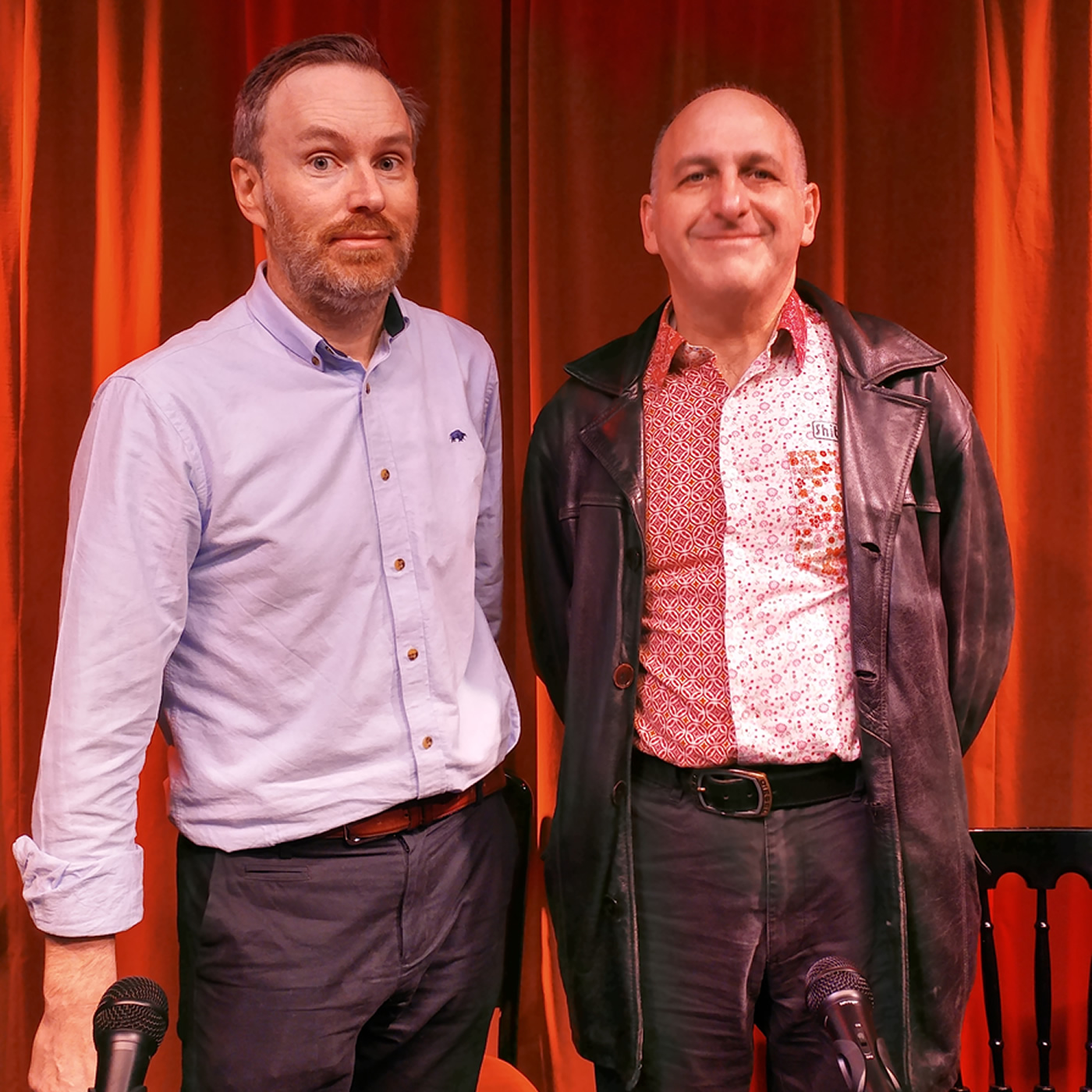
Welcome to sitcom geeks, I'm Dave Cohen and I'm James Carey and this is episode 100! And so you might have noticed we're not actually in our living room or our someone's office, we're actually at the Museum of Comedy so we've got an audience special live edition of the show and we have two special guests please welcome Marcus Briggstock and Sarah Morgan! Slightly louder applause to Sarah! Yeah, I know, I know.
What if? Actually shall we start with your sitcom at the two of you who have written together? Mmm, they're currently here now. We're two days away from the next recording.
Oh yikes. Yeah, that's not all good. Okay, let's find formatting issues maybe if I just submit it. For you Sarah, like a reasonable amount of time before it's recorded and for me an absurd full two days before it's recorded.
You're so cool, you're just like... There's nothing to do with a call before! Well, no, day off! Formatting issues, sorry what are these?
As in one of you's got final drafting, the other one hasn't? I mean what is it? There is a bit of that, yeah. Seriously, yeah we've got one more.
Yeah, we've got one more. We've got one more. Yeah, radio formatting is a whole different kettle of fish which you know, it's I'm not going to relearn a thing to... It slows the process down to sort of make yourself learn to write in a second language which I'm used to writing in Final Draft.
Actually writing a fade in because it's cheaper. Oh, right. That's it, therefore you're already... Same thing.
Hello, final draft, you get 30% off if you join the Writers Guild of Great Britain. There you go, there we go, a little plug in there. Tell us what the show's called, which we haven't had yet. It's called The Wilson Save the World.
And what would be a reasonable way of saying it? So it's a little bit like the good life, but without quite so much bullying. Who are you? Tom Barber, I don't know.
Yes, exactly, Tom Barber. Yeah, it's a bit like it's sort of if you actually try to do the good life now in 2018 when it's basically impossible to know how to be good. It's how to be good in the 70s, it's fine, you've got a pig and you've got a garden in the green broccoli and you've horrible to your wife. Yeah, yeah.
That was fine. And in 2018 it's really, really difficult to know how to be good because you're good in one direction and then the other direction you're wrong and someone will tell you you're wrong on the internet. Yeah, really quickly. That's the idea.
I mean, we wanted to create something that said trying is good. So it's very... Like all the things that I like the most, it's very sentimental. It's got a lot of hearts to it.
At least that's what we're trying to do. Definitely. And all that. So the family have, you know, they're right up the unbearable smug end of this stuff.
They have an ethics jar and they have to make a contribution to the ethics jar if one of them has forgotten their travel cup and you know, done something else or gone into a Starbucks, even for a wee, I think. No, wow. They put into the ethics jar. So because we wanted to sort of own that, own the smugery of it as well and how they tie themselves in knots over questions that really can't be answered.
And usually, you know, they conclude with, well, we've given this a go. It's all right. We have now actually made them vegetarian in series one. I think I resisted it.
Because I was like, I'm just so far away. I'm trying to go in the show, but they kept calling themselves vegan and then we were doing episodes at our cheese festival. Yes. Except the daughter who works at the table.
So you mean they're less extreme by being vegetarian? Or you haven't got a vegan to go to in series three? Well, one of them's vegan. Yeah.
So it's the classic set up. It's a mum, dad and two kids. We've got two daughters who are one's a teenager, one's a 10-year-old and obviously Mike and Kerry Godlyman who plays Max, Max's wife. And everyone is coming up being good from a slightly different direction, but they love each other and they, you know, take off they try and work it up.
So it's a lovely show and I really enjoyed it. And at what point, how long did it take you? You sort of came up with the rough idea, but how long did it take you to resemble the show it now is? To what extent did you think it's good for this?
And then you go, oh, actually, it's not that show, it's this show or? I can tell you exactly how long that took. Because I kicked around an idea based on this about 10 years ago. And then I went to the Craft of Comedy Festival up in Clandano and attended a talk about creating family, creating structure and zip, particularly through family.
And heard what Sarah had to say and went, yeah, that'll do it. It took 10 years in a way and then basically being in a room with Sarah, forgive me, I'm going to blow smoke up from here. Really? No, no, no amount of time.
No amount of time because I'm really bad at structure. Always have been with the Jaws won't be the whole set. I've written loads of hopeless at the structure of it. The arc, the story, having a beginning and all the rest of it, useless and all that stuff.
I have other talents certainly, but. Jokes is a happy start, isn't it? Jokes is a happy start. He's funny, he's really helpful.
And people speak. Yeah, I can do those things. So to be honest, when we got a room and actually put it together, it didn't take very long, I don't think. Right, right.
Is that your memory? That is my memory. I mean, for me, it's a writer, it's actually lovely because everyone knows about the craft of comedy I was seeing, which is a fantastic comedy writing festival in Wales. And the lovely thing is everyone is sort of on a level pegging.
So I was doing a workshop there, but also I was attending all the workshops that everyone else was doing. And Marcus was doing a same artist. You were doing satire, I think. You had a much more satire.
But everyone sort of knocks about and listens to each other. And there's no sort of separation of people there. It's lovely. And Marcus and I got chatting afterwards.
And he said, I've had this idea for a sitcom read before, and to me it was like being sort of handed a presence. It was like, oh, well, this is just, it's the good life. But now that is a fantastic pitch. It was all in place.
He had a couple of pages that were really funny and I could see all the ideas there. And we just, yeah, it was really, to be happy for me, it was like being handed like a lovely present. Like, we'll just, I can see. That's it.
That's it. This is how I touch you, Mo. It's like the world's. This is nice to each other.
It's so nice to be writing. I threw up the door on my lock up and went, see this pile of crap. Yeah. And I'm like, when I told you.
I stuck it all on eBay and it was like, I thought. Yeah. Yeah. So let's talk a little bit about that seminar that you would do.
Yeah. Because it's about family. Yeah. But obviously, it's not necessarily, you've ended up writing a family sitcom.
The idea is your theory about comedy being families. But why don't you say a bit more about what that is? Sure. Well, this is not, it's not my theory.
Sure. But it's one I'm obsessed by because it's really useful for writing comedy. I first heard it on a podcast called How was a Week Post by Julie Clowson. And she was into Mitch Hoet, who was the creative director of development.
And he was saying, when he starts writing a show, he always looks out for, does his cast of characters include a matriarch of Patreon, a cross-man and a clown. No, he doesn't know where that came from. It's sort of community-dollar, but it's not really. Essentially, and then he said it sort of applies to Beatles.
There's a mum, basically it's a mum and dad and two kids. And once you kind of get that stuck in your head and then you do away with gender roles and all that kind of stuff, and you forget about whether men and dads and women and mum and all that kind of stuff. And you just establish that someone is the sort of driving force. Someone is a more maternal force.
He's like a carer who drives into, might restrict the plot or might push the plot. And then there's a clown kid who is the old id and will, whose Bart Simpson basically, you're home in my heart, Lisa. Yeah. That's the same thing as the perfect example of the paradigm.
Yeah. And you can apply that to so many other sitcoms that aren't anything to do with the family. It just happens that we wrote a family sitcom, but you can apply to the young ones, you can apply to the good place, you can apply to anything read to all the great one, because Holly's the only one in the cast. Pete Great Wall, Holly's in the cast.
Holly is not the mum. Crikey's the mum. Crikey's the mum. Crikey's the cleaning, looking after gives advice.
You care about him and he gives someone a safe place to land. He'll give you a cuddle, essentially. Holly wouldn't do that. In the good place the female lead is the patriarch.
She's the dad, Gd is the mum, because he's wise and kind and gives you a cuddle. And cross-man and you can have as many as you like, because they're just brilliant characters who are always smart and one's always crazy, and the mum and dad look after them. And it's so important to pick the young ones. Who's the mum and young ones?
Neil's the mum. Mike's the dad and Vivian is crazy. He's a clown. He's eerie.
He's emotional. They like eating and sex and sandwiches and that is what clowns do. That's what Bart does not sex, obviously. But you follow there's our emotion.
He's a sex clown. That is a thing you've just read them, it's a dreamy hat. And the craftsman who is often thoughtful and sensitive and clever and often doesn't want to be in the family, but loves the family, but doesn't want to be there. It gives you so many plots for everything.
What do you have a craftsman who loves the family, but wants to get over them? That's Rick in the young ones. He also has a good craftsman. Oh, so many.
I mean, we talked a little bit to Paul May, who asked her a bit about this as well, about families. Every sitcom is a family sitcom. But in a sense, sometimes it feels like, are we imposing our viewpoint on something that's already been? Oh, certainly.
If you look at the top 100 sitcoms of all time, you can go through it when it's a very fun game. You can go through it and go mum, dad, try and grasp it. And often you do it retrospectively. But it just means that it works in a similar way, or something like that.
And often if you're writing something and you go through your script and you realise that the plot's not moving or something like that, you're probably missing one of those energies. You might have too many craftsmen and no one's a clown, no one's crazy, no one's going to do something unexpected. Put more clowns in, make a clown, come up with your favourite clown and run wild. In a way, it feels like we're all of these theories trying to tap into something that seems to be universal human eternal inside.
It could be Earth, Earth, Earth, Earth, Earth, Earth, Earth, and water, Paul, George, Ringo, John, that's a weird way to say the big ones. That way round, you know. It's not necessary men, women, it's in it. But as you were talking about it, I just thought, oh, that's a prodigal son in the Bible.
So there's two brothers, there's the prodigal son who goes off and squanders the money and comes back and there's the bitterly resentful older son. Interesting in that, I would argue that the father is the matriarch. Because he's not looking for his son and comes back and goes running towards him. Yeah, yeah, absolutely.
And also, those roles can shift even once you've established them. Surely so, James. When you wrote Thinkable, how? Because that was relatively early on in your writing.
Completely. How structured in terms of an approach was your writing? Did you think about any of these sorts of things? I don't.
I think maybe subconsciously I did. You're just sort of aware that each of the character needs to be different from the other. So I think, yeah, so it probably ends up falling into that, because we ended up with four characters who did. Do you mind pointing out, as a Marcus, was Maphysica, my writing's called Thinkable, and Marcus was in it.
And it was a lot of fun, wasn't it? That's great. I'll be honest, I was as honest, because I'd known James. We did Club Seals, was the comedy group I was involved in at Bristol, and you were in the Durham Review, and we used to do exchanges.
I think we each sort of saw each other's work. Oh, yeah, funny. Yeah, good. That was crap.
And then he came up with this script and I went, oh, yeah, James, yeah, yeah, he's quite funny. And I looked and I was like, oh, this is the whole thing. It's great. It really was, man.
It's brilliant. Well, firstly, firstly, firstly, firstly, firstly, firstly. I mean, look, when you're given something as a performer to play, and I played this character, Ryan Packer from unthinkable solutions, it was a perfect name. And they did, for example, they tried to make banks more, for any fact, the banks now looked like this.
They took all the glass screens out of banks at the time when people were still dealing in cash, they wanted to make banks more touchy-feely, inevitably there was a robbery. So they restructured everything, and ruined everything, and then moved on without consequence. I think, and wait, so I had a knack for that show, you do need a philosophy or something. So for me, it wasn't so much the characters as.
these people know almost a little knowledge is a dangerous thing. And Ryan Packer in particular, your character was 100% confident in the 5% knowledge that he had. That's right. Very much in the Dean Dory's before we used it.
And then we'd be the culture shifts. And suddenly, we used the expression pushing the envelope, got a laugh in 1999. That's a really stupid way of talking. Absolutely idiotic.
And yet now for some reason, it seems to be completely acceptable as a way of talking. So suddenly it became like, how did that sneak in? So these things had to have their time as well. So for me, it was about the philosophy of it.
And the fact that there were people who I was at university with, who were now management consultants. And I was thinking, how can they be management consultants, telling people twice their age, where their company is going? That seems funny to me. But anyway, family, sorry.
Just to take that show as an example, even if it isn't a family stick on the writing, you're thinking of something. What are families, if not a bunch of people who don't know what they're doing, trying to do something? I'm trapped together only by deciding that. They've decided they're trapped together and you have to give them enough reason to be trapped together.
You can't just put them in prison. If you're working in an office, people leave. But why do they all say it? And the office, one and the way they all love each other.
That's how you do the American office, is they all really like each other. They laugh at Michael, the original office, they laugh at David Brent. They want to see what he's going to say next. So you build a trap even if there isn't one.
No, I've got a... It's just great, isn't it? So handy, a hatred. So I had a little bit of a difference of opinion in the dressing room earlier, which may be the audience.
You're the audience might be able to settle this. I've got a chapter in my book, which I spoke to Sarah and knew about this, which is about families and sitcoms. And I'm showing it to Sarah. And there's a paragraph I had where I talked of the office as like a family and David Brent as the father and Tim as the mum sort of clearing up the mess.
And you were not having any of that. Well, I don't think Tim's the mum. If we'd again change his character's character. I'm sorry, what is gender?
What are gender roles? Anyway, I think that, yeah, personally, I don't think the office is that David Brent is not the patriarch of the sitcom because he doesn't drive the story. Tim does. It's all Tim.
Tim is the hero of the thing. David is a lovely clown. He's never going to... He's...
You have to look after him. He's like a baby following and clearing up his messes. Dawn's the mum. She goes to your cuddles.
She's a soft place to land. There's lots of... Tim is like a craftsman patriarch which you can actually have in your sic. I love a craftsman.
Do you make it a craftsman, Patria? I feel like it feels like an episode of Question Time now. I'm kind of... I'm putting a sense from the audience.
What's the... You didn't get a round of applause for that. So, I'm like... It's the fact that...
It's the fact that... It's the fact that... It's the fact that... It's the fact that I've done this...
I've got a PowerPoint presentation for this. And it's... I'm in charge of it now. Like I've got to look after it.
You win. Like all theories. It's like you can know the rules and then just not follow them. It's a helpful thing if you like rules.
But I did it a... Arvonne, where you're like living together for a week for writing. And people spent the rest of the week jumping out from hedges and shouting sitcoms at me. I'd say if I would be like, stop to go, God, you're right, this doesn't apply!
But then they say things like, Big Bang Theory. And I'm like, duh, it's really... Everyone do the Big Bang Theory in your head now because they're the names of the characters. So, but you do the Big Bang Theory.
And the other guy... There's the one who's nice and maternal and cuddly and there's one who's like... Oh, Rosanne. But like, Braney wants to leave the group and then there's one who's...
Yeah, I mean, it works. It really just applies to everything. And Rosanne Rosanne's the dad. Let's get over it.
Not now. People still on board with Big Bang Theory. Big, big, big boy, what's that? I'm curious about it from a far less geeky point of view.
Just looking, going, that's so funny. I remember watching that, going, yeah, we're right. And then putting it on one time and just feeling angry within a couple of minutes. And I can never put my finger on why that is with certain comedies.
And sometimes you're like, I think it's because you maybe invest a sense of trust in it or something and then when it doesn't deliver or you maybe you see through something, then you're like, this is cheating and it's really inappropriate. It's not how people are... The Sheldon character is supposed to be sort of obsessive and nerdy. And he does things like he categorizes, socks by counting them one by one.
And I'm like, no, you wouldn't do that. You'd have a system. That's the one I watch for five minutes. And he's not like that at all.
He's not a nerd. I would, I mean, the young ones changed everything. And it was the most amazing thing. And we're probably all here because Neil is the mama.
I accept that. But have you watched an episode of The Young Ones recently? It's not an easy watch, really. No, it's not.
It shows off their time. I mean, the young was so totally blew everything else away. You know, inevitably that was never going to be such a... I showed it to my kids, hoping they would react to it the same way I had.
But obviously, all of the context of it has changed. And one of the things that made The Young Ones so delightful for me was I was forbidden from watching it. And it was, like, I've been processing Credible so good. Yeah.
But that bit when Viv comes to the good life paradigm, then we've come crashing through the dark. God, that felt so important. And now, no, it turns out, we're being the good life. Because we pretend that we like it more.
It makes us feel something more. And we thought, well, that's... I remember, I've been out and sort of apologise for that moment, I think. He said, oh, you know, it was a different time.
But actually, that was quite an important moment. And they were sort of showing the credits for the good life, and then Vivian's sort of tears through. Oh, bloody, bloody, bloody, bloody, bloody, bloody, tracol cheddar. But Rick loves her.
I mean, it's more in the books than in the movies. You know, it's poems in the publicity, you've only with electricity, but that does not mean you're shocking. I can do the whole of The Young Ones book about his present. That's a voice.
See me after. No, I've got that on the rise. Not season one, surely. No, not season one.
It's got some very funny jokes in it. It's season one, including my science statuette of Judas Iscariot. It was all about the best part of it. But it's not when he's begging for his life.
The reason for this is just going back to Big Bang Theory before we go back to how you guys write together, which we intend to get to. I wonder if it's a Big Bang Theory, the thing that you feel cheated by. This is where sometimes I feel when I'm reading a script, it has all the rhythm of comedy, but ultimately it doesn't feel like there's quite enough. Ah, yes, fascinating.
So I think Big Bang Theory, even when it's not funny, it sounds, you have a new, I think Fred Barron, and my family's to call it JLS, which is a joke like substance. Have you seen John Mulaney? Sorry, John Mulaney, live from Radio City. OK, no, no.
It's a phenomenal piece of stand-up. Absolutely, it's where Hall's in the hospital, that Donald Trump routine where he never says Trump's name, it comes from. It's a phenomenal piece of work, and even while enjoying it, there were some JLS's in No-Joke. No doubt he has an extraordinary speech with them, which he does some one thing great jokes with, and then sometimes kind of does it, but uses the same speech with them, and takes things that are, when you analyse them, moderately funny into a place of being absolutely hilarious, and obviously as someone who I only write in order to perform.
I always have a fun writing, difficult and painful and exhausting. So I do it in order to perform. Nothing to do with you. I can manage that.
But, yeah, so I've no problem ever with someone delivering far more than is there. But I don't know what happened with Big Bang Theory, it did feel like it. In terms of it, it just feels like it's sort of, I guess there's a truthiness. It's like, it hasn't been based on truth, and it was already a little bit dicey to start with, and I think it was sort of drift.
Well, and I think they're 40 now. And they're still students, they're like eternal students, trapped in a thing. That's sort of what happened with friends really, wasn't it? You kind of thought, I've had about a series eight or nine, you sort of think, God, do I, would I like to be around this kind of weird cult?
If you take out Santa can make like a dark con. Friends is great, because they're all terrible, particularly Ross, who's like basically a murderer. One of the things that's all shagging his cousin and wearing leather trousers by the last season. One thing to swing in leather trousers, one thing to do is clear to me about that, and a great many other sitcoms is they have what's referred to as a magic money tree always.
They never face very serious money problems. They're all incredibly rich all the time, and sitting in coffee shops doing nothing. And then hadn't the most expensive place in a lot of apartment. He's explained that he's one of those grandmas apartments.
We're not having it. My writing was fun. They do explain why she's living in a beautiful apartment. But you just don't know.
I mean, that question did occasionally come up when the years I was working on not going out. So, I mean, there doesn't seem to be a kind of like, you have to find £200 suddenly, or you get your kneecaps removed, or something like that. The money is found, but then a worse problem comes. But it's sort of like, for me, it's like, God, well, I'm kind of fine.
£200, and then it's sort of magic £200 appears. I think that's a problem. Yeah, it's not even going out. I would say it's, yeah, it's, you do it, like Lee has never really had a surname.
I think Lucy's had a surname. It was decided in the recent series that Lee has to have some kind of job. And it was fun. They did really hamper.
No, because no one cares. They just want to see a funny family sitcom. But Lee has to go out to work, and then we sort of go, yeah, exactly. My camera's a joke.
We know roughly what Mike's job probably is, but... We know, but we don't really feel anything else. And then Mike goes to work. Then Max works in the library.
That came in handy when we wrote some library based episodes of series. And was that a decision early on then? I'm just thinking, I'm imagining you two basically on a sitcom writing date. Because it was just like, so, we're going to do a show together then.
Let's make each other laugh. Yeah, that's right. Exactly. They just established ideas to info about who they were.
Max is a lovely kitchen, and he's a very good cook. So, Marcus makes lovely lunches. And we sit in his kitchen. And because it's a show about ethics, we tend to pull up like the Guardian green pages and see what the thing is.
So, it might be all plastics are big thing this week. And then we combine what we want to say emotionally about our family, our characters, and how we react. We've made characters who are going to feel differently about things. Mike is very locally sourced.
Yeah, exactly. And if so, is that the best thing? Yeah, it's all fun. Yeah, it's fun.
Yeah, so Marcus is very lovely. So, I went vegetarian. He was furious. That's what it's done to be mushrooms.
Yeah, yeah. So, when you got together to series two, were you going from, okay, here are some issues we've had? Or here are some funny scenes or I just think it would be fun. No, issues.
It's my character. It was. I had no trousers. It's an issue.
It's an issue effectively. So, but it's not necessarily, I don't know whether people think it was an issue. So, one of the episodes in this, we did a dress in the first series that Max, the mum, has been keeping a library open because the council came to close it and she said no. It's the real thing that happens, they call community libraries.
People just, like, and they get occupying while they people squat in libraries. Danger of squatters living in libraries just running libraries based on donations. That's what I was thinking. Yeah, exactly.
It sounds really pumped and really sort of lovely in community at the same time. And that is exactly what they are. I mean, you're looking at, you know, people who, who's squatting buildings that ought to have tenants in anyway going, oh, by the way, if you want to do this, this is how you do this and they help each other. And they fix the plumbing and they get them.
So, that seemed like a very good episode and also a very pleasing way to introduce Maxine's mum who was a Greenham Common Protestor, which is where Max was conceived. No one's sure how or by whom. So, that was a nice way to bring her in as this sort of the old face of what protest was in the 1970s and the 80s. And then, you know, the police...
They wonderfully police the Talbot by both. She's so great. Because the series where we had Mike's parents who were sort of... They're my parents.
Oh, yeah, the character is sort of loosely based on our cartoon dynamic between this. Marcus is a very posh and I'm very weapon class and he cooks everything. He cooks everything like Pothra and the guards making royalties. And I'm Green because I'm poor and trust me.
I'm fine because it's the thing. Yeah. It's a good person. Yeah.
So, you can buy a breeder and I drive a car the same. I just fly a safter. Which one of us is more Green, hard to say. It's not a thing here.
Yeah, these are the kind of conversations we have. So, it's like Kelly Kerry Godley when it's sort of based on sort of my version of me. And she's brilliant. So, deciding who I'm on was going to be was a lot of fun.
Yeah, no, it's great. And there's a whole bunch of stuff we know about that we find very funny that we've not yet written, like how they met. So, they met at a pub concert. Mike was dancing to common people and singing along.
And she's billed Maxine's point and she explained to him at length why he was the only person who couldn't sing along with common people. He was wearing a chilé. He was wearing a chilé. And ended up buying drinks for Maxine.
Max and her friends all night. Right. And that was it. So, these are things that we know that delight us.
And actually, they're little kind of touches of that. Not the story, but just of knowing those things. We've known them differently. Even those are kind of, oh, this is our backstory.
It pleases us to kind of know what those things are. It takes a lot of chat, isn't it? It takes a lot of time. It takes a lot of time.
It's always a question. Especially with ethics. Because we start from the point of view of saying, well, they're not right. They're not correct.
But they are trying to, I suppose the best way to put it might be cause the least harm to the love of the people. If you remember a few of the fewest numbers of people. Exactly. And we've been able to address an interesting thing in the most recent series.
Which is basically about plastic use. And, you know, disposable plastic blah blah blah. But the, I don't even want to say it's the B plot in the episode. But the other plot at work in the episode is that Maxine's mum declares that when she's 80, she's going to go after she's 80.
She says, I don't want to bloody live forever. I'm not an espresso pod. Things should have a lifespan and they should go. And she points out things like the 80 percent of your NHS.
80% of your NHS spend occurs in the final two years of your life. And so what we're able to do with the family is have maxing absolutely devastating by how that feels and her mum, who's got a lifetime in being a protest, to talk about it at arm's length and go, no, it's just the right thing to do. Yeah, yeah, yeah, yeah. And I won't say how we, you have to listen, because I'm really, really proud of what we've built there.
But it was a, for me, a far more interesting thing than wagging a finger and going, what, stop using plastic straws? Exactly, it was sort of a spur from all those guardian articles that are like, oh, family gave up plastic for a week, and then they drove to find different supermarkets, to buy cheese, and you're like, that's not helping. That's, it's sort of Instagram helping, where you take a picture and go, look at my avocado, and then it's like, we're, yeah. But don't you think, I mean, there is more of a sense, actually, of people are becoming more extreme.
I think there's more of a division in the country. And it sort of feels like, nor that actually, there's a sort of, I am right, and you are wrong. We know far too much about each other. This is my theory on this.
We simply know too much about each other. I mean, pre-internet, you might know what your mates voted for, come a general election, you probably would you'd have talked about it. You might know what the best film is. You might know what poster they had, I know all of you were at uni with it.
But that's about it. Now, I know what you had for lunch. I know how your children are. I know what you believe passionately.
I know what things you've not been able to resist, making a grand statement about, even if it's not. And so, we're trying now, all of us, to navigate this thing, where we just know absolutely everything about it. And Sarah and I have, I would say, massive ethical overlap. And then a few things where we're like, no.
And we've had to, you know, we've bunched up against it, quite rightly. It's a great way to help those people in a writers room thing and go, okay, this particular thing, let's park that over there and leave that the hell alive. Because, and actually, some of the other types of things that come up with this, we know too much about each other. And that makes ethics far more difficult.
You know, I mean, Brexit's the lightning rod, isn't it? I can't say that was tricky. That's a joke. I'm a retrass, I can't believe it.
And I know it's wrong. And I read an intellectual, obviously, know it's wrong, that those still in support of coming out of the European Union, that there's something wrong with them. There's something wrong with those people. There's some pathology at work.
Or worse, or maybe they're just evil. Maybe they're just wicked. And I'm like, that's a stupid thing to say. It's a stupid thing to believe, you know?
I'm not going so far as to say, there are some people who've concealed their reasons for either being for against Brexit and that, you know, concealing your reasons, I think it's legit to point and go, yeah, no, you're a bad one. But outside of that, yeah, it's a big problem. Well, if anyone's still listening to this question. Luckily, you've got 52% of their 48% of the listeners.
Well, actually, James, you've lost less than half. You've lost so much weight over the last few months. I think the 52.48 is actually swinging in my direction. I'm sorry, you do that very well.
Because I've been saying, well, when they've actually put on, quite a lot of weight. You look well, like Henry VIII. Looked like Henry VIII. A good life, yes, not good.
Just for running this sort of bin off in terms of it, it sounds like you've learned a lot from each other. I mean, it sounds like Marcus, you've learned a lot from Sarah to destruction, that kind of thing. What else have you learned from each other that you maybe do slightly differently than you have got from? I mean, I've always been a fan for a very long time.
So I'm very happy to kind of take the Marcus as a brilliant comedian and he's very passionate. And it's a joy to butt heads with him when we disagree on stuff and then work out where the overlap is and talk about how we make that funny and how we present that as not just someone, as we call it TED talking, when the first draft of any episode of the Wilson's looks a bit like a TED talk, where it's just someone saying what we reckon in a long paragraph block and then we sort of work out how to make that funny and how to make that. But it's the... I'm not gonna have a bluff and stuff.
Yeah, so... There's a lot of more standards now. I've never had to bother with moving on from just being a TED talk. Yeah, for that, I'm not a fan of an aura standard.
I'm an aura standard. I think I've never done it myself. And I'm absolutely an aura of people who can do it. I think we work really well.
We are the original couple in many ways. We're very, very different. But it means we make a really... Hopefully we make a show talking about ethics that will be a reflection of how the listener is listening to it without being sort of a big lecture.
And we structure it like the American shows where at the end they sort of sum up what you've just seen. I was just joking from there, Jeff Winger early on. Jeffing Community does a lovely Jeff speech at the end of every episode of Community. We try and do that.
We try and make it interesting. Last year we had Katlyn Moran do the big sort of something up speech and this episode we're at least the series we're least at, we're doing a couple. We've got Lola at Fabulous Action called India who is 10 and she's so... They're such good actors.
They read straight off the page. And... I think we're in Brinstone. Brinstone.
Who's like 16 or something who plays his plays. The Risel Kicks don't care. Yeah, we've written a joke about asking her parents for a Risel Kicks tattoo on her neck. She was really sweet about it.
She's not for the table reads. She went, Justina guys, Risel Kicks, haven't actually recently over three years. We were so happy with that reference. We were like, oh, Radio 4, listeners.
They'll just think that sounds like a funny word. She's like, could we make it something else? And she suggested a much better band of the funny. I'm never like, this is...
Yeah, yeah, great. I think there's an interesting thing for me anyway about this, which is, you know, I mean, ostensibly it's a show about a family being ethical, but you know, I noticed when it was written up, you know, this is coming out before it was released. A lot of people went, oh yeah, of course it is Guardian Pew! All of this kind of stuff.
And what's nice for me about it is there isn't anybody in it genuinely who I don't love. So the next door neighbour's called B&D. I think my wasn't an ex-brilliant thing. Absolutely adorable.
Yeah, and he's a really great guy. He's talking about the plastics thing and going on about that and saying, saw this, who's the whispering chap on the, on the telly? And that's him. Anyway, I was watching this documentary about a tortoise with straws in its nose and its bum.
And Mike says, like, it's a turtle. Pretty sure it was a tortoise, Mike. He just has a lovely way of driving on. And even when you're writing, you know, BMW Paul is actually, he's very benign, but he's our family's baddie.
Yeah, he's certain of everything and our family is never certain of everything. They're never certain of them, right? They're dithero's. And someone like BMW Paul is seductive because he comes in and he just knows what he reckons and he's really confident he's really happy.
And the same, Rupert Van Derse who's the guy from Four Weddings who says, so if I can go and find that cake, he's just a little bit of a crumb. I think I was in there. Nice smell. Yeah, nice smell.
Yeah, let's go over this brother. Buck, let's talk with him about life. He's a great, great guy. And actually, it's interesting.
I mean, I sort of have to say this because he's in, I think, but it happens to be true. Within that range that he's been cast only ever to play, he's utterly brilliant. And my guess is, more than capable of doing a million other things, four bags never been asked here. But there was a lovely thing in the first series where Mike had been called a snowflake.
And his dad actually delivered this really wonderful speech about saying, I looked up that snowflake thing and it's sort of people who care about things. It seemed pretty solid to me. And it was very, very loving. And he could be awful, but the parents could be monsters, but very loving.
And I think it's good to love your characters, whether you're a real villain. I think if you can't get there, that actually, for me, I'm probably right in the wrong thing. Hello, James here. I hope you're enjoying this slightly mammoth but celebratory episode of SitCongeeks.
And we're very grateful to Marcus Briggstock and Sarah Morgan for joining us. Just wanted to mention that Sarah Morgan has her own podcast called The Fear, where funny people talk about their greatest fears. Do go and search for that one and I'm sure you'll enjoy it. Thanks for listening to the podcast.
I don't know how many of you have listened to all 100. If you have, maybe you consider supporting the show via Patreon, where lots of goodies await you, including Patreon-only podcasts. So you can get more than 100, including our new series, which is about to be released called Soup to Nuts, where we create a new sitcom from scratch before your very ears. Also, if you've listened to all 100 episodes, do send us an email and tell us.
Email sitcomgeeks at gmail.com and tell us what you've liked and what you want more of. We're also on Twitter and Facebook as SitCongeeks. Dave's new book, The Complete Comedy Writer, is available on his website today, coen.org.uk. And you can pre-order my book, The Sacred Art of Joking, out in January via my website, JamesCarry.co.uk, Kerry as belt, C-A-R-Y, as in Kerry Grant, not George Kerry.
If you'd like to see us live, you can do that in January at the Chortle Funny Book Festival, which is taking place at the British Library. We're going to be there doing a live show with an exciting guest talking about their favourite sitcom and we will put that name of that guest up on that Facebook page and on Twitter when that's all confirmed. And we'll also be at the Leicester Comedy Festival on the 14th of February or the 15th or something like that. That's outside London.
I know, incredible. Do go and look on our Facebook page for more information on that too. Let's get back to our recording of our hundreds episode at Museum of Comedy, More Marcus and Sarah in a few minutes. But first we have a bonus guest in the form of Aaron from the British Comedy Guide, who've been good enough to host our web host podcast and have been very kind to us from day one.
And they have some exciting new products coming down the pike that Aaron's going to explain to you, as he did on the night. And then we'll get back to the interview with Marcus and Sarah. Marcus will have to also run off just before the end, so we get Sarah to ourselves for a minute or two before we wrap things up in this mega episode. Okay, back to the Museum of Comedy.
And we're welcoming from the British Comedy Guide. Please welcome Aaron. You may see the name many times, but you don't see the man very often. And I'm now getting self-conscious about the call you Aaron.
Aaron, Aaron. You're an Aaron. But it is written Aaron. It's a double A.
It's your biblical name. Moses is brother. Moses is brother with Aaron. That's how I've been.
You are Aaron and will forever be. Very much the upgrade. Aaron 2.0. One of you tell us about British Comedy Guide hosts this podcast.
They have it on their servers and they basically put it up and do the blurb and work well. You write the blurb, don't you Dave? They make it happen, which is very kind of them. But they offer lots more and there's more to come from British Comedy Guide.
Why don't you tell us a bit about what the plan is? We've for a long time now had a section specifically for writers primarily, and forums for writers and performers and increasingly now, of course with more and more stuff being produced online, producers, directors, filmmakers. And we are now expanding that significantly with a whole new section called BCG Pro. This is...
I think we should all go, ooh! Thank you, Dave. So that is quite apt. So this is backed up by about past decades' worth of work we've been doing, recording meticulous, ridiculous amounts of data, credits, production companies, commissioners, executives.
Far more far than IMDB, frankly, isn't it? When I need to check by royalty payments from various royalty companies, I always have to go to the British Comedy Guide to check what shows, what episode of what show I wrote on. And is that a level of detail? Of course we do cover radio as well, which IMDB certainly doesn't.
Yeah, there you go. So yeah, so BCG Pro is a new suite of tools for both comedy aspirants and professionals. I hope there's a good smattering of both of you in the audience. I like that suite of tools.
I'm going to use that sometimes. There are three different subscription packages available depending on where you are in your career. So there's a range of features within BCG Pro for everyone. There's the Opportunities hub, which lists competitions and like, all those talent contests and finding new writers and things that you see from various organizations across the year.
And that will also enable you to post and to find opportunities with other like-minded people such as yourselves. There is Skills Academy, which will be building up with lots of bespoke training and informative guides on range of subjects. Dave is kind of going to be helping us with a little bit of that. And that will be more interactive tutorials, guiding you through quite in depth in some places, different aspects of comedy.
And again, there'll be different things with different people. So most of people listening to this and in the room tonight will be writers, but that will be stuff, whether you're a performer or a filmmaker or anything in between. Can I just say again, pick up Sarah, which do you prefer writing on your own or writing with a partner? Oh, I like both.
I think they're both, I really happy when my weakest split down the middle. I love both of them, absolutely different things. I love that my career is at the stage. I'm not always on my own, having ideas and firing them out into the universe.
It's a cold, empty universe, but I also would go mad if I didn't just sit in my pajamas and just put it all down myself. I think the perfect balance is a bit of both. It's like I was saying earlier, if you could make the person sitting next to you laugh, then that's already made a person laugh, which is kind of a good one. But you've also got to get the confidence to know that you've written as a thing.
That's also really important. But yeah, if you like sitting in your pajamas writing on your own, then tick on writing is the top of the top tier of BCD Pro. For full-time comedy professionals, we are launching full profiles in much the same vein as you might have already seen guides to our TV film Radio Coverage. And these can include your credits, biography, all sorts of data that will help maybe casting directors or stand-up bookers, find you and find your relevant talents for whatever project they're looking for, and basically to control your presence on comedy.uk.
Great. There's also Inside Track, a library of feature content, including articles, videos and podcasts where A-list names are sharing their wisdom with you. We've got a great selection of content already built up, and that will continue to grow throughout 2019, 2020, as long as you're subscribing. There will also be networking opportunities, and we're launching our own set of talent awards to highlight and celebrate the best new creators.
We want some moves. The thing I like most about comedy, which is why it's worth just thinking about doing one of those three things is the fact that what I love about you guys is that you love comedy. Which I know sound a bit crazy, but actually lots of people who get in the way who love the idea of being a writer rather than writing, and there are lots of people who want to work in the media, and they've ended up in comedy, and you just think, why are you writing? You're just in the way now.
Yeah. So, it's a rule of life, generally, it's also not even a remainder. It's not even a Brexit season ever. No one thinks they're the bad guy.
Yes, they're the bad guy. And it seems to me that I've got a blog post a year or two ago where it said, previously you used to have an idiot in a sitcom, and now you seem to have some kind of sociopath. And it seems very well, and I've never really liked that. There's a lot of sociopathic comedy going around the place.
It's very fashionable in time. I like a lot of those shows when no one's likable, but I couldn't. I couldn't. Then I could try, but I would still end up, I sort of have to fall in love with whatever.
I'm writing a crack of Norrie episode, and they suggested they wanted to do a barbershop quartet. This sounds really weird, but I'm going so much more trust me. And I was like, barbershop would have done nothing to me. I was like, well, that's just a load of white blokes singing.
And so I went deep on it, because I just went deep on the research. And all of a sudden I found myself falling in love with barbershop, because there's this thing called the magic, the fifth note, the angels voice that they make. I was like, well, that's this four men working together to make magic in a room. And then I read about racism within it.
And by the end, I was obsessed by barbershop. My husband got me tickets to go and see a gay barbershop quartet for my birthday, because I was so in love with barbershop quartet. And I think the more you get to know a person or a thing, you have to be as a comedy writer, you go really deep on me. You end up having to fall in love with it a little bit.
Yeah. It's very deep, isn't it? But you can't also write all these away in college, and there's loads of blue do-right stuff that's very popular, but it's not for me. And I love what you get for people who try to write a character.