
EPISODE · Jan 24, 2026 · 19 MIN
Episode 107 — Transfer Learning and Embeddings: Reuse, Fine-Tune, and Cold Start
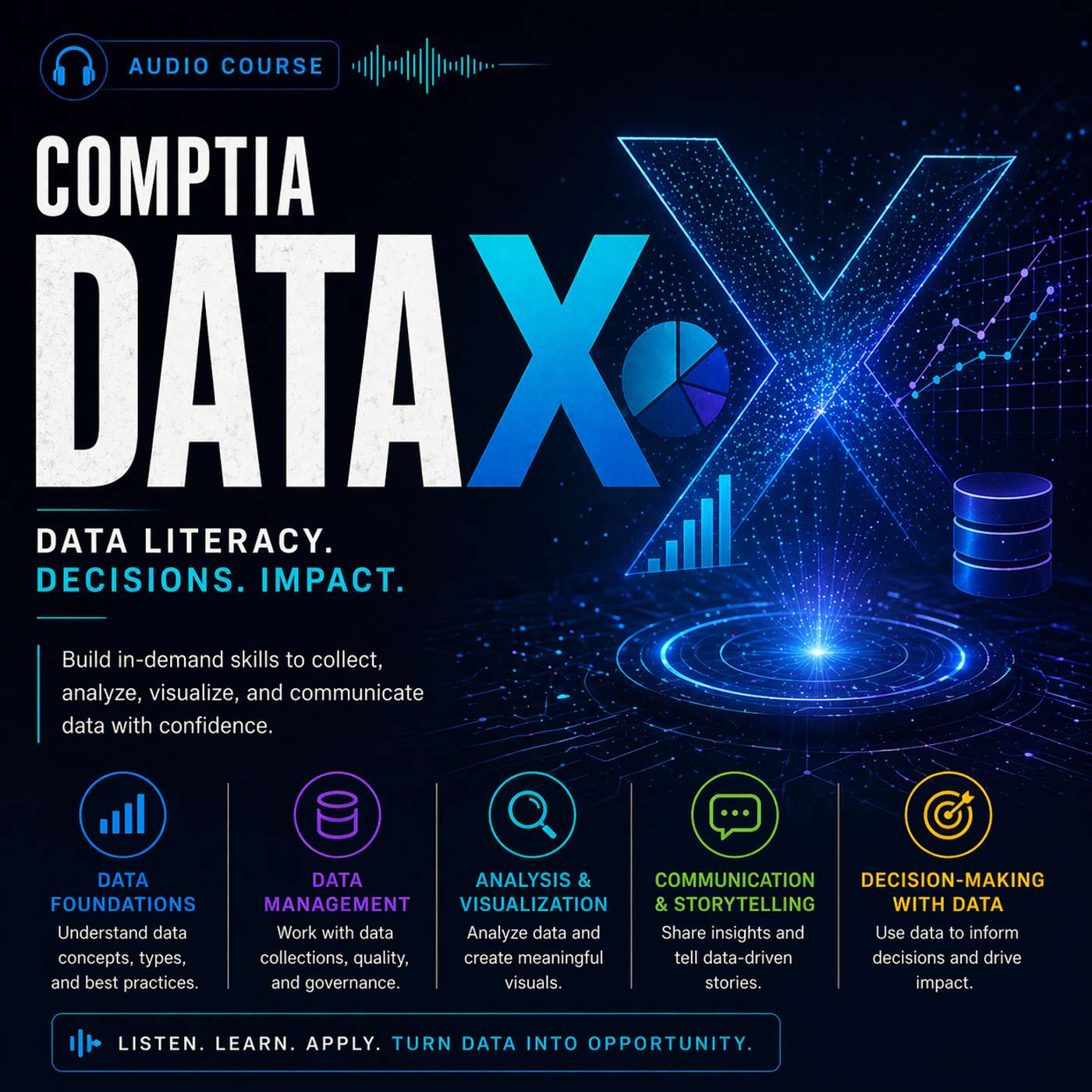
from Certified: The CompTIA DataX Audio Course · host Dr. Jason Edwards
This episode explains transfer learning and embeddings as strategies for reusing learned representations, because DataX scenarios may test whether you can recognize when leveraging prior learning is the most practical path to strong performance under data, time, or compute constraints. You will define an embedding as a dense vector representation that captures similarity and structure, allowing items like words, documents, users, or products to be compared in a meaningful geometric space rather than through sparse indicators. Transfer learning will be described as reusing a model or representation learned on one task or dataset to accelerate learning on a new task, often by starting from pretrained weights rather than training from scratch. Fine-tuning will be explained as adapting the pretrained model to your specific domain by continuing training on your data, which can improve task fit but also introduces risks of overfitting, catastrophic forgetting, and increased operational complexity if data coverage is narrow. You will practice scenario cues like “limited labeled data,” “domain similar to known task,” “need faster development,” “text or unstructured inputs,” or “cold start for new items,” and choose whether to reuse embeddings as fixed features or to fine-tune end-to-end based on constraints like accuracy requirements, explainability, and compute. Best practices include validating that the transferred representation matches your domain distribution, using careful train/validation splits to avoid leakage and overclaiming improvement, and monitoring drift because representations can become stale as language or behavior evolves. Troubleshooting considerations include embedding collapse where different items become too similar, bias inherited from source training data, and cold start challenges where new entities lack interaction history, requiring hybrid strategies that combine content features with behavioral signals. Real-world examples include classifying support tickets using pretrained language representations, recommending content using user and item embeddings, and accelerating anomaly detection by leveraging pretrained encoders for representation learning. By the end, you will be able to choose exam answers that distinguish reuse from fine-tuning, explain why embeddings help similarity and generalization, and justify transfer learning as a practical engineering decision rather than a buzzword. Produced by BareMetalCyber.com, where you’ll find more cyber audio courses, books, and information to strengthen your educational path. Also, if you want to stay up to date with the latest news, visit DailyCyber.News for a newsletter you can use, and a daily podcast you can commute with.
Embed this episode
NOW PLAYING
Episode 107 — Transfer Learning and Embeddings: Reuse, Fine-Tune, and Cold Start
No transcript for this episode yet
Similar Episodes
No similar episodes found.
Similar Podcasts
No similar podcasts found.