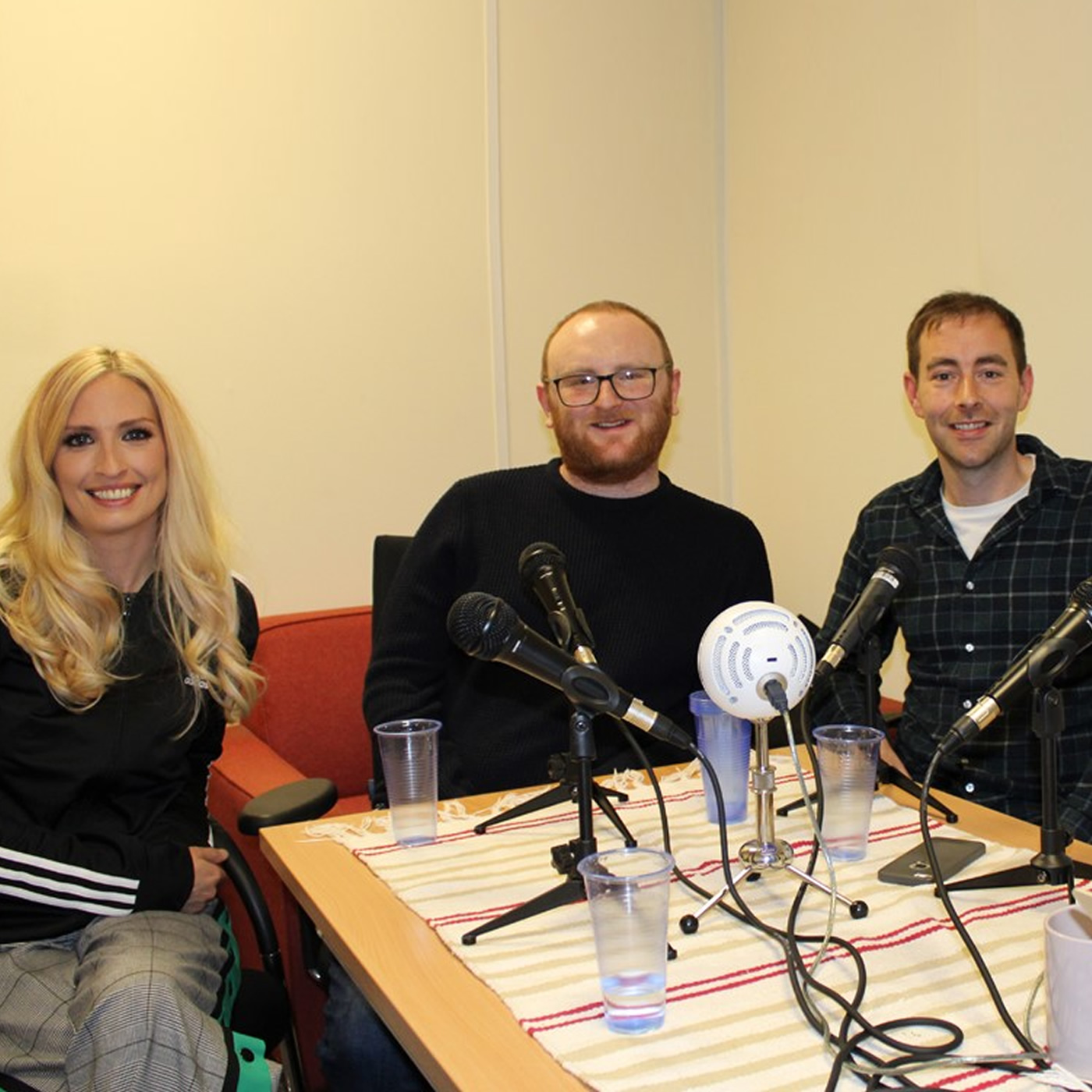
Hello and welcome to SitConkicks, I'm James Carey and I am in Belfast which is extremely exciting and not only is that exciting, I am with a team of Soft Bauda Patrol which is a new comedy from Northern Ireland and as the title suggests it is about the cutative Soft Bauda which is hopefully going to exist. We record this on the day when it looks like the government is going to disintegrate and everything's going very badly with Brexit but frankly that could be any day really, couldn't it? The previous year and the next year and a half so not knowing it down. So let's introduce who I've got here.
I have Marie McDonald and why don't you say hello and what you do with regards to the show? Hi I'm glad to be here and I produced the show. Marie McDonald is the producer of the show, we also have Alan Irwin. Yes I am, thank you for having me.
I'm Sandy, I play Sandy. Great, I'm Mark and I was a writer and minor performer on the first series and story producer on series 2. Okay here we go, why don't we talk about how that show came to be and how people were pulled in or whatever, what's... Really started with the comedy unit which are the production company based in Glasgow who also makes Scott Scott which is another brilliant monkey entry from BBC Scotland and it's now just one of our standards and it's this series I think.
So that company they recognize that people in Northern Ireland are really funny and they are, great sense of humor and it's brilliant comedians and all. So they really wanted to work here and they were very much working alongside Keith Martin and the BBC writer's room here in Northern Ireland and just the whole Brexit subject matter and what could we do here about it and in that documentary format it just really started at the time when everyone was trying to start out what was going to happen with the border, who knows then the whole idea of software control was generated so through the comedy unit and to the Northern Ireland BBC writer's room they got together all their writers and the people that are in their grips and their schemes and so lots of sketches were submitted and the first series is difficult because we didn't really know what we were, almost what we knew it was a monkey entry, we knew sort of the format in the side but I mean right so up in the air we were writing stuff and that was coming true in the news and then we're writing stuff going now this is ridiculous and that's actually not that far-fetched in the room today. Absolutely, so there's a lot of that back and forth and just so much material from the writer's room loads and loads and loads that we would select all the best of. Okay so we're a load of writers given this kind of brief and then whose job was it to kind of collate it all and turn it into some kind because you're making it sound a little bit incoherent as in not going back to ritual that's the first episode.
Oh it's a show, this is a lovely funny show about people trying to make the best of it, it's a very optimistic, funny, I really enjoyed it because it was like there's this complete dog breakfast of a political solution here and this is what it looks like, it's just Joe Schmo on the ground trying to make it work, trying to tell a farmer that he can't have a plank across his... That's the thing, that's what the border looks like, it's the majority of the comedy that we do in soft border patrol, it's not generated in reality, it's come from the news, it's come from the situation, it's come from what's happening in border areas at the minute so it was just quite easy to draw from all that reality and a normal situation no matter how ridiculous it is, is actually happening so we just left out. So how did it come, so you've got all this material then, suddenly it starts turning up on emails or whatever and somebody has to sort of go through it and turn it into something kind of kind of kind of... Yeah, it's kind of in the comedy unit as well, so because we knew we had a certain amount of characters we needed, so we knew we'd have a couple of sets of officers, we'd either be like a boss person which is the character of Lisa, so the sketches were sort of divided up that way, this will work for guys who are in the countryside, like a single lone wolf of Sandy, so a lot of sketches suited him and that character, a lot of the stuff we knew would be driven from an executive position like Lisa's character, all the formal, the chat and the public face of it and then it's just sort of divided between all that, themes tend to generate naturally then with all the sketches, so like one episode we called The Eyes of the World and it was a big incident and the fish and all that stuff, but it's all connected throughout, something's gone wrong, so there's a general theme one and three each episode and we start to tie it all together.
Right, so to what extent I get the sense of it was a little bit improvised on set, is that how much? Yeah, there was sort of like a basic guessing I'd bound with, you know, different points, some things were written more detailed than others, but there was sometimes a lot to go off the page or sometimes it was like a paragraph, you know, that turned into a big thing, it's just a day out. And so you're not going in with the script, here is version one, we'll try that and then I think about it, I think about process is okay, we're gonna, we write this then they're maybe some rehearsals and then they rewrite it and then they they perform it and then they perform it again, it's like okay, make it up this time, that's fine, it sounds like you didn't even listen. We don't have that second stage, so just in nature of it at the time we don't have time to bring Alan in and every actor that he's going to be performing way to do a rehearsal, so a lot of our actors will meet up before the performer on the set or in make-up, like, oh okay, you don't have time to go through it and you know when you do that was when something is kind of over rehearsed, you can really kind of lose that natural feel, that a lot of serious fads, like you know you can kind of tell just from the way Linus said or the way it's edited that, that came up, that you know, it was made up on the spot, but you know, it was one occasion, I'll be vague but it was a couple of actors who rehearsed a little bit and when they did the scene you're like, that's a real sitcom singer, a stage scene there.
Yeah, no that's what you're doing, yeah, because once you then start to deviate from that house style you're gonna, it's just gonna have a different tone to it, it's very hard to put your finger on it, it may also maybe somebody don't even notice it until you look what you're back. I think you can tell when actors are acting and with the nature of this and the way we did, the performer or the actor has to think so much about what they're going to say next or what the person who are playing opposite is going to say to them and how they're going to respond, that everything just becomes more natural because you're concentrating so much on that rather than giving your delivery. So in which case you're going to meet some actors with a fair bit of improv experience who know how to listen and then build on it, how did you go about, you know, pulling people together to do that? It was a big casting process.
Yes, huge. Like Alain said, this was first acting role, you know, basically they cast a really wide net for comedy performers, actors, some comedians who could audition for this and I think keep Martin in the writer's room suggested a bunch of names and he drew my name down just because I played a small part a few years ago, I don't act at the moment and Alain because we knew Alain was going to be the same and they met before, so everyone showed up and all of a sudden we were seeing actors in oh, it's not for the sit down audition first. Yeah, sit down first and just stick a camera in the background and invite the actor in character and we'll speak to them in character and we'll listen to them in character. Okay, wow, that's cool.
They've been your own character, you know, whether that's a patroller or someone who stopped at the board. And some characters were born, a couple of people came in and the character that they did, it's like, oh, that's great, we'll have that. Some actors who got roles came in with a completely different character and we were like, really really, really performance, but maybe just try this instead and we'll be this character instead, so there's really a lovely way to do it. Wow, this is a very time consuming process, isn't it?
Yeah, but you see how it pays off because when it snaps to first stage and then we'll get an email going, oh, these guys again, oh, I've made it true to the group audition stage, you know, like what's that, you know, because we don't act normally, so you go to that and then all of a sudden you're in a room with say 15 people and they carry you up and it was like a lot of fun, I know it's a little big guy, but that's why I'm a writer. I was like, don't, don't. I got four or five different combinations of people just to see how, and then they went, oh, he's better on his own. Or that you could handle it.
Yeah. Because delivering all that in your own is quite tough and the other performers have a partner to bounce back off because a lot of times you're not. What I find in both editions was that anybody on YouTube is an actor that was going for was actually more afraid than the people who were stand-ups. Okay.
Because the whole idea of, you know, you have some points to head, but you kind of riff around it. It's basically what most stand-ups do. So I felt more natural while I had a script that I had to learn lines and come in, and I'm just in that way. I first of all have a terrible memory.
As they tell the test, sometimes a lot of takes to the point. But it just led to self-moored in what I'd already been doing. So I didn't think I'd be able to play off something else. Like I've never done improv as such, but it's not a million miles away.
Yeah, stand-up is still the importance of extent because you are bouncing off the audience and you're riding waves really aren't you? Rather than reciting material is not a great, well, it doesn't work for most people anyway. I guess it did stay the same though during filming as well as what you've just said. Some of the people who are traditional actors who've always just acted were so much more nervous on the mornings.
You'll have their breakfast and get their hair and makeup done and stuff. And so, so much more nervous than any of the guys and dares that have comedy backgrounds or sound of experience. Okay, it's an ill-conceived confidence. Yeah, but that's a good thing.
Yeah, yeah, absolutely. So you're presumably shooting a lot more than you were using in that first series, presumably were you shooting a lot and it's a huge getting. You shot a huge amount of stuff, a huge amount of material. And just so we have lots of options too.
Also by the time we finished filming and then added everything, the whole world could have changed. Yeah. Around Brexit and then what we did have to go back and do some ADR actually, when a law changed that we had actually specifically mentioned a sketch around. So we had to do some clever, personal work.
It was too good to do so we just kept it and just put some ADR on. Before does law change? It's a situation like this. Yeah, it's changed recently.
So it seemed refreshed though, which is good. Wow, that's real attention to detail. I think that's the reason why, I mean, if you watch it, no point does it really clear what powers this, you know, is the house. They never really because otherwise it could date quite quickly.
Yeah, or we might give the government ideas. Well, that's the thing, yeah, my favourite thing about it. Vice-versa. So you got it to manage to cut it down and cut it down.
Were you guys, who was looking at edits? I was. Yeah, myself and they, exactly, produced a Rob Christie from the comedy innit. Right.
And obviously the commissioner and BBC Justin. But not, no other writers, just you guys. Yeah, just us. Okay.
I guess because there's no one's really authored it other than you guys. Because you're kind of assembling it. Those guys have done Scott Squad for so many years and their editors are amazing. They're so used to watching hours of really long takes of finding the gold in it.
So you kind of just need those minds in that room. Okay. Yeah, it's not really a good opportunity. Yeah, the first thing was a record of one of the takes was 22 minutes long and the per-beam operator was just looking at everybody with this little pain and plate please.
And it's a piece of it. So we'd sometimes let it run by long, some sketches that are a minute in the show are about 15 in this novel version. Goodness, that's a completely different way of conceiving of stuff. I don't think we've talked about a show that's been done that way.
So that was the process of Series 1. You've just finished shooting series 2 over a week ago? Okay. Was that how did the process change or because you've got the same people, you're bringing in some new people.
We've got the same castor back, which is great. And we do have some new characters as well. We didn't have to do a sort of wide audition because there's a lot of people who were in last year's auditions and we just couldn't find a place for them. But we knew that person's brilliant.
Let's remember them and get them in for this. Yeah. So there was a lot of that this year as well. That's something that people often forget.
I think lots of people listen to this podcast, you know, bang your heads against wolves, we're cleaning like it is. You don't know that if you turn up for something, it doesn't go your way there and then that you will be remembered. Absolutely. And suddenly you'll just go, oh, do you remember we saw that person for this or that?
Or I'll read a sketch to someone who would be great at doing that. Yeah. This person. Yeah.
From a writing point of view, were you going back to, were there certain writers who came through series one who kind of just seemed to get the right tone, he just seemed to get that, that he went back to or how was that process different? Yeah, because with series one, one of the things is not normally knew what the tone was. The right person anyway. I mean, they had some producers had something in mind.
And we also didn't know what the rules were for this fake organization. And so, you know, first year you probably would have got a little bit of this year, you get some scripts and it's like at the end of the sketch, they arrest the guys. Like, well, they're not the police. Yeah.
And it's like, well, they give them a fine. It's like, well, we've got to be very vague on what the person, you know. The fine could be from someone else. They're just informing them that a fine is coming from another organization.
It's always the way around it. No, they're always in the audience, sort of, don't care. Yeah. Well, they have to remember how much they kind of just wanted to get on with this joke.
Yeah, especially A, that and B is because you have created your own, you know, we don't know what a soft border patrol unit looks like and what powers they have. They're sort of police, they're sort of customs, they're sort of, there could be any of these things. And when they were talking about when I saw when they were pulled over that van with all of the teething gel. Yeah, yeah.
Which is true. That's based on their life. When I was thinking that to sound, you wouldn't make that up. That sounds true.
It's true. But I just thought, I sort of believe that you could kind of do these things. Because I mean, it'll probably be asking people to work for customs the next size. They actually have greater powers than the police.
Yeah. They can enter your home than anyone who went to your home. I mean, if they think you're breaking the law with regard to VAT, they're coming in. Yeah.
And funnily enough, do you know who else has those kind of powers as well? Is the fishery officers in the Locks Agency here in Northern Ireland who look after the foil and part of it? They can stop any car they want if they think that you are potentially doing anything that might harm the fishery environment or poke general anything about. They're allowed to search your car, and whereas the cops can't do that.
Yeah. That's, you've looked at, you've really looked that up. Unless you... I honestly think I could fix all of this mess.
Sammy would say... You have a sideline where you secretly steal the rare fish. Yeah. That seems more plausible.
It's amazing. So, you're going back to... Yeah, are you trying to make me happy to go along with the powers, the police, or the court patrol force? But now what happened this time around is, all our writers can watch the show and now you're cutting.
Okay, that's the tone. It's generally quite friendly. Like you said, it's just these record guys on the ground. But they're all smiling.
You know, it's generally really, really positive. It's like a disastrous situation, but they're doing it as kindly and as nicely as they can. So, they know the tone of it now, and they know who are main cast there. And they're able to look at that and go, well, what were the strengths of those characters?
Is Alan Goode when he's confrontational with somebody who's afraid of, or is he afraid of when he's helping someone who is less intelligent or weaker? So, you know, their personality is a bit better now. So, I think that was a big help. Did you discover any writers through this?
Were there people who were... Absolutely. I mean, the grips that are in the writers from this year here in Belfast are so talented. So, I can't remember him.
I worked between 25 and 30, potentially, or about 20. And out of that, you know, nearly everybody did get something. Okay. Or at least...
Something that's developed into something. Yeah. So, sometimes someone would say on something, it doesn't work or the sketch doesn't work or it's not right for the show, but there might be some two lines that are off. So, hilarious and reports will take that and develop it.
That was another team we did was, we had a day for the writers here in the backstaff, where myself and Marie, Rob, Christine and Keith Martin from the writer's room, and so we had invited all the writers in. So, everyone else invited in has demonstrated talent through the process of the writer's room, whether they're a picture for radio stuff or short stuff or online comedy. Yeah. So, they were invited, they were caused, you know, these guys are good.
So, we had a couple of new people that I had never, you know, came across before who've written for the second series, so I'm like, oh, I want to see loads more of your stuff. Yeah, so definitely. It is a really great initiative version here. It sounds like they're sort of using it.
It's a bit of a wrong on the ladder, it's a bit of a bit of practice. It's a great raw material for you guys. It feels like a really virtuous cycle. And so, you did three episodes of series one, is it three, six, two, or you ran into it?
Five. Five. That's pretty good. Yeah, yeah, just a few.
So, that's a lot more telly, lot more writing will be required. Yes. And when does that come out? That comes out in...
Well, there's no official date launch yet, but we're hoping Fingers crossed that it will be around March this year. Okay, for this round. I dated before a civil war start. Yeah.
It's like a Christmas movie, it comes out at Christmas. Yeah. Or the Council Brexit altogether. Yeah, yeah, yes.
He'd have made up orders, so often. Yeah, he's very, very, very, very good. Yeah, well, who knows? I mean, I think in a way, because even now, it's never since alternative reality.
It seems to me that you're kind of okay. Yeah, yeah, we've... That's the other weird thing about it, is because the show essentially takes place post Brexit. We never talk about the dates.
No, no. We just say things like, since Brexit, after Brexit, and things like that. Yeah, so yeah, we have... So, that's the one gamble the show has taken out, it has predicted a future.
Yeah. But the only way for it to not to come true is for it to be a hard border, and it's just never going to happen. Yeah, no, but yeah, there'll be... Because someone has to...
Someone of the apocalypse will return at that point, all about that. Civilization will end. Yeah. And it'll be, yeah, it'll be standing around, flaming braises, warming our hands.
Hope you're enjoying this podcast, just interjecting to let you know that our new podcast series, Sitcom Soup to Nuts, is out now. Dave and I are creating a brand new Sitcom from basic idea to, hopefully, radio recording. It's exclusive content for Patreon subscribers, so why not get along to patreon.com forward slash Sitcom Geeks and Join Us. There are loads of other benefits too, including free copies of our books, access to a private Facebook group, and tons more audio content and full-length unedited interviews, like this one with the Software Patrol Guys, there's an extra 20 minutes on the Patreon page.
So for that, and Sitcom Soup to Nuts, send the first 10 page challenges and lots more of a side to go to patreon.com forward slash Sitcom Geeks and now back to the interview. So in terms of where you've got to, there'll be people listening to this just thinking, well, that all sounds great. I don't live in all of the Netherlands, where they seem to look after writers and nurture them in some way. There is a writer's room in England, obviously, although in England you'll be competing with 55 million people.
Yeah. So it's a slightly different numbers game in that sense. But just going back to, you know, what, when you see writers coming through your reading scripts and stuff, what, what mistakes are you seeing them make? What mistakes were you making?
What advice would you have for them? You know, what kind of stuff is, do you see? I mean, a mistake would be if they kind of just get a tone completely wrong. Yeah.
It's like, oh, right. Instead of watching the show and looking at sample scripts, they've decided to just bring in their own material anyway that they've been working on, and you can kind of go, well, that doesn't really work. You can't have to show and deliberately write for it. And you do get that.
You do get people who you just think, wow, if you really not, do you really hold this process in such content that you can't be bothered to, you know, we could never use this. Yeah. But that surprised me, comment, isn't it? Yeah, that is.
That is, I'm trying to consider anyone that kind of, what I would call a mistake. There might have been one or two times where they've maybe got the characters wrong, maybe the character personality. Like I think we might have got to sketch in for Alan's character of Soundly, which had him being quite mean and quite harsh, and Soundly's just not like that, and he would never be like that. He's just not in that character's nature.
So that's just little things like that. We also had two or three different writers script that revealed that Alan's character of Soundly was an incredible singer. It performs a song. It wasn't bothered to check.
Could I play that? You know, just, wow. Do I need to wait for second series to discover that? He definitely doesn't.
No, I do sing in one scene, but I like it. Okay. It sounds like you might have some points on it. Yeah, I mean, there's a card I'll be borrowed on the road if you want, but I will prove you're off.
Okay, I'll take you from here. From a production point of view, though, sometimes I think maybe some writers can be a bit over-ambitious with what we could actually do in the show, and not just what wouldn't work, but what we could afford. Yeah. As well, like, you know, I can't have a sketch talking about the software but we'll suddenly, you know, because I'm never going to get access to a submarine.
Yeah, I'm sorry. No, I'm sorry. Sorry. Yeah, yeah.
But if there were 18 people on horseback, you think, okay, that's going to be, we could probably manage three. Yeah. Having said that, you kind of, it's often the way, isn't it? You don't want to, you don't want to say no to anything, because you don't want it's going to lead to, and you don't know, you know, the thing I learned filming, we did three series of Bluestone 42 in South Africa.
The things you think are expensive might not be. The things that you just assume are straightforward are possibly illegal, or just very, very expensive, whatever. Yeah. And so I did the fine, so I just write it and let them figure it out, and be aware that there won't ever be enough extras, you know, here's the right.
No matter how many extras, you know, you need 300 extras to make a film or, you know, a show feel like it's sufficiently populated. Yeah. And it just, oh man. Sometimes that's a good learning experience for a writer, a writing on this series was we'd have a sketch, and let's say it's Alan, and there's these things, Sandy, and there's two people, and there's an extra person comes by.
And then, you know, Marie and Ra will say, this is great, really like this. And Marie will go, take, you know, you got to cut down on speaking part. You got to make a, can you still do this joke, this idea, and touch on this topical story, but have only speaking to one person. Okay.
And if there's not a person there, can they not speak? And that might sound really stingy, but it's just like, you know, across the whole series trying to make every work on their budget, like this is good, what we got to do. And then you just, you're challenged to go back in and keep that joke alive, deliver it in a different way, but cut down on those expenses. And it probably just improves it, you know, because it just tightens it.
Yeah, there was like a specific example of that, the series where I'm talking to a bunch of people, and they're not interested in what I'm saying. So initially they answered me, but it was just like, right, guys, we do not answer them. But that made it funnier because the whole point was that they didn't want to talk to me. So I'm having only completely ignored me for extended periods.
And that wouldn't work. So I'm watching, now I spot that in TV shows, you know, we're standing there, like it's been walking to the police station and admitted to a terrible crime, and was like, treat policemen and another person standing there, and everyone just looked, Aaron Shock. And no one spoke. And in the same continent, they're not allowed to speak.
You have to pay them an extra lot more. But sometimes it's not even that, especially the nature of the improv and the way it's shot, the way we recorded as well, if there's a lot of people, and they're all talking, it's really hard to cut around that. And you miss stuff because people talk over each other naturally as well. And you can't audio is way harder to fix and people realise.
Absolutely, it's the most important thing. So especially in this, because sometimes what's said under the breath, what's a throwaway comment is the joke. Or it's the point at the end of the scene. So yeah, I think when it comes to what you're seeing, sometimes you can just push in slightly or you can fix it.
You've got a couple of examples. If you haven't got the sounds, and ADR, it's still amazing to me. This is how boring I am, but my wife used to work in television as well. Occasionally when we were watching TV and we hear something that's obviously been done with ADR, one of us was first shot.
Dubb, we get weird satisfaction from that. That's fun, yeah. But it is amazing how hard it is to fix that. Did any of the writers come on to set?
Did you get any of that? It's too busy because we pack a lot into the days. In the first series, the first AD, he'd never really done a mockumentary before. Or that sort of process.
No one here has really got that experience. So the first series he came on to set in the first day, came walking up to me was really concerned with the call. She'd go, where do you have a question about this? I'm not the director and I were like, he hated us by end of it because we just had one.
No, it's improv, it's fine. It's fine. Yeah, yeah, yeah. And because it was so different to what everything that they've learned, all the rules that you have for set, all the rules that ADs have.
And stuff, just goes like the window completely. First time guys as well, we don't know what to do before. We don't know when to speak. That's not what we are.
Because in TV comedy, which has a proper full-on script, is it where you're shooting seven or eight pages? And that's a lot. But you don't have pages in quite the same sort of way. Yeah, I think we have pages, but then to count them in the same way, is incorrect.
So it's natural. It's natural for a first day to take a whole page and go, right, well, that's six eights. But sometimes that six eights might take 20 minutes. And sometimes it might take five.
Sometimes it might take an hour. So it's really hard to gauge unless you've kind of been doing it. And you can't be doing it. You don't have to be doing it so much that they're like, you will get it done.
So after the first couple of days, I was like, can we do every show like this piece? Right. No. No.
Sometimes it's better when they write it down first. Sorry. That's all I've got. I've got to be honest.
I can't do improv. I don't know. This is your way. It's not open to me.
So just to wrap up then, it would be good. Just to get it, to talk about the mistakes the writers make, they may be writing something that you obviously can't film. But again, we sort of want to temper that with. You don't quite know.
So maybe pitch stuff anyway. What in terms of, I mean, it sounds like there's lessons here to be learned in terms of persistence and just like finding a way. And there you were making stuff almost pretty YouTube. Yeah.
Before YouTube and then sending it to the bandwagon in 2006, I think I was already trying to see what that was. So none of you were overruled by the process of making television necessarily, because you'd all had a bit of either in terms of you guys knew about the nuts and bolts. Alan, you knew about the kind of listening, responding, just kind of not getting faced by the fact that there are people around you. You get out of clubs all the time.
It's sort of fine. So there were those kinds of skills that's about to put in place. Yeah, there's a lot of people there who had some experience in comedy and entertainment and all that helps. And the actors are, there were stand-ups, but there's also a few of them have done a lot of improv before.
You're right. Dionidore, for example, a place of Tracy on the show. We've been at a sketch group together. Anytime there's a scene that requires us.
So what's this sketch group? You're in a sketch group together. I was in a, when I came up here, I started working on TV. I wanted to do something.
I don't stand up and don't know what I want to do. Sketch coming out and kind of share the blame. OK. So we started, me and Jordan Dunbar on Tom Flight.
We started a sketch group called FNT. It was like Friday Night Teraby. It was supposed to be just our way of doing Saturday Night Live in the local comedy theatre. OK.
And so we would produce that. Everyone would write and perform. And I would also make the videos that we'd play on a projector screen next to the stage. So we'd go off to a costume change and play a video.
We did one fringe, one with that. And that was all fine. But yeah, you just have to keep on making stuff from here. There's some people who write one script and are sitting around for years going, when is someone going to commission this?
And you just like, you have to never stop writing. Never stop on shows. And you see, the comedy scene wasn't great here a few years ago. And the local comedians, this generation of comedians have to build it up just themselves.
And during that time, YouTube now exists. They're able to build online followings and do it their own way. Because it was almost like there was no infrastructure for comedians to understand. I think a lot of the comedians here that have sort of become, or not even for a time and have not done everything else.
It wasn't because of the old fashioned infrastructure it's been online, video is not sort of thing, which means they can go to England and Scotland. So it wouldn't have been really been passed. Because even if they had got a TV show here and all that, without any player, nobody else had ever seen it anyway. So the old infrastructure has kind of died out and allowed them to have that option to create their own audience.
So yeah, just kind of doing stuff, making stuff. You're doing a live show with video inserts and all that kind of stuff. It's just a question of finding out what you can do, isn't it really? And keep writing.
Just keep writing. It's keep writing. I think some of the people think that script is like, when's I'm going to produce this? And also this script is my ticket to being writing.
So no, no, even if that is commissioned, you're going to have to write five more. Everyone forgets that. In about four months. You've taken four years to write the first one.
And you will then have to write a lot. They act like a commissioner as a comedy winner, as a lottery winner. Yeah, that's me for life now. You will make your sitcom.
And you get to chill out next to a pool in LA. And it's like, no, now it's going to get terrifying. Because now they've paid you just a contract. And you have to write this.
And you told everyone you were funny. And they're going to have to prove it. So it only gets harder after you get your first credit. But you know that going into it.
You know all the risks of this before you go into it. And if you still want to do it, then go for it. You have to love it whatever you want. Yeah, no, that's it.
And that's one of the things that we've learned quite a lot on this podcast recently. It's just how, just talking to people like Barry Cry and people like that, is they just love comedy. And they just have to do it because they just want to do it. And it doesn't matter who they're doing it with or where or how, or even how much they get paid.
Obviously, you want to pay the mortgage. But actually loving comedy, loving what you do. Or loving writing. For me, it's comedy, rather than writing, writing is something that I have to do in order to write comedy.
You can't write comedy about writing. But yeah, no, it's just trying lots and lots of different ways in. And last but not the last, any sort of sitcoms in the last sort of five, ten years where you were, that you watched, that you've really learned from or you just thought, I want to be good to get that kind of thing in or that. So that your own writing or performing has been all producing.
It's been modified. I mean, Scott Squad presumably is a very big influence in that. Yeah, well, that was, especially when I was asked to pitch ideas for an audition for a Scott Squad for a self-water patrol. I just went and watched all of Scott Squad's study they've done before, you know, and I think that really helped.
But you mean in general? Yeah, just in general, yeah, just in terms of writing or stuff that you've found, you know, it's touched my mind. It's obviously the stuff that's kids that I've really connellied on that. But and that's stated here a long time, doesn't it?
Yeah, it really does. And I think I've really connellied pretty much every time I wash my hair in the shower. And I'm thinking of Ho Ho Bo. So what's Ho Ho Bo all of a sudden?
I just love the way he says all of a sudden, I don't know why. It's sort of like my favorite thing comes with things like Triti Rock and, you know, I love Faraday T. I teach things like that. But from a writing point of view, I've been, and had that move along and resolved at the end, and maybe learned a lesson.
And I realized the show that does that more than anything is more than a modern family. Because it's like, and I started telling writers that I was working with watch the pre-title sequence of modern family, and they're going to set up six stories. And then after that, you're going to jump into those stories. And at the end, they'll all intersect, and then everyone will fight, they'll make up, and they'll learn their lesson.
And that shows 21 minutes long. So how did they do that? And then I download a script I looked at. I'm like, it's seen that in my head was probably a minute long.
It's actually a quarter of a page, or a third of a page, and you're like, that's how to do it. Economy of writing. Getting to the actual meeting problems. It might feel like exposition or an info dump.
But then again, so is the beginning of a good law and order, where they just troll information actually for a minute and a half, and go ding ding, and then they start investigating. So I think that's really good. From a story writing a joke telling, from a story writing and structure point of view, it's worth looking at a modern family. That's funny to mention.
I've been writing a blog post this very morning, and one of the things was, I've just been really quite a lot of scripturally and just thought, so often, as we regularly say on this podcast, people, if you're a page unsubscribe, you can send us your first 10 pages, and we'll read them and do a podcast full of page jointly members. The main problem of the first 10 pages is almost always the same. Nothing happens. And the number of scripts you read where basically nothing happens, or a lot of stuff appears to happen, but nothing actually happens.
Lots of characters say stuff. We're in multiple locations and you think, nothing's actually happened. And then go to a modern family, you've got 21 minutes, and within seven minutes they've started. All these stories and move them on at least once, with a split between nine, 10, 11 characters.
It's incredible. And people seem to love the fact that, are modern families not as good as it used to be? You go, oh, what? So it's now only excellent.
Because the first three series were flawless. They were amazing. To the point where I was just thought, I might as well do that. And now occasionally I watch an episode just saying, oh, that wasn't perfect.
I could have written bits of that. In a lot of hand holding. And those incredibly well established defined characters. It's kind of right itself.
But yeah, no story wise, it's really efficient, isn't it, in terms of... I don't know, I've walked through the writer's room for reading sitcom scripts, new writers, and yeah, it's the same thing. It's a lot of people talking. Or the most famous trope, if you read a lot as well, it's a male character and a girlfriend's just dumped on a best friend once in the go out and get later or whatever.
And I'm still surprised how many times I get that exact few pages from so many writers and those open up pages. Shane Allen, the head of comedy that we see, they last BBC writers festival in London in Stratford. He just, I did ask, what scripts are you really bored of reading? And he said, oh, somebody gets fired and comes home to find that his wife has left him or was having an affair.
And it's like, oh, OK. And actually, both of those things are events. They're not a story. There's something that's happened to somebody.
And they're kind of inciting incidents, I guess. But they are. But it's just not really. I think it's just because we've seen a lot.
No, I know it has worked in lots of stuff. I love Happy Gilmore, for example. He gets dumped at the start. When the singer gets dumped at the start.
Just stick him out and send it. It's funny. He gets a frontal attack. The top of the space there, the open and scene, the space, is a break up scene.
And then we know that Simon Pegg's character and that essentially has that trope. But they do that in such an original way. And the pace that Edgarite gets into it. I mean, the direction of that is almost a character, isn't it?
And it's such a strong house style. Where's the SAC bang bang bang? Here we go. Yeah, they do not want to bore you.
Exactly. Yeah, I just not want you to look away from the screen for a second. Because it's not interesting. Any other inspiring sitcoms that sort of talk to you?
I don't know if it's really classed as a second. But Fleabank for me, I think, is a massive massive huge game changer. Just the way to shut, obviously, the story. Can you really like an asshole?
Right. I think it's a hard thing to do. But yeah, just breaking that wall as well. Just something about that.
I really love shows that do that. Like modern family. It's kind of slight with them. But I just thought it was a massive game changer.
Yeah. Yeah, no. That's a true thing. Watch a twice in a row.
Oh, really? OK. Well, like there and then is it where you just like. Watch them.
And then. Watch them all again. Just watch them all again. And then just watch them all again.
OK. So again, you're going back to you. You have to see this. You have to see this.
I'm sort of boringly evangelical. I mean, partly about Jesus. But also you've got to talk about it as well. You've enjoyed it.
I'm literally evangelical. But yeah, about comedy as well. It's like, you've got to watch this moment. It's a grand day out.
And they go to the moon. And it's really funny. And that amazing joke where they're on the moon. And they've got a ball.
And he just like throws a ball in the air. And just boots up in the air with his knee. And wait for it to come down. And it doesn't come down.
I just sort of love that. And any for you any sort of stuff? I find the last couple of years that I've really started to gravitate towards any sort of sitcom. Where there's a lot of warmth.
Like you like the characters. That'd be a nice person. Monkey dust. Monkey dust is, I mean, I thought it was a sort of, you know, it may be redundant now.
But things like my wife and I watched Parton Rack right through. And it's like, you know, this is, you like everybody. People who had the same effect for me were there a bit more sociopathic. And actually, weirdly, I just finished watching Fraser the first time.
I was like, this only works because Fraser has a kind of format to it. You know, there's a lot of, if you guys have had a chat about this at the start, we're fine. But it works because you love the people in it, you know, for different reasons. So I went from all the, let's watch terrible people for having art to either nicer terrible people, but that are likable.
So you're lovely now. And you want a bit more sexy opposite. Is that what you're saying? Well, yeah, I mean, I'll take some of them.
Making them lovable is almost cheating. Yeah, somebody's a really nice guy. And then I think it does something where you see a really nice character sitcom. And you just feel bad for them.
It's not particularly funny because, I'd say a big happy person would be crushed. So it's nicer to see somebody who is terrible, but you identify with that. That's an untarable. No, no, we aren't all terrible.
So, by the way. Call yourself ugly and terrible. This is simply, yeah. No, well, you thought you cornered pretty well.
I think our time is up. So I'm so grateful for you guys. And I really hope we get series two out before the European Civil War. The 30 Years War in 16, now 1618.
We're just at a 400th anniversary of a war. It's like time for one. We're never looking for a true European army, apparently. Yes, that's right.
And presumably at some point the answer, Christ. So that took a strange turn, didn't it? But anyway, Marie, Mark, and Anne, I'm so grateful for you coming in. And good luck with the second series.
Can't wait to have a look. And thanks for listening, everyone. And speak to you soon. Bye-bye.
Great. Thank you.