We begin this episode with a little known linoleum block print by Leopold Mendez made sometime in 1950. This is author Susan Vogel. This is of a man with a mustache in front of a chessboard. Most people don't know who this guy is.
His name was Henry Lane Wilson. He was the US ambassador to Mexico from about 1910 to 1913. He's wearing a suit and a tie and behind him, a kind of ominous looking people with dollar signs in their eyes or on their glasses. In front of Ambassador Wilson is a chessboard.
And with his right hand, he's got a chess piece. This piece represents General Victoriana Huerta. In his left hand, he's pushed aside two other chess pieces. Those chess pieces being swept aside by the ambassador represent Mexican president Francisco Madero and some anonymous Mexican revolutionary.
This work is about the assassination of President Madero, along with the vice president Jose Pinot Suarez and Madero's brother. The American ambassador helped to plan this coup d'etat. We have the La Bessinatrajica, which is the 10 tragic days. And this is February 19th, 1913.
Most people have probably never seen this print before. And I'll bet most people in the United States have never heard of this event. I certainly had it. But it was like throwing a match into a pool of gasoline.
The United revolutionaries across Mexico and inflamed what was already a violent, confusing and expansive civil war. This was the Mexican revolution. It lasted for nearly 10 years. And it raged just south of the United States border.
And sometimes it crossed over our border. I think the Mexican revolution is fascinating, confusing, and tragic because the million people died. But the US really was involved. And not so much the government yes will talk about, but people.
The US people were very involved in the Mexican revolution. This plot to kill the leader of Mexico was among several occasions when the United States interfered in the politics of Mexico in the early 20th century. What turned into the Mexican revolution started off as many conflicts do, with a plan to turn a dictatorship into a constitutional republic. To overthrow a dictator.
But the violence spun out of control. Millions of people, including civilian men, women, and children, would lose their lives. To this day, many would agree that the Mexican revolution has never fully been resolved. The lasting impacts of this conflict still impact Mexican people, their government, and their society.
In many ways, what happened in the Mexican revolution still impacts Americans as well. So what does this mean for those of us living in the US, specifically in Utah, and why does it matter? Well, I'm Ross Chambliss, and this is Nuevus Vosas, a podcast by Artist de Mexico in Utah, a non-profit based in Salt Lake City. And here we talk about the Mexican revolution through the lens of art.
This is part 11. And so to understand how all this started, let's take a step back to the moment where it all began. I put a picture of him when he was very young. That's Fanny Blower, who was raised in Mexico.
She's talking about Porfirio Diaz. He served seven terms as President of Mexico, a total of three and a half decades, from 1876 to 1880, and from 1884 to 1911. It is true that Mexico during his term had a lot of prosperity. It was Porfirio Diaz, who implemented a lot of the progress in Mexico, the railroad, for investors.
And it was an opportunity for everyone to come to Mexico and become rich. Susan Vogel. Yeah, it was really when you see what he was doing the same thing in Mexico that people were doing in Europe, in terms of building boulevards and public works, engineering, opera houses, the railroads. Every modern country was building railroads.
Prior to this period, Mexico wasn't widely recognized as a developed modernized nation. And now here it was on the same level as a lot of European countries perceived that way, thanks to him. So there was a lot of progress, and his motto was order and progress. But there are other thoughts on what this was like for Mexicans.
Luis Lopez gives a Chicano perspective. Yes, he's credited for pushing Mexico, you know, getting caught up, if you will. But I always ask him at what cost, right? I mean, although when it comes to like industrialization, there were more in the forefront.
Of course, there's always communities and people that suffered because of that. And so that is something that I think is important to recognize and come from the Chicano perspective. You know, I kind of look out for my people that way too. And man, yeah, it was great for the country maybe at the time, but a lot of those communities, it was horrible.
Here is Syriac Alvarez. Yeah, and I think a lot of ways, Bordeo really represents that disconnect between communities. Indigenous communities, the marginalized communities really did not see that same girl, did not see that same stability that Bordeo really was pushing for. And I think that also that disconnect really helped push towards change.
As the social and economic disparity worsened, uprisings began to occur. One lithograph created by artist Pablo O'Higgins, who was an American expat born in Salt Lake City, by the way, illustrates one such uprising. And it's called Wellga de Caninea, so strike in Caninea. Caninea was a town in a state of Sonora near the US-Mexico border.
He shows a worker participating in a strike and with a sign that says Unidad Obra de Iguaridad, so worker unity and quality. And they're at the doors of a place called Green Consolidated Mining Company. And through the door is bayonets coming towards the strikers. In many ways, this event foreshadowed the Mexican Revolution.
By 1910, foreigners owned half of Mexico's oil industry and 20% of Mexico's real estate. So what's happening in this is that the Mexican workers are protesting the fact that they're paid half than the US workers for doing the same work. So these US mining companies who controlled, they owned apparently like 50, I think 90% of the mining in Mexico were discriminating, treating the Mexican workers much differently than the US workers were the same work. And the workers began to see this as unfair and began to organize against it.
Okay, remember Francisco Madero? He would eventually become the new president. This is before he was to be that chess piece being knocked off the board by the American ambassador. He emerged as Profirio Diaz's main political opponent for the 1910 election.
One thing I like about, I think it's interesting about Madero is that he studied at UC Berkeley. He came from a very wealthy family from Northern Mexico, but he was still an advocate for the social justice and democracy. And his voice was really taken by the Mexican people. But after Diaz had promised that he wouldn't run again for office, he changed his mind.
And he had Madero and thousands of his supporters thrown in jail. And then of course he claimed himself the winner in what was actually a rigged election. But shortly thereafter, Madero escaped. Madero fled to San Antonio, Texas.
And Madero wrote his plan they sent Louis Potosi. From Texas, Madero called out Diaz's illegitimate presidency and called for an armed revolution to begin on November 20, 1910. Basically, things are going to get really complicated here. So let's just summarize by saying, Madero returned to Mexico within a matter of months.
The enormous backlash of resistance to President Diaz forced him to flee to France with his tail between his legs. Porfirio Diaz doesn't really want to be in the middle of this. He does not say something. He says a Madero just unleashed a tiger.
So Madero became president. And as we know, his tenure would not last long. But there's a famous mural by Juan O'Gorman that celebrates this chaotic moment early in the revolution. Madero is shown prominently in the middle, riding a white horse.
Madero arrives in Mexico City and he's so well received by the people. Everybody loves Madero. An important detail of this mural is the slogan written on the red banner above the crowd. So Frájio is effective on our election.
It means the effective voting, nor re-election. And that is, let me just give you an idea of how powerful that phrase is. That in every official document in front of the government, that sentence is always printed at the end of the year. I grew up, my grandfather was an attorney, and any official document that came from a federal organization or of Mexico City will have that phrase.
So there is no right, the Constitution of 1917 after the end of the revolution, established that no president could be re-elected after the period of six years. That was one of the main outcomes of the Mexican revolution. Because Portfio dea's had gotten himself re-elected for 30 years. I guess we just don't want dictators anymore.
But we will talk about that later because then we had the problem of Juan, political party holding power for 70 years. Here's Siria Calvres. Well, for me, I think it's also really interesting just how close the painter put everybody next to each other. Like on the left-hand corner you see two very wealthy men next to a little boy without a shirt, and then another man who has a very ratty shirt.
Just kind of to show that this no re-election was for everybody, not just one group of people. And then on the top right corner with doves, kind of like having this idea of peace and unity and heroic, I guess, idea of this, of doing this. So people have different classes coming together? Yeah, right.
At least idea of people from different classes coming together. Yes, to kind of go along with that with this mural, you start to see different people represented with where's what's between the guys. You didn't. You just saw the elite, the European.
So that thing, that's one very powerful aspect of this mural and other mural's done at the time period to unify the country under the national identity. It should also be pointed out that there is no flag of the Virgin of Guadalupe shown in this image. Remember, the Virgin of Guadalupe is not necessarily an iconic religious aspect, but it was an icon of identity, which we don't see here. It's suddenly the flag, the Mexican flag, but we see everywhere in the paintings of it.
The beginning of the 20th century. So it's really implementing this idea of nationalism. But there were different competing ideas about what kind of nation Mexico should be. One of the leading revolutionaries fighting in northern Mexico was a guy named Francisco Pancho Villa.
You may have heard of him. His story is so fascinating because he was abandoned. And he knew every square inch of Chihuahua, which gave him a great advantage as a revolutionary. And Madero gave Villa a chance to do something really important to redeem his past and to become a hero.
People, I think, they believe more what they see on the picture screen. This is from the 2003 American film and starring Pancho Villa as himself, with actor Antonio Banderas. When your president Wilson, he sees my movie, he will know he must support Pancho Villa. He will see Pancho Villa as a good guy that he's not like president.
He will take all that together, fuck it'll be wrong. Don't you fuck. Got it. Pancho Villa had Hollywood film crews film the revolution from El Paso.
That's amazing. And it had the battle stage so that they would be in good light for the filmmakers. At the same time in southern Mexico, there was another famous revolutionary, Emiliano Zapata. This is from a 1952 American film, Viva Zapata, with Marlon Brando playing the role of Emilio Zapata.
Now the Earth that's true for the crime, he's hit on his cousin Zapata, the Robin Hood of Mexico. The man with a circle around his name. I'm a jetting in his hand, firing his blood, taking my storm and holding my fury. And where he rode they conquered.
So Pancho Villa was fighting for something, so it's justice. Some basic sense of fairness and justice for Mejikanos. Whereas Emiliano Zapata was really very, very focused on what he was fighting for, Teira Ibertad, Land and Liberty. They were fighting in the south to regain the lands that their families had formed for thousands of years.
When Zapata, Emiliano Zapata indicates the idea of equality and freedom, and the land is for those who work the lands. Madero was not too sure exactly how to understand that aspect of what was happening in Central Mexico. Despite Francisco Madero's early popularity, he failed to grasp what so many impoverished and alienated Mexicans wanted to achieve. A year after Madero's plan of San Luis Potosi, Zapata decided that Madero had betrayed the revolutionary ideals that he promised.
And he came up with his own plan, the plan of Ayala. At the same time, Pancho Villa had also grown disillusioned with Madero. And then there was the 10 tragic days in 1913, when General Victoriano Huerta and military leaders with the help of U.S. Ambassador, Lain Wilson, organized to coup d'etat, and Madero was killed.
The killing of Madero ignited the Civil War, and it just continued to get really terrible. So just to summarize, General Victoriano Huerta, who had betrayed Madero, took over. But he was met with fierce resistance from all sides, including the U.S. President Woodrow Wilson, who set Pancho Villa's fighters' weapons and support across the border.
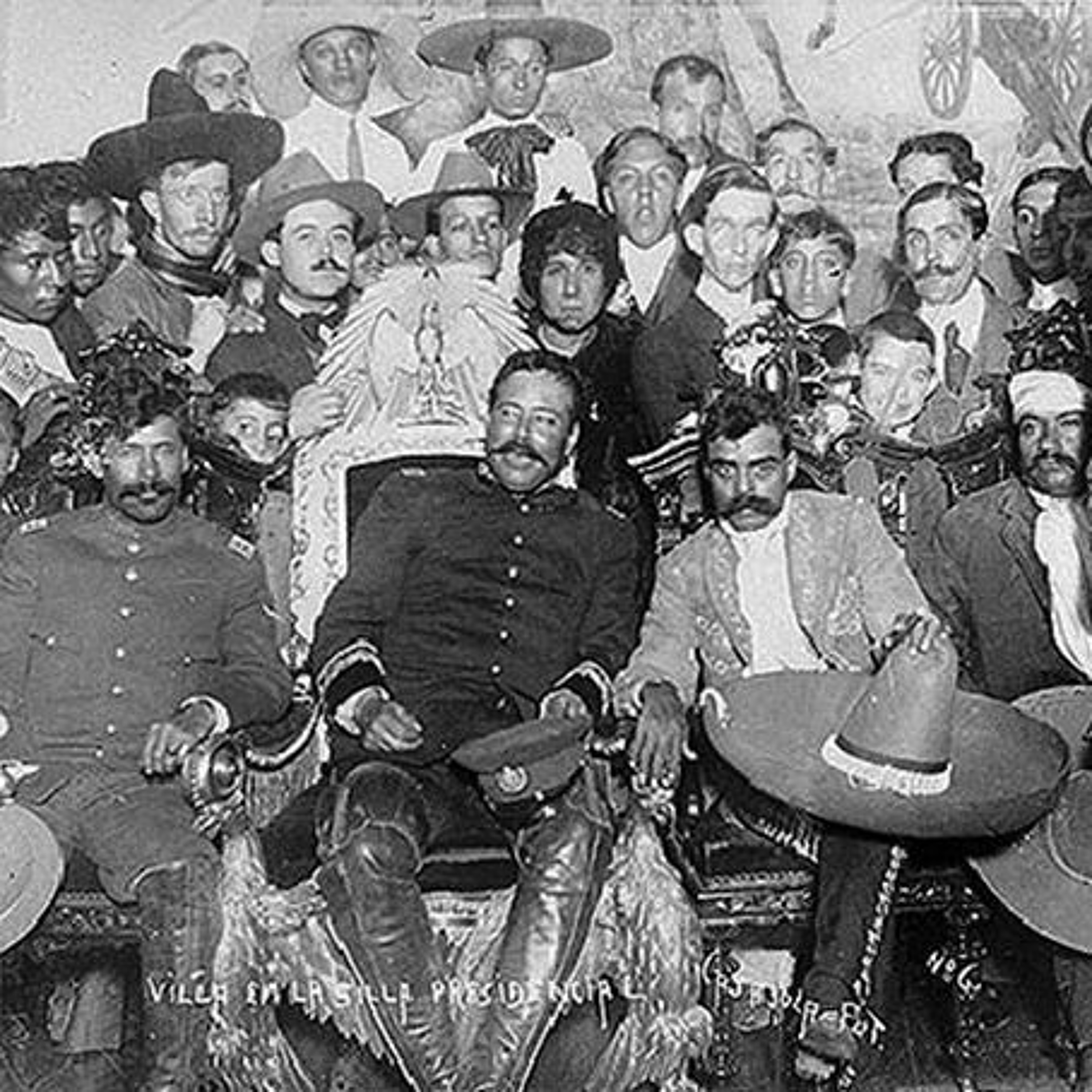
America Marines even invaded Barracruz to take down Huerta, who himself finally fled the country. And this takes us to when Pancho Villa from the north and Emiliano Zapata from the south converged on Mexico City. And in a moment famously captured in a photograph, Villa and Zapata were presented with a presidential throne. It is told that during this picture, I read about it, there is a C.A.
President's Hill, right? The throne. It's the golden chair that was actually, I learned this, that by Juarez, surprisingly. Juarez was the first one who saw it in his chair, and then, for video, it was his chair, the golden red velvet chair.
And Pancho Villa, what we see here, he is making fun of basically taking the chair. What is interesting to me in this, during this conversation, what happened in this event is, it's believed that Pancho Villa asked Zapata to sit first. And Zapata said, no. And this is where you can see the ideology being so different from each other.
I think they were both fighting for the same, but in a very different way. Zapata was very genuine, very loyal to his people and to his ideas. And the fact of sitting down in this chair was, the humiliating, was, would represent what, to see on something that he has been fighting for many years. This music is called a Carito, a Mexican ballad, about the presidential throne, La Sia President's Hill, which Pancho Villa sat in with Emilio Zapata at his site.
The singer is lamenting how anyone who sits in the chair is corrupted by power and forgets the people in their pain. He sings that the chair is red, just like the blood of all Mexican people. La Pancho Villa, La Pancho Villa, La Pancho Villa. What else is this moment or this photograph interesting or important?
I think it's interesting in that all the people standing around in the background. We've looked at so many pictures of people in suits and people all decked out in European royalty, and this one just shows it's so many different kinds of people that look like they're from different backgrounds, different ages. We don't see women. And women were very much involved, either as actual soldiers or the Adelipas who went with the soldiers.
So the men and the military men were not just going off by themselves. Women went with them and did a lot of work. Some of them fought and those were called the Adelipas. And then women wore pants and also carried guns and actually were soldiers.
So this unfortunately doesn't show the women, but it shows several gringos. And there's a lot of speculation as to who they were. People, this was very alive in the US, the Mexican Revolution. If you go down to the archives of the Salt Lake Tribune and look at, on Microfiche, if you look at the newspapers for that time, the front page was the Mexican Revolution.
And a lot of it was because of the Mormon colonies in northern Mexico. I mean, come on, they're right in the middle of it. Puncho via is in the Mexican colonies. They're trading arms.
Some of the people are trading arms. So it's really alive and well in the US, and it attracted a lot of people from the US. Let's be clear. Any war is horrible.
It's awful for soldiers who experienced it, and it's also harrowing for the civilians who get caught up in it. Anyone from northern Mexico has a great story about the revolution, because their grandparents remember. One of my friends said, whenever the revolutionaries came through our town, our family would hide their silver and their daughters. Another friend said her sister disappeared, her grandmother's sister disappeared, and her grandmother's brother, when he was 12 years old, was taken by the troops and was traded from one revolutionary group to another.
Came home knocked on the door two years later, and the mom said, who's there? She said, your son. She said, I don't have a son. So she never expected the son to come back, and he did, but the daughter never came back.
Here's Luis Lopez. I just heard some of these stories through our elders, our grandparents. I know my wife, so the family from each other, and her grandmother shared a story about hiding the women in the graves when revolutionaries would come by and stuff like that. So that was very interesting to me.
And I also found that they would respect the Pontones, right? That's the one place that they would not go and search. But yeah, that's where they would have to hide the grandparents. They would not search the grave guards.
Fanny Blower has a more intensely personal story. She says during the revolution, her grandfather on her mother's side and his family, who lived on the southern side of Mexico City, owned a store, and tried to support Zapontas fighters. As the revolutionary took place, they run out of goods. And one night, as my grandfather described it, the bandits came and asked my grandfather to give them food and things that they had in the common store.
My grandfather said, we don't have any more. We have food only for us, for my three kids and for my wife. So the bandits were really upset. They said, if you don't give us what you have, we're going to kill you.
So they took him towards the wall, and when they were about to shut him, my great-grandmother, Guadalupe, grabbed her three children and put herself with the children against the wall. And my grandfather said that he remembered how his mother asked him, close your eyes. And he was six years old when this happened. And you can imagine how frightening it could have been.
However, he remembered a very strong position of his mother's hand and holding him very tight. And as she said, close your eyes, the bandits said, move away. No, I am not moving away. If you are killing this man who's my husband, he is a main provider.
We are nothing without him. If you kill him, you kill us all. Well, they ended not killing my great-grandfather, and my grandfather was always so touched by this act of courage and bravery by his mother. Panchovia and Emiliano Zapata together conquered the Mexican capital, but neither of them wanted the presidency.
This meant a power vacuum, and the chaotic fighting continued. So the aftermath of this is that Carranza, Vinostiano Carranza, becomes president. He is responsible for the first constitution, the constitution of 1917. Apparently, there's some murals about him too.
Not his man. He's not really lauded as one of the revolutionary heroes. The US acknowledges him as the president of Mexico, which really sends Panchovia into a tailspin. And what does Panchovia do?
Invades the US. Lingos! Cam, surrender! Do!
I am Panchovia! You surrender, I'll cut your ears off! This is from a ridiculous 1973 American film called Mexico Invades the US. We don't consider that an official invasion of the US in US history, but he invades Columbus, New Mexico about 16 people are killed, and it's, you know, what you do.
And it's, you know, it's not funny. It's a serious thing. It was awful. Naturally, this pissed off a lot of Americans.
And so the US launches a raid to kill him. You can see old footage of American soldiers crossing the border and pursuing Panchovia. And it's 10,000 people were involved, airplanes, and we can't find him. Why?
Because he's very wily, and he knows every square inch of northern Mexico. This Carrito marks the fertility of America's pursuit of Panchovia. You know, family and I have given classes. We kind of tried to show the Mexican point of view, and the Mexican point of view is often on how Mexico was fought off foreign and vapors.
And one of the points of pride is Panchovia, we could not get Panchovia. We spent so much money. General Pershing was involved. We spent so much money and manpower trying to find him.
We could not find him. I want to share this story. It's very powerful. As I said, my father's family were very supportive of Mexican revolutions, were in direct Lissapata, and then my father later was involved in politics in his 20s, 30s, even 40s.
And Panchovia was, I mean, he had collections of books, and I have those books at my house. Pictures of Panchovia in my house. So when I married, I got married, I am married with a white American from a very conservative family here in South Lake City and having his conversations, even with my husband. And the first time I remember asking him who is Panchovia for you.
And his response was he was a traitor. He was a bandit. He was not a good man. And when he said that, it was a big shock because I grew up with this figure of this Mexican revolutionary who was the Robin Hood.
The Mexican Robin Hood, yes, he stole and he was bandit, but he gave to the people that really deserved it. So it is true that the figure of Panchovia in the US might be very much a traitor. When he was probably both. As a white American, when I've heard the image of Panchovia evoked, it's usually been an insult or a stereotype of Mexican people.
Here's Luis with his Chicano perspective. The US propaganda was a major influence on how he was viewed, not just about Mexicans and revolutionaries. Mexican men were portrayed as his tequila, drinking, gunslinging, marijuana, smoking, banditos. When Panchovia didn't drink, he was against all of them.
So the way that they were portrayed, right? And I think definitely once he decided, okay, well, I'm going to invade the US real quickly, all that came into play, and that changed how he was viewed. Caranza would remain president for several more years until he was murdered in 1920. A guy named Alvero Abrogón took over and finally gave Mexico its most stable presidency since the revolution began.
Reforms remained to Mexico's education system to teach the values of the revolution, along with labor laws to protect workers. And much of the fighting phase of the revolution was over. But it also meant that Vía and Zapata would also have to end too. Well, when the revolution ended, Panchovia and Emiliano Zapata were definitely, they had to be eliminated.
And the stories of both of those are very interesting and very much a part of Mexican history. And the way Panchovia or Emiliano Zapata was assassinated was really, really tragic. This corridor is about the death of Zapata. We won't get into it here, but the story of Zapata's ambushed assassination is a story worth learning about.
Still today, Zapata is a big deal. His legacy and his principles of standing up for poor, hardworking farmers lives on even today, with revolutionary groups including the Zapatista uprising movements in the 1990s. His image is seen in murals along with Cé Guvera and more recently with Cesar Chavez and the late Venezuelan president Hugo Chavez. As for Panchovia, he also was met with a violent end.
He was gunned down with his companions while driving one day. Susan says in the greater scheme of things, his death along with Zapatas was necessary. The government needed to get rid of those revolutionaries in order to move forward and not, you know, they weren't going to come into the fold of the government. And so who knows what they were going to do?
For some, the revolution brought about some positive changes for farmers and indigenous peoples. Some of the most patriotic Mexicans were determined to stick it out, unless they betray the values of the revolution. But for others, the chaos of the revolution never really dissipated. The nearly ten-year-long civil war made life hard, and it stayed hard.
Many Mexican families had lost trust in their government, trust that they would never regain. Right now, we're so far away from the revolution, we can, you know, laugh at Panchovia and just kind of smile about different things. But when you think of all the people who suffered the lives that were lost, for what? All this bloodshed.
A million people dead for what? And so that's another, that's a really important question. You can see images of the art and photographs about the Mexican Revolution we discussed during this episode on the website and home for this podcast, ArtusMexUT.org. What are your thoughts on the Mexican Revolution?
What stories does your family have to tell about the revolutionary period? Has it had a lasting impact on your family? Let us know. Thanks to Luis Lopez for his Chicano perspective.
Thanks to Fannie Blauer for her Mexicana perspective. Thanks to Susan Vogel for her enlightened perspective as a scholar of Mexican art. And as for me, Ross Chambless, I'm just learning about all of this so much for the first time and it's reshaping how I think and feel about this country south of our border. I'm your Pinto and Al Caiola.
This podcast is made possible by a grant from Utah Humanities. Thanks to KCPW for the studio space. This is Nueva's Vosos.