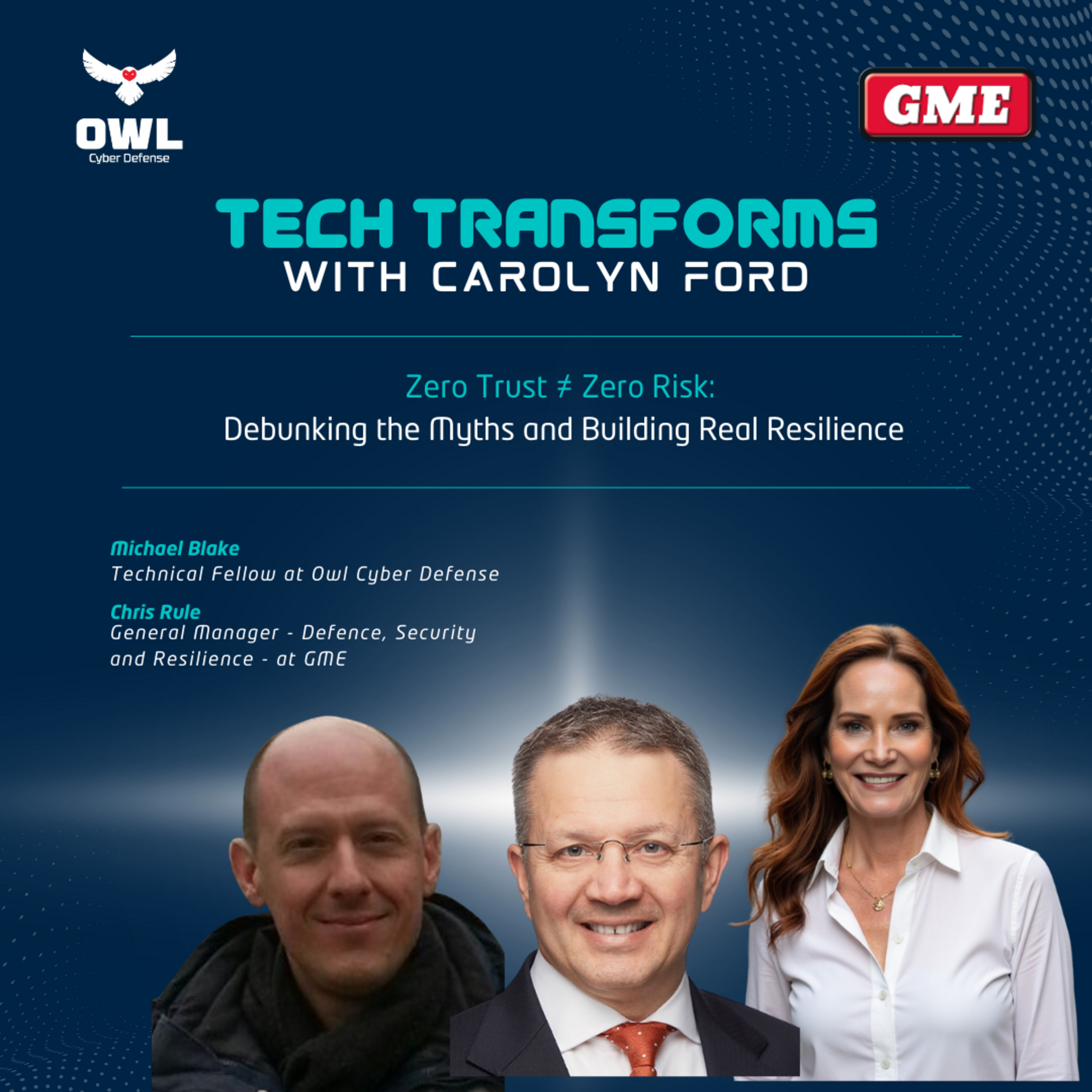
Episode 118: Zero Trust ≠ Zero Risk: Debunking the Myths and Building Real Resilience episode artwork

EPISODE · Mar 10, 2026 · 58 MIN

Episode 118: Zero Trust ≠ Zero Risk: Debunking the Myths and Building Real Resilience

from Tech Transforms · host Carolyn Ford

In this episode of Tech Transforms, Carolyn Ford sits down with Michael Blake of Owl Cyber Defense and Chris Rule of GME to unpack one of cybersecurity’s most misunderstood concepts: Zero Trust. What begins as a discussion of architecture quickly evolves into something broader, an exploration of mindset, modernization, and the reality that today’s networks must operate under the assumption that a breach has already occurred. The conversation breaks down the core principle behind Zero Trust: minimizing the “blast radius” of a breach. Instead of assuming everything inside a network is safe, Zero Trust requires constant authentication, strict access controls, and segmentation so that even if an attacker gains entry, they cannot move freely across systems. We explore common misconceptions, especially the idea that Zero Trust is a product that can simply be purchased and installed. In reality, it’s a whole-of-organization approach involving people, processes, infrastructure modernization, and ongoing monitoring. Legacy systems, skill shortages, and the sheer complexity of modern networks make implementation a long-term journey rather than a quick fix. The discussion highlights why segmentation, boundary management, and cross-domain inspection remain critical even in a Zero Trust architecture—particularly in environments with legacy infrastructure, international partnerships, and tactical edge deployments. As AI systems and autonomous technologies increasingly interact with sensitive networks, the need to treat AI as another “actor” with controlled privileges becomes essential. The episode concludes with practical guidance for leaders beginning their Zero Trust journey—from inventorying everything on their network and planning segmentation, to implementing role-based access controls, budgeting for modernization, and ensuring organizations have the skilled personnel required to sustain the architecture. Ultimately, the takeaway is clear: Zero Trust isn’t a tool—it’s a strategy for operating in a world where persistent threats are the norm. Show notes: GME - www.gme.net.au Owl Cyber Defense - www.owlcyberdefense.com Modern Defense Architecture (Australia) - https://www.cyber.gov.au/business-government/secure-design/secure-by-design/modern-defensible-architecture Chris Rule - https://www.linkedin.com/in/christopher-rule-fieaust-cpeng-gaicd-05600b30/ Michael Blake - https://www.linkedin.com/in/michael-blake-734b0a21/

In this episode of Tech Transforms, Carolyn Ford sits down with Michael Blake of Owl Cyber Defense and Chris Rule of GME to unpack one of cybersecurity’s most misunderstood concepts: Zero Trust. What begins as a discussion of architecture quickly evolves into something broader, an exploration of mindset, modernization, and the reality that today’s networks must operate under the assumption that a breach has already occurred. The conversation breaks down the core principle behind Zero Trust: minimizing the “blast radius” of a breach. Instead of assuming everything inside a network is safe, Zero Trust requires constant authentication, strict access controls, and segmentation so that even if an attacker gains entry, they cannot move freely across systems. We explore common misconceptions, especially the idea that Zero Trust is a product that can simply be purchased and installed. In reality, it’s a whole-of-organization approach involving people, processes, infrastructure modernization, and ongoing monitoring. Legacy systems, skill shortages, and the sheer complexity of modern networks make implementation a long-term journey rather than a quick fix. The discussion highlights why segmentation, boundary management, and cross-domain inspection remain critical even in a Zero Trust architecture—particularly in environments with legacy infrastructure, international partnerships, and tactical edge deployments. As AI systems and autonomous technologies increasingly interact with sensitive networks, the need to treat AI as another “actor” with controlled privileges becomes essential. The episode concludes with practical guidance for leaders beginning their Zero Trust journey—from inventorying everything on their network and planning segmentation, to implementing role-based access controls, budgeting for modernization, and ensuring organizations have the skilled personnel required to sustain the architecture. Ultimately, the takeaway is clear: Zero Trust isn’t a tool—it’s a strategy for operating in a world where persistent threats are the norm. Show notes: GME - www.gme.net.au Owl Cyber Defense - www.owlcyberdefense.com Modern Defense Architecture (Australia) - https://www.cyber.gov.au/business-government/secure-design/secure-by-design/modern-defensible-architecture Chris Rule - https://www.linkedin.com/in/christopher-rule-fieaust-cpeng-gaicd-05600b30/ Michael Blake - https://www.linkedin.com/in/michael-blake-734b0a21/

NOW PLAYING

Episode 118: Zero Trust ≠ Zero Risk: Debunking the Myths and Building Real Resilience

0:00 58:37

No transcript for this episode yet

We transcribe on demand. Request one and we'll notify you when it's ready — usually under 10 minutes.

No similar episodes found.

No similar podcasts found.

Frequently Asked Questions

How long is this episode of Tech Transforms?

This episode is 58 minutes long.

When was this Tech Transforms episode published?

This episode was published on March 10, 2026.

What is this episode about?

In this episode of Tech Transforms, Carolyn Ford sits down with Michael Blake of Owl Cyber Defense and Chris Rule of GME to unpack one of cybersecurity’s most misunderstood concepts: Zero Trust. What begins as a discussion of architecture quickly...

Is there a transcript available for this episode?

Yes, a full transcript is available for this episode. You can read the complete transcript on the episode page.

Can I download this Tech Transforms episode?

Yes, you can download this episode by clicking the download button on the episode player, or subscribe to the podcast in your preferred podcast app for automatic downloads.
URL copied to clipboard!