This message comes from Viking, committed to exploring the world in comfort. Discover the heart of Europe by river on an elegant Viking longship, with thoughtful service, destination-focused dining, and cultural enrichment on board and on shore. And every Viking voyage is all-inclusive, with no children and no casinos. Learn more at viking.com. In December of 1763, the American colony of Pennsylvania became the site of a bloody mass murder. The victims were 20 indigenous people, men, women, and children from the Conestoga or Susquehannock tribe.
The killings came in the wake of a conflict that Americans call the French and Indian War, but the rest of the world calls the Seven Years' War. This was a complex conflict that spanned across European and North American theaters. But one of the most substantial outcomes was that by war's end, France had surrendered many of its new world possessions to the British. In 1763, there was an entirely new colonial dynamic in North America. But just because the war was officially over didn't mean that the violence had ended along the frontiers of Britain's American colonies.
In Pennsylvania, the war hadn't really been about the ambitions of faraway European powers. The conflict was instead characterized by violence between British colonialists and various indigenous groups allied with the French. Indigenous raids into Pennsylvania had been common, as had been violent attacks organized by the colonists. Tensions between native people and colonials eager to expand westward had never been higher. But in 1763, the treaty that ended the Seven Years' War was supposed to settle this question permanently.
A line was drawn through the map of North America, roughly along the Appalachian mountain range. The so-called Proclamation Line was supposed to demarcate what part of the continent belonged to the European settlers and what part was to remain in the hands of North America's first people. Everything west of the line was supposed to remain indigenous territory. The new proclamation line did not sit well with many American settlers. Many felt entitled to lands beyond the line, and still more felt a special resentment over the fact that the lands had been guaranteed to indigenous people that they saw as their enemies. Some were looking for revenge. However, if there was anyone less deserving of the ire of American colonists, it was the Conestoga people of the Susquehonic Valley in Lancaster County, Pennsylvania. The Susquehonic people had a long history of peaceful coexistence with the white settler population.
In the 17th century, the tribe even entered into a formal treaty of friendship with William Penn, the founder and namesake of Pennsylvania. After a conflict with another Iroquois group decimated the tribe's numbers, they came under the protection of the Pennsylvania government. Penn even guaranteed the Susquehonic people 3,000 acres of protected land, which his sons and heirs would later whittle down to 400 acres. That's how these things just tend to go. Still, the relationship between the Susquehannic people and the colonial powers that be had been characterized by peace and a long history of deal-making. By the 1760s, the Susquehannics had become known as the Conestoga, and they were, by that point, a tiny group of people with only 20 individuals living in their small settlement known as Conestoga Indian Town. By this time, most of the Conestogas had converted to Christianity and had adopted many of the customs of their Quaker and Mennonite neighbors. They traded with the colonists in nearby Lancaster and, by all accounts, lived modest Christian lives.
But in 1763, a group of aggrieved colonists, calling themselves the Paxton Boys, smarting from raids of the Seven Years' War and outraged by the limitations of the new proclamation line, were looking for revenge against indigenous people. The Paxton Boys formed themselves into a loose militia and started raiding into indigenous territory north of the Susquehannock River. They found little success, and on one occasion they were ambushed by an Iroquois group and lost four men in the battle. Raids against well-armed and war-ready indigenous groups simply were not going as planned for the Paxton Boys. Then, they heard about Conestoga Indiantown. The Paxton Boys made it known that this group of Conestogas were in fact a danger to all white colonials in the region. Rumors were spread that the people of Conestoga Indiantown had actually been aiding and abetting the Iroquois groups who had raided and killed settlers.
There was no truth to these accusations and no solid evidence that this had ever occurred. But rumors and misinformation have a way of taking on a life of their own. A formal petition was sent to the Pennsylvania Assembly by the Paxton Boys to send an armed detachment to the region to protect against the Conestogas. The Assembly, seeing no credible threat from the Conestoga people, declined. So the Paxton Boys took matters into their own hands.
On the morning of December 14th, 1763, 50 of the Paxton boys raided Conestoga Indian Town. In the modest settlement, they found only three men, two women, and one young boy. They killed them all, mutilated the bodies, stole what they could, and then set the village ablaze. As it turned out, the village had been so sparsely populated because most of the Conestoga people had been in the town of Lancaster that day trading with their neighbors. When word reached them of the attack on their village, they sought the help of the local authorities.
It was determined that the safest place for the surviving Conestogas was in a recently built workhouse. So there they stayed in a workhouse in Lancaster for nearly two weeks while rumors swirled around them. Then, on the morning of December 27th, the Paxton boys arrived with at least 50 men to finish the job. The authorities, who were ostensibly there to protect the Conestoga people, stepped aside as the armed gang advanced. What ensued was a second massacre.
Once again, men, women, and children were indiscriminately killed and their bodies were mutilated. The Paxton boys then boldly celebrated their murders by riding around the courthouse and shooting off their guns. Now, the Pennsylvania government tried to get justice for the Conestoga people. They placed a $600 bounty on the heads of anyone involved in the mass killing. However, none of the killers were ever identified and no one ever faced justice.
In the aftermath of this bloody and senseless event, the massacre became a bit of a political football in Pennsylvania. Many loudly denounced the Paxton boys as cold-blooded killers who had unjustly murdered a peaceful and blameless people, while other pro-Paxton groups claimed that the murderers were actually just defending Pennsylvania. They acted when the corrupt government fat cats had not. This argument played out in the media of the day, which took the form of cheaply produced pamphlets. Even Benjamin Franklin himself wrote a pamphlet denouncing the attacks. Weirdly, one's opinion of the Conestoga massacre became a litmus test for your political allegiance in colonial Pennsylvania. If you agreed with Benjamin Franklin that the Paxtons were brutal murderers who had unfairly targeted the peaceful Conestogas, that allied you with the traditional colonial power brokers, in this case, the Quakers.
This anti-Paxton group used their pamphlets to lampoon the Paxton boys as murderous hicks. If you were pro-Paxton, then you saw the killers as heroes who were opposed to the lazy, sheltered elites who refused to protect the colony from a dangerous native group. They in turn made their own pamphlets caricaturing the Quaker leadership of the colony and their indigenous friends as riding on the backs of colonial farmers. Somehow, the murder of 20 people became about whether you were for or against the old guard in the colonial government, if you saw yourself as an elite or an everyman. But all too often, when people have explored this dark chapter of American history, the focus has fallen on this conflict between settlers. It can be easy to get caught up in the pamphlet wars, especially considering that one of your main pamphleteers was Benjamin Franklin. All too often, the indigenous perspective is completely sidelined.
The Conestoga people often get shrugged off as the unfortunate pawns in a larger game being played by colonists. But these were human beings. These were people who were brutally murdered for no other reason than they were indigenous and they were nearby. What's their story? How would this event have been seen from their perspective? These are exactly the questions that the graphic novel Ghost River, The Fall and Rise of Conestoga seek to examine.
Ghost River comes from the Library Company of Philadelphia. It grew out of the research of scholar Will Fenton, but it was brought to life on the page by writer Lee Francis IV and artist Weishoyo Alvitre. These two indigenous artists sought to tell the story of the Conestoga Massacre with empathy, humanity, and the focus squarely on the experience of indigenous people. The result is a remarkable work of history and art. Today on Our Fake History, I'm lucky enough to be joined by the creative team that brought us Ghost River, the fall and rise of the Conestoga. Can we get to a deeper understanding of the Conestoga Massacre? Let's find out today on Our Fake History.
Hello and welcome to Our Fake History. My name is Sebastian Major and this is the podcast that explores historical myths and tries to determine what's fact, what's fiction, and what is such a good story that it simply must be told. Today's show is going to be one of our occasional interview episodes. As I mentioned in the introduction, today I have joining me on the show the creative team behind the graphic novel Ghost River, The Fall and Rise of the Conestoga. Now, what fascinated me about this particular story was how misinformation played a role in the tragedy of the Conestoga massacre. Unsubstantiated rumors about the Conestoga people were used to justify violence against them. Then, after the horrendous killings, the meaning of the event was immediately contested by competing pamphlets. In many ways, it's a story about fake news becoming fake history. But what really struck me after speaking to today's guests is how important it was for them to tell the story of the indigenous people at the heart of this event.
As you'll hear in our interview, far too often the story of the murderers is privileged over the story of the victims. And even more often, the history and perspective of indigenous people is overlooked entirely. Recently, I was joined over Zoom by scholar Will Fenton, writer Lee Francis IV, and artist Weishoyo Alvitre to discuss how their graphic novel, Ghost River, sought to remedy that. Will Fenton is the director of research and public programs at the Library Company of Philadelphia and the creative director of Redrawing History, Indigenous Perspectives on Colonial America, which is funded by the Pew Center for the Arts and Heritage.
His digital scholarship includes the digital exhibit Americanization, then and now, the online research guide Diaries held at the American Philosophical Society, which canvassed more than 1,700 journals, and Digital Paxton, a scholarly edition, digital collection, and teaching platform devoted to Pennsylvania's first major pamphlet war. That is co-sponsored by the Historical Society of Pennsylvania and the Library Company of Philadelphia. The author of Ghost River is Lee Francis IV. Lee Francis is the CEO and publisher of Native Realities, and he's the owner of Red Planet Comics and Books in Albuquerque, New Mexico. And, even cooler, he's the organizer of Indigenous Comic Con. Lee Francis IV comes from a remarkable family of Indigenous leaders who have made a huge impact on politics, culture, and the literary arts.
Native Realities publishes books and comics featuring superhero tales of indigenous icons, First Nations freedom fighters, aboriginal astronauts, and Native American superheroes. Lee has said that Ghost River has fit in well with his larger mission to fill in the gaps of the Western historical narrative through word and illustration, and by creating positive and dynamic representations of Native people. Finally, Weishoyo Alvitre is a comic book artist and illustrator who hails from the Tongva First Nation of the Los Angeles Basin. Weishoyo has been working in the comics medium for over 15 years and has since contributed to numerous Eisner Award-winning books, including The Umbrella Academy, Little Nemo, Dream Another Dream, and Little Bird. She's earned accolades for her work that visualize historical material, including graphic classics, Native American classics, The Cattle Thief, and the 2018 AILA Best Middle School book, Tales of the Mighty Code Talkers.
According to Weishoyo, her work in Ghost River is intended to shed light on a dark corner of early American history by giving a voice to those who have been silenced by colonialism. So, without further ado, here is my conversation with Lee Francis IV, Weishoyo Alvitre, and Will Fenton. Hope you enjoy it. All right. Hi, everyone. Welcome to Our Fake History. Today, I am lucky enough to be joined by Lee Francis IV, Weishoyo Alvitre, and Will Fenton, the team behind the new historical graphic novel, Ghost River, The Fall and Rise of the Conestoga. Lee, Weishoyo, and Will, thank you so much for being on the show today. And if I may, if I may, congratulations on the creation of Ghost River.
Right on. So here's how I wanted to jump into this conversation today. Ghost River is trying to give us a new perspective on the Conestoga Massacre that's been overlooked for centuries. First of all, why did you choose to focus on this particular moment in history? And what do you think we've been getting wrong about this event?
I'm happy to kick us off and I'm sure that Lee and my show will have much to add. I really was interested in this because I see it as a turning point in the history of settlement policy in Pennsylvania. And of course, Pennsylvania was the seat of what would become a new republic. And so I see this as creating a template for westward conquest and indigenous dispossession that we typically associate with the 19th century. When we're thinking about this particular story, though, the intervention I was trying to make as a scholar was to really push back against this idea that this was the end of a particular tribe.
I think it's important to understand that the Conestoga lived on Conestoga Indian Town, which was set on a reservation that was created by William Penn with the founding of Pennsylvania called Conestoga Manor. And on Conestoga Manor, you had indigenous peoples and Western settlers interacting regularly. A lot of these indigenous peoples wore Western dress, had English names, played with English children and so forth. And so I think it's important to understand that while this is a tragic story and one that we don't want to treat as anything other than a tragedy, it's not necessarily an ending unto itself, because I think to call it an ending would be to deny the resiliency that the Conestoga had achieved through a series of assimilation, through intermarriage and through travel West.
Right. And I guess that plays into sort of a bigger myth out there about indigenous people in North America that they disappeared, that they are this sort of tragic lost people. And, you know, that's not really true. And it's something that I really appreciated that theme in the book. You know, Lee or Wishoyo, do you guys what do you guys think we were getting wrong about the Conestoga massacre? Well, I think there's been so much. I mean, what I'll say is propaganda since, you know, the mid 1600s with the rise of the noble savage and this this iconography that was created in a way to.
you know, perpetuate policies against indigenous peoples as, you know, westward expansion happened, as Manifest Destiny took over. We went from being noble and, you know, and valiant and all the rest of that to being the enemy, right? So in the westerns, we see this, right? So I think what the Conestoga history and all of the things that surround that actually encapsulate what we're, both the past, the present and the future at that particular moment of what is going to be seen in popular media, right? So we have this idea that there are the, you know, the Conestoga people prior to that, the natives, the indigenous folks, they helped, you know, the colonists, you know, come in.
rock and everything else that we can you know cheer on and then subsequent you know like right around that exact same time you see the same thing which is now also they become the enemies right and so you have in these old broadsides and things that we brought out in the comic of like how the natives are handing weapons to the you know to the quakers and how native women are represented as whores that are like tantalizing the native folks right so we said that so so western uh the western manifestos western media sets the terms very early on on how native people are going to be represented for the next 300 years in america and so i think that is primarily the base of what gets wrong right it's not necessarily the stories because In some ways, you know, Ben Franklin and his narrative, although it is used to, you know, used to the Native folks and the Conestoga people are used to perpetuate his political aims, he's probably the closest one that actually recognizes their names, calls them by name, calls them, you know, calls attention to this horrific event that takes place where innocent people for no other purpose than living and existing as Native people are murdered in their sleep, are murdered, you know, in captivity, right? So I think that that is one of the things that the majority of history is set out during the Conestoga and what...
I think what we saw subsequently gets wrong about the fact that these are people that were living, they were just trying to survive. Like many refugees, like many immigrants, they were refugees in their own homelands. And that's what happened in my interpretation of the Conestoga peoples, the Sasquahannics. Right. Well, and I appreciated that about Ghost River is that you kind of put the humanity of the people, you know, front and center in the story. And, you know, they're no longer sort of these political pawns, right? Nor they're not, you know, the stereotype in any sense of the word. They're neither sort of the vicious savage or the sort of helpless, you know, children, which, I mean, these are the kind of old, you know, racist stereotypes about indigenous people from, you know, all across North America. And so, yeah, I just, I love how you guys really kind of forefronted the fact that these were human beings and they're maybe not even the human beings you might expect, right? These were Christian people.
There were surprising things about the people that lived there and that were the victims of this crime. So, you know, I really appreciated that. You chose a really fascinating structure for this book. You chose to sort of jump between moments in time. You go from like the beginning of creation as sort of understood by Iroquois people and go to now or to the moment when you're the creation of the novel anyway. So why did you choose to jump back and forth in time? What was the idea behind playing with that chronological structure?
Well, I mean, I'll talk a little bit from my end as the writer and then kind of, you know, kick it over to my amazing compatriot who illustrated it. But, you know, I think when we had our initial conversations, what I was running into was the fact that narratively, it's, you know, what we wanted to include because the pamphlet wars happened well after. So if we're going to move linearly in terms of the structure, it wouldn't, I mean, just from like a writer's perspective, I don't think it would be as satisfying, you know, for a Western audience that is really used to sort of like this, you know, that sort of narrative arc, you know, beginning, middle and end kind of thing. So it was trying to, so automatically when I began to write, I recognized that there was going to be a, we would have to play with the timeline just because it wouldn't work. And also to include what happened with the Philadelphia, the Moravian Lenape, what happened with.
the pamphlet wars. And then as I began to write it, I recognized that the process that we had was so profound and recognizing that for all the work that I do, what I'm so inspired by Washoyo and her work is this idea of like, we're showing live natives at the end of this because too many of the things that we see show too many dead natives and dead Indians at the end of the work, right? Because it's this fetishization of tragedy that what I just alluded to, these Western constructs sort of demand, right? So I was like, I don't write like that. I never write like that. And I was not going to write like that as well. So I was like, all right, well, now I got to incorporate a present day narrative. I've got to incorporate...
sort of a twist in the narrative because what happened to the Conestoga people and then there's Lenape people and then there's the pamphlet war. And then I also was just like, you know what? Just as a writer, I'm gonna give a little shout out to my friends. Um, cause I like to be able to do that. And so I was like, well, why don't we talk about the process where we were, you know, I'm gonna throw Will in there. I'm gonna throw me and we'll show you in there, which was really fun for her to illustrate. Cause I remember she's like, this is terrible. I hate you. Why did you do this? It was my favorite part. Um, and, and also one of our favorite people who was this, you know, one of our mentors and native elders, uh, you know, Lenape who gave us that creation story. He was the one that gifted us with that for the book. His name is Curtis Zuniga. Um, I also want to throw him in the book. So he's our, um, if you go, if you read the book, he's the, he's the docent at the art museum explaining about the art piece. So that's where we threw him in. So, so I wanted, so, so.
there was the reality of what we were trying to do structurally. And then there was the underlying narrative that we'll show you when I talked about of indigenous structures, which is that it's not linear. It is cyclical. It is, it is, it is, it's a spiral shape because we are always living in these multiple moments, you know, and we can say it's, you know, cosmic theory or whatever, but we take it as indigenous theory because, you know, it's not a beginning, middle and end. It's a, it's beginning. And then, and then maybe there's like an end, but the end is really, you know, centuries down the road, but it's not really an end because it's a new beginning. And it, you know, so it builds into those philosophical pieces. So, and that, you know, and that was a lot of conversations that she and I had when we were building.
the structure, right? Like I passed it. I was like, here's the story. What do you think? Yeah. And to bounce off that too, I think something that's really powerful about this book is the way that you bounce from timeline to timeline. I think for us as indigenous people, it seems less strange. I know there's been some comments from people reading the book saying, why does it, you know, I get thrown around all these different locations and stuff. But when you come from a background of trauma like that, you constantly live in this like day to day where you're reflecting on the past, reflecting on things that happened to your immediate family and then reflecting on.
who you are in that present moment and where you're going to move in the future. And I think, you know, so many of these historical books, when they tackle instances like this, they don't often reflect on how we can deal with this now, how we're reacting in present time. And I think, you know, the power in this graphic novel is the fact that he not only incorporated present day living individuals. I mean, he mentioned us, he mentioned Curtis Unica and Will, but we actually incorporated members from the Circle Legacy Center and many of the people that we met on our meeting in Pennsylvania in the book. And I think by doing that.
It really solidifies the impact of having, you know, present day people react to this historical event. They all know of the event very well, you know, from a very personal standpoint. But for outsiders to the situation to be able to see living survivors of, you know, this type of trauma in present day in the graphic novel, I think, really, really strengthens it. And I hope that, you know, people that tackle historical events like this and other graphic novel forms or other novels or however they want to deal with it, that they do focus on the impact of relating it to people that are alive today. Because, yeah, to go back to your first question, too, so many of the tribes share this sort of instance of either a complete tribal genocide or tribal erasure. Almost every single tribe has a story of one of their major villages experiencing massive genocide where either all or 90% of their people were extinguished. And this particular story was something I didn't learn in school, so I wasn't as familiar with it. But I could relate and empathize with it on.
the basis that my tribe experienced the same thing. We were nearly completely wiped out through the mission system here in California. And, you know, seeing that same type of erasure on the East coast that happened a hundred years before it happened to my tribe, you know, I can relate to it on that. Yeah, sure. There's a hundred year difference, but how many thousands of years had we existed on this continent prior and how quickly were, you know, all of those thousands of years, all those, the languages, the people, everything else was just extinguished in a 10 year period, 20 year period. So. Yeah. Well, I appreciate that, especially, you know, your point about.
creating something that makes history sort of vital and living and not some sort of fossil, right? And I know, you know, even in what I'm trying to do with my little podcast is trying to make people feel like this stuff actually matters. And yeah, no, and I appreciated that so much about Ghost River is that it's, yeah, it's like this stuff matters right now. And I like that meta moment of like, it also matters to the people that are creating it and the people that are remembering it. But yeah, interesting that like the structure of the graphic novel actually sort of reflects an indigenous philosophy about time. That is really cool. Because here I am thinking that you guys are just like referencing sort of classic comic books and graphic novels. To me, I was like, oh, this reminds me of Alan Moore. It reminded me a bit of Watchmen and how that sort of plays with the chronology as well. So I thought, you know, I love that, you know, ultimately it's sort of, you know, representing an indigenous perspective on time. But I'm just like, oh, these guys are just comic book heads.
Also true. Let's not diminish that at all. We are all indigenous up in here. So we grew up on a steady diet of Alan Moore and comic books that play around with structural narratives that don't go from necessarily beginning to end. I mean, I think that's one of the beauties of storytelling. Right. You know, and especially indigenous storytelling.
you know, as a lot of the, the, for me, the philosophical underpinnings, you know, I grew up on traditional stories from my dad. Um, and, and as we learned, you know, as I learned, I don't, I don't teach storytelling as a beginning, middle, and end like a, you know, intro conflict, you know, a resolution type of thing. I've always looked at it as, as, as a setup, uh, tension and release, right. So, which really aligns more with the traditional storytelling. Because you need to set up because you need to know what's going on. And so in the long ago time, that's how we started traditional stories, also how I started Ghost River. And so in the long ago time, here's how things came into being. And then something happened. And it created, I won't say a conflict, it created an obstacle. Now, there's definitely a conflict within the Ghost River space. But I don't think of it consciously like that when I'm writing. And then there's a release. There's a release of that tension. Now, that could be that everybody's killed. But I think for me, the release always comes in.
when I write, I want to write something that people can, that release is also, and they call it the catharsis, but I also mean, you know, I mean that it's a, it's a satisfaction, right? You're satisfied even when you have like a no ending, right? Like as, you know, as art has developed, it's just like, and we're just going to stop. There's no ending and you're left to guess. And it's like, that still can be really satisfying, right? So we think about what the satisfaction point is. Whereas I grew up, you know, it was just that the story never ended. The story just ended when the storyteller stopped.
telling the story at that moment that was the end right and there's so many stories that like western you know western folks have tried to transcribe from native identity you know from like native traditional stories and they get like like it ends up being like three stories like fused together and i was like that's because the storyteller you didn't tell him to stop the storyteller had plenty of time so they just kept telling a story you know um so i think for me that's kind of where you know it's like we had to squish sort of like two plus stories together And this is what came out, you know, and I think in a way that we really tried to make sure that we told the story right, that we had a responsibility to not only our ancestors, but our kin in Lancaster with Circle Legacy and the people that were there. We had a responsibility for that. So it was really important that we did it in the right way, in the good way, as we say.
Yeah, and I think the final touch on that is then sort of taking it and interpreting that through art, right? So it's like you have now this vast idea of what maybe constitutes the truth from all of these very diverse sources, and then it's like, okay, now filter it through an artistic vision. And so you get this sort of cherry on top with the comic book, which is pretty cool. But I want to talk about the art a little bit more. This story touches on the history of representation, or rather, the misrepresentation of Indigenous people in art.
So with Shoyo, this is more for you. How did you approach the art in this book? Were there specific things you wanted to express about the indigenous people in this story through your art? Yeah. Initially on our trip, we were granted access to archives of some of the original political cartoons. So after we sort of initially met, we went upstairs and the archivist up there had this whole table set out with some of the political cartoons that we actually incorporated into the graphic novel.
so many of the the art pieces from that time period were either pen and ink illustration or there were some etchings as well and they also had some etchings on display at the library company that were really fascinating so I immediately am thinking um what type of tools would best represent something like this um and uh previously I had worked on Alice Sixkiller with Lee Francis and it's sort of a story that's inspired by Alice in Wonderland and so what I did with that project is I took pen and ink illustration style similar to the illustrations in Alice in Wonderland and tried to incorporate that into a comic book format um and It takes a little bit more time to be able to do that type of art style. But I kind of proposed to Will, too. I said, can I just kind of mimic these 17th, 18th century pen and ink illustrations? Because I think that sort of European art style would be kind of very powerful in reinterpreting the event that happened in this Western kind of art style. And also, it ties back to the cartoons that we were looking at directly, which you can access on the website and take a look at.
Yeah, so I started going down this deep rabbit hole of like tools and very early tools. I have a collection of antique pens. So it kind of gave me an excuse to splurge on an additional one for the project. And all the illustrations in the book are done with 1800s Aiken Lambert ink pen. And all of the colors on the book are hand painted with pigment paints. So I also was looking into the historical references of what type of colors and palettes were available at the time. And yeah, all paints during that time period were done out of either minerals that they would grind up and make by hand or plant pigments. So that kind of.
guided me to picking a very earth-based palette. The paints are all pigment paints. They're made by hand by a guy who's in the, I think he's in New Mexico now. He's the pigment hunter on Instagram, but he makes these palettes and all the paints are made out of crushed rocks. And it's very, I don't know. It's almost like alchemy. So yeah, that's awesome. I love it. I love that your palette was like guided by the history. That's so cool. I've heard this story for so long now and it never fails to astound me. Like for this entire time, we've done like interviews and we had the opening and every time I hear it, I'm like,
What? You are incredible. Anyway, I just love to throw that in. I was just like, it still blows my mind every time. And we'll show you. You throw it out there like, no, baby. Just getting like hand to ground, like super authentic. Well, I'm just, I'm like a stickler for like.
That type of stuff. And if I can go down and access those things, I will. And most of the time they're off limits. So honestly, when we went to the library company the very first time for the meeting, what inspired me is they had a display down in the gallery and there was a palette on display for enamel paint. So it's the same process. Enamel paints are ground up pigments and then they fire them and they can change color. But they were in these little glass vials and that's just right there. I was like, this is the direction I need to go with it. So it was really inspired by our time in Philadelphia. And then it kind of just.
pushed me to do what I normally do anyway and finding weird antique stuff. I looked into getting actual paints from the time period because they are available, but they're very, very costly. You can buy antique. You know, people have them. They find them in attics and they're unused. But some of the colors, you know, are made with like toxic materials because, you know, lead, all kinds of things. So I thought, well, you know, out of the two choices, I probably should choose a safer one. Yeah, fair enough. That's so cool.
There's a lot of really striking images in the book, but the moments where you seem to be depicting spirituality and the spirituality of the people in the story, those images really struck me the hardest. I think they're some of the most beautiful images in the graphic novel. I was curious about how you approached those images in particular. And I'm thinking about the beginning and then also, you know, when the Conestoga people sort of kind of come together to sort of, I guess it's sort of a ritual. Just how did you approach those moments? Yeah, the introduction story, we went back and forth with exactly...
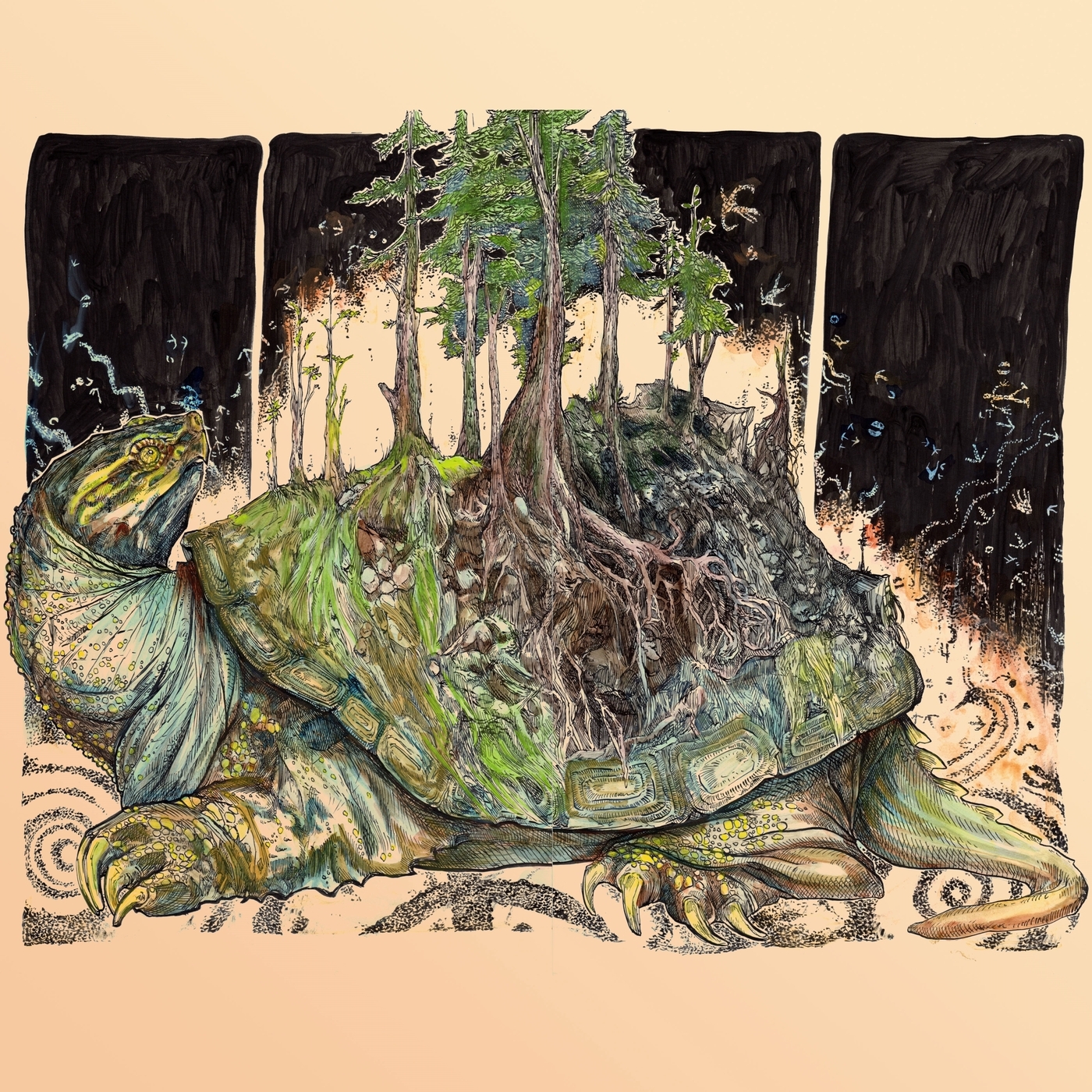
we were going to tell that because it was literally only a few pages and we had a very a longer um creation story originally that we had decided to shorten down and make more concise so we were trying to be as true as possible to the oral history but at the same time create something that was a launch pad for the story to start and didn't take up too much time um at the the forefront but was also respectful to you know what we need to show respect to so um initially i had done those first two pages as panel breakdowns so sequential art And it just was not working for me. And I tried, you know, a very heavy handed panel breakdown. I think I had something like eight or 10 panels across two pages and it just seemed too busy and too fragmented. So I finally thought, OK, what if I just do a double page spread? How would I interpret that? And I took an image that, you know, many, many tribes use. A lot of tribes have turtles involved in their creation story. And, you know, the concept of Turtle Island is one that's pretty well known. So I took that and I did research into the types of turtles that they have on the East Coast in relationship to the tribe here.
that we were talking about. And that led me to just doing research about the botany in the water, the different plants and stuff that are in Pennsylvania. And then, of course, that sort of went through petroglyphs. So many of the tribes across the United States use petroglyphs in their creation stories. They use them for ceremony and a lot of other things. And in the Susquehannock River, there's actually petroglyphs in Pennsylvania that are from this tribe and surrounding tribes. So I did a lot of research into the petroglyphs.
of the area and what i did is i i tried to pull ones that i thought were maybe not necessarily religious and could be reproduced in a format such as this so um on that double open um spread you'll see on the sidelines they're sort of bird petroglyphs and they're taken i tried to take them and pull them directly from the the rocks as they were and not mix them up too much because i feel like the space that you have in between one image from another image and the interaction of that is meaningful and i didn't want to it's like words dissecting a sentence if you were to take out words and then just throw them on a well it's not going to make sense and i didn't want to be disrespectful to the culture so um i tried to pull them as closely as they were from the the actual rock um reference i used um the other page i think you're referencing is the sort of the fire um yes yes that's what i was thinking um and that i was just thinking um primarily of gathering um i wasn't thinking of anything necessarily too spiritual but you know these people who have been taken from their homelands it's in the dead of winter and they're you know being shoved into the unknown like how can you make them feel secure and
just safe for a brief moment in time. So I, for me personally, you know, I think that, that script had been written that they were gathering around a fire and that's, that's the most like primal type of feeling of safe. If you're around family members or friends and you're around a fire and you're all there just to be around one another, you know, it's something that we don't even have in this COVID time. And not knowing that if you're going to wake up the next day, basically. So I was, I was trying to encompass that feeling of joy. And it's such a small feeling of joy that they get to experience because most of the time they're just being, you know.
run off from their village site and then move from their tribal lands. And it's just constant like pushing and jumping in all these directions. So yeah, I just kind of use that double page spread as a real kind of like a pause in the story. Like these are human beings and they need to feel this safe space, even if it's just for two pages, because we know what's going to happen to them towards the end. So that was kind of what was going through my mind when I was doing that page.
I also want to say that you had a spiritual experience of doing all of the bricks by hand, if I recall correctly, because I wrote that it was old Philadelphia. And so my favorite part of the email conversations were back and forth of like doing each brick. So it is quite a testament, but I feel like that was a spiritual experience for you of drawing and illustrate like each and every brick in that space. And I just remember that as one of the big things about the illustrations. But I think that also speaks to the testament of the work and the people and the work that you did on this.
Yeah, that was a meditation experience. I've been involved on projects before, and a lot of the time they'll use what they call paste up. So they do a digital wall of bricks, and then they can paste it up in Photoshop, and then they can skew it or whatever to fit. So it's efficient time-wise with this, and just due to the nature of early East Coast. bricks being made by hand um i didn't feel like that was going to surface the story um and then as i started you know going into these panels and spending hours and hours replicating brickwork um i started thinking about just how bricks were made because my tribe has an experience we had to make adobe bricks for the missions here and it was basically slave labor to where they would form boxes they would um you know mix adobe with hay and some other ingredients sometimes lime to form this very very thick sticky brickwork um they would pour these molds and the bricks ended up being like 60 pound bricks and all of the missions up and down the coast of california are manufactured this way So I'm thinking the same thing with these buildings on the East Coast. Somebody had to make those bricks. I'm not really sure who did, but they're made out of the ground, basically. And so I was trying to tie that into the irony of in this ground probably lies the bones of thousands of years of Conestoga Native people, as well as their blood memory, their DNA. It's mixed into that dirt. And in turn, that dirt is getting mixed into the brickwork and building these buildings, which will eventually house them right before they're massacred. So I think that's just something that was running through my brain as an artist. I don't think many readers will quite make that connection.
some of the process work in dealing with this environment and dealing with these spaces. Well, I think things like that, you know, that attention to detail, though, might not be, you know, tangible or immediately evident to someone reading the book. It seeps through almost subconsciously. You're like, wow, this is powerful. And you're not even quite sure why. But now I know it's because every leaf on that turtle's back is accurate to that particular ecosystem. And every bit of dirt in the brick has intention behind it. That's awesome. That's really cool. I love that. Pivoting just a little bit.
I want to talk about misinformation because a theme that runs through Ghost River is misinformation. And this book sort of explores the idea of how fake news or even historical fake news can become fake history, which is kind of what I'm interested in. What were all of you trying to communicate about that theme? Will or Lee, what do you think? Well, go to it. All right. For me, I came in, as I said, interested in the print debate. And that print debate bears some uncomfortable similarities to the sort of online debates that we're seeing play out today. The pamphlet by 18th century standards was a very inexpensive, very fast medium. You can make these things, multiple pamphlets in one day and disseminate them very widely because they were so affordable to create. And you had a lot of people creating pamphlets based upon hearsay, under pseudonyms, repackaging each other's words and using it to score political points.
And so the print debate that sort of sparked my interest in this was so widespread that it came to comprise the Paxton debate. Just the debate about the conduct of the Paxton men and all the stuff that got rolled into that over the coming year comprised one-fifth of all the printed material in the colony of Pennsylvania, which was really like the center of North American print culture at this time. So it's a lot of material. It's a lot of material and it's a lot of fake news. And it has real consequences. It's an election year. It happens to be an election year. And a lot of people that wind up...
taking any kind of stand against the Paxtons and their allies lose their seats. And that includes Benjamin Franklin. This was one of his rare defeats in politics. He lost his assembly seat. And he barely got sent to England as a sort of ambassador after this because his reputation was so tarnished from his engagement in this very debate. So if we're thinking about fake news today, this is sort of version 1.0. And it might not have moved quite as quickly or quite as elegantly as the fake news traverses our ecosystem today. But I think it's uncannily similar and it has real political consequences.
Yeah, yeah. So go ahead, Lee. No, I was just going to jump in. I think partly what it does is in any of these instances, it creates a mythos. um around the various characters fake news essentializes everything it boils it down and it's really about it's not about the news itself and that's that's what i've been you know deliberating on is it's not actually about the information it's about how you're cultivating people around the information so it's all about power dynamics so when i what i set out to do was to write uh away from that and to write you know a different narrative of a group of people that did not have power at that moment right a group of people that did not have access to producing thousands and thousands of pages of text and pamphlets and all the rest of that and i think that that's the part is when you think of the power less and the access to the media that's also what we have you know in play today you have that taking place you know right now in terms of you know who's you know who's accessing who's divining who's creating this and then who's consolidating um so this was a way to consolidate and and move the Quakers out because they had they had dominated you know Pennsylvania politics for so long well this was a way that they could finally and we see that in the records of the people that forced the Pakistan murderers not forced them but uh how do we say paved the way for them to commit these atrocious acts well that also is the parallel for today right here's a group of people that were
as the Conestoga, we, you know, we're, we're basically just poor people. They were poor, they were poor Christians. They lived, you know, from handouts and all of a sudden they become the targets of a war that they didn't even want to engage in. For me, I call that from the Paxton murder side, I call it cowardice, but that's, that's the effect of fake news. And we see it 300 years ago. That's the, it is 0.1.0 or I don't even know if we're that far ahead. I'm like, it's like 1.1 right now. So.
Well, one thing, you know, one of the more poignant moments in the book is also when you see, you know, the Conestoga people interacting with the pamphlets. And it's like this moment of like weird cognitive dissonance and like, or like being like, is this how they see us? Like these like weird, weird cartoons. Is this who they think we are? But, you know, that's sort of the frustrating thing about, you know, living in an environment with a lot of misinformation is that it makes you even question yourself. It makes you even question your own, what you know to be true, right? Like, I know I have my own moments when I'm picking through something for this show that is, you know.
fraught with misinformation, you kind of feel like you're going crazy at a certain point. Because you're like, I don't even know if I, maybe I'm the one that is wrong. Maybe the people who are creating the misinformation are right. And you kind of got to shake yourself out of it for a second. And I kind of found that moment really pointed in the book where you have an indigenous person looking at a pamphlet about indigenous people and being like, what is this? Right. Well, and when we looked at that, that was actually a conversation that we had up in the archives, right? Like as we're looking, we show you and I were talking about it. In fact, I replicate the same conversation in the comic, you know, part of that metanarrative. But that was one of the main things.
when I would put myself in their perspective, again, from there, they would have known some sort of English because they were Christian and they had been Christianized. If they're on the streets and this much material is being shot out and they're there in Philadelphia, they're not going to be ignorant of what's there. They can choose to, they could choose to ignore it. But I felt that it was really poignant. As you say, I think it was, it's an important moment that they recognize, especially as Christians, especially in that moment as Christians, that they would be like, what are you doing? Because they probably would have recognized that like, okay, yeah, we're, you know, we're.
disputed class anyway. But then to call into, you know, to basically say that they're whores and prostitutes. That was the pamphlets. That was the broadside that was there. Imagine you see that. Imagine that's the fake news part. That's the piece where, like, you walk in and someone's printed something on the side. It's just like, you know, Lee Francis is an idiot. You know, and you're just like, I'm not, I'm okay. What are you talking about? But even, like, even more because it was so much more despicable. And to, you know, to these folks that were, you know, impoverished, they were Christian, they had been Anglicized, you know, they still had their traditional values because that's why they were still in the Conestoga Township to begin with.
But, you know, and even the Moravian in the same, you know, in the same way as we see many of our relatives today within Native communities that are, you know, either Christian or Catholic or, you know, Episcopal or Evangel. They still they still show up for the various, you know, traditional things that we do. I've got plenty of family members like that at home. Right. So that was what I was trying to strike at was this is how a regular person would react. Is this what you think of us? We have been loyal, you know, to not only you, but also to God, to all of these things. And this is what's coming out in the paper.
I'm sorry, sir. This is ridiculous. Right. So that's where we were. You know, that's what I was trying to hit. And I think, you know, as we were talking about, we show you and I had a big conversation. It was like, yeah, yeah, that makes sense. This is how we get to missing murdered indigenous women right here. Sure. Sure.
yeah it's so directly tied into the way that we're treated currently too i mean you can look at you know the um pocahontas tweets on twitter and how you see such an outrage in the native community and yet the outrage is not translated into major news the major news would rather cover the talking point and not cover the actual people being affected by this so i think that's such a powerful point for him to have included that in the script and to be able to draw that like just that what are you doing to us you know The same thing now. I mean, so many indigenous communities are, you know, direct supporters of, you know, political campaigns. They're direct supporters. They're within the political systems. And yet we're still the minority voice. You know, nobody wants to listen to us. Indian issues don't matter. It's like, how would history have been changed if, you know, the American Indian movement had full press coverage back in the 60s and 70s instead of independent press coverage or press deliberately not covering those issues and not giving sound voice to Native people? I mean, how would history have been changed?
the voices had been listened to or even just given a platform to speak and i'm seeing some change today but i mean a lot of it is just repeat behavior and over 300 years and i think well actually no i was just gonna add just one last tale i think that was what i tried to you know put at the end of that you know it's sort of like the stinger out is like you know the the the franklin surrogate or the person that comes and talks with them you know after she confronts and he's like thank just thank goodness you're still alive right it's not like we're not even going to take into your concerns of that you know like you know whatever it's just like you should be grateful and thankful that we have done so much for you so that was kind of also my dig into what we show you was talking about in terms of media is like yeah we're not even gonna recognize your humanity we're not even gonna recognize your wards of the state and therefore you know yeah okay bummer oh you know get over hashtag get over it because we see that so often too when native folks bring we're just like hey this is really an issue and they're like man that was so long ago get over it so for me that was one of the parts of just like that's exactly how you know it's version 1.0 right like we already saw this so you know we're just seeing you know these echoes still today
Yeah, the one other point I'd add here is imagine if the way that we remember this moment was just by looking at archive tweets. It would be maddening, right? Like that would not be a faithful representation of who we are in this moment. It would deny us the humanity that makes us such rich creatures. And I think that what's really powerful about that scene where you have a Native woman confronting one of these colonial officials saying, this isn't who I am. It's a cry of humanity. And it's a cry against the sort of...
lack of neutrality of the sources we take for granted. Because, of course, the materials that we are drawing upon, the materials that structured our first research trip, were basically the tweets of the 18th century. We were looking at the pamphlets because those were the things that were authorized material. And what this book, and what I think Lee has done so adeptly, what Washoyo has done so adeptly, has been to really push back against that and to humanize the actual historical actors in a way that rings true today. Well, everything you guys were just speaking of kind of takes me directly to what I wanted to get into, which is how your identity as Indigenous people affected how you told this story. I mean, one of the things that's important about this book is that it's an Indigenous story being told by Indigenous people. And Lee, I know telling Indigenous stories and amplifying the work of Indigenous artists is what you do, right? This is what you've made your career doing. So I was curious, and you guys have already spoken to this, but how has your experience as Indigenous people informed how you told this story?
On top of that, you know, being that neither of you are from the Conestoga First Nation or identify as Susquehannock, did that pose any challenges? Yeah, I think... I think for me, I mean, to the two points, I mean, you know, one, as I kind of was outlining the whole idea of like indigenous storytelling, the indigenous philosophies that were built in there, you called out the fact that like, you know, we started from a place of traditional stories, which is how we start all of our narratives, right? And the important narratives that we're going to do, it's like, and so we start with the time of creation. And that was actually very deliberate that I wanted to put that in there. But I think for me as an indigenous writer, you know, I want to write a good story, you know, because I grew up with the, you know, the stories, the traditional stories, they educate and entertain. And that was fundamental to my upbringing.
think it was always saying like you know i want to be able to educate i want to be able to entertain entertain but i also there were certain things i wanted to check off one because i have a deep history of understanding the ways in which native people have been portrayed in popular culture this is one of those you know milestones one of those those key moments of how native people are represented in popular culture so bringing out the ideas of how native women were represented that is a huge thing for me and the issues of missing murdered indigenous women um how native people have been portrayed through time remembering their names like that's so that was so significant the framing of of the whole perspective of this that we weren't going to tell a story that was from franklin's perspective we weren't going to tell a story of the conestoga perspective we weren't going to tell and i was very clear to will at the beginning that i was like this is not going to i mean like i know like i like history so i was like man the pamphlet wars it sounds so amazing i was like but i They've already had their story. They've had their time to tell that story. This is the story for these people. And I think that gets to the second part of the question, which is the, I'm not, I'm Pueblo. My family's from Laguna Pueblo, you know, 45 miles west of Albuquerque, New Mexico. We're desert people, you know, and I was invited into this home to tell the story. So there was an incredible responsibility that I had. And I feel like it's, and even more so for what I do for a living of telling these stories and bringing these things to life that I am, you know, that I was honored and gifted with this story by the descendants that are still there in Lancaster.
by our ancestors and elders that you know that brought will out to albuquerque to meet with me that that connected me with we show you a long time ago and she was just like you know like i want him to write you know all of these these beautiful interconnections are so significant so for me i think that's where my indigeneity is really you know it's it's the it's the foundation for all of this stuff um and i never forget that i'm a writer i want to make something that people want to read from beginning to end i write comic books so i'm never going to stop writing a comic book because i could definitely espouse but i was like no i still want people to be like what's going to happen on the next page so i got to still stay within a format But all of the things that I tried to throw in there, that's for me the fun part about writing and the exciting part about writing is it's like a Rubik's Cube because then I've got to figure out how all the pieces that I want to put in there, how they all come together. And then when I get really good editors and really good illustrators, then we're able to create something magical because it's like some of that has to go, some of it can stay, some of it has to be refined. And what we come up with is this piece that I feel, because we had the feedback from our family out there, from our elders and whatnot, that I feel that we did right.
by them. You know, I got the blessing from Curtis Zuniga from, you know, so I was just like, I'm out. Peace. That's all I gotta do. I'll see y'all later. You know, I was like, that meant so much to me. And of course, all of the other folks, you know, that we had that read the graphic novel and they were just like, yeah, this is the story you want to tell. And I was like, oh my gosh, that was the most, that was the part that meant the most to me in terms of what we did.
Yeah. When I initially met with Will at Indigenous Comic Con, before Lee was even involved, I was really, really encouraged by the passion that Will had in setting this up as his thesis and everything else prior to me working on it. But at the same time, as excited as I was, I was also terrified because I knew that a project like this in the hands of the wrong writer or in the hands of maybe a non-Indigenous writer could blow up in my face. You know, it's something that I think major publishers are just now starting to realize. They're starting to think like, oh, hey, maybe for authenticity's sake and for the sake of, you know, the responsibility of everybody involved, we should probably have indigenous people write books like this. It's just this aha moment that I keep seeing sort of like flash back and forth in the publishing world. And it's crazy. And, you know, I was just writing about this on social media, too, because I turned down two jobs this week of people that are like, hey, you're native. Can you draw this native thing? Because it's native and we need a native person, you know, for that sort of thing. And, you know.
I'm like, well, can I read a manuscript? And they're like, oh, well, sort of like you can read a couple pages. And I'm like, oh, well, that's not going to work for me. You know, I need to see exactly how this is going to be representative of the people that are involved. Because, you know, being a native person, you can't just do this work and throw that to the wayside. These are people's ancestors. They're their family members. They're people that are living today. And if this gains any sort of traction, the project, whatever project it is, it's going to either negative or positively reflect the people that it's being told about. And that's this huge level of responsibility that I think.
anybody doing this sort of work really needs to take to heart um and something that you know when will asked me oh can you recommend any native writers i knew for a fact because i'd worked with lee prior that yes he would and i could trust him in that and it would take away all of that stress and anxiety of me you know wondering about this writer if i was going to have to do like you know just dealing with an inaccurate script or a script written from a you know non-native perspective lots there's lots of problems that could have happened and i'm so thankful that they didn't and that will chose But as a credit, you know, like it's so much easier to find a non-Indigenous person to write these sorts of things. And Will very easily could have probably found, you know, five different writers that would write something in regards to this. But I don't think that they would have gone through the same amount of, you know, heartache and, you know.
responsibility, seeking out elders, seeking out people from the community, fact-checking things on a, you know, we fact-checked up until the very end on this book. We were constantly in a communication and dialogue back and forth, making sure we had things properly set up. And that's, that's something that you don't often see in projects like this. So I always, you know, I want to give tremendous credit to Lee and to Will for both taking up that responsibility and Will for, you know, being kind of thrown in with me and Lee who had worked together prior and we kind of had our working style and adapting to how we worked and sort of the things that we already knew about each other. We had that level of trust between ourselves that we knew we could.
do things and he was kind of like is this okay like is this working and it did work out amazingly because it could have very well run into a lot of different problems um and i will say too um you know i'm tongva i'm from the los angeles basin um this tribe is literally as far away as you could possibly get i'm way over on the east or the west coast and this was you know a tribe on the east coast we do have a lot of differences and so i was jumping into an area that i was no expert on um through all of the introductory meetings that we had in pennsylvania i learned a ton meeting people from the tribe learning you know their creation stories being welcomed into the circle legacy center and introduced to all these people was a huge huge um help for the project but also when i left and i came home i was googling you know a reading list and a research list while I was on the airplane back. So when I got back, I put in a huge Amazon order and I ordered all these books that were, you know, had little tiny things, stories, or one of them was on historical costuming. So all these things that I need to do as an artist in order to properly represent these people as best that I could. So it does take a lot of care when you're dealing with entities that are outside of your own culture. And you do hope that you're doing the best that you can on a project like this. And, you know, you have to accept that maybe you won't get something right. And all you can do is sort of do your best with the best intentions.
Well, I think that care came through. I don't think anyone could accuse you of slacking off on this one. I think it comes through in the art, it comes through in the care, in the storytelling, and it comes through in the research. So I think you can be proud of what you guys have achieved. So just to bring this in, in the end, and this is for all of you, what do you hope readers take away from Ghost River?
I think that I hope that they take away the fact that we're still here, that there's descendants of people that have experienced genocide and atrocious, you know, instances of humans clashing. And yet descendants still survive through all of that. And they don't necessarily hold grudges against, you know, the instances that happened to them in the past, that they can't heal from those things. But it's important to recognize what happened in history and not throw it on the wayside or not give them representation in historical books because, you know, everybody's human. It should be double sided. You should learn about the oppressor and the oppressed in history. So I think just being able to hear voices of survivors is very powerful and something that I hope people come off, you know, reading this book. I think I have two things. One is I from, you know, sort of the publisher industry, deeper perspective, the people that are, you know, that are exposed to this, that, you know, that.
hear the various things. I want them to know that there's a better way to write about Native folks. I think the way that Will brought us together and had the library company and Pew Arts and Culture and the Heritage Foundation, all of them, coming in to support this is like... I haven't seen it before. And so this was so, such a wonderful experience for me to be able to like walk out in that space. It was like more people need to do that when they're, when they're working on, on types of things about native people. Um, so I think that is what I hope people, you know, get out of this. That's why we put so much in the forward and we talk so much about this is, is that we want to see that too. I think too, also to, to build on we show you his point is that indigenous people, um, have agency.
have had and will have agency. And that also extends to all of humanity, even in times of genocide and ethnicide, people still make decisions and those decisions then become magnified to be something so important to them. The moment, you know, that we write when they're in the church, when, you know, excuse me, in the church is what I feel like, when they're in the workhouse, you know, and they're taking this moment to pray. When they're taking this moment where one of them among, you know, one of the characters among them says, I won't die laying down. I will be on my feet. You know, like they know what's coming. And so we take these moments of agency and that agency is so critical and important for all of us.
And ultimately, that agency is what leaves us to be here. I'm going to that's my I guess my third point. My last echo is that we're still here, you know, and I'm going to end every book I write like that. We're still here. We still have, you know, and we carry these stories from our ancestors forward. So, you know, that's that's what I hope people get out of it. Yeah. And from my perspective, I'm thinking about my my fellow nerds, particularly in the academy and not just in terms of the production of history, but scholarship more generally. I mean, what I was supposed to do after I wrote my dissertation was I was supposed to revise it into a scholarly monograph.
that 500 copies would get picked up by research libraries around North America, and I'd hopefully get a tenure-track position with that. My aspiration with this was to take a very different route in that I would sort of try to maybe get out of the way a little bit, maybe surrender the authorial pen for a moment and think about what happens when I work with people with a totally different set of expertise than I have. And I hope that as a lot of my friends in graduate school, recently out of graduate school, are thinking about... what their role in the public humanities might be. They might think about it as one that is more reciprocal in nature than one that is sort of based around consulting with a partner here and there and then sort of having that blessing on that final product. Instead, it really requires them to get into an uncomfortable position and to take a risk because this certainly was a risk. And I sort of hit the lottery in finding two amazing creatives that had a fantastic working relationship who basically carried this forward irrespective of whatever damage I could do.
There certainly is a risk, but my hope is that this will take this story that I've been wanting folks to think about outside of just sort of the rarefied circles of early Americaness and really get it out to teenagers all across North America and really to get it out into a world where it challenges some of those mythologies that we take for granted. Well, I salute you for that. I mean, it's something I see as part of my own mission, right? To take history that can seem so far away, can seem so... boring even, and make it alive. And Ghost River is nothing if not alive. So I just want to thank you so much for being here today. Thank you for, you know, sharing all your thoughts with me. And it's been a real pleasure speaking to you all. So thank you once again. And I encourage everyone listening to check out Ghost River.
Okay, that's all for this week. Once again, a huge thank you to Will Wachoyo and Lee Francis IV. You know, we went deep in that conversation. Hopefully you came along for the ride with us, but I thought there was some good stuff in there. If you're curious about seeing the graphic novel, Ghost River, you can actually access it for free. Yes, for free. Just go to read.ghostriver.org and you can look at the graphic novel right now. I'll post that link in the show notes. I'll have that link posted on Facebook. And I will also have that link posted at ourfakehistory.com on the page for...
this episode. Before we go this week, I also need to give a shout out to the following people. Big ups to Doug Risley, to McCarthy Hawkins, to Adam Myers, to Stormy Hufflepazizzle. Stormy Hufflepazizzle, I like you. To Andrew Walsh, to Charles Lipscomb, to Christopher Zapatini, to Daniel Cowell, to Jewel Fiona de Rivera, to Aaron Medina, and to Don Watts. All of those folks have decided to pledge $5 or more on Patreon every month, so you know what that means.
They're beautiful human beings. Thank you so much to everyone that supports on Patreon. Thanks so much to everyone that supports at the $1, $3, $5, and beyond levels. Thanks to everyone out there that's just been supporting the show for so long. Even if you can't support monetarily, that's fine. Sometimes people will send me messages being like, I'm so sorry I can't support on Patreon. It's okay. Podcasts are free. It's all right.
But I do really appreciate the Patreon support because, you know, I'm getting very close to making podcasting my full-time job. So thanks again to everyone that supported that. I really do appreciate it. And there are so many awesome extras now on Patreon. So if you think you might want to get access to all that extra stuff, you just want more Our Fake History in your life, go to patreon.com slash ourfakehistory and see if there's a level of support that works for you.
If you want to get in touch with me, you can always send me an email at ourfakehistory at gmail.com. You can hit me up on Facebook. That's facebook.com slash ourfakehistory. Or you can follow along on Twitter at ourfakehistory. As always, the theme music for the show comes to us from Dirty Church. Check out Dirty Church at dirtychurch.bandcamp.com. And all the other music heard on the show today was written and recorded by me. My name is Sebastian Major. And remember, just because it didn't happen doesn't mean it isn't real.
This message comes from Viking, committed to exploring the world in comfort. Discover the heart of Europe by river on an elegant Viking longship with thoughtful service, destination-focused dining, and cultural enrichment on board and on shore. And every Viking voyage is all-inclusive with no children and no casinos. Learn more at viking.com.