Episode 13: A Thousand Cuts
from Electric Bison Hosted by John B Driscoll
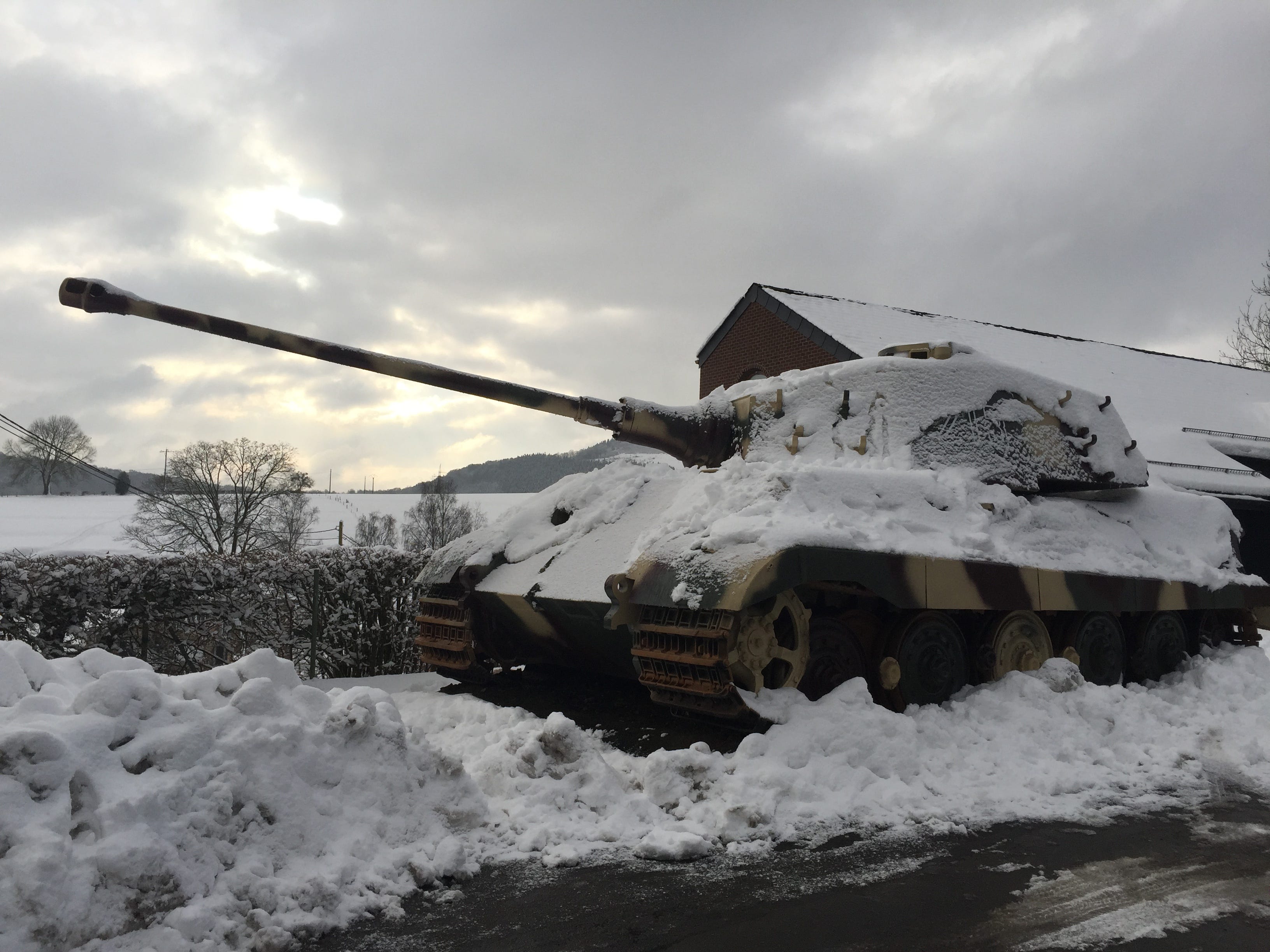
The southernmost route contributing to Dietrich’s Sixth SS Panzer Army’s attack led to the Ambleve River system flowing away from the German border through Stavelot, Belgium. This route seemed ready-made for flinging a deeply penetrating spear through the thinly stretched U.S. defensive line. Chosen to execute the task, Joachim Peiper, once personal adjutant to SS Chief Himmler, gave his name to the tailor-made military formation, Kampfgruppe, or Battle Group, Peiper, the largest of four task-organized mobile strike units of the 1st SS Panzer Division. Kampfgruppe Peiper contained the armored vehicles of the full SS Panzer Division, including the new 70-ton King Tiger tank, or Tiger II, which was impervious to U.S. anti-tank weapons but required a gallon of fuel to run for half a mile. When the Kampfgruppe began moving west it had only one-fourth the expected fuel requirement for reaching and crossing the Meuse River. According to an optimistic timetable, German plans counted on Peiper’s fast-moving armor unit to refuel at U.S. fuel depot as they were overrun. From the outset of executing its critically important task for Hitler, this formidable SS striking force began suffering defeat from a thousand cuts. A few miles south of Monschau along the German-Belgian border is the beginning of the five-mile wide, seven-mile deep “Losheim Gap” in the Eifel Mountains. This and the westerly valleys in Belgium offered perfect terrain for launching the surprise offensive. There were no serious rivers or mountains to negotiate. From here, paved Highway 626 went northwest to Losheimergraben, then branched either north to Krinkelt-Rocherath and the eastern end of Elsenborn Ridge or, if continuing straight on Highway 626, northwest along the Ambleve and Lienne Rivers. Kampfgruppe Peiper took the latter route, passing through Lanzerath, Honsfeld, Bullingen, Malmedy, Stavelot, Trois-Ponts, and Werbomont on the way to the Meuse River crossing at Huy, Belgium. After Malmedy, the terrain changes and the westerly river valleys develop steep banks and have narrow roads, which Peiper complained were better for bicycles than 70-ton tanks. He road-tested his armor for speed and believed his battle group of 5,000 infantry and 70 tanks could make it along the Losheim Gap to the Meuse route through Stavelot in the required time, cooing the Meuse on Day 2. Between and across low snow-covered hills as far as one can see, he would be followed by four supporting elements from the 1st SS Panzer Division. Charged with clearing Peiper’s way into Lanzerath and Losheimergraben were the 12th Volksgrenadier and 3rd Falschirm (parachute) Divisions. The 12th Volksgrenadiers quickly ran into trouble in Losheimergraben on the Belgian-German border when they were stopped by the 1st Battalion of the 394th Regiment, U.S. 99th Infantry Division, backed by the 3rd Battalion in reserve near Bucholtz Station. The 1st Battalion fought from two customs houses and railroad crossings, using quad .50-caliber machine guns, called “meat-eaters” by the Germans. At one point, they destroyed a German self-propelled artillery piece before elevating their own mortars to 89 degrees, in order to drop rounds directly in front of their own positions. They held for one day before withdrawing to Murringen. Today in Losheimergraben there is a monument dedicated to the 1st Battalion, 394th Regiment, another bunch trained in Texas and Mississippi With the help of tanks and 20-mm flak panzers in Peiper’s battle group, the 12th Volksgrenadiers finally took Losheimergraben and continued towards Murringen, where they were blocked by elements of the 23rd Regiment, U.S. 2nd Infantry Division, under Lieutenant Colonel John Hightower, who rushed down and screened the 394th’s withdrawal to Elsenborn. The other unit charged with clearing the Peiper battle group’s way, also behind schedule, was the 3rd Fallschirm Regiment, which was slowed for an entire day by Lieutenant Bouck’s 18-man Intelligence and Reconnaisance Platoon of the U.S. 99th Infantry Division assigned to the 14th Cavalry at Lanzerath. In knee-deep snow and foxhole at the edge of the forest, Bouck’s small team held off German paratroopers who were charging uphill in waves. The Germans took 200 casualties before forcing Bock to surrender, but not before Bouck and his band had ruined the Sixth SS Panzer Army’s schedule, earning a Presidential Unit Citation in the process. This was the smallest military unit ever to receive such a distinction. Peiper’s battle group finally broke loose from Lanzerath through Honsfield on December 17, advancing toward the U.S. fuel depot at Bullingen. Peiper managed to take Bullingen late on the 17th, but the delays gave other U.S. combat engineers time to block roads and blow up bridges off to the west. Peiper refueled at Bullingen and charged west along the Ambleve River, passing through Baugnez Crossroads, site of the Malmedy massacre, and Ligneuville, and stopping for the night at the eastern edge of Stavelot. There, running low on fuel, he started hitting more resistance. He was now entering an area of forested hills, streams and rivers, and steep twisting valleys. Seeing the immediate threat from Peiper’s force, the U.S. 30th Infantry Division had moved 49 miles from Aachen to Malmedy and Stavelot along Peiper’s route, and to Stoumont in front of him. The 30th was a veteran unit; it had landed at Omaha Beach shortly after D-Day, famously held out against German counterattacks in the Mortain Pocket, and spearheaded the U.S. breakthrough at St. Lo in Normandy, earning the nickname from the Germans as “Roosevelt’s SS.” It had recently been engaged at the tough battle for Aachen where it took 50 percent casualties, and now, after learning of the Malmedy massacre, was not taking many German prisoners. The SS Division they were facing, the 1st SS Panzer, “Liebstandarte,” was Hitler’s elite. But the two had met before in Normandy, and the confident 30th Infantry had a mantra going into this battle: “We beat them at Mortain.” On December 18, Peiper’s tanks took Stavelot and moved west towards La Gleize. The following day, however, the 118th Regiment of the 30th Infantry retook Stavelot, counterattacking against Peiper’s rear elements, blowing up the bridges in the city, and cutting off the corridors for fuel and communications between Peiper and the other elements of the 1st SS Panzer Division that were trailing him. Ahead of Peiper, U.S. engineer combat battalions played a crucial role, defending against Peiper’ battle group at several junctions and towns, and destroying bridges over the Lienne, Salm, and Ambleve, earning Peiper’s angry outburst at finding his river crossings blocked: “The Damned Engineers.” With little fuel, he had little room to maneuver or fight tank battles. Cut off to the rear, spread out piecemeal, and unable to get to the crossing to the south at Wanne and Trois-Ponts or in the center at Habiemont, he left part of his force at Cheneux, and backtracked with the majority to La Gleize, proceeding west from there down the meandering Ambleve river, along the dangerous winding river valley road, susceptible to ambush towards Stoumont and Werbomont, where he would finally enter open country around the Liege highway. However, the U.S. 119th Regiment, 30th Infantry Division, had by now blocked the main road west of La Gleize in nearby Stoumont, and the 82nd Airborne had arrived Werbomont slightly to the south. On December 19 Peiper pressed ahead, attacking Stoumont. Using infantry followed by Panther and Tiger tanks, Peiper’s armor finally tipped the balance as the entire 3rd Battalion of the U.S 119th Regiment was battered, with one of its companies totally destroyed and the rest forced back under cover of artillery. The 1st Battalion reserve set up the last available roadblock at Stoumont Station west of the city. The situation for the Allies was critical. If Peiper broke through Stoumont Station, he could … Get full access to Electric Bison at driscolljohn37.substack.com/subscribe
Embed this episode
No transcript yet.