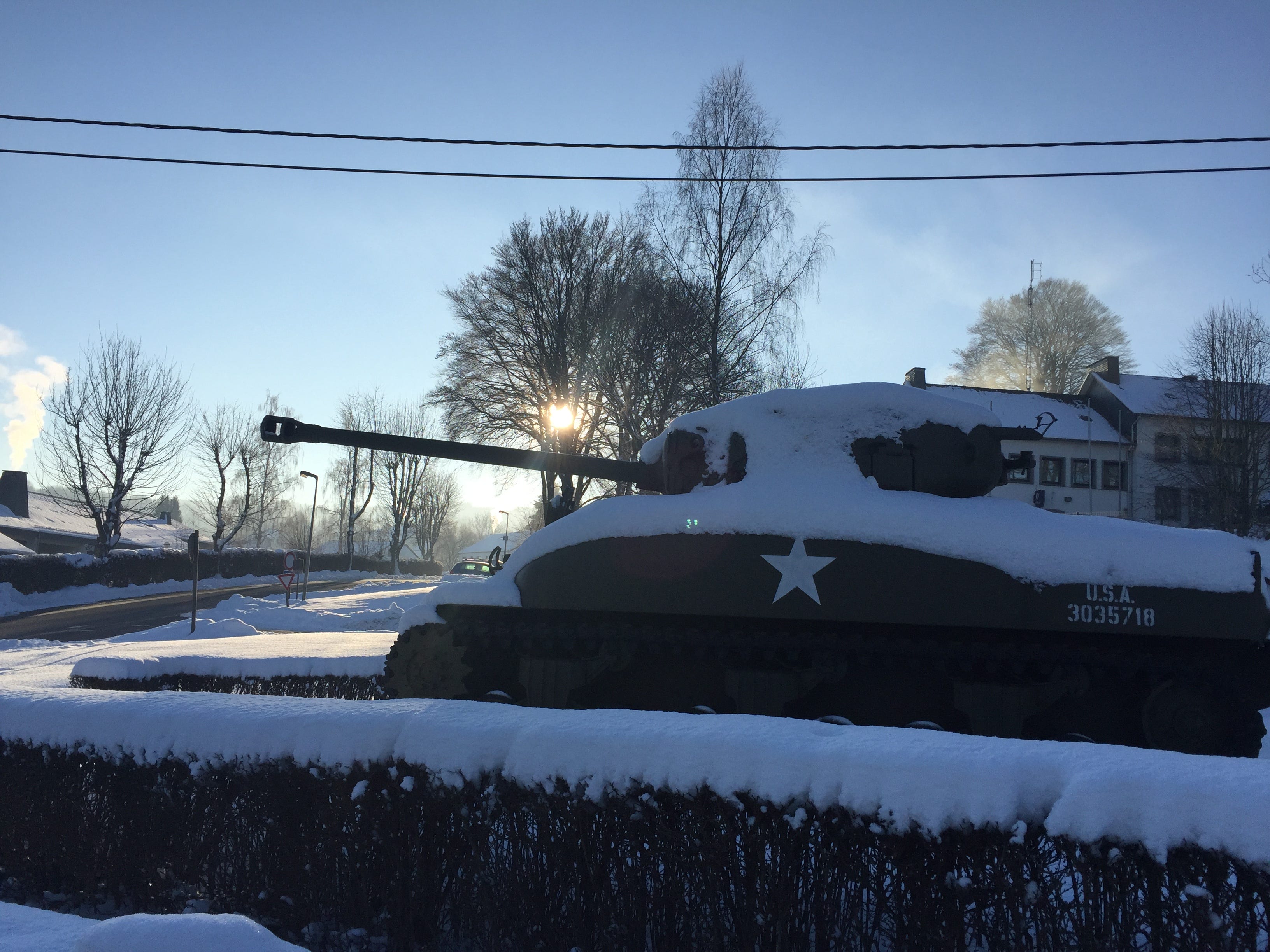
Episode 14: Saint Vith
from Electric Bison Hosted by John B Driscoll
Saint Vith, much like the next place picked to dig a line in hopes of stopping a forest fire, must be seen in its unique context. Because the place is a crossroads town, the divisions in General Lucht’s 66th Corps of Manteuffel’s Fifth Panzer Army fully intended to capture and control those intersections. Not only a town was at stake, but the timetable for the German offensive. In this sector the Germans heavily outnumbered U.S. defenders, more than on any other fronting the Bulge, and the gradual terrain offered flexibility to the attackers, with Saint Vith only seven miles west of the German border. As the Losheim Gap seemed an open door to Peiper’s battle group attacking northwest, so did the same low place present a southwesterly route with no serious rivers or mountains to overcome, an area of the Bulge less rugged than the northern or southern shoulders. It was a region of low hills, some bare, others forested, separated by valleys and draws, stretching from Krewinkel in the north to Bleialf in the south, with four east-to-west roads. On December 16-17, three German prongs of attack followed the main roads. In the north, the 18th Volksgrenadier Division launched an encircling movement with support from the Sixth SS Panzer Army’s reserve Tiger tanks and the Fuhrer Begleit (Escort) Brigade. By the evening of the 17th, this German pincer had surrounded the U.S. 422nd and 423rd Regiments of the U.S. 106th (“Golden Lion”) Infantry Division, novice units in their exposed position for only a few days. These two regiments fought another two days under constant artillery fire and tank and infantry attacks. They found themselves without ammunition and trapped, with no communications to their division headquarters. On the 19th, 8,000 men finally surrendered at the village of Schonberg and were marched into Germany. They included 22-year old Kurt Vonnegut, subsequently imprisoned at Dresden to survive Allied fire bombing of that beautiful city. From that experience he later wrote Slaughterhouse-Five, and concluded that war, unfortunately, is inevitable. His essentially anti-war view argue that it’s therefore doubly important to ensure there are only just wars. Montanans Mel Mellinger and Kenny Newton were with the 423rd Regiment in the surrender. They described landing in France and being taken directly to foxholes along a 22-mile front in temperature ranging from 32 degrees at night to 38 in the day, with lots of snow the night before the German offensive. Newton described the day the Bulge was launched, “hearing the rumbling of tanks, then retreating and mass confusion; no leadership, just a scramble. And fear, remembering the body of a soldier of the division in a foxhole under his greatcoat; he had shot himself; it was depressing; he had committed suicide, it was that tough.” According to Mellinger, “the situation was changing so fast, no one knew what was going on. German 88s were there, combing the area for three days, pinpointing their shots, raking back and forth. By the 19th, the situation was really bad, with units hiding in the wooded areas, vehicles tumbling into a creek in the withdrawal, German shells coming back and forth; there were bodies pretty prevalent around the whole area; guys didn’t make it when they started to round us up. The Germans lobbed shells right into the field hospital.” “We had a choice,” he said, “of lying in our ‘v’ trench full of water, five of us lying there soaked to the bone either that or the choice of getting shot. Finally, around the evening of the 19th, we were instructed by our leaders to start dismantling our rifles. We were surrendering. The Germans surrounded us and herded us like sheep to corral, 2,000 of us with no food for one day to the railroad spur, then a two-day and night march, throwing away our overshoes, our feet freezing, we were loaded into 40x8 boxcars, riding ten days with just room to sit, two meals a day, broth and a slice of bread, to Limburg railroad yard during an RAF bombing attack, then on to Dresden with tough guards who separated the Jewish POWs out.” Another Montanan was also there, James Dew of Missoula, who confirmed that nobody knew what was going on. Dew also recalled the utter chaos, saying he was sure if there hadn’t been a surrender they would have all been killed, and being terrified when they did surrender, knowing the Malmedy Massacre had happened two days earlier. “I was extremely lucky,” he remembered. “I could have been killed with shrapnel right off.” Private First Class Stuart Bethel of Helena, Montana was killed with the 423rd, shot at Bleialf while serving in an anti-tank company. He is buried at Henri-Chapelle. Slightly to the south, the 62nd Volksgrenadier Division attacked along the Steinebruck-St.Vith road, defended by two battalions of the 424th Regiment of the 106th Infantry Division, reinforced by Combat Command B of the U.S. 9th Armored Division, including the 27th Armored Infantry Battalion and 14th Tank Battalion. The 62nd Volksgrenadiers were initially blocked at Steinebruck and took tremendous casualties, but eventually penetrated U.S. defenses. Intensive shelling by the U.S. 591st Field Artillery enabled the Steinebruck defender to escape, outrunning a near encirclement and fighting their way back to assume defensive positions at St.Vith and Grufflingen. Fortunately, as soon as Eisenhower heard of the German offensive, he had dispatched the 9th Armored CCB and the 7th Armored Division south to St.Vith under the command of the 7th Armored Commander General Hasbrouck. Rather than attempt a counter-attack to rescue the trapped U.S. regiments, Hasbrouck chose to defend St.Vith with its vital road junctions. He charged General Clarke, Commander of the 7th Armored CCB, with organizing the city’s defense. “Clarke of St.Vith,” as he became known, created a defensive “horseshoe” facing east, northeast and southeast around the city, positioning field artillery to range all approaching roads with supporting fires. He faced the 7th Armored Division Combat Commands A and B east and North, with the 9th Armored CCB facing south and west, while feeding remnant of the 112th Regiment of the 28th Infantry Division, and the 424th Regiment of the 106th Infantry Division into the horseshoe as they withdrew to St.Vith. The 7th Armored was a veteran unit with combat experience from Normandy to Holland. Aided by clogged, muddy roads and traffic jams that were slowing the Fifth Panzer Army movement, especially the artillery, Clarke was holding the city against fierce but uncoordinated piecemeal attacks. German commander Manteuffel, himself was out on the clogged roads, trying to direct traffic, realizing the importance of taking St.Vith on schedule to protect the German supply line and free up troops for the drive to the Meuse using the St.Vith road network. After surrounding the American regiment at Schonberg, the 18th Volksgrenadier moved to attack the next U.S. roadblock at Prummerberg Height, a commanding hill located five miles directly east of St.Vith along the main Bleialf to St.Vith road. Here, the Volksgrenadiers encountered tough resistance from the U.S. 81st and 168th Engineer Combat Battalions, a part of the U.S. 38th Armored Infantry, and the 275th Field Artillery, aided from overhead at one point by three P-47s. Employing effective mortar and directed artillery fire, the defenders held their line of foxhole over three days against three separate German attacks by infantry and self-propelled assault guns, earning the defenders a Presidential Unit Citation. On December 19 another German threat developed, this time to the northwest behind St.Vith, from the fast moving Fuhrer Begleir Brigade panzers. There had been one clash already involving a task force of the 1st SS Panzer southern wing. Here, 7th Armored’s Combat Command A (CCA) again successfully defended Poteau crossroads, keeping open the St.Vith escape route west while outlying U.S. units around … Get full access to Electric Bison at driscolljohn37.substack.com/subscribe
Embed this episode
No transcript yet.