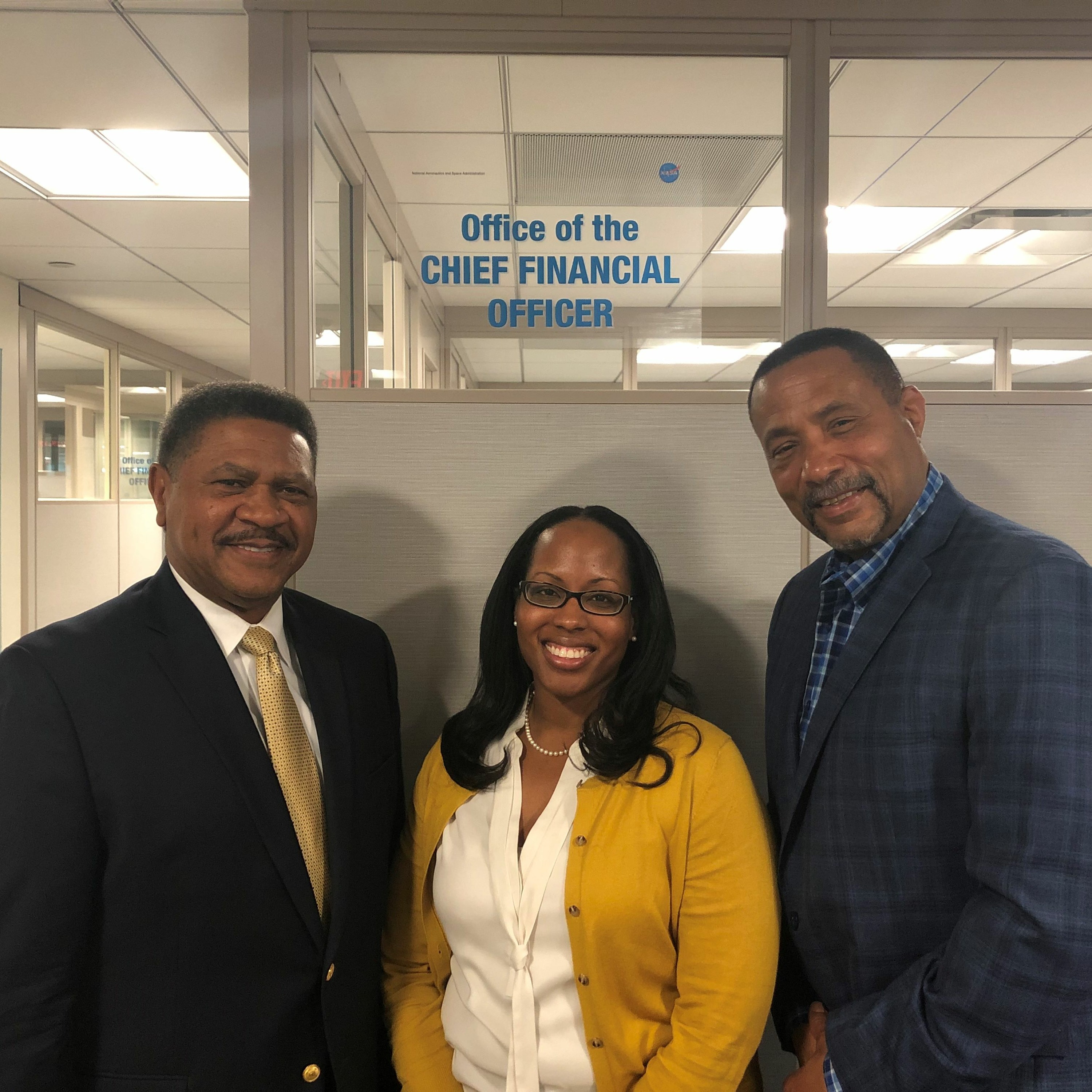
Welcome to Risk Chats with a firm. I'm your host Paul Marshall. Today we head on over to NASA. Speak with them about their unique approach to Risk Management.
How they got their Enterprise Risk Management program up and running. This is where they are due. Let's talk to NASA. Hello, welcome to the podcast.
Today I'm visiting with NASA and their ERM program. And I'd like to have three folks here to introduce ourselves and start with the series. Hello, I'm Cherise Kiel. I am the Interim Control Program Manager here at NASA with an Equality Trust Division within OCFO.
And I work on the ERM program here in NASA. Hello, I'm Darren Podkasland. This is Frank Peterson. I am the Director of Quality Assurance and the Office of the Chief Financial Officer.
And I am pretty much in charge of the Enterprise Risk Management program for NASA as delegated by the Chief Risk Officer. Hello there. My name is Larry Shaw, and I'm on detail from the Johnson Space Center in Houston, Texas. Helping this team out with Enterprise Risk Management.
By the way, Cherise and I both work out headquarters. Okay. Thanks for joining us. So I want to go through a few things.
The history of your program, where you are today, where you see the future coming. So why don't we just start off a little bit of history. You know, it seems like NASA has a unique risk culture. I mean, that's what very inherent to what you all do.
So I want you guys to know a little bit about the history of NASA's kind of risk culture. Yeah, on the risk culture, yeah, as you mentioned, we do have a rich risk culture here. Obviously what we do each day is trying to do great things with Moon and now going to Mars. Possibly, you just start on a risk-rich environment.
Larry Shaw, though, has been with NASA for over 30 some years now, if I may. He can really give us some real from the ground up type background on the risk culture here. Okay, thank you, Frank. I appreciate that.
As Frank said, I've been around for a while and I go for us back to the late 1999s when we started Risk Management for the most part here at within the agency. And then we migrated to what we call the Enterprise Risk Management activities in the last several years. And that activity was kind of mandated by OMB and we've kind of come forward to develop a framework here at headquarters. And we've capitalized on all of the existing Risk Management activities that we currently have in place.
And we built our program based on the existing Risk Management activities within the agency. And I think that was a great start for us and you will find out that we see this as a process that will continue to mature over time. So that I'll throw it back to Frank or Sherry and let them at little as well. Yeah, the thing, the interesting thing about how we got the Enterprise Risk Management program within the internal control division, we actually were looking at compliance with the requirements of the OMB circular that came out.
And trying to get ahead of the curve on that, we initiated a process just to see, evaluate sort of where NASA is with regards to Enterprise Risk program in relation to the requirements. And so we were just endeavoring to just figure out if there were gaps. And as we were doing that and as we were doing the interviews and talking to folks, and we started to realize there pretty much that NASA had enough already in place that it wouldn't be a heavy lift to actually go to the Enterprise level program. And as we were talking to folks in the ACE, the Deputy Administrator, and we were saying, hey look, we can do this without a whole lot of heavy lifting without necessarily reinventing the wheel here.
We think we can get in compliance pretty quickly and we weren't volunteering for the job, but we were handed the job based on the approach to possibly making this happen without a whole lot of heavy lifting and a whole lot of really reinvestment into basically, as Larry said, 30 years of Risk Management culture already in place, we were really able to just sort of gather the activities that were already going on and sort of building a program around and leveraging around a lot of the activities that were already underway for years. Right, so you had the situation where you had programs and they already had, they were already looking at risk obviously for years. So it's just how do we kind of pull this all together into an Enterprise program and really just to report it up so folks know what's going on on the U.R., you are looking at it holistically so to speak, but NASA has already been tracking these things for years. Right, right.
And yeah, we're talking really, a system was pretty much hardly in place. And when I go and I've done a lot of presentations and shared NASA's practices and how we do our E.R.M. program, I say to folks and remember being over at the architect of the Capitol and they gave a great presentation on how they had a key challenge. They had to get the Capitol ready for an inauguration and they had to do some major challenges.
And when I got there, I got there, I got, they did the presentation about the things that they were doing and I said, you know, you can't accomplish those kind of achievements that you accomplished in such a short period of time if you didn't already have generally Enterprise risk management in place, you probably are already doing that in some form or another. And I say that most folks, even any good manager, is probably doing some form of enterprise risk within their particular enterprise. It's just how you make it tangible and be basically deliberate about it. And really when you think about it, it is not a real heavy lift for most folks.
I'm not a good manager already, pretty much doing enterprise risk management. When I do presentations, I say, you know, when I go up, I was doing enterprise risk management every day when I left the house because my lunch wasn't made until school when I had done proper enterprise risk protection and analysis to get from home to school each day. And so when you leave your house in the morning and you're trying to get the work, you pretty much are doing enterprise risk management as a natural, you know, just a survival skill. And just to add to that, taking a step back was again, our enterprise risk management process was built on what we call our continuous risk management process and we had several elements involved in our continuous risk management process, which basically consist of identified, analyzed, planned, tracked, and controlled risk.
And we taught that throughout the age of C, so every organization is aware of continuous risk management in one form or another. So, then that we had that in place, we just decided, okay, if you're doing it in the down-and-down organizations, you can look across all of those organizations and see which of those risks actually affect enterprise, as opposed to being systemic within those existence dialogues and so forth. So, that's kind of what we did. And I think we added a lot of value by not going in and trying to affect what was already in place, but to build on what was in place, and then look at the cross-cutting effects that they were having as it relates to the enterprise.
Right. So, then, by building this program, did you find that now there was a little bit more sharing across what may have been more silos in the past, or is that something that's happening more so? Well, we are seeing an interchange of data at this time, probably a little bit more than what we've seen in the past, but for the most part, the enterprise risk that we are discovering nowadays, we have no conversations at the higher leadership levels, as opposed to the down-and-end levels, you know, and mainly because they've already been placed out at the lower levels. Yeah.
Yeah. When we did our initial interviews, and we interviewed folks in the A-suite and across the sort of highest echelons of the organization, they were able to articulate their key risks almost to the identification of 10 to 12 key risks. Most, every organization had some form of that already in their thought process. And as we did those interviews, and we started to realize that there's a natural process that NASA undertakes with its governance model, and we were able to articulate basically that because of the way NASA operates, we called it the Unified Comprehensive Operation Risk Network, it's a unicorn basically model, that there is an organic way that the risks flow to the top of the organization.
And once we were able to pretty much validate that the risks were pretty much already on the top of everyone's minds, we knew then that it didn't need a huge sort of infrastructure investment. It was pretty much human intelligence was already available that clearly gave us a real solid enterprise risk list. So, let's talk a little bit about the Genesis of the specific ERM program. Is this something you guys really kicked off from the OMB mandates, or do you already do it in this manner for years?
How did you decide to do this actual ERM's official program? So, actually, yeah, the OMB guidance of the requirements, actually what started it, however, as we started to look, we already do risk management here, and we do it well, so just leveraging what we already had, and also not being so prescriptive to the guidance, but really taking the step back and say what makes sense for NASA, what makes sense for us, and building our program around that. And so, I think that was the charge from our leadership from day one. Of course, we want to make sure we're in compliance, but let's really take a step and look at what makes sense for our organization.
And that's what we did, and I think that's why everybody has fallen in line, because we really truly did leverage what was already in place. Yeah, and we are able to show value right from the very beginning, I think. That's to get the buy-in and to show the value, and also clearly the senior leadership was really one of something that was efficient, but really wanted an effective approach that worked for NASA. And we feel like, as I was having conversations with the administrator at that time, Robert Leifwood, and when there was some discussion about whether we would or wouldn't do the Enterprise Management Program, and whether it was an unfunded mandate, and there was still a draft, and so there was a lot of discussion about whether or not to do this.
But I think one of the things I said at that time was to the administrator, I said, you know, from our analysis and the way we do risk, we almost owe it to the American public to do this and show folks how to do it right, because it's almost like we have lightning in a bottle. If we could capture our Enterprise Management Program in our approach, it is really a model, not only for the federal government, but even private sector, we have an outstanding program. And I've really wanted to persuade them to pursue this, and I think the administrator was clearly, clearly having been around NASA for 30 years and seeing it at the center level and at the shuttle and some of the station days. I think he was clearly on board that we have to kind of pursue this and show the world, basically.
So what are some of the mechanisms of your programming, now that you are, your program has been up for a few years, you know, how often do you go out there and reassess, or how often do you meet with senior leaderships and let them know what's going on, and how they kind of take it in to how they run the programs or the agency, so to speak. As I mentioned, we have a pretty strong governance model, and when we, you know, that was a great question that got us, in the initial phases, how do we socialize this and how do we, what's the best venue for sort of discussing the risk and so forth. We have a quarterly BPR along many other meetings that we actually present out on the Enterprise Risk List quarterly, and then we do annual updates, that's what's called the Agency Program Management Council. And those venues already have the key leadership in place, and that BPR, Larry, you can help me out, but the BPR, which is, which is held pretty much monthly by all the key mission directors, they're already meeting, and they're bringing in their key risks up to the sweet and up to the senior management, so that there is no surprise, it's basically, so we go to those meetings and listen out for sort of the things that we see maybe systemic and so forth, and so Larry has been really instrumental in helping us put all that together, because he's the one main army, so Larry, go ahead.
No, no, no, no, you're doing great, Frank. In fact, I think you just about said, all we need to say on that subject, and a couple of other things, you know, you're absolutely right in that we have an awesome framework in place, and the fact that we go to these meetings, we not only go to the meetings, but we also meet with the different organizations on recurring frequencies to make sure that we understand the risks that they are identifying on a recurring basis. They carry their list, we take a look at their list, and we're looking for those systemic things that would affect the entire Enterprise. Also, just recently, we've set up an Enterprise Risk Management Working Group, which I think is really going to serve and improve very valuable for this Enterprise Risk Management activity.
Recently, we set this group up a couple of months ago, and we've turned out some great products. We met with our senior management just recently as of the other day, and they elected direction that we're headed in, so we really think we're on the right track. I think we got, like Frank said, we have an awesome Enterprise Risk Management process in place. And then that BPR mission, that's the baseline program review, baseline performance review, and all the key mission directors come in and present their mission directors and mission support directors.
So I think one thing for other agencies are trying to get their programs going is sometimes they have issues with buying in from senior leadership, or maybe some tone at the top. What is the approach to leadership that really gets them on board with a program? I mean, I know you've already had a risk culture to start with, but why are you now? What kind of convince them to do it?
Enterprise, why? And bring things together? We've reached out and talked to folks quite frequently about this, and some folks have even come over, and I was surprised that they were, you know, NASA, the tone at the top is really the key. We have extremely outstanding leadership at NASA.
That's the best place to work in the federal government, and largely because of the leadership and the mission, and people have great buy-in for that. And so tone at the top is really critical. The key to folks who maybe have to kind of persuade management, and I think by example, I've used earlier, in a lot of cases, a lot of this is already going on, and I think you have to figure out how to sell the value of Enterprise Risk Management, and it's not a check box exercise, and try to leverage existing activities that are already in place. That went a long way for us.
There was a lot of discussion about whether we do or do not, but once we were able to show, there's pretty much a lot of this is already going on. Getting a buy-in at the leadership level, I think that you have to, as an individual, if you can show value, and if you have examples of where Enterprise Risk could be helpful, if you're able to even categorize some of the risks that you may think are already out there, that could benefit from Enterprise Look. Those are some good things to bring forward to the leadership, and just got to keep working it. And of course the firm and some of these other training exercises are already out there.
There's a lot of, even the green book with the principles and standards and so forth. There's a lot of information out there, and even private sector. One of the things we did was we actually had the private sector, some folks come in from some of the bigger firms, and take a look at what our concepts were, and so they were immediately saying that we were on the right track. So that kind of helped too.
So that's a little bit of a branding. I don't know if everybody can kind of afford that, but in a lot of cases, if you talk to some of the bigger firms, they'd be glad to come out and do a presentation for you to talk to them. I'm just going to say, I think I totally agree with what you said, and the fact that we were able to demonstrate value at the beginning, we had the tone at the top, because it was coming from at the time the happy administrator saying, you know, this is what we're rolling out, and that, you know, we just took a common sense approach to really again leveraging what we already had and just building on top of that. I think it didn't seem like a heavy lift across the board, and that's why we got the buy-in that we did.
And it went a long way with really kind of the speed in which we were able to really formalize our program. And one of the things we also did was we did Enterprise Management, we did Road Chokes. We actually went out and spent some quality time with pretty much every organization in NASA. And we had some very strong, I want to give a shout out to Frank Robinson Jr., who retired shortly after we got this going, but he was very instrumental.
And of course, Larry had already been there. So, Sarisa and I were basically a countenance. And so, you know, we had no idea, you know, we would got this assignment, like, you know, whoa, this is interesting, we better get some experts. And so, Larry and Frank Robinson Jr.
were experts in risk, and it was interesting when we did the road shows, almost every time we went somewhere, somebody would say to Frank or Larry, I haven't seen you in a long time, and they were shaking hands. And it was really good to have that expertise. So, if you're a financial person and you're trying to be an Enterprise, you need to get some of the folks that are in that particular field to support you and go out and reach out to the folks, because they could talk the language. Larry and Frank were both engineers, you know, and so a lot of the engineering programs and directorates and science, and they could talk to talk.
And so, it was really helpful to do that and socialize it so that it's not, you know, when you talk internal controls to somebody, like, I don't, it's like the flu. Those are yours. Keep those over there. And my legacy one day I've ever had a legacy that I wanted to leave is like, everyone understands their role in internal control, because it's the people are really the key internal control component.
And the same thing with Enterprise risk, it's the people, it's human intelligence, it isn't like a check the box activity. Yeah, very good, Frank. I'm glad you brought up the road shows. I thought that was really valuable added in that what we did in the road shows, in addition to what Frank has already mentioned, is that we had a subset list of risks at the time.
And basically we socialize that data with all of the officials in charge, and we gave them an opportunity to take a look at our list and say, okay, do you feel like this is complete? Do you feel like this represents the Enterprise? And we got a lot of support in that we were headed down the right path. Also, we had some of them to step up and say, hey, what about this?
What about that? So we were able to add to our Enterprise list through the road show process, you know, and when we finalized that we were able to come back into the top, the A suite here and socialize that data at the A suite and let them know that after going out, this is what we have. And when they looked at it, they said, wow, this is great. In fact, they thought it was right size, you know, from the standpoint that, you know, if the list was too big, we didn't do our job properly, but it was right on target.
So I think the road show has really added a lot of value here. So something I'm curious about, so is that your program, you know, we're exactly as a situated here, because I don't just mean you mentioned your accountants, is it part of the CFO's job? Is it different? What level is it at?
And how does that work here? Well, it's, well, we actually were recruited and volunteered by the associate administrator and basically the deputy associate administrator. At the time, the acting administrator, and I guess even Charlie Bolden was the administrator, and basically they felt like they owned all of those Enterprise risks. We had such a strong list and they said, yeah, you know, all of these are in the right level.
We are the unit that needs to look at this. And of course they have folks that are working it, that report into that A suite. So that's pretty much we are working, even though we're in the CFO shop, we work basically at the behest of the administrator, associate administrator and deputy associate administrator. We meet regularly with the associate administrator and the deputy administrator.
And when we do meet with the administrator, we get a chance to share the list with the administrator as well. So we are at the highest levels of the organization. And when you look at our Enterprise risk list, not only does it cover like masses in the Enterprise risk, but we're almost into industry risk. Some of our risks really are a part of the environment that we work in.
We work in space. So you have issues around space that are on our list that we actually need not only other federal entities to help us with, but worldwide organizations. We have risks on our list that are international concerns for space flight. So we clearly the folks that are at the highest levels of NASA and even in the federal government are working some of these risks.
Well, let me ask a little different topic here. So I'm going to talk about your NASA's risk tolerance a little bit. How would you characterize that? I mean, you have some very inherently risky programs and missions and things like that.
So how do you all characterize your risk tolerance? I think Larry is probably the best person to cover that. And I just want to just as a segue into that a little bit. We recently had a town hall about our mission to Mars.
We knew the Mars new program is being announced. And in the town hall, we had organically a lot of our key risks come up. And the administrator is there talking about, hey, we got to achieve this great thing in five years, but at the same time, we have to be attentive to some of those key concerns that we've always had with safety and so forth. Well, I think you're a spot on Frank.
The bottom line when you come to risk tolerance, basically, it's not just risk tolerance in general. It's risk tolerance as a relate to the program or project that we're working on. So most of that is inherent within the program managers activities. As a team, they identify what they think is the appropriate levels to either burn those risks down.
So risk coming to the process, they look at them and they decide, okay, what is the acceptable level? Or what is my tolerance that I can accept regarding this risk? And from there, they set it as a team and they try to march down to those levels and try to burn the risk down to a level to where it now, they can move forward. So we don't necessarily spend a whole lot of time worried about what our risk appetite is or so forth, because we think it's based on what can we tolerate?
So that's where we are with the risk tolerance consent. Well, NASA TU has got years of experience, so this is going to be a risky endeavor. So here's all the things we're going to do to mitigate that as much as possible. That's right, it's right.
Within the budgets and the constraints and the whole thing. You've already got the tools to deal with it, which is, again, an advantage over a lot of folks. They don't really think about it to this level. Has any of that correct and concern more than operational or financial?
You know, things that aren't as life safety concern, some of those techniques for risk mitigation coming across other areas too? Thanks, much. Yeah, again, you know, what about training process? Can we evolve from the risk management general training process?
And within that training process, there are some built-in tools that people become aware of. Whether it be the financial team being trained on it, there are tools that they need to be able to analyze, track plan and control their risk. So whatever those tools are, that's what they use. The technical side, they use a different set of tools.
They may use when they come to analyze and they'll risk, they may use things like poultry analysis, like FDA's, hazardous analysis, so forth. So they use all these basic tools to help figure out how they're going to manage these risks. And from there, you know, those tools become inherent to help people become specialists as it relates to some of these tools. And all that information comes together.
At the end of the day, they can decide how they're done at home, how they work this risk properly to get it to an acceptable level. That's what it comes down to. But on your question about financial risk and what's interesting is about, you know, I think it's a blessing in a way that we have actually adopted the Enterprise Risk Management Program, because we have been dealing with financial risk and financial statement audit, and there are A123 programs, so we're able to kind of get an excellent confidence of all the risks, both financial and management and technical. And, you know, when I first got here, I came in, we had a dis-claimed audit of pain for almost a decade, and we were able to institute internal controls and continue this monitoring program, and she's in her team now through A123, Appendix A, as well as the management controls.
All of that is right within our Bayley Wig, and so we're able to really look at risk tolerance, and from natural risk, of course, our current CFO, Jeff DeWitt, is very focused on ensuring that we continue to have a clean opinion, and we don't have anti-deficiency act violations. And the current administrator, Jim Bridenstine, while he's very focused on ensuring a safe flight and so forth. So we have safety culture, we have an office of safety management and assurance, it's very focused, and so it's really a great place, like a one-stop shop for all the critical critical things that we need to do to basically be an ongoing concern, if you will, is all within our shop. So we have Larry Sort of handling a lot of the risks that are more technical than nature.
She runs the financial risk under her units, and so we actually have a very strong quality assurance program that is probably the model in which, if you had a model, that OMB kind of wanted to prescribe, I think we'd kind of fit. Pretty much right in that perfect balance of all of the things that you need to control to meet your objectives, we have it all here in one shop. And we have a strong voice, and we have a very close connection to the ACES, to the CFO, to all of the top officials in the ACES. Actually, so how does the internal control program kind of feed off the ERM or vice versa, how do you guys integrate those things?
Well, unfortunately, I kind of manage it all. So I do a 123R assessment, and then also have a tie into ERM, and also our agency's think of a storage process. So because I have insight to all of those, it kind of just happens organically. If one thing comes up in one area, I'm able to automatically apply or see what the impact would be on the others.
So again, I think that's the benefit of having it kind of in the OZFO shop, if you will. And the fact that we do have the retinear with our ECE votes. And again, all those are agency level products that we work. So again, if an item comes out on one assessment or risk assessment or testing, whatever, there is kind of just cross-pollination, if you will, just because of how it's centrally located here.
Yeah, and what we have is basically we've, Sharice designed a, what's we call the CES, which is a control- Virtual environment summary. A controlled environment summary, and that's based on the 17 principles and GAO 17 principles. And we added some questions on enterprise risk there to cover that as well. So that's where we integrate the two.
We actually have an interesting challenge this year. We're looking at a new, possibly a new question to add into our process that takes one of the key enterprise risks and brings it into our annual statement with Schinor's process to get folks to weigh in. And basically place accountability, not only on that organization that sort of leads it, but there's a lot of inputs that have to come in from other organizations to solve this problem. And so we're trying to sort of look at that sort of integration right there within our statement of the Schinor's process.
Okay, well I had just one more question for you guys. Where are you now, maturity-wise, where would you like to be the next couple of years? What is the future of the program? Well, I think we've come a long way.
We've only, I guess we've been at it for a couple of three years now. We had a great head start and we had a strong foundation to begin with. On the maturity model, we're starting to now talk about, we feel we got a very strong list of our enterprise risks. We have a very strong program with the Enterprise Management Working Group and we have very good focus and attention.
So we have a robust sort of culture of enterprise risk. And so now I think some of the next levels are how do we move towards getting some of these risks into the budget process? And how do we really get folks to focus on when they're looking at their planning forward planning to get these enterprise risks into sort of the strategic planning process, the SOAR process, the budget process, or that culmination and what the A11 requires, I think that we're starting to really start to look at that and say, well, what comes first to chicken and the egg? If you have, before we didn't have an Enterprise Risk List per se, but folks were working within their particular risk management processes and within their individual budget processes.
And now we're looking at, well, so how do we ultimately get the use of the information we have, we have some really good information about risk, how do we get it into the decision making process from the beginning at the weight upstream, rather than now trying to look back and say, well, where do we budget for this? Or how are we handling this? We just want to get that Enterprise Risk List out front into the minds of the decision makers right at the beginning of the budget process. This is a particularly rich time to try to do that as we start to endeavor into moon and Mars, we're possibly going to have an entire new mission to interact with.
And so this would be a really good opportunity to start to say, as we're investing in our future for the next 50 years, let's take a look at our key enterprise risk and see if we can sort of make sure we're attentive to those as well. Because the tendency is to always buy new and go straight for the new and shiny object, but a lot of times that takes you away from your infrastructure and some of the systemic problems that are chronic in some cases. You don't want to miss out on curing some of those as you look to your future. And I would say for me, one of the benefits I've seen from having a formalized ERM program is that down in risk management, but on the mission support side, I mean, typically it's the ERM programs and project, but one of the values that we saw is even within OCFO, we now have a formalized risk management process.
And not to say it wasn't done before, but again, it's more formalized, it's more appointed, it's more direct, and it's well supported by our CFO and the senior level folks within OCFO. So I would just like to see a continuation of that when the mission support side is really having that more formalized down in risk management, and so the information that flows out of that are the true and key inputs that are needed for our enterprise level risk management. So I would say from my perspective, I think that's an evaluate and I'd like to see a continuation of that. Well, I want to echo what Frank and Cherisa's already said, to be honest, I want to say just did all of that.
But the bottom line, I see also that as our enterprise risk list continues to evolve, it will become the best for our leadership. That's what it will be. And from there, they'll be able to look at that, push up a button or whatever and see what those things are that affect the enterprise. And also as we start making it global within the agency here, start putting the programs and projects in as appropriately, and then they can look across it, and find out these are my top risks that I need to really deal with from the enterprise standpoint.
So I think the integration of all of that activity is where we want to be at the end of the day, and therefore it becomes really a truly management tool for management to start figuring out where the burden of the business. And then start figuring out where the budget line goes, how am I doing these areas? Because I think with the risk, you've got to like Frank said, you've got to add some budget to it, you've got to follow the budget line and see how you're going to mitigate these things. Because we're not just trying to develop a list just to have a list.
We want to make sure we're managing this as well. So that's where I see it. Let's go. Well on that, no, I appreciate everybody, Larry Frank, Cherisa.
Thanks for coming on the show and I really appreciate it. It was a good break for me back today. Thank you so much. Appreciate it.
That's our show. Thanks for listening. Check us out at firm.org. We'll find all our podcasts, all our illustrious guests that we've had.
And as always, we're always looking for new ideas, new topics, new guests. So give us a shout out. Let us know what you'd like to hear. So until next time, this is Paul Marshall signing off for RisChests for the firm.