
EPISODE · Apr 10, 2026 · 18 MIN
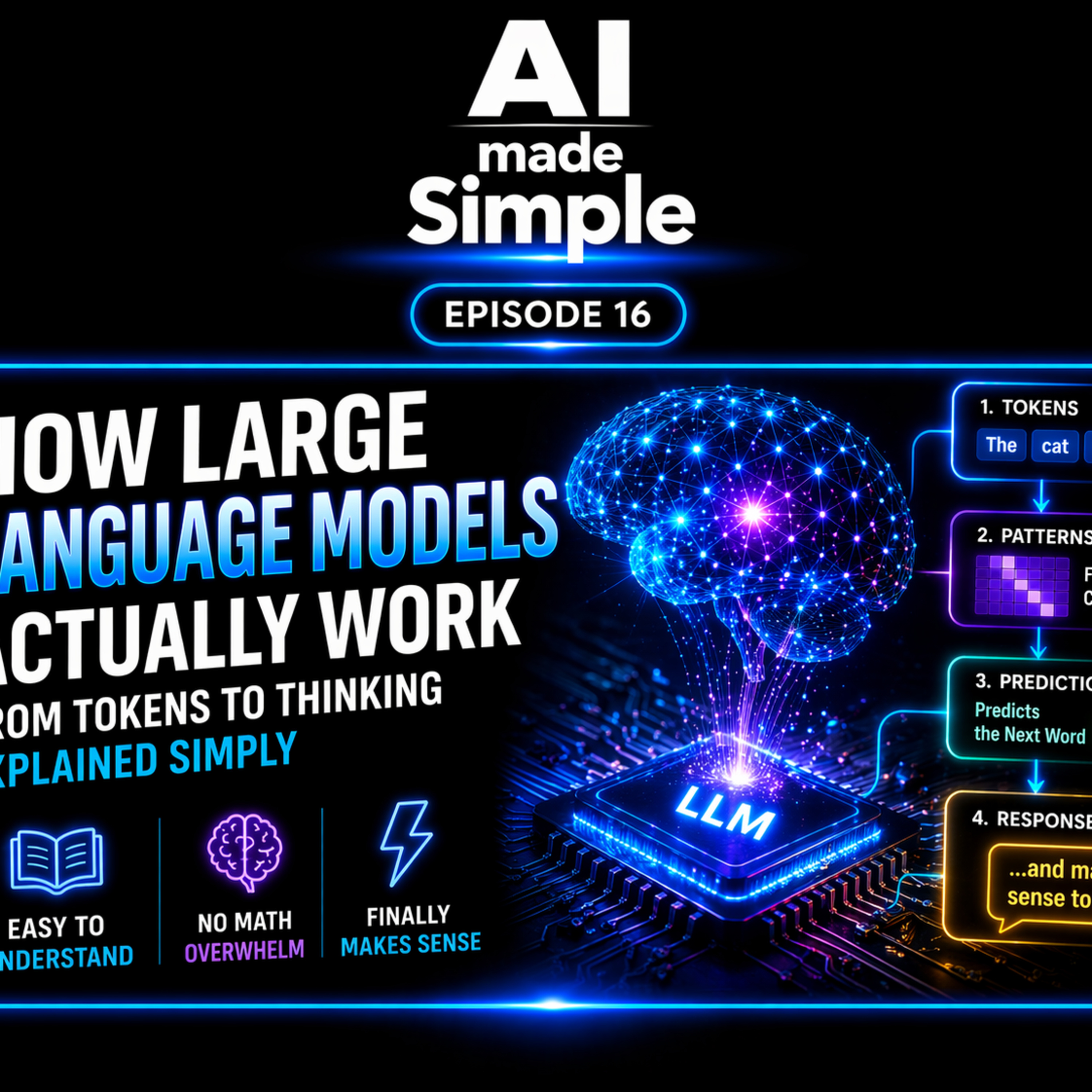
Episode 16 - How Large Language Models Actually Work — From Tokens to Thinking Explained Simply
from AI Made Simple · host Saral Gupta
AI tools like ChatGPT and Claude feel intelligent—but under the hood, they work very differently than most people think.In this episode of AI Made Simple, we break down how Large Language Models (LLMs) actually work in a clear and practical way. We go beyond surface-level explanations and build a mental model you can use to understand—and use—AI more effectively.You’ll learn:Why LLMs are not databases and do not “know” facts in the traditional senseHow training works, including how models learn patterns from massive text datasetsWhat tokens are and how AI generates responses one step at a timeWhy hallucinations happen and why they are a common limitation of this architectureHow context windows and memory limits affect AI behaviorWhy long reasoning tasks can break downHow prompting techniques like examples, constraints, and step-by-step instructions improve outputWe also explain key concepts like vector space representations—how AI turns language into mathematical relationships—and why this allows it to mimic human communication so effectively without true understanding.Most importantly, this episode shifts how you think about AI:from a mysterious black box to a predictable system you can guide with structure.If you’ve ever wondered why AI sometimes feels incredibly smart—and other times completely wrong—this episode will give you the clarity you need.
Embed this episode
NOW PLAYING
Episode 16 - How Large Language Models Actually Work — From Tokens to Thinking Explained Simply
No transcript for this episode yet
Similar Episodes
No similar episodes found.