Feel the action with Betway Casino. Enjoy live games, fast payouts, and all your favourite casino games in one place. Get way more with Betway Casino. Must be 19+, Ontario only. Please play responsibly. Concerned about your gambling? Visit connexontario.ca. In 1541, deep in the South American jungle, a group of Spanish conquistadors concluded that they probably weren't going to find El Dorado. The expedition was led by Gonzalo Pizarro, the vice-governor of Quito and the half-brother of the famous Francisco Pizarro, conqueror of the Inca Empire.
After serving as vice governor for roughly a year, Gonzalo had been convinced that somewhere to the east of Quito, down the slopes of the Andes and in the vast jungle, there was a fortune waiting to be discovered. Rumors spoke of a so-called land of cinnamon somewhere in the South American interior. While this valuable spice was certainly a motivator, tales of a golden city presided over by a king who covered himself in gold dust, El Hombre Dorado, were even more tempting. So in February of 1541, Pizarro set out from Quito, the high-altitude capital of what is today modern Ecuador, with 220 Spanish men and roughly 4,000 indigenous guides and porters. But the expedition very quickly proved to be a disaster.
When the party entered the rainforest on the eastern slope of the Andes, the Spaniards quickly discovered that they were woefully unprepared for the journey ahead. The jungle was treacherous. It was filled with venomous snakes, giant spiders, jaguars, and disease-carrying mosquitoes. The plate armor favored by the conquistadors was hot, cumbersome, and quite frankly, a ridiculous choice for the humid jungle. Not to mention the fact that many of the indigenous groups who called this region home interpreted the Spanish expedition as an aggressive incursion into their sovereign territory. And so they responded violently. After nearly a year slogging through the jungle, fighting local people, and enduring the insects, predators, and diseases of the equatorial forest, the expedition decided to call it quits. The desire for cinnamon and the legendary gold of El Dorado was simply not worth the torment that they were facing in what later explorers would nickname the Green Hell.
By the time they reached the confluence of the Coca and Napo rivers, 140 Spaniards and 3,000 indigenous party members had already died or deserted the expedition. Pizarro decided to simply turn around and lead the survivors back over the Andes to Quito. But a second group of some 50 men chose a different path. Well, actually, it's not clear if they chose this new path or simply had this path foisted on them by circumstance. The sources disagree on this. But what is clear is that in December of 1541, the party split. One group commanded by Pizarro headed west back over the mountains. The second group, led by Francisco de Oriana, the expedition's second in command, decided instead to follow the current of the river heading east.
To this end, they built two Spanish-style brigantines in the rainforest, out of trees they felled themselves and other materials that they just happened to have brought along with them. They miraculously constructed two quite seaworthy ships in the jungle. Then, Oriana's breakaway group of conquistadors headed east to escape the green hell by following the river until it finally spat them out into the Atlantic Ocean. It was an absolutely bonkers plan, and it should not have succeeded. The conquistadors were heading into the part of the continent that had been completely unexplored by Europeans. They had no idea how long the river that they were sailing upon truly was. They had no way of knowing how many dangerous sets of rapids or even large waterfalls might be ahead of them. But amazingly, against all odds, Oriana and his band of survivors succeeded.
On August 24, 1542, the two brigantines emerged from the mouth of the Great River into the Atlantic Ocean. The river that they had managed to sail in its entirety had been known as the Marañón to the Spanish. This expedition accidentally proved that the Marañón was, in fact, one of the longest rivers on the planet. The giant waterway was rivaled only by the Nile in terms of sheer length. Oriana didn't know it at the time, but this river was part of the largest watershed on Earth.
After this expedition, the river would no longer be known as the Merignon. Instead, it would be given a far more romantic name, Rio Amazonas, the Amazon River. But why the Amazon? Well, that had to do with one of the more memorable stories to come out of Oriana's journey. When Oriana finally returned to Spain, he gave an account of his journey to the Spanish court. The king, Holy Roman Emperor Charles V, took particular interest in the conquistadors' claim that he had been attacked by a group of fearsome warrior women who lived somewhere along the shore of the mighty Marañón. These female fighters reminded the Spaniards of the legendary warrior women of Greek myth, the Amazons.
The most detailed description of this alleged Amazon battle was recorded by Friar Gaspar de Carvajal, a Dominican missionary who had sailed the river with Oriana. Carvajal's account of the journey claimed that as the Spanish brigantines moved steadily eastward downriver, they started to hear rumors from the local indigenous population they encountered of a society nearby dominated by ferocious female warriors. In his writing, the friar immediately associated this unnamed indigenous group with the mythical Amazons, who tangled with ancient Greek heroes. According to Carvajal, it would not be long before the Spanish sailed directly into what he called, quote, the excellent land and dominion of the Amazons, end quote.
There, they met fierce resistance. The friar tells us that one particular riverside village, Oriana attempted to make landfall with a small group to hopefully trade for supplies. They had barely made it to shore before the landing party was rushed by a large group of indigenous warriors ready for a fight. A bloody melee ensued, but in the chaos, the Spanish spotted a remarkable group of women. Car Vajal would describe the scene like this, quote, but our boats looked like porcupines. End quote. According to Car Vajal, the Spanish just managed to escape with their lives after killing a handful of these Amazon war leaders. Now, it's no wonder that descriptions like this caught the attention of the King of Spain. The idea that somewhere deep in South America, there lived a group of tall warrior women, each as strong as ten men, who can fire arrows through the hulls of wooden ships. I mean, that's pretty wild.
What's more, Carvajal would provide other tantalizing details about this indigenous society. For instance, he spends a considerable amount of time describing the Amazon's yearly mating ritual. First, he tells us that, quote, the Amazons are women of great valor, and they have always preserved themselves without ordinary intercourse with men, end quote, before launching into an elaborate description of a ritual where men from a neighboring tribe would be invited to join the women for a few weeks every year. The visitors would couple up with the Amazons and some of the women would become pregnant. Then, when the ritual was over, the men would be expected to leave.
The friar explains that then, quote, the daughters who are born from this intercourse are preserved and brought up by the Amazons themselves, and they are destined to inherit their valor and the customs of the nation, but it is not certain what they do with the sons. I've been told that the boys were given to their fathers when they returned the following year, but others, and this account appears to be the most probable, as it is the most general, say that when the Amazons find that a baby is male, they kill it, end quote. Now, this description is curious. It's not strange because it's unusual. It's odd because it sounds so familiar, especially if you're someone who knows your classical mythology. The ritual being described here by Carvajal is nearly identical to an ancient Greek tradition about the original Amazons. The Amazons were well-known figures from Greek mythology. Legend had it that the Amazons lived east of the Greek city-states, at the edges of what the Greeks would have considered the known world, near the coast of the Black Sea.
They were an exclusively female society, where the women trained themselves to be fearsome warriors. The military might of the Amazons was thought to be so great that they could only be overcome by demigods like Heracles and Achilles. These Amazons, let's call them the classical Amazons, also had a yearly mating ritual, where neighboring men were invited to couple up for a few weeks. The female babies were kept, and the male babies were either returned or killed. The fact that Carvajal's story about the South American Amazon's mating habits seems cut and paste from Greek mythology is very suspicious. In fact, it's so suspicious that some think that the friar may have invented the entire story. There are other parts of his description that also seem unusual. The fact that the women warriors are described as light-skinned is somewhat curious. His claim that one of the arrows penetrated the side of the brigantine by a span, which means that it went nearly a meter deep, seems like it may have been an exaggeration.
So, was this whole Amazon story completely made up? Was the Amazon River named after a piece of fake history? Well, some scholars have been a bit more kind to the good friar. First, it's possible that Carvajal was being entirely honest. This group of women may have existed, and they may very well have had mating rituals oddly similar to those ascribed to the Amazons in Greek myth. I mean, it's a hell of a coincidence, but stranger things have happened.
We now know that a number of indigenous societies from that region had a matriarchal power structure. This meant that women were often in positions of power, and female warriors were not uncommon. It's been proposed by author Bill Yen that the Amazons, encountered by the Spanish in 1542, were in fact female warriors from the Ikamiaba tribe, an especially matriarchal group from the Amazon basin. The nearby Piritapuya people have also been proposed as candidates for Oriana's Amazons. The thinking goes that the Spaniards were indeed attacked by female warriors from one of these groups, but then Carvajal rounded out their story in his account by including elements borrowed from Greek mythology. To this day, it's still unclear exactly who the Amazons of the Amazon River truly were. But what of the original Amazons, the classical Amazons? Their story ended up being so enduring that 16th century Spanish conquistadors thought of them instantly when they encountered, or imagined, female warriors.
And in a way, this shouldn't be surprising. Literate men like Friar Gaspard de Carvajal would have received an education steeped in the classics. He would have known his Greek myths, where the Amazons were important, reoccurring characters. Female Amazon warriors were also popular subjects in Greek sculpture, vase paintings, and other forms of art. The idea of a society that completely flipped and challenged the gender roles common in ancient Greece clearly fascinated artists and storytellers. Ancient Greece was famously patriarchal. Women were often tightly controlled by their fathers and husbands. Politics and warfare were seen as entirely the province of men. But then we have the Amazons, who were ferocious female warriors and held all the power in their society.
The fact that Amazon society seems so self-consciously anti-Greek can make it easy to conclude that they existed in Greek mythology simply to act as a foil. You could see the Amazons as a useful storytelling tool that acts as a kind of dark mirror for Greek culture. Amazons also usually appear in stories about invincible Greek demigods. This can make them seem entirely mythological. The Amazons seem like a construction of the ancient Greek imagination.
However, more and more evidence seems to be pointing to a kernel of truth behind the Amazon myth. Could there have been a real society living east of the Greeks that may have been the basis for tales of fearsome Amazon warrior women? Were the classical Amazons somehow more real than the South American Amazons? Let's find out today on Our Fake History. Episode number 161, Real Amazons?
Hello, and welcome to Our Fake History. My name is Sebastian Major, and this is the podcast where we explore historical myths and try to determine what's fact, what's fiction, and what is such a good story that it simply must be told. Welcome to the start of Season 8! Eight seasons of Our Fake History. We're doing it! I hope you were able to hang in there over the past month when I was releasing throwback episodes, but now we are back with all new shows from now until the summer of 2023.
Now, if you are a patron, then you know that I haven't just been sitting on my butt these past few weeks. I was able to release the long-promised patrons-only extra episode on the legendary golden city of El Dorado. As you may have gathered from the introduction, my research into El Dorado inspired me to start Season 8 with a close look at the Amazons. Now, if you are not a patron and you'd like to hear the extra episode on the surprising history of El Dorado, just head to patreon.com slash ourfakehistory and start supporting at any level to hear that show. If you would also like to hear this podcast without any ads, then consider supporting us at $5 a month. That will get you an ad-free feed and every single extra I have on offer. So please, check it out. Now, there are a few reasons why I got so enthused about the idea of an Amazons series. First, the Amazons have been on my to-do list forever.
But even more compelling for me is how the Amazons tie together a number of threads that I've been tracing on this podcast over the past seven seasons. Every now and then I come across a topic that weirdly acts as a kind of hub for everything I'm interested in. The city of Atlantis was one of those topics. But the Amazons have their own fake history gravitational pull. Not only do the Amazons tie into my research on El Dorado, but they also connect to the Trojan War, Eleanor of Aquitaine, Steppe horse archers, Theseus and the Minotaur.
The Alexander Romance, Shakespeare, Griffin Skeletons, and my favorite professor of folklore, Dr. Adrian Mayer. I once quipped that on our fake history, all roads lead to Atlantis, but maybe another set of roads lead us to the Amazons. Now, as I mentioned in the introduction, the Amazons were a fixture of ancient Greek mythology. A number of the most celebrated Greek heroes were said to have tangled with a society of ferocious female warriors who lived somewhere on the periphery of the ancient Greek world.
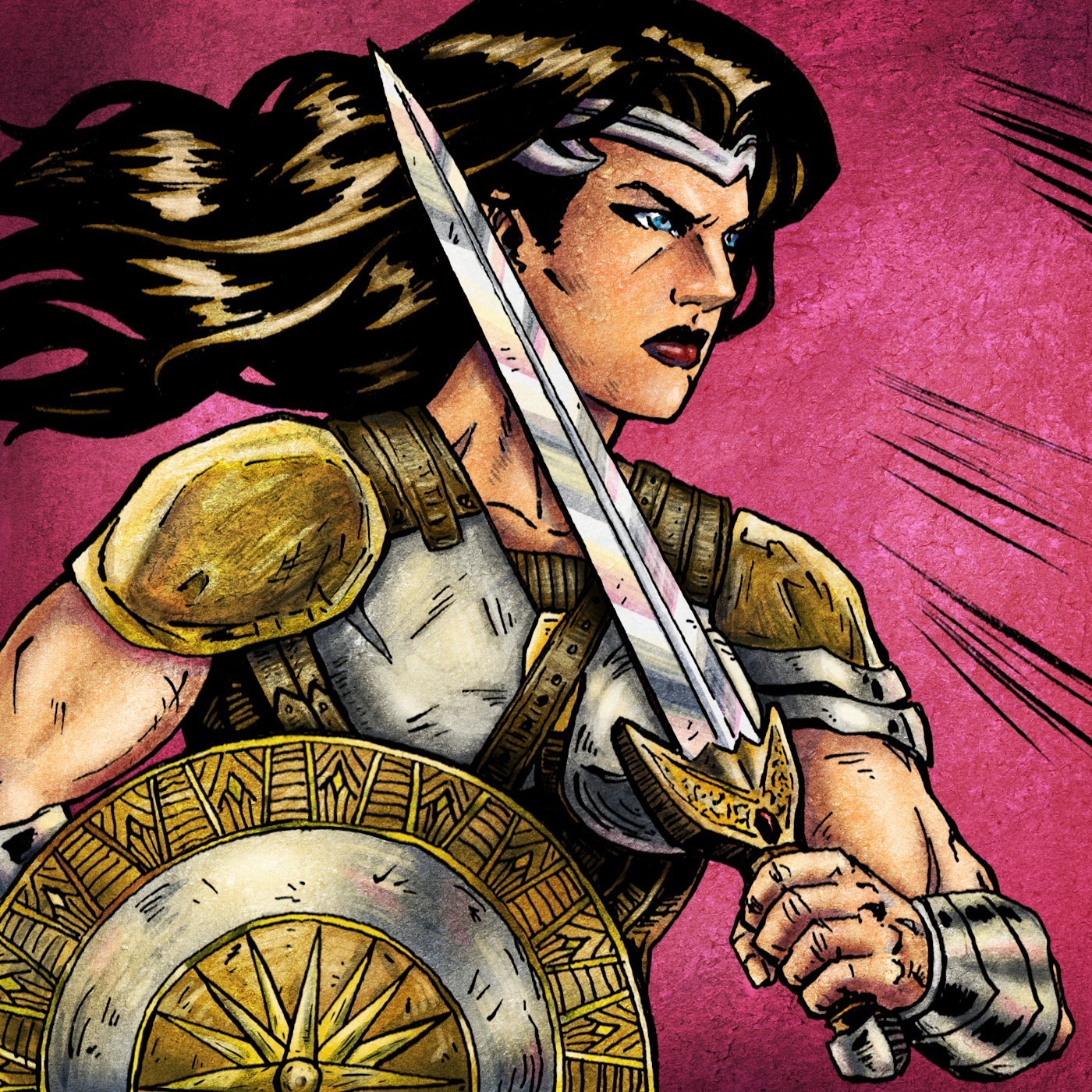
Their prowess on the battlefield was rivaled only by the most formidable of Greek warriors. They were said to be expert equestrians who were masters on horseback. Many traditions had it that Amazon society was exclusively female. Not only were the Amazons dominated by powerful queens and defended by female warriors, the women completely shunned the company of men, except for the purposes of procreation. In the mythological tradition, the Amazons seemed to defy all the gender roles that defined ancient Greek society.
To the Greeks, Amazon society obliterated the line between what was considered appropriately feminine and what was appropriately masculine. This was sometimes presented as a grotesque reversal of what the ancient Greeks would have perceived as the natural order. In some mythological traditions, Amazon society was described in terms that made it seem dark and barbarous. It was said, for instance, that the Amazons would cut off their right breast or would mutilate their children to keep the right breast from properly developing. It was said that this was done to allow the Amazon warriors to better draw their bows and throw their spears. This act of self-mutilation could be read as a type of barbarian fanaticism. It could also be understood as the Amazons denying a certain element of their femininity.
Destroying a breast in order to become a more effective warrior seems loaded with symbolic meaning. However, we need to be careful not to be too narrow in how we characterize how the Greeks understood the female warriors of myth. Female warriors were not always presented as savage barbaric perversions of quote-unquote proper male heroism. Those of you who know your Greek mythology are surely aware of the fact that the deities associated with military strategy and hunting were the goddesses Athena and Artemis. Athena was the patron of battlefield ingenuity, tactics, and clever strategy. As such, she was represented wearing full armor and carrying weapons. Similarly, Artemis embodied the cunning, instincts, and courage required to be an effective hunter. It's notable that both of these deities were gendered as women.
When approached from this angle, the Amazons seemed less like a perversion of Greek norms and more like an extreme expression of certain Greek ideals. Scholars like Lorna Hardwick also remind us that in Greek mythology, the Amazons were often presented heroically. Rarely was Amazon society presented as something monstrous. In fact, the Amazons were often presented as noble adversaries for various Greek heroes. Hardwick explains, quote, That's a great point. The Amazons often appear in Greek mythology as an obstacle that needs to be overcome by a Greek hero. However, unlike a monster that needs to be slain, they are presented as respected opponents. What's clear is that the figure of the Amazon held a unique, if contradictory, place in the Greek mythic imagination.
But Amazons didn't just exist in myth. Amazons were also described by ancient Mediterranean historians and geographers. Detailed descriptions of Amazon life and customs turn up in the writings of Plutarch, Strabo, Diodorus of Sicily, and our fake history all-star, Herodotus, father of history, father of lies. All the roads lead to the Amazons. Now this is notable because all of these authors were trying to create factual representations of the world and its history. Now that doesn't mean they always succeeded. As we've explored many times on this show, Herodotus is infamous for mixing legend and rumor in with the more carefully sourced elements of his history. Diodorus is very similar. Plutarch tends to be a touch better as he more carefully cites his sources, but even the most reliable ancient historians always need to be read with a healthy amount of skepticism.
Still, it's notable that all of these writers spoke of the Amazons like they were a real culture, with a distinct homeland. For Herodotus, Plutarch, Diodorus, and Strabo, the Amazons were as real as the Egyptians or the Persians. So here's the question. Were the Amazons a purely mythical people whose story wormed its way into historical writing, or were they a real society who found themselves represented in myth? Well, over the next two episodes, I hope to answer that question. Here's how we're going to do it. First, we're going to have some fun with the Amazon mythology. I want to look at how these warrior women turn up in stories featuring various Greek heroes. Then I want to look at what the ancient historians and geographers had to say about the Amazons. And finally, I want to look at what modern archaeologists and classicists have proposed about the possibility of a real Amazon society. So let's take a quick break, and when we come back, we'll dive in to the Amazon mythology.
Viking, committed to exploring the world in comfort. Discover the heart of Europe by river on an elegant Viking longship with thoughtful service, cultural enrichment, and all-inclusive affairs. Learn more at viking.com. If we are to follow the Greek mythic timeline, then the Amazons first appear in the context of the Heracles myth. You might know Heracles better by his Romanized name, Hercules. I could say Hercules for the rest of this, but I'm going to stick with the Greek version of the name because we're talking about him in the Greek context. So Heracles, he shall be.
Now, I know that a lot of you listening really know your classical mythology, so forgive the recap. But for those of you who may not be familiar, Heracles was one of the most storied of all the ancient Greek heroes. His mother was the mortal woman Alchemene, and his father was Zeus, king of the gods. Heracles was famously the product of one of Zeus's many extramarital affairs with mortal women. This earned him the ire of Hera, queen of the gods, and Zeus's immortal wife.
The very existence of Heracles was a reminder of Zeus's infidelities, so Hera made it her mission to destroy the young hero. Thanks to his divine heritage, and a little trickery that ironically allowed him to drink some of Hera's breast milk as a baby, Heracles was blessed with supernatural strength and stamina. As a young man, Heracles ended up marrying and having two children with a princess of Thebes named Megara. But Hera, unwilling to allow Heracles to enjoy domestic happiness, used her power to drive the hero mad. While he was in this fog of madness, Heracles tragically murdered his wife and children. When he finally emerged from this spell of insanity, he was overcome with grief at what he'd done. So Heracles went to the Oracle of Delphi in the hopes that the Oracle might give him guidance on how to properly atone for this heinous act.
The oracle, who was also being manipulated by Hera, told Heracles that he needed to go to the city of Tyrens, where he would become the servant of King Eurystheus. If Heracles could complete ten labors devised by the king, then, and only then, would he be granted forgiveness from the gods for the murder of his family. The labors he would end up performing for Eurystheus would end up becoming his best-known adventures. At one point, the king used a tricky technicality to get two more labors added to the demigods list, and voila, you have the twelve labors of Heracles.
Now, we are most interested in the ninth labor of Heracles. For his ninth task, the king, Eurystheus, commanded Heracles to travel to the land of the Amazons and steal the Amazon queen Hippolyta's prized war belt. Now, sometimes this belt gets translated into English as a girdle, but that kind of gives the wrong impression. Expert Adrienne Mayer has pointed out that that translation is loaded with connotations that make the belt sound like it has something in common with women's underwear. She makes the case that this is misleading.
The Greek term that's used for this belt is a zoster. This term comes up regularly in the works of Homer when he's describing the armor worn by the Greek heroes of the Trojan War. A zoster was a large leather belt that sometimes incorporated metal armor that was used to protect a warrior's midsection in battle. In other words, this was battle gear, not sexy underwear. Hippolyta's zoster was particularly desirable because it had been given to her by her father, Ares' god of war. The belt was once worn by the god himself, and had been gifted by Ares to his daughter after she had proven herself on the battlefield to be the most ferocious of all the Amazons. We're told that the zoster was beautiful and adorned with gold. It was truly a piece of armor fit for a god.
The beauty of this war belt was so renowned that even Eurystheus' daughter, Adamity, back in Tyrens, had heard of its splendor. Adamity wished to have this zoster for her very own. So, King Eurystheus commanded that his servant Heracles sail to the land of the Amazons and bring back the zoster by any means necessary. Now, there's something worth noting here that will be important down the line when we start examining whether or not there were real Amazons. In most versions of this myth, the homeland of the Amazons is located in a very specific place. We're told that the Amazons lived near the mouth of the Thermodon River on the southern shore of the Black Sea in Anatolia. That would place them on the northern edge of what is today the modern nation of Turkey. Mark that detail, because we're going to return to that.
Before Heracles set off on his journey, he took stock of the challenge that he faced and determined that he could not face the Amazons single-handedly. The Amazons were such ferocious warriors that even Heracles' superhuman strength wouldn't be enough if it came down to a fight. So the hero rounded up a crew of adventurous Greeks to accompany him on his quest and act as his makeshift army. In some versions of the tale, we're told that he set off with one ship. In other versions, we're told that nine ships loaded down with heroes sailed to the Black Sea and towards the homeland of the Amazons.
We're told that Heracles followed the same route that he had taken with the hero Jason when he had served as an Argonaut in the quest for the Golden Fleece. Finally, after many weeks at sea, Heracles and his entourage arrived at the Amazon capital of Themistria, at the mouth of the Thermodon River. There, he met the Amazon queen Hippolyta. At first, it seemed like the entire situation might be resolved diplomatically. Heracles met with the queen and explained his strange lot as the servant of King Eurystheus.
He then went on to tell the queen of his eight previous labors, listing the monsters he had slain and the challenges he had handily overcome. Hippolyta was impressed by these tales and saw in Heracles a rare person that she could respect as an equal. Quite simply, game recognizes game. So in a magnanimous act, Hippolyta decided that she would freely give her zoster to Heracles as a gift. Honored by this, Heracles then invited the queen to be his guest aboard his ship.
Now, sometimes this is presented by the storyteller as having obvious sexual connotations. Wink, wink, come aboard my ship, there's something I want to show you. Sometimes this is presented more like a state dinner. But in either case, the goddess Hera simply could not abide the fact that Heracles had managed to secure the Amazon war belt so easily. So, she transformed herself into an Amazon warrior and started running through Themistria, raising the alarm. She called out to the other Amazons that their queen had been kidnapped by the duplicitous Greeks and that they couldn't let them get away alive.
The Amazons believed her and quickly suited up for battle, mounted their horses, and charged at the Greek ships. When Heracles saw the Amazons coming, he jumped to the conclusion that Hippolyta must have tricked him. The gift of the zoster must have just been an elaborate ploy to get him to let his guard down so he could be ambushed. Before Hippolyta had a chance to explain herself, Heracles turned on her and killed her on the spot. And just a side note here.
No matter how much time I spend with Greek mythology, I never cease to be amazed by the brutality in these stories. These Greek heroes will kill people at the drop of a hat. And that's to say nothing of the sexual violence you get in many of these stories. But man, that's just the nature of ancient Greek myth. There's just no avoiding it.
Anyway, after killing Hippolyta and wrenching the war belt from her dead body, Heracles and his band of Greeks threw themselves into an all-out battle with the Amazons. We're told that the fighting was fierce, and the Amazons more than lived up to their reputation as formidable warriors. But Heracles was Heracles, after all, and so thanks to his great strength, soon many of the Amazons' greatest heroes lay dead. With the Amazons defeated, the Greeks weighed anchor and turned their way back to Tyrans with the gold zoster in hand. So, how should we interpret this story?
while in a way it neatly encapsulates the often contradictory ways in which the Amazons were understood. There's one way to interpret this story that sees it as an affirmation of the superiority of patriarchal ancient Greek society over the foil of a female-dominated Amazon society. The Greek male hero violently takes what he wants from his female counterpart. For all their might, the Amazons are overcome in battle by Heracles and his male entourage. The patriarchy comes out on top.
But there's another reading of this story that suggests that Greek feelings about Amazon society may have been more complex. In the story, the Amazons are presented as intimidating, but not monstrous. Hippolyta is deeply reasonable, more reasonable than Heracles, in fact. Adrienne Mayer has even argued that she's presented as a heroic equal to Heracles in this story. The ancient audience may have understood the death of Hippolyta as a tragedy akin to the death of Heracles' family. This is quite different than when Heracles slays a monster like the Hydra.
Perhaps the listener was meant to have some empathy for Hippolyta and her Amazons, and not simply regard them as a group of backwards barbarians who deserve their violent end. Art historian Andrew Stewart has made the point that, quote, Now, because this is a myth that originally existed as an oral tradition, there are many variations on this story. In one of the variations, Hippolyta isn't killed at all, but is instead kidnapped by Heracles. He then takes her back to Athens, where he presents her to the king, the Minotaur killing Theseus. Theseus and Hippolyta are then married. In other versions, it's said that Theseus accompanied Heracles on his initial voyage and personally kidnapped Hippolyta. Those of you that know your Shakespeare might remember that the wedding of Theseus and Hippolyta is the framing device for the comedy A Midsummer Night's Dream.
But the most common version of this story is that Theseus was not with Heracles on his fated journey to Amazonia. Instead, we're told that Theseus undertook his own journey to the Black Sea home of the Amazons. On this journey, he met the Amazon queen Antiope, the sister of the deceased Hippolyta. In this version of the story, it was Antiope, not Hippolyta, who was forced to marry Theseus. This wedding would end up sparking one of Greek mythology's most underappreciated epic battles.
I'm speaking, of course, of the Attic War, when the Amazons very nearly conquered Athens. Before we get into that, let's take a quick break, and when we return, we'll dive into the Attic War. The circumstances concerning how Antiope, Queen of the Amazons, became Antiope, Queen of Athens, vary depending on which version of the story you are reading. In some versions of the story, Theseus is essentially an unrepentant sexual predator who abducts the queen against her will and forces her into wedlock.
But there are other versions of the story where Antiope legitimately falls in love with Theseus and makes the choice to leave behind her Amazon sisters and live the life of a Greek queen. Now, the inconsistency around this reminds me quite a lot of the story of Helen of Troy. You might remember from our Trojan War series way back in season one that there are conflicting traditions around how much Helen consented to being whisked off to Troy by the Trojan prince Paris. In some versions of the story, she is forcefully kidnapped and sexually assaulted. In other versions of the story, she is romantically seduced by Paris. In yet others, the goddess of love Aphrodite makes her fall in love with Paris on first sight.
The theme of the kidnapped bride comes up a lot in Greek mythology, and some traditions are more violent than others. The story of Antiope and Theseus is no different. The version of the story recounted by the ancient historian Plutarch falls somewhere in the middle. In his account, Theseus sailed to the land of the Amazons on a diplomatic mission. When he arrived, he was given a warm welcome by the queen. Now, he identifies this queen as Hippolyta, but many other storytellers like to identify the queen as Antiope. For the purposes of clarity, I'm just going to keep saying Antiope. Now, we're told that Antiope bestowed a number of rich gifts on the visiting Athenian king.
Theseus then invited her aboard his ship, an invitation we're told that she eagerly accepted. But once aboard the ship, Theseus had his crew weigh anchor and they set sail for Athens. So yeah, this was a kidnapping, but a slightly less violent kidnapping than you get in some other versions of the story. We're told that the remaining Amazons were not interested in the nuances of how much Antiope may have wanted to sail away with Theseus. From their perspective, this was an act of war. Their queen had been abducted by a foreign invader and this simply could not stand.
So the Amazons prepared an all-out invasion of Attica, the territory surrounding Athens in southern Greece. Their new war leader would be the mighty Orathia. While the Amazons were able to muster an impressive army of female warriors, Orathia knew that if they were going to be successful, they would need allies. So the new Amazon queen reached out to her neighbors in Scythia. Now, we know that the Scythians were a real group of nomadic horse archers who roamed throughout Central Asia. You might recognize that name. The Scythians have come up on this podcast before. Now, this part of the story is significant because it's really going to play into our future discussions about the reality of Amazons. So mark this point too.
We're told that Orathia arranged a meeting with Sagalus, king of the Scythians. During this meeting, she explained to Sagalus that the Amazons had once been Scythians. According to Orathia, the Amazons had broken away from the main group of Scythians a few generations earlier. The first Amazons were Scythian women, who felt that the Scythian men at the time did not fully appreciate their abilities as warriors and leaders. So they headed out on their own and created their all-new, female-centered Amazon society.
But now the Amazons needed King Sagalus' help, and so Orathia appealed to their shared Scythian roots. She argued that by capturing Antiope, the king of Athens had insulted not just the Amazons, but all Scythian people. Well, Sagalus was convinced by Orathia's impassioned argument and agreed to join her in the war against Athens. So it was that a massive army of mounted Amazons and Scythians made the journey from the shores of the Black Sea to the Greek mainland. Eventually, they closed in on Athens, but Theseus and his army were waiting. Plutarch tells us that Theseus and his defenders attacked first, but they were quickly overwhelmed by the Amazons and their Scythian allies. The Athenians were pushed back until they were finally able to dig into a stable defensive position at the base of the famous Acropolis. The two sides then dug in for a brutal four-month siege. How did the war end? Well, even Plutarch admits that the mythological traditions are frustratingly inconsistent on this point.
In one version of the story, Antiope herself brokers a peace. After months of fighting and hundreds of deaths on both sides, Antiope emerges as the one figure who can bring the two sides together. She encourages her Amazon sisters to lay down their arms and negotiate with the besieged Athenians. The negotiations were a success. Solemn oaths were sworn in a temple known as the Horcomosium, and the Athenians agreed that every year before the Feast of Theseus, they would make a sacrifice to the gods in the name of the Amazons. That's the happy ending.
In another version of the story, Antiope completely rejects her past as an Amazon and fights on the side of the Athenians. We're told that Antiope, being a formidable warrior, slew many of her Amazon sisters before being laid low by a dart slung by an Amazon named Melopatia. With Antiope dead, the reason for the war was over and the Amazons withdrew. Or the death of Antiope so enraged the heartbroken Theseus that he threw himself into the battle with renewed vigor and managed to force the Amazons into a long retreat. And then there is the third version, and this is the really juicy one. Plutarch tells us that according to an ancient Greek poem called the Theseid, the war happened under completely different circumstances. In that account, Antiope was not kidnapped. She fell in love with Theseus and left the Amazons completely on good terms. The Amazons wished their queen well and felt no need to launch a war to avenge her.
That is, until a few months later, when Theseus decided that he couldn't marry some barbarian Amazon and dumped Antiope so he could marry the Cretan princess Phaedra. Antiope was heartbroken and enraged, so she returned to the Amazons and raised an army of female warriors. In this version, it was Antiope who personally led the Amazon attack on Athens, which she planned to coincide with Theseus and Phaedra's wedding. The Amazon attack was ferocious and culminated with Antiope finding Theseus in the fray and challenging him to single combat. In the end, Theseus managed to overcome and kill Antiope. With their queen dead, the rest of the Amazon army retreated. Now, all of these stories are amazing.
As I said before, the Amazon siege of Athens is kind of being slept on as one of the great Greek myths. I took more than one class in classical mythology as an undergrad, and it was only researching this topic that I finally learned about the Amazons nearly sacking Athens. Part of the reason why this story may have remained so obscure is because it isn't quite as ancient as some of the other Greek myths. Here's what I mean by that. The story certainly takes place early on in the mythological timeline, but it was developed much later than many other well-known stories. This particular story first starts to appear sometime in the mid-5th century BC. Most experts think that the story of the Amazon invasion was developed in response to the Persian invasions of the 5th century.
During the Persian Wars, the Greek city-states famously resisted the much larger Persian army, the sack of Athens notwithstanding. They also dealt the Persian Empire some notable defeats at the Battle of Marathon and the Naval Battle of Salamis. The thinking is that the story of Athens holding out against invaders from the east would have echoed contemporary events in the 5th century. Theseus' Athenians, putting up a noble defense despite being hugely outnumbered, may have acted as a mythic example that 5th century Greeks could have been inspired by. The story also clearly borrows plot points from other, more ancient myths. A woman is kidnapped, an invasion is launched to get her back, both sides dig in for a protracted siege. You might have heard that one before. It's the Trojan War, right? The alternate version of the story where Antiope is set aside and leads the invasion as revenge, well, that borrows huge elements from the story of Jason and Medea. In that story, the hero Jason, the chief Argonaut, falls in love with a powerful woman from the Black Sea region of Colchis, named Medea.
After having two children with her, he then cruelly sets her aside so he can marry a princess of Corinth, leading Medea to take a truly horrible revenge. Look it up if you're interested. The point is that the Amazon invasion of Attica is clearly a later mythological creation. It was a reflection of contemporary 5th century events that borrowed liberally from more established mythological traditions. The Amazons never besieged the Acropolis in Athens. But does that mean that there were no Amazons at all?
The stories we've heard so far have contained tantalizing clues about the geographic location of an Amazon homeland and even the ethnic roots of Amazon society. Are there real Amazons waiting to be found somewhere near the Black Sea? Or is our hunt for these warrior women just another El Dorado? Okay, that's all for this week. Join us again in two weeks time when we will continue our look at the Amazons. Before we go this week, I need to give a shout out to a whole lot of people. I'm a month behind on the shout outs, so gear up for a long list. Big ups to Avrin Keating, to John Lang, to Ella, to James Kuhn, to Eric the Exile, to C. Colleen, to Tyler Reed.
To Aaron Dodge. To Marco Amorim. To Cecilia M. To Nathan Stringer. To Tracy Bachman. To Troy Shea. To Laura Wester. To Andrew Haas. To Anthony Copeland. To Chris Fraunenberger. To T.I. To Rob...
To Andrew Depew. To Charles Davis. And to Mason Martin. All of those people have decided to support this podcast at $5 or more every month. So you know what that means. They are beautiful, beautiful human beings. I don't know how to thank you folks enough. As I said on the last episode before the end of Season 7, I have now transitioned into a full-time podcaster, if you can believe it. And that was only possible because of your support. So thank you, thank you, thank you for truly changing my life.
If you want to get in touch with me, you can send me an email at ourfakehistory at gmail.com. You can hit me up on Facebook at facebook.com slash ourfakehistory. You can find me on Twitter at ourfakehistory, and you can find me on Instagram at ourfakehistory. As always, the music for the show comes to us from Dirty Church. You can check out Dirty Church at dirtychurch.bandcamp.com. All the other music you heard on the show today was written and recorded by me. My name is Sebastian Major, and remember, just because it didn't happen doesn't mean it isn't real.
You've built your success. Let's plan your legacy.