Hello again, everybody, and welcome to another edition of Political Beats, a presentation of National Review. Find us on x at political underscore beats, also over on Facebook as well. We invite you to subscribe to our feed for new episodes through Apple Podcasts or elsewhere where you find your audio. Also at nationalreview.com. You can click there on the podcast tab. Listen, leave reviews where possible, help others find and enjoy the program. We also issue a hearty invitation to join us at our Patreon page, patreon.com slash.
Political Beats. Support us, help the show stay ad-free as it has been. We've got entry-level for your support and some voting privileges along the way, mid-level for early access and shows at a higher audio quality, and upper-level best friend level for early access, higher audio quality, monthly exclusive content shows, remastered episodes, like the most recent one on The Smiths, playlists, and much more. Find it all at patreon.com slash politicalbeats. Now the part of the program where we thank, now the part of the program where we thank some of our Patreon supporters, some of them for a long, long time have been with us, including Joe Llewellyn.
Matt McInnes, Christopher Merkel, Stephen McHugh, Angela Guillory, Brian Zeno, Brian Berkey, Sean Bible, Stephen Carl. Thank you for all your support. You can be on this list too, patreon.com slash politicalbeats. My name is Scott Bertram. Find me on X at Scott Bertram. My tag team partner standing by as always, Jeff Blair. Jeff, how are you? I don't care if Monday's blue. Tuesday was gray and Wednesday too. Thursday, I didn't even care about you because Friday, I'm in love.
How appropriate we record this episode on an actual Friday as well. Jeff is over on X at Esoteric CD. And our friend, our buddy, our pal has decided to return for a second bite of the apple as we talk about the cure. Derek Wilczynski back with us, attorney, general trial practice representing political figures as well as the treasurer for the Macomb County Republican Party. Derek, thanks for returning. Well, thanks for having me. I appreciate it. I am very, very excited.
Good, as well you should be. We've got a whole lot of music to get through in this part two of our episode on The Cure. If you didn't listen to part one, well, pause, grab it, listen, and then come back. But we left off after The Top, an album from 1984 from The Cure, and we enter 1985. And Jeff, perhaps you want to set up where we go from here.
Oh, gosh. Well, it's a sea change because as we were discussing at the end of our last episode, The Cure had already turned a corner in their musical idea and in the musical ideas that Robert Smith was bringing to the group. They become poppier. They become more. They become bigger fans of psychedelia. They still not become any less drug addict at that point. But after the top, Robert Smith decided, hey, you know, I can't just be gigging with Susie and the Banshees. I have to form my own working touring group again. And that one didn't quite work out.
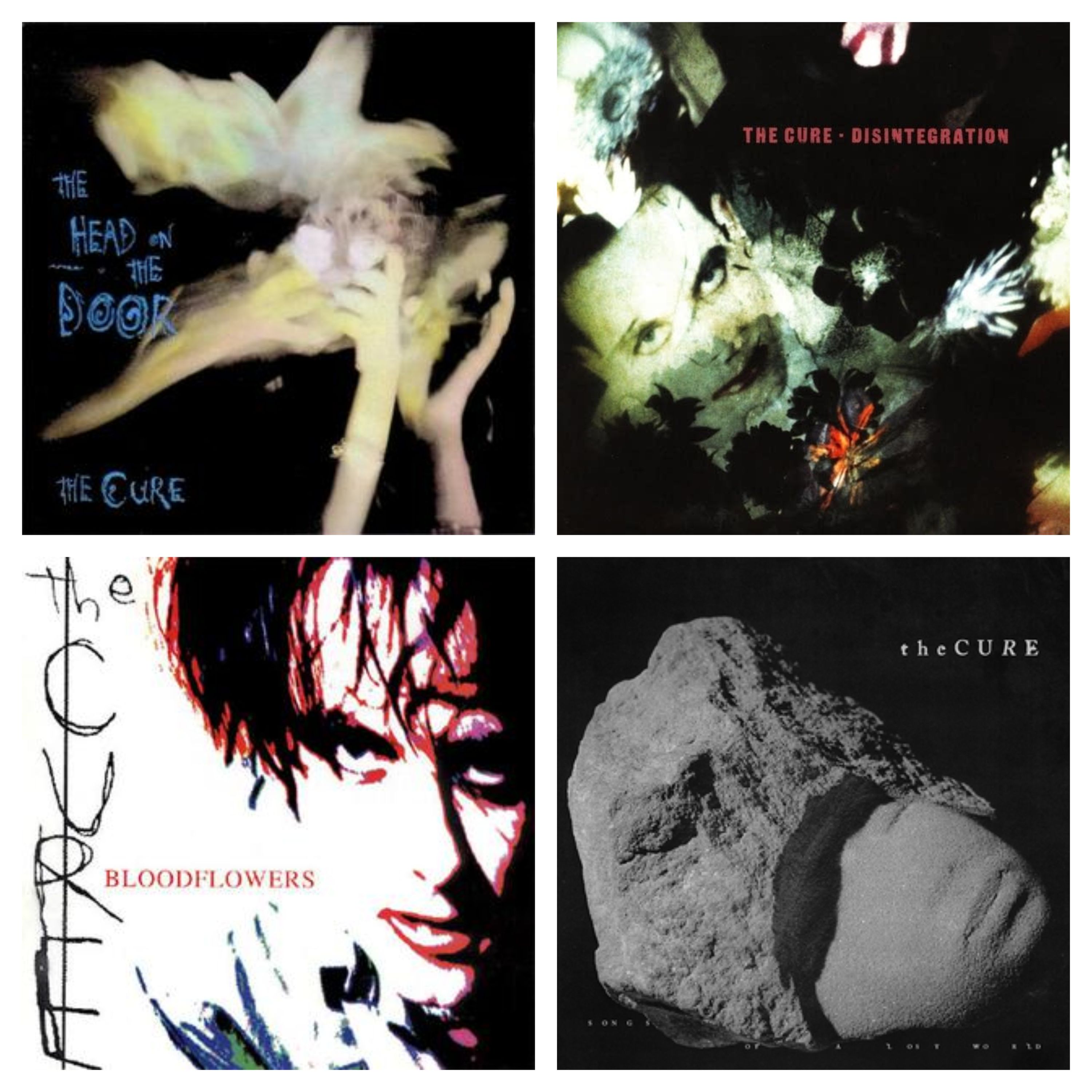
But what did work out is when he finally recruited a drummer named Boris Wilson, and then he got back with Simon Gallup, who had left the band in anger after pornography, and guitarist Oral Thompson, who was a guy who had been an early member, a second guitarist in the Easy Cure before they became the Cure. And so they headed into 1984-85 with a head full of steam and an actual group. This is the first album where all the songs are composed only by Robert Smith. And it's interesting to notice that he would actually abandon this approach in the next two records because the rest of the group would start bringing so much good music of their own to the table. But the head on the door, it sounds like a reinvention for this band. And we noticed how live the top felt. Oh, finally, they've got a real drummer in the studio playing actual drums as opposed to Lowell Tollhurst. But now they actually have a band that sounds in sympathy with one another. Everybody can play together well. And of course, why wouldn't they? You've got basically all old school friends playing in the same group. Lowell's still there. He's playing keyboards. They haven't had to bring in a second.
secondary keyboardist yet so it's all his work on this record and the head on the door isn't perfect but it is a glorious pop reinvention for the cure it is them announcing their entrance into i guess the upper sunshiny reaches of the charts as opposed to all the gloom and doom and weirdness that had previously characterized them rebirth has a fantastic record even though there are a couple of tracks on it that i'd probably say are weaker than the rest there's there's nothing on it like um the empty world that made me want to just shake my head and wonder these people are out of ideas and what is going on here it's a great record
Boy, Jeff, this is where the phrase your mileage may come in because this to me is a top five desert album record of all time. No problem. I don't think there's a weak song on this record. And it's highlighted by the fact that this does now sound like a band as opposed to taking pieces of instruments and pieces of Robert Smith's vocals and putting them together. This is tight from the very beginning. I mean, it starts out with In Between Days, which is one of the great intros that The Cure has. As a band, I don't think that the songs that lead off their albums are necessarily their strongest works, but In Between Days really is.
It's fantastic. And then you get Kyoto song, which has a bit of an Asian influence in it. The blood, which then becomes like flamenco style and acoustic and is absolutely fantastic. And it's hilarious, too, by the way, the blood. It sounds like another one of those gloomy pornography cure themes. You know what the blood is about? It's about being drunk off your ass in Ibiza, right? Because it's about being paralyzed by the blood of Christ. That's sangria. He's had a few too many and now he's just blowing on the floor. And of course, that's why it has that Spanish flamenco guitar theme, because they're tuning their arrangements to the lyrics.
Yeah, it's a great song all the way through. I generally don't like when there's long intros to Cure songs, but Push really, really is fantastic. Close to me, it was like the biggest pop hit that I think they have on this album where it's listenable and it's not overwhelming for people to listen to. But the one song that always grabs me is A Night Like This because it's a saxophone driven song. And I emailed you guys as we were getting ready for this episode and noted that you just do not hear saxophones and rock and roll anymore. It's like the lost art. It was in the 80s. You couldn't miss it in the 80s, but today not so much.
Hall & Oates would have half of their number one hits if it wasn't for the sax, you know, and horns. And hopefully it'll come through during this episode, but I love when The Cure puts horns in their music and A Night Like This has it and it's prominent and it's just absolutely fantastic. Like I said, I don't think there's a bad song on this album. I love everyone. Even some of them obviously are weaker because when you rank songs or albums, whatever's going to be at the end is weak. I still think this is their best work. And I love it all the way through. Scott? I think it's fantastic. And perhaps this is a spoiler alert indicator for how some of the show is going to go. This is the high point of this era of the band as far as I'm concerned. I think this is my favorite record from this part two we're going to cover on the show today. It's not to say I don't have nice things to say later, but this is my favorite. And you know the best thing about this record?
10 songs, 37 minutes. Not going to say that again for a really long time. It's sleek and it's managed. And there is a sense of an editor involved in the process of the head on the door. The songs are fantastic too. And that's really important. Derek talked about a number of songs I really like, but there's a path from six different ways all the way through close to me. And it's at four or five songs. They're all just immaculately done. Six Different Ways is this wonderful oddball. There's a lot of odd, weird cure we talked about.
toward the end of the last episode. Shows up in many places here. Shows up on six different ways with Smith kind of howling up in his upper register. Derek mentioned Push. I think that's a dynamite song. That whole intro kind of reminds me a bit of like Edge-like U2 guitar at the beginning of that song. And that just keeps building and layering and that rhythm pushes forward. And I think it's the very first words of that song are Smith shouting out, go, go, go, go. Like you feel it. There's a real energy and motor in that song.
It has a sequencer or a drum machine mixed with live drums, very frantic and jagged. I couldn't ask for more. You said take it all and strike me, strike me, strike me, strike me dead. That's a fun and then close to me, which Derek mentioned too. I hear that and I think it's something that The Strokes would do today. Like Julian Casablanca would love to craft a song that sounds something close to me. This kind of claustrophobic little rhythm, simplistic and spare in a way, but also catchy as all hell. That's a fantastic run of songs. And this album is so good that even a song that Jeff knows me well at this point, you might think I'd...
won't like something like Screw very late in the album. Oh, that's one of my favorites. But I do. That baseline is so great. Yeah, it's mechanical and buzzy and very bass heavy. On its surface, not a song I likely would say is a favorite, but man, I like that an awful lot. I don't know if I'm not going to go as far as Derek and my praise, but as I said, it's my favorite of this era and there's a lot of right turns taking correct decisions made everywhere on the head and on the door.
Well, you know what, Scott? There's a lot of urgency and energy and, I don't know, freneticism to this album. You use the word editing, and you're absolutely right. For whoever was behind it to say, don't make the songs too long. Don't overdo them. They're all the right length, and they all hit just the right way. And the mix between Robert Smith's vocals, the way he sings, the lyrics, and the music is really sublime on this record. It's fantastic.
It's really funny. You guys have stolen all the notes that might otherwise have offered for the head on the door. Because first of all, there are a few songs that I don't love. Six Different Ways is a great example of a song where they had a better option available on the B-side called, was it A Few Hours After This? But that was too orchestral. And they thought, wow, you can't really, it's not a band thing. You can't see that being performed on stage. So they put it onto a B-side. Meanwhile, The Baby Scream is probably my least favorite track on the record. And I think Sinking is kind of a song. Sorry. You focused on Screw and A Night Like This, which I think are just great, weird tracks.
But I want to say something that you guys have already mentioned close to me. The only demerit about The Head on the Door is that it's the single version, the single mix of Close to Me that you need to hear and not the one that's on the album. I remember I'd been familiar with the big horn solos and all the great little like, you know, filigrees that get thrown out of that single mix that they only figured to do afterwards. And then it got the album like, wait, where are all those great solos that I would accustom myself to? You won't find them there. You'll find them on Standing on the Beach or on The Greatest Hits. But gosh, the rhythm track on that one, which I've never been known for like Flash or Chops. But yeah, that's the one that makes me think of Spoon. They're in such a tight pocket with that. It feels so claustrophobic.
Smith actually pants and respirates over the rhythm track. He's like, heavy breathing and all that. It just works. It works as an emotionally climactic moment that is shrouded in weird anxiety and darkness. And again, that's the cure. Finding all those random notes to push. He's building up to something great, but he couldn't be more terrified of it. That's what Close To Me is about.
You know, what's funny, Jeff, is we actually heard the version of Close to Me with the sax, the horns. I don't know if they're saxophones, in a local radio back in 1985. It was the first time I remember like alternative mixes of songs being played, you know, in the middle of the day or at night or whatever on FM radio. And I love horns and rock and roll. So that version got to me and is always snug. It's so tight. Even the bass line is tight. It's not that normal thuddy, cured bass sign. And it sounds like it could be played like on a double bass, like on the top, a stand-up acoustic bass. It has that jazzy twang. Scott, any last thoughts before we move on? No, I'm good to go.
Okay, so here we get to The Cure's weird flawed double album. And I'm laughing when I say that because it turns out they're going to have a lot of these. The Cure at this point are going to cease really being known for editing themselves. They're going to move fairly boldly into the CD era. This is their transitional one. Kiss Me, Kiss Me, Kiss Me from 1987 was the big follow-up to The Head on the Door. And we can clearly see that this is a transitional moment and they're heading straight towards disintegration.
But Kiss Me, Kiss Me, Kiss Me feels like half a record. It's always been my problem with it. The first half of it is stacked with great songs, really moody album tracks that feel quintessentially cure like torture and If Only Tonight We Could Sleep. And then the second half of this album just sort of falls off. And you can get the sense that they had walked in with too much material. Looking at the B-sides makes it clear because there are even more B-sides that are equally as interesting on this record sessions. They overstuffed it. Instead of editing it, they overstuffed it.
And that's really my main objection to Kiss Me, Kiss Me. All the songs that have three exclamation points after them always bug me. Hot, hot, hot. Which is better than Buster Poindexter's Hot, hot, hot. But it's no great shakes. Hey, you. I don't know. That one has grown on me. But for me, the one I really want to single out is the weird French chanson called How Beautiful You Are. I believe it's based on Balzac or is it Baudelaire? It's a French short story. And it's a great lyric that I almost don't want to give away because Robert Smith actually does a very good job of explaining this. He's not the first person. He's not the first time, rather. He's written about French literature. Of course, Killing an Arab was the debut song for The Cure. And now he goes back to that well with a wonderful story about no more.
matter how much you think you know a person maybe you don't really know them at all and that's why you know human connection is a very pessimistic theme human connection is truly impossible no one ever truly knows or loves another is the moral of this story but the accordion that just opens the song you hear it puffing away in the background to give that that parisian feel all these little touches that develop into a song that's so well told that you don't even realize that it's nothing more than a dress rehearsal for love song off of disintegration the exact same chords the exact same approach they found a different baseline and it became an iconic track
That song fits into the category. I call it the Sammy Hagar, only time will tell if we stand the test of time for poor rock and roll lyric writing. What do you don't like? It's the boy's eyes uttered nothing but a mutant utter joy. And he keeps repeating utter about the song. Oh, doesn't it get to you? As a writer, that's the thing that kills me in my copy. When I realized that I used the word one too many times in a sentence, I'm like, oh, how amateurish. Smith had time.
The music on that song is fantastic. And look, Robert Smith's never been known for mysterious lyrics. He's really straightforward in the way he writes. But this song is entirely about, I had a girlfriend. I love the girlfriend. Then I realized that she was pretty lousy because she wanted poor people to quit looking away at me. She was superficial. It's so superficial. You wouldn't have noticed that. It's not great. But the song is catchy and it comes back. It's almost like I got a hook even though there's no chorus to it. The music on it's fantastic. And I really, really like that. I like this record better than you like it.
But partly because I'm pretty forgiving when it comes to double albums. I realize that half of a double album is going to usually be junk and filler. And then we get to disintegration. Well, let's hold that for a second. But, you know, Catch, which was the first single off this album, really, really nice strings in it. And how uncharacteristic, too. They're really making it a point to sound different than they used to. There's no stereotype sound anymore. In fact, there is, but it's left of the albums. And if you haven't ever seen the video for this, watch it. I think it's like on a French seaside town and they're in some old...
building like an old house castle something like that and it's a really fun video watching the band they're all kind of separate and on different levels of this house either playing or robert singing and and yet somebody in the band got mad because one of the extras just walked down the stairs incorrectly you'd never know it to watch it but that's what the cure was right they got mad and all bent out of shapers but it's a fantastic song i really really love it Sometimes we would spend the night Just rolling about on the floor And I remember soft at the time
Why Can't I Be You and Hot Hot Hot, again, with the horns. Love the horns in the 80s. Those are fantastic songs. And then I think the best song on this album is Just Like Heaven. It is, to me, a perfect pop song, especially in the mid-80s. You didn't hear much like that at that time, and yet it still holds up today. It's absolutely a fantastic song. I like All I Want quite a bit, too. It's nice. It's got layered guitars, keyboards, drums. This song builds up, pulls you in, keeps you in the song. I really, really like that.
I have a soft spot too for Hey You and I Sink Sugar because they're shorter songs that just kind of burst in with energy and then leave. So I like this album quite a bit. The Perfect Girl is another one too. Good short song, two and a half minutes. It's fun, it's bouncy, and the keyboards are engaging. So a good album all the way around. I really like this one. There's a lot of songs here that feel like prototypes for things that Robert Smith would attempt with more success on the next record, like The Kiss, for example. It's one of those classic moody slow openers.
But, you know, your mileage may vary. Yeah, your mileage may vary. I don't think it's bad. I mean, that's the thing. All these songs are fun and there's nothing. There are tracks where I sit up and I say, I object to that. I don't do anything like that here. It's not that kind of not that kind of an album, but it's overstuffed for how much great material it actually has.
fair enough scott any thoughts you know um i was fresh to almost all the cure as we started this this process uh every now and then a song will pop up oh yeah i did know that one of course i knew just like heaven i knew uh other songs uh along the way but but for the most part the bands knew i knew that ryan adams was a huge cure fan and it all makes sense now because they both need editors editors desperately um kiss me kiss me kiss me uh introduces what essentially is my take for a vast majority of the rest of these records which is uh the curious is an enjoyable band but to me ultimately frustrating for various reasons on almost all the records. Somewhat comes back to all being about editing and length and the idea that repetition is superior to rhythm. And we'll come back to that maybe on the next record. But like on Kiss Me, Kiss Me, Kiss Me, there are really phenomenal moments. Derek mentioned Catch. Man, Catch is a fine song in the tradition of the Caterpillar. Even has those doo-doo-doos and just a lovely little song with strings and I think they're using brushes on the drums and lyrically very nice too. Sometimes I...
even tried to catch her, but I never even caught her name. Those little twists of phrases. Catch is a great song. Just like Heaven, of course, is wonderful. Derek also identified the perfect girl as being a real spotlight here. Why Can't I Be You is one that, you know, I've been with these songs for the better part of a month now. That one just keeps popping up in my head over and over. That riff, that melody, you know, the fake horns that are actually synths, they still somehow work in this song. That's a real highlight here.
So my problem comes that listening to this 17-song 72-minute double album is that it sounds even longer than that. Because so many of these songs have minutes of repetition before the lyrics begin. The Kiss is almost four minutes until lyrics. If Only Tonight We Could Sleep is two minutes and 45 seconds to lyrics. The Snake Pit is 224. One More Time is 210. Icing Sugar is 210. Shiver and Shake is two minutes. So you have 72 minutes of music and then a third of the songs are minutes upon minutes of music until you get to the lyric part of the song.
To me, it feels just interminable in places, and it just slows the rhythm and a pace down. I mean, if you're going double album 17 song, there's got to be some... reflection uh to how it's going to be paced as i said it should have been a single record and i would have juggled everything up to in a completely different order it's just really hard they and to your point if they just throw everything on and there's different you know there's different types of songs different types of approaches different types of links certainly to you know the perfect girls only 236 works really well but in terms of how this package all comes together good moments but again ultimately frustrating for me to try to listen to and to get through in between those really good moments It's chaos, and that has always been my impression of the album, because I, of course, got this record long ago. And I always wondered, well, this is a big, epic double album statement. Why does it feel so fragmented? Why does it never come together? Why does it end so seemingly and differently? And the reason is, it sounds like it lacks focus for the simple reason that it actually lacks focus. That was a mistake. I think this record was, you know, I would wait to be a B. It's flawed.
One of the things I was going to say is with regard to the editor, this reminds me an awful lot like Mel Brooks when he did his movies. The Producers is one of the great comedies of all time. And he had an editor telling him what they think they should have cut, what they should keep. By the time Mel Brooks starts editing himself and isn't listening to anybody else, you get Spaceballs, which has some funny moments on it. But for the most part, it's bloated and it's not great. Or especially Robin Hood, Ben and Tights, if I can just interject. Yeah, terrible. Do you want to turn this into a late period Mel Brooks episode? I agree with most of what you guys are saying. Well, the other thing, too, I would say, Jeff, right around this time.
Remember something, The Cure has not played on TV in America. They don't play until just before Disintegration comes out at the Video Music Awards. The first time American audiences see them on an American show, in other words, you're not getting it from Britain or something like that, is at the VMAs. And they get introduced by Arsenio Hall, who actually does a really nice introduction for The Cure, but you can tell he has no idea who he's introducing. Now, they play just like Kevin, and it's fantastic. But with that big hair and all that makeup, they must have come off quite a scene in America. You can catch it on YouTube, and it's worth watching.
They don't look like anything else on that show. Definitely don't look like Guns N' Roses, right? Although the hair is probably similar. Similar length, I suppose, right? I don't know about that, Jeff. Back in 89. These guys have been selling out stadiums all over America. This is their first U.S. television performance. Put your hands together for the cue.
Now, what happens when Robert Smith has a midlife crisis? Because what happens here is he gets to, I think, was it 29 years of age, maybe 30 years of age? He says to himself, well, what have I really accomplished in my career? What has the cure really done? Except just sort of hover there, make a few good singles, a couple of decent records, but a lot of flawed and overstuffed material, as we've all talked about. Now he decides he's really got to go for the brass ring. And what we get is he apparently also retires to the countryside and starts taking more acid again. And the result of this is disintegration.
I can already anticipate what Scott is going to say about this record, is that it has like four or five of the greatest pop tunes of the era ever heard, stuffed on it, and then it's got way too much gormless noise with very long introductions and not a lot of melodic interest. I used to think the exact same thing as Scott. And of course, I don't actually know what Scott, he hasn't spoken yet. I don't know what he'll say about this. But what I mean is... There you go. I have come around on disintegration. I've come around this record so much, and apparently I have to educate Derek about this as well. I thought the same thing as the rest of you.
that there's too much material, and some of these songs just go on for too long. And then I put it back on again. It was like three or four months ago, and I didn't think that anymore. There are maybe two songs on here that I would take off. I don't really know if Last Dance needs to be there, and Prayers for Rain is maybe a bit too do me. But everything else on this record is legitimately brilliant, melodic, or lyrical, and usually both idea. And they all actually deserve to be developed as long as they are.
I really, maybe the same deep water as you doesn't need to be nine minutes long. There's a classic example where I'm just thinking, Scott, he's like, you know, his finger is twitching as he's over that skip button. It's like, do I hit forward? Do I hit forward? No, I have to be fair and I have to give this a fair listen. But yeah, I can understand that, Scott. But I listened to pictures of you. I wouldn't want to hear the single version of that, which edits out that long flowing guitar solo that opens it. That song needs to be seven minutes, seven and a half minutes long. Plain song, which just fades in quietly with tinkling bells before it opens in these glistening organs. What a way to open the record. I think it is the best cure opener of their entire career.
And of course, the hits are infamous. The only thing I want to say, you've heard all these tracks and I want to let you talk about them. But as I pointed out earlier, Love Song is really just a rewrite of, you know, how beautiful you are. And the difference is Simon Gallup's bass. He really contributes to this music as a writer because what he brings is that bass line, which takes the same chord sequence and makes it so much more expressive. And it works with that lyric, which is the most naked confession of hopeful love that Robert Smith ever put onto an album in the midst of all this.
drear and gloom. That's the other thing I'll say. You talked about how Faith was a mood piece, Scott. You had to really get into it to understand what The Cure was going for. I obviously don't have those problems. I very much like The Gloom, but talk about a mood piece. You have to really put yourself in a frame of mind where you don't mind sitting somewhere for 70 minutes and just listening to this and nothing else. Maybe a book, maybe your own thoughts to keep you company. And maybe that's why this is one of the albums that was most beloved by dreary and moody teens back in the day, because teens are exactly like that. I wasn't even listening to The Cure when I was in high school.
but I can relate to this album so well. I'll be jumping in. I'll jump for Derek and say that Jeff's spot on with his predictions of what I would say about disintegration. 12 songs, 72 minutes. And let's start with the good because yeah, there are some amazing songs on this album. Pictures of You, which Jeff already mentioned. No, I wouldn't touch it. Wouldn't change it. Wouldn't cut a second. It needs the time. Not every song needs that length of time, but Pictures of You earns it, deserves it. I think it's almost like a joke of an open because you come out with this goth rock, plain song, disintegration. And what is Pictures of You open with? This...
wash of wind chimes which is what i've placed on the whole record it feels very theatrical right yes exactly uh but that that that is what that's an all-timer i mean that and that's that's a song that i knew the cure did never heard before and of course it earns its reputation as being one of the band's best there's no doubt about it I like Lullaby on this record, which is one of the darker ones, creepy ones. I call it the Spider-Man song as I was walking the dog and trying to remember what song is which. Yeah, that's the Spider-Man song. Lullaby is good. Not a good kind of Spider-Man though. This is not your friendly neighborhood web slinger. Fascination Street is a favorite of my colleague and former guest on this program, John J. Miller. He's not here to talk about Fascination Street yet, right? Yeah, you got this integration. Fascination Street is really fun. That bass line could carry the song all by itself.
The guitars are really good. They keep adding layers while preserving this sort of thumping groove going on. So yeah, good stuff. And actually, I think Untitled, the very final song on the record, is really beautiful. It's not just an atmospheric exercise. The song really fits well along with the lyrics, and it's a nice way to end the record.
Never quite said what I wanted to say to you Never quite managed the words to explain to you Never quite knew how to make them believe Now the time has gone Jeffrey identified some of the problems. I think Prayers for Rain, Last Dance, not two of my favorites here. And it's just a matter of, I mean, you can take my comments about faith and almost copy and paste them forward toward disintegration. You've got to be in that mood. You've got to be willing to just sort of wait and sit for that song to grind and crash forward to get to the place where Robert Smith wants to go. And he's a star and a great songwriter, and I'm not, so grain of salt. But it just feels like, you know, it's that one weird trick.
It works, but you don't want to use the one weird trick every time you have the opportunity. That was kind of the problem with Kiss Me, Kiss Me, Kiss Me. Disintegration, it feels like it fits a little bit better because it is that type of record where it wants to set the mood piece, gets you in that frame of mind. But I still just don't think every one of those songs that has that approach, it was necessary to use that approach. These aren't my songs, they're Robert Smith's songs. It can't diminish those highlights on this record, though.
One thing to note is that this is such a dense production. In a way, no prior Cure album would be, but I think almost all of them afterwards would. That's probably one of the things that bothers you about the Cure's mood here. It gives you a lot of lovely, heavy tunes, which does encourage repetition. I love that. Again, I love the density of the sound. I think it's a very well-mixed album for how many instruments are competing with one another. Derek, what do you want to say? Well, you talk about strange occurrences. So from Kiss Me, Kiss Me, Kiss Me, just like Kevin hits number 40 on the Billboard charts, this album comes out, which to me sounds like Faith, 17 Seconds, and Part of Pornography got together and had a baby because it's not really an album to me. It's like a vibe piece more than anything. You guys have identified this, right? You have to be in the mood to listen to this album. And yet this album still ends up selling a ton of records.
and it has a number two hit. Love Song actually hits number two on the Billboard charts. Pictures of You charts as well. These are the first songs by the Cure I remember hearing on the radio. I mean, before anything else, it's of that age range for me that Love Song, I didn't know it was by the Cure. I didn't know it was called Love Song, but I remember that synthesizing lick. Kiss Me, Kiss Me, Kiss Me got a lot of airplay and a lot of play on MTV. It was pretty prominent. So I don't dislike this album, but it's not one of my favorites. I don't care much for Plain Song. You know, it starts out, it's very...
It's very muffled to me. And one of the things I'm not crazy about is that a lot of Robert's vocals are... kind of indistinguishable. They're hard to hear. Lullaby, the Spider-Man song, Stouts, it starts out that way. And it is funny when my daughter was little and I'd be putting her to bed at night, a lot of times I would sing that as, you know, to her at the start of that. That's what Robert Smith's dad did. I mean, that's what the song is about, like the scary stories. His dad was supposed to like suit him to sleep, right? Like something nice about sheep jumping over fences, but instead his dad would be like, oh, the Spider-Man's going to come and suck out your juices from me. You're going to wake up encased in webs, you know, like some sort of monstrous thing to really put the fear of God into your kid. I guess it worked. It resulted in this, but I love the image of like, you know, my grandpa or my dad not knowing.
and anybody are just wrecking my young mind. And I enjoy Love Song. It's a good, you know, three, three and a half, four minute song. Pictures of You, I got to disagree with you guys on this one. I just think it's too long. It earns a lot of the intro, but it's just too, too much. Again, an editor would keep it down. The song I want to, or would keep it into, I think, a right frame. But the song I really want to talk about is Fascination Street, because if you ask me to name a song by The Cure that is the quintessential Cure song in the second half of their career, Fascination Street would be that song. It's not my favorite. I don't think it's their best, but it kind of takes every bit of.
what it means to be the cure, puts it into a song, distills it down, and you end up with a really, really nice song. It's got a driving bass line to it, a fantastic bass line. It's got nice vocals to it. Robert's voice on a lot of these songs sounds really, really good when it's not muffled or when it's not too quiet. So I enjoyed Fascination Street a lot.
I do want to give some love to the song Disintegration. I was wondering if someone would mention that. It starts out with a nice, it's not necessarily a driving beat, meaning screaming guitars, but it's a beat that engages you from the beginning. The tempo picks up and keeps you throughout the whole song. It's a screaming bass. Yeah. It's driven by a bass. The only thing I don't care for is there's not a hook that brings you back to it. So I'll listen to that song, really enjoy it, and then forget about it 10 minutes later, where Why Can't I Be You will stay in my head for five days.
That's a great point, because the title track of Disintegration really does run on. It's like eight and a half minutes. It never feels like it's too long. But you're right. Whatever is memorable about it is carried by the keyboards, right? By the way, the keyboard is no longer really being played by Lowell Tolhurst, who is about to fall out of the band because of alcoholism. They bring in a new guy named Roger O'Donnell, who, along with the other guys who are already in the group, does most of the playing on this record. But I think that's a song that is carried by the rhythm section and the keyboards. In fact, it's actually interesting. A lot of the memorable tracks on this record don't have memorable guitar contributions. Fascination Street is all about the bass.
It's about that industrial rhythm. It's about Robert Smith putting down lyrics like, move to the beat like we know that it's over. That's a nasty line, but it really gets to the urban industrial groove of that song. I have to say, mood piece, but man, I'm always in the mood for disintegration. You can pretty much get me to freeze in my spot for an hour just to listen through to most of this. Maybe I'll skip prayers for rain, fine. But this is one of those few records, and I don't think they would ever go pull this off quite as well again. One of those records where the length of these songs, to me, feels entirely earned, even the ones that Scott would throw.
We'll be right back.
All right. Now, does anybody have anything more to say about Disintegration or do we move on to the single most important album in the Cure's discography? Well, I think this isn't from Disintegration, though, Jeff, but you had, I don't know, given us some homework to listen to a lot of the singles. At least on my list, this is where Harold and Joe pops up. That is from that next album. That is from Mixed Up, the completely pointless, you would think, remix album. The Q released in 1990, just to mark time after the release of Disintegration. By the way, just to locate people, Disintegration was a huge success, a massive commercial smash. The band basically became the most popular artist in all of Great Britain. They played Field, Wembley Stadium, which is like a soccer stadium. It's not like a normal concert hall. That's the place you'd expect Genesis to be playing. They're at their commercial peak.
Something in addition to that, though, too, from Disintegration, Lullaby is the Cure's biggest hit in the UK, and it only hits number five. It's funny. It's always been funny to me that they're a quintessential English band, and their biggest hit is Love Song in the States, which hits number two. They don't get that high in their own country. And Robert, at this point, starts talking about how he doesn't like being a stadium act. So they're playing Wembley, but he's not enjoying it. No, he's definitely not enjoying it, but nor is he going to quit that same kind of commercial path.
In the meantime, he retires for a bit and he gets into remixing his old back catalog. Now, the album Mixed Up did actually turn up one new song, two new songs, really. One of them is called Never Enough. It's the last song on Mixed Up. And if you're going to listen to it, it's a pretty good little non-album track in its single version. The album track is too long. Boy, isn't that a funny little thing that keeps popping up?
This is an album full of really lengthy remixes. So I've got to think that if you guys had really even listened to it at all, you must just hate it. Meanwhile, I adore it. I love it. I love the three CD, three CD reissue version where Robert Smith loves the idea of remixing stuff so much that he just did it again. Like 2024, he sat down and he remixed one song from every one of the Cure's albums. And they're actually all pretty interesting tunes.
You've got to have a love for The Cure, and you've got to really like remixed music. I just can't imagine that you guys paid much attention to this, but if you paid any, I hope it's to the B-side, the B-side of Never Enough, which is another non-album track, and it's called Harold and Joe. And for all of its digital sound, it may well be one of the top 10 greatest tracks The Cure ever recorded. It's one of the reasons why I love the B-side's box set so much. I would never have known about this random, naff, little, semi-novelty track that really just kicks all sorts of ass.
You were about to talk about it, Derek. Do you have any other thoughts? Well, yeah, I think Harold and Joe is the best Depeche Mode song that the Kirov did. And they did it better than Depeche Mode. You know, they also do World in My Eyes, which comes from that beast. It's not as good, right, yeah.
Well, it's better than Depeche Mode, which is damning by faint praise because I am just, with all due respect to one of my best friends, Charlie, who I talked with about The Cure getting ready for this episode. I'm just not a Depeche Mode fan. They end up on opposite ends of the fandoms for obvious reasons. The Cure fans all think Depeche Mode is insincere and they're just like lightweight. Meanwhile, the Depeche Mode fans think that The Cure are just Moby bastards who can't struggle with hook together. They're more on the Scott side of things, I would say. Well, there's zero Pinocchios there, Jeff. I can't argue with you about that at all. But Harold and Joe is a fun song. It's a good song. It's frothy. It kind of bounces around a bit and it is pretty good. All kidding aside with regard to Depeche Mode. I enjoy it. It's a good song.
good song now scott i'm assuming you don't have deep thoughts on this album so we can move on or do you have something you'd like to contribute i have no deep thoughts on the reenix album though well i'm wondering we do get the close to me a version in here with the yes which yeah you got to go back and listen to that because the horns really make that song well i think the horns it's interesting the horns are the same horns that are in the single mix on the radio from head on the door but what they do is they change the beat uh and there's a little i almost have to say there's a generic mid-90s beat in some ways it's the same thing you've heard in every remix of every song from that era what It kind of works. It kind of works when you strip back the tension of that song, because it's obviously such a ratcheted up performance in its original version, and then they just make it much more chill.
Again, nice album to have on the background on a Sunday morning, which is, I guess, you know, it sounds like it's weird praise, but it has its own use occasion. I think we'll all have more to say in praise of the next album out, Wish, which is The Cure's very self-muchist decision to follow up Disintegration. They took their time with this. I believe it came out. Disintegration is 89, mixed up is 90. It's going to be 92. So they did not rush it at all. And the thing is, people always treat it as like a lesser follow-on to the peak of Disintegration. I did as well, but I go back and listen to it as I prepare for this episode. I can already...
anticipate the criticisms that Scott is going to offer. But of course, because I don't have those objections, I find this album to be a lot better than I realized at the time. And of course, it has the most famous Cure single of them all, Friday I'm in Love, which is also the most uncharacteristic Cure single of them all. There's probably not a coincidence in that. I like this album. It's not my favorite from the era, but I think it's pretty good. 12 songs, 66 minutes. So, man, what do you do with the extra six minutes of your life that the cure does not take to put on Wish on a CD? Dude, there's an extra EP on the album of instrumental tracks, and they're like 100 B-sides. They had so much stuff. Yeah. So, you know, yes, some of these songs are still lengthy. Yes, some of these songs still use that extremely long buildup to lyrics. I think the difference for me is that the ones that do, by and large, are brighter, a little more immediate, and just a little more fun.
Something like Open, which starts kind of noisy and buzzy. It has a very 90s guitar attack to it, so the guitars are a little brighter, a little louder, and it sort of cuts through that noise a little better. High, which is the second track, I said it sounds like a prescription drug commercial soundtrack. Ask your doctor about The Cure, which actually makes a lot of sense, I guess. Yeah, it does, doesn't it, right?
There are really great, I mean, Friday I'm in Love is, yes, not quite a Cure song in the traditional sense, but there's very little wrong with it. I mean, it's just great. That bridge is immaculate. It really makes the song, and when it kicks into, you know, Saturday, wait, there are multiple. It even has a snappy little lyric, like all those little lyrics, they hang together, you know? It's like something almost serious about its frivolity. That's what I like about it. Like, it really takes the Friday I'm in Love conceit, you know, pretty seriously. Two of my favorite songs on Wish are actually, I guess, what you consider down songs. I think apart.
which is the slow, bruising ballad probably would fit pretty well on disintegration. There's no real sharp hook to it, but I do love the feeling that is developed there. That's six and a half minutes, so it's not stretching out to nine minutes. How did we get this far apart? I thought this love would last forever, the lament lyric of Robert Smith. I think a part is a really good song. And then A Letter to Elise, which I think is another one where, yeah, I knew that Kier did that track, probably hadn't heard it before, at least if I did, didn't put two and two together.
That's a great song, too. Another down song, but very tuneful and pretty in places. Guitar and synth have these counter melodies that are stacking out each other as it builds and builds. Guitar solo really works in that song. That's, I think, the best song on this record. And even something like Doing the Unstuck, which to me sounds like an up-tempo Smiths song.
It has that exuberance that occasionally will pop through on these Smiths records. I wish Smiths records. I'm learning what catches your ear, you know, as you go through this for the first time. And it's fascinating to find out that these are the things that popped up in my notes as well. I mean, I could have almost predicted this because they're uncharacteristic. They avoid the cliches, the things that you identified as like over-personifying the cure, the repetition, the dirge and all the things that like the one note guitar solo that kind of becomes overdone or after done.
Yeah, I really like this album, too, and it's grown on me over time. I was in college when it came out, and you're busy with a lot of things. I didn't pay that much attention to it other than the singles back then. Interestingly, and this is something that I've always found funny about The Cure, they always seem to introduce their single almost out of order to me. So their first single off this album was High, which is a good song. It is bright. I think Scott used that word, and he's definitely right on. It's poppy. It's got a good sound to it.
To think that Friday, I'm in Love shouldn't have been the lead single from this just always baffles me. Now, it's a business decision. I get that. I would think there was thought put into that. You could say the same thing about Just Like Heaven from Kiss Me, Kiss Me, Kiss Me. That was the third single release. The first two were, why can't I buy you in cash? You know what it is? I think Robert Smith said, okay, that is obviously the radio hit. If we put that out first, people will think, okay, well, that's all they got. There's nothing more. So they went with something that was interesting, but maybe not quite as commercial as an intro. And then, boom, hey, see how deep this album is? We have Friday, I'm in Love on it.
It's the same thing that Radiohead did, that they intentionally released Paranoid Android from OK Computer first because they wanted people to be thrown off. And then they put on the nice stuff later. It always feels to me like when you hit that 220 hitter at number two in your lineup, he can butt and get on base. But he's not your number three hitter. He's not your number four hitter in the lineup. It's always funny. Friday on the Love does not sound like a cure song to me. I'm 100% in agreement with Scott on this one. But it's good. I can't complain about it. It's catchy. It still stays with you.
You guys didn't give any thought to Wendy Time. I really like this song. That one kind of bugs me. I'll admit it. See, I like that one. And it's got this Stone Roses sort of wah-wah guitar in it that was unfortunately popular at the time because I never got into the Stone Roses. Everything was too long, too dense. But I really like Wendy Time.
Scott, I agree with you on doing The Unstuck. That's a fantastic song too. It pops, it keeps you engaged from start to finish. And it's just really, I like Robert's vocals on that too. He does a good job there. And I generally don't like the longer sort of epic sounding poetic songs that The Cure does, but I like A Letter to Elise as well. I think partly because he keeps coming back and mentioning Elise over and over again. So he kind of creates the impression that he's doing the chorus or a hook, even though he's not, but that's another good song too.
I've gotten farther and farther away from the release date of this album. I've liked it more and more and more, and I can re-listen to it more than I thought I would back in 1992. It's a good album. I listened to this record for 25 years or so, and I'll confess all these records, and I could not tell you the difference between If Only Tonight We Could Sleep from the same deep water as you and from the edge of the deep green sea. There's these sort of like many prepositions that raise things that Robert Smith loves to title his songs. And his other habit, and this one really pops up on Wish, although it was also there on disintegration, is the one word title. And I cannot help it. I have, again, lived with Wish. I've lived with disintegration forever. I have to think real hard. What are the differences between open, high, apart, trust, cut?
And this is going to continue on on the next few albums. He's just so fond of them that cut and end are actually both very good songs, but they're too close together and they're too similar basically in their themes that. I have trouble telling the difference between the two. But again, this is one of those surfeit of riches kind of problems that the cure is really going to keep coming up with it. I always say, what would happen if somebody took Robert Smith and put a gun to his head kindly and said, 39 minutes or bust. You've got to get an album out on vinyl and it can only be one slab of vinyl. What do you do? I read an interview with him and I think it's actually on the next record. So maybe we can transition. It was around Wild Mood Swings where Smith literally says, I always think that 70 minutes is way too long. 70 minutes with one artist is just too long. And then he says, but then I try to edit myself and I can't. This song needs to.
be eight minutes this song needs to be ten and a half minutes like he understands the problem but has no solution he just can't help himself and then that's funny and by the way this is a point before we move on to that next record this is one of the reasons i love that join the dots box set because he was doing a lot of other side stuff he's taking his time in between projects he does there's a cure live album two live albums in fact that come out in 1993 of the paris and show you don't need to hear either of them the paris one's a little bit more interesting has more rarities but they don't matter what does matter are some of the things that he throws away on that are on albums hang on one second jeff yeah if you don't mind but um show was actually recorded over two nights in Detroit of Auburn Hills. And I was at one of those shows and it was terrible. It was terrible. It sounds okay on the album. What do they edit it all? They overdub everything. Maybe they didn't put anything from that show on the record. No, I think because they were recording for the live album, the show was extremely boring and it had no, no soul to it. It had no verve to it. It had no depth to it. It was just there. And you could, you could kind of, it was kind of like going to see a comedian who was trying out a material for a new, new, new album or something like that.
Interesting. Did they do that thing that they sometimes do before the show where they announce, like, this show is being recorded potentially for a live album? Did they tell you that? Oh, they did. And that's why you knew to be disappointed. That's so funny. So the live albums didn't work out that well. But there are a lot of B-sides and offcuttings from this era that are pretty wonderful. There's a B-side, I think, of Friday I'm In Love.
That was played at my wedding. It's called Halo. It's just basically a bass riff. And you can tell why it doesn't get on the album. It's a little bit too repetitive. But boy, is it fun to dance to that song, especially if you're dancing with your wife. And it is, of course, about that. You are everything. A wonderful song. A nice emotional moment that probably didn't get fully developed enough, but it seems worth having.
And then, of course, they did a, I guess, I don't know what album. Oh, it was for The Crow. That was what it was for. A song called Burn, which most Cure fans are more or less agreed on, is their greatest non-album track ever. Now, Scott, I didn't signal this one to you in advance, so I can only hope that you managed to listen to it. Derek, are you familiar with Burn? Because I love this track. It is drama, it is thunder, and it's also basically unrelated to anything the Cure would get up to on their actual albums, precisely because it has so much kinetic energy in a way that none of their other stuff really will from this point onward.
Yeah, I am familiar with this for a couple of different reasons. I remember when it came out, I saw The Crow in the theaters. It was actually a pretty good movie. It is. Based on a graphic novel written by- I read the graphic novel. I was a nerd at that exact moment, so I read that. And the creator of The Crow was James O'Barr, O apostrophe B-A-R-R. And in the back of the graphic novel or somewhere there, he dedicates it to Joy Division and The Cure. He was a big fan of both. And I actually met him at a show and he signed it, which was pretty cool.
But this you're right about this song. This song has a lot of energy to it. It's got a lot of pop and a lot of punch to it. It's really, really a good album, you know, soundtrack version. And this is interesting, too, because this is around the same point they do. They do burn. Then they do Judge Dredd a little while later. The song Dredd for the movie is really lame, but the song is good. We didn't see Rob Schneider like in the background as Dredd song was playing. But, you know, it's a good track.
I agree with you there. And then they do a song for the X-Files as well. So for some reason, they're doing all of these soundtrack versions and they're all pretty good. And I like them. Yeah, good stuff. Soundtracks probably pay a bunch of money, which I'm sure they didn't mind. And of course, everybody wants the cure, even if they're singing the Young Americans. By the way, their version of Young Americans is great. But while we're on this subject, they did it back around the disintegration era. Their label came to them and said, hey, it was Elektra. I said, can you cover one of our famous artists for this 30 years of Elektra thing that we're releasing? So they were forced to do Hello, I Love You by the doors.
You know my opinion of Hello, I Love You, Scott. And I'm certain I know your opinion of it as well. It's not a good song. And their normal rock version of it is just boring. But at the same time that they recorded that one, they recorded this really slow, drugged out, psychedelic version of Hello, I Love You. And since you're not into the repetition the way I am, Scott, you probably don't love this nearly as much as I do. But I think it's brilliant. It is the only version of Hello, I Love You, whether you say it's by Jim Morrison or it's by Ray Davies.
that I ever want to hear. It's drugged out. It's their sitars. It's Indian. It's tech adult nonsense, but that's the only way that song should ever be treated.
Blind to every achievement Do you think you will be the God? Here's how I look at The Cure doing these other songs. Like they did World in My Eyes by Depeche Mode. They did Hello, I Love You. It was about 15 years ago, I think. And U2 was supposed to be playing somewhere and Bono was sick. So Bruce Springsteen filled in for him, right? And it was a terrible performance of Where the Streets Have No Name. Wait, are you making this up? Because Bruce Springsteen does not have the same voice as Bono.
that that's why in part why it was such a bad song and no i have to look this up okay my wife's cousin was it was a dj down in florida and he and i were texting back and forth and he was saying this is terrible this is the worst song i said yeah but you know what i'm glad it exists because you're forever going to be able to go look up springsteen singing with you two the match doesn't fit but it's awesome to just see and it's the i know the version of hello i love you is boring but i'm glad that it's there and i'm glad that i can go listen to it because it's at least interesting and say what you will about the cure people that don't like them could never say they're not an interesting band they're just they're always interesting That's the way they're willing to show, pay tribute to some of their less expected views. The Cure are weird, avant-garde, they're dangerous and strange, and yet they also grew up on Jimi Hendrix, so hey, let's do another version of Purple Haze. Why not? All right, so why don't we swing into what I think most people, most Cure fans are...
I don't know what people think anymore. I'm old and out of touch. Most Cure fans regard as their one weak album of this era. And I'm going to be the guy to disagree that Wild Mood Swings is actually a mood swing away from quality for them. This is a record that I think people criticize because, A, it has all the same problems that other Cure albums do. It's too long. It's not entirely focused. But I think the reason a lot of people don't like it is because it takes chances and it's diverse.
The truth is, I don't really love a lot of the singles on this record. Strange Attraction, Mint Car. These are nice and upbeat, which is uncharacteristic for The Cure, but it's not really what I want to hear from them. I really don't want to hear Gone. I don't like that as a single. It's just like one of the least worthy tracks they ever released. But the 13th, for once, The Cure actually put out a great single.
And people don't appreciate it because the 13th is so uncharacteristic. This sounds like it could be Herbie Albert. OK, the Tijuana brass, it has wonderful, smooth, almost, I don't know, south, southeastern, southwestern Mexican horn lines in it. And I don't really even care about what the lyric is about. But this is a mood that Robert Smith is going for. And it's a reach for the cure. And it's a reach that he brings off in a way that he doesn't bring off some songs like Club America, which has never worked for me one bit. People down on wild mood swings for its diversity. But I actually think that it takes some really interesting chances that come off.
I think it's underappreciated for that reason alone. I got a theory based on what you just said. I don't love this record. And as you said, I think there's varying opinions. And I wonder if there's varying opinions because everyone likes something different. So I completely disagree with what you just said. I think the 13th is one of the lesser songs on the record. I understand the quirkiness and I like that about the band in many places. I just don't think it has the structure to sort of hang together.
I think Gone's the best song on the record. I really like Gone. I like the kind of, you know, the crime story or PI show, like theme from Peter Gunn, kind of baseline. I like that the shimmering synth keys that are throughout the horn solo, which I think is a muffled trumpet. I think Gone's the best song here.
So we disagree on all that, but I also think that the up-tempo songs, like you mentioned Mint Car and even Strange Attraction, they're okay, but The Cure have done those songs much better on previous records. And the songs in which they try to get a little more modern or, I say cutting, but not like a cutting edge kind of way, but just sort of almost abrasive, they don't work. You mentioned Club America. Yeah, I think Club America has that real abrasive guitar tone. It tries to be the swaggering rock track. It's 1996 after all, and I don't think that works.
all that well it loads up like a typical gear album want has this extremely long intro with this ominous dark music but then we get this very eclectic um kind of sideways record and in 1996 you have that that alternative era guitar sound that creeps it in places they try to do some pop stuff that they've done better previously so i do wonder if one of the reasons why there's such a a consensus that it's uneven is because everyone just likes something a little bit different on wild mood switch She disappears away Was that the Jupiter show? That kinda wasn't quite what I'd hoped for, you know In a way she stands up softly Around her the night turns Around her the night turns I like the weird stuff like Jupiter Crash or Return, where Smith is trying to write an actively eclectic, melodic pop song and pulls it off. It's like his voice is going to places like his voice has no right to be going there at this late age. That's it. By the way, another thing I'll point out about Smith, his voice has remained very strong all the way until the modern era, which is a rarity for him. I'm so emotive and he yelps a lot of the time in his music, but he's kept it together.
Yes, I agree. There are no major numbers on this record. In fact, you would probably argue there are no major big singles for the rest of their discography. They're not working in that genre. But here, I actually think they're taking this is the opposite of the top for me, where they're very diverse and taking a lot of chances and they all feel like they're failed experiments. This is one where they do it. And actually, nobody loves it except me. I think the one that really lets it down is Bear at the end, which is another one is eternal eight minute long kind of dirges. It's them slipping back into a cliche that it's already become sort of, you know, overdone cure. It's what they're known for. And it's too easy. A straight jacket to put yourself back into.
Derek? Yeah, you are right, Jeff. I've looked up a bunch of recent Cure performances and Robert's voice is still incredibly strong. I mean, he really has kept it together hitting 70. In contrast to that, I just saw Echo and the Bunnymen about four months ago. You talked about this, yes. Oh, Ian McCaul. I forgot we did, but yeah, Ian McCaul's voice just not strong there. I think, look, this is probably the weakest of the later end output by The Cure, but we're in the mid 90s now and they had to take some chances because grunge was still pretty popular. We hadn't hit the late 90s teeny boom with Britney Spears and Christina Aguilera yet. And so I think they were sort of like on an island, not knowing what to do. I like this album a whole lot better than most people do. And I like it a lot better than Robert Smith himself does. He doesn't like it.
Part of the reason he doesn't is because they're getting a new drummer at this point. And he said, you know, we're bringing the drummer in and I don't even know who it is that we're bringing in from day to day. But with regard to the individual tracks, I actually like Club America because it's sort of this chaotic, bombastic song that hits you from a lot of different levels. Robert wrote it literally after clubbing in New York for quite a while.
Accept all names alive Through love and a kind of roar Take a while here and enjoy It's a great story. He took one of those celebrity photographs. I think it was him and Iggy Pop or whatever. And he's like, God, I promised myself I would never be in one of those lame pictures. He's like, you had to work it off the song. Yeah, I like the 13th a lot because there's horns in it. It starts out with trumpet. And Jeff, you're right. It does sort of have that sort of Spanish-Mexican sound to it, which is interesting. And they take some chances with it. Strange Attraction is a song that I like, even though to me it doesn't sound like The Cure. The big problem with that song is it ends up being...
pretty forgettable. It doesn't stick with you at all. I do like Mint Car. I don't think you guys liked it as much as I do, but it's got a nice hook to it that constantly pulls you back in, and I enjoy that. Okay, Derek, can I tell you the stupid reason why I have a problem with that? A, I've never liked the Anglicism, mint car. That's like the way British... Well, it's the name. The name's terrible. All right. But not only that, it's just like the image of Robert Smith, like loving like a really souped up Jaguar, it feels in a posit. It's like, that's not something Robert Smith should care about. He should be caring about like, you know, Joycean poetry or something like that. He should not care about like how many horsepower are underneath the hood. That's it. No, I agree with that. It's a visual image. It's not even fair.
Scott, you stole my thunder on Gone, because if you were to look at my notes now, it says more horns. It starts out like the theme to a 60s detective show, and it has that sort of anxiety-driven freneticism about it. And I kind of dig that. I think that's pretty cool. I like Numb, too, partly for this reason. It starts out with these Middle Eastern-sounding guitars or violins, and they pick it back up in the middle of the song. They keep returning to them, and it's a different-sounding song, so they took a chance. It's not the greatest, but it's still, at the very least, interesting. And the instruments are layered pretty well, pretty much on this whole album. It is chaotic.
this is more chaotic quite honestly jeff than kiss me kiss me kiss me is but it's still listenable and there's a lot of pop songs on it so i really enjoy this and in fact return and trap almost sound like like alpha and omega to toward the end of this album and i enjoy both of them they're pretty straightforward pop songs and they're listening And at this point, Scott's mentioned this a couple of times already. It's the 90s. What does the 90s mean? Well, there's been grunge. There's been techno. There's been dance. There's been all sorts of trends that have been taking over the charts, swamping them, really. And where does the cure fit into all of this? They don't really fit in very comfortably anymore. It seems like their moment has passed. Robert Smith is not stupid about that. He actually takes stock. He steps back. He takes four years off of the Wild Moon Swing store. I don't actually even know if they toured it in 96. I assume they must have, but I couldn't tell you.
And they finally come out with a singular album. And I mean singular in the sense that it's another one of these slab like albums like disintegration or pornography. And it's no surprise that a year later, Robert Smith was performing all three of these records and suite for audiences. The album I'm referring to is Bloodflowers. And it is a remarkable record that I'm sure Scott has no time for because the flaws are obvious. There are tracks that I've already dismissed out of hand and I have been doing for 25 years.
But this is the funny thing. This is the moment where I came into The Cure. It was this that I started getting their older albums and I bought the boxed set. We've talked about this. This record has held up remarkably well. Our songs on it actually speak to what The Cure has always been about, although they're probably not the most commonly well-known ones. I think it's a great record, even though the flaws are also obvious as well. Scott, you want to just open up the bloodshed? Tell me how much you hate watching me fall. Not so fast, my friend. Oh.
This is something Derek I talked about. I held it from you intentionally. Sneaky like this. I thought I was going to be the one to somewhat defend bloodflowers on this podcast. And I saw you post about it. You love it too. So this is an album. I keep going back to time and length. Nine songs, 58 minutes. And yes, it's shorter than usual. It does try to complete like this gloom and doom trilogy. I give you that. But a key difference, a real key difference is when I hear most, not all, there are flaws.
What I hear most of the songs on Bloodflowers, what I hear is not that gloomy repetition that we hear on the albums of the past. You hear melodies. And a deeper attention to rhythm. There's actually a rhythm that pops through on a number of these songs. So Out of This World, the very first song, is sort of descriptive of my take here. It starts by establishing this loop, which, yes, is very similar to what you'd have happen on Faith or on Pornography or on other albums. But...
Then about a minute and 20 seconds into it, there's this guitar figure that really jumps it to life. And then, hey, about 25 seconds later, there's another guitar that comes in and gives it something else. The vocals are at 210, not three and a half minutes. There's, you know, this melody develops. There's this piano that enters late. There's introduction of different musical themes throughout the loop that's been established that makes that song so much more interesting than things they have done in the past.
Watching me fall, I swear to you this is true. I listened to this album three, four times while not looking at the songs. It was walking, mowing lawn. You know what I do when I listen? Thought it was three different songs? No, I was shocked. Yes and no, I was shocked it was 11 minutes long because I think in my mind, as you just mentioned, Jeff, it moved enough in those 11 minutes for my brain to think, oh, these are different tracks. So there's movement, there's differentiation inside these tracks. Maybe Someday is a fine track, one of the more accessible ones here.
It was the sort of non-official single when it was released. That was the one I heard on the radio. Yeah. And so multiple times on here, I think you have a similar blueprint, but different execution for tracks that actually really serve the song a lot better. Now, I'd say I think it's not solid throughout. I think it limps to the finish line. I don't like a lot of the stuff on the back half or don't like it as much as the front half. There is no if. I don't love the loudest sound. Not great. I think 39 is pretty OK. But the first five ninths, the first 55 percent or so of this record is is different enough from those previous Gloom albums that I actually found myself enjoying it.
quite a bit and it's remarkable vitality for a band that's over 20 years old at this point To start out, I think it's pretty funny that we are now introducing each of these Cure albums as if we're reading Jameson Williams' receiving line for the game, 9 for 58, 10 for 72. And you have to do that with the Cure, right? They kind of make you do that. And look, I think this album has aged an awful lot better for a couple of reasons. I think there's two things, and they're both sort of production-related, is Robert's vocals really stand out kind of above everything on these albums. I'm never listening to hear what he's saying because he might be muttering, and I think they do that well. And the other thing, too, is that the instruments are always...
layered really well so scott talked about out of this world and i like that song too the pianos kick in it about our keyboards picking it kicking it about the 420 mark of the song all of a sudden they're introduced when there's a lot of other uh instruments that have already been prominent it's a sign i think of good of good production um watching me fall is one of the very few cure songs it doesn't feel like 11 minutes and it's pretty good i don't have a whole lot to say about where the birds always sing i really like maybe someday That's one of those songs with a lot of Cure songs. I think Jeff said this earlier. I have a lot of trouble remembering by the title of the song, which one it is. So I'll read the title of the song. Which one is that again? And have to go back and listen. But maybe someday. God, open a part. Even when I'm going to say trap, treasure, bear. It's like all these wound words. This is a preview, but what about the fact that the two most recent albums, the final songs are called It's Over and End Song? How do I remember which one is which?
Yeah, right. Well, they do that a lot, too. You know, plain song, where they end it with song, love song. The name of the last song on Wish is just called End. End versus end song. Who can remember?
Yeah, The Last Day of Summer, I really like that as well. That one's got this sort of driving sound to it, and it kind of keeps coming back to the title of the song, The Last Day of Summer, and it's really, to me, quite a beautiful song. I disagree with Scott. I like There Is No If. It's kind of a catchy sort of a little trickery in the way that he writes everything, and it's clever, and I enjoy that a bit. I like the loudest sound.
But that reminds me of an 80s album where you've got like video game lasers going in the background and it's well-paced, it's melancholy. You know, I like this a lot. So this was a really nice sort of a comeback for them. I enjoyed it when it was released. It didn't get a lot of airplay. And this is the time in the Cure's career where they're just not getting a whole lot of press too. So you realize, oh, there's a new Cure offering out there. I really haven't heard a lot about it. They're leaving the public's consciousness until at this very same time, I think it's in the year 2000, Robert Smith is a guest on the show South Park.
And I did not want to leave this episode without including this because it still remains to this day one of the great South Park episodes of all time. And they let Robert do his own voice. This is the second season of South Park. But they let him do his own voice. He does it. And it's a fantastic. Are either of you familiar with this?
Are you kidding me? I was not going to let this show end. In fact, I am already putting it in this show with a clip of it. Because here's the thing. There was something really rebellious about this. South Park at the time, you guys, well, you all remember it, and you guys don't. It was seen as the scenic, outrageous, vulgar, disgusting, rebellious television. How could these people get away with this horrible vulgarity on cable? And that was the joke, because it was on cable. The FCC could not intervene. And here comes Megan Streisand versus... The joke here is that Barbara Streisand is on her censorious brain page, and she's...
become basically like Godzilla. She's stomping on South Park. What can they do? They have to call for Mothra. But of course, it's basically Smithra. Mothra is now played by Robert Smith of The Cure. And it's just the most ridiculous, wonderful, silly thing of all. And also gets a really nice dig in on Barbra Streisand because who doesn't love that? Make it go away! I hate Barbra Streisand! I hate her! My mom always said there were no monsters, but there are. Aren't there, chef? We have to say goodbye to South Park. Am I too late? Who are you? Dude!
Robert Smith of the Cure! Here, you boys, hold this walkie. You can help me fight her. You can try, Robert Smith. But that thing just beat the crap out of Leonard Martin and Sidney Poitier. I have to try. I can't let Robert Streisand do this to the entire world.
Yeah, and one of the, I think it's Kyle, one of the South Park characters, as Smith's leaving, yells at Disintegration is the greatest album ever. And now they're somewhat back in the public consciousness, even though, you know, they're not selling a ton of albums and they sort of left the consciousness for a little bit, but it was just a great episode. By the way, it's one of those things, because there's some sort of a... promotional dispute on their greatest hits record galore. Smith said, we're not releasing any singles from Bloodflowers, which is probably one more reason why I didn't get a lot of play. But man, maybe someday it was a great potential single. And there's an even better B-side that no one else except fanatics have heard called Coming Up that is as good as anything on this record.
I have to say, it was really impressive. This is Smith during his taking stock period. They released a greatest hits record where they put on a really neat little new tune called Cut Here that I've always liked. It's very much more electronic and techno, but it doesn't get talked about enough. And then that was when Join the Dots was released. And then The Cure released an album and then fell silent for a very long time. There are three more albums to talk about. We can cover them fairly quickly. But what do we do with the first self-titled album of The Cure's entire career? I think it's 2003, 2004. 2004.
The Cure. This is, again, has a very familiar formula, a couple of great tracks, probably one of their lesser albums of this era. But again, people may have different opinions. Yeah, I agree. I think it might be the weakest of this era. It's, you know, when you go self-titled in 2004, which is what, 30, 35 years into a career. It's a statement, right? It's like it better mean something. What do you want it to say? Is it going to have a fresh start? Is this a real statement of exactly who we are as a band? Exactly. We're still who we've always been. More of the same. And I don't know that they have an answer to that here, right? I think this is the record. This is the note I made above everything else. For whatever reason, this seems to be the record where Smith's vocals are pushed.
farthest to the front of the mix like his voice is very strong cutting through everything on this i think my note was like hey i can't believe his voice actually still sounds good yes it does sound good but i don't know if that's the best recipe for cure songs to have that voice so far in the front of the mix so um yeah a lot of these songs blend together a lot of these songs aren't all that singular or aren't all that distinctive i like the one the end of the world the hook is What did you say? Those were your favorites or least favorites? One of my favorites. All right, good, good, good. We're on the same page. That hook is right up front. It's a sharp, catchy song. And it's full of modulation, which we don't always get from them, right? It's fast and it's slow. There's a stop at one point. There's modulation, which makes the song interesting to listen to.
I like that one. I like Never, which is on the back part, very tense, tightly wound bass part. There's some kind of fast and clipped energy in that song. But a lot of the ones just sort of come, a lot of the ones just sort of come and go and wash over me and I'm waiting to get to the next record so I can make some more notes. This one does not leave a mark. Okay, Scott, that's a wonderful point because this actually gets to the heart of what I like and what I criticize about these late period Cure albums. I like it when Robert Smith takes melodic chances and also rhythmic chances because, again, there's this sort of default Cure sound. We've talked about it, the repetition, the organs, the keyboards, the sort of drone.
Man, one of the reasons I've loved The Cure forever is that that drone is directed straight at my wavelength. I love that sound. But even I can recognize, okay, well, it's like eating a lot of McDonald's hamburgers. It's not the most nourishing thing in the world. It's just comfort food. And a lot of these records, except actually some interesting places on the final one, Songs from a Lost World, feel a bit too much like comfort food to me.
have a few thoughts on this and there's a reason why the sound is different in this album and they bring in ross robinson who was a new metal that's n-u producer he did corn and slipknot and so he pushed a lot of robert smith's like just like you said or scott maybe you said it uh push the vocals to the front it was really prominent with the guitars and the drums and he made the keyboards go to the back seat so that's why you get this different sound and i think this was a you know look they wanted to sort of fit in they wanted to be modern you had a lot of these acts like cordon slipknot who were popular at the time um and there's some tracks that just don't work like the first track lost it's haunting it's low-cooked but then it burns so it's like they left it out on the stove for too long and they ended up with a not a great uh not a great song i do like before three it's energetic it's got sort of a driving sound and even though it's not so much the keyboard there's almost like an electric sound that kind of fits throughout all of it I do love The End of the World. I think that's a really, really good song. Anniversary is another song that has a lot of an electric sound to it. It's atmospheric. It's not spooky, though. It's methodical. It's deliberate. In other words, it's not so much the Hounded House song we talked about in the last episode, but it does have an atmosphere to it.
Us or them, I could take or leave. It's kind of a driving, sort of a screeching song. And if I'm in the mood, it's fine. If I'm not in the mood, I'll just hit the skip button and go right past it. And then they've got that song, alt, dot, end. And bands do this sometimes where you can look at the song listings and know exactly when an album's released because, oh, okay, that's when we started using the dot something. And it's kind of hokey, but it's an interesting, it's fun, it's jumpy, it's enjoyable. I will say, and I feel almost bad bringing this up, but this is another example too. I know Robert Smith's niece or somebody like that did the cover art to this.
children's art right and i get it i don't want to ever pick on a kid because you know it's it's cute when they do it but man and this goes not just for this album but for the most part their cover art's just not good by the way get into it By the way, I'm glad I have a chance to mention this. You mentioned Robert Smith's niece. One of my favorite jokes is that the Cure superfans, probably the most depressing thing they ever discover about this band, is that Robert Smith is, in fact, a happily married guy to his childhood sweetheart. Literally a girl he met in high school or middle school. Mary Poole. And I think they got together in 1989 or 90. And maybe that's why the Cure took a much brighter turn throughout the rest of their career. And he has no children, but he has a lot of nieces and nephews. Gosh, now that I think we've disposed of the Cure self-titled album, what do we think about?
the one that came out and was the last word for a very long time, a few years later, 413 Dream, which I assume refers to one of those early morning, late night, 413 AM dreams that never quite gets out of your head. I actually like this one a good bit more. I love this one. There was real adventure to be heard on songs like Real Snow White, which again, I looked at the title and I thought, this is going to suck. This is like late period guys stabbing for ideas. And then when I put it on...
There's this outrageous melody. There's a great pop melody. There's Robert Smith stretching his vocals. Again, the wonderful thing about Cure vocals is that Robert Smith never has to quite get on the note. He has to get near it with enough power that it sounds like, ah, that's that same old howler that I've loved for 30 years.
I love this album. I love the melodic inventiveness of it. I love the opening. There's a song called Underneath the Stars from the title alone. It's just, it's a special tune. I think there are really, there are, again, for a late period cure, it follows a formula where even the songs that sort of drag on will kind of drag on pleasantly. But I'll notice there are no really long dirges on this record. It's like four minute, four and a half minute long tunes. Boy, that's the last time we've heard that from the cure. Well, there's a good reason for that, Jeff. This was supposed to be a triple album. And Robert Smith.
They had so much material. God, help me. And this is sort of the, this is the contrapositive to kiss me, kiss me, kiss me. Instead of doing 39 songs, a triple album where you're going to hate two thirds of them, he narrows it down to 13. It worked. All relatively short and it worked. This is an example of, hey, good decision-making. It may have taken you. Finally, after like 15 frigging albums, you learned to edit yourself. You self-edited yourself. Now, having said that, and I look, I love this album. I think this album is fantastic. I enjoy almost every song on it. There is something about some of.
Robert Smith song titles that reminds me of like the kid in the band in the eighth grade where the teacher goes to him and says, you know, your songwriting is pretty good. Your titles are okay. And someday you're going to get mature enough to get them to be really, really good. So, you know, the real Snow White, it's just kind of a silly name for the song, The Hungry Ghost. And I love the song. I like The Hungry Ghost, man. I like that. It's a lovely image. I'm sorry.
But it's such a hokey sort of the song, you know, song title. Love Cats is what I would say. Love Cats is hokey too, okay? I can't disagree with you. That's absolutely fair. But the reasons why the third one, really good. And I actually like the title on that one, but really good, fun pop song. It's got some dreamy interludes in it, driving guitars, and then there's a ton of effects layered into it. Really, really fun song.
I'm just reading this now on Wikipedia because I never bothered to. And Smith says, I regret the way this album came out. I wanted it to be a double album with expansive instrumental tracks all over the record. And I'm thinking of Scott just howling. He's like, no, no, it's the wrong move. And it was the wrong move. I'm glad we got it in the way we got it. Oh, I do too. I do too. I like Freak Show an awful lot too. It's sort of a propulsive song. It's a little punchy. It's not overly long. It's a pretty short one.
By the time we hit the fifth song, Siren Song, it's another song that he ends with song in it. It's another banger. He keeps going. And this album keeps delivering song after song after song. And then we get the real Snow White, the Hungry Ghost. I'm not...
Not quite as enamored with Switch. It's fine, but not memorable. But then we've got The Perfect Boy, This Here and Now with you, and Sleep When I'm Dead. It's all getting toward the end of the album. They're all fantastic. Sleep When I'm Dead, if I listen to it, I'm still hearing it two or three days later. Sleep When I'm Dead, you angels. Sleep When I'm Dead. It's a great, great, great hook.
And then the last two, the scream and it's over. They're good. They're fine. I enjoy them quite a bit. Robert Smith was supposed to, he said he wanted to release an album right after this called 413 Scream. I don't think that ever got released. If it did, I never listened. And I'm glad he did because I think these songs work just as they are. They're all, for the most part, they're fun. And they don't, like you said, Jeff, they don't dirge on it. These are really good, tight, well-layered songs and extremely well-produced. Scott, is it a comeback or is it a flop?
No, it's good. You guys have said a lot of what I actually would want to say. Let's go to the tale of tape. 13 songs, 52 minutes. So we're in pretty good shape here. There's a strength to the conciseness of a lot of these songs and the record overall. It sounds like something that is put together with the listener in mind, right? In fact, the only song I really don't like is one that Derek said he liked a lot. So sorry, Derek, but I did not like Freak Show. I don't think that's one of the stronger tracks on the record, but the only one.
Very nice tracks. Bright, jangly pop. And again, that really energetic Smith vocal track. Siren song. Just two minutes, 23 seconds. Two minutes, 23 seconds is all it takes. And the first to my ear that I remember, this really prominent slide guitar part, which I really liked on that track. We had The Perfect Girl previously. Now we get The Perfect Boy, one of the more immediate tracks on 413 Dream. And then it's over. They don't have the best track record, at least in my mind, with closing songs on these records, but It's Over is a pretty solid closing song to this record. I didn't spend...
Probably quite enough time with this to have really indelible opinions on it. But from what I heard, it's one I wouldn't mind returning to again. Very bright, very brief in places in a strong, strong bounce back from that self-titled one, which I think is, again, probably the weakest one of this era. And that was pretty much the end, except The Cure took a 16-year interregnum. When people asked me, hey, are you ever going to do The Cure? I thought we would only have these many albums to cover, and I was obviously dreading what we'd have to talk about for these last few, the sameness of it. And then, in 2024, The Cure finally released another record. And, of course, Scott, you joked about, what was it?
The last record, 413 Dream, had 13 songs in 52 minutes. This is eight songs and it's 49 minutes. So maybe The Cure has finally learned their lesson. Songs of a Lost World is an album that actually other guys I work with asked me, hey, are you going to find time to talk about this one? I actually thought it was really good. And I thought, well, I don't know. I mean, my track are late period albums from the artist's cover is never great. And then I got it. I have to say, they keep surprising me. Robert Smith keeps surprising me. And by the way, it's hilarious. He says, I shouldn't have made an album this short. I'll be releasing another one in 2026.
We'll see. The hour is late, okay? But man, Songs of the Lost World has that elegiac sound that I associate with traditional cure. And I have to say, it's not perfect, but it opens so string. Alone, Nothing is Forever, and A Fragile Thing are just really great tracks. And it's all topped off by the one that he wrote about his brother, I Can Never Say Goodbye. These are actually standouts in a world where the late period cure sort of, you know.
Balls Between the Cracks is a little bit generic. This is a surprisingly stark album that jumps out to me. And I'm not saying they're at their best. This is one of the best albums they've ever made. But boy, and again, it's not quite Spoon. It's like Lucifer on the Sofa. It's like the most recent album written by an artist that we've covered on the show, which just blows my head off. It's not quite that level, but this is a really impressive late period contribution from a guy who, as we pointed out, is nearing 70. It should be at the end of his road, but still seems to find he's taking his time to put this one together. It's only 49 minutes long.
Thank God he's learned to be mature and to edit his thoughts. And I like this record a lot. Well, it's funny you say that, Jeff, because he is very mature on this album. And there's a couple of things going in the background that I think we need to touch on. The first is that 10 years before it got released, he was talking about doing this album in interviews and magazine articles that I read about them. So this had been percolating for quite a while. But in 2012, Reeves Gavros, who played guitar with Bowie for an awful long time, and he's fantastic.
He joins the band and it's when they get inducted into the Rock and Roll Hall of Fame in 2019. He's there, even though he hadn't played on a Cure album up to this point. He had just toured with them. So he's playing the guitars here. And I know one of the things that Scott's likely to say is, yeah, but the intros to these songs are so long. They're far more engaging here because of Gabriel's guitars. They are just fantastic. And he weaves in.
his guitars, but the rest of the music on these, unlike a lot of things that we'd heard before. And so it gives it sort of that, that polish, that shine that I can't add a whole lot to what you said. I like the same songs that you do alone and nothing's forever. And a fragile thing are great. A fragile things like about the closest we come to having a hook on this album, but I never get tired of listening to these songs. And the mood is always fantastic.
I would note, though, that this is the first time that The Cure ever won a Grammy. They won two Grammys for this album, for album of the year and for song of the year. It's Jethro Taldese, right? We all know it. So in February of 2026, they finally got to accept a Grammy. Of course, in typical Cure fashion, they weren't at the show because the band member was sick. And I think actually he may have even passed. Oh, dear. Yeah. But I really, really enjoy this. I do think one of the things I'd say about this album is it sounds an awful lot like it could be a soundtrack to like a Broadway play. No.
Just but in a good way, like where it's really driving the story along. And I'm not a big musical fan. I'm not crazy about musicals, but I would go see a show if this was the backing music to it. Scott, like you, Jeff, I had a lot of people say, man, make sure you hear songs from a lost world with a good record, you know. And so I wonder if I know where this is going. I wonder if those expectations were a little too high. I don't.
think it's all that great i think it's what they do best and if you don't like what they do best there's part of that we are back to the swirl and churn and grinding sounds uh in a lot of these tracks and that's not my favorite thing this band does uh if you liked uh those albums in the past this is a return to form uh for people who like those albums like disintegration i didn't love it um to derek's point there is a little bit more interest here i think there are two i think there are two really excellent tracks and you guys have already talked about both i think a fragile thing is really excellent it has a melody that cuts through some of that churn that establishes the song And I think all of us will agree, I can never say goodbye. That is the standout song from Songs of a Lost World. That arrangement is wonderful. The piano really adds a lot to that track.
uh that's the best thing on this record but like i mean come on war song the first two minutes of war song which is just noise and guitars walking it's just it's just not for me apparently it was a late substitution to the album it was his wife who encouraged him to put that one on okay well i don't want to i don't want to sound sexist or anything but maybe you shouldn't farm those decisions out to your wife well and you know so i feel bad kind of being the last word on this especially because people seem to like it a lot but my guess is those people like the sign of the cure that i don't necessarily love again that disintegration and faith and things like that and if you do like that then you'd see this as a little more modern and as derek said a little more developed perhaps of the past. But for me, it's just more, as I said, the swirl, churn, grind before you get to the lyrics, to the more melodic part of the song. And so I don't like it as much as apparently a lot of people do, unfortunately.
say this if this turns out to be the last album that they ever produce i think it's a good bookend to three imaginary boys so three imaginary boys very sparse uh you know a lot of times the instruments don't complement each other even though it's a fantastic album but then you get to this album and everything sounds like scott used the phrase well developed he's absolutely right everything's well developed here it's a nice bookend to the career i'll still take more but if this is what it is it's still pretty good And by the way, the career, in theory, is supposed to be ending soon. Robert Smith has announced that in 2029, I believe, like after he turns, I don't know what the age is, he's going to retire. I think it was like 50 years after the Cures career began. That was the anniversary. Now, he said stuff like this forever and a day. We'll see if it actually happens. But if he does, man, what a great career. I mean, and what a wonderfully curated career as well. Curated. That was not an intentional pun. Robert Smith has really been very loyal to the fans. It's one of those things that I just noticed as I went through his discography, through all the stuff that we've reviewed.
He's made it very easy for anybody who really likes this group, likes the sound, likes the evolution, to get into it in like four or five easy steps. And I have to say, it's one of the very few times where you can go through a discography and notice the non-exploitation. Not one of the things you might think about when you think about The Cure, but they've really done right by the people who love them. All right, we get to the part of the episode where we give you the two albums you should own, the five songs you need to hear from this era of The Cure. Our guest, Derek Wilczynski, he gets first crack at this. Derek, your two albums and your five songs, please.
Well, you know, I've listened to every episode of Political Beats, Scott, and I've noticed that from time to time when there's a large catalog and it really sort of defies the numbers, Jeff has pulled the host's prerogative and done a little bit of a cheat. So I'm going to be the first guest in Political Beats history to pull a cheat. So my cheat album is 413 Dream. These are all the cheats are all on the back end because they're not as widely known. But I love 413 Dream, a lot of pop tunes, not overly long. It's pretty.
Pretty good. My top two albums of the first half of the second half of the career, I love The Head and the Door. Just love it. I've told you guys at the beginning of this episode, I think it's one of my desert island albums where I would take this on a desert island if I had nothing else to listen to. I absolutely love this. And then Kiss Me, Kiss Me, Kiss Me is my second. I know it's overly long and it's overly bloated, but it has so many good to great songs on it that it overcomes the deficiency. I absolutely love them. My cheats from the second half of the...
catalog that we talked about today. I love The Hungry Ghost. I think it's a fun song. I love A Fragile Thing from Songs of a Lost World, and I love The End of the World as well. I think those all mix really, really, really well. My top five songs, you guys are going to probably think are a little bit controversial here because they're all clustered from The Head on the Door, In Between Days, and Close to Me, and Close to Me because it was the first radio song I remember The Cure doing, and I listened to different versions of it back then, and I really liked it. It may not be one of their great ones, but it is to me.
And then from Kiss Me, Kiss Me, Kiss Me, my next three, I've got Why Can't I Be You. I just love the energy on that song, the way it just kind of pops at you and it keeps you involved through the entire song. Just Like Heaven, to me, one of the great pop songs of all time. Really enjoy that. And then Hot, Hot, Hot because of the horns in it. And it is Jeff, but better than the Buster Point extra song. But I just love that song. And Catch was a really, was a near miss on this one. That album has four of their, I think they're four of their great songs of all time. Just, I love that one. And I love those songs.
All right. My two albums, along with Derek, I recommend Head on the Door. And the second one, I'm choosing Wish. So Head on the Door and Wish are the two albums. The songs from Head on the Door, Push. I echo Derek, Why Can't I Be You? Pictures of You, Letter to Elise. And I think the fifth one, I'll take one of those slower churning songs and say Apart. Apart is the fifth song on my list of five. Jeff, over to you.
There's a reason I denounced Derek as a pirate, as a buccaneer, as a savage, as an overthrower of traditions. It's because I myself was about to break this tradition and the bastard beat me to it. I have three albums that I have to choose because Disintegration and Bloodflowers to me would be, in any other situation, the two albums you pick. But I have to throw in a third, and that would be the boxed set, which, yes, you're right. You got to go out and spend that much money to be a sufficient keeper upper on the political beats lists. Join the Dots is the B-side set. It goes all the way back from the beginning to about 2002 or so. And it completes the story of The Cure. And it's one of those things that, to me, always really filled in the blanks and explained to you how great Robert Smith and the rest of the team were as a band, as songwriters, and basically as they expanded over time. Now, OK, my top five. In between days, from the head on the door, we talked about it. Boy, Scott, you never even got around to admitting to me whether you will confess that.
In Between Days was totally ripped off by Wilco for Pot Kettle Black. I don't know about this for sure, but you certainly can hear the echo. No, no, no. No offense, brother. It's for sure. There's no way you can put this two back to back and think otherwise. But anyways, How Beautiful You Are, that French-laden accordion hooked thing from Kiss Me, Kiss Me, Kiss Me. Wonderful track. Very literary.
Friday, I'm in love from Wish. I'm not going to mention anything from Disintegration because we can just skip right to Wish. And yeah, I don't care if it's poppy. I don't care if it's like more uncomplicated than The Cure typically is. It's a great hook. It's a great song. It's a snappy little lyric too. The 15th, the one that Scott apparently doesn't appreciate from Wild Mood Swings. It's a classic little arrangement. And again, if you like The Love Cats, if you like it when The Cure takes left turns, then that's what that song is about. And probably it's their best executed left turn in their entire career. I would take it over something like The Love Cats or The Walk.
And then from 413 Dream, you can take one of their later tracks. I say Real Snow White is a great kind of outrageously inventive little pop tune that you would not have expected from Robert Smith at this point. As we talk about, they fall into a cliche, an easy line that they can churn out. And they're really going to break that rule here. And then host prerogative, I will name a final song. And that's an outtake from Kiss Me, Kiss Me, Kiss Me that no one talked about during the show. It's called To the Sky. It's one of those songs that Robert Smith left behind because he thought, oh, I've never finished it. It's one of the most wonderfully dreamy arrangements they ever came up with. A song of aspirations and hopes, unrealized. And boy, it is the soul.
of what The Cure was always about. There we go. It is the Political Beats look at the back half of the career of The Cure. We thank our guest, Derek Wilczynski, an attorney, general trial practice representing political figures and the treasurer for the Macomb County Republican Party in Michigan. Derek, thanks so much for joining us on this journey.
Thanks for having me. It was a blast and I enjoyed it tremendously. Glad we finally got around to it. Jeff Blair over on Accent Esoteric CD. We unusually, I like it when we do this. We have the next, what, three shows planned out, I believe? I think even more than that. I don't want to give it away, although I sort of already did. But what I love the most about what's coming next is that it should be themed. All right, there's your clue. It should be themed.
at esoteric cd on x i'm there at scott bertram remember join us at patreon for uh bonus exclusive content shows a nice year in music recently up we've got our ask us anything coming our funeral for a friend in january of 27 as we look back on those we lost in 2026 join us for all that at patreon.com slash political beats entry level mid-level and our upper level support is there also subscribe for new episodes apple podcast where you find the audio national review.com click on podcast find us there and all the fine and our audio we're on facebook we're also over on x where you can join the conversation at political underscore beats This has been a presentation of National Review. This is Political Beats. Bye, Robert Smith. Thank you.