
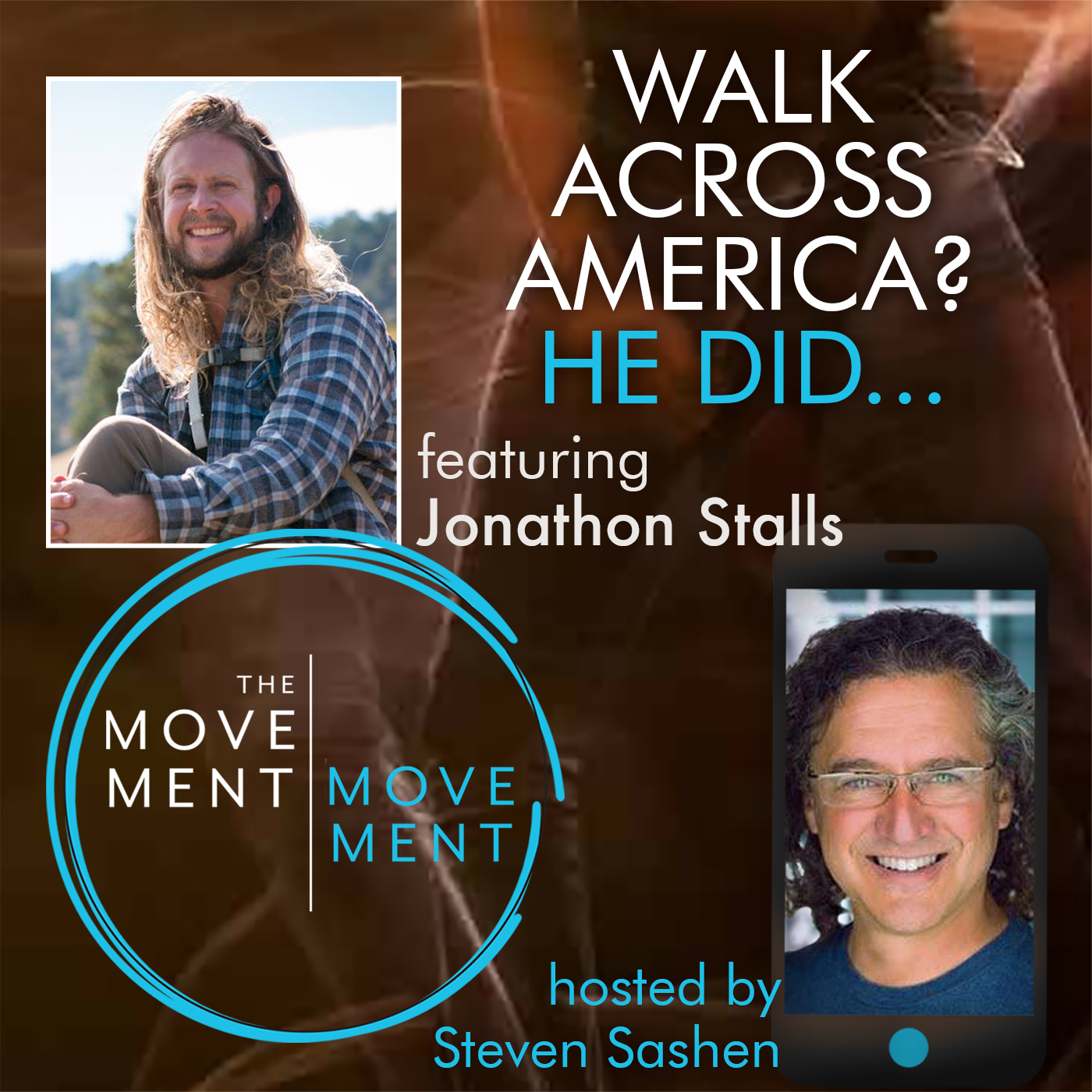
You may think you know how to walk or what walking really is, but you might find that walking can be a whole different game than anything you ever imagined. It's not about instructions, although that might come up. But why don't we jump into it? On today's episode of the movement movement, the podcast for people who want to know the truth about what it takes to have a happy, healthy, strong body starting beat versus, you know, those things are your foundation where we break up or break up, where we rip apart, where we look at where we explore whatever the mythology, the propaganda, sometimes the lies you've been told about what it takes to run or walk or hike or play or do you go across that or dance dance revolution or Eastern racing, whatever does you like to do and do that enjoy efficiently and effectively, like that I say enjoyably I can't talk.
Don't tell me. I know the answer. I know I did. That's a trick question.
Look, if you're not having fun, do something different than you are because you're not going to keep it up. If you're not having a good time. I'm Stephen Sashan, your host of the movement podcast CEO and co founder of zero shoes calm. We call it the movement movement because we're creating a movement that involves you.
It's easy to tell you how to second about natural movement letting your body do what it's made to do without getting in the way and interfering with quote technology that actually does the exact opposite. So here's how you can participate. It's really easy. Go to www dot join the movement movement calm.
You don't need to do anything to join. There's no secret handshake. There's no cost. You don't need to learn a song or do exercise every morning.
That's just the domain that I got. You'll find previous episodes all the place you can interact with us on social media, etc. And to be part of the movement moving this now from moving forward. Just like and share.
Give us some reviews. Give us five stars where you can thumbs up where you can hit the like button where you can subscribe thing where you know what to do. If you want to be part of the tribe, please subscribe. Alright, let us jump in Jonathan.
Give me a favor. Tell people who you are and what you do and then we'll jump into things from there. It's really simple. Well, I'm honored to be here.
My name is Jonathan Stalls. I consider myself a walking artist. And so I do a range of things. I'm multidisciplinary.
So sometimes it's my bring a sketchbook in my backpack and I'll often walk 15 to 20 miles a day, often long distance through towns and counties and lots of drawing lots of writing. And I also do a lot of documenting around pedestrian safety poetry, all the things. So lots of things. Walk a lot.
Well, so the obvious question. How, why, when that's I know three questions, but how does one become a walking artist? I was one to get to what it means to be out in the world walking in pedestrian safety and all those things that concern you. Yes.
I, well, I would say the how is just, you know, this all started and maybe it connects to the why a little bit they blend. But it started for me in 2010 when I did a walk across the United States. And so this was eight and a half months, 242 days. It was a really personal journey.
I was trying to recalibrate a lot of things. And I wanted to learn a lot of things from different teachers, teachers of earth and body and stranger. And I needed to walk things out for a long time. So walking things out is one thing, getting the idea.
Why don't I just walk across? I don't know. That's a bit of a leap for most people. It's like, hey, maybe I'll do it.
Maybe I'll just, you know, take some time. I just want to get from, I need a little, I need to clear my head to walk across the United States. Yeah. I just, well, I've also background to the why to, I've always been an artist.
And so growing up, I moved every two years of my life. I've been jumping around a lot. So kind of fitting in a big thing about being a new kid in new schools. I went to 14 different schools growing up.
And so always trying to fit in, always trying to be liked by the people to feel a sense of belonging in school in neighborhood. And it was always changing. And so all of that stuff was stacking over time. And as an artist, I was trying to create worlds around that sketchbooks painting.
You know, this was my work. I was trying to just move beyond some of the work. And it didn't really come to surface until I was in my late teens, early twenties that this was, there were a lot of things I was burying and suppressing hard things just related to my sensitivity. My comfort as an artist, like who am I outside of fitting into a million different groups?
Like, who am I? Like, I'm just, I've spent 16 years of my life being who others want me to be. And I got to get out there and figure some things out. And so it was a mix of that.
I'm also, you know, gay LGBTQ. I was coming out. That was really difficult. It was a heavy process.
So being an artist, being sensitive, moving all over the place, I was like, this is going to require weeks, months. And I'm not sure I've never done anything like this. My backpack for those of you who do backpacking and hiking was 95 pounds. So you can pretty much off the spot.
Like, this guy has no idea. And when I moved to New York City in 1983, I don't think I had 95 pounds or the stuff in my car. 95 pounds on a Jansport external frame. I mean, it was, and I had my blue-hiller Husky with me, which was amazing.
You know, that partnership was incredible. And yeah, so that it was a series of things. I stumbled across the book, Walk Across America by Peter Jenkins in the Arreria Campus Library in Denver, Colorado. It was 20 cents.
And that I canceled all my classes. It was two and a half days. I just wept. I screamed.
I threw the book. I came back to the book and I read it. And it was like, that's it. That's what I need.
I got it just eight months. Okay. Well, I had the least, you know, there was an actual catalytic event because still the leap from, I got to clear my head to watch the country was still a little broad. So 14 schools, like military brat or just get kicked out everywhere.
Just it was so my parents split when I was six and they both re-buried pretty quickly. Early moves. My dad actually played in the NFL and got traded twice. That was that.
And then my stepfather, who I ended up living with and my mother primarily was in the cell phone industry. So this was, I'm 40. And so the country was in 2010. So we were moving.
We were the ones building cell phone towers for the first cell phones in rural USA. I mean, I grew up with the lifeline of the big, heavy car portable phone. Yeah. So once you got this idea, I mean, you don't just go, Hey, I think I'm going to walk across the country.
Let me pack everything I own into a backpack and take off. Talk to me about once you want to occur to you to that first step, if you will. What was in between those? Yeah.
So in all honesty, I was, I was kind of the combination of being completely terrified because I just had no idea what I was doing. I was terrified. Where am I going to sleep? Where am I going to eat?
I'm not. There's no support. People are dropping me off on the East Coast and I'm just going. So all of these really complicated fears were all, you know, boiling at that point.
And I was just as equally filled with excitement and adrenaline. And I'm an athlete too. So I played sports that was part of my soul. Some of that, like having a goal, getting to the Pacific Ocean, like having some, you know, that that was helping.
But it was a combination of adrenaline and being terrified. Those first steps. The psychologist Fritz Purls, his line is anxiety, it's just excitement without the breathing. Yeah.
Yeah. Yeah. But even still, I'm going to keep getting you to drill down on this stuff because I find this totally fascinating. I mean, I'm someone who, um, planning is not my thing.
So I took a trip to Asia in 1989 and I've done as much planning as I could do, which is not very much. But the moment I landed, I landed in Hong Kong, it was one in the morning. I had a phone number, I was supposed to call. I didn't understand the area code system in Hong Kong.
So I was calling someone on the wrong island and waking them up repeatedly, like, you know, one in the morning. But then I very quickly, I just remember this. A woman comes up to me. She was, are you looking for someone to say?
It's like, oh, this is sketchy. And she says, wait, hold on. Hold on, it just hands me a Xerox of a lonely planet guide newsletter that said, I landed in Hong Kong, I didn't know what to do. This woman came up and asked if I needed somewhere to stay.
I was clueless, so I just went and it turns out she has an incredible guest house. She says, that's my guest house. Let's go. And from that moment on, I realized all I had to do was show up and I could figure out the rest in real time.
But walking across the country, I mean, A, did you have a root plan? I mean, that whole thing, where am I going to sleep? What am I going to do? Did you think how much mileage you were going to do per day?
What were you planning about for food? How long were you guys already said that? How long were you expecting to walk? Let's start with the easy thing.
Let's start. Yeah, it was the Delaware coast. So Lewis Delaware, which part of my very, very loose planning online, I had talked to a handful of people who had done a walk across the country in their own way and people of different backgrounds, a couple of women who had done it. And I just, so getting tips and tools from them was really helpful, but I was roughly using what's called the American Discovery Trail, which is this very, it's a national seeding trail.
It's technically 6,000 miles because it connects local regional and state trails to each other with a lot of gaps. And you got to kind of figure it out. And I just knew, I'm probably not going to be honest the whole time, but it was at least helpful to get a sense. So that trail starts in the same place I started in Lewis Delaware.
So it was just a line straight across the US was nice. And the timing helped. I tried to loosely guess the timing because I knew I wanted, if I could, to avoid the snow over the Sierra Nevada's I was going east to west. And so those loose things were helping me plan.
And my planning was honestly, it was literally just get to these big cities. The cities were kind of the desk, like the big benchmarks. So the first city was DC. The next one was Cincinnati.
The next one was St. Louis Kansas City. You know, and just as you described, that's a, it was day by day. And I see what happens.
Let's see who shows up. Let's see what the sun says. Like it was all of that day by day and it taught me so much about, you know, to trusting the moments. We'll get to that in a minute.
But I'm still backing up a little bit. So what in got 95 pounds? Well, I think, yes. And well, it's so funny is this is 95 pounds where I, at the beginning, my dog had one of those rough wear dog backpacks.
And I was called out pretty quickly in Washington, DC by this. It's a really interesting story. It's this guy came out of nowhere, long white hair, probably in the 60s, had overalls, no shirt underneath the overalls. All the skin was out like barefoot character came up to me out of nowhere and just started petting my dog, talking a language I didn't understand and was just in turn to me really quickly and just dogs are not made to carry weight on their back.
They're made to pull weight. So you need to take this back off if you're going to do any more mileage and then you just got up and left. And so grateful I did because my dog has it had a really long back. And anyway, so the 95 pounds was in addition to what can know what was already caring.
So at one point, it probably was more than 95 pounds when I took everything off of there. It was extra, I thought I needed extra of extra, like extra, I need a couple more extra socks. I really need maybe an extra, the layers were unnecessary. I had a lot of unnecessary just silverware utensil things I had.
And I got rid of it quick. After DC, that backpack went down to 65 pounds. It got down quick. You want to keep going from there?
Yes. I started cutting toothbrushes, limiting. Yeah. Yeah.
And I took, I learned so much. And as I went through the desert and I learned quickly too that I don't want to have a backpack through the high desert. So like a friend of mine who had done a long walk, Holly Likovsky had a custom baby stroller, a bop stroller that had, that was customized. So I'm now in the desert of Utah pushing a stroller across the highway 50, which was amazing.
So on that discovery trail, how much of it, I want to put it, how much of this trail, how much of it is roads, how much, I mean, weird in those gaps, what you have to do. I mean, by the way, you're mentioning like Delaware to DC, that's going in the wrong direction technically, that's just heading south. And then if the next one is Cincinnati, that's a hell of a trip. So that'd be your next spot.
In fact, you should mind me, I bought a car, I'm out in Colorado. I bought a car that was in Buffalo, New York. And I connected with a friend of mine who was coming from DC back to Colorado and he rented a car and we met in Cincinnati with the idea that we would then drive the rest of the way together. Now, by the way, the punch line is he was going just under the speed limit and would not use cruise control.
And one of those guys who put his foot on the gas, took it off the gas, was constantly like, uh, and I said, do you not like cruise control? He goes, now, I kind of puts me to sleep. I said, do you not like going over the speed limit? He goes, now I got a bunch of tickets in the past.
I'm a little nervous about the speed limit. So then I don't like you driving. So I drove the rest away and just driving the rest of the way was, was crazy. So you know, there are cities between DC and Cincinnati, FYI.
But totally, I just, these were the ones that, cause I wanted to be, I learned quickly that I didn't. So I got off the, what's called the ADT, the Discovery Trail. I actually got off of it within a couple of days. I just was like, I want to, like I would just talk to people.
You mean people that woman you mentioned who just approached you, I just start, and I they would just say, well, actually this road, this list back way or cut through that ranch or go down by that freak or you're really going to want to get to this town. This is where you're maybe going. I would just listen to local people and, and I learned that I actually was drawn more to the roads were stressful and hard and, and I needed to get off of them for serious stretches of time. But primarily I was drawn to going in and out of small towns and villages and going, I loved learning about these little villages and towns all across the country.
Like they were just, it motivated me as a, as a, as a destination going into like sticky diners, talking to people after some good solitude and movement. I, so I ended up doing a lot, a lot more road walking than I had originally planned, which was a, which was great. I stayed with 120 strangers on this trip. So that 242 days and 120 people who invited me or over time, like learned about me through other people throwing lasagnas out the truck as they're driving by.
I had people bury, bury things in the high desert. Like I wanted Dr. Pepper, water and gummy bears and beer. Those were the four things on my list.
Those are the four things healthy. Yeah. I don't know. Anyway, the, the, by the way, it's chocolate just in case people want it.
Right. Right. So, so what were you doing for money? Yeah.
So I, I only, I only, this was me because it was such a, I needed to do it. Things were not going well. I was going through hard things. I was just like, I, my mental health was really just not, it wasn't steady.
It wasn't grounded. And so I just knew it needed to happen. And I was prepared to work along the way. It may not, I may not, this timeline may not work out in it.
Maybe a couple of years I may have to divert, I may have to pause. So I literally left with $1,000 in my account, but I also did some work. I wanted to support, you know, a cause of some kind to kind of get out of, you know, I wanted something that I could, you know, talk to people about that I believed in. And there was a group that I had connected with.
And some of my college courses called Kiva, which is a group that helps small businesses all over the world. So I got to work with the U.S. with through micro lending, just get started or help save or support their business in crisis. And I loved it.
And so I was raising awareness for this organization, doing little talks and just sharing things as I could. And it ended up that a lot of the supporters of Kiva found out about my walk. And we all, and the staff, we created a budget and I ended up raising about, you know, 10,000 for my own expenses. And then we raised a lot more for these amazing businesses throughout the walk, which was really, really cool.
Yeah. Awesome. So on average, how many miles a day were you walking? So East Coast, because of the grid, you have more towns that's closer together.
It was 11 to 15 miles. I just didn't, I wasn't wanting to rush the East Coast because I was just learning how to do this myself and I wanted to train my body. So 11 to 15 miles on the East Coast and then moving through the Midwest was about 15 to 18, 15 to 20 miles. And then as things got more spread out, getting into, and I'm in Colorado too.
So I live in Denver. So I'm getting in my home state and then in the Utah, that's where Colorado went down a little bit because of the elevation all up and down. But the high desert ended up being 20 to 30 miles average. You ton of out of it's just all day in these open.
It's wild horses in the morning. Yeah. I have a great UFO story. I mean, there's just.
You can't just leave it. I got to leave it. I got to leave it. No.
It's in the book. Check the book out. It's probably a bit of a bone. Just use the term anal probe if you want me to give me something.
Oh my gosh. I love it. All of that. It's honestly promising.
It's in my journal. I did a summer salt wipe my head and all the things for 20 minutes. Look at this thing. Not on drugs.
Not doing anything. It literally looked like a floating jellyfish. It had kind of these tentacles. It transitioned from green orange and yellow.
And after about 20 minutes, it turned and flew away. And it was in the middle of right over Sacramento Pass as you get over Great Basin National Park. And the first thing I could do was run to my journal and draw this thing in detail. I was asking everybody in all the libraries and little mining towns like, have you even they're like, okay, we're in Nevada, dude.
There's lots of stuff. You know, there's testing. I'm like, no. No.
So, yeah. All right. Well, all right. We will.
That is a good teaser. That is a good teaser for you to get to that. So how much time did you find yourself? I mean, having to camp out versus, I mean, where were you sleeping?
Obviously 120 people, I'm guessing. I'm going to go those were letting you crash somewhere. But when you didn't have 120 people to help you out, then what were you doing? Yeah, it was all camping in any place.
All the places, it bitches underneath highway overpasses if the weather was rough at times. I did some of that. Lots of ranches, like just dark, like, you know, spot camping wherever as that sun went down. You know, and there were lots of, there was several kind of middle of the road where I would, you know, get permission to pitch a tent somewhere.
For example, sometimes I go into, I make a call into a town or library where the private like, I just learned pretty quickly trusting my instinct was, I was building this instinct relationship around something about this town. And me just popping a tent doesn't feel right. Listen to that. Make a call.
I call the library. I call the school. Sometimes I'd actually call the dispatch office and be like, Hey, I'm walking across the US. I'm going through, do you have a suggestion on where I could just put my tent?
I'll be out in the morning. And a lot of the time, not all the time, a lot of the time people just say, Yeah, just put it behind the big tree next to the dumpster on the other side of the pond in this park and we'll have our night officer just, you know, we'll let him know that you're out there. So sometimes it was that, but a lot of it was just, you know, wherever I would land it. I love it.
I have sometimes lamented that I am not a member of a very tight knit religious organization. Cause then you could just go from one to the other to the other. You could, you know, pick a church, pick a mask, pick a mask, whatever. Yeah.
Exactly. So I have a friend who she describes herself as a winter pilgrim and she goes on these six to eight months, usually winter pilgrimages all over the North America and around the world. And she's extremely Catholic and she just has the churches everywhere. They're just dialed.
Yeah. Happy to help. It's their job. It's a similar thing for Muslims that I know.
Yeah, I don't have that luxury. But then again, I'm not planning to walk across the country or just go randomly at this time and have to figure out and wait, you were how old when you did this? Yeah. How old seven?
Yeah. I went to Asia. I was, let's say, 89. Oh, same.
That's 27, 26, 27. Awesome. And that's an interesting age to be when you're doing something like this. Cause I think people are more likely to help you.
And like, if I tried to do it now at 60, people would just think I'm not sort of a loser. But you know, when you're, when you bump into somebody who's 27, who's doing some crazy ass thing and they're lost or they're out of money or whatever, you know, you can't help them on a path on the head. I mean, I, I remember I was in India and I'm trying to leave the country and I didn't know there was an exit tax at the airport and I had no money at that point. I mean, I think that was my last stop on the way home.
And some guy realized, so I'm an exit tax. What? So he paid my exit tax and said you probably don't have enough money for dinner. And this flight was just late five hours.
Only by dinner. And just, you know, things like that happen at all time. But I think about it now. So if I try to do that now, it's 60.
I don't know if I get the same treatment. Yeah. It's, it's so interesting. There's a lot of older, different ages out there doing, you know, walking across the country, at least within this circle, there's always, you know, there's people out there who aren't publicizing it or they're doing it for a lot of different reasons or needs.
But for people that are making it a little bit public, there is a circle of us that we support each other. We have these little groups where we connect and I'm amazed at how many 50s, 60s, 70s, a couple did it in their 80s. I mean, they had the 80s couple had some support, like a van, a different most of it. But it's a cool, some people, a couple of them just retired.
Like, you know, they're just like, I just, I've always just wanted to walk the land. And they just go, ah, yeah, it's cool. Let's talk about your body. So you started out, I mean, I can only imagine you weren't walking 10 to 15 miles a day before you started.
So what was that like suddenly picking up that much mileage? What do you feel? What was working? What was it working?
What did you discover? What changed? I mean, talk about the evolution of your, just literally how your body dealt with doing all these miles. Yeah, that's a good question.
I, yeah, so I had only really done, you know, I would work out in a gym. I'd lift weights. I would play ball sports. I would be a beach sand volleyball player, you know, things like that.
So having, you know, not having a lot of hiking, walking experience it. Luckily, I tested out some good shoes and I luckily had just some good advice from other people who were just, who really just told me in their own words, because it's walking and because you're not in a rush, like trust that your body is going to find its rhythm and it's going to communicate to you when something needs to shift. And so just listen to the language of your body and listen and your body will train itself for what it needs to do, what you're inviting it to do. And that advice was spot on because I, from the beginning, I was like, all right, blister is forming angle, feel, backside.
I mean, obviously shoulders 95 thoughts, but like there were things, so listening, like not just saying, oh, I'm heard, I just got to push through kind of like sometimes you do in sport mindset. Yeah. So if I'm the long journey, like if I'm noticing these pain points, I need to stop and listen and adjust. And that's exactly.
And I'm really grateful that I loosely planned just 11 to 15 miles on the East Coast per day. And so I really had time to work out the Kings, take lots of breaks, shoes on and off, let the beat breathe and sock changes. So I got some great tips on that from the beginning. And I walked myself into the ability to do 30 mile days in the desert.
It was amazing. Yeah. Are you aware of anything in particular about how you're a gate changed or how you're paying attention to feedback you're getting? Yeah, that's a really good.
Well, and so this is all before I started wearing more barefoot. So I have different things that I integrate into that now. But I would just say there were two different distinct shifts in my movement when I had back back and then when I was pushing the baby stroller, you're in the car in the desert and different things I'd learned about my body and posture. I'd learned, I mean, there were just, there were so many things related to just the way my hips, I'm kind of knocked knee in bow legged.
And so there were certain parts of the road. Like I actually would feel less, you know, I learned just naturally. Nobody told me didn't read anything about it, but I was like getting off the pavement. I need to get off the pavement.
I need diversity and landscape to massage the different relationships to the unique changing landscape of my body. This soft body with a soft earth. And I just was, it was so, so that became a real significant learning to get off the road and be on those dirt medians as much as I possibly could and seeking the little nubs of grass and, you know, almost like these mini massages throughout the days route, you know, now that are so much more with barefoot shoes that it's so much more tangible than it was just a little more like, I could feel it, but now I really feel it. Yeah.
Well, people will sometimes say about the most footwear barefoot stuff, they go, well, we didn't evolve to walk on the surfaces like that. I go, well, first of all, the hard-packed mud in the place that we evolved is as hard as concrete. Secondly, because we didn't evolve doing something, we're not equipped to do something. We didn't have all the deltoist and double backflips, go watch the Olympics or fighter jets.
Totally. Yes. Yes. But to your point, but the thing that we definitely did not evolve to do and we're not necessarily equipped to do is the same motion on the same surface day after day after day after day.
Right. Yeah. And that's one mall four. You know, we don't have the, it's a bad idea to run in some middle shoe and do 26 miles ago.
Yeah. If I, our first customer, happiness manager, he was our only customer, happiness person. He did, he was 65 years old and he was doing 120 miles, running 120 miles a week, mostly on like cement or pavement or whatnot in our four millimeter sandals had no problem because he had really, really good form and he was doing basically 10 miles a day and then long days on long runs on the weekend. So you can do it, but he would also go on trails and do other stuff and get that variety, which is important for your body for many, many other reasons.
Right. Yeah. Oh, the variety was just, that was the biggest teacher for me on that walk. It was just the variety, the relationship to it.
Yeah. And just, and I think just listening to the body in general, like learning to listen to the body, like not tell the body what to do, not try and corner the body, not just put the body into like kind of this default, whatever the default is, whatever you grew up with, it didn't grow up with whatever brand, whatever, like to actually shift the relationship and listen to it. That was, and these were all things that were helping me learn about a walking pace and again, anyway, all those things. Yeah.
You remind me, I mean, this whole idea of how we just try to force our body to do things for whatever reason. I mean, there's two things to puff in my head. One is, when I got back and sprinting, it took me maybe at least three years, maybe four, till it occurred to me that when I had the thought, let me just do one more, that was my cue to stop. I just want to do one more.
When you have the body. Yeah. Right. Yeah.
Yeah. Like, you know, if I'm on track now, if I feel something just, something feels a little off, I'm like, I'm just done. I don't need to. I'm just through it.
And I mean, I've remained basically uninsured for 13 years as a result of that. But you also reminded me of one of my favorite version of this. So I'm a 17 year member of the polar bear club. So January 1st, you know, they chip away the ice, we go jump again, the reservoir.
And it used it for a while. They had a thing where they did it in between two docks and you could just jump in off the dock and then get out of the water, or you could jump in and swim to the other docks. So maybe 50 feet. And I'm there with a friend of mine, a woman who, there was two things that were really fun about this one is they said, who wants to do this naked?
And she just immediately raises her hand and then looks and goes, Oh, that wasn't a good idea. I haven't shaved my legs. And I said, trust me, no one's going to be looking at your legs. So, so, so.
I did not do that. It's like, all right. Yeah. So dive in off the, off the dock and start swinging the other dock.
And I get there first and I jump onto the dock and jump out of the water onto the dock. And I turn around just as she gets her hands on the dock and starts to lift herself up and then gets this weird look on her face. It was half terror, half confusion. And she starts to sink back into the water and I've never and lifted her out of the water and you know, put it.
And she says, that was the first time in my life that my body didn't do what I told it to do. Wow. And it just literally just shook her to the core. And for whatever reason, and I don't know why.
That's the relationship that most of us have most of the time. It's a weird one. Yeah. Yeah.
And it, I wouldn't have had the language for it back then. As somebody who, as I shared earlier, like just suppressed so many things, just buried things in my body, mental things, emotional things, situational things. I just buried stuff and, and so I can see, you know, just how disconnected I was from my body and why this, you know, this really complicated, almost lava-like energy around when I was reading this book, Walk Across America and the Body, all these things were happening. And I didn't understand all of it until I was just out there just moving with it.
And it was like, it was, it was an interesting, like, it was healing, but it was also grief. And it was just coming into this, like, I don't know, moving into the full thing. It was powerful. And that's, I mean, because of me, I'm just talking about it now, it's just why, you know, I was so eager to learn from my body, from the Earth, from people, from, I just wanted to restart.
And I think that's where I'm already having kind of the, like, just being an artist as a kid. That's, hence why now just being a walking artist is like, this is my work. I love it. We will get there in a moment.
But first, two questions. One, I would be, miss if I did not ask any interesting romantic stories. Oh my gosh. I mean, so I, well, I had a partner that was, that was mostly, we were mostly together throughout.
So part of me like laments that. I'm like, man, can we just have waited? Like, there were some just beautiful opportunities of exploration and color. I think about just different musicians I met, people in different stories of, ah, so there's more like just like, ah, what could that have been, you know, times maybe 15 across the country?
I got to get you on. When, when Layne and I first got together, we were couple. I mean, I definitely knew I wanted to marry this woman, but we went back to my 25 story and all the man, except for one. And that's all the story that I'll say for another time.
But most of the man had gotten pretty fat and pretty bald. And I turned to Layne and I said, ah, I got to tell you one of the reasons I love you. She goes, what? I said, because you will appreciate what I mean when I say this.
If you weren't here right now, I would so be getting laid tonight. So, so I appreciate that there's opportunities that you were in a situation where you weren't in a situation where you weren't. I get it. Yes.
And I, you know, it's just, I think part of it too is what like even the neurology of walking is so beautiful to me. And so to be out there for so many days, I love the neuroscientists. I'm not sure why I'm spacing his name. I think crazy blocking is his book.
But he's just, he's a neuroscientist and he just kind of breaks down and he's just based in simple terms, is just saying like, after about 20 minutes, you're creating new neuropathways. Yeah. And I just that, like, so to be on these, like to be walking 15 miles a day, to be seeking all these, and I'm such a feeler and I'm a sensitive person and I just, oh my gosh, sexual energy was going in every direction. And it was amazing.
Like just reclaiming sexual expression. Like I walked hours naked in the desert when there were, you know, cars or I mean just her parading around and I was just such a, so I loved, I lament being in a relationship was a good relationship. We're still together. We're married, but it's like, but you know, I'll throw this in the mix though.
And I wonder if this is your experience. Like when, when Layna and I, before we were a couple and I was trying to do everything, my power to make us a couple, which she had no interest in whatsoever. In fact, I went to visit her once she moved Albuquerque and she didn't come visit, but you can just sleep on the floor and you know, don't touch me, don't even think about it. And I was very attracted to this one.
And so I had all this sexual energy sort of moving through my body, but nothing to do with it. And by the end of that weekend, I was just so blissed out because it wasn't being used and there was a way. We could be able. Yeah, absolutely.
And it was, well, and I, the only way I relate to it is it was just, I was even, I was so much more, you know, just sometimes different teachers of mine have shared things like sexuality being a portal, like just not necessarily like relational intercourse, but just sexuality in general, like sexual connection. And so I just would find myself really drawn to these stories of people I would stay with or walk with or get to know like during my breaks. I just, I would find myself like so much, like even more engaged and present and like there would be all these things connecting where I would literally like hug trees for long periods of time. I would feel this the more mud under this kind of the creek and really centrally like, so yeah, I don't know if that's the same, but it's a similar like, no, I think it is.
Because I think we all have habits of how we deal with energy in our bodies. Like Elena's taking a, we're going to Europe to do some business with our European office, and she's got really bad jet lag issues. So she came up with this brilliant idea. She's taking the Queen Mary, which is a riot.
And so they have formal dinner and then three gals during the trip. So she got all these clothes to wear. And so she asked me to take pictures for her mom. And I was just commenting on just like how incredibly zap is wearing how hot she looks.
She goes, well, you know, I noticed that you'd like glance at me and then just like look away. I said, yeah, because I can't tolerate anymore. I mean, it makes so much happen in my body. I literally.
It's beautiful. It's beautiful. It's just beautiful. Sexual energy so beautiful.
You know, it's one that I don't think we, we don't explore it in a way where people can talk about it or explore it in a way that is either safe or just not about having actual sex. Just what is it when this comes up with, you know, maybe someone that you don't expect it to or someone you did and it doesn't. Right. You know, it's a very interesting topic that and I know just in my own life, it has not happened in a way that then like a conversation like this, frankly.
Yeah. And it's I just I think, you know, for me at least, you know, coming so much of my walk was about accepting sexuality because, you know, some of the background, this is in my book as well. I get really raw about like just my personal. I was, you know, there's a lot of shame around being gay or queer kind of on the spectrum.
And I just was like, I was suicidal for three months. I lived in Ireland. I was on that edge. I grew up with complicated religious stuff, stories of, you know, all the things that get attached to those things.
And I was like, this is part of my, I've got to walk, I got to walk this out. And so anytime it would come up, I just want to de-greet it with like, with warmth and curiosity and like, how do I treat this differently as it comes out? And so just I think again, like that, you know, eight and a half month relationship shift to all these things that were trying to take me out in some ways and walking, literally being a medicine for so many things and sexuality, like sexual expression and what people go through sexually and the hard things, the shameful things, the deep things, the dreaming things, the secret things, like how to just, and I love what I love about walking is when I'm moving with other people and sexual stuff comes up. It's like, you're side by side.
You're not, you're moving. There's movement. And you know, you have nature all around you. Sunset, sunrises, trees that twist and break and bend and non-binary, non-conforming, queer flowers, like you just got like stuff saying, be you.
And, and you're to be a witness and to someone's, oh, I can go on and on. We could do a whole thing on this. It would be interesting. I'll tell you.
There's a very, I wonder if this is, if there's a variation. So let's see. I don't want to dive into this too deeply. Some people know I had a, we refer to it as a health scare or a health something or medical something.
In short, there was a period of time in the last few months where it was indeterminate about whether I was going to be dead within one to five years. Wow. From the moment that I got that diagnosis and did not know, and arguably still don't really because none of us do, but that's different sort of, but this is something that, you know, demonstrably could have been something that would have killed me. A hundred times a day, I was just blissed out by either, you know, seeing clouds and just the way I described it sometimes I go, I felt like an alien that I either just landed here and was going, oh my God, or I've been here for a while and had to go back to my planet.
I was like, oh, I'm going to miss that. But it wasn't sad. It was just like, this is so enjoyable. And I don't remember it having a sexual component per se, but it was just this like full body kind of gratitude slash bliss slash a lot of movement.
And not always when I was walking, but I mean, I walked my dog for about an hour a day, a lot of time walking the dog often when I was in the car, often it was delightful in the truest sense of the word. Yeah. That, yes, it's like probably one of the, I mean, just in just honoring what you shared, and that's exactly one of the things that the awe, I think you're thinking of awe, like just awe, awe, awe, like, and I just the gifts of walking as a practice. So there's utilitarian walking where pedestrians got to get to the store.
There's exercise walking, but just front like to open towards just awe and to let those channels, the emotional ones, the sensual ones, the, I'm actually maybe a part of the cloud and the cloud is a part of me. Oh my gosh. What does that feel like? Like that kind of stuff.
Yeah. Yeah. It's a good one. And I think we just hit on something which is that it's unusual to have those experience unless for some reason voluntary or otherwise you're sort of thrust into a radically different world, if you will, a radically different way of experiencing yourself on the planet.
And so, you know, mine was just like, Hey, by the way, this could kill you. And you're like, Hey, I'm sure you had that thought every now and then. And then this one, this is sketchy. I hope I make it.
Oh my gosh. Several times. Yeah. Yeah.
Yeah. Yeah. Yeah. No, it's no, it's no question that hold the tension of those edges, you know, helping kind of guide a whole new way of just listening, connecting, opening, releasing, you know, all these different things that happen.
You know, I was referenced walking, but I think it can be other things. It's just, you know, I have friends that experience and some of things like that in music, but just like, yeah, it just on the edge, like this is, I'm going to, I may not survive this. And so what does life look like forward if there is a forward and, you know, and, you know, and And here, the thing that occurred to me, I remember when I started having this experience, there was two meditation teachers, husband and wife who decided to experiment and pretend they were going to die a year. And to see what was it like to kind of gear up knowing that a year from now they were going to die.
I remember this is 30 years, 35 years ago, I remember even then thinking, you know, you can't fake it. No. It's not what was going on for me. I kept thinking about that book.
And you know, I don't, I wouldn't argue that anyone should put this in a position like this artificially. But I mean, I talked to a number of friends who had been going through cancer treatments, and I was telling them what I was experiencing. And they went, you know what, other than when I'm having chemo or worried about my kids when I'm dead, that's exactly the experience. Because I mean, I know that this is not going to end well or not, not well, it's not going to end the way I imagined.
It's sort of a shame that there's not another, let's call it Safeway. I know that sounds paradoxical before we're talking about to have that kind of experience where it's just, it is almost thrust upon you the awesomeness of things, the preciousness of things. And maybe, maybe it's a psychedelic thing. I don't do psychedelics.
Yeah. Yeah. There's people I know that will share some things like that. The chapter at the end is called Walking is Right of Passage.
And I, I just, I put it out there. It definitely wouldn't say easy. It's not, you know, but it's like that there's something about like, call the little subsection of the 18 edge. And it's like, even just like the thought, I share this with a lot of students when I'm doing school stuff and they're like, Hey, where would you like, you know, like, where could we go?
What should we plan to do? Like, how, how do I do something like this? I'm like, honestly, right out your front door for six days. Oh, just go for six days, three days to and just see like, even that mindset of like, out of those comfort, the comfort defaults.
Yeah. But I wonder, you know, you're, you had a plan, but no, you're right. It's, it's, yeah, it's, it's not the same. No, to know that certain amount of time you're going to come through things and be cool.
Totally. It's going to, well, it's going to bring me somewhere. But first I have to say the whole thing about building a new neurons, Kurt Erickson, University of Pittsburgh, this is 10, 12 years ago or so, he had just completed a long, jutunal study on elderly people walking and found that the ones who walked more or maybe walked at all retained more gray matter than those who didn't. And I said to him, imagine, I said, why do you think that is a good wall of stimulation?
I said, imagine what it would have been like if they weren't walking in big, thick padded mushroom girl shoes, he was like, Oh, yeah. So but that was a nine year study that had lots of money behind it. We don't have that luxury at the moment, which brings me to you get to the Pacific Ocean. And when it where you landed, but be I can't even imagine the panoply, a word I don't get to use very often of emotions and feelings you must have had at that moment.
So where'd you land and what was it like to even knowing you were going to be there in some amount of time and then actually getting there? Yeah, it was the words that I use that were just so very loud then and are still now is like just the beginning of that walk was kind of like a trembling like this is this kind of I don't want to say last shot, but it's a big shot. Like, am I going to survive this? And the leading story was I don't have what it takes.
I don't have what it takes. I don't have what it takes to be strong to defend myself to name what I'm hurt to name when to name my dreams publicly to name and be the reason there's conflict, whatever. Then I don't have what it takes. I don't have what it takes.
You don't have what it takes. All these voices and by the time I cross through Nevada, walking naked in the desert, UFO talking to me, getting to California, I'm like, I have what it takes. I just climbed over mountains. I met millions of thousands of people.
I survived. I learned things I never so getting to that beach at San Francisco is where we finished. And so funny story, randomly connecting nakedness. But like I had.
Please don't please don't. Please don't. It was Baker Beach. It was.
And I had no idea. So I didn't know. We got to say why that's explained why that's irrelevant. It's a nude beach in San Francisco.
And I'm just like, so I have I have my great uncle from Kansas and my great aunt's from my rural people are lying out. I'm like, we're going to meet at this beach because this is close to the Presidio where we're doing the event and whatever. So we just everybody met there. And I had amazing people who were host families were flying out to walk with me that last day along the beach, which was so we had about 100 people moving through the city because Kiva's headquarters are in San Francisco.
So they had staff, we had host families. And then my like rural Kansas relatives are waiting at the beach and they're just so like in their suits and tumble and we get to the beach and we are all hundred of us walking through hundreds of naked bodies. It was the best. My uncle's just like, oh, my aunt is like clinging and looking and they're all everybody's getting excited about doesn't know what to do.
The people who are nude hanging out like, why are you walking through us? Oh, it was amazing. It was amazing. Absolutely amazing.
So was it was it relief? Was it? Was it ending? I mean, I can just imagine, you know, things rolling through one after another after another, some contradictory, some just expanding whatever the previous one was.
I mean, and then the next day you wake up. I mean, what the hell is happening? Yeah, it was all the above. And it was just and that really started like a couple weeks into California or towards the end, I just was like, what?
This has become my not only like my kind of recalibrated sense of self and connection to others and to the planet and to these new teachers. But this is this is my primary medicine, clearly. And so how do I, what do I, how do I keep this? Do I just keep walking?
Do I do a different like long distance trip? How do I, and it just, you know, and so it was pretty quickly, I was like, I have to integrate it. I have to keep walking. I know I have to keep walking.
I know that's that's in the cards. It's in the story. And so then it shifted, you know, a couple months and I started as like one of the loudest things along the walk was what I would also notice in other people as that when they would join me for an hour or a couple days or I mean, within 20, 30 minutes, the things that we were able to share with each other, the things that were able to kind of surface, the way they would be able to communicate, well, I had never walked through my town from this side to the other side before and I've lived here my whole life and I'm 45 or like I've just, these things that just were, I've never shared that with anybody or it felt so good to just move and just get out of like whatever I was stuck in or, you know, all these things that the reflections would stack and stack. So I experimented with this project called Walk to Connect.
So I called it connection because connection just felt so loud around all of it. So then I just within a couple months just started hosting walks and I started, I put it on meetup.com and my first walk was 26 mile loop around Denver who wants to join and no sign up to none, nobody. And I was like, well, okay, well, it's got to be 24 next weekend, 24 miles. Nobody signed up.
And then I bumped it down to 18, had three people. And that was the first walk to connect experience. It was an 18 mile loop around Denver. And then from there, it was just hosting walks of all sizes, themes, topics, training leaders, doing things that that for years, you know, so I kept myself out there, had to.
That's beautiful. And so we started the conversation. Part of what you mentioned was correct me if I'm remembering the phrase around pedestrian safety. Yeah.
So there's a project that has, so throughout the cross country walk and then as I started doing walking events with walk to connect, a loud learning, loud was just around built environment and safety and accessibility, I would just spend hours waiting with people connecting with people at bus stops. I have so many visceral memories of and still to this day of elder, specifically elder grandparents folding with one hand, their grandchildren, like clutching their hands and then the other hand, like four grocery bags waiting for a bus that only comes once an hour without a bench or a shelter in the rain and just experiencing these families that are just from all these different backgrounds and situations and circumstances, people who move on wheelchair who are in a state highway who live in the apartment or trying to get the grocery store because there's no sidewalk. I just would see scenario after scenario, hundreds of how pedestrian mobility is so under-prioritized as a modality of transportation. And so all this, most events got elected, leaders out, did things for years.
And I just, I still wasn't seeing like enough changing in the system. And so I, as an artist, I just the last three, four years, I'm like, how can I just try and get more creative with this? And how do I engage younger audiences in particular? And so I created this project called Pedestrian Dignity where it was just focused on like the dignity of a human body moving through any given environment, trying to get home, get to work on foot or on a wheelchair.
And how can I share stories related to this topic from the lived experience framework? And so I've been playing on TikTok and Instagram. I'm 40. I don't know what I'm doing on there.
I should be on there. I hate it, but I love what I'm, I love who I'm connecting to on there and some of the seeds that are getting planted around telling these stories from a lived experience framework. And so the Pedestrian Dignity Project is a part of my creative work. Yeah.
I love it. Well, I hate to do this because I think we could keep going forever. I've got to do this. But A, we can't for numerous reasons, not the least of which being I got to pee.
And not the most pressing one I will confess. Right. This has been an absolute pleasure. And I'm sure there's a million questions that I haven't thought to ask and that other people have going through their head because just trying to imagine doing something like what you've done is that alone is a bit of an adventure.
And I'm curious to hear where people go with that and what they want to know. And I imagine they can ask you those questions. So people want to get in touch with you and find out more. I hear a rumor that you have a book of some sort.
I don't know where I got that idea. But can you tell people how they can find you and find out more and find your book, etc.? Yeah. Thank you, Stephen.
I work as titled Walk, All Papittles, and Slow Down, Wake Up, and Connect at one to three miles per hour. And so it's nonfiction, creative nonfiction. I do pen and ink art work. There's art work, there's practices, stories, essays.
And you can find it in any works or sold, check your local bookstore. I highly recommend the audio book because you can take it with you as you're moving while you're walking. And then it just, my creative work is at IntrinsicPaths.com. So you can sign up for events, hosting events all the time in Colorado and outside.
And I've got my pen and ink artwork on there as well. So IntrinsicPaths.com is a great way. I can only assume there's a link to find the book from there as well. Yes, yes, yes.
So, well, then please do reach out to Jonathan with any questions, any whatever. Find the book, go for a walk. If you can't find him, just go for a walk. Yes.
It's been a total pleasure. So first of all, again, thank you. Looking forward to what's next since we're neighbors. We need to do something about that.
Absolutely. We can take a walk. Right. And if I can promote your shoe, I mean, at least I've loved them.
This is my first pair. And I'm wearing them everywhere. I love the way they feel. I love the way they support me.