
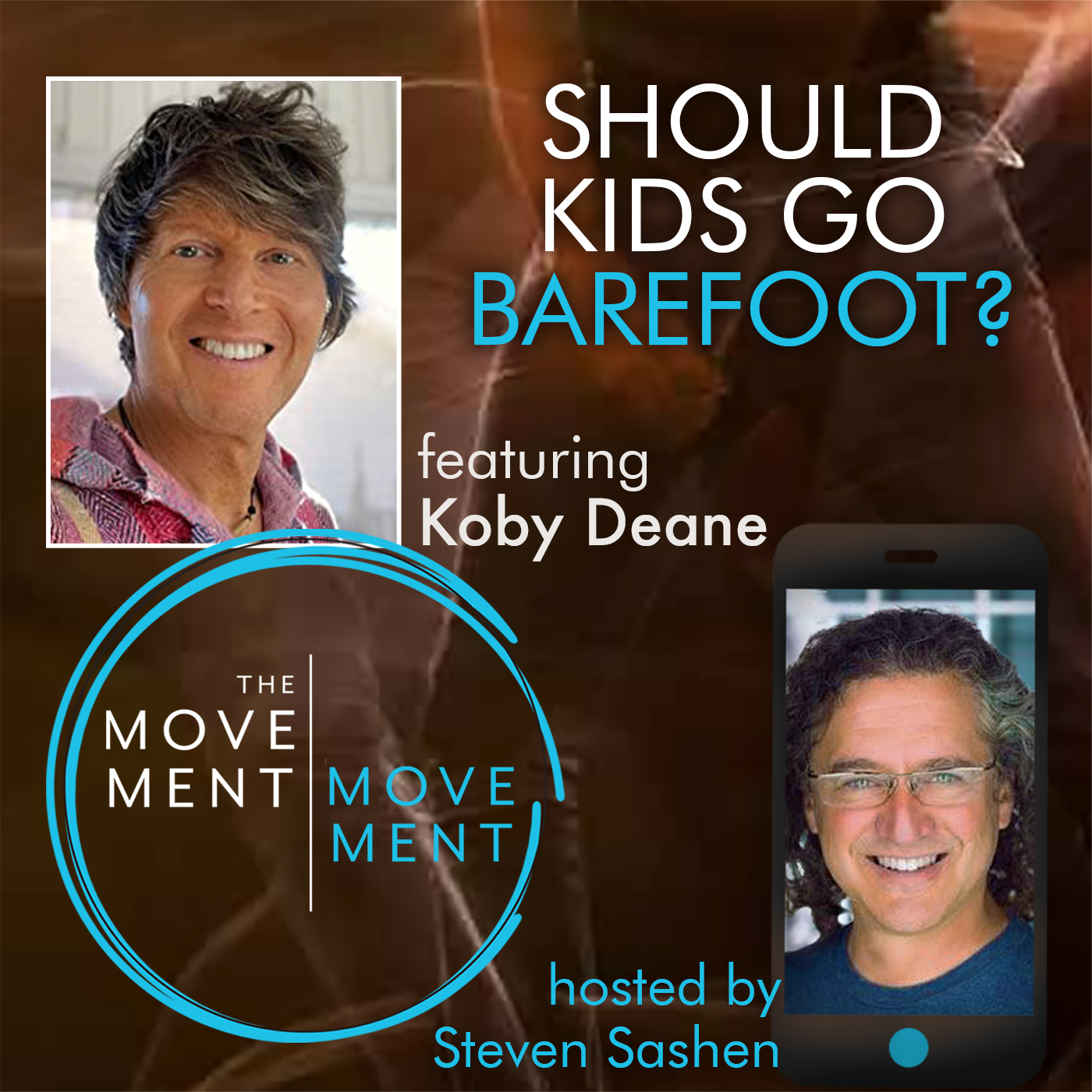
A number of years ago, I was talking to Dr. Irene Davis, who was sort of the godmother about natural movement and footwear. And she said, if we just got kids wearing minimalist shoes in 20 years, we would not be treating adults for the billions of dollars of problems. They currently have with their feet and everything above.
Well, we're going to be diving into that and many more things I'm sure on today's episode of the movement, the podcast for people who want to know the truth about what it takes to have a happy, healthy, strong body starting feet first as you know, those things are your foundation. And we also break down the propaganda, the mythology, and partly sometimes the outright lies you've been told about what it takes to run or walk or hike or play or to yoga or cross it, whatever it is you like to do and to do that enjoyably, efficiently, effectively, did I say enjoyily? Yes, I did. It's a trick question.
Because if you're not having fun, you're not going to keep it up. So, you know, do something that's kind of fun. I'm Stephen Sashan from zeroshoes.com, your host of the movement movement podcast. We call it that because we are creating a movement about natural movement, letting your body do what it's made to do without getting in the way and the movement part, the moving for it, that's all about you.
Doesn't take any effort. It's really easy. It's all what you know how to do. Just give us a thumbs up and a like and a review and a share and a hit the bell icon on YouTube.
I mean, you know, the gist of it. If you want to be part of the tribe, just subscribe and also go to www.jointhemovementmovement.com to find previous episodes, to be learned about new episodes and to find all the places you can find us on social media and wherever podcasts are pod-cassable. All right. That's all the interest.
So, I'm not going to introduce my next guest because, you know, I hate doing that because I never say things that are interesting as them. So, tell people who you are and what you're doing here. You're always very interesting, Stephen. My name is Kobe Dean and I'm the author and illustrator of the children's book, I Go Barefoot.
I had one sitting on my desk last weekend or last week. It was sitting on my desk and it disappeared. So, there you are. I go barefoot.
It's probably backwards, but it looks totally correct. You're readable? It's exactly correct. So, tell people about this book and why you did it.
Yeah, I was inspired. I like to go barefoot myself and I wanted to create a book that would inspire kids and parents about the fun and positive aspects of going barefoot. I think a lot of times there's just this like fear about, oh my gosh, what's going to happen if you don't have shoes on your feet? And you know, it was just almost paralyzing.
And so, and there's a lot of things that we'll probably discuss that stem from problems that stem from that mindset. So, when I created the book, having, you know, I love the subject and I wanted it to be fun and positive because there's just too much negative about it, you know, or even our mindsets. You know, like, oh, no, I can't do that. You know, so that's why I did it.
So, I noticed, so where are you located? I can't remember. I live in North Carolina with my family. So, interesting.
Neither of us are in places that people typically think of as barefoot friendly, like basically a beach or somewhere that's warm all the time. And I know that, and I bring that specific example up because when I'm like walking around barefoot in Costco, which I do often, I've had kids come up and look at me and I'm like, I'm like, and say they're, you know, mom or dad, hey, that kid's not wearing any shoes. And if the parents are hip enough to do it, they'll say to the kid, well, go ask them about that. And my response is, have you ever been to the beach?
And they say, yeah, do you wear shoes at the beach? They go, no, I go, whoops, pretend to wear at the beach. And parents, I'll say, since I'm in Colorado, just pretend we have post-earthquake beachfront property. So, I spent a lot of time barefoot all seasons, but talk to me about how you, A, found yourself spending more time barefoot.
What was the inspiration and what'd you notice when you started doing that? And last but not least, what's it like doing that in North Carolina? Not the most, depending on where you are, not necessarily the most open-minded state in the country. And I say that as someone who lived there for five years.
Yeah, I heard that. I was listening to the podcast about your Duke experience. So that's pretty cool. Yeah, you know, I've always, you know, when I was younger, I didn't go barefoot as much as I do now.
I had a mom who was very protective, I guess, you know, or she was just like, oh, you know, you need to put your shoes on, et cetera. It was kind of like the default, right? And so as I could make my own choices, as I grew up, and I just, I was a lot happier that way. I had the feeling of shoes on my feet.
And you know, there were some hurdles, like, you know, sometimes you just wonder, like, what other people will think of you or, you know, but I just pushed past that. I just knew that, you know, I was, it was just part of who I was. And yeah, so that's kind of my dream. Do you still find yourself having the thoughts that people will think you're crazy or from the blank, but you just don't care that those thoughts come up or do they not come up?
So here's what I found that if you, it's a confidence thing. So if I'm in an environment where, you know, I'm going to a store and I choose to be barefoot in the store, I'm not going to make a big deal about it. You know, I'm not, I'm not trying to make a statement. I'm just, that's just part of who I am.
So I just, I'm just going in and I'm not looking at my feet and I'm not looking around, you know, like people, I wonder what people are thinking of me, you know, because when you do that, you know, it's like you're a magnet, an attention magnet. But if you're, you know, pushing your car through the store and you're, you know, you're saying, okay, I need to go this section and you're just not, it's just like, it's if you had shoes on, you had the confidence, you know, to be barefoot in that environment. I find people don't really even pay attention for the most part. Interesting.
And, and sometimes, okay, like here's an interesting story, like you're telling about your kids in Costco. So I was in one of the big box home improvement garden centers a couple of a year or two ago and I was, you know, barefoot and so I was walking past like a grandma and her young grandson, he was probably about, I don't know, seven to ten anyway. And if not, he said, he said to her as I passed by, he says, I hate wearing shoes. And I think it gave him a voice, you know, in a way, give him the opportunity to dialogue about how you really felt.
I'll give you another example. Okay. I go to a chiropractor and I'll go there barefoot. And one day we were waiting for the chiropractic office to open.
We're standing around. There was a couple people, one, a couple older ladies, a man, he didn't say too much. But one of the women said, you know, it was just really, he was like, oh, that's really amazing that you're going barefoot. I said, yeah, well, this is part of what I, you know, who I am.
And she said, well, thank you for being brave and being a leader in that because I honestly wish I could be as brave as you were. So sometimes it just takes that, you know, that confidence that we have in ourselves, you know, this is not a wrong thing to do. It's a very natural part of living. And you know, it inspires others, you know, to that they would want to do it as well.
Have you ever had, it's been a while since I've been in this situation, but have you had a situation where you were hassled for being somewhere barefoot and how did you respond? Oh, it's a great story. Great story. Okay.
I'm for anyone listening. The moment that I finished the question, you got so ridiculously excited that was wonderful to see. So I was in an airport. Okay.
Not a huge internet. I was in an airport, but not a huge one. And so I had just left my wife at the gate, you know, to be checked in. And I was kind of like standing out in a hallway because you couldn't go past this or point.
And I was waiting to hear back from her on the cell phone about, you know, she got on and stuff like that. So as I'm standing there, reminding my own business, I guess she was a stewardess or somebody walked by and she was like, you know, the matron. All right. She was like, where are your shoes?
And I just politely said, I didn't wear any. And she says, you need to wear shoes in this airport. This is a, this is, you cannot be here barefoot in this, in this airport. So my reaction was this.
I said, wow, okay, thank you very much for telling me. Thank you for taking the time to tell me that. And you know, so much, like, have a good day. And she was like, I guess she was expecting like an argument or something like that.
And so, you know, so I said that it diffused her and you know, she was like, oh, okay, well, yes, have a bite. And I said, like, have a good day. And it was just like over, you know, and I just can't really just stand there. I think I moved off to the side.
So I wasn't like out in the open, you know, at that point. But you know, it was just our response is critical. You know, and, and, and, and I don't know, navigating through that situation. I mean, you know, I just, I just put myself in a very, you know, I wanted to be gracious.
I didn't want to be a jerk about it, you know, but I didn't also want her to intimidate me either because I knew that there was no real rule about that. But I was just being polite and I just, well, thank you for taking the time to tell me. Yeah, you're a better man than I. The last time I was in a local grocery store and one of the people said, you know, you can't be in her bare feet.
I said, why? She said it's a health code issue. I said, it's actually not just, you know, there's no health code about it. And she's well, it's about sanitation.
I said, I'm really not worried about my feet getting dirty. You know, like, what was the last time she was in a car? Right. I mean, you're not picking up the lettuce with your feet.
In fact, you're picking up the lettuce with your hands, which are probably just as unsanitary as your feet are. Oh, no, no, much, much more. Probably. Someone told me that there was some study that they read that like most unsanitary thing in the grocery store is the handles on the cards you're pushing because I'm so very clean.
But, you know, it cracks me up. It's like, I'm much more attentive to how my, how clean my feet are than I'm to how clean my shoes might be. Yeah, that's right. That's right.
That struck me as a good one. I had my favorite one. Oh, and Whole Foods, which ironically they've hasled me a couple of times. Just as their hassle, I mean, I said, you know, what's the problem with being in their feet?
And they said, well, you could step on something at that point. Somebody walks by with their dog and well, what about the dog's phone or something? And there's just no response to that. So I mean, I haven't really been hassle.
My favorite thing is if I wear shoes and people have probably heard me say this, they've listened to this before, I'll wear mismatched colors, which I'm doing right now. And I'm in line at the pharmacy at Costco and the guy behind me says, Hey, your shoes don't match. And the pharmacist is without even looking up says he's wearing shoes. So, you know, they know and they, I was going in there for years without anyone saying anything.
And then they kind of hassle me at one point and I just showed them a letter from the secretary of state saying, there's no law that says that you know, you can't be here without shoes. And it is something where people can have a rule and they can, what's the role I was looking for, enforce. That's it. Enforce that rule.
But there's no law that I've ever heard. Now, the airport once interesting. I got in and have it for a while. After I took my shoes off when I had to do that, I take my shoes off to go through TSA checkpoints, and then I just wouldn't put it back on.
And then I just not didn't put them on to begin with. And I just walked through, not a problem, not a problem for years. And once getting on a Southwest flight, the guy at the counter says, you have to wear shoes. I said, why?
He goes, it's the law. I said, no, it's actually there's no law about that. He goes, well, it's my law. I said, no, there's no such thing.
Well, you know, it's like, if you don't wear shoes, I'm not going to let you on the flight. So I put them on just enough to get by him. And I took them off when I was on the jetway. And then I'm looking, like he had to run down the jetway for something and he saw me and he got like, you're a yes.
It's like, I'm going to put it back on. Now, here's the thing that's interesting about this. He was kind of right. When you get an airplane ticket, you're actually in a, I can't even think of the words that start with each day.
You are entering into a contract with the airline and they are giving you the right to fly on their plane, contingent on certain things. And one of them is they can remove you from the plane for any reason. And it explicitly says for being in bare feet. Now, if you look into why that was written in like the 60s, early 70s, when they wanted to keep hippies off the plane.
Oh, wow. And they just never changed it. And there's no reason for it. It's just one of those things.
So, you know, I go back and forth and I'm going to go back and forth. It seems like someone's going to give me a hard time or not. I'm not trying to. I don't want to be combative, but I can't say I don't enjoy it.
You know, I'm surprised you're able to get into Costco and successfully like that. Because in their bylaws, they do say, you know, they have to pursue, you know, they never had an issue there. The other grocery stores that I go to, again, I've had one person make one comment and then I go, all right, next time I'll, you know, do that and I never do. And I love to say that on a hot summer day, going into the produce section in bare feet and standing by the produce when the mister is going off.
It's like the closest thing you can do to being a kid running through the sprinkler when you're in the bed. Right. So when did you start your barefoot journey, if you will? I guess it was gradual.
Once I got out of college, I was, you know, as I was just regular life, I just started doing it more. I had a job, I worked in quick printing for about 10 years and the owner worked without shoes. So yeah, that was awesome. So I started working without shoes and sometimes I'd walk to work without shoes and it was a great experience.
I enjoyed it so much. What about the rest of your family? Are they doing it as well? My wife was a hardcore barefooter when she was younger.
She doesn't so much anymore, but she doesn't care about my, you know, going barefoot. She's not embarrassed or anything like that. So, and my son, you know, he's just, you know, he's content where she was so I don't push it. It's so funny.
He said she's not embarrassed. It never occurred to me to ask my wife how she felt when we were together and I was in bare feet and in bare feet is a weird way of saying it when I wasn't wearing shoes. And I'll have to ask her. She certainly has never, like I said, anything.
And of course, the number of things that I could possibly do that would embarrass her way beyond not wearing shoes is just a legion. So I'm sure this one's just like, yeah, that's no video compared to the other stuff he says and does. So then you decided at some point though, even though your son is not particularly in barefoot lifestyle, which by the way, I can imagine for kids, there'd be more attention to how other people respond and peer pressure, et cetera. So I would never push it as well.
But what made you think, okay, I got to spread the word and then decide to write and illustrate a book? What was my motivation for that? Like, you know, why that versus any of the myriad other ways that one could try to get the word out? Well, you know, it's just a fun topic for me.
And I felt like there was enough need in culture to talk about it or, you know, to bring it up in a book formed with kids to be exposed to because too often, for whatever reason, you know, parents are like, okay, we're going to put your shoes on. Let's go. You know, it's like the default all the time. And so you get, you know, kids are conditioned that, okay, I'm going out.
I need to put my shoes on. And I felt like I wanted to counteract that a little bit, you know, and present another way in a way that broke the paradigms that people have about going barefoot that, and in this book, it's based in a beach town, you know, because I guess people, you know, it was, there was a lot of things activities you can do barefoot that you do at the beach, but some things you can carry over in non-veach environments. And so it just, you know, it's 44 pages, 44 fully illustrated pages. And I never thought I would have that much material, you know, on the subject, you know, I just started doing it, right?
And I thought, oh, what about that? I could do that. And then it came into like a rhyme, you know, I came, it's prose. And then it's actually a song.
I'm a musician as well. And this is a very strong, very, very great, and really, really good of a song. And the thing is that you can download the audio book. It's literally a musical audiobook that goes along with it.
And again, that's the type of thing that, you know, it's music. It's got a very strong hook for the chorus. And, you know, it's one of those things that kind of gets in you. Music has a way of, you know, getting inside of you.
And in your head as well. So I wanted just to, you know, push the, push the envelope, so to speak, and break, help people break free from some paradigms. I'm really glad you're doing podcasts like this because it really is something that needs to be addressed. The whole movement thing being barefoot while you're moving, so important in the development of children.
Huge. And I worked at the public school system as well. I did that for about 14 years. And I started out and progressively I saw things that were happening that were more regulations, more restrictions on children.
For example, well, you know, and basically where that came from in the policy making for schools was they were fearful of lawsuits. So they would make these rules like, okay, for example, no monkey bars. Okay, you can't be on the monkey bars. Now you talk to people and I'll mention this other woman right now, I might as well.
Her name is Angela Hanscomb. She wrote the book Balanced in Barefoot. Oh, yeah. It's a fantastic book.
Oh my goodness. If you could get her on your show, dude, that would be amazing. I'm making a note right now because I should have an intimate thing. She is an occupational therapist by profession and she reads the mail of culture in the public school and even in American culture or Western culture, I would say Western culture because it's not just Americans also like England and other English speaking countries, something like that, whatever you want to say.
But she assesses in the first part of the book is an epidemic of developmental disabilities, statistically compounded over the decades of problems that our children are currently facing because of lack of physical movement in an unstructured outdoor environment. And she even goes, and as far as saying with shoes on, the introduction of the book talks about it's okay to go barefoot and it's probably better for them to be barefoot. I've been reading the book lately and I've got to read some of the, the first part of the book is so like, oh my gosh, all the problems. She addresses like, why can't my child sit still?
Why does my child need therapy? Why can't my child pay attention? Why can't my child physically keep up? Why is core posture the new norm?
Why are they frail like Ram others find China? Why does my child also often? Why is my child so aggressive? Have difficulty reading so emotional?
Why does a child like to play? It's, and it's all, and she's presenting all these things and she's, she's giving the stats. So if you're a numbers person, it's not just her opinion. She's in the field as an OT.
She did the research with the percentages of increase and the amount of all the kids are in tests that have developmental disabilities. There's not enough OT people to go around. And she's saying, look, part of the problem, you know, basically the root causes, we're not getting that physical movement outside in unstructured free play. Interesting.
And while you're there, take their shoes off. You know, we've had, I'm not suggesting, or I'm not, I want to say this, I'm not a doctor and I don't play one on TV. Correct. We're the internet.
But, and there's no science behind what I'm about to say, but there is a not insignificant amount of anecdotal information that is spontaneously given to us. And this is that parents of kids with ADD, ADHD, autism, who say, my kids only want to wear your shoes and they're functionally better. And I said, especially for the ADD, ADHD thing, I said, I think I know why from a neurological standpoint, I would contend that the stimulation they're getting from either being barefoot or being in shoes like ours rather than big, big, cushion things has a similar impact to a real and, real is a mild stimulant. When you haven't been letting your brain feel things and then you let it feel again, it's a stimulating effect.
And in the same way that when I was living in New York City, I used to joke that the best place for me to meditate was on the subway because the noise of the subway was a little louder than my thinking. And it was surprisingly easy for me to concentrate there or just relax there. And this is a thing that no one has researched yet and I really would like to. There was research in Japan years ago that showed that kids who were barefoot were developing socially more quickly than those who weren't.
And they theorized because they had to pay attention to what they were doing with their feet and how people responded to them. And so it just accelerated their awareness about how to take care of themselves and how that worked just in relation to other people. There's a professor, his name is Stephen Hepple. And he's based in England.
Several years ago, he was commissioned to do a research on how to make schools better. And there are multiple facets to this. But going barefoot in school, having a shoeless learning environment was a big part of it. Interesting.
Oh, yeah. He wrote the article. In fact, what I'll do is I'm going to any resource that I'm going to talk about today, I'm going to put down in my blog and I'll make it available for everybody. That'd be great.
So his, and I have a link to his research. First of all, we need to understand that shoeless schools, I depict that in the book. I wanted to depict that in the book because people need to know it really is a thing. Yeah.
Because most people are like, are you kidding me? A shoeless school? No, that's crazy. But it's not.
It's actually, they can't really figure out why. But as they do the analysis, grades are improving. Behaviors, bad behaviors are decreasing. School maintenance costs are decreasing.
So that's a trifecta right there. You know, better academics, kids are able to concentrate better, less bullying, cleaner schools, they're usually lower costs. I mean, it doesn't take a rocket science to figure out that, scientists to figure out that's a good thing. Yes, I would argue that is true.
That is fascinating. The, um, there was a thought that I had that just flew right out of my brain. So this whole idea about the benefits of barefoot beyond just your own personal thing, just how funny it could be, how good it feels. And of course for people who haven't really tried it, I know, in fact, I'm going to toss this one out there.
What would you recommend? I have some thoughts about this. I haven't really entertained this thought before. So I'm watching them kind of bubble up in my head.
If somebody hasn't tried being barefoot in public, what would you suggest they do? What would you think they might need to be on the lookout for or where of or attentive to and not think about surfaces. I'm thinking about what might be happening inside their mind, for example, or whatever else you can think of that might give people the willingness just to give it a shot. Well, in the book, I addressed that on a kids level.
Uh, one of the first things it says is that at first it feels prickly. The ground is much rougher. But as I continue, my bare feet get tougher. And so what I'm saying is that, you know, it's normal when you start going barefoot to feel like, Oh my gosh, everything feels so loud.
I don't think I can do this. And then if you push past that, it's like, Oh yeah, okay. Actually, it's almost like you wanted to appreciate. Oh, that's the next phrase of the book.
Avoiding sharp objects like sticks and sandbears, I learned to appreciate different textures. It's interesting. I have the idea that your feet get tougher. Well, you definitely do over a not insignificant amount of time.
The skin does get a little thicker, but not like what people think where they think your feet become like a baseball glove and protection from everything. My suspicion is that at first that feeling you described is from the fact that you haven't been getting that stimulation and then your brain is a little hypersensitive. Right. So what your brain does really well in all circumstances is it's really good at filtering out unnecessary information.
It's like one of the biggest functions that it has. And so over time, you actually learn that you don't need to be that hyper reactive, hyper responsive because it's not problematic. And so it's just that you're getting used to something. You get more attentive to what is or isn't something you need to pay attention to.
I also, there's so many things that I wish I had done had I, the crystal ball known what my barefoot experience was going to lead to because I would have taken an imprint of my foot to show my crazy ass flat feet and then how that doesn't change. And the other is doing some way of measuring my reflex. Sorry. Just how quickly I stepped off of things because actually there's a third because I don't feel like I've become numb or not feeling.
I feel like I'm much more attentive and if something's bad, I'm just off of it more quickly and mostly there's a reflex. Yes. And I also think my feet have become in addition to stronger. That's kind of a no brainer, but I also think they become more flexible.
And that allows me to kind of things that I when I first started doing this, things that I used to step on that were uncomfortable now are like a foot massage. And the number of things that I step on that are uncomfortable has gotten to be very, very small. Now pointy cactus things that's a whole different story, you know, in the normal world. So I have a slightly from take on what happens as you progress in this experiment.
But one thought that just popped in my head and said, I'll forget it. But cracks me up is when I am running around barefoot is people will say, but what if you and they fill in the blank with things that just don't happen? What if you step on whatever or my favorite is what if you step and dog shit? And I say, when's the last time you did that?
And they go, I don't know 20 years ago. I said, well, why are you going to start now? Yeah, I mean, yeah, I mean, it's always like some of the worst things I've ever imagined never happened to me. Like what?
Well, I'm just saying as a phrase, you know, worst things that we imagine just never happened. Or where's the issue? It's in our heads. It's in our heart.
What if what if what if I mean, it's paralyzing? Well, I've I woken fast. I've stubbed my toe twice in the last 15 years. So, you know, I mean, yeah, I mean, it happens.
I mean, there's risks everywhere. You get in a car to drive somewhere. It's a risk. You don't have to cook something.
Boy, water. It's a risk. It is true. I mean, and to be clear, I did the same thing twice.
Once I was at my sister's house, I'm going walking up the driveway. I didn't notice that the garage pad was about two inches higher than the driveway. And I just so I stood my toe. And then I'm in downtown Boulder and I'm walking with a friend and we're walking in the sidewalk and I didn't notice that one of the little tree areas, one of the rocks they had surrounding the tree had somehow escaped.
It was trying to go somewhere else. I don't know where and it was in the middle of the sidewalk and I just wasn't paying attention because I was engrossed in the conversation and stubbed my toe there. And so I mean, many people will find this to be horrible, but I had to have a band-aid on my toe for almost 24 hours. I mean, you know, that was a big deal.
It happens, you know, but I think that that's, you know, that's what we need to get free of that fear, especially with, you know, as we help our kids develop because this is not just like a preference thing. I mean, yes, it is a preference thing, you know, there is an aspect of it. It's also a huge developmental thing. Yeah.
Because if you're putting your kids feet in shoes all the time, those feet are not getting strengthened. Right. And you know, you Google something like, is it okay to go barefoot all the time and usually you'll get some expert who's a podiatrist who will say, oh, well, you know, going barefoot is good, but you really need to have your feet in shoes in order to develop the support that they need to, you know, function well, right? You're shaking our heads, right?
It's totally. Okay. So what's, why are they saying that? Well, I'm always not honest and I don't mean to insult any podiatrists, okay?
But really what's your motive there? Yeah. I mean, do you make a significant income out of your profession from orthotics? Do you know where they where it's really hard to find a podiatrist?
We're where? Anyplace where they don't have indoor plumbing. Anyplace where they're not wearing the shoes that we wear. And, um, and I, a friend who went to ever space camp and he's watching these shurpas who were just like flying up the mountain and at best, they were wearing flip flops and, you know, these amazing hiking boots and they are totally fine and never had a problem.
No, it's this is the counterfactual thing that I like is we're so in our own private Idaho here in the west that we're shocked when we go somewhere where they're doing the exact opposite and they're totally fine. And some people will then go, huh? Wait a minute. That's the opposite of what I thought.
That's a counterfactual. Maybe there's something to that. And other people will just think they're weird. They're unusual.
They're special. And no. So, I mean, you look at a guy like Paul Thompson, you know, he interviewed with, he's the barefoot podiatrist in Australia. Yeah.
You know, he lets his kids go barefoot all the time. And you know, he recently posted something on social media. Those kids fear like, I don't know what you want to superman feet. I mean, they're just really, they're like, he just doesn't climb in rocks and they're like rolling down the hills and they're like, they're just all these physical activities that kids should be doing out indoors and barefoot.
And they're like healthy, happy kids. Well, and I'm going to brag a little bit because this is something that I just discovered. I want to be clear that just if people listen to this are not children, which I'm assuming most aren't, you can start this whole thing at any age. There's no reason to wait.
There's research showing that people in their not use it. They start doing weight training, get stronger. And there's a study, it's the RSI study. It's a reflex study.
Basically, you put your hands on your hips and you videotape this at at least 240 frames a second super slow. And you jump up and down as quickly as you can. You want to use a little knee bend as possible. Basically, there's bouncing off your feet as quick and as fast as you can.
And what you measure is the amount of time you're on the ground and the amount of time you're in the air. And you just divide the amount of time you're in the air by the amount of time you're on the ground and you get an RSI score. And if you are a very accomplished athlete, your score will be over 2.5. If you're an extremely accomplished athlete, it'll be over three and anything over like 3.5.
You're a freak of nature. And so I'm 61 years old and just a little bit. And I got a 2.6. And this is all it's really fundamentally all about foot strength.
And I don't know what I would have scored 15 years ago before I started doing this. But you know, I'm almost 61 years old and I'm outperforming professional athletes who are half my age. No reason not to start going back to Angela Hanscom, the author of a balanced and barefoot. I mean, she was to her own admission, what we would call a helicopter mom.
She would. She has, I think she has two daughters and she would just make sure that everything was safe for them. She would everything was protected, everything was sanitized. And so she realized that she was doing her child a disservice because there's so many things that children should be exposed to in an outdoor environment in unstructured free play.
Barefoots. Yeah, that will strengthen their immunities, build their arches, strengthen their feet and increase their stamina, stimulate their imagination and cognitive development. Her daughter, I think if I remember correctly, had flat feet. Up until the time that she got this revelation about being outside and being barefoot.
And then she just let her daughter go without shoes. And what do you think happened? She got her feet back. Yeah, she got her arches and she didn't need orthotics or anything like that.
And let's be clear, arch height is predominantly genetic, but arch strength is what determines how much you're maximizing the arch that you have. I was at a chiropractic conference a while back and the guy running it said to the other chiropractors, if you need to pay a section five bucks to feel his feet, pay him because at that time they were flatter. You know, so they're not what you would think is ideal from a from a just sort of visual perspective, but then check out how strong they are. And that's the important part.
And this is the thing that I harp on is that it's about strength and flexibility, not about some magic number of, you know, how high your urges are not. Yeah. Yeah. This whole, you know, why is wacky attention?
Do you know why? Because I don't if you have flat feet that kept you out of the army back in the fifties and sixties. And you know, that's a good question. That is true.
Look that up. I have no doubt that it was based on some complete bit of mythology that had no basis in fact. Maybe it was because you didn't have enough strength. I don't know.
Maybe I don't know. Well, look into this. This could be a fun one. If anyone knows, you know, let me know.
You know, it's like Paul Thompson is saying, you know, you build strength on the ground up, you know, your feet and the rest of all this. Oh, oh, professional power. If you say that for every lift, they do. They say, look, even the bench press starts with your feet.
There you go. And we've had a bunch of we've gone to power within competitions and had a bunch of lifters like try on our shoes that are booth. And then we've had more than a handful say I'm about to go compete. Can I wear these and then they go and set a personal best and yes, it could be psychological.
It could be able to see both. I could be something that they come back almost without question or without exception. Say, see another e word that I couldn't find almost without exception saying I just felt like I was really pushing out of the ground better than I was before because their toes were being squeezed together. And if you look at people who are doing the deadlift in particular, they will usually be in barefoot or barefoot or be in socks or be in some pretty low profile shoe, but usually still too narrow for their foot.
So there's there's that component as well. And then guys doing the squat, that cracks me up because they think they need squat shoes, which if you look at a squatting shoe, it's basically a wooden soul, stiff wooden soul with a bit of a heel lift. So the shoe does nothing. It's basically the floor at an angle.
And the guy who invented that was someone who had like short femurs and needed that because he just the way his body worked, he couldn't squat all the way down. And so came up and said, yeah, which help. And everyone's like, Oh, I guess we need to elevate our heels. That was just for me.
Yeah. That happens. That is the nature of the professional sporting world is someone does something a little different, does really well. And everyone goes, well, we better do that too.
Otherwise, we may be at a disadvantage without understanding what the thing is or what it actually does or doesn't do. Yeah. Yeah. So as we bring this into a soft landing, how are you making people aware of the book?
Well, through podcasts like this and an organic awareness of it, I am going to start advertising a little bit more because that's part of the marketing of things. But it was released in November. So it's pretty new still new book. It's a baby.
Yeah. But you know, like my, my desire, you know, is to equip parents really to be aware, to break free from really mindsets that are stifling their children. Yeah. And it has to do with being barefoot, but it also has to do with getting outside and doing unstructured free play.
And, you know, the resources that I'm going to spell out in the blog that I'll put on the website will list these, you know, like balanced and barefoot by an inch of my hands come in. And, uh, oh, another one is a thousand hours outside. And that's why I'm reading you your, you like this too. Wait, he's fine.
Virginia, you're rich. Writing it down. What I can tell you from a marketing perspective is this, if you go after mommy bloggers and your basic pitches, do you want your kids to grow up with fucked up feet? I was thinking of a better way to say that, but I couldn't think of a word with E.
And so if you want, if you don't want your kids to have their feet get messed up, which would be bad for balance and strength and agility and all those things, then we need to talk. And because no parent wants to put their kid at a disadvantage. Ironically, if you make the same argument to them, they may have an issue. But if you say it's about their kids, be more attentive.
And I say this because I have a friend who started a footwork company for kids. And that's, that was her entire pitch to parents. That was her whole marketing was going for mommy bloggers. We are, by the way, going down in sizes to get smaller and smaller to be people who are coming to people who think their kids need something or for when their kids do.
But just as an FYI, that's the, that would be the angle that I would take if I were in your not shoes. And so if people want to find out more about your book and get a copy and hear the song that goes with it and everything else you're doing, please tell them how they can do that. Sure. Yeah.
You could go to barfusa.com, B-A-R-F-O-O-Z-A.com. And if you can't remember that, I also purchased iGoBearFoot.com and that will roll over to barfusa.com. Yeah. There you can order the book.
You can get the download of the audio book. The blog will be there for with the link. So it's under a footnotes to parents. That's what it's called, footnotes to parents.
And I'll add all these links to it, which will help equip you as parents to really help in your child's development. Awesome. Yeah. Well, Kobe, this has been an absolute pleasure.
I want to thank you for this way. This happened to you spontaneously and without any provocation. Send me a copy of the book and I said, oh, we got a tag. And here we are.
So I'm so glad you did that. And so glad we're able to have this chat. And for everyone else, I hope you do go to iGoBearFoot.com or barfusa.com and check it out, grab a copy for yourself or a parent that you know who has a child that you would like to help grow up, happy, healthy, et cetera. And for everyone else, just a reminder, go to jointhemovementmovement.com to find all the previous episodes, all the way you can engage with us if you, and again, like and share and give us a thumbs up and give us a review somewhere.
And if you have any recommendations, anyone you want on the show, I'm always looking for someone to talk to someone who thinks I have a case of cranial rectal reorientation syndrome. I can't see them to actually join me on the podcast, mostly because in the conversation we have leading up to the podcast, it becomes clear that they're not going to have a good time or not the time to expect. But again, if you have anything comments, requests, et cetera, drop me an email. I'm at movemovee at jointhemovementmovement.com.
But most importantly, just go out and have fun and live life. Be first.