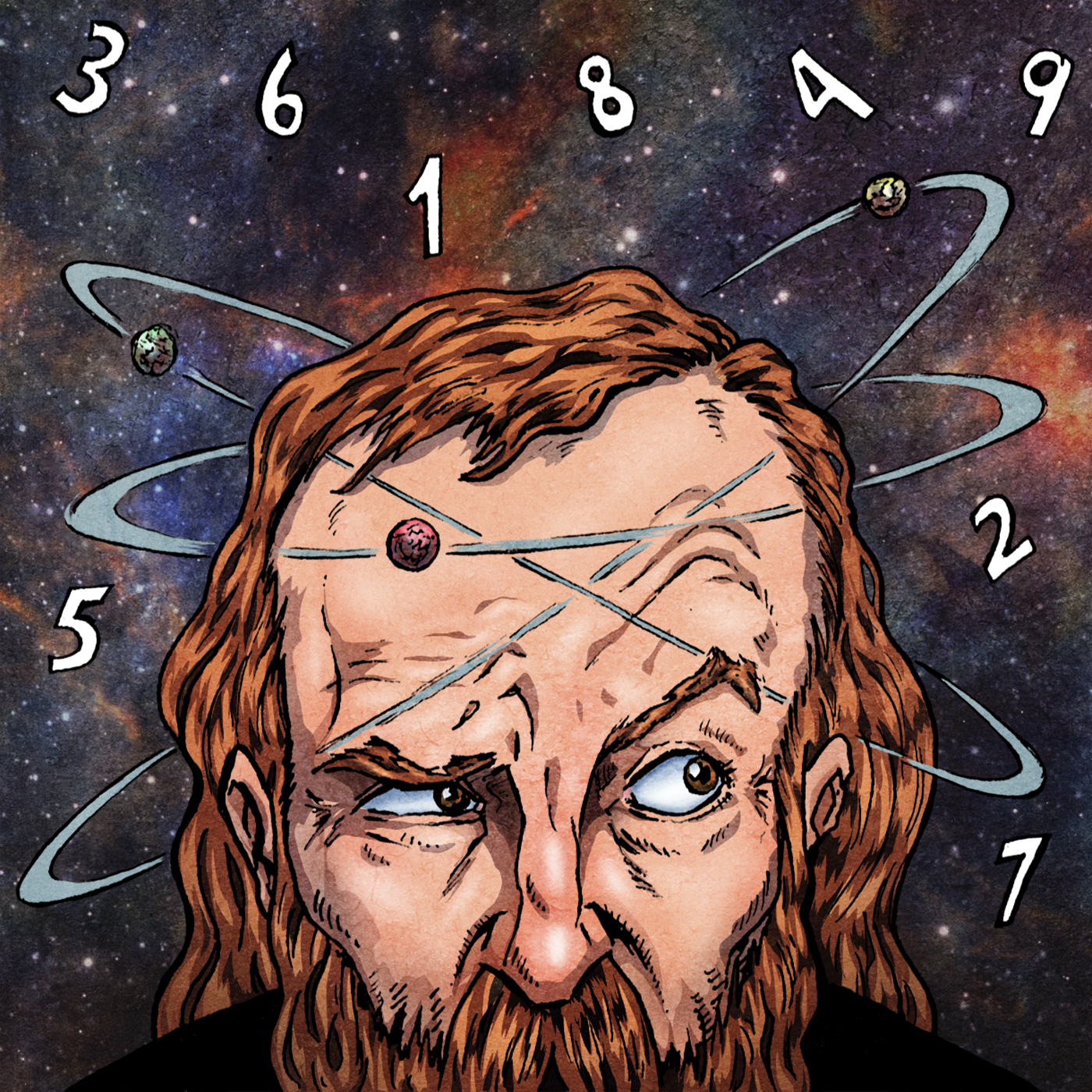
Friends, the time has come on this podcast for us to speak of men's thighs. In a way, this has been a long time coming. You see, there are some parts of the human body that just seem to have a deep mythological significance. Often, the body parts that are loaded with the most symbolism in ancient legends are our sense organs. The eyes, in particular, are often given special attention in ancient storytelling.
The metaphorical meanings associated with eyes are usually fairly easy for modern folks to grasp. We get that vision acts as a good metaphor for perceptiveness in general. Being thoughtful, being aware, being able to accurately make predictions, or simply being free of delusions is easily understood as a type of vision. Ancient authors loved playing with this trope. They often added the ironic twist that the most wise or farsighted character in a drama was literally blind. The blind prophet Tiresias was a stock character used in Greek drama. Despite not having the use of his eyes, he always saw more than any other character in the play. In the famous tragedy of Oedipus Rex, the titular king does not want to see the horrifying truth about his family life. When the truth becomes impossible to deny, when he finally sees...
He, of course, punishes himself by gouging out his eyes. Of course, the associations don't end with the Greeks. Eyes are one of the most popular and easily decoded symbols used in what we think of as the Western literary canon. Shakespeare loved using characters' eyes as metaphors. The play King Lear is famous for having a character who's ignorant of deception and then loses his eyes. The poetic twist, of course, being that he is more deeply aware of who he should trust only after he has lost his literal vision. When I was teaching high school English classes and was trying to get my students to understand symbolism, eyes were always a great starting place. Very quickly, my students picked up on the idea that eyes could be more than just a body part. It was a totally legible symbol that made intuitive sense.
High schoolers could write me papers on the symbolic meaning of eyes all day long. But I'm sure there are some of you out there right now who are scratching your heads. In that first line, did Sebastian say eyes or thighs? I could have sworn he said thighs. Yes, I did say thighs. You see, not all symbolic body parts are quite as easy to parse as the human eye. Take, for instance, the thigh.
You see, there's a curious story that has come down to us about the ancient Greek philosopher, mathematician, and sage known as Pythagoras. Our source for this tale is none other than Aristotle, a giant of Greek philosophy in his own right. And according to our friends over at the Constant Podcast, patient zero for all sorts of stubbornly persistent backwards ideas. Anyway, Aristotle tells us that Pythagoras once attended the Olympic Games as a spectator. After taking in one of the events, Pythagoras rose from his seat in such a way that the people sitting near him were able to catch a glimpse of what was underneath his robes. They were astonished to see that Pythagoras had a golden thigh.
And I don't mean a honey bronze tan on his upper leg. No, Aristotle tells us that those men who were sitting near Pythagoras swore that the philosopher's upper leg was made of solid gold, an entire thigh made of precious metal. Now, how are we supposed to interpret a story like that? I can just imagine trying to throw that one out to a room full of grade 10 students. It's one thing to ask them why they think Shakespeare chose to have his character lose an eye. It's very different to ask, why do you think people said Pythagoras had a golden thigh?
I can see the blank stares now. Well, as it turns out, the thigh has a long and storied mythological pedigree. Blogger and librarian Neil Godfrey has pointed out that in many ancient cultures, the thigh was thought to be part of the male reproductive system. Sometimes the thigh was used as a euphemism for the male sexual organ, or as a metaphor for male fertility. For instance, in English translations of the Old Testament, the many sons of the patriarch Jacob are said to have come from his thigh.
References to Jacob's virile thighs pop up in a few places in the Bible, but the clearest is perhaps in the book of Judges, where we are told, quote, he had 70 sons who came out of his thigh, for he had many wives, end quote. This association between thighs and male reproductive power extends well beyond the Bible. Classicist Debbie Felton has written that, quote, classical scholars are generally aware of the trope that in literature from around the world, thigh wounds are often euphemistic for castration, or at least impotence. But classicists have not noted how thigh wounds frequently symbolize not only physical impotence, but political or spiritual impotence, and how such wounds also represent a temporary or permanent loss of heroic status, end quote.
Felton's observation about this trope in classical literature can also be applied to medieval mythology. Fans of Arthurian legend might be familiar with the figure of the Fisher King. The Fisher King is a monarch, usually depicted as one of the keepers of the Holy Grail, who has been wounded in the thigh. His wound has not only made him impotent, but has also cursed his kingdom, which is similarly infertile and stagnant. The Fisher King cannot ride a horse or do any other activities considered appropriately kingly, so he spends his time fishing in a river until his thigh can be healed.
It usually takes some act of daring do from a knight of the round table to magically heal the Fisher King and restore his kingdom to glory. But to understand Pythagoras' golden thigh, perhaps we should take it back to the ancient Greek context. One of the best-known myths concerning the thigh has to do with the birth of the god Dionysus. In one tradition, Dionysus is said to be the child of Zeus and the mortal woman Semele. But while Semele was pregnant with Dionysus, she was tragically struck dead after Zeus was tricked into revealing himself to her in his unfiltered divine form.
The unborn child was then removed from Semele and sewn into Zeus's thigh, where Dionysus completed his gestation. This is why Dionysus is known as the twice-born god. But the point is that Zeus's thigh was depicted as the male equivalent of a womb. For the ancient Greeks, creative power, fertility, and by extension, a heroic demeanor, was all in the thighs. So, when the people of ancient Greece heard that Pythagoras had a golden thigh, that would have had all sorts of positive connotations. It suggested that he was incorruptible. In a way, he was the inverse of the Fisher King. If his thighs were made of a precious metal, then he couldn't be wounded there. This meant that, symbolically, his power could not be taken from him. His heroic status could never be diminished. Perhaps, most importantly, it suggested that his kingdom, or in this case, his polis or city-state,
would always be effectively governed and blessed with prosperity. Now, I'm sure some of you are going, what? This seems like an awful lot to put on the triangle guy. And I know what you mean. Most of us first hear the name Pythagoras in elementary school math class. The Pythagorean theorem is one of the first mathematical equations many of us commit to memory. How do you find the hypotenuse of a right triangle? Say it with me, kids. A squared plus B squared equals C squared.
If you're like me, when you first encountered the Pythagorean theorem, your teacher perhaps didn't provide too much other context about the man who supposedly first discovered this mathematical relationship. If you were lucky, you may have learned that Pythagoras was a brilliant ancient Greek mathematician, but it's likely that the biography stopped there. Now, I'm not blaming your grade 4 math teachers for this lack of context. They had triangles to teach you about and they could already sense that they were losing half the room so they needed to keep things moving. Also, as much as I'm the kind of person that wants every class to low-key transform into a lesson about Greek history, I understand that I do not speak for the rest of the class. Still, the result has been that most of us know Pythagoras as the triangle guy and the story ends there. But for the ancient Greeks, Pythagoras was so much more than just a mathematician.
He was remembered by many as a nearly divine figure whose wisdom helped usher in a golden age in his adopted home of Croton, a Greek city-state in what is today southern Italy. The stories told about Pythagoras aren't much like those told about philosophers like Plato and Aristotle or ancient mathematicians like Archimedes. Instead, the stories told about Pythagoras share more in common with those told about religious figures. Centuries after his death, admirers would still be telling tales about Pythagoras' divine parentage, miraculous abilities, and wise teachings. In those stories, he comes off less like an ancient scientist and more like the Buddha, Moses, or Jesus Christ. On the other hand, there are a few sources that suggest that far from being a godlike innovator, Pythagoras was little more than a clever fraud. Have we been celebrating a charlatan cult leader for over two and a half millennia?
When exploring the life and legend of Pythagoras, mathematics is just the tip of the triangle. So, who was the man with the golden thigh? Did he really run a math cult? And can we blame his untimely death on a field of beans? Let's find out today on Our Fake History. Episode number 176, Was Pythagoras Killed by Beans?
Hello and welcome to Our Fake History. My name is Sebastian Major and this is the podcast where we explore historical myths and try to determine what's fact, what's fiction, and what is such a good story that it simply must be told. Before we get going this week, I just want to remind everyone listening that an ad-free version of this show is available at patreon.com slash ourfakehistory. If you start supporting at $5 or more every month, you get access to an ad-free feed and all the other extra shows that I currently have on offer. If $5 sounds too steep, there are also $1 and $3 levels of support that also come with some great extras. But if you want the whole enchilada, including the ad-free feed, then please head to patreon.com slash ourfakehistory and start supporting at $5 a month. Today, we are turning our attention back to ancient Greece to explore a figure that has been described as living at, quote, the hinge of myth and history, end quote. This is the ancient sage known as Pythagoras, who, tradition has it, made a number of early mathematical breakthroughs, including the famous observation about triangles that still bears his name.
It was the 20th century mathematician and philosopher Jacob Bronowski who first gave us that wonderful turn of phrase about Pythagoras' place in the human story, a figure who stands on the hinge between myth and history. For obvious reasons, I love that. Our best information tells us that Pythagoras was born in or around the year 570 BC and lived to around 500 BC. In many ways, this was a liminal period in our history, especially in the Greek context. In the century or so after the death of Pythagoras, history would snap into sharper focus.
What do I mean by that? Well, the Greek tradition of history writing comes into its own only a few decades after Pythagoras' death. Our old buddy Herodotus, father of history, father of lies, was born just 16 years after we believe Pythagoras died. He started producing his famous or infamous histories around the middle of the 400s BC. By the end of that century, we also get the groundbreaking work of the historian Thucydides, whose history of the Peloponnesian War is considered so reliable it's been traditionally noted as the first work of, quote, scientific history.
The 400s BC were the heyday of classical Greek civilization. This was the century of Socrates and Plato. This was the era of the great dramatists like Aeschylus, Sophocles, and Euripides, just to name a few. The point is that the 400s BC is an era that we know an awful lot about. Sources survive from all sorts of different perspectives, and there's an abundance of writing. This is what I mean when I say that history snaps into focus. By contrast, considerably less reliable material has survived from the century previous.
Now, it's not like we don't know anything about that era, but compared to what was to come in the 400s, it just feels murkier. This is where we find Pythagoras. Now, as I mentioned in the introduction, for most of us, Pythagoras is first and foremost the triangle guy. He's popularly remembered as a mathematician. Trigonometry begins with Pythagoras, right? Well, it may not be that simple.
You see, the ancient Greeks seemed to have understood the legacy of Pythagoras quite differently. The generations that would precede Pythagoras would remember him more as a philosopher, a purveyor of wisdom, and a man deeply concerned with the fate of the human soul. But with that said, it was understood that Pythagoras had a deep affinity for numbers. His followers would argue that the existence of mathematical principles suggested that the universe was a rational and well-ordered place. But like many of the religious institutions of the era, the Pythagoreans, as Pythagoras' followers were known, believed that once you were taught a secret of the universe, you had to keep it secret. Pythagoras lived at a time when a popular form of religious expression was through institutions historians call mystery cults. These were religious communities where the teachings could only be shared with fellow initiates who had taken part in the cult's sacred ceremonies.
Pythagoras' teachings were passed on in a very similar way, like a form of sacred wisdom. This wisdom was then to be kept secret and only passed on to those who committed themselves to the Pythagorean community. In other words, he had a bit of a math cult. And as much as math cult is the perfect, if a little on-the-nose, name for your next math rock doom metal crossover band, the secrecy inherent in this community has meant that Pythagoras has remained an enigma for historians. In her book, The Music of Pythagoras, which has been an essential text in the creation of this episode, expert Kitty Ferguson describes the situation like this, quote, Pythagoras and the devotees who surrounded him in his lifetime were obsessively secretive. As far as known, they left no writings at all. There is no scroll, no text, no fragment, no firsthand account by any witnesses, no artifact for archaeologists to scrutinize, no tablet to decipher, end quote.
She sums up by saying, quote, It seems no other group has ever made such an effort to remain secret or succeeded so well as the Pythagoreans did, and yet became so celebrated and influential over an astonishing period of time, end quote. This secrecy has contributed to the lack of historical certainty when it comes to Pythagoras. Kitty Ferguson laments that everything that can be said conclusively about the life of Pythagoras can be summed up in one short paragraph. It's true that when investigating this figure, if we only examined those verifiable facts and completely ignored all the legends about Pythagoras, it would be hard to understand why people thought he was important and why he has been so well remembered. This is one of those wonderfully paradoxical situations where we need the myth to understand the history. When all of these traditions are taken into account, a picture of Pythagoras emerges and has way less to do with triangles than you might think.
So, let's dive into the life and legend of Pythagoras and see what we can find out. Picking apart the life and legend of Pythagoras presents me with a rare opportunity on this podcast. That is, I get to dissect the mythology of a religious figure while simultaneously offending no one. As you will hear, many of the myths associated with Pythagoras are very similar to the sacred stories associated with figures like the Buddha, Jesus, King David, or the Prophet Muhammad.
Now, in the case of the figures I just listed, I don't need to tell you how careful one needs to be when critically evaluating the historicity of those living traditions. Those sacred stories are, well, sacred to millions of people still alive today. Now, I don't believe that any religion should be spared a certain degree of historical analysis or thoughtful critique. But, you know, anytime I tangle with a religion that's still being practiced, I'm deeply aware that I'm playing with fire. If mishandled, I would basically need to retire from the internet.
But with Pythagoras, I'm pretty sure I'm going to be okay. Questions about the historical Pythagoras are less hotly debated than, say, questions about the historical Jesus. And yet, I can't help but feel that if Pythagoreanism had survived as a religion and spread as widely as Christianity, Buddhism, or Islam, it would be just as taboo to question the veracity of Pythagoras' history as it would be for the founders of those other faiths. The tales about Pythagoras were clearly once venerated as sacred stories by the Pythagorean community. And so they have the feel of many other sacred tales that you might be familiar with. Let's start with Pythagoras' birth. There is a tradition that Pythagoras was the son of a god.
Specifically, it was said that he was the son of the god Apollo, who impregnated his mother Pythias on the island of Samos. As such, he had the powers of a demigod. Apollo was also the god associated with reason and rationality, and as such, Pythagoras was blessed with a certain type of divine wisdom. According to the classicist Christopher Riedweg, the golden thigh was considered evidence of this divinity. One story has it that Pythagoras once encountered the mythical Hyperborean people who were believed to live at the northernmost edge of the world.
Pythagoras displayed his golden thigh to them as proof that he was the son of Apollo, the god that the Hyperboreans worshipped above all others. They were impressed, and he became known as the Hyperborean Apollo. Now, interestingly, this idea of a divine birth seems to have been a tradition that was developed long after Pythagoras' lifetime. Expert Kitty Ferguson points out that the story of Pythagoras as the son of Apollo first appears around the 1st century AD, thanks to a self-proclaimed miracle worker named Apollonius, who claimed to be the reincarnation of Pythagoras. More on reincarnation later. The Apollonius stories were then given a boost in the 3rd century AD by the Roman Empress Julia Domna, the wife of Emperor Septimius Severus.
Apparently, the empress had hoped that the story of a divine Pythagoras and his miracle-working avatar Apollonius might compete with the rising popularity of Christianity. If the Christians worshipped a miracle worker who was the son of a god, well, the pagan world could produce one that was just as good. Or so went the thinking. Now, interestingly, most of the ancient authors who wrote about Pythagoras, who are usually pretty credulous when it comes to these kinds of stories, were skeptical about Pythagoras' divine parentage. But the commonly accepted reasonable story still has elements of prophecy associated with it. A Roman-era Pythagoras biographer named Iamblichus tells us that Pythagoras' father was actually a merchant from the island of Samos named Menesarchus. While on one of his many commercial expeditions, Menesarchus found himself in the city of Delphi, home of the famous oracle.
For those of you that don't know, the myth behind the oracle was that the god Apollo had slain a monster known as Python on that spot. So the oracle temple that was built on that location was known as the oracle of the Pythian Apollo, and the priestess who delivered the oracles was known as the Pythia. So, when Menesarchus visited the Pythia, she told him that while he did not know it yet, his wife was pregnant. What's more, their child would be beautiful, wise, and would be the, quote, greatest benefit to the human race pertaining to human achievements, end quote. When Menesarchus returned home to Samos, he discovered that the oracle was true. His wife was indeed pregnant.
So to honor the god Apollo and the Pythian priestess, he changed his wife's name to Pythias. Because apparently that was something you could do in Greece in the 500s BC. Just change your wife's name. He also decided to name his son Pythagoras to honor the oracle of Apollo. So even the reasonable story of Pythagoras' birth still has some mystical elements. How many other sacred stories can you think of where the birth of the quote-unquote great benefit of the human race was foretold by a prophecy? I can think of a couple.
Nevertheless, most modern historians accept that Pythagoras was indeed born on the island of Samos. I've also heard the name of this island pronounced Samos. I'm going to stick with Samos, but, you know, you folks can find it out in the comments if you don't dig it. Pythagoras' father likely was a merchant, and his mother was likely a descendant of one of the island's ancient aristocratic families. In this era, Samos was a bustling and prosperous island that lay at the crossroads of Greek, Egyptian, Phoenician, Hebrew, and Neo-Babylonian culture.
Samos was also very close to the city of Miletus, home of the pioneering Greek astronomer known as Thales. Thales has been called the, quote, first to introduce the study of nature to the Greeks, end quote. He's credited with accurately recording a solar eclipse in 585 BC. Some of our sources tell us that as a young child, Pythagoras became the student of Thales. But as soon as he was old enough, Thales encouraged his brilliant young pupil to strike out on his own, see the world, and learn as much as he could from the great thinkers in Egypt, Babylon, and beyond. Apparently, Pythagoras did just that. Now, not all of our sources agree that Pythagoras was tutored by Thales. There's a good chance that he never even met him. But that's one of the traditions, so I thought you should know about it.
One Roman-era biographer named Porphyry would record that Pythagoras traveled wide and learned from the best. He wrote that, quote, the Egyptians excelled in geometry, the Phoenicians in numbers and proportions, and the Chaldeans in astronomical theorems, divine rights, and the worship of the gods, end quote. Porphyry tells us that, quote, it is said that Pythagoras learned from all of them, end quote. Now, when Porphyry wrote that, it was meant as praise. In his estimation, as a young man, Pythagoras absorbed everything there was to learn from the great teachers of the world and then went on to produce his own brilliant insights. But this is a good point in the story to introduce the other big narrative that has been preserved about Pythagoras. And that is that he wasn't some quasi-divine wise man. On the contrary, some of his contemporaries thought Pythagoras was little more than a plagiarist and a charlatan.
One of his contemporaries, the natural philosopher known as Heraclitus of Ephesus, had very little good to say about Pythagoras. He wrote, Okay, what does that mean? Well, according to Heraclitus, Pythagoras stole all of his apparently original ideas from ancient texts. Pythagoras had no breakthroughs, he was just well-read. Or so says Heraclitus. Now it's not clear how much we should trust Heraclitus on this account. Kitty Ferguson goes out of her way to point out that Heraclitus was famously ornery and didn't really care for many of his contemporaries.
But Heraclitus' observation is still notable because it's one of the few mentions of Pythagoras that actually dates to his lifetime. So let's pull at this thread of Pythagoras as a charlatan for a minute here. There's one other really disparaging story about Pythagoras that was preserved in the writings of Diogenes Laertes, who was one of the premier biographers of philosophers from the Roman era, and in the writings of our old buddy Herodotus. We are told that after Pythagoras returned home from his travels, he made an early attempt to set up a religious community in Samos. To create an air of mystique, Pythagoras conspicuously disappeared into a set of underground chambers for a number of weeks. When he finally emerged, he looked gray like a corpse, and he loudly declared to all who would listen that he had just visited the underworld and had miraculously managed to return to the land of the living. This journey had apparently enhanced his already formidable mystical abilities.
To prove it, Pythagoras then recounted in detail everything that had happened to each individual in the gathered crowd while he was gone. But the sources tell us that he pulled off this little bit of stage magic with the help of his mother, who had meticulously recorded everything that had happened to her neighbors in the weeks that Pythagoras was pulling this little underground stunt. Like any good magician's assistant, she briefed Pythagoras before he wowed the crowd. It's the kind of routine that Harry Houdini used to publicly debunk as part of his stage show. Diogenes adds the suggestive tag on the story that after successfully bamboozling this crowd, the gullible men then, quote, trusted Pythagoras with their wives, end quote. While Diogenes doesn't put too fine a point on it, the suggestion is maybe those guys should not have trusted Pythagoras around their wives? So was this the real Pythagoras, a man who used cheap magician's tricks to manipulate people? Well, it's hard to know.
These stories have just as sketchy a providence as those that say he was a brilliant leader of men. For the record, Herodotus was skeptical of this story. In his version of the story, it was Pythagoras' former slave and not Pythagoras himself who pulled the trick. And even then, Herodotus thought it was likely bogus. And this is why Herodotus is the patron saint of this podcast. He would tell you the crazy story for the entertainment value and then go, ah, that one probably isn't true. My guy.
But even if Pythagoras wasn't pulling manipulative parlor tricks, we should take a minute and consider Heraclitus' charge that Pythagoras just repackaged old wisdom as something novel near the end of the 500s BC. If Pythagoras wasn't a full-on flim-flam man, perhaps he was just unoriginal. Well, here is something that we know for sure. Despite the popular tradition that tells us otherwise, Pythagoras was not the first person to discover the so-called Pythagorean theorem. The mathematical relationship between the sides of a right triangle, A squared plus B squared equals C squared, was understood and taught by the Babylonians a solid millennium before Pythagoras was born. We know this because archaeologists have found ancient Babylonian math homework. For real. Archaeologists have found tablets that were clearly used to teach math to students in the ancient scribal schools. These dated to the Old Babylonian Period, which lasted from 1900 to 1600 BC.
Now, the history of these archaeological finds is kind of mind-blowing. I love it. See, originally, the archaeologists found a tablet that was filled with math questions, including a question about how one should calculate the length of the sides of a right triangle. So when they found that tablet, that suggested that they probably knew about the Pythagorean theorem. Then, years later, another archaeological dig turned up a second piece of that same tablet that joined perfectly with the original piece. That second piece was essentially the answer key for the first piece. It contained all the answers to the questions that had been on that original tablet. So, the answer sheet tablet conclusively showed that the Babylonians understood what would later become known as the Pythagorean theorem.
I just love that. Imagine being the archaeologist that found the answer key and it fit perfectly with the original question tablet. That's just the stuff of archaeologist dreams. So cool. Other tablets that were recovered from a site that was once the ancient scribal school of Babylon demonstrate that the ancient Babylonians also understood square roots, cube roots, and even the concept of pi.
So, if we accept the tradition that Pythagoras visited Babylon during his educational tour of the Near East, then is it possible that he learned his great mathematical insight from the Babylonians? Heraclitus' take that Pythagoras was just an unoriginal plagiarist might nudge us towards that conclusion. However, perhaps we shouldn't be so hasty. While we have clear archaeological evidence that the Pythagorean theorem was understood in the old Babylonian period, we have no evidence that it was still understood in the 500s BC, an era known as the Chaldean period or the Neo-Babylonian period.
Here's the thing. In the 1,000 years between the creation of that ancient math homework and the life of Pythagoras, a lot happened. Civilizations had risen and fallen. Cities had been destroyed. Conquerors had established new empires, which were then ground into dust. In Pythagoras' era, the city of Babylon was experiencing a bit of a renaissance. But much had been lost since Babylon's earlier golden age, a millennium in the past.
it's highly likely that much of that mathematical knowledge was lost in that intervening time. Sadly, we have no contemporary evidence that the Neo-Babylonians had preserved all the mathematical knowledge of the earlier era. So, what can we say for sure? Well, if Pythagoras truly, independently discovered the relationship between the sides of a right triangle and did not learn about that during his travels, then he had effectively rediscovered a mathematical principle that had been known a thousand years earlier. So he may have made that discovery, it just wasn't the first time that discovery had been made. It's also highly likely that this independent rediscovery wasn't even done by Pythagoras himself, and was instead something learned by some of his later followers and then attributed to the old master. So, knowing what we know now, A squared plus B squared equals C squared really should be called the Babylonian theorem, right? Sorry, Pythagoras, even if you figured this out on your own, you certainly were not the first.
Anyway, tradition has it that after traveling the world, Pythagoras returned to Samos where he began teaching. One tradition has it that his community became known as the semicircle and was soon attracting the attention of great thinkers from around the Greek world. There's a local tradition in Samos that Pythagoras lived and taught in a specific cave. However, expert Christopher Reedweg is skeptical of the stories about teaching on Samos. He believes it's possible that they were embellished or even cooked up later by the people of Samos out of a patriotic feeling for their home island. Pythagoras' cave has become a bit of a tourist destination. To this day, the people of Samos will also happily sell you a fun little novelty cup that they claim was invented by Pythagoras.
The so-called Pythagorean cup is cleverly designed with a special siphon, so that if it's filled too high, all the contents will drain out the bottom. The legend is that Pythagoras taught moderation in all things. So, if you poured yourself a little too much wine, the Pythagorean cup would punish you for your gluttony. Sadly for the souvenir shopkeepers of Samos, there is zero evidence that Pythagoras actually invented this cup. The fact that it's essentially an elaborate practical joke actually flies in the face of what we're told about Pythagoras' philosophy. Yes, he seems to have advocated a life of moderation, but that also extended to moderating one's emotions. Some sources tell us that while Pythagoras was generally even-tempered and kind, he didn't laugh or show immoderate levels of joy. One biographer even wrote that he, quote, abstained wholly from laughter and from all such indulgences as jests and idle stories, end quote.
So according to this source, Pythagoras wasn't really a prankster. In fact, playing pranks in any way would have been antithetical to Pythagorean philosophy. But the finer details of Pythagoras' philosophy are up for debate, so who knows. What all of our sources agree on is that when Pythagoras was around 40 years old, he left Samos and moved to the southern Italian city-state of Croton. Why did he leave?
Well, our sources are divided on this. Iamblichus tells us that he was simply overwhelmed with all his civic duties on his home island and wanted to go to a place where he could just be a philosopher. Another source tells us that the political situation had changed on Samos. The tyrant Polocrates had come to power on the island, and Pythagoras, being a great lover of freedom, no longer felt that he could live there. But again, our sources disagree on how committed Pythagoras was to freedom as an ideal. In fact, some sources tell us that he could be a bit of a tyrant himself. Still, it was in Croton that Pythagoras truly came into his own as both a philosopher and the subject of legend. So let's take a quick break, and when we return, we'll get into his remarkable takeover of this southern Italian city-state. Ancient Croton was located on the shores of southern Italy, roughly around what would be the instep of the Italian boot.
Now, despite being located in Italy, Croton was very much part of the wider Greek world. Like many cities in this region, it had been founded by Greek colonists nearly two centuries earlier. In the case of Croton, the original settlers had come from a small city in the Peloponnese. The Greek identity of southern Italy would prove to be quite enduring. Long after the Romans conquered the area and incorporated it into their growing empire, it continued to be known as Magna Gratia, or Greater Greece.
We're told by the ancient biographer Iamblichus that after arriving in Croton, Pythagoras quickly threw himself into public life. In many ways, he acted quite similarly to how Socrates would in Athens a few generations later. We're told that Pythagoras went to the public gymnasium where he started engaging with the young people and recruiting them as students. Now, as many of you know, this kind of thing would eventually get Socrates into all sorts of trouble, as he would eventually be accused of corrupting the youth of Athens. But Iamblichus tells us that Pythagoras' message was actually quite parent-friendly. He apparently preached that the young people of Croton needed to practice temperance, cultivate a love of learning, and honor their mothers and fathers. The most unbelievable part of this whole story might be that this message was attractive to the teenagers of Croton. Live clean and listen to your mom has traditionally been a tough message to sell. But we're told that something about Pythagoras made it compelling.
The elders of Croton were also into it, so before long they invited Pythagoras to address the ruling assembly of the city, known as the Thousand. Iamblichus recorded that Pythagoras told the leaders of Croton to humble themselves and consider themselves the equals of the people they governed. They should rule the city with justice and take no offense when someone contradicts or even insults one of the city leaders. They should stop procrastinating. They should go out of their way to win the love of their children. They should only have sexual relations with the people they are married to. They should not hurt other people on their quest to achieve greatness. Expert Kitty Ferguson paraphrases Pythagoras as saying, quote, if you seek glory, try to become what you wish to seem to be, end quote.
Iamblichus' version of Pythagoras' wisdom really reminds me of what you see in the Sermon on the Mount. There's a real blessed are the meek, turn the other cheek, honor your mother and father vibe to this whole thing. So much so that it's not out of the question that Iamblichus may have been influenced by the increasingly popular Christian religion of his own day and attributed some of those teachings to Pythagoras. But that is pure speculation. It's just as likely that this is just timeless wisdom that has a way of popping up again and again.
One of the pieces of advice that Iamblichus attributes to Pythagoras that seems more specific to Pythagoras' particular philosophy is his insistence that the people of Croton build a temple to the muses to celebrate symphony, harmony, and rhythm. Now, this is particularly Pythagorean because one of the mathematical insights most experts believe can be confidently attributed to Pythagoras or the early Pythagoreans has to do with the mathematical ratios that underpin music. We're told that Pythagoras conducted a series of experiments with the strings on a musical instrument known as the lyre, which is kind of a small harp. He noted that different string lengths created different sounds. Some sounds sounded pleasing when played together. Others sounded off-putting or discordant. From there, Pythagoras discovered that there were consistent mathematical ratios which could be used to predict which lengths of strings would sound good when played together.
This unlocked the mathematics of harmony. Sound could be organized using math. Pleasant sounds followed a predictable mathematical pattern. This insight seems to have become the cornerstone of Pythagorean philosophy. Mathematical order in music suggested a mathematical order underpinning our observable reality.
According to the Pythagoreans, the universe was rational and could be understood with numbers. Math and geometry were proof of a divinely ordered cosmos. As such, numbers themselves were a form of divinity. For the Pythagoreans, certain numerical patterns were considered to be particularly powerful or beautiful. For instance, the number 10 was considered a perfect number, especially when it was expressed using the geometric form known as the Tetractus.
Now, explaining this in an audio medium is a little tricky, so indulge me here for a minute. But the Tetractys was essentially a triangle. This triangle was created by having four points along the bottom, then three points above that, two points above that, and one point at the top, forming the apex of the shape. Four plus three plus two plus one equals the perfect number 10 and makes a very pleasing-looking triangle. This mathematical pattern was seen as yet another proof of order in the cosmos. Triangle as proof of God, or the gods, if you will. We're told that the Pythagoreans would swear oaths by the triangle. Now, while most experts believe that the insights about the mathematics of music can be dated to Pythagoras' lifetime, all the other numerological elements of this philosophy may have been developed later by people who identified as Pythagoreans.
For instance, there's some good evidence that suggests that a man named Philolus, a Pythagorean writing a generation after Pythagoras, may have introduced many of the numerological elements into the philosophy and then credited them to the old master. The only other tenet of Pythagoreanism that experts feel confident came from Pythagoras himself, or was at least developed during his lifetime, has nothing to do with mathematics. Instead, it's a belief about the immortal soul. Pythagoreans believed that every individual had an undying soul and that it was reincarnated after you died. You might return again as a human being, but you are just as likely to return as an insect, a cat, a cow, or a tree. Over time, a soul could be nurtured to the point where it could escape this cycle and could experience a somewhat ill-defined heavenly existence.
Students of religion might see some notable similarities between this and Buddhist and Hindu teachings. I know those similarities really smacked me in the face when I first read about Pythagorean ideas of reincarnation. But it's worth noting that the belief in reincarnation was not entirely unique in the Greek world at this time. The concept seems to have originally come into Greek religious thought by way of the Orphic mystery cult. This was a mystery religion that, among other things, worshipped the hero Orpheus, the legendary musician who, in myth, traveled to the underworld to rescue his bride, Eurydice.
It seems like Pythagoras was deeply influenced by the teachings and the ritual style of the Orphic cult. Eventually, Pythagoreanism and Orphism would essentially merge into one tradition. Interestingly, many of the legends about Pythagoras have to do with his belief in reincarnation. Like the Buddha, he is said to have been able to recollect his past lives. Tradition has it that in his first life, he was the son of the god Hermes. And yeah, for those of you keeping track, that's another divine origin for Pythagoras. He was either the son of Apollo, the son of Hermes, or maybe the son of some random merchant. You choose. Anyway, the story goes that it was Hermes who granted him the ability to remember all his past lives.
One of those past lives was as the Trojan war hero Euphorbus. Euphorbus fought on the side of the Trojans and, we're told by the poet Homer, had his arms torn off on the field of battle by the Spartan king Menelaus. There were also stories of Pythagoras experiencing more humble existences as well. The life he lived before being born as Pythagoras was as Pyrrhus, a poor fisherman from Delos. He also recalled many lives where he had been all sorts of different animals and vegetables.
Now, it's hard to evaluate the provenance of all of these stories, but the reason that most experts feel confident that Pythagoras truly believed in reincarnation is because his contemporaries mocked him for it. A satirical poem written by one Xenophanes of Cellophon, who lived in Sicily around the same time as Pythagoras would have lived in Croton, had this to say about Pythagoras. Quote, Once, when he passed a puppy that was being whipped, they say he took pity on it and made this remark. Stop, do not beat him, for it is the soul of a dear friend. I recognized it when I heard its voice. End quote. Xenophanes thought it was funny that Pythagoras believed that his deceased friend's soul might reincarnate in a puppy. In the context of the poem, it's clear that the author thought that Pythagoras and his followers were kind of ridiculous.
The story about the puppy was obviously meant as a joke, but there was a larger tradition that Pythagoras had the ability to communicate with animals. One source tells us that he could summon eagles from the sky who would then dutifully perch on his arm, which, you know, is pretty badass. I want to be an eagle summoner. There's another story that a marauding bear was terrorizing a community until Pythagoras intervened. The story goes that he approached the bear, patted it on the head, offered it some barley and fruit. Then he whispered into the bear's ear and made it promise to never hurt another living creature. Legend has it that the bear never once broke its promise to Pythagoras.
The other famous story about Pythagoras and animals has to do with his encounter with a herdsman who is letting his ox eat beans. Pythagoras thought that this was no good, and he told the herdsman to get his ox away from the beans. The herdsman thought this was ridiculous and openly mocked the suggestion. So Pythagoras approached the ox and whispered in its ear that it should abstain from beans. Not only did the ox follow Pythagoras' instructions, but the diet advice prolonged the animal's life. He was eventually worshipped as a sacred ox of the temple.
Now, these miraculous Dr. Doolittle stories come from much later sources and are most likely exaggerations, but they contain in them what may have been kernels of truth about the Pythagorean community. You see, once Pythagoras had thoroughly established himself in Croton, we're told that he surrounded himself with a large community of followers. To be a member of this group, some might call it a cult, members needed to follow certain rules. Tradition has it that the Pythagoreans shared all their possessions communally and maintained a strict vegetarian diet, with the added requirement that they avoid eating beans. But modern experts have expressed skepticism about all of these alleged requirements.
First, while it seems like later Pythagorean communities were vegetarian, there are all sorts of contradictory bits of evidence concerning what Pythagoras himself thought was a healthy diet. One very early source records that Pythagoras believed that athletes training for the Olympic Games needed to eat lots of meat. Many other early sources seem to show that Pythagoras advocated for a balanced diet. He didn't think anyone should eat too much of anything. As for the beans? Well, that has been the source of controversy for centuries.
The first question is why? Why no beans? Well, the famous Roman politician and writer Cicero thought that Pythagoras' prohibition on beans had a very simple explanation. Beans make you fart. If you're gassy, this can disturb your sleep at night. A fart-free life is a happy life. So, of course, the wise man once told his people to avoid beans.
Pythagoras expert Kitty Ferguson has also pointed out that some other ancient commentators believed that because beans caused farts, that must mean that they contain air. There was a popular belief that the soul was also composed of air. So if beans had air inside them, then perhaps they were filled with tiny souls. It follows that Pythagoras didn't want his people or that ox eating beans because they were likely ingesting souls. I kind of love that explanation, but it's unlikely. You might remember that Pythagoras taught that a soul could be reincarnated as any animal or vegetable. So literally every vegetable would contain a soul, not just beans. You eat a bit of lettuce, you just ate some souls. You eat a pepper, you ate a soul. That was Pythagorean reincarnation.
Since at least the 2nd century AD, there have been historians who have argued that the whole bean thing is just an elaborate misunderstanding. The 2nd century Roman author Aulus Gellius pointed to a few ancient sources now lost to us that recorded that Pythagoras ate beans all the time. Further, he argued that the misunderstanding came from the misinterpretation of a poem by a Pythagorean poet that had a line that went, quote, Wretches, utter wretches, keep your hands from beans, end quote. It was Aulus Jellius' opinion that this line had been taken literally when it should have been understood euphemistically. In his estimation, beans were euphemisms for testicles. This Pythagorean poet wasn't saying don't eat beans. He was saying keep your hands off your balls or avoid sexual indulgence.
So, the legend that Pythagoras forbade eating beans may have actually been a case of broken telephone. Pythagoras thought that people should be moderate in all things. He also believed, according to Iamblichus, that sex should only happen between married people. So, Pythagoras said, don't sleep around. A poet, inspired by his philosophy, expressed that as keep your hands from beans, and then people who read that poem centuries later just assumed that Pythagoras said, don't eat beans.
Now, remember, this is just a guess put forward by an ancient Roman historian, but I think he might be onto something. Anyway, back to Croton. We're told that over the course of a few months, or perhaps it was a few years, the group of students-slash-followers-slash-cult members that surrounded Pythagoras grew to the point where he was able to take control of the city's government. Now, it's not really clear exactly how much power Pythagoras had or how he wielded it. Remember, the government of Croton was essentially an oligarchy. A council known as the Thousand, made up of local aristocrats, made the decisions. So over time, the followers of Pythagoras may have formed a kind of de facto political party within this council. At a certain point, the Pythagoreans gained a majority and reliably voted together as a bloc. We think. Again, it's unclear. Now, was this a good thing or a bad thing?
Well, later Pythagoreans would write about this time in Croton like it was a golden age. According to writers like Iamblichus, under the wise guidance of Pythagoras, Croton flourished. Crop yields were better than ever thanks to the common sense agricultural reforms brought forward by this wise thinker. People were better educated. Thanks to Pythagoras' tips on diet and exercise, people were healthier. There was greater harmony between all the citizens. Perhaps the most miraculous thing of all was that married couples stopped getting divorced.
If we believe the Pythagorean sources, then Pythagoras was the ultimate marriage counselor. Married couples were happier and families were more functional in Pythagoras' Croton. On top of all that, according to these sources, Pythagoras kept showing signs of his near divinity. One day while crossing a river, his companions heard the voice of the river greet Pythagoras by name. On one particularly miraculous occasion, Pythagoras was said to appear in two places at the same time, being spotted in both Croton and the nearby city of Mepontum at the same hour.
Now, as you might imagine, much of this seems like hyperbole. But there is some archaeological evidence that the era associated with Pythagoras, that is, between the years 570 and 500 BC, was a time of genuine prosperity for the city. We know that Croton first started minting coins during that era. Was that all because of Pythagoras? We have no idea. But it's worth mentioning that at that point in history, the city had clearly entered a new level of economic development. So who knows? Maybe Pythagoras really was onto something.
But with that said, there are lots of reasons to be skeptical of this exceptionally rosy picture. The downfall of Pythagoras suggests that there may have been considerably more discord in Croton. It may not have been the divorce-free utopia described by some. While there are some traditions that would have us believe that Pythagoras was a Buddha-like man of peace, there are others that suggest that he was a militaristic tyrant who used his power in Croton to dominate the other city-states of Magna Gretia. For instance, multiple sources tell us that during the reign of the Pythagoreans, an army from Croton scored a massive victory in a battle with the neighboring city of Sybaris. It's debated if this was an act of Crotonian aggression, but it very well may have been. There's another story that tells us that a power-hungry Pythagoras wished to extend his power all the way to Sicily. This put the Crotonian army at odds with the powerful Sicilian city-state of Syracuse. We're told that after losing a battle to Syracuse, Pythagoras himself was captured and killed.
The power-hungry tyrant undone by his own hubris. How poetic. But this is not the most commonly repeated story about Pythagoras' death. Many other sources tell us that Pythagoras was overthrown by a group of conspirators from Croton. Now, as always, the sources are super contradictory when it comes to all of this. One version of the story is that after 30 years of enlightened Pythagorean leadership in the city, a group of well-born, darkly dispositioned aristocrats sought revenge against Pythagoras for excluding them from the Pythagorean community because of their many vices. In other words, these conspirators were pure evil and hated Pythagoras because of his virtue.
But of course, other sources spin the motivations of the conspirators quite differently. One story recorded by Iamblichus tells us that it was Pythagoras who had become power-mad and evil. One of his followers even advised Pythagoras to make the government more democratic before the tide turned against him. He stubbornly resisted, and so he was deposed. In both versions of the story, we're told that a group of angry Crotonians chased Pythagoras from the city. In one version, we're told that the angry crowd tried to burn him alive in one of his friends' houses, but Pythagoras' followers threw their bodies on the flames, forming a human bridge so their leader could escape. From there, he likely made his way to the neighboring city of Metapontum, where he found safety. There, he would live out the rest of his days in exile, his influence completely diminished, and his community in shambles.
But there's a much more fun version of Pythagoras' final moments. And of course, it has to do with beans. The story goes that after the local rebels had chased Pythagoras out of Croton, they kept pursuing him. They kept after Pythagoras for many miles, and the philosopher may have just managed to escape had it not been for a field of beans. We're told that if Pythagoras had cut through a field of beans, he would have easily made it to safety.
But old Pythagoras simply could not bear the thought of trampling on some beans, so he took the long way around. His pursuers caught him and killed him on the spot. So ended the life of one of the ancient world's greatest minds. Or so goes the tale. Now, given that the whole bean prohibition thing is likely a historical myth, this story is probably untrue. But I love it, because it's so stupidly poetic. A man undone by the very beans he swore to protect.
So, in the end, what should we take from the endlessly controversial life of Pythagoras? Hopefully, I've proven my point that in this case, the myth is essential to understanding the history. The undisputed facts of Pythagoras' life can be summed up fairly quickly. A man named Pythagoras was born around 570 BC on the island of Samos. He left that island when he was around 40 years old and moved to Croton in southern Italy. There, he gained a reputation as a teacher and religious thinker, and he built a community of followers.
That community was likely one of the first to understand some of the mathematical principles that underpin music. They also believed in reincarnation. The followers of Pythagoras gained influence in Croton. Then they lost influence in Croton, and Pythagoras died. That's it. Those are the facts. Everything else is disputed. But if this podcast had just stuck to those facts, you would have no idea why this guy was worth remembering. You need the wild stories to understand Pythagoras as a concept.
Now, if nothing else, I think we can set aside the idea that Pythagoras was the triangle guy. Because he really wasn't. But he was pretty freaking interesting. After all this research, it's unclear to me whether Pythagoras was a brilliant philosopher, a power-hungry demagogue, or a cheap hustler. He may have been all of the above.
What's fascinating to me is just how diverse the opinions about his character are. I have a suspicion that if Pythagoreanism had ever really caught on as a popular religion, this diversity of perspectives may have been purged from the historical record. I can imagine a scenario where, centuries after the death of Pythagoras, this unlikely cult manages to become the dominant religion in its society. For the sake of this thought experiment, imagine if, say, a king or an emperor became a Pythagorean. The people that lived in that empire would also probably be encouraged to become Pythagoreans themselves. Pythagorean teachers would all of a sudden wield tremendous influence and power in that society. Do you think, in that society, the stories about Pythagoras the charlatan, Pythagoras the warmonger, and Pythagoras the tyrant would have been allowed to survive? Maybe, but likely not.
In this imagined society, I suspect that it would have been difficult to find historical sources that challenged Pythagoras' image as a serene wise man who could see all his past lives, saved marriages, governed justly, performed miracles, and for some reason insisted that you can't eat beans. But despite a few notable revivals over the course of the centuries, the Pythagoreans never again wielded power like they once did in Croton. The historical record was allowed to remain messy. And so we are left with a messy Pythagoras. But a messy Pythagoras is an infinitely more human Pythagoras.
Okay, that's all for this week. Join us again in two weeks time when we will explore another historical myth. Before we go this week, I need to give a shout out to the following people. Big ups to Neil Tassie Patterson, to Michael Beach, to Michelle Wells, to Haydner, to Jim Hess, to Tyler Alomong, to Sam Kopnik, to Robert A. Justin, to Quinn Collard.
To Call Out Boy. I like that one. Big ups, Call Out Boy. To Joshua Biddick. And to Tomasz Bazanik. All of these people have decided to pledge at $5 or more every month on Patreon. So you know what that means. They are beautiful human beings. Thank you to everyone who is supporting the show. Hey, if you want to support the show and you don't got money to do it, I get it. It's tough out there. Think about leaving a nice review of the show somewhere. Give us five stars. Say some nice things. That helps. Think about just...
recommending the show to a friend if you think they would dig it. That also helps. If you want a t-shirt or a tote bag or a hoodie or some other bit of merch with the original Our Fake History art on it, then please go to our Tee Public store. The easiest way to get there is just going to OurFakeHistory.com and following the links to the store. All of the art is created by our very talented resident artist, Frank Fiorentino. It's the best. I love it. Frank rules.
If you want to get in touch with me, you can always send me an email at ourfakehistory at gmail.com. You can find me on Instagram at ourfakehistory. You can find me on Twitter at ourfakehistory. Or you can find me on Facebook. That's facebook.com slash ourfakehistory. The theme music for the show comes to us from Dirty Church. You can check out Dirty Church at dirtychurch.bandcamp.com. And all the other music you heard on the show today was written and recorded by me. My name is Sebastian Major. And remember, just because it didn't happen doesn't mean it isn't real.