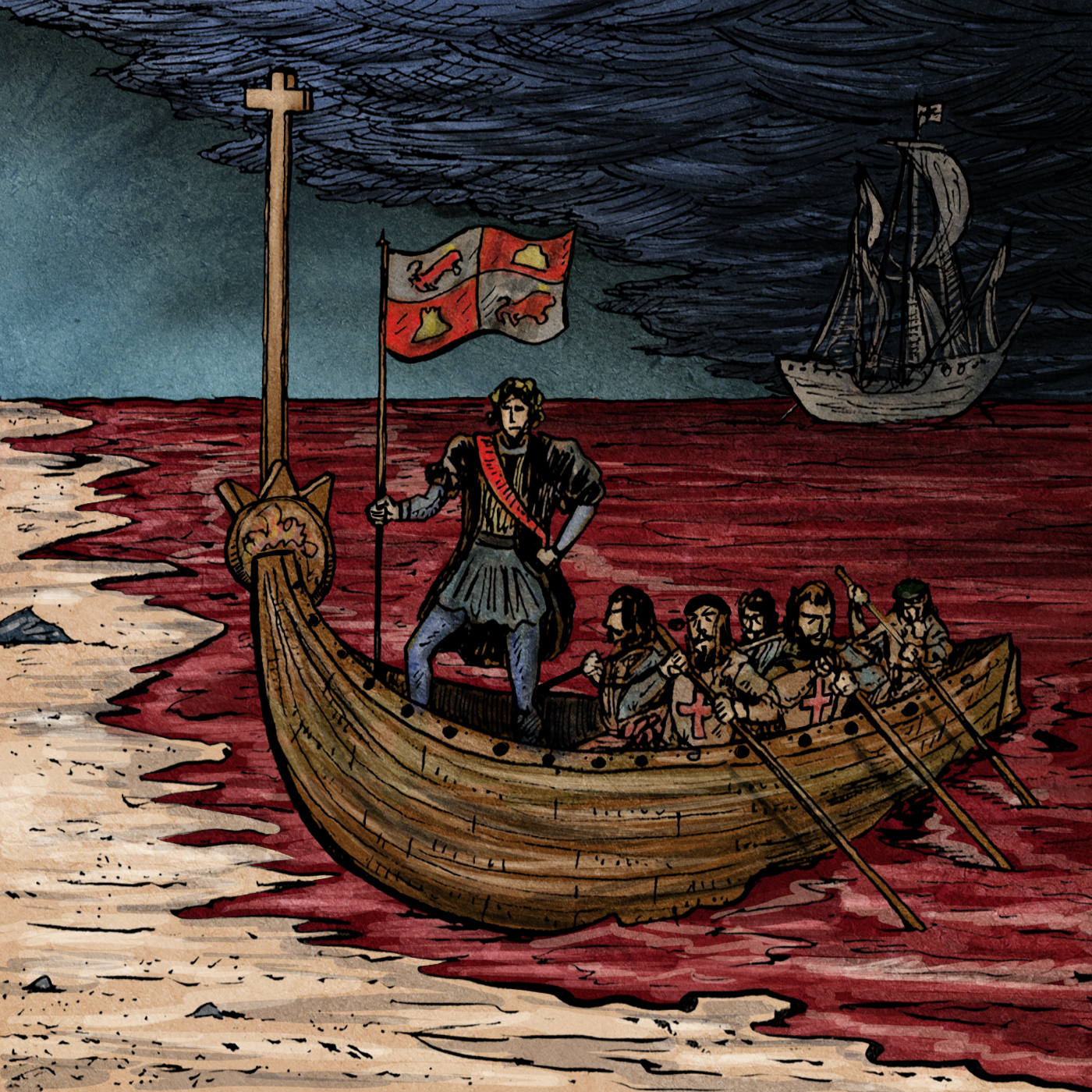
It was a warm June afternoon in 2020 when a group of protesters in St. Paul, Minnesota, turned their attention to a statue on the grounds of the state capitol. The activists, many of whom were associated with the American Indian Movement, climbed the 10-foot bronze statue, tied ropes around its neck, pulled hard, and within a few minutes, it had toppled off its pedestal and lay face down on the concrete sidewalk. The gathered crowd cheered, drums were played, people danced, and the official American Indian Movement song was sung loud. One of the activists at the scene was Mike Forcia, chairman of the Twin Cities American Indian Movement and a member of the Bad River Band of Ojibwe. When asked for comment by journalists writing for the Minnesota Reformer, he said, quote, for healing to happen, this needed to happen. It was here for far too long. It's a slap in the face to all Native people and all people of color, end quote. The statue that Mike Forcia and many others saw as a slap in the face was that of the famed Genoese mariner, Christopher Columbus.
The St. Paul Columbus statue was not the only one to be targeted by protesters during those heady days of early June 2020. That same week, a Columbus statue in Richmond, Virginia was torn from its pedestal and deposited in a lake in a nearby park. In Boston, a well-known statue of Columbus was beheaded. In fact, it was the third time that particular monument lost its head, having been decapitated first in 2006 and then again in 2015.
A few weeks later, as protests continued into America's Independence Day, a statue of Columbus in Baltimore was toppled and then rolled to the harbor where it was unceremoniously dumped in the water. By September of 2020, CBS News was reporting that as many as 33 Columbus statues across the United States had been removed or were in the process of being removed from public display. This was remarkable, but also a drop in the bucket, considering just how many public memorials there are to Christopher Columbus across the United States. In October of 2021, the Washington Post reported that despite the recent push to remove monuments to Columbus, 130 still remained. This perhaps shouldn't be surprising, given the fact that Christopher Columbus is the third most memorialized person in America. Only Abraham Lincoln and George Washington have more statues made in their likeness currently standing in the United States.
This is to say nothing of the more than 60 cities and counties in the United States named either Columbus or Columbia. America's national capital, Washington, D.C., is, of course, named for two of its top three most memorialized people. That's Washington in the District of Columbia. One study from MIT found that there are over 6,000 public references to Columbus across the United States. We're talking churches, schools, municipal buildings, roads, rivers, and mountains that all bear some version of Columbus's name. He is memorialized in some way in every U.S. state except Hawaii. This is remarkable for a man who was born in Genoa in northern Italy, served the monarchs of Spain, and never once stepped foot on the mainland of North America.
Christopher Columbus could not have conceived of an entity like the United States. He died not even knowing that the landmass occupied by that nation even existed. He died insisting that Asia was surely just a few leagues away from those islands that he had encountered on his four voyages. The existence of a giant North American continent would have arguably been upsetting news for Columbus. And yet, somehow over the centuries, he came to be adopted as one of the most potent symbols in America's civic religion.
He is honored publicly in the United States more than in any other country in the world. More than Italy, more than Spain, even more than Colombia, a country literally named after the guy. Exactly how and why Columbus's memory became so essential to the greater mythology of the United States is an interesting story. There are few historical figures I can think of whose historical reputation has swung so wildly over the centuries. He's been cast as a hero, a villain, a messianic religious figure, a genocidal maniac, an unimportant footnote, and one of the most consequential human beings to have ever lived. How many other people who lived over 500 years ago still inspire such a passionate response from both their detractors and defenders? There was a time when it was simply common knowledge that Columbus quote-unquote discovered America.
But of course, nothing about that is true. And in 2023, most people know that, even Columbus's defenders. One of the first historical myths most people have debunked for them is the idea that Columbus discovered anything. But often, the public debate around Columbus comes down to what he means as a symbol. And indeed, Columbus has become more of a symbol than an actual human being with a life story.
Those statues of Columbus that fell in 2020 were brought down not simply because of the details of Columbus's biography, but because he represents colonialism itself. His image is seen by many as a reminder of all the many harms done to indigenous communities across North and South America since 1492. That is certainly how the activists from the American Indian movement perceived the monument they toppled in St. Paul. But that's not all he represents as a symbol.
Many of the groups most vocally upset by the defacing of Columbus monuments in 2020 were Italian-American advocacy groups. In fact, many of the statues still standing around the United States were originally erected in the late 19th and early 20th century by Italian-American service clubs or Catholic fraternities like the Knights of Columbus. When they were first erected, these monuments were meant to serve as a symbol of Italian immigrant pride during an era when anti-Italian sentiment was hitting a peak in the United States and violence against Italian immigrants was all too common. At that time, a statue of Columbus was a reminder that Italians had been part of North American history for centuries. To these Italian-American groups, these statues had less to do with Columbus's record as a conqueror, slave trader, and colonialist, and more to do with the Italian immigrant experience of the late 19th and early 20th centuries. Columbus, the man, mattered less than Columbus, the symbol.
This attitude was perhaps best summed up by former New York Governor Andrew Cuomo in 2020. He was questioned about potentially removing the statue of Columbus from New York City's famous Columbus Circle, to which he replied, quote, I understand the feelings about Christopher Columbus and some of his acts, which nobody would support, but the statue has come to represent and signify appreciation for the Italian-American contribution to New York. For that reason, I support it, end quote. I found that fascinating. Cuomo was basically saying, I don't support Christopher Columbus the man, but I do support Christopher Columbus the symbol. Can you do that? Can we really divorce the man from the symbol? Well, to answer that question, I think we need to explore both the history of the man and the history of the symbol. How much do these two things have in common? How many different things can Christopher Columbus symbolize? And does he deserve to be attached to any of those things?
I would argue that despite having one of the most recognizable names in human history, many of us remain hazy on the specific details of Columbus's life. How groundbreaking were his so-called discoveries? How brutal were his crimes? Why has his historical reputation transformed so radically and so often over the centuries? Were the protesters right when they quite literally knocked Columbus off his pedestal? Let's dig into it today on Our Fake History. Episode number 178, Columbus, part one.
Hello and welcome to Our Fake History. My name is Sebastian Major and this is the podcast where we explore historical myths and try to determine what's fact, what's fiction, and what is such a good story that it simply must be told. Before we get going this week, this is just a reminder that an ad-free version of this show is available through Patreon. Just go to patreon.com slash ourfakehistory to get access to an ad-free feed and all the other extra content I have on offer. There are currently over 20 extra episodes that are available through Patreon. So if you're loving the show, you want more of it in your life, and you want to hear it without ads, then consider becoming a patron at patreon.com slash our fake history.
Okay, this week we are embarking on a new trilogy of episodes on a figure that I have long considered one of this podcast's white whales. When I started Our Fake History, I knew the day would eventually come when I would need to tangle with one of history's most heavily mythologized and deeply controversial figures. I'm speaking, of course, about the man English speakers call Christopher Columbus. Why have I waited eight seasons before turning my attention towards a man whose life story is basically the definition of a historical myth? Well, there are a few reasons. First, if this podcast is going to last, I need to be judicious about how I roll out the big, obvious, he's-gotta-do-that-one topics, right? But I've also held off because I always knew that Columbus would present a unique challenge. To say that the legacy of Columbus is contested is putting it lightly.
The destruction and defacement of Columbus monuments over the last few years, and the inevitable blowback from that, is evidence that many people feel passionately about how we should remember Christopher Columbus. I can't think of another 500-year-old figure that has managed to stay right at the heart of our ongoing culture wars. Now, I usually try to avoid click-baity culture war kind of topics. They tend to elicit knee-jerk responses from more casual listeners. It can be hard to examine a figure where many of us are coming in with our hot takes already locked and loaded.
To do an Our Fake History on Christopher Columbus is potentially to court controversy. I needed to feel ready for that challenge. I also needed to be in a place where I could do enough research that I could really feel confident in my conclusions. One simply does not walk into a Columbus show, if you know what I mean. I will say that the research for this series has been fascinating. Rarely do I come across a figure where there's still so much diversity of opinion in the contemporary literature. Now, obviously, historians are always trying to find new ways to illuminate the past or are looking for fresh angles on historical events and figures. But usually, there's a certain amount of consensus that only occasionally gets drastically overturned by new research or a new methodological approach.
But based on my reading, it seems like the historical community remains just as divided on Columbus as the wider public. This has meant that I've been engaging with even more literature than I usually do. What I've learned is that no two Columbus biographies are alike. Many of them also have a habit of becoming polemics. To engage with Columbus is to engage with one of the central myths of quote-unquote Western civilization. So authors have a habit of becoming hyperbolic in either their praise or condemnation of Columbus.
Let me give you a flavor of what I mean. In the 16th century, the Spanish chronicler Francisco López de Gamora described Columbus's 1492 arrival in the Caribbean as, quote, the greatest event since the creation of the world saved the incarnation and death of him who created it, end quote. So that's our starting point. Some early Spanish historians were comfortable saying that Columbus's achievements were second only to those of Jesus Christ. In the 1700s, famed economist Adam Smith echoed this sentiment by saying that, quote, the discovery of America and the passage to the East Indies by the Cape of Good Hope are two of the greatest, most important events recorded in the history of mankind, end quote. But this effusive language isn't just relegated to histories written hundreds of years ago. In the early 1990s, as we approached the 500th anniversary of Columbus's first voyage, there were a whole raft of new Columbus books published reassessing the man.
One of the most read and best reviewed was Kirkpatrick Sale's Conquest of Paradise, which was regarded in some quarters as a particularly balanced and reasonable take on Columbus and his legacy. But even Sale makes the choice to refer to Columbus as The Discoverer, written with a capital D, and his voyages to the Caribbean are similarly called The Discovery, with a capital D. In his introduction, Sale mused on why the United States so enthusiastically embraced Columbus as a de facto founding father. He noted that America has, quote, taken as its greatest hero, as its very symbol, the discoverer himself, end quote. He further explains that Columbus, quote, represents the soul and spirit of that nation and embodies what it takes to be its sense of courage and adventure, perseverance and triumph of brash indomitability, end quote. Now, to be fair to Sale, his book does temper that particularly glowing description as it progresses. But that's his starting point.
Now, on the other side of the coin, we have equally effusive passages from historians describing Columbus as one of history's great monsters. Another book that came out in 92 to coincide with the big anniversary was Professor David Stannard's American Holocaust, Columbus and the Conquest of the New World. The title alone should give you a sense of Stannard's take on Columbus. He begins that book comparing the first test of the atomic bomb in New Mexico to the arrival of Columbus's three ships in the Bahamas. He tells that oft-repeated story of Robert Oppenheimer witnessing the first atomic bomb blast and whispering a passage from the Hindu holy text, the Bhagavad Gita, I am become death, destroyer of worlds. The author then suggests that the sailors aboard the Nina, Pinta, and Santa Maria may as well have whispered the same thing, because, as he explains, quote, both instances were preludes to orgies of human destructiveness that each in its own way attained a scale of devastation not previously witnessed in the history of the entire world, end quote.
That's what we're dealing with here. The range of opinion goes from this guy is second only to Jesus to this guy is a nuclear explosion. When the views are that extreme, there can be a feeling like to be fair means to fall in the middle. But I don't think that is necessarily the right approach. Just because you're in between the extremes doesn't always mean your assessment is any more accurate. Instead, I think we need to reacquaint ourselves with the facts of Columbus's life.
As I mentioned in the introduction, despite the fact that Columbus is one of the best-known historical figures, the specifics of his life, voyagers, and tenure as Viceroy of the Indies aren't nearly as well-known as his fame might suggest. What I really want to explore is if the facts of Columbus's life justify his continued existence as a symbol, be that a symbol of brave exploration or genocidal exploitation. So let's pick apart what we know about Columbus, dispel some misconceptions, and hopefully, if I do this right, at the end the facts will speak for themselves. So, let's start the journey. The story of Columbus begins in the coastal city of Genoa, in the region of northern Italy known as Liguria. Or at least, that's what we think. Even this basic detail has been the source of controversy over the centuries. Researchers have put forward all sorts of novel theories about Columbus's quote-unquote true origins.
It's been suggested that he was actually Catalan. There's also a hypothesis that he was originally a French pirate known as Columbus the Younger before reinventing himself as an explorer for hire. Now, it turns out this Columbus the Younger guy actually did exist, but he wasn't the same guy as Christopher Columbus. One of the more interesting theories is that the Columbus family were secretly Jewish and had fled either Spain or Portugal and settled in Genoa in order to avoid one of the many waves of persecution faced by Jews in those countries. But this theory and others concerning the non-Genoese origins of Columbus have been roundly debunked by historians. Noted Columbus expert Philippe Fernandez Armesto has written, quote, The Catalan, French, Galatian, Greek, Ibethan, Jewish, Majorcan, Scottish, and other Columbuses concocted by historical fantasists are agenda-driven creations, usually inspired by a desire to arrogate a supposed or confected hero to the cause of a particular nation or historic community.
or, more often than not, to some immigrant group striving to establish a specific place of esteem in the United States. The evidence of Columbus's origins in Genoa is overwhelming. Almost no other figure of his class or designation has left so clear a paper trail in the archives. End quote. That's an interesting point. The evidence is overwhelming that Columbus was born in or around Genoa. But according to Fernandez Armesto, the push to create a different origin for Columbus seems to have stemmed from an urge from different communities to make Columbus their own.
The Columbus myth carried just that much prestige in the 19th and early 20th centuries. He was born Cristoforo Colombo, or potentially Cristofa Corombo. It gets tricky because the man himself rarely used the Genoese version of his name during his life. In English, we know him as Christopher Columbus, and that's an anglicization of his Latin name, Cristoforus Columbus, which he did use at various points in his life and on some surviving documents. In Spain, he's known as Cristobal Colom. In France, he's Christophe Colom. Columbus is one of those rare figures whose proper name gets changed depending on which language you're speaking. This is something we don't usually do. Jacques Cartier doesn't get called Jack Carter, you know what I mean? But with some historical figures, especially royalty and other folks of note, we change all the rules of proper nouns, which is just more evidence from my wider case that the conventions of human language are ridiculous and should not be taken too seriously.
Anyway, for the sake of clarity, I will continue calling him Christopher Columbus, even though no one ever called him that to his face during his lifetime. Now, the early years of Columbus's life are pretty hazy. The sources we have, like the biography written by Columbus's son Ferdinand in the 16th century, are famously muddled and untrustworthy. For someone so significant, we really can't say too much for sure about him until he starts appearing in the courts of Europe, pitching his plan to sail west in around the 1480s. But the best evidence suggests that he was born in the year 1451, the eldest of five children born to Domenico Colombo and Susanna Fontanarosa. While Christopher's son, Ferdinand, would later claim that the Columbus family had some aristocratic pedigree, this was later shown to be untrue. As far as we can tell, Domenico was a wool weaver and may have operated a small cheese stand. While not exactly peasants, the Colombo family seems to have been of modest means, which suggests that Christopher would have been given an equally modest education as a child.
While Ferdinand Columbus tried to obscure these humble origins, later Columbus fans would celebrate them, as Columbus could then be held up as the ultimate pull-yourself-up-by-your-bootstraps kind of guy. Like many Genoese of his station, Columbus started working on ships at a very young age. Some sources suggest that his first job as a ship's boy started at the age of 14. In the century before Columbus's birth, the Republic of Genoa had been recognized as one of the most formidable trading powers on the Mediterranean. At the height of its power in the mid-14th century, the Republic controlled one of the Mediterranean's best navies and held colonies in Corsica and around the Aegean. For a period of time, the Genoese also enjoyed a near monopoly on trade in the Black Sea, making them one of the key importers of Asian goods to Europe at that time. But by the time of Columbus's boyhood, things were changing for the Italian city-state and for Europe as a whole.
The rise of the Ottoman Empire in the east coincided with the decline of Genoese power. The fall of Constantinople in 1453 to the Ottoman Turks had huge consequences for the entire region. But perhaps most significantly for our story, it became far more difficult for Europeans to get access to trade goods from Asia. The Black Sea trade that had been so significant to growing Genoa's wealth was after 1453, severely limited by the Ottomans. Now, there's a misconception that the Ottomans banned Christian Europeans from their empire, or forbade European merchants from trading there. You will sometimes see the phrase that the Ottomans, quote, blocked the Silk Road, end quote. This is a little misleading. Under the Ottomans, trade was still possible, but it just got considerably more expensive for Europeans.
The empire taxed foreigners liberally, and trade goods would often have to be moved through several middlemen, each of whom would take a cut. This meant that trade slowed down, and goods became more expensive for Europeans. The rise of the Ottomans and the realignment of European trade not only led to the decline of the Republic of Genoa, but was also one of the key motivating factors for Europeans to start seeking new maritime routes to Asia. By the time Columbus was first shipping to sea, Genoa was no longer the regional power that it had once been. But Genoan sailors were still recognized as some of the finest in all of Europe. Now, none of the details on this are clear, but it seems that as a teenager, the young Columbus started a career as a merchant sailor that took them all around the Mediterranean and to many other ports of call in Europe.
By 1477, when Columbus would have been around 26 years old, he left Genoa and relocated to Portugal. Now, historians are divided on exactly how and why Columbus moved to Portugal, but the move usually gets described in conjunction with a particularly dramatic story in the life of young Columbus. We're told that Columbus got a job serving on a ship that was part of a trade flotilla that moved goods from Portugal to Flanders in what is today Belgium. The ships were off the coast of Portugal when they were attacked by French pirates. Columbus's son would write that the crews, quote, fought fiercely, hand-to-hand, with great hatred and courage, end quote, before Columbus's ship caught fire. Most of the crew was killed, but Christopher managed to jump overboard, grabbed a buoyant oar, and swam two leagues to shore. And that's nearly 10 kilometers, or six miles. After that, he settled in Portugal, where he just happened to wash up.
Now, it seems unlikely that Columbus settled in Portugal just because he was shipwrecked there, even though that's how the story sometimes gets related. For instance, in Carol Delaney's book, Columbus and the Quest for Jerusalem, she writes that Columbus hit the shore near Lagos and determined that Portugal was just the place to be. But it seems more likely that Columbus's move to Portugal was a bit more deliberate. Portugal was becoming a more lucrative place to be a merchant sailor in the late 1400s. Genoa was in decline, and Lisbon is where the jobs were.
What's clear is that by 1477, Columbus was based in Portugal and was regularly working on Portuguese vessels. Over the course of the next five years, Columbus would travel more extensively in the Atlantic, making calls in places as far afield as England and Ireland. He would later write that he even, quote, sailed 100 leagues beyond the island of Thule. This island is as big as England, end quote. So if we take him at his word, that means he may have traveled to Iceland, which was sometimes called Ultimate Thule in those days. And I have to say it, if you're listening in Iceland right now and you're looking for a band name, may I suggest Ultimate Thule. Now, one tradition has it that while in Galway, Ireland, Columbus became aware of two frozen bodies that washed up on shore and deduced that the deceased people must have been Chinese or men of Cathay, as China was sometimes called.
Depending on which sources you trust, this may have been one of the inciting incidents for his idea to push further west across the Atlantic. If dead people from Asia were washing up in Ireland, then surely Asia was not all that far from Ireland. Or so went the thinking. In those years, Columbus also ventured south to trading outposts that had been recently established by the Portuguese in West Africa. While working on a Portuguese ship, he voyaged to what is today Ghana, but at the time was known as Guinea. As far as we can tell, this is where Columbus first engaged in the slave trade.
At this point, the European trade in African slaves was only a few decades old. In 1455, the Portuguese Prince Henry the Navigator had encouraged the Pope to give his stamp of approval to Portugal's nascent colonial efforts in Africa. In that year, Pope Nicholas V issued a papal bull that gave Portugal dominion over all the lands and islands they encountered along the African coast, along with the right to enslave any Muslims or pagan people they happened to find there. Now, did the Pope really have any authority over the coast of Africa and the people who lived there in 1455? Of course not. But this bull was used to deter the ambitions of other European powers. It also gave the Portuguese explicit moral cover to enslaved people. Now, to be clear, there is sometimes a misconception that slavery had been taboo in Europe since the rise of Christianity. This is only partially true. Throughout Christendom, it was generally seen as wrong for one Christian to enslave or own another Christian.
Now, we could get into the debate about serfdom and whether or not that constitutes a form of slavery, but I'll leave that can of worms for another day. What I can tell you is that in the 1400s, there was a European slave trade that predated the African slave trade. The enslaved people were mostly Muslims or pagans from Eastern Europe and the Asian interior. This trade in non-Christian European slaves was particularly common around the Mediterranean, especially in trade hubs like Genoa. Popular historian Lawrence Burgreen takes some time in his book Columbus The Four Voyages to describe the trade in young women and girls that was common in Genoa during Columbus's lifetime, writing, quote, Once acquired by a Genoese master, girls became mere property, bound to gratify his sexual wants as well as those of his friends. End quote.
Why linger on this detail? Is Burgreen being gratuitous here? Maybe. But he's clearly trying to establish how slavery, and especially sex slavery, was very much a part of Columbus's world. And given where this story goes, that's not an immaterial detail. But as far as I can tell, Columbus did not cross the line into becoming a slave trader until he ventured to Guinea sometime around 1482.
He would later write quite callously about his experiments importing entire families from West Africa to Portugal and Spain. He would note his disappointment that despite the fact that he chose not to break up families, this didn't necessarily improve the behavior of the enslaved people. Turns out having your entire family forced into slavery alongside you only acted as a cold comfort. Now again, I'm pointing this out because Columbus's tenure in the New World would be deeply colored by slavery. It's worth noting that he was a slaver before 1492.
This is worth keeping in mind because I think it helps us understand how he perceived the people he would eventually meet in the Caribbean, even before large-scale slaving really got underway. Now, one of the more ambiguous elements of Columbus's life is just how successful he was in those years. It's not even clear if he was consistently acting as a ship's captain while he was living in Portugal. Some sources describe him as a great up-and-coming navigator, while others conclude that he was a fairly unremarkable sailor. But in 1479, he did manage to marry well above his station. In that year, he met and married Donna Felipa Perestrello. Felipa was the daughter of Don Bartholomew Perestrello, an Italian aristocrat who had moved to Lisbon and had found favor in the court of Prince Henry the Navigator. Don Bartholomew was even given the honor of being appointed governor of Porto Santo on the island of Madera.
He would end up dying there in the year 1457. Despite this, Perestrello's family remained well-connected in Lisbon. So, the fact that Columbus was able to marry a woman like Felipe suggests that he had earned enough of a reputation and enough money that the family wouldn't fight the match. This marriage would end up opening many doors for the ambitious Christopher Columbus. It also led to him relocating and setting up a home on the western Portuguese island of Madeira, where Felipe's father had once been governor.
So, he was more or less living at one of the most westerly European outposts in the Atlantic. You see, in those years, a plan started to take shape in his mind. And thanks to the connections Filipe's family had at the Portuguese court, now ruled by King Zhao II, Columbus now had access to the kind of people who could make his audacious plan a reality. How did Columbus get the idea to head west over the ocean sea? Was this truly a lightning bolt of inspiration? Or were there precedents for this kind of thinking?
Well, let's take a quick break, and when we come back, we'll unpack some of these questions. One of the big myths about Christopher Columbus is that he was a man out of time, that he was a visionary who was deeply out of step with the backwards age into which he was born. He's been portrayed as a free thinker who managed to see through the religious dogma and superstitions that defined the late medieval period, to perceive a deeper reality about the size and shape of the earth. He sometimes gets presented as a man of science, willing to put his life on the line to test his radical hypothesis.
This portrayal of Columbus deeply informed Ridley Scott's 1992 film, 1492, The Conquest of Paradise. The text crawl that opens that movie declares, quote, 500 years ago, Spain was a nation gripped by fear and superstition, ruled by the crown and a ruthless inquisition that persecuted men for daring to dream. One man challenged this power. Driven by his sense of destiny, he crossed the sea of darkness in search of honor, gold, and the greater glory of God, end quote. Now, I don't mean to suggest that Ridley Scott is some sort of authority on this, but that three-sentence bit of stage setting quite neatly summarizes a perception of Columbus, and by extension the late medieval period, that became particularly popular in the 19th century. This is the idea that Columbus was a modern man in a dark world. But the idea that Columbus was the one man who challenged the power of the church and the crown is so out of step with the facts, it's ridiculous to the point of being laughable.
Columbus was very much a man of his time. He was deeply devoted to the monarchs he served and even more committed to the glory of his church. His commitment to an apocalyptic, crusading brand of Christianity at times verged on zealotry. Columbus was no maverick. In fact, in many ways, he was quite conservative. But he also advocated for what was a fairly radical idea, sail west over the ocean sea. So how do we explain that? Well, first, there's one big thing that we need to get out of the way right at the top.
I'm sure most of you are familiar with the well-worn historical myth that before Columbus, Europeans believed the world was flat. Columbus's plan was so radical because he proposed an entirely new shape for the world. Ridley Scott's opening crawl hints at this myth. The first scene in 1492 has a man peeling an orange, visually suggesting the radical idea that the world was in fact round. Now, we've discussed this on the podcast before. I actually got into depth on this way back in season one when I looked at the story of Magellan.
I honestly feel like this has become the training wheels version of a historical myth. Because now I think pretty much everyone with an interest in history knows that it's not true. In the 1400s, Europeans did not believe that the world was flat. In fact, the roundness of the globe had been accepted since ancient times. Aristotle had famously concluded that the Earth was a sphere. The highly influential ancient astronomer Ptolemy proposed the idea that the universe was made up of a series of nested spheres. Dante's Divine Comedy, with its depiction of an underground hell and a mountain of purgatory, still incorporated the idea of the universe being a series of spheres.
This idea of around Earth was even part of one of the best-read books of the 14th century. This was The Travels of John de Mandeville, a book we've discussed on this podcast before. As you might remember, The Travels of John de Mandeville was an elaborate fraud, or as some have argued, a piece of fiction that was mistakenly interpreted as a legit travelogue. But in its day, the book's descriptions of faraway lands were mostly taken seriously. It proved to be immensely influential on the medieval and early modern conception of the Earth.
In chapter 20 of The Travels, the author tells us the tale of a nameless traveler who very nearly circumnavigated the globe. We're told that this traveler headed east from his home and trekked overland before hitting the ocean beyond the kingdom of the Great Khan. Then we're told he traveled by sea until he came to an island where he heard his own language spoken. Had he just kept pushing east, he would have eventually come back to his home. But tragically, or hilariously, we're told that the traveler was unable to catch a boat for those last few fateful miles, and instead decided to head home the way he came, retracing his steps all the way back around the world. Now, even though this story is pretty ridiculous, it once again affirms that even casual readers in the mid-1300s understood that the world was round.
Now, some sources tell us that Columbus was one of those people who took John de Mandeville seriously. If this tradition can be trusted, then the detail from the story that piqued his interest was the fact that this unnamed traveler was so close to Europe after traveling a few islands beyond the realm of the Great Khan. Could it be that Cathay, the realm of the Grand Khan, was just that close? The other book that seems to have hugely influenced Columbus was Europe's other most popular travelogue, Il Milione, The Travels of Marco Polo.
Now, there continues to be a lot of debate around just how trustworthy that book truly was. Remember, it was sometimes joked that the title Il Milione referred to the fact that the book was filled with a million lies. But most modern experts believe that many of Marco Polo's descriptions of Asia, while sometimes confused or exaggerated, stand up to scrutiny. Whether or not he visited the places he claimed to have visited, the information he related was often accurate. But not always.
For instance, one of the passages that most interested Columbus was Marco Polo's description of a place called Sapango, which has since been identified as Japan. Now, not even Polo claimed that he went to this island, but instead reported that he had heard rumors of this place while in the court of Kublai Khan. Of Sapango, he would write that the island had, quote, gold of greatest abundance, its sources being inexhaustible, end quote. Marco Polo also described houses in Sopango where, quote, the entire roof is covered with a plating of gold. The ceilings and halls are also of the same precious metal, end quote. As I already mentioned, the Turkish monopoly on trade with the East had already given Western Europeans an incentive to find new routes to markets in Asia. Tales of a gloriously rich Japan sweetened the pot.
While there's a lot of disagreement around exactly how Columbus got the idea to go west, the versions of Columbus's journal that have survived are fairly clear that finding the golden-roofed cities of Sapango was a huge motivator. As we will see, during Columbus's first voyage, he was constantly assuring himself and the later readers of his journal that Sapango was surely right around the corner from what we now know was the island of Cuba. In the book Race to the New World, historian Douglas Hunter does a particularly good job of tracing all the contradictory stories that are out there concerning the genesis of Columbus's big plan. Columbus's son Ferdinand would claim in his biography of his father that when Columbus married Philippa, he received as part of her dowry a hall of navigational charts, some of which allegedly contained secret knowledge of lands that existed west across the ocean sea.
But this is contradicted by a Genoese chronicler who wrote in 1506 that the idea to sail west actually came from Columbus's brother, Bartolome. Bartolome Columbus had been working as a cartographer in Lisbon and as such had been absorbing all the maritime knowledge he could from Portuguese sailors. While in the process of creating new maps of the western ocean, Bartolome became convinced that it could be crossed. But there are still more stories that suggest that Columbus got the idea from various sailors who claimed they had seen land while at the most western extent of their voyages at sea. There was one particularly dramatic story that was repeated in a number of early Columbus biographies. Douglas Hunter describes it like this, quote, End quote.
Now, I like that story, but I'm skeptical of it because it's just a little too romantic. A mysterious man from the sea gives a tantalizing clue and then dies. I mean, that's like how every pirate adventure starts. Now, that doesn't necessarily mean it's not true, but I've been doing this long enough that anytime a story sounds a little too literary, I get suspicious. Now, interestingly, there were some early Columbus fans in the 1500s who took offense to the idea that Columbus hatched his plan based on rumors and sailors' stories.
When the significance of Columbus's first journey became clear, after the fact there were some who insisted that this could have only been achieved because Columbus was a genius with a unique mastery of the science of navigation. A 16th century bishop named Alessandro Geraldini would write in a letter to the Pope of his disgust at the idea that Columbus had hatched his great plan based on the chatter of sailors. He instead insisted that Columbus was, quote, moved to undertake this long ocean expedition not based on the vain chatter of men or the experience of Galatian sailors, but by reasoning and a sure knowledge of heaven and earth, end quote. He would go on to insist that Columbus was, quote, well known for his knowledge of cosmography, mathematics, and techniques for measuring the sky and land, end quote.
The sentiment expressed in this letter by Geraldini would eventually take hold as one of the central Columbus myths. This is the idea that Columbus's achievements could be chalked up to his mastery of navigational science and mathematics. But I would argue that it's wrong to think of Columbus as a great man of science. It is true that Columbus pitched his plan based on his calculations of the Earth's size. But those calculations were famously wrong.
In a way, Columbus got to the Caribbean because he wasn't a particularly skilled mathematician or an especially scientific navigator. Here's what I mean. In the 1400s, not only did scholars accept that the world was round, but they were also aware of a few different calculations for the size of the globe. Now, all of these had come down from antiquity. In 240 BC, the ancient Greek mathematician Eratosthenes concluded, after conducting some experiments measuring shadows made by the sun, that the Earth likely had a circumference of around 40,000 kilometers, which he wrote as 250,000 stadia. Now, this was remarkably accurate, given that the actual circumference of the Earth is 40,075 kilometers. However, the work of Eratosthenes was later eclipsed by the Roman-era astronomer Ptolemy, who we were speaking about earlier.
Ptolemy made his own calculations about the circumference of the Earth, but for a number of reasons, they ended up being less accurate than those made by Eratosthenes. Ptolemy's Earth had a circumference of around 29,000 kilometers. This smaller circumference for the Earth became widely accepted, and in Columbus's day, Ptolemy was still regarded as the authority. So, it seems like Columbus took the works of Marco Polo, who had measured the road from Venice to Peking over land, and then combined that with Ptolemy's guess on the circumference of the world. Columbus then liberally made his own guess at the distance of Japan, Sapango, from the Asian mainland, placing it helpfully further east.
This led to his proposal that the distance from the Azores Islands in the Atlantic to Japan was a manageable 2,400 nautical miles, or around 4,400 kilometers. In actual fact, the distance is roughly 10,000 nautical miles, or 18,520 kilometers. Now, all the sources seem to agree that Columbus was nudged towards this incorrect conclusion after being exposed to a map and a series of letters written by a Florentine mathematician and astronomer named Paolo Toscanelli. In 1474, Toscanelli's work had been brought to the attention of the former king of Portugal. The Florentine had guessed that based on Marco Polo's description of the size of the Asian continent, the Western Ocean Sea could be crossed. Now, unfortunately, Marco Polo's descriptions weren't perfect, and Toscanelli wrongly concluded that Asia was 5,000 kilometers longer than it actually is.
Now, the similarities between Columbus's calculations and those proposed by Toscanelli are so similar that many believe that his plan was almost surely inspired by Toscanelli's work. There are also a number of sources that say that he was shown Toscanelli's letters and the proposed map. There's even one story that claims that Columbus carried a copy of Toscanelli's map with him to the New World, but that cannot be confirmed. Now the myth would have us believe that initially Columbus had a hard time finding backers for his plan because the powerful men he proposed it to were so clouded by medieval superstition that they could not see the truth of his science. Turns out the opposite is more true. When Columbus's plans were reviewed by experts working first for the King of Portugal and then later for the monarchs of Spain, they found that his math was fairly wishful, even when considering that most folks accepted Ptolemy's smaller estimation of the world's size.
Even then, Columbus's numbers didn't quite add up. It wasn't that his science was revolutionary but ultimately correct. On the contrary, Columbus's science was deeply wrong, and many of his contemporaries realized that, and as such counseled their monarchs not to fund his expedition. In the end, Columbus found the Caribbean not because he was right, but because he was wrong. And when we get to examining the actual voyages, I think that it will become clear that Columbus was also not a particularly scientific navigator while he was at sea. He was more of a feel guy. To give credit where credit's due, Columbus seems to have had excellent instincts as a mariner. He often navigated based more on experience and a sense of the winds and the water currents than any precise calculations. But more on that later. What we know is that in 1484, Columbus made his first pitch for the expedition west to King João II of Portugal.
Now, from what we can tell, the Portuguese king was genuinely curious about the possibility of finding new trade routes west across the Atlantic Ocean. After all, the Portuguese had for several decades been actively building their empire in the Atlantic and down the coast of Africa. We're told that Zhao had Columbus's proposal reviewed by a committee of experts, who, according to one contemporary historian, ultimately found that too much of it was based on, quote, imagination and stories of the Isle of Sepango, end quote. There's also some evidence that Zhao may have sent an expedition of his own west from the Azores while he had Columbus waiting for the committee to deliberate. But that expedition found nothing but open sea and stiff headwinds blowing them back to Europe. Or at least, so goes the story. No good documentation of that voyage has ever been found. Columbus's pitch was ultimately rejected, and by the end of the year, he discovered that Portugal was no longer safe for him and his family.
Columbus's wife's family had found themselves on the wrong side of a court intrigue, and so the enterprising sailor felt compelled to pack up and head for Spain. However, not long after leaving Portugal, his wife, Felipa, passed away. One of Columbus's more religiously-minded early biographers would insist that, quote, God took Columbus's wife away so he could do the Lord's work, end quote. This may seem a little flippant, but Columbus did seem to pursue his grand plan with even more fervor after the death of his wife. He also began to understand his mission in more starkly religious terms. This expedition wasn't just some get-rich-quick scheme. This was a holy task that had been given to Columbus by God himself. Columbus's conviction that he had been chosen by God to change the world became more and more acute as his life went on, culminating in what some have described as messianic delusions. In Spain, Columbus would eventually get the year of the co-monarchs King Ferdinand and Queen Isabella, two rulers with messianic presumptions of their own.
They would ultimately take a chance on this persuasive navigator with an unorthodox plan. He was granted three ships, ships that would go on to become the most famous or infamous flotilla in all of history. For better or worse, they were about to change the world. Okay, that's all for this week. Join us again in two weeks time when we will continue our look at Columbus. As you can tell, we're just getting started here. There's so much more to talk about. Before we go this week, I need to give a shout out to the following people. Big ups to Bobby East of the Wood, Unlockiner of Worlds, to Kevin Castle, to Johan Carl, to Lillipop.
to Peter G, to Victoria, to Matt Ambrogi, to Eric Pickering, to Andy, to Ian Goodfellow, to Reed Putnell, to Ricky O'Dell, and to Ben Wonders. All of these people have decided to pledge at $5 or more every month on Patreon, so you know what that means. They are beautiful human beings. Thank you to everyone supporting at every level. Thank you to everyone that writes five-star reviews for the show. Thanks to everyone that is spreading the word about our fake history.
It makes a difference. It really helps. If you ever want to get in touch with me, you can always send me an email at ourfakehistory at gmail.com. You can hit me up on Facebook at facebook.com slash ourfakehistory. You can find me on Twitter at ourfakehistory. And you can find me on Instagram at ourfakehistory. And guess what? I'm going to have TikTok, if you can believe it, and more YouTube stuff coming very soon. So keep your eyes and ears open for that. You can also always go to ourfakehistory.com, follow the links there, check out the archive, check out the bibliography, and check out the link to the TeePublic store where you can find merch that features the art.
from our amazing resident artist, Frank Fiorentino. The theme music for the show comes to us from Dirty Church. You can check out Dirty Church at dirtychurch.bandcamp.com, and all the other music you heard on the show today was written and recorded by me. My name is Sebastian Major, and remember, just because it didn't happen doesn't mean it isn't real.