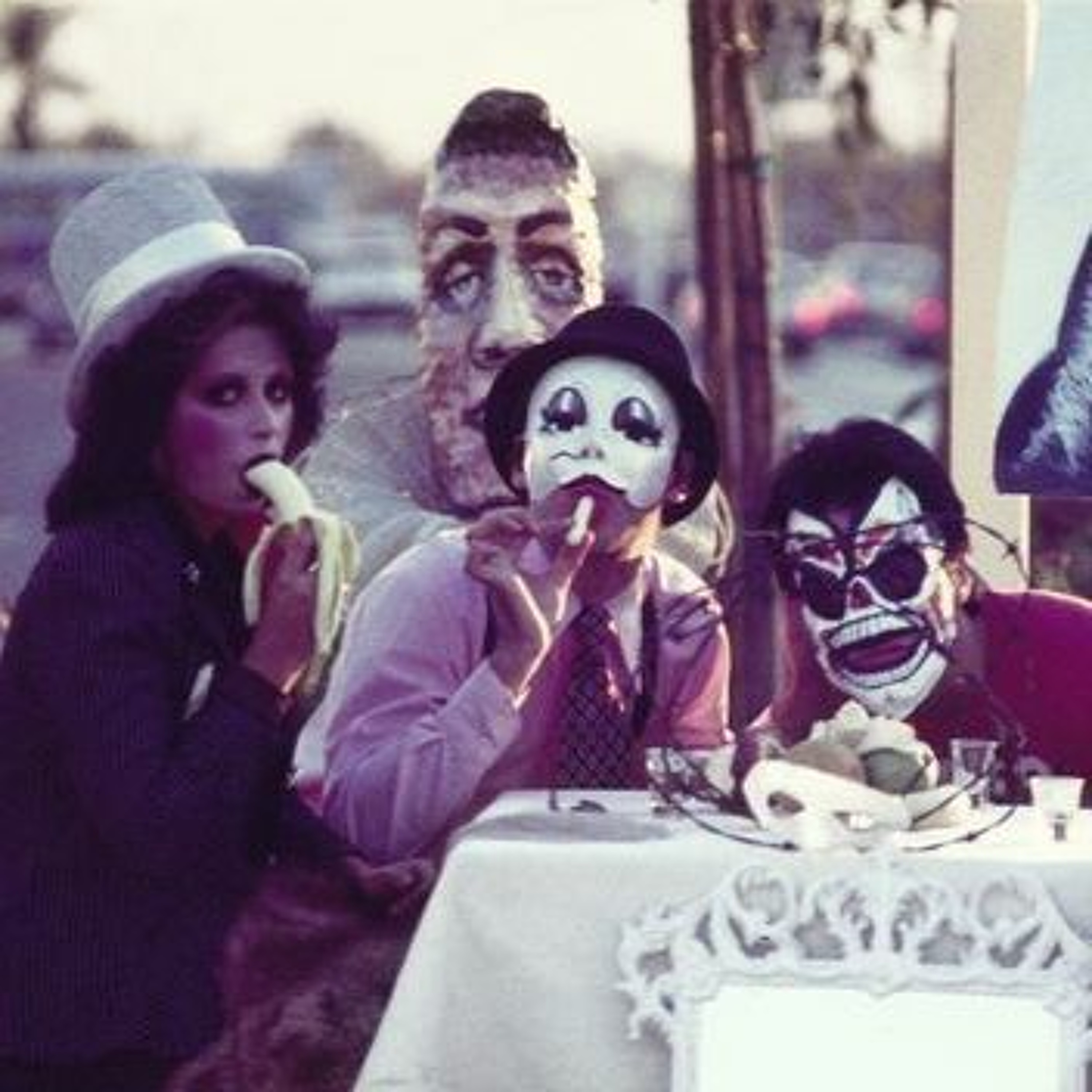
In 1971, in an East Los Angeles neighborhood, a group of young Mexican-American artists hatched a plan for a unique artistic act. We decided to create an anti-war statement, anti-Vietnam war statement, by essentially recreating the stations of the cross. This is from a documentary about the OSCO Art Collective. And I played Jesus Christ carrying the cross.
Grunk was Pontius Pilate. I decided to dress up as sort of a zombie-like altar boy wearing an actual animal skull on top of my head. We basically paraded down Gileer Boulevard to the recruiting station and sort of collected people as we walked. People just started to follow us.
Before you knew it, we were all heading towards the Marine Recruiting Station where we leaned up the cross, dumped all of our costumes and the popcorn, and we left it there so it essentially blockaded the recruitment center. So for that particular day, there would be no more Chicano's joining the Marines and going off to Vietnam. This act of artistic defiance and protest towards the American government's war in Vietnam was among the first of many by OSCO in the early 1970s. This group's public artistic performances exemplified how many young Chicano's were finding new and relatively rebellious ways to resist oppression and systemic racism during this period.
And that word Chicano became a new term for young Mexican Americans to express pride in their own shared cultural and community identity, and not without some political nuance. Okay, well this is Noeva's Folsos, a podcast by artist of Mexico in Utah. This is episode 18. And in this episode we're talking about what it means to be Chicano or Chicano, and what the Chicano movement did for Mexican American art.
This note could be a very long conversation, but today we're keeping it focused on the Utah perspective with a few voices from our local Chicano community. I'll let them introduce themselves. Okay, I'm Gloria Gonzalez Cook, and I grew up in Salt Lake City. I grew up on the West Side, went to West High, and went to the University of Utah.
When I went to the university I studied anthropology. My focus was Mesoamerica, so that was what I studied there. But I was at the university in the 1970s when a lot of the Chicano movement was starting and or had started, and there was a lot more activity at the U, a lot more Hispanic people than I'd ever seen before or met before. So that was really new for me.
My name is Fani Walalupa Blauer. I am from Mexico City, raised and born. I've been in this country for 22 years now, but I had all my education and childhood and everything in Mexico. Okay, my name is Chris Macias.
I was born in California, but I was raised in Utah. I like to actually identify as a Uthano. I feel like that speaks more to my experience. But I am either a first or second generation son of immigrants, depending on where I talk to them I tell you it's a little bit different.
But that's me. I actually grew up in Kearns, Utah. I went to the University of Utah for my bachelor's degree and now currently my master's degree as well. Right now I work for Trio programs, which is a college access programs for high school students.
I am a member of the Salt Lake City chapter of the Brown Barres. I'm also serving on the board for the Chicano scholarship fund, so I do work directly with this community quite a bit. Hello, my name is Luis Lopez and I am originally from Santa Ana, California. I'm a transplant to Utah, so I was brought here at the H17.
My senior year of high school actually, so that contributed a lot to my experience and my self-identification as she kind of. I actually also worked with the Trio upper bound at the University of Utah with Chris and just three weeks ago during the same master's program as well. So I bother him a lot. We have a lot of these discussions and it's also why I'm very excited to hear today.
Sorry. I'm going to start with the coordinator. Hi, my name is Jorge Rodriguez. I am the program director for Artes de Mexico in Utah.
I'm also the host for the Spanish Radio Show for Park Cities KPZW, Cadadameño. Oh, and then there's me. I'm Ross Chambless. I'm a white guy who grew up in Salt Lake City and I'm grateful to be invited to produce this podcast about Mexican art and history.
And although these are subjects that I haven't until recently known anything about and I don't speak Spanish and I've only been across the border to Mexico a couple times, this is a chance for me along with you to learn to get beyond the misconceptions, the stereotypes or the versions of the history that we seldom get to hear. Anyway, we will talk more about the art, but first, I want to know what exactly to do. What does a person define his or herself as Chicano or Chicano? I think somebody who started hearing the term for the first time in the 70s, it was somebody not born outside of the United States because that was important because I'm also the daughter of immigrant and immigrant grandparents.
And so it was somebody born here, but it was also a way to try to unite Hispanic. So I think when it first started, they wanted it to apply to everybody, whether you were Puerto Rican or Cuban or anybody who had grown up here, lived here, and we all went through similar struggles and that was the idea of how to why to call ourselves something other than Hispanic or Mexican American or Spanish or whatever. For me, I think the term Chicano, it really varies, the definition varies depending on who you ask. For me, it was more of the recognition of my indigeneity, although I can't pinpoint it exactly where it comes from right now, it's in me.
And so I didn't identify with terms like Hispanic or Latino, although I will use Latino for solidarity depending on the situation. Chicano was different and spoke more to me. And so for me, I guess I would define it as an American of Mexican descent with a non-Anglo view of myself is how I see it. So like Luis said, it can vary from person to person, from community to community.
The reason that I choose to identify as Chicano is because I think that identity speaks to my own experience, which is somebody who grew up in this country within these borders, understanding that I grew up bilingual, speaking two languages, understanding that sometimes I feel like in certain spaces I would fit in in a certain language or a certain identity, a certain look, in certain spaces I did not, so I had to bounce with the two. Also Chicano to me means existing in that third space. A lot of people see it negatively as like, oh, Nita, Gini, right now from here, nor from there, even though my family does come from a land-breaking country, they come from Mexico. And I actually do know some of the connections that go to my own indigenous background.
So from Jalisco, Mexico, there's a group called the Cuicios Nation. And I know that I have roots in that as well. So I can trace it, at least, to that extent, I don't really know too much of it. I personally do not have the full connection, unfortunately, because of the generational gap and the lineage that was here.
But to me, Chicano really embraces that idea of, you know, we didn't cross the border across us. And so because we're on this side is the reason that I say I'm Yudano because of for Utah, but that doesn't necessarily encapsulate everything that I am. So Chicano, again, has different variations, but for me, it kind of encapsulates all of that. For me, it's very different.
I grew up in Mexico. I came here at the age of 22. And I grew up with listening that word in a very negative connotation. And not well, there were two aspects.
You know, the Chicano's are the hard workers in the US. But also, you don't want to be a Chicano because a Chicano is someone who doesn't really have national identity as claiming maybe being Mexican, but not really because they live in the US, but they don't really speak good Spanish. So when I moved to the US 22 years ago, people would ask me, and I don't remember being, no, I am not Chicano. I am Mexican.
I don't even know what Chicano is. Now it's different because I know the culture of the Chicano people. So actually, when I go to Mexico, I'm like, no, you don't know what you're saying. You don't know what a Chicano is because there's a lot of social context into this definition.
But if you go to Mexico City and you identify as Chicano, it might be like, someone without identity. Yeah, see, I've lived most of my life in the US, but I lived in Mexico for a few years. And I actually identify with everybody's definition. For me, growing up, Chicano was a bad word.
It was something that somebody called me as a way to make themselves superior. And it would be either my Mexican side of the family or acquaintances who would be like, oh, so you're a Chicano? And it would be kind of like a little jab with that. But as I grew up and I started learning a little bit more about the history, I'm using it now.
And I'm like, I'm not going to be like a Chicano as a way to take back that side of my culture, because just like it was said before, I am from here and I am from there. I don't look at it as I'm not from either place. I'm from both places. I do hold that third place because this is who I am.
And so, yeah, that's how I see it. As you can see, there are different ways to understand the meaning of the term Chicano. But where does the idea originate? This is from a PBS documentary about the Chicano movement.
It became clear that without political power, Mexican Americans would remain second-class citizens. And we're poor, man. I mean, we're poor. And nobody wants to do nothing about it.
You still catching the democratic party? Thank you, they're going to save you and they ain't going to do it. In a small South Texas town, a new political party took shape. They threatened to change the political landscape of America.
I think that Chicano people here, you've never met us. We're not in the dictionary. We've never met any ball game. You're going to have to be learned all your stereotypes and all you miss because we're allowed to begin creating new ones.
Tough ones. Great ones. And I suggest you learn fast. You want to match it?
As the nation watched, Chicano's took on the most challenging quest of the Mexican-American civil rights movement. The Chicano civil rights movement was an extension of the Mexican-American civil rights movement of the 1960s. In many ways, it could be compared to the Black power movement that extended from the African-American civil rights movement. The Chicano movement was broad in the sense that it involved efforts to give farm workers more rights, to resist the disparity of Chicano young men being sent to the Vietnam War to die.
It was also about enhancing educational opportunities and voting rights to Mexican-Americans and to combat negative stereotypes of Hispanics in mass media. In the late 1960s and early 70s, the movement was simmering in parts of the US like Texas and California where many Mexican-Americans lived. But for those living in Utah, well, maybe not so much. Here's Loria.
Things didn't happen here the way they did nationally. We didn't have big demonstrations about the war and things like that. But as people came in, Ticano's came in from California, for instance. They were breeding their experience.
And also, of course, Cesar Chavez in California and the farm workers union, all of that had a lot of effect on all of us and the other compacino which traveled around the United States. We were very aware of what was happening nationally. So that's how it started to grow. And it did start to grow here.
And people began to identify themselves. And I find it interesting about the idea of the indigenous looking at it as I'm from the India. I always knew I was mestizo or part Indian. And I was very proud of that.
But a lot of the people here who were also part of that movement were people from like Colorado, New Mexico. They called themselves Spanish-Americans. They did not identify as indigenous on any level. But they were also part of that because they grew up here.
They were living here. And it doesn't matter that their ancestors were living in the, like Chris was saying, they crossed the border crossed them. They didn't cross the border. People had that American experience of being people who were exploited and people who weren't really seen as full citizens.
And so their experience was similar enough. And that's where the Chicano was supposed to be a uniting name for everybody. This is from the 2014 biographical film about Cesar Chavez starring Michael Peña. It was actually Filipino-Americans who initiated the first farm worker strike in 1965 in Delano, California.
But by cooperating and uniting, the Filipinos, the Chicano's, and other groups formed the powerful United Farm Workers Organization. Chicano leaders led the boycott that resulted in the collective bargaining agreement that guaranteed field workers had the right to unionize. Just one thing I wanted to add is as we bring up the Chicano soul rights movement, we of course always bring up Cesar Chavez, it's crucial to bring up the L'Oro's as well, right? Because a lot of times Cesar becomes the face but we cannot forget the women that were also part of this movement.
So definitely appreciate the L'Oro's work that Cesar Chavez. Another group that emerged from the Chicano movement in the late 1960s were the Brown Barays. It's a group that you still hear about today. Because Cesar has had some involvement.
So the Brown Barays are kind of a response to a lot of things that were already mentioned, so one of the things that, like Gori mentioned, Chicano became kind of this unifying term, even though at first what he mentioned was kind of this negative connotation, right? It comes from being called indigenous, it used to be negative, right? Because you didn't fit that Eurocentric view that was put on your or you just put that angle of view, so sometimes it came from both ways. But it came from the response to the creation of the word Hispanic.
So the word is Hispanic is actually the creation of American governments to try and encompass everybody from that end, right? So everybody who looks a certain way, who speaks a certain way, everybody who's not white, who's from southwestern, et cetera, at the time would become Hispanic. But then like Gori said Chicano became a response from the people themselves saying, well, if you're going to put us all together in one word, we're actually going to reclaim this word as ours, right? And so the Brown Barays kind of spread it from that very philosophy saying we're going to reclaim our own cultures and we're going to be kind of in your face about it.
And so while the, a lot of schools were actually becoming more educated, educated themselves on what it is to be a certain identity, what it means to be Chicano, Chicano, or what it is to just be existing in this country at the time in the late 50s and 60s, what that experience was a few individuals would actually receive that education, education meeting access to that system that we now understand today, the institutions of going to college and all that. Those few individuals started connecting with high school students to say we're going to show our own communities who we are, what we are. And so the Brown Barays came from a model of actually Puerto Rican descent. So I don't know if anyone was with the young lords, but in Puerto Rico, they started wearing barays like the military and said we are the young lords who will be fighting for the independence of our people, our indigenous nations, the nation's, and for our own statehood, if you will.
Today, of course, Puerto Rico still has to be debated on whether they want to be a state or a colony or territory and all that, but that's another podcast. So the young lords were also sort of what inspired the Black Panther movement at the time. And so the Black Panther in 1960s led by Huynh Nguyen and others were kind of being that militant community view, right? Saying we're no longer going to depend on government, we're no longer going to depend on education, but we're going to do this ourselves.
And so they started creating their own networks, started feeding their own people, started creating communities, started vaccinating their own people, just making something of themselves. And at the same time, pushing the limits of what the quote unquote black community was supposed to be doing at the time, you know, again, the AFAs and 60s. And because of their success, because of that civil rights push and motivation, the Brown race also came to be and said, well, we're going to do the same thing for the Chicano movement. So it wasn't necessarily that one group is copying another.
It's that all of these sentiments were coming together. And there was a lot of different push to do this from different communities because we're all at the time suffering from, you know, systematic poverty. We're all looking into lack of access to education and we're all looking into just many different systems that are, you could call it, oppressing our communities. And so the Brown race was one response alongside other student groups like Mecia or like Lulac or other different things like that, in the mind.
So so the Brown race became known as this almost parramillatine or militant group, just because they were like, pushing the boundaries of what it could do within the law or with education. And they also gave our community a uniform. So in the civil rights movement, you put on a Brown beret, you put on a khaki short khaki pants and boots. You know, whenever we go out in the community and actually wear that, we call it, we're going to get sued in the boot, you know, because we know that it gives that community a uniform and we stand out.
So when we have people, especially nowadays, like white supremacists or other groups who dress alike, or who still keep some of those traditions of like the KKK movement, and you can identify them very easily, this is the response to that. Chris helps us to get a uniquely current perspective on what it means to be a Brown beret. Gloria can offer a perspective from an older generation. I think Chris was right on with what he said.
I just wanted to add, from my generation, okay, we were the children of the World War II vets. So I have two uncles that both served World War II, one in the Army, one in the Navy. My one uncle spent 19, the summer of 1945 in the Pacific. They came home from the Army.
They fought for this country and they expected all the doors to be open that were open to every other vet. My one uncle started college. The other one already had a family, so he went to work. But what they found out that the doors weren't that open.
And so that, I believe, was part of what happened to the, to now their children, my generation. They saw this. They saw that their dads were heroes. But they came back and they still were the stupid Mexicans.
They were still these men who could not achieve what everybody else could. That was, there was resentment there. And so you had these younger kids who were going, we've done everything. We've done everything we're supposed to do.
My dad did everything he was supposed to do. And he came back and nothing had changed. So that, I get emotional. But that was one, I know it's a small aspect, but when you're talking about the history of why this would even happen, why would people start thinking this way or feeling this way?
It was because of what, you know, Hispanics have been in every war in this country, even the Civil War, people don't realize that. And yet, here we are. I've heard people refer to the Mexicans as the new immigrants. Like, what are you talking about?
What are you talking about? We've been here for, you know, 300 years. Romero G. Dental.
What is the G stand for, Romero? The Dentalics. The negative or goofy portrayals of Latinos in the media was also a catalyst for the Chicano movement in the late 60s. And we had the images on TV that, you know, at least here in Salt Lake, okay, we only had three stations.
And so, they were the commercial stations. But you had a program featuring an actor named Heather Gonzalez-1-Sales. And he was basically a clown. He was a servant, but he was this little guy and he was always, I don't even remember, I was very young at the time, but he would get in trouble.
Give me that once more. My father was on salad before he married my mother and my mother was on salad before she married my father. Probably, we're crazy to get married. And then you had the Cisco Kid and his sidekick, Pancho.
Pancho was played by Leo Carrillo, who was a Californian and an old, from an old California family. He was a very well-educated, very sophisticated man playing the sidekick, the stupid sidekick who spoke broken English. But, you know, they would be saying, okay, we're going to go over here and he'd say, okay, let's went, you know, things like that. Cisco's right.
Can I go? Have a good time. Have a lot of fun. And mine's your own business like Cisco don't never do.
And then you had the Frito Bandito. The Frito-Lay put out a commercial and there's this little guy wearing the Bandalero and he's a revolutionary and he's this little guy, but he's the image on the Frito package or he was the commercial. Those were the images that we had of Mexicans. And then here in Salt Lake or here in Utah, it was an insult to be called a Mexican.
If you were Spanish, then you were okay. You were European. But I would have people in this happened into my adulthood who would ask me, are you Spanish? And I would say, no, I'm of Mexican descent.
And they would say, oh, I thought you were, but I didn't want to insult you. And then I'd wait for them to figure out they'd insulted me and never, no, it just would go over their head. But this was the image Mexicans were the dirty Mexicans across the railroad tracks and Spanish was the better people. So it was the images that were portrayed commercially as well as this almost, I don't know, interwitional, if you will, sort of idea of who Mexicans were.
And, you know, I mean, I'm a little bit in between the generations. Growing up as a kid, you know, you see this in cartoons. I mean, you can see icons like Speedy Gonzales, you see Bugs Bunny making, you know, he dressed up as a caricature of what a Mexican would be with, you know, the big San Morero and the, you know, the, you know, the, the, you know, the, the, the, the Pancho. And, and I mean, just the way that these depictions were made, this was what it was to be a Mexican more or less.
And so I also, you know, people would ask me if I was Spanish, but I didn't understand that I took a long time to figure that stuff out. But even, you know, the stereotypical depiction of what a Mexican is, is meant to be kind of a derogatory idea, the depiction of the lazy Mexican laying down asking for, for, for money. And so, I remember in the movie that I used to love as a kid, it was like the Naked Gun. There was a scene where the character, they, they dressed up in a costume as, as Maricis.
And he gets knocked out and he's on the floor wearing the Mexican sombre del and somebody left a hat and they were putting money into his cup. And my father said something like, yeah, they're always like throwing shade at us. And I was like, wait, I guess that doesn't make sense. They're, they're actually, that's a depiction of a quote unquote Mexican right there.
And so yeah, this sort of thing grew up. And if I can go a little bit further, as a kid, I've always been a huge fan of superheroes. And one of the biggest shows I used to watch was, you know, the Super friends, you had Superman, Wonder Woman, et cetera, et cetera. But I always wanted to identify with somebody and they had these depictions of horrible stereotypes of different ethnicities.
They had the samurai, they had the black lightning, Apache Chief, and of course, Elodado. And now as an adult, I look back at them, I wonder how they thought this would be an idea. All of these would be extremely offensive. They tried to do something like that.
But I remember looking back and thinking, I want to like Elodado, but he's terrible. He's not, he's not a good super girl. And so as a kid, you don't have something to look up to. And it just kind of permeates into the whole culture.
By the early 70s, Chicano activist artists like the OSCO Art Collective found new and unique and controversial ways to express themselves. The members of OSCO came up with what they called the Walking Mural. These are OSCO members, Willie Herron and Patsy Valdez, talking several years ago about one particular project they put on after the East LA Christmas parade was canceled after the 1970 Chicano moratorium riots. Muralism was being approached in a very traditional way.
We thought we would take it a step further. And with that idea, I decided to just sort of have myself wear the Mural and walk with it down the street so it could be a sort of a moving work of art. And we did shock people. The policemen followed us.
We had to bodyguards. But it was, I think it was a great success. Traditional murals reflecting the values of Chicano communities were also increasingly popping up in Mexican-American neighborhoods around that time. Here's Chris Masias again.
Well, just on a very foundational level, I feel that especially in the late 60s and 70s, when these murals were becoming a lot more popular and more prevalent in our communities, is because we didn't see ourselves anywhere else. And when I say we, I just mean generational memory, right? Obviously wasn't alive. At that point, I'm from the late 80s.
What this means is it's still somewhat relevant today, where we do not see Chicano's Chicano's represented in the media. And if they are represented, they're disproportionately in a negative view. And so this is one way to kind of showcase ourselves in public view. Like here's who we are.
I'm going to paint myself as I think I am, as I see myself. Or I think I should be. Or an extravagant fashion so I can get that attention that I'm not getting anywhere else. And so this was both a form of showing our presence and both of our communication.
When you travel through an neighborhood, for example, like an East LA, where some of these murals are depicted, you would then see who's in that community and you talk to each other and other people's murals and other people's art. So just on that level, it was just kind of a visual representation, visual statement. As Lopez says that still today in an East LA neighborhood, one of OSCO's most notable murals could be found on a wall. You can see a photo of it on our website.
Well, one thing I think there's a couple common themes when we see Chicano art as a whole, but especially in the 70s is just as there were many responses to what was happening in the country, the art is also the same way. And so it was putting the Chicano struggle, the pain, raw and unfiltered ending your face. Right? And so even with this Oscar mural, you see faces screaming, you see the militarization of police in these images.
And that put the reality for a lot of Chicano's. As a front page to the community, I mean, this mural is on a wall that people walk by, people drive by. So you see it and you're going to get a reaction. Right?
And that's exactly what I feel that they were. That was your adventure. Three thousand years of civilization. Oh, my God.
Talk to Esther. Three thousand years of civilization around the finale. Our people live down the shore. Well, we'll continue this conversation about what it means to be Chicano or Latino in Utah and coming up with episodes.
You can see some of the works of art and interviews and video footage from some of the works we discussed in this episode on the website and home for this podcast, ArtismaxUT.org. Also please share your own thoughts with us. Did you experience the Chicano movement in the late 60s and early 70s? What do you think was the lasting impact?
Also, what about the Brown Berets then? And now, do you think the organization continues to be effective in looking out for Latino, Latina, or Chicano to kind of interests? And what notable Chicano murals have you seen or want to share? What messages or ideas do those murals say about the larger community?
You can share your impressions with us in the comment section on our website. Thank you to Fannie Blauer, Gloria Gonzalez-Cook, Chris Masias, Luis Lopez, Jorge Rodriguez for their thoughtful insight and commentary throughout this episode. The music you heard in this episode comes from Willie Bobo, Richie Valens, Los Lobos, Latin Playboys, Marlo, Chicano Batman, Daniel Valdez, Santo Injani, Gustavo Santalaya, Calexico, Antonio Pinto, and this last track is by the band Los Angelinos. This podcast is made possible by Grant from Utah Humanities thanks to KPCW in part city for the studio space.
I'm Ross Jamblis, this is Noevas Volsos. Go ahead, white fence, paint your coat of arms, and back with locos. Go ahead, dreamer, yes, spray your habitat. Go ahead, clover, sign your treaty, whether you're ahead or not.
That treaty that was supposed to guarantee equality. Go ahead, back with locos, chosen a fast line. Spray your metallic blood, to another wall. Time to say y'all right.