
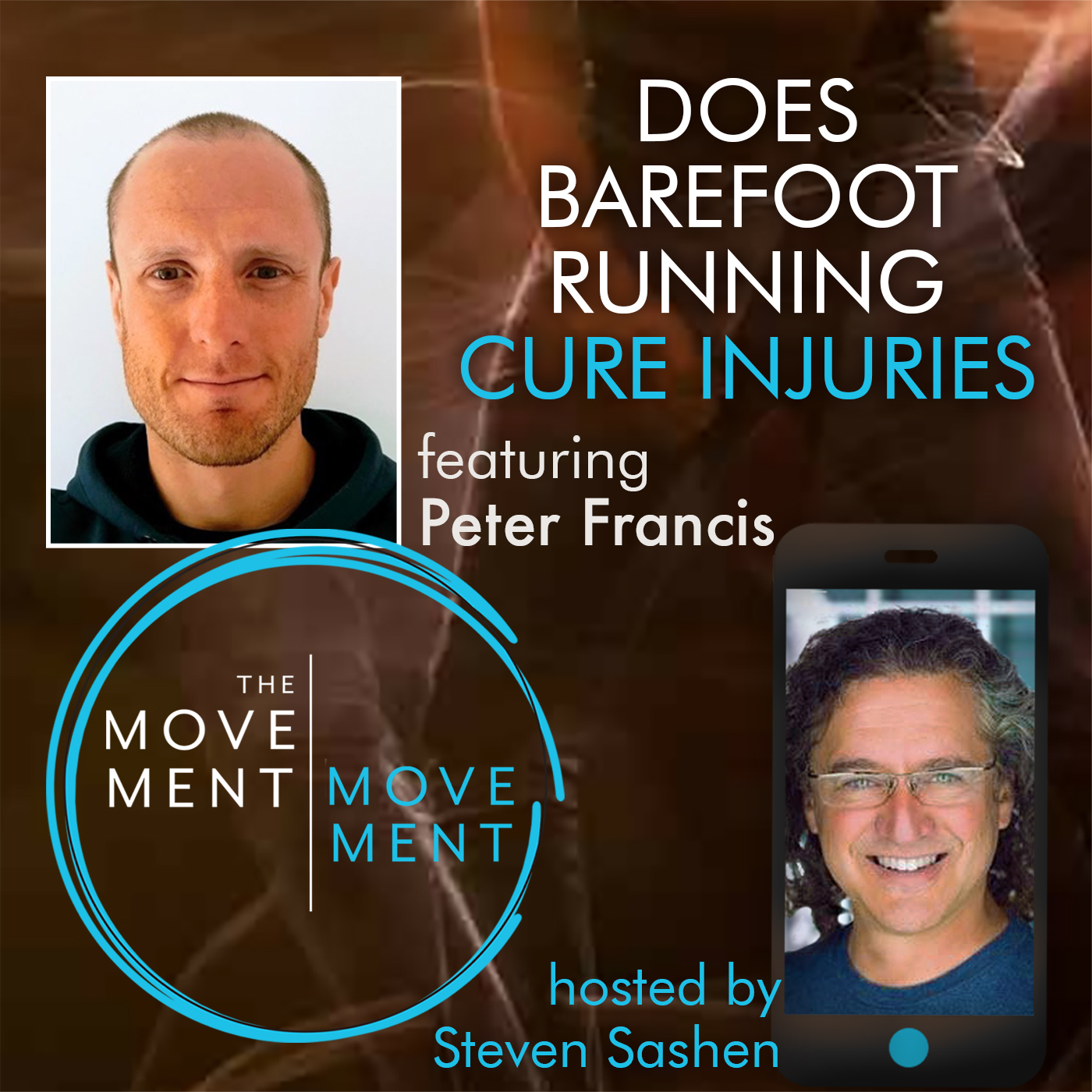
The Holy Grail is knowing how to run without getting injured. Whether you're wearing shoes or going barefoot, I mean, that's really your goal is to enjoy going out, enjoy running and not worry about being able to do it the next day. Well, we're going to be chatting with someone who has some interesting thoughts about that on today's episode of the movement movement, the podcast where people will know the truth about what it takes to have a happy, healthy, strong body starting with your feet first, those things that are at your foundation. We're going to break down the propaganda, the mythology, the often lies that you may have been told about what it takes to run to walk, the hike to play, to lift, to be crossfit, yoga, whatever it is you like to do and do that enjoyably and efficiently and effectively.
I'm Stephen Sashan from zeroshoes.com, your host at the movement podcast. We call it the movement movement because we're creating a movement that involves you about movement and that's about natural movement. We're trying to make natural movement or help people rediscover that natural movement is the obvious, better, healthy choice the way natural food is. If you like what you hear here, then go over to www.jointhemovementmovement.com.
To join the movement, all you have to do is enjoy what we do. Check out the previous episodes, like, share, comment, give us a thumbs up where you can do that, hit the bell button on YouTube. You hear about upcoming episodes. You know how to be part of this.
In fact, if you want to be part of the tribe, please subscribe. Let's jump in. Peter Francis, hello. Hello.
Now, I said, we started this conversation a few minutes ago, and then we started again right now. And when I started with Peter, I said that I was humiliated and embarrassed that it took me till now to discover him, you, because you are a staunch proponent of barefoot things. And we just jumped in that conversation. I found out about you last week or so when there was an article that came out.
Was it in the Telegraph or was it? I can't remember. I think it's originally written on the conversation.com, and then it's got picked up by a few other places like CNN and independent. And the title was something along the lines with barefoot running carrier injuries, and part of me for not being in any way prepared, but that's how I run my life.
Yeah, the media gave it various titles like that. Yeah. So before we jump back into our conversation, and then I will be asking you to give the tour of your man, Kate, again, because I love your new like Adam. Tell me who the hell you are, what the hell you're doing here.
Before we get into how you got into this whole concept of natural movement, what are you up to now? Well, I'm a lecturer at the Institute of Technology in Carro, which is place in Ireland. I'm a sports scientist and a physical therapist. I do research into foot development in adolescents, children, adolescents, and adults who grow up with them without wearing shoes.
So silly as this may sound, that means you have some actual expertise and not just opinions. Well, science is a humbled pursuit, you know. Yeah, well, you know, it's funny when people talk to me about the whole natural movement thing, they'll often say, well, there's a big controversy around this barefoot. So I go, no, no, there's a bunch of research demonstrating the value of natural movement, and there's a bunch of people with opinions.
And the two are, the vent diagram does not overlap somewhere, which is always something for you. Well, anyway, we were talking, so tell me if you can or start to repeat, your story of how you discovered natural movement in barefoot running. So I was a keen runner from the age of 16. And a couple of years into that, I started to pick up a lot of injuries.
I was studying sports science at the time, and I was mainly interested in performance at that time. I got so many injuries, and then I graduated, and I went to the Middle East and thought English for a year. And when I was out there, I couldn't access physio in the same way. And a friend of mine just happened to send me a magazine article that said, have you tried the sparefoot running?
And I thought, well, what the hell it can't hurt? So I found a grass pack. I did two sessions of running, and my factor fashionitis, a painful heel condition, cleared up almost immediately. And when I came back to Ireland, I said to my professor, hey, this really weird thing happens to me in the Middle East.
And I want to do a study on it. And he kind of threw his eyes to heaven, as professors off to do. But he did humor me, and he said, well, let's get one of the undergraduate students to do a small research project to the first. And we did.
And we found that runners, without their shoes, we took the arm off the sofa, and we got some cameras around it. And we looked at runners running at two different speeds with them without their shoes. And at the lower speed, the runners had a shorter stride, more flex, tippling, and ankle. And that was kind of the beginning of, I suppose, my career more in the research end of barefoot.
When was that? That was 2010. Oh, so yeah, so you came in right as the boom started in the boom. Yeah, I guess so.
I mean, it didn't necessarily feel like that at the time, but I just stumbled upon it. And I got some joy from it. And so I became interested in how it was all working. Yeah, you'll meet both.
I mean, I say that way, because we started zero shoes in late 2009. And from late 2009 to mid 2010, basically every major shoot company was putting out content articles very saying, don't run barefoot. You're going to kill yourself. You're going to your mortgage rates going to go up.
You're going to accept on happy turmeric pills, no catchy bola. And it was just insane. And of course, by the end of 2010, the shoot companies were coming out with shoes. They were calling barefoot or calling minimalist, which frankly were nothing of a sort.
But they were trying to capitalize on it before they found out before I was just bailed on them entirely. So that's why I said it was the beginning of the boom. And that was also just that same era when born or run became popular as well. Was that did you read born or run at that time?
Was that in any way inspiring? Or was this all just based on your experience and going, I got to check this out? No, it was just based on my own experience. Wow, that.
So when you say you tested people at different speeds, you saw that and I'm putting air quotes around shorter stride length because that's massively misunderstood by people. But what do you see at the faster speed? And what were the two speeds? I'm curious.
So we saw no difference at the faster speed. And I think that's because when you run faster, you tend to use good mechanics anyway. And I think I have a suspicion the problem of injury and lunges and shorteners is actually in the volume of low speed training. And so therefore, mechanical changes at that speed are probably most important in terms of interest in solving the problem.
So yeah, we didn't see a change at the faster speed, but we did at the slower one. Well, do you remember a bit of Bill Sands? Do you know Bill? No.
Bill was the head of biomechanics for the S on the committee. He used to have a human performance lab at a university out here in Colorado. And I met him, must have been around that same time. In fact, it was definitely right around that same time, late 2009-ish.
And what he would do is he'd bring you his lab. He had this five foot long, 10 foot, or five wide, 10 foot long treadmill. He'd throw you on there and film you from the back and the side at 500 frames a second. And first, he'd have you run your favorite pair of shoes, then barefoot.
And then it was like doing an eye chart or night test. You know, better worst, better worst pair of shoes that you had. And in over 90% of the people, he found that at a normal training speed, their mechanics changed dramatically and improved dramatically when they were barefoot. And then so the question was, what shoes can you wear?
This can give you the closest thing to that experience. He never even suggested people run barefoot. It was just like, if you're going to run shoes, let's see what we can do to be as close to something that we just demonstrated is better. And it was amazing the number of people who found those improvements but still were attached to wearing big, big motion girl shoes that he showed them.
Didn't help them in any way. It was a fascinating thing about people really being locked into an idea that they had somehow gotten married to, despite the evidence in front of their face. Yeah. Cool.
Good. Good. Good. All right.
So you did a bit of research. And what happened next since I was 10 years old? Did that piece of research finish my PhD, which was in an unrelated topic and then started to engineer my work in research more towards running injury and barefoot. And so probably from around 2015 started the publish more and more in the barefoot and in the running injury space, which is what we do now still.
What kind of response are you getting? Let me see if I can preface that question after the fact. What's amazing to me, like I said, there's all this research on after movement and it seems to get a little press, b, arguments from people who know nothing about what they're talking about. And there was a c when I started this thought.
Sometimes just vitriolic responses, people telling me saying this is complete bullshit. But the one that amazes me, of course, is simply how little response a lot of this research gets, despite how profound it actually could and should be. What do you discover when you start publishing? Well, in science, you've just got to do the studies and publish to work.
I can't say that I've had major trouble there. I do try and write blog pieces and try and write media-friendly pieces so that the information is communicated to wider audiences. And we've had some success in doing that. I think also it's complicated because I guess that the traditional influencer has an overly simplistic view, which means the advice from them is as likely to send you in the right direction as it is the wrong direction.
And then you have a lot of scientists, maybe, who don't have real-world experience and application of the information. And so there's a sweet spot in the middle because I'm working on a book at the moment about running injury. And yes, there's a chapter on shoes, and there's a chapter on being barefoot. But there's a whole lot of other stuff, not changing your training loads too quickly, not chasing previous versions of yourself or other people, learning to introduce variability into training, learning not to take what clinicians say to heart too much.
There's a whole lot being less sedentary in daily life, not getting bored and needing instant gratification. There's a lot of stuff that goes into why somebody gets injured. So it's probably when you look at it with a black and white lens that you stack it into trouble. And then you just get overly simplistic arguments over and back in the median.
And it probably doesn't go on you. Well, a lot of that seems to be human beings. They want a simple answer. They want to know, what's the step-by-step thing that I do independent of individual differences?
It amazed me. I'll get an email from someone saying, I want to run this marathon in two weeks barefoot. What do you think I should do? And I, of course, respond, don't run the marathon barefoot in two weeks.
So and that's in another part is people think that if they can imagine something, then they should be able to do it the way they imagine it, which is, of course, not the case. With all the things you described for all those different conditions that can be helpful, it made me think of Arthur Liddyard. There's a great documentary that I don't know who did it about Arthur and for people who don't know. He was perhaps a little successful running coach of all time.
He coached people from 800 meters from marathon, a lot of world champions and Olympic champions coming out of New Zealand, which is a tiny, tiny country. I think you guys used to have some connection to. And Liddyard did exactly everything you just said. I mean, the variability in what he was doing and how he did cross training and how he was a lot of train barefoot.
And of course, he was making shoes for people that looked like ours. They were flat. They were wide. They were like, wait.
He was a professional shooter. And when I'm hanging out at the University of Colorado, watching how they're training, it's just like pounding in the miles and seeing who survives. Or I'll see some guys who are professional coaches and the amount of strength training they do or anything else. It's so obvious that that's something that they're kind of getting a lip service to, even at the Olympic level.
These guys who are, I mean, sure, they're great runners, but can't do a push-up for all practical purposes. And so I love everything you said. I think that proposing that people adopt what you're suggesting is a herculean task. What do you think it's going to take to, I don't know, expand people's mind to get people to think about moving differently, running differently, injuries differently, more than just having this resource that you're going to be putting out?
Well, I think that's a big question. But finding people's mind is perhaps what society is in need of right now. I think I can't remember the philosopher who said it, but Teary is the eradication of nuance. And I think increasingly, in all aspects of life, it's been turned into black and white ways of looking at things.
And I guess if you look at things on an evolutionary perspective, you then have to say, well, why are we obese? Why are we suffering more anxiety and depression than ever? Why are we living in an environment where we're in chronic pain? Why are we so medicated?
And on and on and on in terms of mismatched diseases. So if you take that sort of evolutionary lens, you will start to say, well, OK, how do we become more conditioned in a modern environment? So if we are sitting on a night pad and not climbing a tree growing up, then we need to think about that in terms of the knock-on effects. So you mentioned my cabin.
There's no chairs and any backs on in here. And there's a standard desk. And there's sort of a shoes off. So you're constantly trying to steer yourself towards something that's a bit closer to your evolutionary legacy.
And eating well and exercising and all of that comes, it becomes important. But I guess with barefoot, or not even barefoot running, but just running, if you're sat at an office desk all day long, you're really asking your body to go from zero to 100, really quite quickly. And that body is not conditioned either. So those two things have kind of sudden change on a frame that's not as musculoskeletal robust as a hunter-gatherer as it might have been is an issue.
So I think to get people to expand their mind, you've got to dress it on a whole number of fronts. Absolutely two things. One, to an earlier point, you made the, there's tyranny within the barefoot community as well. And I think some of this is just people trying to establish themselves as someone so they can make a living.
So some of it is, you have to run this way. There's some people who say you have to land on this part of your foot in the following way. I'm not going to get into it because they'll basically identify and talk about. Or even just the ideas that have taken hold like that the optimal cadence is 180 steps per minute.
Or just all these little things that people have tried to turn into, that they've tried to codify. And in ways, in doing that, they've really ossified, which is an amazing thing since this is such a new movement that there's so many ideas that have already become entrenched that we've got to talk people out of. So that's sort of part one, part two. I obviously, and I surprisingly agree with you about the mismatch between our evolutionary history and where we are now.
The thing that I'm curious about, and I wonder, you kind of addressed this, but I want to highlight it, is a point that I made on a panel discussion. I said, look, there's no amount of ancestral movement or climbing trees or whatever that you can do that really replicates what we were doing as tribal society members, where you have to walk to the river 1,000 times to get enough rocks to build a shelter, where you're chasing down food or being chased by things that think you're food. And the example I give, I say, look, as a sprinter, I can tell you, I had a really hard workout on Sunday. I felt a little sore on Monday.
But if I had a race where I worked out one-tenth as much, but was much more intense because it was an actual race, then I'd be sore until Thursday. And so there's just a hormonal thing that happens completely different in the heat of competition than anything I can simulate when I'm training. So similarly, whatever we're doing now is at best a simulation of our hunter-gatherer history. How do you see that and how do you see any way of maybe getting those things a little closer together?
Well, I think the key thing you mentioned there is about repeatedly walking to the river and gathering stones and so on. What you see with that type of activity is it's a constant low level of conditioning. So I think that was probably how we spent a majority of our time. The other stuff about hunting and so on, but it was probably persistent hunting.
So again, long periods of low level conditioning with short bursts of high intensity exercise. So you're not really in a constant state of inflammation. You're in a constant state of activity. I mean, the best example I've seen of it recently is my brother is a mechanic and also a guy who's interested in agriculture and so on.
And so sometimes if I look out the kitchen window, I have a coffee when I watch him. He's in and out of his garage. He's up and down the stairs. He carries this thing across to the compost heap.
And then he turns around and whatever moves down here and there. So I watched him one day and I thought, yeah, this guy doesn't need to exercise because he's mimicking this constant upright posture where he's performing various activities repeatedly. So I do think a modern version of it exists if you have a manual occupation. If you don't, then you're trying to be an athlete.
I think it's very, very difficult. And something I've observed recently is even if I watch two athletes or triathlons or some running events, I notice that the people in the events, they don't really look like athletes. And I understand that the participation sport and I think it's brilliant that anybody at any level or fitness or whatever you want to say, participates, it can only be good for their head and everything else. However, I do feel that when you look at them, they're sort of a really good thing by engaging with the sport.
But you can almost see in how they look and how they move, that they've been chained to a desk or a car or a car or whatever, some sort of seated position in the way that they're moving. And it's really got me thinking around the idea of, can sport serve the purpose? Once did, if we have a population that's so sedentary, that even sport is now quite a stressful event, rather than a form of conditioning. Or fun.
I mean, this is one of the things with the Tutter my Indians. They have running games where they're having fun for days at a time as part of the game. And we've definitely lost that. One of the things that I do when I'm teaching people about different running is we got on a park.
And I do things that are designed to make them do and feel goofy. So I'll say, you know, think about being like little kids when they start running, where they haven't run into their head yet. So it's like they kind of lean their head forward and then they have to catch up with their head, which they can never seem to do because they can't keep it stable. So I just do that.
Like let your head lead the way and just kind of keep your arms flapping by their side. Don't really use your arms. Just try to do something to make it entertaining and get people out of this mindset of trying to accomplish something and making it a goal-oriented thing that you have to do that's got additional tensions. Like my line is always if you're not having fun, do something different than you are, because otherwise, what's the point?
And you don't want to, if you're not enjoying it for the sake of itself, not even for a goal, then you're not going to continue. I mean, I mean, sprinting is a ridiculous thing because it's not easy. But for whatever reason, I love the training. I find it really, really engaging.
And now, granted, having the competition is really helpful because it just, I like having the goal as well. But the goal alone is not enough to make me put myself through that at 58 years old. That's ridiculous. There's some thought that you just said in there.
Essentially, someone showed some photos of Olympic athletes from, I think, like the 40s and 50s compared to now. And in the 40s and 50s, basically all of the athletes look relatively similar. They were all just decently fit people versus the genetic freaks we have on every end of the spectrum now that are seemingly tailored to specific sports. Like if there was an Olympic female gymnast and an Olympic basketball player, and they died at the same time, and they were the only two fossils that anybody found in 10,000 years, people would assume those were two totally different species.
And it didn't used to be like that. Everyone, I think it was a more fundamental level of fitness for people who engaged in sports. And now it's just gotten crazy crazy. Yeah.
Yeah, I guess that wasn't a question. So let me ask you a fun, pointed question. So I imagine that every now and then you interact with other human beings, and they ask you what you do. And you start to say something.
And they'll say, make some comment about some new padded motion control, heel elevated shoe, where they talk about the vapor flyer, some other giant cushion thing. How do you talk about where? Either to people who probably aren't going to, we're asking for academic reasons versus people who are genuinely curious. I mean, how do you engage in this conversation that I have on a daily basis with hundreds of people?
So there's a few things. If I'm talking to runners, which is often what I'm doing if I do a public engagement type talk, I'll generally tell them to have the three criteria I use are life cheap and comfortable. Because when I did eventually overcome 10 years of injury and run my personal best, the shoes I was training in, where if I wasn't running barefoot on the golf course or around the grassy park, I was running in life comfortable and cheap footwear. So I wasted a lot of money for a lot of years before I knew all this stuff.
So that's the advice I give to runners. And then if someone more generally is interested in changing their footwear, whether it's up or down or whatever, I generally tend to say, well, sure, but take your time. Because if you change your load in either direction, there's some good evidence coming out to say that you'll have problems. And I mean, intuitively, people notice if you do circuit training for the first time in a long time, you're sore.
So if you change anything quickly, you'll have a problem. So I want to play devil's advocate, or more accurately, I'm going to pretend to be the kind of person that you have conversations with on a ongoing basis. So let's do this. Well, Peter, I need our support.
I mean, my doctor told me. Well, I think it depends. I think if you grow up habitually barefoot as some of the boys who studied in New Zealand do, then you'll probably have well developed direction and very strong foot muscles, in which case, that you probably won't need our support. So then you get into the same allow we're talking about, are we looking at prevention and long term rehabilitation of a foot?
Or are we looking at symptom management? And it's not impossible that the doctor would be trying to manage a particular symptom using an out support. But again, you'd have to see the individual and know what the situation was and what the long term management strategy was and I suppose what background they came from in the first place, you know? Well, and I also, I mean, clearly I need cushioning, because I mean, running, you could all that force in the ground so I need a lot of cushioning.
I probably answer that in a similar way. If you've grown up barefoot, it would seem to us that you can run just fine without cushioning. If you have grown up with cushioning, my only experience is that you can adapt to running and moving without cushioning, but again, you would need to adapt slowly, you know? Well, and I also pronate.
I mean, there was a guy at the shoe store, well, this guy at the shoe store, he put me on a treadmill and he showed me their pronates. So clearly I needed those anti-pronation shoes as motion control shoes. Well, I get him prescribed anything in the shoe store is not really, you know, that's very different to the medical professional and the first example, isn't it? So yeah, I don't think there's a whole lot of evidence for the shoe store form of prescription.
That's not to say that there is an evidence for buying a clinical assessment and subsequent gate retraining. I think there is some good evidence that muscles start to work a bit better with gate retraining and that gate retraining can be apart from an overall solution, but that's not what happens in a shoe store. Well, then last but not least, so look, if this whole barefoot thing is so good how come we never see barefoot runners in the Olympics? I think a few things there.
That question is the challenge for science and then another challenge for society in terms of, we don't have loads of data yet, that can show us exactly the difference in injury, incidence and prevalence between barefoot and shod runners. And the smaller bit of data that is there, it suggests that we have less plantar fasciitis and less knee injuries in the barefoot group, but we have more calf and Achilles tendon strains in our, sorry, the other way around. Less plantar fasciitis and less knee injuries in the shod or in the barefoot group, but the barefoot runners do pick up more calf, Achilles strains, which is indicative of transitioning to that type of stride. So until we get more clear data on that and how we manage transition, I think you'll always have kind of body water between people who are a bit like me, who are miraculously cured of plantar fasciitis and then other people who've jumped into it and strained a calf.
And so you'll have that sort of muddy water there in that respect. The other thing is society in terms of, I ran for many years on a variety of public spaces on grass, even up to 20 miles barefoot at sub-3R marathon pace. However, I was always conscious that particularly when I was in the UK more so in New Zealand, it's sort of culturally acceptable to be barefoot. But when I was in the UK and Ireland, running around the park barefoot, it's not really the done thing.
And again, when I was in New Zealand, in the equivalent of Tesco, I'm just trying to think about the US, well, maybe, or... Yeah, there's not a grocery store that spans the US. They have to name, including my favorite name of any grocery store ever. In the Southeast, there's a grocery store chain called Pigly Wiggly.
OK. Well, grocery stores, a good way of summarizing them all. So, in New Zealand, you can be in the grocery store, seeing you shopping with no shoes on, I found in Auckland. Whereas you couldn't do that here.
So, I think in terms of realizing the benefits of being barefoot in an urban, modern environment, minimalist footwear, it can potentially play a role because I feel society, I just can't imagine a society, a westernized society, where by walking around barefoot is the norm. You can't. Actually, I can change that first of all, and see. So, but yes, you can, right away.
Go to any beach town. Anywhere in the coast. Yeah, yeah, yeah, yeah. This is the thing that's so funny to me, it's like it's totally normal at a beach town, but as soon as you get away from the coast, that's when it suddenly becomes abnormal.
And, and it, you know, I've gotten the point, I spend so much time barefoot, I walk in some stores, and if I'm wearing shoes, they're surprised. So, it's, but you're right, I mean, the societal pressure, the normative pressure to fit in is a huge piece of it undeniably. And by the way, back up to all your answers to my fake objections, that was, I applaud you for, for really landing on the science, where it's true, we have, you know, anecdotes do not equal data, but when there's so much anecdotal information, you can't ignore it. And I hope that someday, we have both the time and resources, financial, in other words, to do the kind of longitudinal studies that would be required to, I mean, frankly, put an end of the conversation and just land where we frankly think it would land.
But, you know, to your point about the, the Catholic Kelly strains, I've written a couple things saying that those are totally optional, if you transition slowly and attentively. And if you, I have a whole theory, I mean, I mean, I'll bring it up, I have a whole theory about neurological underpaintings for learning new movement patterns. So as an undergraduate, I did research on cognitive aspects of motor scale acquisition. And then I have this weird background of biofeedback and having a knack for picking up physical skills, I was an all-American gymnast, which, you know, learning to do gymnastic skills is a very unusual thing, because there's no, there's no approximation for almost any of those in the real world.
There's nothing in the real world that prepares you to do a double twisting double back flip. So, and learning how to do something like that is, you know, flat out nuts. But anyway, my basic theory is that there's different levels of sort of neuroplasticity and brain function that put people in one or four categories. So, one group of people, they are so unaware of what their body feels.
I mean, they literally, if you ask them if they're hungry, they'll say, yeah, and you go, how do you know? How do you know? I got a thing in the pit of my stomach, I feel kind of empty. And they'll just look at you and go, what are you talking about?
I'm hungry. They go, but how do you know you're hungry? It's lunchtime. And so, some people, if you ask them to run barefoot, they can rip up their feet and they don't even know they did it because their brain map has so de-differentiated, they literally don't feel anything.
There's no connection between their feet and their brain in any meaningful way. And it seems that those people just need to start just walking around barefoot, getting some stimulation, waking up that neuropath way again. The next group of people, they can tell it hurts, but they have bad proprioceptive skills. So, these are the people who will email me and say that they wore out the heel of my shoe.
And so, the rubber needs to be changed. And I say, well, you're overstrying and heel striking because it's just physics, friction creates abrasion. And so, the only way to create that abrasion is to do that is to do that. And so, I think that's a good idea.
And they are overstrying and heel striking. But I've literally had people look at videos of themselves doing that thing and then say to me, yeah, but I don't do that. Dude, it's a video you sent me of you doing what you do. But so, they need more video feedback to get in line with, or get reality in line with what they're doing.
And then the third group of people, they can tell it hurts. They have different proprioceptive skills and you can get them some cues to speed up the process and possibly reduce the chance of injury by suggesting things like, instead of pushing off the ground by plantar flexing your ankle or plantar flexing your foot, that you want to think about lifting your foot off the ground so you're not putting excessive force on your calf or your legs. But you can use cues for that. And then the fourth group of people, there's natural, they figured out, but their problem is they have so much fun that they get tired and that's a slow progressive thing that you don't notice and they revert to one of those previous levels.
Now, the problem with my theory is I don't have any way for having people self-assess and then know what to do to move up the chain, if you will. Any thoughts? Because I've been working on this one for a while. How to categorize existing movement strategies and sensations and then how to monitor progress by intervention with those four groups?
That was good. Yes, that's exactly it. You'd probably do that in the form of a research study where you would have certain physical, perhaps even psychological markers to describe the overall experience of a newly barefoot participant when they run on many different types of surfaces. You then collect that baseline information and then you design an intervention and you would monitor changes and in the analysis controlled for which group they were categorized as.
That would be sort of off the top of my head. This really is fascinating. What's fascinating is that this would not only be relevant for people transitioning to barefoot running, but this would be relevant for people to talk back into what you're saying earlier about people who are sitting all day, they're centering and now they're going out to move and they're still just carrying the same movement patterns through. There are some people who will do that, some people who won't do that.
If we can identify the differences between those two groups, those cohorts, maybe there would even be a way of helping people who are running in regular shoes have better movement patterns. It's funny. I've seen a whole bunch of people lately when I've been heading up to the track who have great running form. There are four foot midfoot landers.
They're healed. We'll barely touch the ground. Not saying your heels should stay off the ground, but that's just what they do. They're still in big thick padded, elevated heel shoes.
It's not thinking why. The way you run, you don't need that, but they still do that. I'm perplexed by that, but suffice it to say what you describe is an interesting thing. Then the magic question becomes how do we then turn that into some sort of self-assessment so that people can figure out who they are without having to go into a research lab and then know what to do to progress.
Because I'm not good at history. I'm really good at statistics. I'm really good at movement, but I'm not really good at organizing my desk. We have these natural appendities for things and people have different parentheses for movement.
We don't like to think of ourselves that way or I'll tell you the one we don't like to think of ourselves as a sprinter. My VO2 Max is pretty low and I'm totally non-responsive to VO Max training. I can do long slow distance stuff all day long and my VO2 Max does not change. I'm a VO2 Max non-responder.
People don't like the idea that there's certain boxes that you might put them in. Even though once you recognize what box you're in, it opens up a whole new world for doing the thing that you fit with instead of trying to do the thing that you don't fit. I always tried distance running repeatedly and I never understood why I couldn't do it. It made no sense to me.
To your point about persistence and endurance hunters, this is a lightly comedic argument that I had with Dan Lieberman at Harvard where he said, we were all persistence and endurance hunters and we just would stalk down our prey. I said, no, no, I'm not one of those guys. He said, we'll use it in train that way. I said, no, no, no, that's what I'll use slow people say.
I was always the fastest kid that people knew and the difference between persistence and endurance and sprinters, you guys would slowly chase down the gazelle and then my guys would show up and we lifted up and carry it home. Me and my friends did lift three times our body weight and you guys can barely push us. He was like, oh, maybe. To the point of finding some way of identifying where you are on some kind of spectrum and how that would relate to what you might need to do to do any sort of movement better than you've been doing it let alone well or perfectly.
If we're going to talk about injury, I think that's kind of the holy grail is people coming to grips with figuring out who they are and what they are and what works with those two things. Well, I think two things. The first one is you do the original study, then you look to apply it. Again, as soon as you look to apply it, you introduce the variable of the individual.
I think you can definitely make positive suggestions for people, but the individual is key when it comes to application. Science is great until you have to apply to the individual, then you need to use your nuance to do that. No, it can be done. You get the original data and then the way I wrote an article that can be understood by the media, you do that kind of thing and then you may be over time developed criteria.
In other fields, they've done that. The second thing is if you want a real quick fast answer as to how someone can start looking at these things, it's to get out with their head and into their body. I think because we're bombarded with technology, news, information, medical practitioners, diagnosis, scans, et cetera, et cetera, et cetera, there's a lot of ancient wisdom that points to getting into your body. If I had friends come back running with me before and I will, they're running me for a while in the shoes and then we've got about 10 minutes left and I want to introduce them to the concept.
I'll get them to pop off the shoes. They talk about things like their child who are growing up on the beach and things that intrinsically feel good. What I would say to anybody is take your shoes off, walk on across the grass or the sand or whatever and ask yourself how it feels. If it feels terrible, then don't do it.
If you want to be really simplistic about it, if it feels all right, then do let it go and see how you can do that. No, the example you gave is literally one of the things that I say all the time. It's like remember being a kid on a warm summer day. You got side, you got your shoes, you feel the grass between your toes or the sand under your feet or the water around your ankles and you just played for fun.
You can have that experience now. That's the thing that I say. You can spot a bear for runner from 100 meters because they're smiling. It's a completely different demeanor when you're out there and connecting with the ground underneath you instead of trying to get over it and get to either the end or just back in a loop.
I think we need to have some better system where you can go for a run where you didn't have to make a loop. I think that thing where you have to turn around and come back, it gets in a way of fun. We got to work on that one too. It can be a challenge because a lot of my later running career was dependent on medium firm sand or grass surface.
So those are the loops. Yeah, quite. Well, I was like, there's this one track that I practice on where there's just a whole bunch of little kids like three to five years old and it is so much fun being out on that track because their parents are playing soccer in the infield and they're literally running and they're smiling, they're giggling, they're playing, they never run in a straight line. They stop when they get tired.
They start again the moment they're not tired. They have perfect form. They never seem to get out of breath. I mean, it is just my favorite thing in the world to watch and I go, that's what we're trying to reclaim.
That's what's it's sort of a sad thing that running became the thing you do to get in shape instead of the thing you do for fun or to get from here to there or, you know, it's become my, my, my, it's like, it's a shame that we work out, which we often do indoors, which also makes no sense instead of having other metaphors and other language for that activity that would make it seem more engaging to begin with. Yeah, I agree. Natural movement, nature, good food, exercise, positive social connections. It's all, yeah, it's all what's kind of going down that at the moment.
It's sort of a shame that the whole obstacle course racing and Spartan runs and all those things are color runs, things that tried to make it more fun. They had a nice big, like really fast rise, but now they're having a really fast fall and not just because of COVID. Prior to COVID, there was a lot of struggle there. I thought that was a really wonderful way of getting people to be more active in a way that was fun and was social and, you know, did still have some competitive components and some challenge, but you didn't really need to engage with that.
I'm hoping that something continues or merges that continues that thread of just making it interesting and entertaining and enjoyable, independent of the idea of working. And so it's funny you mentioned the obstacle course type of event. So I, I finished competitive running about almost a year when last I was over, I did one of those for the first time and it was a lot of fun and I realized I was doing okay in it, which brought the competitor back out in me and I won the race, but I ruptured my Achilles at the finish line. So yeah, I was minimalist when I did a foot.
I hadn't been doing a lot of running for quite a while and I guess getting into your 30s, et cetera, et cetera. So I was just recovered from it now, but I do wonder whether if I hadn't grown up in shoes and if I hadn't spent the first half of my running career in a cushion trainer whereby my calf in the Achilles was having a short in position whether I might have got a bit longer out of it. I think that perhaps when I be running did a lot for me and certainly helped an awful lot. I reckon the capacity of my tendon was limited to a certain period of time.
Maybe or maybe it's been one of those things because sometimes you just step in a weird way. You're like, you know, here's one for you and maybe this is related. I'm not your specific situation. So I have a, for the sake of people who get this, I have a grade two, L5, S1, spondylolus thesis or the simple way I can put it is I've got a slightly broken spine and if you look at an extra area in MRI, look for my sciatica or if you can barely find it coming out of my spine.
And so my doctors can't figure out how I'm running at all. And I do get this occasional symptom that I refer to as butt terets where it feels like someone took a vibrating electric needle and stuck it in right where my hamstring, my glute hit and then they vibrate really quickly. Now I'm actually getting on the front of my head every now and then. But anyway, point being when I first got back in a sprinting and I was getting a lot of calf injuries, mostly calf injuries, what it felt like, and I think this is actually legit, is it felt like the signal for my muscles to work in the proper sequence wasn't getting to the right place in the right time.
It felt like, for example, I'd land and I'm trying, rather than my foot wasn't ready to be like, my foot wasn't ready to be landing on the ground even though I thought it was ready to land on the ground. So I was replying force in the wrong place at the wrong time and that was causing some of the strains. So you look at, I'm remembering Tyson Gay, former world champion, 100 meter runner, 200 meter runner from the US and there was at one time in a race where his hamstring just exploded. I mean these are high level athletes who just are doing the same movement pattern over and over, but sometimes especially at high speed, just something goes awry with the signal getting the right place to the right time where you step and inch in the wrong direction and you're putting force in the wrong place.
In other words, I get where you're going but I want to suggest that in the best of all possible worlds, it's still possible to get injured. I mean, I've had tiny little tweaks in the last 10 years that maybe put me out for a week or two because I had to, because especially again, I'm 58 now, so for the last 10 years, recovering just takes longer, something that would have been a couple of days when I was your age is now a couple of weeks. But by and large, I was thinking about this on the track yesterday, actually. I've been totally fearless and completely uninjured for two years.
And that's, and the thing before that was I had a little weird hamstring pull that had that same feeling of like, my spine got in the way, or my cover my spine got in the way of the signals getting to the right place at the right time. Oh well, it wasn't a big deal. It wasn't a big deal. I mean, it was annoying, but it wasn't a big deal.
I guess I just said that I had the tendinopathy for six years prior to the rupture. Well, yeah, you did that. Well, you know, but even that's an interesting thing because tendinopathy, so have your head prootherapy? Do you have a prolo?
So, prolotherapy, they basically take a needle, typically a very long needle. And they, or it's what most people know of PRP, platelet-rich plasma therapy, which is basically prootherapy delivered by people who don't know how to do prolotherapy and they're using culture sound instead. The same basic idea, the plasma in the platelet part is probably hand-waving and not necessary, or that seems to be the case. So, basically you're selectively re-injuring the tendon or ligament so that it will lay down new tissue.
And because things like tendinopathy, it's really, you know, there's so little blood going into the tendons, it's really hard to initiate a healing response, especially since your body isn't necessarily designed to do anything other than get you moving enough that you can get out of the way or not become food. It's certainly not designed to get you back into high performance or fighting shape. And so, this is an intervention that can be helpful for doing that. So, yeah, tendinopathy is definitely been a cause factor that arguably could have been addressed with something, some intervention that might have been helpful.
But yeah, that's starting out in a bad spot to be in with, doesn't help. Yeah, you should open with that. But yeah, it's funny, but even with that, like when I think about the little injuries that I've gotten, that's the part that I find most interesting is after I start to feel better, is how long it takes until I feel fearless, until I'm willing to go all out, until I'm not thinking about it any longer. And I find that psychological phenomenon really interesting because, of course, it's imperceptible.
It goes from like a little fear, a little less fear, to then suddenly realizing, oh, it's been months since I've been afraid. And that's- Not pain. Well, gosh, no pain, no pain is the best. I mean, that's another thing.
Like, we came up with this idea that pain is somehow valuable, which has become, there's this whole, like, you know, martyrdom syndrome going along with, with, with this exercise. Thank you so much. It's a whole other podcast. That is a whole other podcast.
Sorry, well, actually, I want to leave on this, on this question. I have enough power. I forgot to play on my computer. When people talk about the new vapor fly, when that comes up in conversation, do you have, do you have thoughts and responses about what seemingly is or isn't happening with the new thing?
It's not even new, just like hyper-pad issues. I think it's definitely performance- I think it's definitely performance- Do you? Why? What's the method?
What's the method? I think the data shows clear improvement in running autonomy. Pause. Pause there.
So, most of the studies that I know came from Roger Kravamar from my Down Street from me, who showed an improvement in VO2 Max. And after his second study, where he tried to figure out why that was happening, where he couldn't come to any conclusion, he said, but, you know, improvement in VO2 Max doesn't equate to performance, which is true, because otherwise we were just met at people's VO2 Max before racing about metals. So- Yeah, I follow it. You'll see this as a significant change in performances across the board.
Yeah, but the question again, the question is why. It's not an improvement in VO2 Max, what would it be? Oh, well, the scientists who can speak to this better than me, but there's a couple of things that- there's the foam, and there's the carbon fiber plates, and what they both seem to do in conjunction is a bit like- The trouble with shoes before they vapor fly is that you can't get the response for them, because it's a timing issue. So, you apply force for a certain amount of time when you've put contact with the ground.
So, whatever- if you want to enhance performance, you've got to get something that can deform and respond quick enough. Otherwise, you lose the effect. So, if you think about it, a trampoline, you know, you've got to apply a lot of force for quite a long time. So, then, to then get the restitution.
So, it might seem to have come up with something between the- as I said, I'm not really a shoe expert, to be honest, but the foam and carbon plate thing seems to be able to give something back to the runner. Now, whether they- you know, if you look at them in the context of injury, that's a completely different thing. But if you look at it solely in terms of performance, I think- I don't think you can really doubt what- there's a big issue there around, you know, there's a lot of issues really around this sort of concept of technological doping, whether, you know, if you look at the swimsuits that were banned, you know, whether it represents the spirit of the sport, whether someone can really have a personal best and see it as their own versus, you know, performance enhancing technology. There's a whole load of different debates around that.
But if you just ask this simple question of, you know, can the shoe change performance? I think the answer is yes. I'm going to suggest a couple other possibilities that would argue that. So, one is, I'm going to suggest there's a significant placebo effect that people think they're going to run faster.
And if we use Timnox's idea of the central governor theory that your brain is basically shutting you down in some semi- or subconscious sense. And if you're not in some semi- or subconscious way that you're reframing some of those signals and basically expect to run faster and push through in ways that you necessarily didn't. Especially if you have more people who are now suddenly wearing this shoe and you expect they're going to run faster, you're going to be a little more competitive perhaps. Suffice to say, a number of psychological components that are at play here.
And then actually it was- I did a chat with Jeffrey Gray from Helix. His theory is that the additional height is effectively increasing stride length without- and the light weight is making it so that people are able to keep their stride frequency. And they just get this artificial increase in stride length, which would mean that there's fewer steps for whatever. And so therefore a little more efficient and a little faster.
The carbon fiber plate thing. Simon Bartold made a comment. He said it acts like a- how did he say it? He said it's a- come on, come on, come on.
It's a lever. He said it was a lever. It was getting extra spring. And I said, well that doesn't work from physics because a lever needs a fulcrum.
And there's no fulcrum. Back to your trampoline idea. The lever in that case or the fulcrum would be everywhere. The trampoline is attached to the tramp band.
I think there's less energy from the metatarsal heads with the carbon fiber plate. So, well that was actually one idea that Roger Crom had was that basically on the- the metatarsals and also just in the angle, the shoot basically allowed you to not use your body as much. So you're saving a little effort because you're not having to use your body as much. But to your point about the speed and recovery of the material, A, yeah you have to be the right weight and the right speed to take advantage of that.
And B, of course the phone is going to start breaking down really quickly and then it's going to- that benefit will start to disappear quickly as well. But the magic question still becomes, you know, if we had someone who is a really accomplished barefoot runner at that same level, would we see the same effect? Or I'm just Iffy. I'll tell you, Iffy if for no other reason, then no one has come up with a single testable theory about why people are running faster in that shoe.
And in the absence of something like that, including the absence of that from Nike and then from everyone else who's now making similar shoes, just something seems awry. You can't come up with a really simple explanation that you could then test. It just makes me wonder if there's something else to play beyond the quote unquote technology. Yeah, perhaps.
And as you said, it's going to be massively influenced by individuals. Yeah. Anyway, someday we will have answers to this, suffice it to say right now. And look, you know, as you know, runners, professional athletes or highly accomplished athletes, and I will include myself in that as an all-American, multi-sport all-American.
We are superstitious. We are afraid of someone having an edge. We're simultaneously afraid of trying new things and want to try new things to get an edge. So, you know, there's all these other things at play that like a point you made before, you know, what a high level athlete does and what a armchair athlete does are very different things.
And to try to extrapolate from 105 pound Canyon running 13 miles an hour for two hours to a 300 pound someone running a half marathon for the first time, having not run in 20 years. It's a bit of a stretch. And yeah, people, that's how they sell those products is look what that guy did. Don't you want to do what that guy did, even though you're nothing like that guy.
Yeah. My rant. Anyway, so I'm going to try and give you the last word, which is what thoughts do you have? I'm going to kind of come back in a way to something else we said before.
What thoughts do you have about what it's going to take to make natural movement something that, you know, we had a lot of buzz in 2011-2012. And it was a little hyperbolic and really hurt things in a way because people were claiming that they were promises being made that were not being supported by the research that weren't actually things that most of us were running barefoot were actually saying. In fact, back up to Roger Crom, he was researching VO2 Maxx in barefoot runners compared to shot runners. And I said him, no one ever said that you had better VO2 Maxx when you were running barefoot.
And besides the people you were studying were not accomplished barefoot runners. They were people who've done some barefoot training. But anyway, the point being is things got crazy. The promises got way overblown to us possibly.
And now, you know, things have been coming back. What we're seeing in our business is just a, we've always seen this. The interest in natural movement has just continued to go up and up. No matter what people said was happening where people said barefoot is dead.
Not what we see by any stretch of the imagination. But what do you think it's going to take to get to a maybe a critical mass where at the very least natural movement is seen as a really viable alternative that people should explore, let alone potentially the benchmark by which we look at things and everything else is an intervention off of natural. You know what I mean? Yeah.
So the answer is I don't know. But you and Ben, what I will say is I'll tell you what we're doing science wise and then I'll tell you what we're doing running injury and stuff like that. So from the science perspective, what we're trying to do is quantify the differences in musculoskeletal function, structure and function between kids who develop with about shoes and how that impacts their movement skills as a result of that. And that's in partnership with a minimalist footwear company, Vivo Barefoot.
So they are getting behind that project. They're really interested in that. And also with Vivo, what we've got is another project that looks at adults who have conditions already like me, RCR, Titis and plantaracheitis. Is there any potential in barefoot activities or minimalist activities for the treatment of existing conditions?
And the third part of science is in adults who have grown up shod, what sort of ways can we optimize transition to barefoot activities? So if somebody wants to take part in barefoot activities, what's the dose, what's the program that goes with it? Irene Davis and Harvard got a really nice full core program, those types of things. So that's all the science.
You know, how do kids develop, how do their movements skills develop, how do they change if they're in shoes, not in shoes? How can adults transition if you already have conditions? Is there any potential for this type of stuff there? That's what we're investigating with science.
And then when it comes to running injuries a bit different because that's more of my own work in terms of sort of, I take the science, but I also take 18 years as a runner, my experience as a clinician, and I try and get right into the nuance, get right into the grey, pull all the behavioral psychology and everything else all into one bucket. And then I go to public forums to run as I say, at the moment, this is why I think you're getting injured. And this is what I think you need to do to not be injured. So those are the two strands that I'm putting most of my time into at the moment, the scientific questions, and then they haven't been through 12 years of injury on and off and then managed to run for three years and run some PBs.
I'm trying to pull all that knowledge together, which comes from a lot of different sources, experiential science, clinical, et cetera, into sort of a usable thing. So the talks I do, I can send you one after all about pulling it together into the simple language to be able to use. Back to the clinical part, what are you doing, especially on the people who are currently injured and are using the osteoarthritis in particular, what are you structuring this different thing, what Isabelle Sacco did in Brazil where she just put some men with shoes on a bunch of elderly women with the osteoarthritis and found that it went away? Well, we're doing a few things.
The first part is looking at what is the attitude of clinicians. Walk that way and then find somebody if you can. Sorry. We're going to try and get a sense of what clinicians think about even just bear for activities in a clinical setting and rehab.
We're going to see what they think first and then potentially going to look at changes in biomechanics and pain as a result of different footwear conditions. So that's what we're going to learn. And for the kids, obviously anyway, we can help. We're happy to help.
I don't know if you've talked to Christine Pollard at Oregon State. She's been doing some research on kids. And basically, I don't know if I'm speaking at school when I say this. Well, I'll describe the gist of what she's looking at.
Kids running in a motion control shoe versus barefoot versus in a pair of R-Shoot-Boos and just looking at the differences biomechanically and kinematics. And I haven't talked to her in a while to see what the latest news from the study is, but the preliminary information, let's just say it was very compelling and interesting. Yeah, I'm sure it isn't. Karsten Alander's done a lot of nice work in that space as well.
I'm agreeing, Davis. Her line, she was, if we just get kids living in minimalist footwear when they need footwear, in 20 years, we won't be treating adults for the problems that we currently treat adults for. I hope she's right and I have reasons to think that she is. My suspicion on what I observed in the case of New Zealand would be that that's definitely a possibility.
Yeah, well, I think Lorraine Mueller, who was one of Arthur Lydiard's athletes, she was an Olympic medalist in marathon. I don't remember if she won Boston, Andy Orch, she was a world champion marathoner. She said she never really wore shoes to train until she came to America and got sponsorship. And she said that was the first time I ever got injured.
And it was really interesting. Lorraine's a dear woman. So, Peter, this has been a total, total treat. So glad that we actually find the cross paths.
We'll talk after this about more ways that we can be helpful for you, both personally and professionally. But in the meantime, if people want to find out more about what you've been doing or if they want to be helpful in some way, how can they do that? So, I have a blog, Peter Francis.blog. And I write under the tab running from injury.
There's about 50 blogs on everything you can do to not be injured as a runner. There's podcast interviews on there. There's a recorder talk. There's all sorts of stuff there.
And mainly, I release any of the signs we do on Twitter. And that's just at Peter Francis underscore IE. And that's where you get all this stuff. Awesome.
Well, thank you again and for everyone else. Thank you. Obviously, once again, if you want to find out more about Peter's stuff, you know where to go and you want to find out more about what we've been, all the other conversations we've been having with other people about natural movement. I'm still waiting to have some of the things that I'm completely full of it and have it not going to drag out with them.
That'll be fun. But go to www.jointhemovementmovement.com. You'll find all the previous episodes. You'll find all the places you can find us on YouTube and on Facebook and on Instagram.
And all the places that podcasts are served. And you can leave comments and reviews and do all those things you know how to do, subscribe and share, etc. Most importantly, also, if you have any recommendations or questions, drop me an email. Move at JoinTheMovement.com.
And as always, until next time, have fun and live life. Be first.