
EPISODE · Apr 10, 2024 · 42 MIN
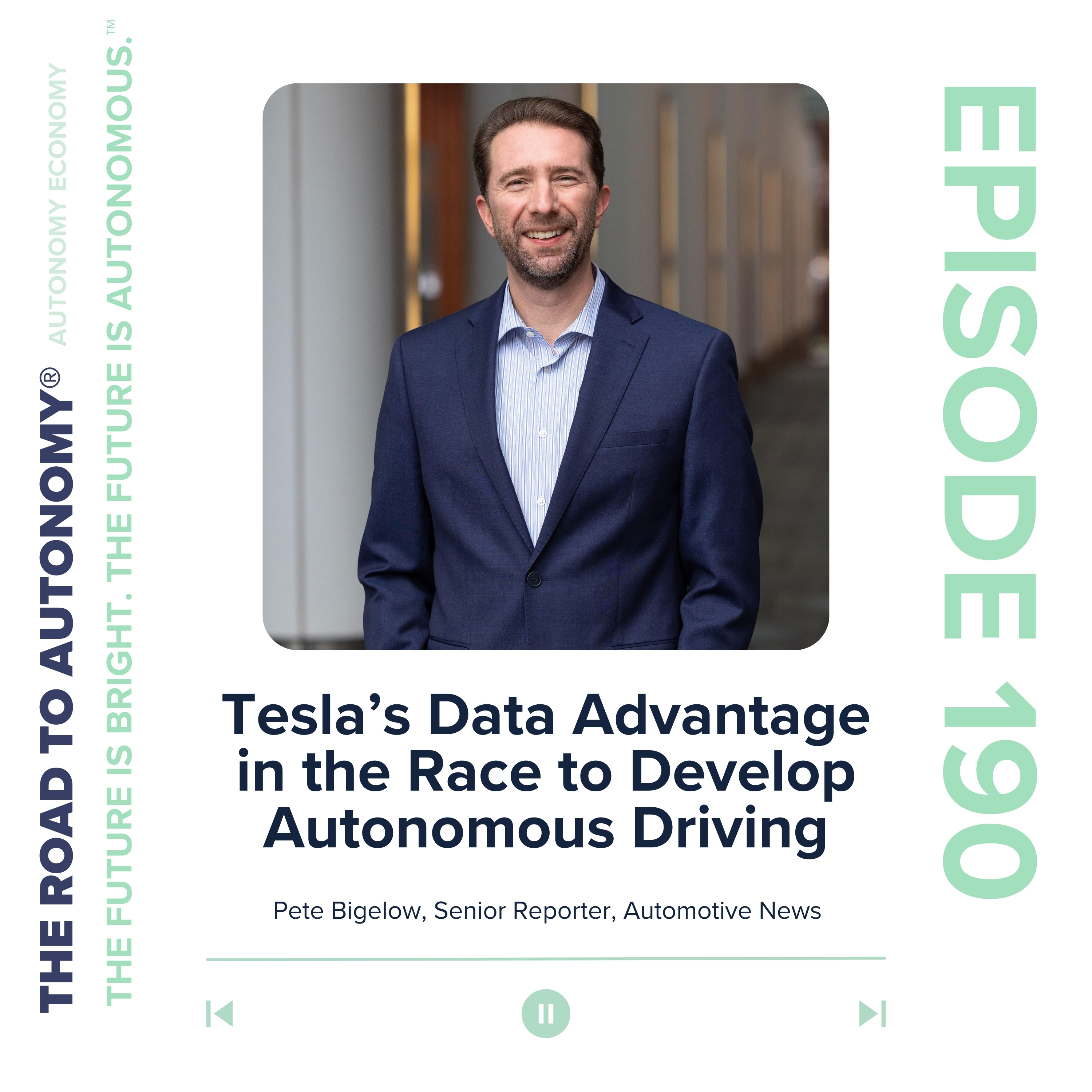
Episode 190 | Autonomy Economy: Tesla’s Data Advantage in the Race to Develop Autonomous Driving
from The Road to Autonomy
Pete Bigelow, Senior Reporter, Automotive News joined Grayson Brulte on The Autonomy Economy podcast to discuss Tesla’s data advantage and what it means to the development and commercialization of autonomous driving. The conversation begins with Pete and Grayson discussing Tesla FSD (Full Self-Driving) and the advantages Tesla has with their data gathering abilities. Tesla has over 5 million vehicles fitted with FSD hardware and software on the road today, driving an estimated 50 billion miles per year — 100,000 miles per minute. This on-going data collection gives Tesla a massive advantage over competitors developing an end-to-end neural net self-driving stack.Mobileye is taking a similar approach to Tesla by gathering real-world driving data to train their autonomous models. Currently Mobileye has over 26 years of data equaling over 200 petabytes of driving footage, equivalent to 16 million 1-minute driving clips. But is it enough data to train their autonomous driving models and scale a business?It has yet to be determined if there is a business there for Mobileye as year-over-year revenues are expected to be $226.35 million, down 50.6% from the year-ago. To try and accelerate revenue growth, Mobileye is moving the business away from ADAS chips to the autonomous driving sector which has larger margins. [Mobileye is] talking about going from roughly $50 dollars of revenue per unit to $1,500 with Supervision to $3,000 per car with Chauffeur. So I think that the path mobilize sees forward is really ramping up production of those systems, finding buyers for those systems, particularly in China.– Pete BigelowWhile it’s well known that Tesla is gathering driving data, it’s not well known that Mobileye is gathering driving data. Could consumers push back and demand to be paid a fee for gathering data for Mobileye? If consumers demanded to be paid, the Mobileye autonomous driving business model would be at risk. Then there is the political risk. What if a U.S. Congressman or Senator introduced a “Car Owner Bill of Rights”?The data being gathered by vehicles is going to be an asset class at some point in the future. When it becomes an asset class, owners of the vehicle will demand to get paid the same way publishers are demanding to be paid today when their content is used to train large-language models (LLMs). Data is the asset that unlocks future business models. One of the most significant business models that will emerge from the development of autonomous driving is licensing. If FSD use rates pick up and Tesla does indeed license FSD, RBC is projecting that Tesla will generate $35 billion in FSD revenue and $18 billion in licensing a year by 2035 for a total of $53 billion a year in revenue.Then there is Qualcomm. In Q1 FY 2024, Qualcomm reported automotive revenue of $598 million up from $456 million in Q1 FY 2023. An increase of $142 million, year-over-year. Sales were partly driven by the Snapdragon Digital Chassis Solution. Their year-over-year automotive revenue is growing faster than both NVIDIA and Mobileye. With a $30 billion dollar design pipeline and focus on ADAS, Qualcomm is well positioned to enter the autonomous driving market in a big way.Qualcomm has become already the quiet giant of the automotive industry. – Pete BigelowWrapping up the conversation, Pete shares his insights into how he sees autonomous driving market evolving over the next five years.Recorded on Friday, March 8, 2024 Episode Chapters0:10 Tesla FSD5:15 Mobileye19:51 Licensing Autonomous Driving Software 29:10 Qualcomm34:48 Evolving Autonomous Driving Market--------About The Road to AutonomyThe Road to Autonomy® is a leading source of data, insight and commentary on autonomous vehicles/trucks and the emerging autonomy economy™. The company has two businesses: The Road to Autonomy Indices, with Standard and Poor’s Dow Jones Indices as the custom calculation agent; Media, which includes The Road to Autonomy and Autonomy Economy podcasts as well as This Week in The Autonomy Economy newsletter.See Privacy Policy at https://art19.com/privacy and California Privacy Notice at https://art19.com/privacy#do-not-sell-my-info.
Embed this episode
What this episode covers
Pete Bigelow, Senior Reporter, Automotive News joined Grayson Brulte on The Autonomy Economy podcast where he discussed Tesla's massive data collection advantage from its vehicles on the road and whether this will allow them to pull ahead in autonomous driving. He analyzes the competitive landscape, including players Waymo, Mobileye, Apple, and Chinese automakers. Bigelow explores the economic impacts and hurdles around data privacy that could disrupt the autonomous vehicle industry.
NOW PLAYING
Episode 190 | Autonomy Economy: Tesla’s Data Advantage in the Race to Develop Autonomous Driving
No transcript for this episode yet
Similar Episodes
No similar episodes found.
Similar Podcasts
No similar podcasts found.