In the years after the Mexican Revolution, beginning in the 1920s, Mexican authorities sought to teach new narratives about Mexico's past to its people. Here is Susan Vogel, who is a scholar of Mexican art. And the government retained artists to paint the walls of, public walls of Mexico. And a lot of people did not speak Spanish, they spoke a lot of indigenous languages, so this was an effort to use visual art to teach people the values of the revolution.
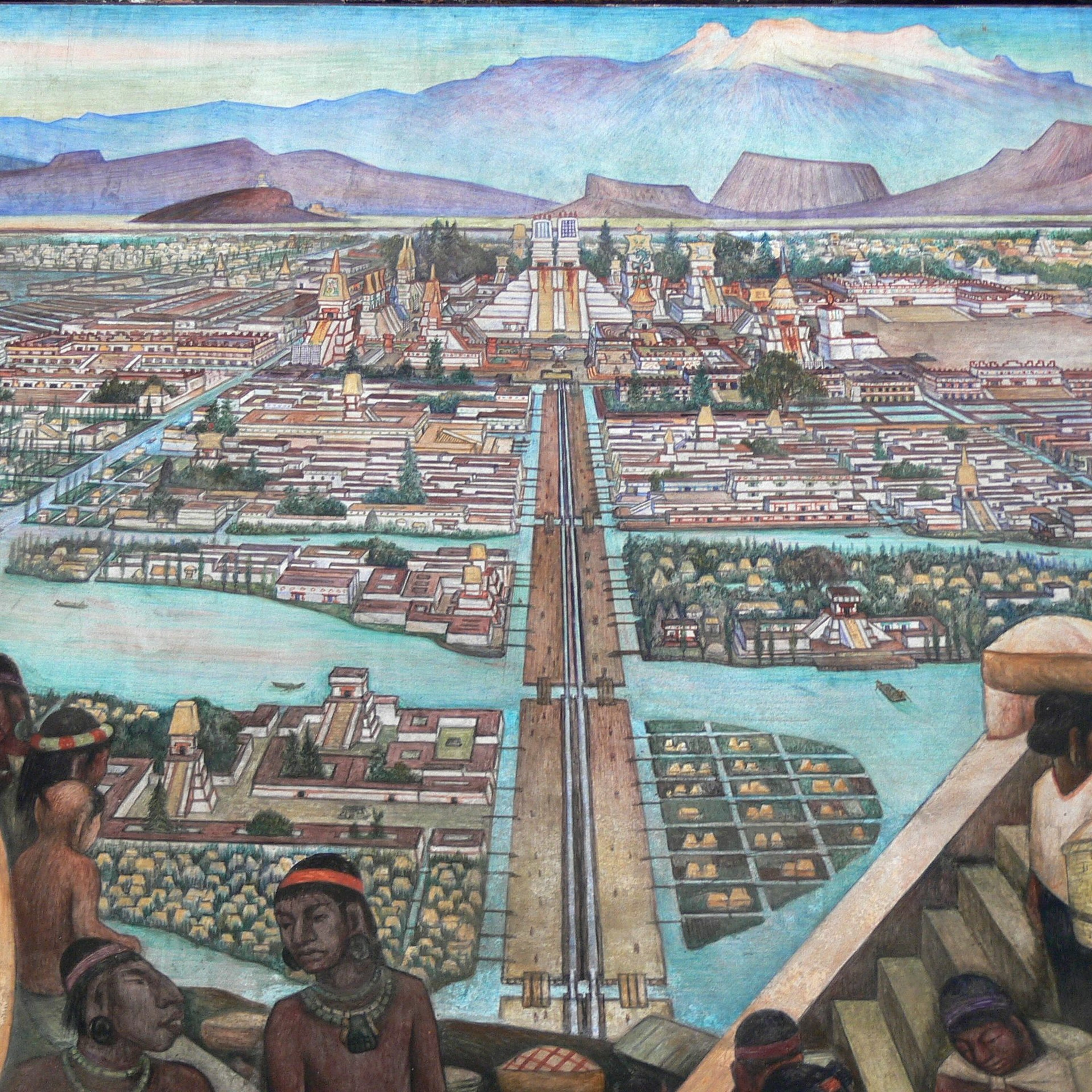
One of the goals of this time was to honor Mexico's indigenous heritage, and not just the influence of the conquering Spanish empire from centuries before. So Diego Rivera painted murals that showed the indigenous history of Mexico, and showed really how amazing it was, and how incredible these cities were, and a lot of people didn't know it at the time. There are no photographs of ancient Tinochitlan, of course, but there were visual representations of Tinochitlan made by the Aztecs found in the CODESES. Diego Rivera had some of these to go on, but mostly it was his imagination.
Many books of historians that had to write against the kings in Spain described the city as, I think, deo Rivera did a fantastic job in putting it all together in one piece of art. This is Fannie Blower. I remember specifically the books that I have read, how Cortes described the temple of Moctezuma as this high pyramid painted a white pyramid with different colors around it, and manifestations of what they believed, and how clean and organized the city was. This is Nueva Sposic's part two on Ross Chambos, and in this episode we're talking about Diego Rivera's mural, the Grand Tinochitlan.
Tinochitlan, now Mexico City, was built on a lakebed that meant there was a lot of water everywhere. So there's all these islands, and there's causeways running across, connecting the islands. There are urban areas, buildings, there are markets, there are people looking out over a balcony. The Aztecs even engineered a series of floating islands for growing crops like maize or corn, together with beans and squash, stables of the Aztec diet.
The city also hosted a large marketplace. The marketplace is bustling with people selling deer, feathers, minerals, fruits and vegetables, flowers, cacao, artwork and even gold. The Aztec city even had its own medical center, which included steam baths and a variety of herbs used as medicine. It's extremely organized, architecturally designed and engineered metropolis that probably had about 200,000 people at the time.
For Fannie and modern Mexicans, this representation of the ancient city has special meaning. Mexicans can even point to their own neighborhoods, shown in Diego Rivera's mural. I grew up in that area where the market used to be called L'Aetelolco. L'Aetelolco was the sister community of Tinochitlan, which is only about two miles away, and that's where the market would establish the city.
Still, there's a plaza in Mexico City that is called the Plaza de la Stres Cultura, the Tree Cultura Plaza. The reason why it's called the Tree Cultura is because you can actually see the remnants of the pyramids, the archaeological sites where the market used to be. The church that later was built during the colonialism made of the same stones that were destroyed. Then in the 1960s, they decided to develop the first urban community within a city in Latin America, 1960s.
I am from there. I grew up seeing these three manifestations of my culture in one place. For many, Rivera's mural helps us to realize the complexity and the advanced development of these indigenous cultures, something that has often not been taught, especially in the US. For me, the spending is especially powerful.
Just because growing up in the states, I didn't get a lot of this history, and so it was really the first time that I got to see the complexity of these cultures. I think at this time period, this city arrived, what was happening in Europe, and I think that's probably why the Spanish were so astonished. Because they arrived thinking, oh, we're going to have these primitive beings, and in some cases, they were equally or more advanced than us. Also, the fact that you have indigenous people painted on here, most art that I would see that is valued tends to be European.
And so here, I see some beautiful brown faces, and so I thought you got on there. Definitely meant a lot to me. And this is still one of my favorite paintings from Nevada, but I still want to laugh. You can see a photograph of Diego Rivera's 1945 mural, the Grand Tino de Lón, which today is found in the National Palace in Mexico City, at our website and home for this podcast, Artesmexut.org.
Luis Lopez, Fannie Blauer, and Susan Vogel are of course the regular hosts of this podcast. This is made possible by a grant from Utah Humanities, and thanks to KCPW Salt Lake Public Radio for the studio space. Music you heard in this episode comes from Ricardo Lozano and Jorge Ramos. Nueva Sposius is produced and edited by me, Ross Chappellis.