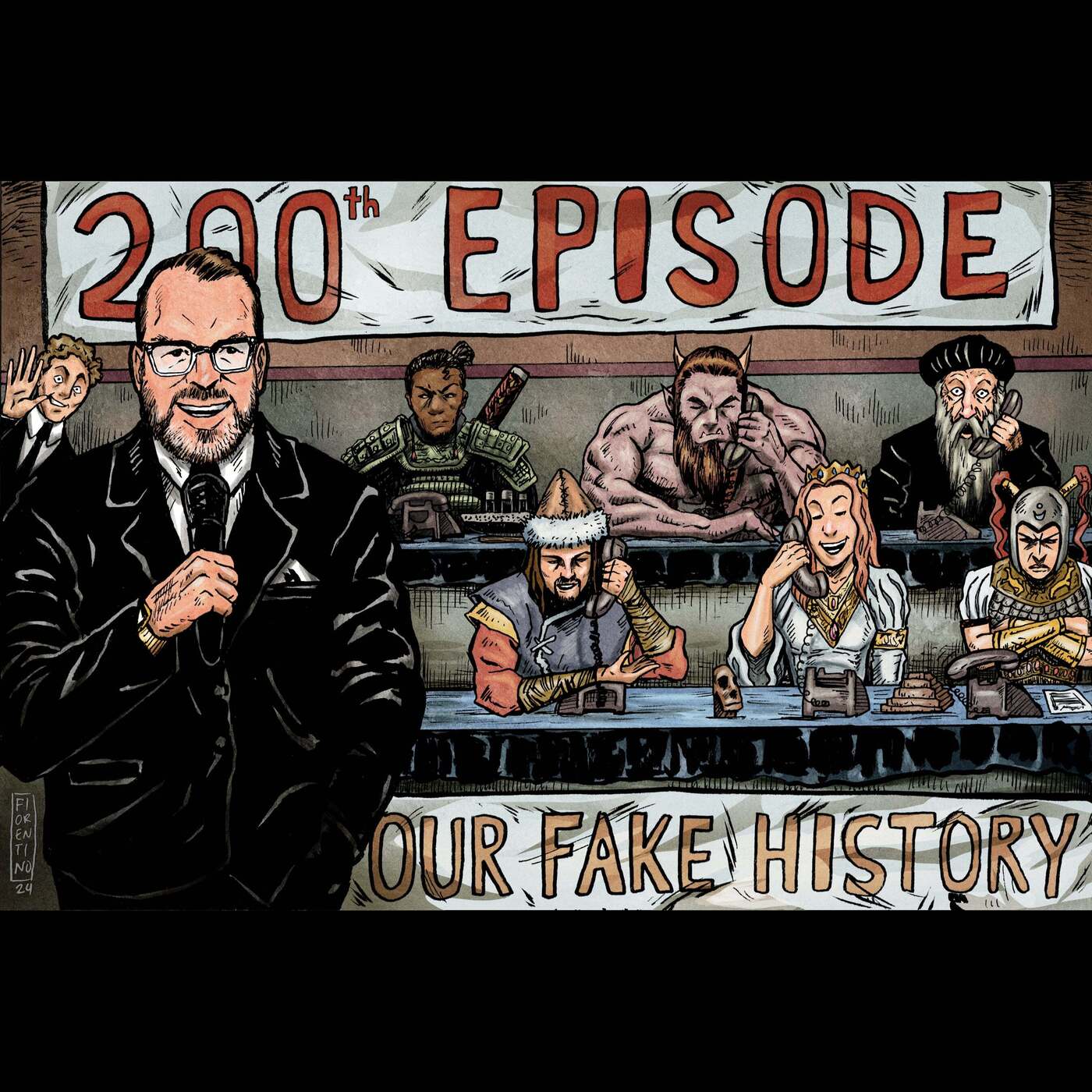
Friends, the experts all seem to agree that the number 200 is powerful, but problematic. Back when I was approaching my 100th episode in 2019, I started looking into the significance of the number 100, and I found nothing but good omens. The number 100 is filled with positive connotations. It's literally synonymous with perfection. Nothing better than keeping it 100. But 200, ooh, there's something shifty about 200.
Now, famously, there are two types of number experts out there. There are mathematicians and there are numerologists. Normally, I would turn to the mathematicians for a sober and precise explanation of the significance of a number. But I've found when it comes to the number 200, mathematicians get downright poetic. It turns out 200 is what mathematicians call an Achilles number.
Now, for someone who spends a good chunk of his life thinking about mythology, that caught my interest. What does the Homeric hero Achilles, the mightiest of the Greeks, have to do with 200? Well, it turns out the term Achilles number was coined by the English statistician Henry Bottomley, who aside from having a deep interest in mathematical patterns, also seems to have spent some time with the mythology of the Trojan War. So, what are these numbers? Well, according to MathWorld.com, quote, Friends, I don't know what any of that means. Over the past 200 episodes, if I've demonstrated anything, it's that math was never my subject. But even if I don't fully understand what's meant by the words prime factor and positive integer, I very much grasp the significance of Achilles.
Achilles was powerful, nearly unstoppable, but cursed with a flaw that was destined to be his undoing. 200, like Achilles, demands to be reckoned with. It's a number that is mighty but prideful. It's also a number with big feels, as the kids were so recently saying. 200 beefs with Agamemnon, stubbornly returns to its tent and remains there unwilling to emerge and bless its compatriots with its prowess. 200 mourns Patroclus and disrespectfully drags the body of Hector around the walls of Troy.
But 200 ultimately reconciles with Priam, allows the old man to bury his son, and embraces him like he was his own father. 200 contains multitudes. It seems appropriate, then, that I've walked a somewhat rocky path towards this 200th episode. It's an anniversary that refuses to be celebrated easily. All the early ideas I had for marking this occasion, live events, collaborations, etc., were stymied by setbacks and complications. 200 was potent, but moody. 200 kept on trying to retire to its tent. It also seems appropriate that 200 is an Achilles number, the number most tied to the Trojan War, because the city of Troy is indelibly tied to the one man who has haunted this podcast since season one.
Oh yes. It's weirdly perfect that archaeology's greatest scallywag and the ultimate Our Fake History frenemy, Heinrich Schliemann, was lurking inside the number 200 this whole time. That man is basically the poster child for being both important and problematic. For better or worse, the mathematicians revealed a deep truth about the number 200. A truth that I am finding oddly comforting. The 200 moment is supposed to be a little awkward.
But what about our other number experts, the numerologists? What do they have to say about the significance of 200? Well, turns out if you Google 200 in numerology, you will be directed to some very colorful websites. But I found myself stuck on a little something I read on a terribly designed site called AffinityNumerology.com. There, the anonymous numerologist explained that, quote, a person expressing 200 energy has the need to be with someone, to coexist. Relationships are comforting. Any relationship where roles are understood and accepted, be it social, career, personal, or any other type of relationship, there is a sense of wholeness and infinite potential, end quote. Now, that might be some new age drivel, but I'll be damned if it didn't stop me in my tracks.
I had decided to make this a call-in show where I would engage with the voices of listeners long before I came across AffinityNumerology.com. And it turns out I really was expressing some 200 energy. I clearly had a need to coexist. This podcast is usually just one voice telling you a story. But now here I am demanding to be joined by the voices of the community. Because it turns out relationships are comforting. I asked you to call in with your questions, and in droves you responded.
My god, affinity numerology. That non-specific pseudo-spiritual tripe was weirdly on the money. So let's do it, team. Let's embrace the Achilles-like power of 200. The eminent but flawed anniversary calls out for the need to coexist. So let's do this together. Will we find a sense of wholeness and infinite potential? Let's find out today on Our Fake History. Episode number 200. Can I ask who's calling?
Hello, and welcome to Our Fake History. My name is Sebastian Major, and this is the podcast where we explore historical myths and try to determine what's fact, what's fiction, and what is such a good story that it simply must be told. As always, I want to remind everyone listening that an ad-free version of this podcast is available through Patreon. Just go to patreon.com slash Our Fake History and start supporting at $5 a month to get access to an ad-free feed and all the amazing extras. We're talking hours and hours of extra Our Fake History goodness.
This week, it's the 200th episode of Our Fake History, and we are opening up the phone lines. For the last month or so, I've been asking Our Fake History listeners to call in to our toll-free line or send me voice memos with questions. And the Our Fake History community showed up, so today I'm going to be answering as many of those questions as I can. First, I need to thank everyone who took the time to call in or send a message. It was an absolute joy to listen to all of your messages. I really mean that. I do this podcast almost entirely by myself. The only real collaborator I have is the resident artist Frank Fiorentino. And shout out to Frank for believing in this show from the very beginning and consistently making stunning images for every single episode. I love you, buddy.
My wife Beth is the moral support of this show and an occasional editor, but otherwise, I'm doing everything myself. This is a solitary endeavor, and I often forget how many people I'm sharing this with. But when all of a sudden I'm hearing real human voices that belong to people that really care about this podcast, I don't know, the audience feels that much more real, so I enjoyed this a lot. Being able to do this podcast as my full-time job has been a real gift. And I'm deeply aware that the only reason I'm allowed to do this is because all of you are out there listening. It means the world to me. Thank you, thank you, thank you. You have let me live my dream, and I really try to not take that for granted. So you can imagine how difficult it was for me to decide which calls would get played on the show. Because really, there's a part of me that feels like anyone who cares enough to call in should have their voice on the show. But honestly, if I did that, we'd be here all night. I had to make some hard cuts.
Everyone that sent messages that were just congratulations or kind words, I want you to know that those messages meant a lot. And I listened to all of them. They were all really sweet. Thank you. But those messages that were just kind words and didn't actually have a question, I figured, you know what, I'm going to save those just for me. The other type of message that I got that was a little less likely to make it on the show were questions that required a lot of original research on my part. These kinds of questions could make for great Our Fake History series if I did the work to answer them properly.
I'm thinking about the caller that wanted to learn more about the history of the Acadians and the Cajuns, or the caller that wanted to get into the conspiracy theories that surround Newfoundland's entry into Canadian Confederation. There was a caller who was curious about the history of gender non-conforming people. Scott Burry from the Beyond Barbarossa podcast wanted to know whether the Nazis were really as into the occult as some sources claim. Then there was that caller from India who wanted to know whether or not the Mughal armies under Emperor Babur would have defeated an equal force of Spanish conquistadors led by Hernan Cortes. Now, these are obviously super interesting questions, but they're beyond the scope of what I'm doing here today. So apologies to those callers whose questions were super interesting, but were altogether too big. Don't worry, though. I'm putting many of them in my back pocket for future episodes.
Similarly, if you had a question along the lines of, Sebastian, will you ever do a show about blank? The answer to all of those calls is yes. Yes, I will eventually do a show about that topic. To all my fellow Canadians, yes, I will be doing more Canadian topics. To my guy who wanted the show about Alistair Crowley, yes, totally. The young woman who wants more shows about South Asia, yes, that part of the world is conspicuous by its absence on this podcast. To my man from Mexico who wanted the Comte de Saint-Germain show, yes, he has been on the list forever.
Don't worry. I need to keep this show going. So have no fear. I'll get to all of it. Questions got bumped up on my list if they were asked by more than one listener. If it felt like a number of callers had a similar question, I took the best phrased call and used it as the representative of the batch.
I will also say that I did not script my answers to these questions, so what you're going to be hearing is me shooting from the hip. So, you know, forgive my hums and haws and my tendency to start speaking quickly when I get excited. I should also let you know that I reached out to a number of past guests on the show to see if they wanted to submit a question, so you might be hearing some familiar voices. Okay, without further ado, let's take some calls. Hey, Sebastian. My name is Jake, and first and foremost, a huge congratulations on 200 episodes. What a milestone, man. I love the show. It's gotten me through some pretty long drives and some pretty tedious chores, and I've learned a ton, so thank you so much. Okay, so now to the question. A lot of our fake history episodes seem to poke holes in the myths of vilified historical figures and sort of rehabilitate their historical image. Most recently, we heard that throwback episode about Nero, and we have that new trilogy featuring Caligula. My question is, do you believe that some of our, in my humble opinion, accurately vilified 20th century dictators, like Mussolini, Stalin, and even Hitler, could have a rehabilitation of their own? If so, how? Thank you so much. Congratulations. Yes, to another 200.
All right, Jake, thanks for the awesome question. When you posed that one, I thought immediately of one of the best pieces of history podcasting I think that's ever been created. And that is Dan Carlin's hardcore history series called Wrath of the Khans, which is all about the Empire Forged by Cengiz Khan and his successors. He starts that series by challenging his audience to write a book that he knows will make all sorts of money, get all sorts of press, be discussed all over the internet, but also might be super dangerous and maybe even immoral to write. The topic of that book would be, here are the good things accomplished by the Third Reich. Now, I don't think he was trying to be an edgelord or make any apologies for the Nazis. He was making the point that a figure like Genghis Khan, however you'd like to pronounce that,
was presented in many Western histories for centuries as nothing more than a murderous barbarian. He was considered one of history's great villains, at least by one stream of history writing. However, in more recent years, there's been a move to challenge that perception. I don't think I have to tell you that in the modern state of Mongolia, Genghis Khan is considered a bit of a national hero. In 2004, the anthropologist Jack Weatherford wrote a book called Genghis Khan and the Making of the Modern World. And in that book, he argued that the Mongol conquests of the late medieval era were actually really good things for the world, that they resulted in all of this new cultural achievement, that trade routes opened up, and that perhaps even the European Renaissance could in some way be credited to the conquests of the Khans.
So in a lot of ways, that's the perfect example of the kind of thing that you were referencing in your question. With enough time and distance, the bloody nature of conquest kind of gets forgotten or the edge gets taken off it. And we can see some of the positives, I suppose. But one thing I really liked about Dan Carlin's series is that he put the blood back into the story because it's important to remember that to create that empire that may have had lots of wonderful cultural achievements associated with it, a lot of people had to die. And it should be noted that the Mongols of that period weren't shy about that fact. That was a big part of their image, was that they were fierce, they were scary, they leaned into that. Now, I'm not saying that just to pick on the Mongols. Quite the contrary, I think the Mongols are actually a very typical empire. Empires, large, you know, continent-spanning empires, are built through blood.
In that series on Caligula, I found myself thinking a lot about how even the quote-unquote good emperors of the Roman Empire had to preside over a military system that was killing thousands of people and enslaving thousands of people all the time. If anything, I think the wider tradition of history writing has been somewhat forgiving when it comes to blood spilled. There's lots of conquerors that we put up on a pedestal. I know I made that point when I was doing that series on Attila the Hun, another figure who's often been presented as a villain. I made the point that maybe he's not all that different than a lot of other conquerors. But maybe all conquerors are a little immoral, right? Maybe? I don't know. Hold that idea in your head for a sec. When evaluating my own biases when it comes to making this show...
I've thought a lot about how I can sometimes trend towards what I see as a reasonable middle ground on things. And that's not always the right thing to do. I have to stop myself from doing that from time to time. Because if you let yourself go too far with that way of thinking, then, you know, a hundred years in the future, you'll look back at a Stalin, a Hitler, a Mussolini, a Pol Pot, whoever you want to say, and you'll go, well, they couldn't have been that bad. The reasonable position is that they're not that bad, but maybe they were that bad, right?
We have to kind of allow for that. And that's something I thought about a lot when I was making that Caligula series. And I hope I got the balance right. You guys can decide. Hey, Sebastian. Chandra here. Long time listener. So my question is, of all the places that you've covered in the course of doing the show, which ones do you most want to visit and which ones would you least like to visit? My mom and I always love listening to this while we're traveling. And it's always cool when we're somewhere that you're talking about. So I'm wondering where you would go if you could. Thanks. Love the show. Bye.
Thanks. I love this question. It's always nice to hear that the podcast has enriched people's travel experiences. A few people have reached out over the years telling me that they've been listening to the podcast while they've been traveling somewhere, and it's made it better. That is so cool. One place that I've been that I know was enriched by all the research I'd done on that place was Mexico City. A few years back, before my wife and I had kids, we got to go to Mexico City, and man, it's an incredible place. If you get a chance in your life to visit Mexico City, highly recommend it.
Knowing a bit more about the history of that place, and specifically the history of the conquest of Mexico, what that place was when it was an indigenous city, you know, the capital of Mexica civilization, made it better. One of the best museums I've ever been to anywhere in the world was the National Museum of Anthropology in Mexico City. A lot of incredible artifacts from all over Central America are gathered there. It's truly amazing. As for other places I've talked about on the podcast that I want to visit, Japan. Right at the top of the list. I really want to go to Japan. A friend of mine went to the Sumo Wrestling World Championship in Japan a few years back, and I really want to do that. That looks like so much fun. So yeah, number one with a bullet has got to be Japan. In terms of places I don't want to go, probably the bottom of the Atlantic Ocean to see the wreck of the Titanic. Famously dangerous. And number two, the moon.
Hello, Sebastian. My name's Luke. I've been a big fan of yours for several years now. The first podcast years I ever listened to was Did Nero Play the Liar While Rome Burned? While I was shoveling my driveway in Alaska, and I was hooked since then. My question for today is, when you're going through and reading the sources and putting the story together, what are your least favorite or your favorite tropes you get from the sources? Be that Wicked Stepmother tropes or Historic Last Stands, which one of these tend to aggravate you and which one of them do you enjoy reading, even if they're historically wrong? I would love to know that, and thank you so much for your work. Thanks for the question, Luke.
When it comes to historical tropes that I find a little exhausting, honestly, all the slander that you find about powerful women. It came up in the very first episode I ever did on Queen Elizabeth, and it keeps coming up again and again and again, and it never changes. It's always the same set of slanders and stereotypes that are used against women. And not just powerful women, really all women. Now, I'm sure if you are a woman out there, when you come across these, they're even more eye-rollingly annoying. Maybe that's underselling it, but...
But after you've studied this stuff for a while, you can feel it coming. You're like, oh, we got a powerful woman here. How long before they call her a lying sex witch? Oh, page nine. There it is. But I suppose I keep coming back to it on the show because it is so persistent and so pervasive and literally thousands of years old. I don't know if there's a set of stereotypes that are as enduring as the ones that women have to deal with. It's there in the historical record. I come across it all the time.
As for historical tropes I find kind of funny, it's always interesting when you're reading a source that was written right when a particular culture felt very dominant and very secure in its dominance, because the writers tend to just assume that they're going to be at the top of the heap forever. This can give otherwise perceptive writers some really noticeable blind spots in hindsight. In the last series I did, I found myself reading a bunch of Victorian-era historians who were just so convinced that the British Empire was the best thing that had ever happened in history and wasn't going anywhere.
Reading that in 2024, you're like, oh, isn't that cute? But of course, this isn't just a British thing. This is kind of a human thing. I noticed it when I was reading sources that were written at the height of the Ottoman Empire. Some of those Ottoman writers were just convinced that their civilization was the best, greatest civilization that had ever existed, and everyone outside the borders of their empire were just hopeless barbarians, especially the Europeans to their northwest. You can notice very similar attitudes in histories written at the height of certain Chinese imperial dynasties, where once again, they are convinced that...
their society is the peak of human civilization and anyone not participating in it has to be a backwards barbarian, right? You just see this again and again and again. All of these cultures also tend to view history as building up to their moment and then culminating in it, you know? Anyway, I feel like there's a lesson to be learned there about humility and the long scope of human history. So yeah, I find it kind of funny. I'm always surprised when people haven't learned the lesson that things rise and fall, things decay, you know, nothing is permanent, right?
Sebastian! It's Amy Nicholson. Hello, film critic, co-host of Unspooled, and happy 200th anniversary. That's just beautiful. You know, I was doing a little Googling, and there's a man who says he can give advice to, like, towns that are celebrating their first 200-year anniversary, which is happening a lot in America right now. And I was looking at his, like, list of things you could do to commemorate an occasion. You know, schedule a ribbon-cutting, create a photo or video montage, wishing your town a happy birthday, give an award to the oldest business, host a community-wide day to give back. And the one that really caught my eye was Idea 11, bury a time capsule. So my question to you, Sebastian...
If you were going to bury a time capsule, you, the man who understands the arc of history better than pretty much anybody, what would you put in your time capsule right now to commemorate this moment, 2024? Thanks so much for that, Amy. So nice to hear Amy Nicholson's voice again. I reached out to Amy. I let her know that the 200th episode was coming up, asked her if she wanted to submit a question, and she sent back that lovely and thoughtful message. What a gem.
Absolutely love her. For those that don't know, Amy is the host of the podcast Unspooled, where she looks at some of the greatest films ever made or debates whether or not a film should be considered great. She's also a film critic for the New York Times and other publications. And she was a guest on Our Fake History last season. And we talked about history in the movies.
So to answer Amy's question, it's tricky because I feel like in 2024, we're still living in a post-pandemic era. I don't know. I feel like we're still processing what happened to us during the pandemic. I feel like we're still emotionally, psychologically and socially working through everything that went down during that time. So I am tempted to put in the time capsule some of that weird paraphernalia that came out of the pandemic that doesn't seem to make too much sense anymore in 2024.
I'm thinking about those weird specific things that will probably never happen again. I don't know if this went down where you're from, but in Ontario, a lot of small breweries and small distilleries made small batch hand sanitizer, especially in 2020. Right in that early part of it, when everyone's like, we're going to chip in, we're going to do this together. And those small businesses that were deeply affected by the pandemic were like, we're going to shift our production to hand sanitizer. So if you have one of those bottles of boutique hand sanitizer from your local distillery, that would be the kind of thing I would throw in the time capsule.
Now, you could argue that that sort of thing is better put in a 2020 time capsule. But I feel like now in 2024, you know, spring is coming. You're doing a little spring cleaning. You come across like a weird half empty bottle of very specific hand sanitizer. And you go, oh, man, this has been a weird few years. So that's what I do. Thanks, Amy. I love you. Keep making amazing podcasts.
Hey, Sebastian. My name is Zach, and I am calling you from beautiful Minneapolis, Minnesota. About two and a half years ago, I became a parent, and it has really changed how I see the world and all of the really wonderful and terrible things in it. My question for you is, since becoming a parent yourself, what historical person or event or time period do you feel you understand better or differently? I will hang up and take your answer off air. Thanks. Thanks for the question, Zach, and thanks for that classic call-in show sign-off. I appreciated that.
Yeah, of course, having kids completely changes your perspective. All the parents listening know this. It's not something that happens overnight, by the way. I think before I had kids, people told me, like, oh, as soon as you see that baby, your whole world's going to change. Yeah, for me, it took a little while. It took a few months for my world to properly shift and change, and it continues to change as your children grow. But yes, of course, it has changed me, and hopefully in a good way. One thing is I'm just way more sensitive to anything involving children in both the stories I research for the show and just media I consume.
I don't like seeing kids in danger anymore. I've got no stomach for it. I think a lot of parents feel that way. As soon as you have kids, you see a kid in danger, even in a crappy movie, all of a sudden you're like, no, I turned it off. I don't want it. But when I think about how it's actually affected how I approach what I research on the podcast, the one series where I think it really came up was the series I did on Mozart. Because so much of that story is about the dynamic between Mozart and his father, Leopold. And I think before I had kids, I would have had no sympathy for Leopold.
Many of the Mozart experts I read were not big fans of Leopold Mozart. And I get it, right? Leopold comes across as controlling, short-sighted, unimaginative. He's obsessed with money. He's constantly meddling in Wolfgang's life. So if I was not a parent myself, I probably would have just taken that as gospel. I would have been like, oh yeah, Leopold Mozart is the worst kind of show dad, and he deserves all the scorn we heap on him.
But now being a parent, I found myself wondering how I would react if I had this prodigy of a child. If one of my kids showed some enormous talent at something, how would I nurture that? How would I help them? What would our dynamic become? And I thought about how difficult it would be to navigate that. And all of a sudden, I perceived Leopold differently. And actually, when I started reading more of the letters, what I found was a lot more affection in them. He had a lot of love for Wolfgang and for actually both of his children.
You know, some of the experts make it seem like he was this cold, unfeeling man just obsessed with exploiting his kids financially. And that's not the whole story. I think there was real, genuine affection. He really wanted the best for them. He just couldn't let go. His grip was too hard. And I couldn't help but feel sorry for him, but also understand him a little bit more. You know, parenting is really challenging. And the thought of someone hundreds of years from now going through all my personal correspondence and then deciding that I was a terrible father, that hit me.
I was like, oh man, how am I coming across to the world? I'm not perfect as a dad. I'm just doing my best out here. That's not to say we can't criticize Leopold Mozart, because I think we can. But I found myself more willing to take a softer view of the guy. Raising kids is tough. Raising a genius even harder. We can cut him a little slack, I think.
Hello, I hope you're doing well. I really loved your episodes on the Bennion Bronzes, and since I listened to them, I have found myself kind of on a bit of a research spiral. I think I've thought about them every day for the past couple of years since I listened to it. And I was wondering if there are any of the topics that you've looked into that have had that kind of effect on you, kind of outside of the sphere of the research that you did for the episodes. Thank you. Bye.
Thank you for the really nice question. First, I'm really happy that that series on the Benin Bronzes resonated with you. That was one that resonated with me, too, to be completely honest. It's a wild story, and I do find myself thinking about that one quite a lot. And I always love hearing when one of my series has inspired a listener to go out and research the topic themselves, get the books, become an expert on it, or just go deeper. I mean, that's the whole point of this, right? It's hopefully to inspire a love of learning. I mean, hopefully that doesn't sound too grandiose.
Anyway, the topics that have stuck with me. Well, this season, a couple of them I found really sticky. The series on the Salem Witch Trials, I kind of got obsessed with that topic. I couldn't let it go when it was done, and I felt like I had more to say about it. It's the fact that there were so many overlapping layers of weirdness at play in that story that I loved picking apart, but I feel like I just scratched the surface of.
odd psychology at play, the sincere belief in witches, all of the politics of Massachusetts that were going on, climate change and how that factored in. It just kept on going deeper and deeper. And all of those things only sort of seemed to explain a small piece of the weird puzzle that was the Salem Witch Trials. So that's one that I still find myself thinking about. I loved doing the Mozart series. I found myself feeling a real affection.
For Mozart. And so I was sad when that one ended. But that one wasn't so much like, oh my God, there's more mysteries here. I was just sad not to be reading books about my friend anymore. I feel like the real history heads out there know what I'm talking about when I say something like that.
When it comes to earlier seasons, I mean, last season, those Columbus episodes really were important to me, and I find myself thinking about that early contact period all the time. Going further back, I think about that series that I did on the Belgian Congo quite a lot. Not only everything that happened in Central Africa, but also just the character of King Leopold II. Something about a guy who is presenting himself as a great philanthropist, but in reality is running... one of the largest slave states in the world, that is a dark archetype that I feel like I see a lot of in the world right now. There you go. You draw your own parallels, but I don't know. King Leopold, I think, is truly one of history's great monsters, and he's not always perceived that way, and he should be. No offense to the Belgian listeners, but I think most Belgians have come to reckon with King Leopold II.
Speaking to you in this heavy Italian accent is me, Daniele Bolelli from History on Fire podcast. Just want to jump in here to say that Sebastian is one of my favorite podcasters, bar none, and he's just an awesome human being. Our Fake History is the first podcast that my daughter ever appreciated, even before growing to like my own, and so just that alone puts our Fake History eye on the list for me. Add Sebastian's great sense of humor, his knowledge, his amazing delivery, and you really can't ask much more from a history podcast. I honestly feel like all of us listeners are lucky.
to have Sebastian delivering such great content year after year. So I'm just going to embarrass him by adding compliments after compliments to this, but honestly, they are very well-deserved. He's just that good. So I look forward to checking out whatever he's cooking up next. Thanks, Daniele. That was, of course, the voice of Daniele Bolelli, the host of History on Fire, one of the greatest history podcasts on the internet today. Long-time listeners know that Daniele's been a guest on this podcast a number of times. So I reached out to him, see if he wanted to ask a question for this episode, and he came back with that really lovely message. I mean, what can I say? That was so nice. Thank you so much. You know, he's right, it can be a little embarrassing to hear someone sing your praises like that, but...
When they do it in a smooth Italian accent, it really goes down a whole lot smoother. So, many thanks to Daniele, and if you're not listening to History on Fire, go out, subscribe right away, enjoy his amazing storytelling. Hey Sebastian, I have a question regarding your research sourcing. We all know that each of your series is well-researched and thoughtfully relayed. It's often the case that you cite several sources that form the base of your research, one of which you rally around. What I want to know is, how do you decide which source you'll rally around? I can imagine multiple ways you might go about this. Maybe you have a preformed opinion on the topic, so you search for sources from that angle, spider out, and land where you land.
Maybe instead you try your best to be objective. Set what you already know to the side, see what academia has to say on a topic, and pick the most believable story. Or perhaps you take the most compelling case based on evidence alone, even if it's not the most believable story. I don't doubt it's a combination of these, but I want to know your process, not the outcome. I get the privilege of hearing your outcome every other week. Of course you pick the argument with the most compelling case. Of course you try to stay objective. But walk me through it. How do you start? Where does the spider begin on this web?
Okay, let's talk research. I really like this question because this gets to the heart of one of the most important questions you should be asking when you listen to the show, which is, should I trust this guy? Right? You know, I'm presenting myself as a myth buster, so I want to be as responsible as I possibly can. So allow me to share my process with you.
I research these shows the way I did research when I was writing papers when I was doing my master's degree. So I usually start out by going online and looking at what the newest and best reviewed book on the topic I'm researching currently is. Now, when I say best reviewed, I don't mean Amazon reviews. I go to JSTOR. For those of you that don't know, JSTOR is an online archive of academic journal articles. Most of the time, a good scholarly book on a topic will have been reviewed by other scholars, and you can find those reviews on JSTOR. So I do sort of a cursory search that way.
Those reviews will usually let me know if there's a serious problem with a source or if there's debate going on within the academic community about the validity of certain things or claims that that author has made. It just kind of clues me into what the discussion is in the academic world. Sometimes I'll get lucky and the topic that I'm interested in has a lecture series associated with it provided by The Great Courses. I get access to that through my Audible account. This is not an ad. It's just I honestly use that service.
Those can be really helpful because they are put together by experts on the topic. These are working university professors, and they also tend to give you an overview of the literature. But of course, you can't stop there. Now, usually there isn't a lecture series, so I'm going to go to the library. You know, the good old-fashioned library. I'm really lucky living here in Ottawa because I have access to two university libraries. I'm an alumni at Carleton University, so I still get access to that library, and my Ottawa Public Library card gets me access to the Ottawa U library.
I'll go to their websites. I will search through their catalogs and see what books are available in those two big university libraries on the topic. I'll then head to the library and check out books, you know, the old fashioned way. This is how I'm doing it. Now, the rule of thumb with these books is usually the newer, the better. The older the book is, the more it's going to reflect the scholarship of an earlier time. So the newer, the better when it comes to books on a topic. Then I start reading. And usually I'll start with that newest and best reviewed book.
But not always. Sometimes I'll get into a book, kind of get a sense of what the author's overall thesis is or if they're carrying any biases, and then I'll switch to another one to see if there's any major discrepancies. I'll kind of bounce around between my books. Now, in the vast majority of cases, I find that the information is pretty consistent, which is good, which is what you want. It means that there's academic consensus out there.
Now, I appreciate how close you're listening to these shows, because you've noticed that often I will find a source that I really like and quote from it a bit more often than I do the other sources on the show. Usually that's just because that author has phrased things in a way that I like, or they've got some insights that I have not found anywhere else. For instance, when it came to Caligula, no one really had the same kind of insights as Alois Winterling. And even though it was really difficult to say that name, Alois Winterling, I had to keep going back to that source. And I also didn't really find too many scholars who were contradicting him. He's really the best scholar there is when it comes to the life of Caligula. However, there were some topics that demanded that I look at as many sources as I possibly could. Columbus was one of those topics. I felt like I really needed a good sense of the literature because there is a lot more...
discrepancy or maybe divergence in opinion within the literature on Columbus. If you go back and listen to those episodes, I think you'll find that I'm citing an even greater variety of sources than I normally do. And by the way, if you're interested in what sources I'm using on this show, for every single episode, I put up a bibliography at OurFakeHistory.com. I don't say this out loud enough on the show. I really should be pointing this out every time. But if you're like, what sources is Sebastian using here? Go to OurFakeHistory.com, click on the episode that you're interested in, and you will see a list of the sources that I used in the show.
But, of course, I'm not perfect. I'm doing my best to be responsible in the shows that I create. But, you know, it's always possible that I've missed something, that I didn't get my hands on important source, or I missed a key criticism of one of the sources that I've been using. I remember getting really excited about the work done by the folklorist Adrienne Mayer. You might remember Adrienne Mayer. She's the author of the books The First Fossil Hunters and the book on the Amazons that I was citing, where she really makes a case that the mythical Amazons were real and were female Scythian warriors. Now, I loved her book. She's a very entertaining writer, and she's interested in a lot of the same things that I'm interested in, the intersection of mythology and history.
But in my first show about Adrienne Mayer's work, that's the show about real Griffins, I missed some of the criticisms that are out there about her work. And honestly, I felt a little guilty about that. So when I returned to her work about the Amazons, I think I was especially skeptical. I gave a lot of time on that show to her critics. And I got some blowback from that from folks that felt like I was too hard on Adrienne Mayer. And as a result, I was maybe too quick to dismiss some of the evidence for real Amazons.
So I guess what I'm trying to say is I do my best using the resources that I have to be as rigorous and as careful on this show as I possibly can be. I try not to rely too heavily on any one source, and I really do investigate if there's some serious controversy around any of the sources I'm using. But of course, I'm not perfect. I can make mistakes. I do my best to fess up to a mistake when I make it. And those who have been listening for a long time know that I make corrections. I've done full-on correction episodes when I've made an error. I've gone on other people's podcasts to discuss flubs that I've made. I want to be as transparent as I can because I'm not out here trying to pull wool over your eyes. I just want us to learn about this stuff. That's truly it. And you can, you know, decide if you believe me or not.
Hey Sebastian, my name is Scotty. I'm a huge fan of your podcast. Like most boys growing up, I was fascinated with pirates. My favorite movie as a kid was Muppet Treasure Island. I probably watched that movie a few times a week for multiple years in a row. One of the things I found most fascinating about pirates and pirate culture was, of course, the treasure maps. I was so obsessed that one time my dad even made a treasure map. He claimed he found it in a pawn shop. The map conveniently started in my own backyard, and after following a set of instructions written on the map, ended in my front yard.
We dug a hole where X marked the spot and found a small chest of treasure. Definitely a core memory from my childhood days. My question for you is, were treasure maps actually a thing? Or was this just a very well thought out literary tool? Are there any examples of real treasure maps out there? If there are, were they exactly like how they described in the stories where X marks the spot? Or were they filled with riddles how movies like The Goonies might have us believe? Thanks again. Really excited for the 200th episode, whether or not my question is included. Thanks so much.
First of all, Scotty, your dad sounds like a real gem. My God, father of the year. I absolutely love that story. That is so wonderful. As for your question, well, I got good news and I got bad news. The bad news is that pirate treasure is kind of just a literary trope. Kind of. You mentioned that as a kid, your favorite movie was Muppet Treasure Island. Well, the novel Treasure Island, written by Robert Louis Stevenson, is patient zero for a lot of pirate lore. The Hollywood archetype of the pirate largely comes from the writing of Robert Louis Stevenson, right? His character of Long John Silver, his whole crew of pirates in that story has shaped how we've thought about pirates really ever since.
The pirate's treasure map where X marks the spot really is a creation of Robert Louis Stevenson. But that's not to say that there isn't pirate treasure out there. Treasure hoards are kind of a thing, right? There are hordes of coins that have been found all over the world. We know that crusaders brought back relics and other valuables from the Holy Land when they were there on crusade. And of course, there are many burial sites around the world that have been found filled with valuables. Now, is that really treasure or are we getting into the realm of grave robbing? You decide.
But to bring it back to the classic age of piracy, during the height of the Spanish Empire, there were all of these ships going from the New World back to Spain, laden with gold and silver that had been plundered from the indigenous people of Central and South America. Some of these ships sunk. Some of them were attacked and went down. Some of them were sunk by storms. We know that many opportunistic pirate-like folks went and tried to salvage what they could from these wrecks, even going so far as to dive when they could to get the treasure.
So these sunken treasure ships are really the closest thing I think we get to real pirate treasure. But unless I've missed something, and I could have, I don't think there are any historical records of pirate treasure maps where X marks the spot. So, sorry, dude. It might just be something that was invented by Robert Louis Stevenson. Hello, Sebastian. Scott Todd here from Mobile, Alabama, USA. Patron and loyal listener since I discovered our fake history in the middle of season one. My 200th episode question for you is a new twist on an old history hunter trope. If I loaned Sebastian Major my time machine with the catch that you can't travel in it but only use it to bring a historical figure into current times to show them around our modern society, who are you summoning from the annals of time and why? Keep up the great work, Sebastian. And remember, just because you haven't seen my time machine doesn't mean it isn't real.
Thanks so much for that question, Scott. A few of you had questions that were roughly along those lines. If I could interview someone from the past, if I could bring someone from the past to now, who would I choose? But I played you Scott's message there because one, I love that Alabama accent, and two, I really like the idea of a time machine existing in Scott's garage in Mobile, Alabama. That just makes me smile. Okay, so who would I bring back? Well, it's got to be someone who's going to be a good hang, right? Someone who seems fun, someone who would be cool to hang out with, right?
a way Galileo springs to mind. Even though he was kind of cranky and ornery, he also seems like he had a real sense of humor, and he would be the kind of person who would have a lot of interesting insights on our modern world. So, Galileo, right at the top of the list. But then I kind of skew towards people that know how to party, you know? Eleanor of Aquitaine would be a good time. She knew how to party. Cleopatra knew how to party. Mozart, I keep on bringing up Mozart, but honestly, I could pal around with Mozart for a day if he wanted, you know, if that was cool with him.
Another person that I'd really love to spend some time with is the Brazilian inventor Alberto Santos Dumont. You might remember he was one of the early pioneers of heavier-than-air flight, and for a while people thought that he had indeed invented the first airplane. But really, he was the guy that made ballooning cool, and he had that little one-man dirigible that he used to fly around Paris and go bar-hopping him. I mean, really, I'd love to go back to turn of the century Paris and go bar hopping in a dirigible with that guy. That's what I really want to do. So I know that's not how your time machine works, Scott, but man, doesn't that sound like a good time?
Hey, Sebastian. Wiebke here. Thank you so much for this listener call. I've been listening to our fake history since the beginning of 2020, which means it became a very big part of my daily walking routine during lockdowns. And I have learned so much. I love your blend of storytelling, human historical detective work. But I was wondering, is there a historical myth that you once believed yourself until you investigated it further? And if so, which one was it? And at what point did you actually change your mind?
Also, will there be more music-related episodes? I'm a classical music buff myself and a violinist, and I absolutely love the Mozart episode and also the Who Invented Rock and Roll one, which I know you liked a lot as well. So I was wondering if there's going to be more musical episodes. Thank you so much. Hey, Vipka. Thanks so much for the nice question. Yes, there have been historical myths that I have believed, and a number of them have come up on this show. Folks might remember my first major flub on our fake history, which was claiming that the Battle of Asian Corps during the Hundred Years' War was the origin of both the middle finger vulgar gesture and the two-finger vulgar gesture that is popular in the UK.
The legend was that the French had been mutilating the hands of English prisoners of war so they would never again be able to draw the devastating longbow. Then, after the Battle of Asian Corps, when the English were triumphant, they then mocked the French prisoners by holding up their two fingers to show that they were still intact. I really believed this story. I even put it in the series on Joan of Arc and then had to create a whole corrections episode where I went into the long and storied history of the middle finger. Turns out that is a textbook historical myth. Now, why did I believe this? Well, when I was a kid, my dad cut out a wacky historical facts thing from a magazine and put it up on the fridge. And that was one of the stories. And I just believed it. And this is how a lot of historical myths get spread. There's a fun little tidbit. It seems to explain something and people get excited about it and want to tell the story to others.
I also used to believe that Cappuccino was so named because after the last siege of Vienna, the Cappucin monks went out into the deserted battlefield after the Turkish army had fled the scene and started rooting through the supplies that had been left behind. There they found coffee beans, which they brewed and added milk to and created the delicious Cappuccino beverage. The cappuccino was such a hit that they then started the very first coffee shop in Vienna, a city that would eventually become famous for its cafes. It turns out that none of that is true, and in fact there are a number of different coffee legends that are associated with the Siege of Vienna that I talked about in that series. Now, why did I believe this? Well, this one I can blame on a university professor. I took a course in my undergrad called Early Modern European History, and the professor in that course, who was an excellent lecturer, threw that little story in to the end of his lecture on the final Siege of Vienna just to spice it up.
He thought it was true. He thought it was interesting. He thought it would make a good hook for the class. And it did. I totally believed it. But once again, this is how historical myths get spread. Otherwise, legitimate historians, like the professor in that class, will sometimes throw in a fun little story as a hook and not really question its veracity.
But I'll be honest, before I started doing the research for this podcast, I told a number of people that Cappuccino was named because of what happened at the end of the Siege of Vienna. In the time doing this podcast, I become super suspicious of any story that gives a neat little origin for something. If it's just a little too cute or a little too perfect, now I'm very skeptical because I used to fall for those all the time. As for the second part of your question, am I going to do more music episodes? Oh yeah, you know I am. I absolutely love doing episodes about musicians, about the creation of musical genres, about artists in general. That is something I really, really love exploring. So don't worry, I will come back to the history of music. I guarantee it.
Sebastian, hello. This is RJ City, and I just wanted to congratulate you on 200th episodes because you told me to. And I love it. I love listening. I love learning. And you'll do things like, oh, did Nero really fiddle or did he play the violin? And, you know, I love that whole thing. But I do have a question for you. What is your holy grail of lost media? Mine is an episode of The Mike Douglas Show where Jerry Lewis wrestles Andre the Giant. They've got it locked up in the vault. I need to know what is yours. God bless you.
Oh, man. What a stinker, eh? I love RJ. Love, love, love RJ. It was so much fun reconnecting with him last season. For the record, I didn't tell him that he had to congratulate me. I was like, hey, man, you want to do a question for the 200th? And he's like, watch this. Watch this. But what should I expect from one of the greatest heels in sports entertainment? For those that don't know, RJ City is a wrestler. He also hosts the show Hey EW, which is the YouTube show where he interviews wrestlers from the AEW. Wrestling fans know RJ.
Now, I love this question because this is such an RJ City question. For those that don't know RJ, he's a bit of an archivist when it comes to the refuse of 20th century media. He's got a love for bad old talk shows and the Broadway stars of yore and TV shows that were popular in the late 70s and the early 80s. So I feel like he's more of an expert when it comes to lost bits of tape. But the first thing that came to mind when I heard his question were musical collaborations that were rumored but never actually happened. So before Jimi Hendrix died, it was rumored that he was talking to Miles Davis and that Jimi Hendrix and Miles Davis were going to collaborate on something. And man, I would have loved to hear that. What weird jazz fusion thing would Hendrix and Miles Davis come up with? So I would have loved to hear that. In a similar vein, before Kurt Cobain died, Michael Stipe.
from REM was trying to reach out to him and trying to get him involved in a new project. I think that would have been cool to hear. What would Kurt Cobain and Michael Stipe have come up with together? Now, these things never happened, but they are kind of the great what-ifs of musical collaboration. So I think those are the things I would love to get my hands on if they actually existed. Hi, Sebastian. This is Chris. Long-time listener, first-time caller. Love the show. My short question is, is there an objective truth about any event or person? And if there isn't, what is the value of history to society beyond the author and the listener's own consciousness state?
The longer White House press, I'm the smartest person in the room version of the question is, for much of our fake history, we've heard numerous authors describing the same series of events, and ultimately those events seem to be colored by the relevance to the author or the author's time in which they were writing, i.e. Eleanor of Aquitaine is a lying sex witch, or she's a strong female role model, mother, wife, etc., depending on who is writing about her life. So which is the right version of events? All of them? Only the ones that are relevant to our own biases? If so, is history just, like you say, a good story that simply must be told? Or is there some objective history that has value separate from our own personal interests, our egos, our nationalism, our feminism, our racism, our ideas, from our own worldview? Thanks for taking my call.
Chris, you have laid down one of the most fundamental philosophical questions at the heart of not only this podcast, but maybe human existence. Is there such a thing as objective reality? Is there only subjectivity? Or is there some sort of objective world that we are bouncing off of? Some of history's greatest philosophical minds have wrestled with this very idea. And obviously, I encourage you to engage with the work of these people who are far more perceptive and far more important than a humble history podcaster like myself.
But of course, I can't resist your question because I obsess over this. Is there such a thing as truth in history or is it all just stories? Is it all just perception? Here's where I'm at with this. Some things happened and we can prove that they happened. There's all this evidence out there that these things happened. Then there's a bunch of other stuff that did not happen. And we can show through research that these things did not happen. We can see where the story came from, how it evolved, at what point in the historical record it got added to the mix.
That's where we have to start, right? With the things that for sure happened and the things that totally did not happen. And because that dynamic exists, I believe that there is some sort of objective truth or an objective reality that we are bouncing off. So we have to start by just separating out the things that for sure occurred because we can prove that they occurred and the things that definitely did not occur because we cannot prove them or there is not enough evidence to show that they did or there's a lot of evidence that shows that they were made up. A lot of what I do on this show is trying to demonstrate which things happened, and here's how we know that they happened, and which things did not happen, and here's how we know that. I think the worst kind of charlatans are the people that insist on things that clearly did not happen or clearly are not true, right? The things that are just so obviously and easily disproved, and yet they stick to that, or they insist that you too come on board with this false reality.
So, to keep this answer focused on history, we have to start with the things that we know occurred and can be proven to have occurred. And then set aside those legends, those stories, those fake events that certainly did not occur. That's an important starting point because then at least we're having discussions based on the same set of facts. We're reacting against the same reality. Then from there, of course, there's going to be a lot of room for interpretation and reinterpretation. This is why we keep writing history, because every generation is going to have a new set of lenses with which we will use to perceive the past. As long as we're looking back at the same set of things, there's nothing wrong with that.
So when it comes to questions like, was this historical figure a good person or a bad person or something in between? Or was this historical event actually as significant as they say? Or, you know, stuff like that. There aren't objective answers to those kinds of questions, right? Then our biases, our ideologies, our cultural moment, our experiences, even the language we use is going to affect how we approach those interpretations. And that's okay. There's nothing wrong with that. It's all right to look back at a point in history with a new understanding, a new lens, and come out with a different set of conclusions.
Those are the interesting historical debates when intelligent people with different perspectives look back at the same event and come away with different understandings of it. That's the good stuff, right? That's where our differences should be celebrated. What's frustrating is when we're trying to have these discussions and, you know, someone is insisting on a version of the past that is not supported by any evidence. Not just an interpretation of a figure or a reading of events, but insisting that something happened that did not happen. Or worse, that something like an atrocity did not occur when it most certainly did. So all of that is to say that I've got a lot of room in my heart for, let's call them, lenses of interpretation. I actually find it fun to engage with different lenses and try on a different way of interpreting the past and then switch out of it and try something different. I like that intellectual...
game, practice, exercise, whatever you want to call it. But we need to start by pointing out which things happened and which things did not happen. And I don't know, maybe this podcast can be a starting place for that kind of discussion. All right. I felt like I was ranting a little bit on that one. But I think about this stuff, guys. I think about this stuff.
Okay, that's all for this week. Join us again in two weeks time when we will explore an all new historical myth. Thanks again to all of today's callers and thanks to everyone else who called but sadly was unable to be featured on the show. It broke my heart to not be able to put every single one of you on the show because honestly, it means a lot that you care enough about this podcast to take the time to make a voice message or to call a 1-800 number. Thank you to everyone who listens to this show.
When I first started this show, one of my close friends, who's a bit of a smartass, said that he only gets interested in a podcast once they've had about 200 episodes. And here we are. We did it. So, you know, see, buddy, I'm a legitimate podcaster now. But in all seriousness, I could not have done 200 episodes of Our Fake History if there wasn't this amazing community of listeners that was out there downloading it, streaming it, being part of the Our Fake History world. So thank you, thank you, thank you for just listening.
Honestly, that's all you need to do to make this podcast happen. I obviously adore everyone that supports on Patreon, that writes nice reviews, all that good stuff. But just being a listener is the most important thing. So thank you so much. It means the world to me. I love you guys. I love you. And while I'm spreading the love, I need to give a special shout out to the following people. Big ups to Jenny Orr, to Jackie, to Ana Kamala Flores, to Herbert Pasfier, to Madison.
to Katie Wallace, to John Tavis, to Mike Wetzel, to Vito Corleone. Look what they did to my boy. Look what they did to my beautiful boy. To Akalia, to Sean Fontaine, to BJ Harris, to Pekan, to John Roig, and to Sondra Walker. All of these people have decided to pledge at $5 or more every month on Patreon, so you know what that means. They are beautiful human beings. Thank you again for your support.
Patrons will be happy to know that because of this 200th episode Q&A, I was able to get a lot of work done on that Merlin episode, and so it is coming so soon, so soon. So keep your ears open for that. If you ever want to get in touch with me, you can always send me an email at ourfakehistory at gmail.com. Hit me up on Facebook, facebook.com slash ourfakehistory. Find me on Twitter at ourfakehistory. Find me on Instagram at ourfakehistory. Find me on TikTok at ourfakehistory. And don't forget to go to the Our Fake History YouTube channel to check out all the cool YouTube videos I'm creating there. As always, the theme music for the show comes to us from Dirty Church. Check out dirtychurch at dirtychurch.bandcamp.com. All the other music you heard on the show today was written and recorded by me. My name is Sebastian Major, and remember...
Just because it didn't happen doesn't mean it isn't real.