
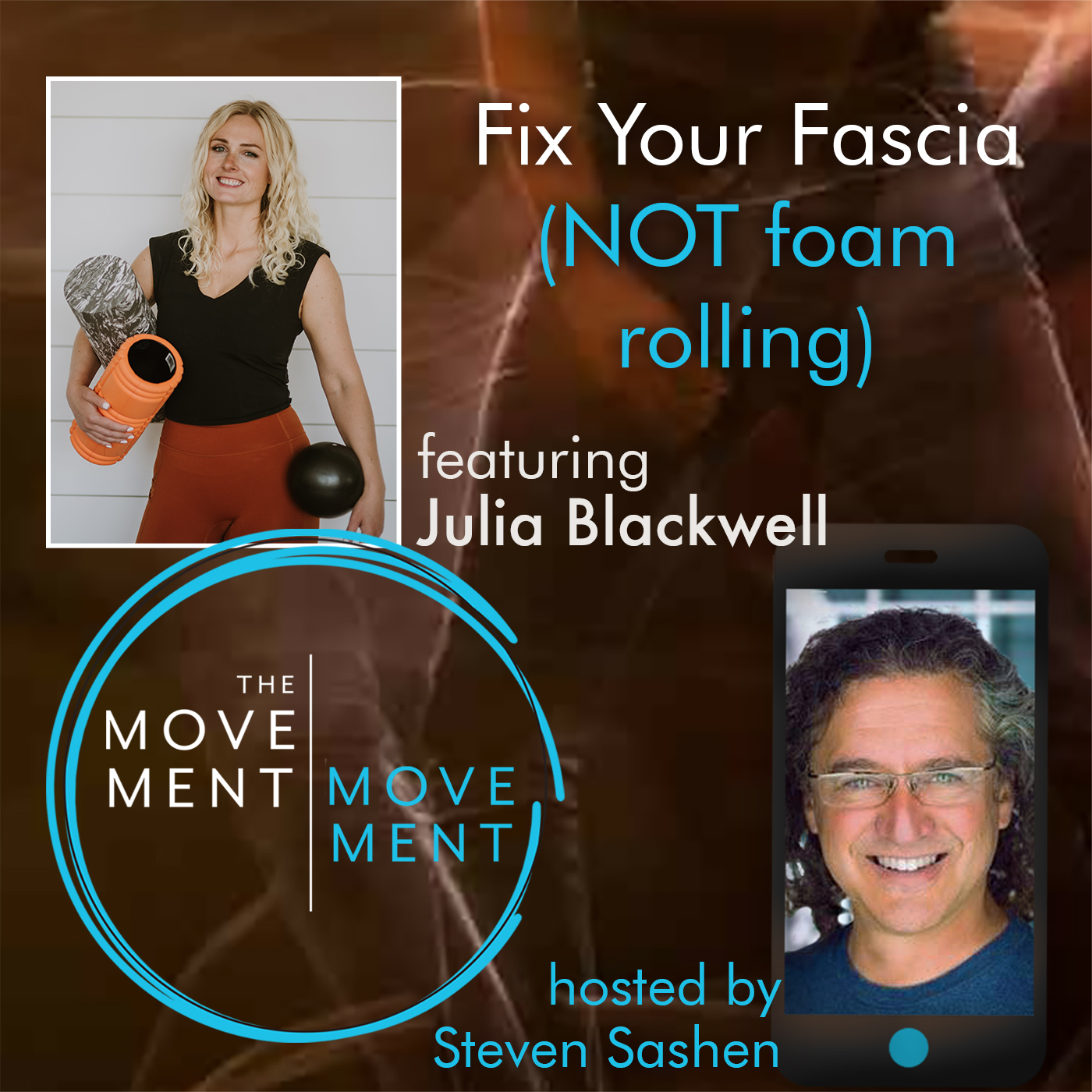
What if there is a part of your body that is critical to your health and you don't even know what it is? Well, you're going to find out about that possibly on today's episode of the movement movement podcast, the podcast for people who want to know the truth about what it takes to have a happy, healthy, strong body starting feet first, you know, those things that are actually your foundation. We also break down the propaganda, the mythology, sometimes the flat out lies you've been told about what it takes to run, walk, hike, do yoga, crossfit, whatever it is you like to do and to do those things enjoyably and effectively and efficiently. And I say enjoy it.
Wait, I know I did because it's a trick question because look, if you're not having fun, you're not going to do it. So make sure you're having a good time doing what you're doing. I'm Stephen Sashan from zero shooters.com and .eu and .co.uk and we call this the movement podcast was we and includes you. It's really easy more about that in a second.
We are creating a movement about natural movement, letting your body do what it's made to do instead of getting in the way and how you can help is really easy to spread the word. So if you want to go to our website, www.jointhemovementmovementmovement.com, nothing you need to do to join. There's no secret handshake, no special dance video, it's seven o'clock every morning, although that would be really fun. But it's just where you can find all the previous episodes, all the ways you're going to engage with us on social media, all the places you can find the podcast if you don't like the one you're getting it from now.
I don't know why you wouldn't, but you never know. So in short, give us a thumbs up and give us a review. Hit the like button on Facebook, hit the bell icon on YouTube to get notified about upcoming episodes. You can also subscribe on our website to get upcoming episode notifications.
The bottom line, if you want to be part of the tribe, just subscribe. So let's jump in. Julia, hey, welcome. Tell people who are what you're doing here, et cetera, et cetera.
Hey, Stephen, thanks so much for having me on. I am your friendly neighborhood fashion release expert in Golden Colorado. I do both in person, fashion release bodywork, but I also instruct people how they can release their fashion on their own with tools like foam rollers. Now, I just like that if no one knows what fascia is slash or if we use it in the plural inappropriately, that some of those sentences sound really weird.
I'm sure. Yeah. Release your fascia. If you don't know what fascia means, like, I can't even imagine what people were imagining in their head in that situation.
So why don't we start there? And of course, at some point, you're going to tell your story of how this happened, but why don't you describe what fascia is? And because again, most people have no idea. This is actually a part of their anatomy.
Yeah, 100%. I find the thing possibly you've heard of before is myofascial release. If you're accustomed to the foam roller or a massage therapist, make it to tell you that. But I am real picky.
I really prefer the term fascia over myofascial because it's one big interconnected system. So fascia is the biological fabric that organizes all of the material in water in your body. It's what holds us into your shape, your structure and your texture that you see in front of you. My favorite analogy is that it's like plastic wrap that wraps around every single thing.
So every muscle fiber, every muscle group, every bone, organ, nerve, blood vessel, literally everything is plastic bags within plastic bags within plastic bags. Recyclable, recycling. Creating a three dimensional plastic wrap suit, if you will. So if it were to magically disappear out of your body, you would go tumbling to the ground and a pile of bone fragments and you could be tumbling.
You would just kind of collapse. It would be a little wicked, which of the West ish. It would be, but that would also be pretty entertaining to see if that's possible. So why do you think it is that this is a concept, little in a thing that almost, you know, so few people know about?
Well, the sad reality is for the longest time when they were dissecting cadavers for research, they would find this spider webby, you know, the plastic wrapy type of material everywhere. And they're like, what is this garbage? Get it out of here so that I can see the muscle or the nerve and they would throw it in the trash. So we are very behind as far as researching this material goes.
But in the last 30 or so years, it's really starting to get to the forefront of the topic of conversation, which is in the last few, it's really accelerated. I think it was an episode of a radio lab, perhaps, where it was the guy who was the first one to rehydrate that material and go, what the hell is this? It's everywhere. And the name that they're using in the medical world is interstitium.
And they're talking about it like it's a whole separate organ or organ. They still aren't even sure what the hell it's doing and how it's doing it. So there's nothing more entertaining than the idea of people discovering a new part of your body that is most of your body. And it's like you said, responsible for 40% of the fluid in your body and people had no idea and that's just sort of mind blowing.
Yeah. And the fun part is honestly, the more we learn about it, the more mysterious it gets. It's like we keep discovering these new roles that it's playing, that we had no idea. So I think it's only going to get more interesting.
Well, my other favorite part is that when it's just sort of becoming obvious, that this was this communication network for your whole body, then all of the like, a lot of, let's say less educated, traditional Chinese medicine, less educated, are your Vedic medicine people were saying, Oh my God, this explains everything we're doing. And the more educated versions of those people were going, whoa, slow down, sparky. It may be related in certain ways, but we don't even know what those are yet. So let's not get ahead of our skis and analogy, dive using a lot lately, even though I don't ski.
So so let's back up before we talk about what, how people can discover what you're talking about. Let's hear the how you got here part because this is a not, I'm saying this the most entertaining way I can a not non interesting story. Oh, thank you. Yeah.
Normally you can make the joke when you ask someone how they started and like, well, when I was born, but that's the literal. No, no, no, no. I don't look, I literally do this when you'll say how did zero shoes begin? I say when I'm, I'll be less a daddy very much.
Exactly. Yeah. That's the joke, but it really did. So when I was born, I was almost a 10 pound baby and in the process of being born, I got stuck.
So when they pulled me out, they tore and stretched all the nerves in my right shoulder, making my right arm essentially useless until I had a nerve regraft surgery. But ultimately they did a surgery. They sent me on my way, wishing me the best of luck and the rest of my life growing up. I went to so many practitioners and doctors appointments and, you know, what I call the standard Western medicine run around and didn't get any further answers or possible avenues that I could go down for the limited mobility and the tightness.
I was still feeling so much in the right arm. So it's like being a broken product on a conveyor belt. No matter who you go to, you're just continually rubber, stamped as defective. So I will say that is a, it was an interesting time growing up because so many of those things that people tell you over and over again really start to plant themselves in your brain and you also believe that there's nothing that can be done about this problem.
So while deep down, I didn't think there was anything I still tried just about everything you could think of. I bought all of the fancy tools and gadgets. I laid on probably a hundred tables for treatment by experts, but nothing seemed to make a lasting difference. Then I moved out to Boulder, Colorado, your hometown hometown.
hometowns with Estemarolin, but I moved to Boulder 30 years ago and I'm up 61. So it's getting there. It's getting to be a hometown. Yes.
I met someone who did a form of fashion release and I had never heard of fascia, which is hilarious because I have an exercise physiology degree. I think they might have mentioned it for a hot second, but it was a very passing comment and it was mostly structured around. Oh, this is the thing that is attaching your ligaments to bones. And so I was very interested but had no expectations for it, but it completely blew my mind within the first few sessions.
I was like, whoa, this is different. This is not like anything else that I've done before. And I saw more results in the feel and function of my arm in three months than I had in, you know, some 20, some years doing your typical treatments, let's call it. So it was a really life changing moment and completely changed the trajectory of my life and my career.
So I became very obsessed with fascia, went on to learn multiple more modalities, including that one, but really just turned the light on for me there and have since created my own methodology. And I continue to do all sorts of fashion research. Anything that comes out. I'm excited to hear about it.
Well, we were going to dive into both those aspects in a sec, but 10 pounds, holy crap. You know, I can't imagine for you, but I really can't imagine your mom. I'm hoping she's like nine feet tall and it was effortless, but clearly not the case. She's five four and tiny.
She's 10 year than me. So the part that I was four pounds, two ounces. So to hear about 10 pounds, I don't think I got to be 10 pounds while I was 13 years old. I think so.
That's just plus my point. OK, so why don't we start with something that maybe people can experience? And I'm putting on the spot because we haven't talked about this before. But if somebody wants to get some idea of either what the facial system is, if there's something that they can perceive or something they could do that will give them that hand.
I mean, some little something if you're in an elevator, you got 30 seconds with Oprah. She says, I don't know what you're talking about. Show me something. What are you going to tell her to do?
Well, an easy way you can feel at least the connection of fascia is if you were to stand up tall, reach your left arm straight down towards the floor as far as you can. So your shoulders reaching away from your ear. And then tilt your head to the right. So tilt it to the opposite side.
You'll likely feel a stretch all through the neck, down through the shoulder and possibly even through the arm. And the more you pull your fingers back as you stretch down towards the floor, the more you're going to feel that entire line pulling and stretching because, you know, we don't have 10 hours to talk about the medical system and the things that they have wrong. But we keep in that the body is so simple that it's just one muscle is the problem where there's this one joint that's the problem, but that's not really how the body works. The body is connected through this web of plastic wrap with your fascia.
And so this whole point, this whole line going from your neck down to the arm is an interconnected piece. And we've got to be able to look at the whole thing. You reminded me of something that happened. Do you know what frolotherapy is?
Oh, no, I don't. The prolo therapy, basically the easiest firm is they'll take a needle and just kind of poke into the parts of a layman or tendon that have gotten lax or have some tendonopathy or something. And the idea is that you're selectively re-injuring that spot. Now you're actually going to be injecting some little saline solution, just something to basically, you know, irritate that thing.
Because when you get injured, your body will do as much as it can to heal to get you back functioning, but not necessarily getting back to where you were before. Anyway, my friend, Dr. Tom Raven is like the guy who taught prolo at everybody. He's working on my shoulders, thinking of a needle in my shoulder because I had a bunch of shoulder things from being a gymnast and something like radiated down my hand.
And I went, oh man, you hit a nerve. And I said, what? He goes, that's not a nerve. I said, well, how is it?
I'm feeling that in my hand. He goes, well, if you remember when you were a fetus, there was a time when you had little handbuds coming out of your shoulders and then those extended became arms. And so there's a thing that's still connecting all of those things. And he didn't, you know, say it was fashion, but that's a giant part of what we're talking about.
And, but just that image of like remembering developmentally, you know, things extended out of the middle in ways that are still connected. They're not just disjointed like you were saying. And but that was like my first visceral experience of it, which just shocked me. And but then it made total sense.
Oh, yeah, that's a cool one. Yeah. Get that just get a picture of that one. It's like, here's how you became something.
So, so you had this amazing experience. You learn these other modalities. We've just given someone a way of feeling that thing that we think of as just a muscular something until you realize that it makes no sense that it would just be muscular to go from your middle finger all the way to the top of your head, which is that fun part of us just feeling with a few things, a few spots that are more active than others. So what are the things that people come to you for that are primarily fascial in their cause?
And that also makes me think, you know, do somebody walk in and you go, yeah, this is not necessarily the right thing for you. Go see, film the blank. But, you know, what's the, what are you doing with human beings? And let's, you know, dive into something so people can understand that and get a, at least a picture in their mind, if not something else that they can do.
So they can experience this more. Sure. I work with a pretty eclectic mix of people these days. So still far and away, the most common thing is pain.
Any pain you have in the body, I would say is 95% of the time is a fascial problem because as fascia wraps around everything, it's going to therefore influence the position and function of everything. So as a muscle is hurting, a joint is hurting your experience, any type of chronic pain or something that's bugging you and your runs, it's almost always a fascial problem. So that's what I work on with people the most, but I certainly work with people who are struggling with mobility, which of course is very near and dear to my heart. That's a big part of my journey.
And I've got a handful of people who really just get it and they're all about the performance element. So the more hydrated and supple your fascia is, the better we can absorb shock, the better all of our other systems function. And so we're getting more of that elevated high performance part of it. But I will say the vast majority is pain.
Got it. So somebody comes in, they've got a pain in the somewhere. Do you find that the issue is there or that it's somewhere else that's just being felt in whatever spot they're noticing the issue? Yeah, where we feel pain is almost never the problem.
So even though all of our facials system is one unit, it's connected, it's also this series of pulleys that need to be equal in order to retain balance in our body. So most of the time with pain where you end up feeling pain is where something is overstretched or something is overworking. And we have to go find that crumpled up all of plastic wrap, if you will, that somewhere else and it's throwing the whole pulley system out of balance. So, you know, the fun joke is that I'm some kind of a wizard where I'll step on one thing or, you know, work on one thing.
We haven't even got into that. That's how I work on people. I actually step on them. But I'll work on one area of fascia through, you know, the specific way of compressing and moving through something and they're like, wow, now my back doesn't hurt or now my shoulder doesn't hurt.
I had no idea that that was a thing, but it's all about the balance and finding the root cause instead of going after the symptom. So now I can't get out of my head, this idea, stepping on people. And of course, if you do it in high heels, you can probably charge more. Oh, yes.
No, I have a hilarious collection of socks. I surely own 100 pairs that are constantly being recycled. But yeah, you're tied on. Ooh, at least five.
OK, back in the days when I was wearing socks, all I had was tied on. Oh, that way you don't worry about the matching. Oh, that's true. Yeah.
I do love animals. So I would say 70% of my socks are some type of animal. And it's really entertaining. Every once in a while, someone will come in that they don't know exactly what I do.
They've just heard that I need, you know, they need to come see me and they walk in and I'm wearing some hamster socks. And I'm like, this person probably thinks I'm insane. But we'll get there. To be clear, I'm assuming these are socks with hamster images, not socks, made of hamsters.
Correct. OK. That would be extra crazy. Just want to validate and verify that for the PETA people.
So when you when there is this crumpled up a bit of plastic wrap or plastic bag somewhere, how are you finding that? And is there something that like some self diagnostic thing, somebody might do to go, Oh, check that out. Well, one of the biggest things I look at is posture in general alignment with someone because fascia is likely the thing that's pulling bones out of alignment and creating really poor posture. So looking in the mirror, if you notice that one shoulder is elevated or one hip is elevated, if both of your feet turn out to the side, like duck feet, you can do a little bit of that self analysis on yourself that can give you an idea, OK, all of my load joints should be stacked both vertically and horizontally, right?
If you drew a straight line down through the shoulders, hips, knees, ankles, and then vertically or horizontally through them, they ideally make roughly 90 degree angle. So anything that looks off, if you look a little twisted, that's a way you can look for yourself. But truly, if you have any kind of pain or you don't have the mobility that you used to, it's pretty easy to assume that you've got something, fashionally speaking, going on that needs to be released. So let's say I've got a I'm going to pick shoulder pain for lack of a better something.
And I go, OK, so that's indicating there's something special. Now, before somebody comes to have you attack them with your feet, what might they do to palpate somewhere or do some movement to highlight where that special tension may be? Sure. So my motto is essentially healthy fascia doesn't hurt.
So if you start palpating around in the bicep in the tricep in the pec, you may find, ooh, this feels really tender or sore when I'm adding some compression to it. That's another way you're going to know something is going on there. Usually with shoulder things, it's I mean, it could it really depends. So actually the picture shoulder because that one is so complicated.
That one is a little complicated. A billion causing that one. But there are so everybody's a little bit different because we all have our own unique patterns. We all have our own unique experiences that we're carrying with us in our body.
But there are definitely ones that are very common for most pain. So back pain, for example, everyone thinks, oh, my handstrings are really tight. Oh, my back hurts. And it's usually coming from facial restriction in the quads and in the adductors, occasionally the IT bands.
But it's these places that aren't actually near the spot. If that's why you or that's why you still have back pain after stretching the ever living crap out of your glutes and hamstrings is like, that's not what's happening. So one of the reasons that I decided to have you on the podcast is because you are doing something even within this whole domain of facial stuff, you're doing some things that are different in ways that I frankly agree with. But more importantly, you're not doing what many people think of as sort of normal stuff.
So most people will get on a phone roller and just roll back and forth, roll back and forth and then wonder why they're still rolling back and forth, rolling back and forth. So can we let's dive into what happens? Somebody comes to see you. And even if they're using a phone roller, you're addressing this and there's, I only know one or two other people who are doing anything similar.
So talk about what you're doing differently than the average, you know, a special person or person who just bought a phone or a dick sporting goods. Yeah, here's the thing. Fasha has a lot of different roles that we've discovered. One of them is a as a protector.
It's what protects us from impact and damage. It absorbs shock prevents us from every time we bang our elbow against a door frame from crazy changes to be happening in our body. And so because Fasha is playing this protector role, it doesn't change easily. You have to come out Fasha in a very specific way.
And most people are missing the combination of what it takes to really get Fasha to change. Otherwise, it's actually going to resist the change that you're actively trying to make. So it's kind of like a speaking Fasha's language. So first, there needs to be an element of compression, fascia loves compression.
And instead of rolling around on your foam roller, aimlessly and wildly, we want to stay on one area and compress it. The second element is there needs to be some type of cross vibering happening. So that just means you're going perpendicular to the way muscle or fat fascia fibers run. There's a really specific cell.
I want to say it's it's been only five, six years since it was discovered. It's called a Fasha site, very well named, right? And a fascia site only gets activated with a shearing motion, that cross vibering motion. And once it's activated, it starts the production of hyaluronic acid, which is what helps really deeply hydrate us.
It's like full body grease for our joints and our muscles and allows glide to happen much more easily. And that's not going to happen with rolling with the grain of your muscle. So let's say we'll take your quads, for example, if you're rolling up and down from the knee to the hip, going with the grain of the muscle, we're getting very little cross vibering and shearing in. And then the last component is some type of an active movement is very important when talking to fascia.
Fasha has its own communication system that can communicate outside of the nervous system. They certainly talk. I've got a pod right there because for me, just that idea sounds crazy. I mean, literally the people who started, you know, figuring this out, not that long ago thought it was crazy.
But so let's change the plastic bag metaphor to something a little more three dimensional because literally what's happening in the fashion is just, it's a fluid filled thing where there's information going all around the body and people again, are still just figuring that out. But just to clarify, it's not like just stretching a plastic bag. There really is some, there are things going on there in this three dimensional fluid conduit, something system. So once we have this, you know, the kind of 3D idea that changes some of the way to envision what's going on and what you might be doing.
So sorry, that was just an interjection when you were starting to get into the movement component. No, that is really important. I use plastic wrap because it's a good visual that people can understand, but your fascia is largely water and water conducts electricity. So signals are traveling very fast.
I believe nerves travel at about 150 miles an hour and signals are going through your fascia system at something like 750 miles an hour. It's just happening way faster and it's communicating around the whole body in just a different, very amazing way. Well, hold on. I've never heard that before, but as I'm thinking going, how does that make sense?
And the one way it makes sense is going to sound weird is so nervous. Impulsive travel, of course, down the ax on the nerve. But then when they're going from nerve to nerve, there's a chemical process, electrochemical process that does take time. But if you think about a fluid filled, you know, like a six lane highway just to simplify it.
And it's fluid filled. If you compress one end of it, there's an instantaneous effect on the other end because of the way that because of the way that because I mean, that's the part, if you think about it is just crazy. I mean, like, we're oblivious to this. It's not part of the way we think about the human body in general.
And then something like, okay, that sounds like, I mean, I was almost thinking of it. Kind of like electrons where the idea that electrons are moving through a wire is not necessarily the case. It's just you just put a new electron on one end of the wire and one on the other end shoots out. So it's a similar kind of thing on the fluid side.
And so painting that picture as an interesting twist to the whole idea of movement. I want to come back to the cross fiber stuff too in a second, but let's continue on the movement thing. Cause I keep, you know, there's so many fun tangents we can go down. But one of the elements of that communication is that we have so many proprioceptors in our fashion.
So there's 10 times as many in our fashion than there are in our actual muscle. And so we're really lighting up that proprioceptive element when we do active movement. So we're re stimulating, reigniting all of these proprioceptors in the area that we're working on. And we're also telling our brain that, hey, it's safe to access this range of motion in a way that we're not going to get with a passive treatment.
So I've been naming all these things. So let's bring them together. So if you're going to compress cross fiber and active move on your foam roller, it's going to look like we'll stick with the quad example instead of rolling up and down from the knee to the hip, pick one spot that feels tender and sore because healthy fascia doesn't hurt, right? And then slowly bend your heels back from the knees and straighten out.
So it's like a little bit of a hamstring curl. Do that a few times, keep your knees bent and your heels back for a moment and then rock your heels from side to side to go across the quad instead of with it. And we're combining all of those things together and it makes your hydration and the release effect go through the roof, but so much greater than what you would have if you just rolled around on your roller. And let's be clear, this will not be pleasant.
Correct. Now here's the thing though. And I had, I was talking to, I was talking to, uh, on another podcast, a few months back and this lady was like, Oh, I did one of your videos and I was like, what in the hell is going on? This was so intense.
But the thing is, is we're not normally talking with fascia in this way and asking it to change and move in this way. And so it's going to feel intense at first, but two things. One, I think you're going to be surprised how quick it decreases intensity because we're improving the health of your fascia the right way and so much more quickly. Um, but two, we want the nervous system to be on board with the changes that we want to make.
So if the intensity is at an eight, nine or 10 out of 10, we're not going to have our body accept that change very well. So there's no bonus points for pushing through something needlessly painful, where you're scrunching your face, you're not able to breathe. You're moving really quickly through that movement. We're actually not going to get as far as we would if we can bring the intensity down to say six or seven.
So this is what's interesting about this is, um, I've mentioned Feldenkrais work on the podcast number of times and if people haven't heard, the gist is it's what you just said. It's reminding your brain that it has been limiting your bodily movement, your range of motion unnecessarily and you kind of fake your brain out to do this. So the first time I had a session with someone doing this, and this is actually the guy who brought much of Feldenkrais to America. Um, and it's got him Tom Hannah and he, he diagnosed it.
Basically my right lat was all hypertonic and, you know, way too tense. I don't know why I just got a thumbs up on the video, but that's really annoying. I got to make that crap stop. Um, cause I didn't even make do a thumbs up.
So anyway, it doesn't matter. New, I know when you said you're a lot was tight and it gave a thumbs up. I was like, Oh, no, who's making a thumbs up for that? It's something in the new Mac operating system that does that and I haven't learned how to turn it off yet.
But anyway, so he had me do this, this simple motion where I didn't even realize that, you know, let's say I could only lift my arm a certain amount where suddenly my arm was all the way above my head with more range of motion than ever before. And then it's like, Hey, notice that. And it was in literally a physical version of an epiphany and it's like, Oh my God. And then your brain goes, Oh, I can do that.
Okay. That's cool. And I see that. Um, I think about that in the barefoot running world where people say, Oh, well, I switched from some big high-heeled shoe to your shoes and I got a Achilles tendonitis.
I said, no, no, what happened is you hadn't made the transition in a way that reminded your brain that you could use your Achilles fully because in the higher heel shoe, you had trained your brain to only use it a certain amount because it wasn't going to move any further. And so it realized, Oh, I don't need to do that. Great. I won't do it anymore.
So, but the idea that you're sending similar kinds of signals, maybe even the same, but similar kinds of signals at the very least to your brain so that the fashion, there's two parts, the facile thing that we're describing. One is literally impacting the physical structure of the fascia. And the other is that, like you said, this neurological conversation between what's going on in that spot in your body and your brain to remind your brain, Oh, no, it's cool. You're whatever happened before, that's done.
You can chill out now and come back to normal. That's a, for me, at least a mind-blowing layering of ideas that frankly, that's not a conversation you're here every day. Yes, that repatting. That's what I call it, that repatting element is really important and you won't get it from a passive thing where someone else is forcing you into a position and you lay there and you're thinking about, you know, what you have to do for the rest of today.
You're just letting someone else move this part around. It doesn't connect to that new range of motion that you could have access to or how to use your muscles in this new way. You have to move yourself for that to integrate in your brain. It's really, really interesting.
So someone comes to see you. What happens then? Because so far we haven't talked about, you know, doing the stuff with somebody in their socks doing something around you to you. So the way that I'm getting that combination of fascia release to happen is through using my feet, I will find the spot that feels the most dense or the most texturally odd and compress it and then talk someone through the range of motion themselves, but they're still the one that's doing the range of motion.
I'm just providing the compression and a little bit of the cross fibering element to ensure that we're getting all of the components in one sitting. And then truthfully, I let someone else tell me how we're doing. So I have all of these ideas of what might be happening in their body based on their alignment, based on how they're moving. But ultimately our body is super smart.
It knows what it needs. So I'll work on a couple of areas of areas, have people walk it out, check back in with the pain they were feeling and things usually change in that session for the most part, at least like 90% of the time. And then we're using the information that their body is giving us to help interpret what they need in the future as well and what's helping their pain the most because I'm still surprised. I've been doing this for 11 years and every once in a while, I really think I know exactly what's happening in that police system and it doesn't seem to quite land and we do something seemingly random and that's the thing.
So I really do believe that ultimately our body is going to let us know what we need the most. So I do the same thing when I work with people, you know, I work with people virtually. I have some programs to teach people how to foam roll for themselves because I also believe that you can figure it out yourself. It just takes a little bit more time and intention.
But it's the same thing. It's like, well, let's follow the basic patterns that normally happen. For a certain type of pain or restriction you're feeling, but then see what your body tells you, you may find that releasing something different is the key for you. So basically, A, you're a human foam roller.
Yep. I think it would make a great business card and it would certainly make dinner party conversations much more interesting. And that, but B, backing up to this whole foot thing, how did you, was it your idea or did someone teach you this thing of feet versus hands or any other part of your body, frankly? Yeah, the initial body work that I experienced was a stepping modality.
So that was the one I experienced and was like, whoa, this is so much more effective, partially because of the weight that you can add, you can add so much more compression than you can with your hands and your upper body. But we're also grabbing so much more of the fascia through a bigger surface like the foot than we would get with a thumb or an elbow. Oh, that's interesting. That makes sense.
And I do have to tell you in the early days when all we had to do it yourself, sandal making kit and all my videos were like, here's my feet making sandals. I got a surprising number of emails or then I get voicemails or like, uh, can you make more videos of your feet, please? So of course, I did not do that. Um, I did not need the money that badly.
So that's very interesting. And do people know that when they're coming in the door that you're going to be stepping on them, basically? These days, yeah, 99% of the time they do. I just had someone a couple of weeks back though that just came in from a referral and was like, I know this is great.
I've heard nothing but good things, but she also didn't tell me really what we were doing. And I was like, Oh, okay. So that's why I really quick. Yeah.
So in the early days where people, I mean, I can only imagine there were some people are like, Hey, wait, wait, what? Sure. The fun part because I have a competitive nature and I love just winning people over is I would let them be really weirded out by it. And so they started walking between each technique and then be like, wait, I'm confused.
Why is this getting better? We haven't even worked on the spot yet. And it was very satisfying to get people excited about being stepped on. Well, I will confess this one too.
I was dating one the way back when who getting massages was like, you know, one of the things we would do. And invariably she would end up saying things that, um, well, like, Oh, remember when they put those cucumbers on your eyes at the end of the soggily? No, I didn't get cucumbers. Remember when they were stepping on your back and it's like, no, nobody stepped on my back.
It was always like one thing. It was especially those two are the ones that I remember the most because I didn't have someone stepping on my back. And I want to, that sounded something like I wanted that. You know, I very rarely are stepping on people's back.
It's crazy. Low back pain, especially it is. It's not your back, friends. It's it's very rarely do I, do I get in there?
And it's more so in an attempt to balance things after the parts that are really tight, have a lease and I want ultimately everyone to have very squishy, malleable, hydrated fashion. So we'll start working into some of those other areas, but yeah, it's, it's not common because it's not the problem. No, well, and again, this is just, you know, for massage, not for something. I will confess one time when I walked in one place, they did step on you.
It's like a Japanese spa, New York, and they had this big sort of rig over the massage table. Okay. That's a kinky. Um, and then it's like, Oh, just so they can hold themselves up on the step on you.
And that's not so kinky. Oh my gosh. I have a big, um, balancing pole that I use. So I'm, I'm not always putting my whole weight on people, right?
I'm, I'm using some blocks for leverage. And I'm mainly using one foot, but I have a, a big pole that I use for balance. And I've heard all of the jokes between stepping on people and the big pole that I'm balancing. I was going to say, you know, your, your, your father wanted you to stay off the pole.
And here you are. I know. Here we are. Right.
That would actually, that could actually make another good business card. I haven't worked out the exact title, but just anything with the word, Paul, that would be good. Oh no, that sounds like a nightmare. That's going to bring all of the wrong people in my business right now.
Um, when I was doing comedy for a living, I had a business card. I picked it up from the, the print shop that was on the ground floor of the building. I lived in in Greenwich Village in New York. And my card said, Stephen Sachin, comedian, actor, Jellimo.
And the person standing behind me said, and this, I'm not doing the voice for no reason. It was a gay man who said, who Jellimo, what's that? And I, because I couldn't resist a joke, said, that's just something I do on the weekends. He goes, really?
I said, no, no, I'm kidding. And I couldn't talk him out of the fact that I wasn't actually a Jellimo sometimes. So again, I did not do that one either, because I didn't need the money. So.
So yeah, yeah, I mean, I'm totally, again, fascinated by the whole thing. I'm trying to think, where else do we want to go with people's either understanding or their own self exploration about how to work with fashion things? I feel like I'm overlooking us something. You know, I've learned so much about Fasha from Thomas Myers and all of his research on anatomy trains.
That's helped me quite a bit understand more deeply the pulley system and where things are more interconnected than others. I love him, but I'm also a science nerd. So it may depend on, you know, what you like to watch and learn about, but he's one of my favorite people to continue to learn from, for sure. We can mention that in the show notes for people who want to dive in and science nerd out.
So anything else other than the Hey, let's point people to you so they can find out more about what you're doing if they're having, again, not only anything painful going on, but anything where they want to improve performance by letting your body move more. I don't even want to say correctly, but that's the best word I thought at the time. Cause. Yeah, you know, just a reminder that since the facial system wraps around your nerves and your blood vessels and your organs, if you can improve the health of your Fasha, you're going to improve the health of all of these other systems simultaneously.
Yeah, your lymph, your lymphatic system lives in your superficial Fasha. So any kinks in your Fasha itself is going to affect your ability to detox, your ability to have a good immune system, the ability for blood flow to reach all the right areas, things that you may not think are Fasha. Say your, your hands fall asleep at night or you have a pinch nerve. Those are actually Fasha related things.
You just have to find the area. So highly recommend to go exploring and start learning the texture of your own Fasha. It's, it's totally changed my life. And I've seen it change the lives of hundreds and hundreds of people I've worked on over the years that were told just like me that there was nothing they could do about their problem or that they assume it's a product of getting old, something like that.
And it's, it's really more accessible than you think. So I'm happy to help anyone on that journey who is looking for pain relief or better mobility. Or like you said, just improving their performance even more with what they're doing now. And so how will humans find you?
Well, I am the most active on Instagram, which my handle is at Movement by Julia JU L I A or you can head over to my website, Movement by Julia.com. I've got a free video series you can sign up for calls unlock your hips where you can dive into my style of foam rolling and feel the difference for yourself. Awesome. Well, I do hope people take you up on this because like I said, I only know, I think actually only one other person who does anything remotely similar to what you're talking about.
And I've experienced that. So that's again, why I want you on here because I knew the value of this. And so we're getting my personal endorsement, even though we haven't worked together yet, but since you're down the street, we're going to have to make that happen. Yeah.
And so again, you know, do check out what Julie's up to and let us both know how that goes. And also just a quick reminder, check us out on our website, www.jointhemovementmovement.com. And that's where you find previous episodes and all the ways you can find us on social media and all of the ways you can find the podcast on other places that have podcasts. And if you have any requests or suggestions, anyone you think should be on the show, I'm still hoping that there's someone who thinks I have cranial rectal reorientation syndrome who I can get up here to have a chat with that would be really fun, but not for them.
And but you can drop me an email, move M-O-V-E at jointhemovementmovement.com. And until then, go out, have some fun and live life-free first.