
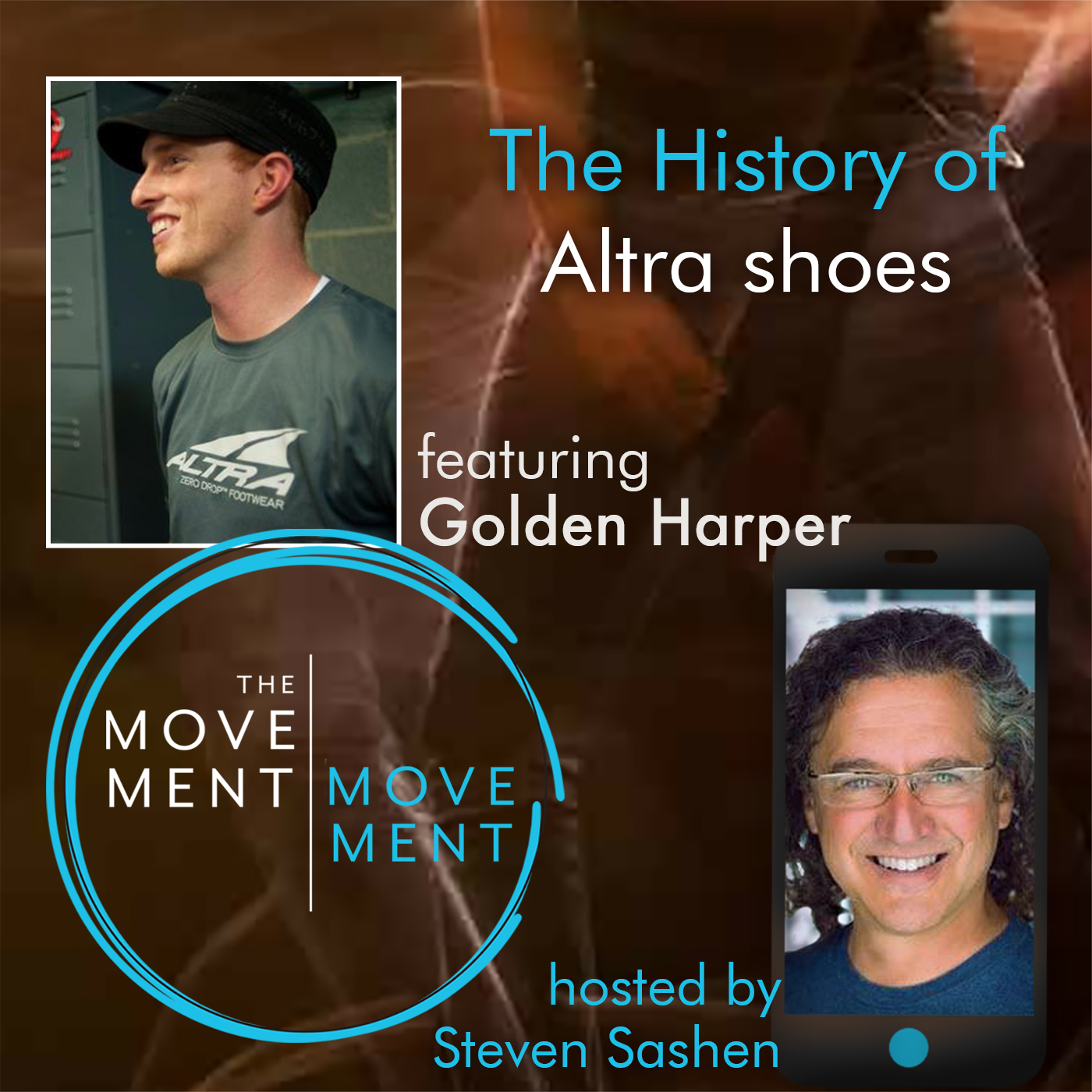
You want to behind the scenes look about what it takes to run a natural movement, but where Bran, well, you have come to the right place. We'll be doing that today on this episode of the movement podcast, the podcast for people who want to know the truth about what it takes to have a happy, healthy, strong body starting feet first, you know, those things at the end of your legs. And as you may know, we break down the propaganda and the anthology, sometimes the outright lies, you've been told about what it takes to run or walk or hide or play or to yoga or cross it, whatever you like to do and do those things, enjoy it efficiently and effectively. Did I say enjoy it?
No answer is a trick question. So I always say, if you're not having a good time, do something different to you are. We're not going to keep it up if you're not. I am Stephen Sash and your host of the movement, movement podcast.
We call it the movement because we, including you and everybody here, are creating a movement about natural movement. We're about that in a second. Basically, we want to make sure that you know, you can do what you enjoy by getting out of the way, letting your body do what it's made to do, not interfering with that. And the part where you're involved in the first part of the movement movement is just spread the word.
Give us a great review, a thumbs up, a like in the appropriate place, hit the bell icon on YouTube, go to our website, www.jointhemovementmovement.com. You'll find all the previous episodes, all the places you can find us on social media, and of course, other places to find the podcast if you don't like it, you found it on now, which seems kind of odd, but I said it anyway. And I think that's, in short, look, if you want to be part of the tribe, just subscribe. So let us jump in Golden Harper.
Welcome. Tell me who you are and what you're doing here. I'm Golden Harper. We already established that.
You have established that. I am a runner, coach, exercise science guy, founder of Altera Creator, Valta Originally, and PR gear and running technique guru of sorts. You can keep going. We can go on and on, but that's good for now.
So let's start with the Altera part for people who don't know. I mean, you and I have a similar thing in that I am the quote face of this brand. You were really the face of Altera. And so why don't we start with the part that most people probably don't know, which is the, what led to doing that and what made you kind of take that leap from the beginnings that I'm hinting about because I know about them to actually saying, Hey, let's start off with our company, the dumbest thing in the world.
Yeah. Yeah. What I always say as the quickest way to go homeless. Well, didn't I tell you what the guys that I met like seven months inside us?
No. So these are guys who've been in footwear for like 35 years and they sat down at our kitchen table with me and Lena and said, we believe in you guys. We believe in what you're doing. And we would start this with you, but we've been in footwear so long that we're not stupid enough to try to start a shoe company.
So our guys basically told us the same thing. And these are just listen. Yeah, exactly. Back up prior to actually starting.
What led to that happening? She's so much. I mean, I was born in shoes, born in footwear. The baby picture show.
Not born with shoes on, but you know, from a career standpoint, my dad was working for Nike and I was born left there because they were unethical and moral, you know, basically terrible people and went to Sakhani to let us about nine. And then he was a for Sakhani. Yeah, well, he was a paid product tester for Nike. He had around 100 miles a week.
And this was when they put the air in the shoes for the first time. And they all got injured, all the testers. And they all felt like they were like 150 miles a week, which is not sustainable. And so they all wrote in and said, what have you do?
Don't put this in running shoes. And wouldn't you know, wouldn't you know, they came back and said, yeah, we got your feedback, but we're going to make billions off this. The marketing is just too strong. Sorry.
You know, and my dad said every tester he knew essentially they all quit because they just couldn't do it. And also, you know, they had an acknowledgement from the company that, hey, we understood you're concerned. We know you're all getting injured and we've just frankly don't care because we're going to make lots of money off of it. Well, his thought was pressured because have you looked on the run for your list age in the last couple of months?
I guess I have. It actually shows a portion of the abstract of a study that never actually got peer reviewed published. But basically in the zoom structure 22 in a 12 week half marathon training program, they developed 30.3% of people got injured in that shoe. And of course, as you know, injury rates go up over time.
And they reacted to a run quote only 14 and a half percent. So they demonstrated that shoes can cause injuries and different shoes cause injuries at different levels. But no one has picked up on that in a way that would complain about that. And someone asked me a couple weeks ago, they said, why do you think they can publish it?
And it suddenly hit me. My suspicion is it's for the same reason there's a warning label on cigarette boxes. They're concerned at some point someone's going to go after them and then they go, but we published it. But we published it.
So we showed that this year reliably injures one in three of you. Yeah. This was only in a quarter period of time. And this was only one in six.
Yeah. He's caked. Okay. So so he left Nike mood to talk and he and doing some more things.
Western sales manager covered Colorado California, Canada, Mexico. Okay. Basically I didn't see him much. You know, I was really young though.
So so he didn't know it looked like anyway. So here's a picture. It's like okay, good. Yeah.
So he's like, I'm going to stop doing that because he got like he needed to be around us more. And so and then we opened the shoe store when I was nine. So he learned nothing from being a salesperson. Correct.
Yeah. He learned that he this man loves running more than anybody ever met. And I've met all kinds of work at least on par with everybody ever met them. Just loves running loves everything about it.
And so I started working there at age nine. I started being left there alone at age 10. So 10 you're like me to the cash register and yeah, because really five dudes with 500 bucks started the store and worked their day off of their real job. And when somebody couldn't, you know, make it, I would get left there for hours, you know.
And when you're left in running stores at 10 year old, you better have chops for one. And you better know your stuff. And luckily I had had some running success and I was a shooter to the end degree. So was every time you think of something happening when I was 10, I got really into hypnosis when I was like eight.
And I remember having a conversation with a friend of the family who was a head of anesthesiology at a big new hospital, we're all having dinner and we're talking about the clinical applications of hypnosis for anesthesia. And in the middle of the conversation, he stops, and his tracks and goes, you're eight, you're 10. I remember thinking, yeah, so I imagine you had some of those two. Yeah.
In fact, that definitely happened. A lot of times what would happen to is people would come in and they'd be like, is there somebody who here who can help me? And I'm like, yeah, I can't. You know, is there anybody else?
You know, yes, just me right now. So, you know, yeah, it's just me right now, you know, right. A couple of times higher. And they turn around and leave and I can see you have some rare footage version on your stock and issues with ground reaction and nursing device.
Sometimes I run a 308 marathon. I might be able to help you. You know, sometimes I imagine that would, you know, stop in the interaction work and other times just like, great, is there somebody over? Yeah, pretty much.
Okay. So you're you and he are running a running shoe store. You're getting closer to the next thing that would lead to what eventually became ultra. Yep.
So I managed the shop, you know, started managing near the end of high school and after high school. And then as I went off the college, you know, there was, we get all this training runs especially, but it's not training. It's propaganda. So the only training anybody runs especially gets is from shoe companies.
Right. And so again, it's not training. It's propaganda. Okay.
And I realized, well, give me an example. Like, what will be, you know, they come in with a new shoe and what do they tell you and how does that go? Well, I think the most classic one is like, you know, these shoes are going to save your money. You know, this cushioning system is going to help your knees out.
It's going to help your joints or it's going to, you know, whatever. And it's just, and we can get into this later. It's literally exactly the opposite of what science would say about that technology. Right.
If you had an actual scientist doing a study or you had studies on hand that analyze this, you know, that had to do with this technology, you'd see it was exact opposite of what we were being trained. Right. And that's a problem. And that was, you know, or another one would be like, you know, at the time, the whole pronation paradigm was really big.
It was like, Oh, your feet roll in. You over pronate. You're going to get hurt. You know, that's bad.
And we need to fix you. Seller essentially, how to help people is half the people that come into a run especially sort of by shoes don't even run. They're just there cause their feet are jacked up or something hurts and the other half, you know, they might run, but they're usually there because something's wrong as well. And you know, I'm a passionate person.
I love helping people. And I just really wanted to be good at helping my customers out. So I, you know, in my book, I was going to come back and manage to shop the rest of my life and this was my life's work was to figure out how to best help people that came in the door and then onto the next chapter. Yeah.
So I'm one of those people that took nine years through college use call those dockers, but or select. That was, like minus a four here degree. you know, happened to get stretched over nine years because I studied whatever I wanted and as much of it as I wanted, I had enough credits for multiple degrees. And when I ended up going to Hawaii along the way, and I spent two years out there.
And that was just, that was kind of these switch flipper, I guess you could say. Because I had looked at everything through a running lens, okay, previous, and for a couple years, I had been toying around with the human five fingers. My shop was the first store in America to carry them, first running store. Okay, no, there's a store in Pearl Street that they're known for being the first one to grab.
So they got the first pair of trucks, they had the first pair of five fingers to start. Okay, yeah. So but yeah, we were the first running store. In fact, when we told we came back to the OR show that they're very first OR show.
We came back after retail, we had to have a retail retailer, a big show for everything related to Apple or etc. And we run the order to them, you know, they were like, okay, what's your shop name or like a runner's corner? And they were like, what are you going to do with these? And we were like, what are you going to sell these for?
And we were like, for running. And they were literally like, oh, no, no, no, no, no, no. Like, no, this is at the time they just had the one slip on classic model. That was it, you know, and our thought was we're going to sell these as a training tool to help people work on their running technique and strengthen their feet.
Because in our book, those were the two most important things that happened to any runner out there technique and strong feet. So that had been going on. And I got to Hawaii. And it's, you know, my entire life with all the propaganda training, I've been given by the shoe companies is flat feet or bad.
Over pronation is terrible. If you're overweight, it's going to make it 100 times worse. And it's basically that triple combination is the end of the world, you know, for people. So for people listening, see if you can predict what's next.
Because, you know, if you think about Hawaii and think about Native Hawaiians or some moans. So put your, there's nowhere to actually enter your guesses, but keep it in your brain and now back to you golden. Well, and I think the part I missed on the end of there is that, and that good shoes, good shoes are really important in all of this. Oh, yeah, they'll fix all this.
And I've had this beaten into my head my entire life. It's hard to pull that out, even though I was doubting it. Yeah, still get over there. You got tons of 300 pound giant humans walking around just giant Polynesian people.
They got flat feet. They rolling like crazy. So they're, they're pronating and they're wearing no shoes or they're in slippers, you know, flip flops. They had any problems like the people that came in your running shoes.
Well, so this is the thing is like, I felt for a minute there when I first got there like, you know, okay, I doubt this stuff, but it's hard to root it out. So I get to know these people. I'm like, okay, I'm gonna wait, I'll get to know them well, then I'll ask them, then I'll help them. And you know, my first one is like my boss, you know, and I get to know him really well.
We worked together daily and I was like, hey, you know, tell me about your feet because I can see, you know, you're a big guy, they roll in, you wear craft shoes. Like, this is what I do. Like, I can, I can help you and tell me about your feet. They hurt, right?
And he's like, no, bro. And I'm like, no, it's okay. Like, it's fine. Like, I'm not, you're not your niece.
Yeah, this is what I do, right? You know, and he's just like, no, bro, I'm gonna feed to her. No, I need to know her. Sorry, bro.
Like, just nothing, you know, I mean, ignoring for the sake of argument that there's nothing that Hawaiians like better than white guys are showing up and telling him what to do. Yeah, which is why I waited like months to get to know people before even starting to open, but across the board, like almost nobody's hurt me, et cetera. Right. It was the exact opposite of everything I've been trying to my entire life.
And again, I started questioning it before I got out there, but this was seeing it in person. Yeah. And then I'm running the best I have in my whole life. I'm running barefoot on the beach at the 90 minutes at a time.
And I'm dominating collegiate cross country races, setting records, et cetera. And at the same time, I'm wearing slippers and walking around barefoot at a time, and, you know, living this lifestyle out there. And so that kind of thrust me into this whole, like, study the foot part of things. Right.
And it, you know, added on to all the exercise science and running technique and running injury stuff that I've been doing. And it tied in really well because it turns out that feet are a huge part of all of that, you know, and they go hand in hand. On a turn. And exactly.
And so as I came back from Hawaii, I came back to the running store. And my first thought was like, Oh my goodness, I don't really believe in anything we're selling anymore. You know, and that was a really tough place to be because this is where you're making your living, right? Right.
And my dad has people who is knee-opling in college football and has my car legends knee. And the only way he was able to run, he actually got dared into becoming distance. He got a postcard in the mail from his roommates dad that was like, if you guys are really tough, if you guys are real man, you'll do this. That's all it's a postcard.
Pretty much. Well, you understand the psyche though. You know, these, oh, no, I get it. It jumps off 90 foot cliffs for fun.
You know, just to prove how macho he is. And so when somebody sends a postcard and says, if you guys are really tough, if you're real man, you'll do this. I'm going to send a postcard. If you were a real man, you know, you would give us a whole bunch of money right now.
If you were a real man, but you know, I want to highlight something you said because people ask often why we and I'm going to include both Ultra and Zero and some ways you know why we're not in more stores. And I said, because fundamentally, people realize in stores that they have to learn something new and that if they learn what we're saying is true, they won't be able to sell anything that they have on the shelf. And so, you know, it's, it's a tough road to hoe when you're threatening someone's livelihood. Yeah.
Yeah. It's, it's very difficult. You know, and I think Altra is in 1200 plus stores nationwide. They're almost all running stores though.
And yeah, I mean, the number like stores for which you or I would be appropriate is somewhere in order of like 50,000. Yeah, it could be a lot. But yeah, no, your point is, is true. It's, it's very difficult at least to manage this idea of looking through things through a different lens, a natural lens and still be able to make a living or still be able to sell that other stuff.
It's the selling of other stuff. That's the challenge. I mean, there are a couple of stores that focus on middle-less natural movement and they have not code, they figured out how to do it. It is totally doable.
But the idea that you're going to take a store and have them switch over to that is the answer pretty much close to zero. Well, it takes years. Yeah. It's, it's, it's harder.
Yeah. That's the thing. It's doing things with the right way it's harder. It's harder to make money.
It's harder to learn it. Once you've figured it out, it's more fun. It's easier in a lot of ways. It's certain about it.
It's more rewarding. Right. But the training is more difficult. Yeah.
Well, because again, you're taking people that have been programmed a certain way their entire life and having to flip them. Correct. I'm doing this with my staff, you know, right now. Well, it's easy story to say some version of cushioning are supported.
Yeah. You just need to say those three words. People are like, I'm in because that's what they've been taught. Yeah.
So yeah, it is a different game. So anyway, you came back, you're looking at the wall going, how am I going to do this and then? Yeah. So back to my death.
He's got no cartilage in me. It's dared into running Las Vegas Marathon. Forable. Just crawls across the finish line.
One of the last miniatures of the race. Yeah. And this is guy who was drafted to play pro baseball, who's never really been bad at much of anything, but no endurance jeans, no athletic jeans in his family. And it's actually the same on my mom's side and except she didn't get drafted to play pro baseball.
So he eventually after failing at the marathon six times, like laying in gutters, begging for cocaine and food, you know, just disastrous results, crassico, because he figures out, if I run like those guys, the canyons, they float. Now this is a guy that's 5'9", 240 pounds of solid, you know, muscle bound. Right. And so it's a little bit funny to think about, but you know, he thinks himself, if I ran like that, you know, I crashed down the road.
Everybody around me, most everybody, we crashed down the road. Those guys, it looks like they barely touched the ground. I mean, they just float. And this is the inspiration for what I call float running now.
Mm. And so, and he, uh, he basically teaches himself to run like a canyon. And for purposes of the story, we'll shorten it. We'll skip ahead seven years.
So seven years later. Sorry, wait, do, do, do, do, do. Okay. He runs two 22 wins the St.
George marathon in 1984. I would be two years old at the time. And he becomes, you know, ranked in the top 15 in the country as a runner. And, you know, becomes a runner sponsored athlete and, you know, getting paid to run essentially.
And so that is kind of his thing is he, he, he attributed almost all of his success outside of just our work and stuff to take a great running technique, low impact, efficient running technique. And so this brings us back to where you were. Okay. And so we're trying everybody that comes in the door, our store is unique in that we didn't really do this.
We did the whole pronation thing for about a year and we kept, we kept stats on it. And we knew that when we did pronation testing on the treadmill and assigned shoes that we saw twice as many injuries, our return rate was twice as high. And we in general, just the customer experience was not as good. Right.
So it was after that, my dad was like, get rid of the treadmill. We're not going to do the pronation analysis thing like that. You know, we're going to look at, we're going to go back to focusing on people's running form and boom, injury rates went back down return rates on shoes went back down. Customer experience was better across the board.
And so we had been there done that. Right. And so focusing on teaching people how to move inefficient low impact ways as part of the shoe selling process, which as far as I know, there's like almost no running stores across the country to do this. And when you think about it, it's straight up crazy because in any other sport, the first thing we do in every other sport is teach people how how to do it.
We teach them how to do it. I'm thinking how to do it safely, efficiently, better, you know, more effectively, etc. This is the only sport where we tell people just not, just go ahead. Well, because this is kind of like writing, you know, you go through school and you're writing papers, so everyone thinks they're a writer, same thing.
You know, You know, we grew up, you know, we walk, we run. Oh, I know how to walk and run. It's like, no, you probably, I mean, even if you did, and of course we all know that you watch the little kids before they get in shoes and they know how to do both those things beautifully, but we don't think about how the footwear then impacts that and changes your gating. You can become habituated at that.
But everyone still thinks, oh, I know how to run because I've been running. You know, I run to the mailbox, I run the car, I run to whatever. But the thing that people don't think about is that running is also the only sport where we put a, the mandatory, mandatory piece of equipment on your foot that actually teaches you to do it wrong. Correct.
What I was about to discover is that the shoes that I've been selling and wearing my whole life had actually been making it difficult for me to do just this. And dude, you're doing this in chapters. This is like crazy. It's like, OK, we're on the chapter three.
Yeah, gold is discovered. Yeah. And, you know, go back to 84 and my dad, when he was into work, he found that for his knee, again, cartilage, none, bone on bone, no meniscus, and, you know, 222 marathon, no meniscus, visibly limping. But he found he could run with better, efficient, low and back technique when he drilled holes in the back half of the shoe.
So he was essentially lowering the heel height and getting the shoe more weight balanced. So drilling holes, like, going through the middle of the sole. Yeah, sideways. Yeah, yeah.
So he's drilling all the weight and height out of the middle. I hate to say this way, but I will. So he was doing the early version of what on is doing, except on the way on is doing it. It's not real.
Yeah. Yeah. He would just do the back half the shoe. Because back then, there was basically no cushion in front half of shoes.
Right. You know, it was thin and it was firm. So in a way, he was leveling the shoe out and weight balancing it, which is really what I ended up doing. So really, really interesting.
And so he was really passionate when people came in. Let's teach them technique. No, I was going to say, give me your shoes and my balls in. Yeah, back later.
Yeah. I'll go over really well at first. But yeah, we did do that in a way. But either way, you come in the store and my dad wanted to share like, hey, this is what helped me.
I think it can help you. And it was part of our sort ethos, if you will, to teach people how to run actually, how to run the flow of impact efficient technique. And so we're doing this. And at the same time, just back from Hawaii, high speed video, let you see things in slow motion clearly becomes available to not rich people.
Right. And so we get this handheld slow motion video camera and we start filming our customers. And of course, we're filming them with the shoes on that we're selling them. We're filming them in racing flats.
We're filming them in five fingers and we're filming them barefoot, some combination. And it becomes really obvious, really quick to the point where people run pretty great without shoes on. They run pretty decent in five fingers. Some change, but not tons.
And then we're filming them with the shoes on them. And we're kind of starting to do this thing where we're like, I don't know. The con it was, I don't know if we're really helping people here. That was this moment of like, oh, no.
And it was it was this idea that the shoes we're selling people are physically changing the way they move. And now like the way I actually talk about this with people is the modern shoes have fundamentally changed how we move as a species. What is the West? Anyone wearing them?
Yes. Yeah. Anyone wearing modern shoes, it's changed the way we as a species move. So for example, you can go watch any movie pre 1960.
People walk a certain way that they don't anymore. People run a certain way that they don't anymore in general. The only people that walk and move like the people pre 1960s are the people that don't wear shoes or don't wear elevated heels. And if you're listening, you may not understand this.
Like most people I talk to think their shoes are flat. And they think their shoes have a wide toe box. And the reality is 99% of all shoes on the market have an elevated heel. And the middle is almost always twice as thick and heels it is in the forefoot.
And the toe box is tapered, meaning that the big toe gets bent in and the pinky toe gets bent in. You're fundamentally dislocating your first metatarsal. Anytime you put a shoe on, 99% of all shoes. And so people are literally moving differently.
And we're just going back. Yeah, we're going 55 years right now is all. That's it. That's it.
I do know the writer David Sedaris. I don't know if I do. He spends a lot of time living in France. And he said, my French friends tease me that I walk like an American.
And finally I said, what does that mean? They said, you throw your legs in front of you. And if you've got a higher heel and you basically have to lean back to accommodate, the only thing you can do is throw your legs in front of you. And there they wear a lot of flatter shoes.
My line is if you want to see people who have really good walking form in particular, go to anywhere where they also don't have indoor plumbing. Yeah. Yeah, I'll do it. So, OK, so you had the holy crap moment of we're not necessarily helping people.
We're seeing that shoes are making this difference. And then are we still in chapter three? We're under chapter four. We're moving there.
OK. So it was at this point I was like, why? OK, now we're there. Right.
That was the cliffhanger for chapter four. Right. So what about what about these shoes that we're selling? It's causing people to move differently and run poorly.
You know, what is causing them to basically land out in front of their body on a forward traveling leg instead of landing underneath a bent knee on a backward traveling leg. And it's the difference between jamming all that impact up into your joints. Or if you're doing it right, you're landing underneath the spent knee and you're using this big three foot spring goes over impact. And again, why?
And so I started just filming and we started looking at, you know, how shoes will drop us on a turn back then. I invented it. OK. And I got looking at the shoes and none of this was published at the time.
And so what year? This is 2008, early 2008. Oh, wow. Yeah.
Interesting timing is where you're going to find out. And so I start looking at the shoes and I start weighing them and I find out the shoes are all heel heavy. Like if you balance a shoe, you know, in half, it's the back half of the shoe just always cranks off the back, you know, it's much heavier in the back half shoe. And all the cool stuffs in the heel of the shoe, you know, we had we had grid, we had gel, we had air, springs, springs, all the stuff.
It's all in the heel of the shoe, basically. And then also shoes have these like plastic heavy heel counters in the back. There's their structure to keep your foot from moving and doing things that it's quote unquote, not supposed to do. Well, no, designed to do that.
That doesn't mean they do that. No, they don't do that. It just looks like they do that. Right.
So and that's a great important distinction that we know and didn't know at the time. But so so my first thought is, you know, we watch the foot come out in front of the body and that I can demonstrate this on the camera here. But as the foot comes out front of the body and you have to describe for people, generally speaking, when you say barefoot, the foot kind of moves like this, right? And the foot lands relatively parallel with the ground.
Yeah. But when you're when I was filming people in the shoes, I was selling them, what we'd see is the foot comes out in front of the knee, the heels, the ropes and the toes pop up more in the air. And then as the foot comes down, because it's thicker in the back half of the shoe, it would catch the ground two to three inches further out in front of the body before the foot could get underneath the knee. Right.
And so that was the distinction I was seeing is like, okay, so the weight of the shoe being heavier in the back half is actually causing a little bit more dorsiflexion, perhaps. I mean, I wonder if it's the weight or just simply, you know, it's going to be a weird story. So we're moving forward in time a couple of years, about that many. And I give Dan Lieberman from Harvard, who we will mention a few moments, I'm sure, I give him a pair of sandals and a little while later I ask him what he thought, he said, I'm getting proprioceptive information that these things are dangerous.
And I said, without missing a beat, no, you're not. And he and the people around him were sort of a gas that I had just criticized, you know, the pre-eminent researcher and whatever. And by the way, Dan and I are different. But that moment was a little tense.
And I said, well, what do you mean? He's, well, I'm getting the information that I'm going to catch the front edge of the sandal and then I'm going to fall. I said, well, there's nowhere in the running gate where it would be even remotely possible for you to catch the front edge of the handle. And even if you did it, we'd just flip over and flip back.
So you have a picture in your mind of something that is telling you, basically, you have an idea that's patently false. But the reason I bring that up with regard to shoes is there's things that we do in our brain because of what we, so what's actually happening is you're getting no proprioceptive information and you're turning that into this story that you haven't really proven true or not true. But so I would contend that even if the shoe was lightweight, like if you made the heel super lightweight, but still that high, there's still be something, I mean, at the very least, if you're running with that barefoot form, which catches the back edge, regardless of, you know, even if you're trying to land it over flat, you still catch the back edge. But I also imagine that because you saw the same thing, different shoes on different people, different gate.
I saw that in the lab with Dr. Bill Sands, different shoes, different people, different gate and they don't know they're doing it differently. Right. So I would and studies have repeatedly shown that people don't land the way they think they land.
So so I don't know if this is true or not, this is just kind of academic, but I would imagine that just having the shoes on people's feet tells their brain something that's making them accommodate in some way, just in case, you know, for whatever other reason, but anyway, could be the way, you know, it's other thing regardless, same end result. Yeah. So, you know, both the shooting heavier in the back and thicker in the back. Right.
So regardless you're landing, you're hitting, they are hitting two to three inches, more out in front of the bottom, least on a forward traveling leg, instead of hitting underneath the knee, under a backward traveling leg. And this is critical stuff for anybody who studies running technique or physics. Or physics. Yeah, exactly.
And so for me, it was like, okay, so this is what's going on. This shoes heavier in the back half, thicker in the back half. And we saw it, you know, we tried to kind of control out soft. We would, we would put like steel insoles in.
So the shoe was just rock hard, basically. And even with the rock hard shoes, we would see the same thing. And so I don't, I personally don't believe it's because it was softer or it felt like it was going to be nicer to land on it. I hear a lot of that in the in the barefoot crowd is like, Oh, it's, it's an accommodating landing.
You know, I do think that is part of the equation. Yeah. But when the shoe was thicker in the back half and heavier in the back half, it doesn't seem to matter whether it is softer hard, softer hard, right. People still end up catching early because it's just physics, right?
You know, it's heavier. So that's going to change the amount, your dorsiflex midair and it's thicker. So that's going to change the actual contact point with the ground. And so obviously you make it softer and more accommodating than there's the mental of I can do it even more.
You know, so that because to that point, the confusion there I would contain is that if you do make something softer and you're not feeling it as much in the foot or more accurately, the bone is basically dissipating the pressure. The force that has to go somewhere and if you're not feeling it in the foot, which has just more sensory receptors than anywhere else, then it's just traveling up into places into upstream joints, particularly within the hip. You don't have that sensory information available to them. Right.
So it takes longer before. Yeah. Look, you have a ton of lessons too late. Yeah.
And as I would say, force doesn't magically disappear. It has to go somewhere. Yes. So if it's not getting absorbed down low and controlled down low, and again, this is why foot strength is so important.
Um, if your foot can't dissipate impact at the point of impact, then the force doesn't magically disappear. It translates up the kinetic chain hit your weak link, you know, and this will come back to this because this is a whole cushioning discussion that we need to have. Look at it. So just and if we're like, we're going to do so close to starting a shoe company, one chapter away.
Where? So it's at this point, you know, my brain says, I'm training for a rocky 50 mile race and mums and I'm an elite athlete, but I'm, there's a good chance I'm going to win this race. Against paid professionals. Um, so I need, I need to shoot that I can run as fast as possible.
Um, but I, and I need something that simulates me essentially being barefoot on natural ground and, um, and I'm looking at my customers who for the most part, run on concrete and sidewalk. And we've been selling Veeam or Vive fingers for a couple of years at our shop at this point in time and we're having great success with anybody who uses them as a training tool a couple of times a week, strengthen your fee, run short and moderate distances in them, work on your running technique, et cetera. But no matter how hard we try, very few of these people are able to, you know, keep running 30, 40, 50 miles a week while in the five fingers. Well, if for no other reason than all the mocking.
Yeah, sure. Because they just look stupid. Um, yeah. So social pressure aside, um, but yeah, it's, it's difficult.
And so my thought was like, Hey, I want to make something that stimulates running on running barefoot on grass or running barefoot on dirt, you know, a natural surface. And also I'm running, you know, I'm running this rocky shift about race. I want something that is going to be more protective, you know, and in my, in my mind, there was already kind of a solution for when you wanted to mimic, you know, barefoot purely is you could just go barefoot or put the five fingers on and there's not that long lines. And I find, you know, we get looking at the Tardomara sandals and their niche deck, the, um, the, um, the marachis that they wear.
So this, so I think, okay, I'm going to take these shoes that I've got our best selling shoes at the store and I'm going to get the elevated heel and the weight out of the back half of the shoe. We're going to expand the front half of the shoe as much as possible. So, so we're already most customers. We're selling their shoes, size, size and half, even two, two and a half sizes that you're going to have with.
Um, and even that doesn't even really work. So we end up skipping the laces in the front half of the shoe. So they can't physically tie the shoe, um, in the front half of the toes, spread out as much as possible. And back to our previous discussion about what was happening at the foot.
So I go to my, you know, I tell my dad, I'm like, I guess we look on the film, you know, the shoes are heavier in the back half, they're thicker in the back half. What if we leveled it out, you know, and we kept, you know, we kept the cushion consistent front to back and he's like, that might do it. I, you know, my own shoes that I used to race in, I would always drill the holes out of the back half to make the back half of the shoe lighter and make it lower in essence. And, uh, so I was like, well, I think what I can do is, you know, put a pair of shoes and, you know, heat them up, take out the mitzel, glue in a level flat piece of foam and glue the rubber back on.
And he's, you know, my dad is always like modifying shoes. Like I remember him doing like this glow in the dark paint and he put on shoes. And if you run under street, he'd go run under streetlights to charge it. Right.
You know, and then you keep going and it's, you get the idea. So modifying shoes was totally normal in the house. And so this explains something about your dad's craziness. Uh, was the house ventilated properly?
Uh, no, no, probably not. But in this, my dad's eyes kind of light up and he's like 275, wait till the blue bubbles. And, but downstairs in the, the mini oven, the toaster oven, down stairs. Oh my God.
Her mom won't see because she gets mad when it smells bad. And, you know, you're using a kitchen appliance to bake shoes, you know? And so you're, you're practically Walter white from breaking bad when it comes to footwear. And this is the, this is the footwear version of a meth lab.
Pretty much. Yeah, exactly. And it smells, I don't know what a meth lab smells like, but it definitely smells like burning rubber smells like this is not good for you. Yeah.
So I took the, at the time, the, um, the shoe with the least structure and the heel, I could find the most weight balance. It didn't have all the heavy heel counters and stuff, simple mitzel. And, um, like I took it down, 275 degrees, stuck it in there and waited for the glue to bubble. And frankly, waited too long melted the laces, melted the TPU on the upper.
I mean, it was ugly, you know, pull this shoe out of there and it smells horrible. Grab a pair of pliers, rip the rubber out. So I'll rip the midsole out and I cut out some spendco foam and spendco has this original, they call it their comfort foam. It's pretty firm, really bouncy.
Um, and it comes in these sheets and it's, it's level. It's flat. And so I glued in a couple layers of the spendco foam and then I glued the rubber back on and I instantly went for a run. And for the first time in my life, I'm running down the sidewalk or the road.
And I feel like more or less. And again, the shoes are two sizes too big, but no laces in the front half and they're Frankenstein to the end. It's great. Right.
And, but I feel like I have the sensation of I'm running barefoot on grass and I just have this moment of like, thank you. Like I'm all the running techniques that I've been taught since I was eight years old. You know, I had sessions with Dr. Tom Miller off of a program to run at age eight.
I've been taught great running technique my whole life. And I've always felt like my shoes or my feet bought my running technique. And the first time I'm like, it's just happening. And I feel like I'm running that freedom, you know, and if you've ever run barefoot on the grass, you understand this freedom I'm talking about.
And I just had this feeling. And I was like, Oh my gosh, this is great. You know, and so for me, it worked. And then it was like, okay, I got to prove it now.
Well, I'm going to prove it. And actually I'll do this. The irony here in a way, or I'm not this an irony, but the thing that's kind of entertaining me now that I think of it is if you were older, you might have had a different solution to try because if you were my age on what 500 years old and you have something, you might have remembered the original waffle trainer, which was basically flat with about 10 millimeter phone. That's it.
And you would have like hunted like on Hey, wait a minute, I'm ever using those. And then you would have hunted those down. Well, it's interesting you say that. Because how I ended up proving it is long these lines.
All right, then, hippie. So okay, I'm one guy. Let's test it on our staff at the shop, right? So and we got about two dozen employees at the time.
It just turns away. So I was wrong. So this is another chapter before we get to the start of the show. Okay.
And I'm like, how I can't make two dozen pairs of shoes in the South Sterling, you know, a couple, it's just not efficient, you know, and I see these 1984 Sockney Jazz original. They released. Right. And they're actually similar to the waffles.
Yeah. But all the shoes back then have these two layer mitzels. Right. And I wish I had one here.
I probably have a picture somewhere here. Yeah, it took it. But essentially there's one layer of mitzel that's flat that runs the length of the shoe. And then there's a second layer of mitzel that's the exact same thickness that starts in the heel and then dives down through the arch and disappears by the time it gets under the forefoot.
Right. And so you can visually see the shoe is exactly twice as thick in the heel as it is in the forefoot, which is essentially how all running shoes have been built ever since. Or worse. Yeah, or worse.
And so I went to the shoemaker, the cobbler shop that was just a mile down the street from our running store and the guy that ran the cobbler shop actually ran rivers with my dad in the Grand Canyon. And so I went to this is Robert Glazier. He's a certified pittorthus second generation. Maybe third generation shoemaker.
And I go to him. I'm like, hey, Robert, can we can we see the way that she was built? And he's like, yeah, I'm like, see that top layer of phone there? Can we take that out?
And he looks at me and he's like, well, first off, I usually add things to shoes and not take things out. Why would you want to do that? And I explained to him, well, you know, with that second layer of phone there, it actually changes your ankle position, your knee position, your hip position, your back position. It actually physically changes your posture.
So for standing, it has all these negative effects that your body has to make up for. And then it changes the way you walk. It makes you land out in front of your body on more of a straight leg. It causes more impact.
And it changes the way people run. And I'm trying to make running shoes that don't jack with people. You want to make something that is as natural as it can be and still be a running shoe with some cushioning. And he looks at me and he looks at these shoes and he starts shaking his head.
And he's like, well, sure makes a lot of sense. And it's the exact opposite of everything. You know, he's always adding things to shoes. But well, you know what I'll tell you, it's funny.
You just did with him and he was an apple to it. The thing that. And props to him for that. Well, yeah, well, yeah, because most people, you know, when they hear something in the country, what they believe they latch on to what they believe even more firmly.
But you're doing the thing that we've had to figure out to do in advertising what we're doing, which is get people to think about something unrelated to footwear in to a certain extent that just makes sense. Like, is we were better than stronger? No. When you put your arm in a cast as a come out stronger?
No. When you put your foot in something that similarly restricts this movement, what happens? Oh, and so, you know, you've got to get people to that point of like having that aha moment unrelated in a way and then translated. So you did that with him and he was again smart enough to respond appropriately.
Because when I do this with people, most people respond appropriately. The other half just respond with him more on. Yeah. Which part of weaker, better than stronger was confusing.
Or we are not being better than stronger was confusing. Yeah. So yeah, so long story short, he made this, you know, this first two dozen pairs of shoes for me. We tested out on our staff and 19 out of 20 loved it.
And the 24 is the one who also did not prefer Trident gum. Maybe. Yeah. And the irony is he ended up being an altar wearer like 10 years later.
Right. And so anyway, so 19 out of 20, I was like, well, that's pretty good. That's like 95%. You know, and we're talking about hacked out 1984 reruns shoes that we're getting this kind of success with.
Yeah. And, you know, again, like it's kind of fast forward a little bit. It just got to the point where we're wearing them, testing them in the store. And I'm wearing my pair.
And I just, I just like the way they feel. No other reason, not a ton of science at this point in time. I just feel better standing and then walking around the store, like running in them. And I've got this guy that comes in.
He's had knee pain for 10 years plus. We've tried everything, you know, we're trying everything. And he's like, well, what are you wearing? And I was like, Frank and science shoes.
Basically. And he's like, well, why? I'm like, well, they on video, it looks like they help you run more naturally, you know, my underneath it, that that knee. And he's like, well, my knees are the problem.
Don't you think that might help me? And I was like, yeah, the Frank and science shoes, like I would get sued if I sold you these. And he's like, well, at least let me try them. And he happened to be my same size.
So he puts them on goes for a run and he's gone a long time. And if you're working or running someone's gone a long time, you have the thought of Jack my shoes. Yeah. You know, which happens very rarely.
And it's not smart because usually people working there pretty fast, but I can run you down. It's not to do with being in running shoes for nothing that happened, but when I had a software company on the second floor of this building, we saw some guys, you know, through the window, rip off some lady and take off. What just happened at one of our employees is a nationally ranked marathon. He goes be right back.
And so he caught up at them and he's like, loping. I mean, it's like as slow as he can go. And he goes, you know, I can do this for another two and a half hours of that blinking and they just stop at hand and they've won his purse. Yes.
Yeah, it's kind of like that. Yeah. Yeah. Here's your shoes back.
Yeah. So yeah, anyway, he eventually does come back and he comes up to me and he's like, I'll take them. And I was like, you will certainly not take them. They are mine.
You know, he's like, well, can you make me appear like this? I'm like, well, like, just please don't tell anybody's. We want to get sued. Like, yeah, promise the shoe company that made the shoe is not happy about us cutting, you know, the back half of the shoe out and leveling it out and literally Frankenstein in the shoe.
Um, you know, so just don't tell me that he's like, well, that's fine. If it makes me need better, I'm good with anything. No. And it's not a month later.
Some guy comes in and is like, Hey, who sold Joe the hacked up shoes? You know, I'm sitting there on the fitness. Like, hold you. Tell me what happens.
You tell people not to tell people things. Yeah. They bring it to everybody. They'll give people a mandate.
They'll do the other. Yeah. So again, let's fast forward. We're like a little over a year later.
We've now sold a thousand pair. Ish, about a thousand pair of modified zero drop expanded toe box, big shoes. Because it went like wildfire and real quick, we're like, okay, the only way around this, the only way to save ourselves is we make a research study out of it. So everybody who gets a hacked up modified pair of shoes, we, we set them home with this survey.
We pay him 10 bucks to bring it back in six weeks of store credit or gift card or whatever. And, um, and we get all this data and then we track it and we tell them, you know, by buying these shoes, you are opting into this study, essentially, and we need to stay to back and, you know, you're willingly buying a shoe that, you know, has been changed and that was kind of our way around getting sued. Probably still one of work, luckily we're past the statute of limitations. Well, so.
Yeah. So in a different era, AKA now that would have not flown yet. Those were, those were more pleasant times and more pastoral and, you know, people have pies on the windowsill and they stayed there. It was dreamy.
Yeah. Oh, I'm thinking of the end of the show. So anyway, that's the, we basically had this data though. That was great.
Yeah. And I was able to take it. We had great contacts within the shoe industry. Obviously my dad was welcome at the, we, you know, we were the biggest running store in Utah.
And so it was easy for us to, you know, go to our friends and be like, Hey, we've been getting people's big toes straight now and their toes to be able to spread out and we get the forefoot and heel level with the ground and all these good things happen, specifically like five areas that were really strong with the data. Plinerface issues, Shinsplen runners need IT band and low back. Some of which made sense to us. The Shinsplen runners need an IT band.
No brainer. Yeah. You land underneath, you know, a bit knee. Of course, like three, that's bringing up swords impact.
Those areas are going to take less less of a beat down. The Plinerface one, the low back when we didn't really see coming quite as much. And those were like huge ones. Oh, yeah.
And just massive success with it. I mean, to the point that people were taking in every pair of shoes in their closet, their dress shoes, everything they own and having them. Line down. He wrote out the other time.
And this is where we actually came up with the term zero drop. So when we were modifying, we quickly pivoted to modifying our best selling shoes in the store. And this thousand pair was mostly our best selling shoes in the store, packed up and modified. And so Robert would sit there and measure them with these millimeter rulers.
And I would talk about how the heel dropped down to the forefoot, the cushioning of the shoe dropped from the heel down to the forefoot and he'd sit there and measure and he'd be like, ah, it's, you know, still dropping a couple of millimeters. I'm like, OK, great. You know, Santa couple more out and he'd get the sander out and you know, Santa couple more millimeters out and then we'd sit there and measure again. And he's like, OK, it's dropping zero millimeters.
And I was like, Robert, you're genius. We don't have to call him half that modified Frankenstein shoes anymore. We'll call them zero drop shoes. And this is, you know, ironically, the term described the cushioning in the shoe.