
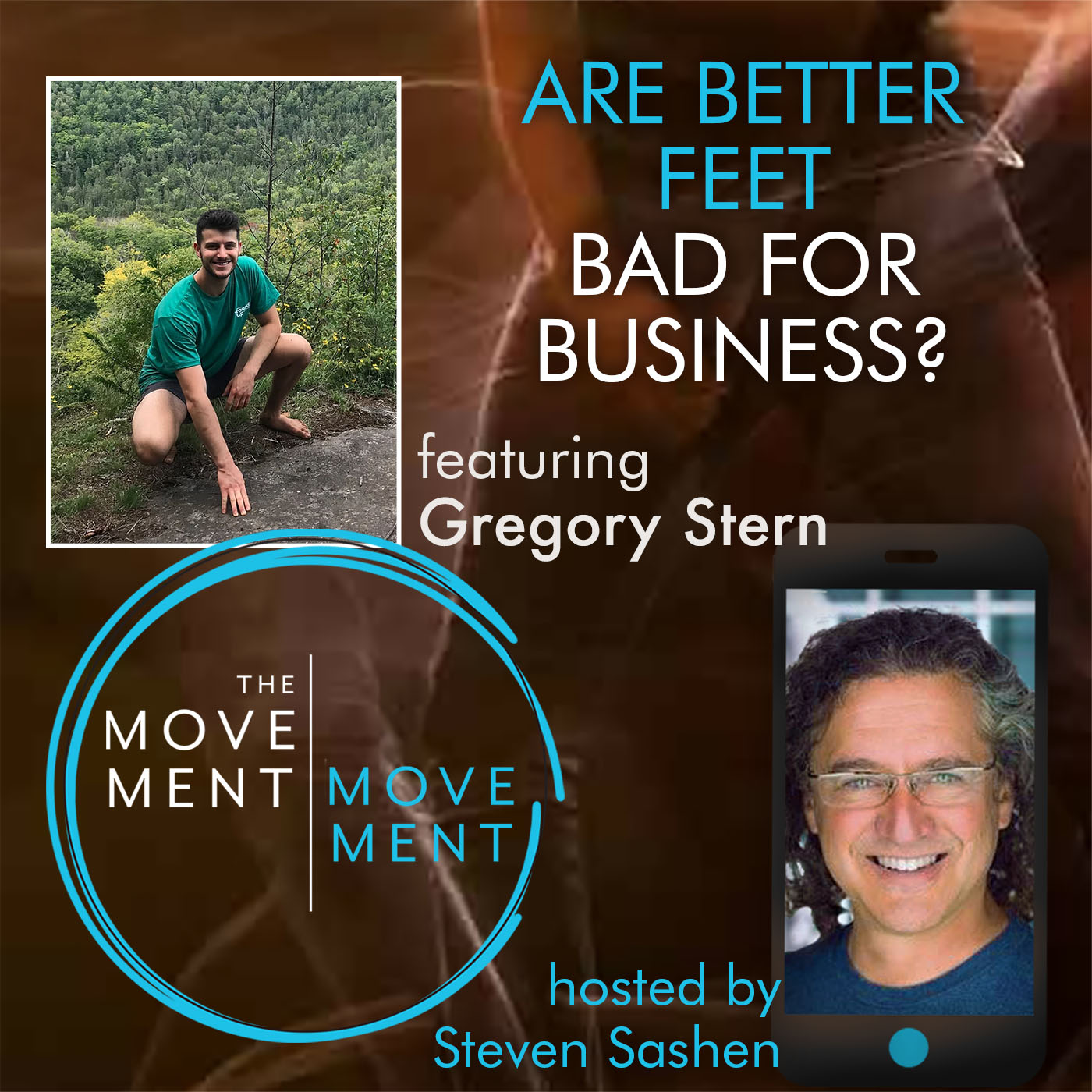
When you discover the importance of foot health, foot strength, basically what your feet do to your body, and what happens if you don't let your feet do their job, it can really change your life for the better. But if you're a professional, it can mess you up, and we're going to find out more about that in just a few moments on this episode of the Movement Movement, the podcast where people who want to know the truth about what it takes to have a happy, healthy, strong body. Starting feet first, you know those things at the end of your legs that are your foundation. We also break down the propaganda, the mythology, and sometimes the flat out lies, you've been told, about what it takes to run or walk or play or to yoga or cross whatever you like to do, and to do those things enjoyably and effectively and efficiently.
Did I say enjoyably? It's a trick question. You know, I did. Because if you're not having a good time, you're not going to keep up whatever it is you're doing anyway, so make sure you're having fun, and that's what we're here to do.
I'm Stephen Sashan from Zero Shoes.com. I'm now the Chief Barefoot Officer. That's my new title. I'm not going to talk about that though.
And we call this the Movement because we're creating a Movement. More about that in a second. I'm not in natural Movement, letting your body do what it's made to do and not getting in the way and interfering, even though we sometimes think that modern technology is better than just what human beings have been doing since the beginning of human beings. Not always the case.
To make this move is really simple. You can help. You don't have to do anything special. This is what you already know how to do.
Go check out our website, www.jointhemovementmovement.com. Nothing you need to do to join, but that's where you'll find out. Previous episodes, you'll find those. You'll find out how you can subscribe to hear about upcoming episodes.
You will find all the different places you can get the podcast if you're not getting it at your favorite podcast or whatever thing now. And the gist is, you know, when you can give us a thumbs up, give us a five star review, share this with your friends. And short, if you want to be part of the tribe, just subscribe. Alright, that's all the intro stuff.
Let us have some fun. Hey, Greg, give me a favor. Tell people who you want to what you're doing here. Absolutely.
I'm Greg Stern, I'm the owner of From the Ground Up Physiotherapy, and you're actually still my title of it. I'm the CFO, the chief foot officer here in Montreal. That's it. And I help people get to the root cause of their pain so that they can get back to doing the things they love.
So this all started with my own personal story as I feel like it does for so many. And as you were mentioning, this idea of navigation through professional pursuits, I'm 30 years old right now, but 10 years ago, I had a very innocent ankle sprained flying football that decided not to heal properly. Up to that point, I had lots and lots of acute injuries. I was the rambunctious kid, always getting into trouble climbing up trees, breaking my nose, breaking my foots, always getting into trouble.
But those injuries always seem to get better. Unfortunately, or fortunately, as we could discuss how injuries could happen for you, if you decide to view them that way, I ended up spraining my ankle and it just never heals properly. So I was dealing with chronic pain for about five years in my foot. Two and a half years into that journey, I ended up getting surgery.
Actually, I had an accessory in a vehicle, so there was an extra piece of bone. But essentially through that process, my father's an emergency physician and my mom is a physical therapist herself, they had suggested I go to see physio. So I went from one physio to the next doing all the things, being super diligent. The homework they were giving me and nothing was really working.
So I was pretty depressed at that point because I couldn't do the things I'd love to do anymore. Every time I would try about a activity, my whole body would ache, my feet were primed for help. And it was a long journey. Like I could fast forward the whole thing.
No, don't. I want to hear some of the other interventions that you attempted. And of course, I'm going to prompt you for what can follow that is having two parents who are medical people. I can only guess that as you got to what will be the end of that journey in the beginning of a new journey, they had some opinions.
Oh, yeah. 100%. I was thinking my whole life that I would be a doctor. I think that was like, I'm super interested in the body and in sciences overall.
And I studied health science through C-Jeep, which is actually pre-college here in Quebec and Montreal. And I was thinking about going to medicine. I had done volunteering opportunities, but I was always super into fitness as well. And my decision to say, oh, actually, I want to go into physiotherapy was met with a note.
And what do you mean, no, and it was a very tough navigation because at that point, all I could think about was getting out of pain and no longer did medicine attract me because I'm pinging with pain 24 seven. And it wasn't a pain that was horrible, but it was constant. The moment I woke up and to the moment I would go to bed, this is this buzzing reminder of this nagging injury that just didn't want to get better. And I had to stand on my own two feet.
I know this is what I'm doing. And unfortunately now, 10 years later, as I own it in my own clinic, it's met with a time. We'll get there. We'll get there.
So back up to half a step. So during that time, and let's just do this one before you found an obvious solution because we know where this story is going. What again, what were some of the other interventions that you tried that were in factual? Typically, as many people will encounter sight of pain, equal sight of problem, the way that most of the videos and chirros and osteos think about the body.
So it was just a lot of hands on therapy to the calf, to the foot, mobilization, the banded elastic drills, calf raises, calf stretching, towel curls, all these things that don't really cut it. And then when they don't cut it orthotics, then I was in big orthopedic shoes, walking around with these heavy cushioned shoes. And that was the main things that I was given, depending, no matter the profession I was going to. And when that wasn't starting to work, I was already starting to look at surgical options and they were looking at CT scans and MRIs and looking at what was the problem?
And what they saw was there was like micro motion of the tendon pulling on the bone that wasn't like a solid connection. Now, I can't say for sure whether like now given the knowledge I have, whether or not I could have helped it versus back then it was just what needed to happen. But essentially the moment I woke up after surgery, I thought all my problems would be over. And then as I started walking on my body, hello, hip pain, hello back pain.
And now I'm even more broken down than before and more depressed than before. And it was obviously super challenging at that point to know what direction is next because I just got the surgery and thought that would be the solution to my problem. And I ended up getting a athletic therapist that served training me more and started connecting my body a bit more. And that helped.
But again, I think it was the transition, I would say, I also then tried to transition to natural footwear to a too fast and aggressively. And I just further exacerbated. So I had to really hit a real rock bottom before I could start making my way back out. So then that rock bottom, what we're going to get to the part where obviously you had a road to Damascus moment.
So what led to that and what was that? And then of course, what followed that? Perhaps the company, the full collective or big company. So I'm quite friendly with the guys there actually gave, if they said therapy workshop to a bunch of the therapists there two weekends ago in Ottawa, which is very cool because that was the origins of my stories.
They were the first ones I started to hear talking about. And one of the physios there had recommended I go into shoes, but actually midway through my physiotherapy degree actually took a year off. And because my family's ties to real estate, I ended up going to real estate for a year, just thinking because during my time in physio, what I was being met with is mentors that were just saying hands on therapies, the key to everything. And I was like, did I just sign up for this?
Is this not what I thought physiotherapy could be? I had been following Kelly Star Red back in the day. And I was very like, all right, like physiotherapy is all about giving personal responsibility to your clients. But that's not what I was being met with in my schooling.
It was really this isolated approach that was super tunnel vision and so focused on hands on and not movements. And I was, I got this opportunity. And while in New York City living there, I was decided I go to Vivo Barefoot, choose the time and walking on concrete like that with a shoot that a foot was already like half dead because it wasn't working properly. I gave myself double plants or fasciitis in the process.
So it was quite a down moment. But what really started getting me out of that actually was a podcast from this guy named Dr. Chatterjee who introduced Gary Ward from Anatomy and Motion. I'm not sure if you've heard of him before.
But he was all into pronation, which I had been trying to avoid for years. And the concept, I don't have to perhaps educate you, but obviously your audience may or may not be familiar, but foot flattening is the key to a happy foot. The idea that our feet are meant to be trampolines that spread out absorb impact. And when I start to teach my foot to flatten, that was when my feet start to respond and I could start to utilize my feet, connect it to my calf, connect it to my knee, my hip and to start to teach all the parts to work together.
And then I just got more obsessed diving down more rabbit holes and just spending all my time like in my basement, just like doing slow movements and like the university degree, honestly, was just self exploration of the different continue education that was available for me to explore. First of all, brilliant. Secondly, I want to highlight this because I like it and I wish I had my foot skeleton with me. Oh, I got one.
Yeah, we moved into an office and it's here. But you can show for people who are watching. You can show up or do a little mild tangent. Pronation is not, it's not that pronation has gotten a bad rap.
It's that pronation has been given a rap at all. And it really came from what I can see when the, what are now the big shoe companies made an Elliott Hill shoe where you end up landing in your heel, which in your heels a ball by the time your foot comes down, it's unstable. And they came to this conclusion, oh my gosh, now we need motion control because your foot's unstable, not having the idea, oh, we made your foot unstable. And so this idea that pronation is bad came from that and it's become pervasive.
Everyone thinks pronation is a horrible thing. My favorite thing is there's a footwear guy, gosh, it's so embarrassing. I'm really bad with names in general and this guy's name always falls out of my head. So it'll pop in my brain within five minutes.
Anyway, big deal foot dude. Let's just leave it at that for now, who was Mr. Anti-Pronation until a number of years ago when he completely made a 180 and everyone said, why have you changed your mind? The research, the research shows there's no correlation between pronation and any injury.
And more, the things that are supposed to stop pronation rarely do because of the amount of force you're putting into the ground and what they're using to control that. Or if they do, you're creating other problems by immobilizing your foot. Anyway, that's my rant about that. But if you show on your little foot skeleton, what happens when a foot contacts the ground?
Because when you say the foot flattens, it's not like it necessarily completely does that although it can't because you'll never have that much ankle flexion. But regardless, you do have this arch thing in your foot that under load when it starts to flatten, actually gets stronger and utilizes muscles, ligaments, and tendons as natural springs and shock absorbers. And then you're like, I'm just saying, I'm just saying what you would say if I didn't shut up. But also you're doing the visual part under the audio part.
I don't know why. It also is sending messages once your foot is engaged that way up the chain to tell the rest of your body or ankle, your knee, your hip, et cetera. How do function properly? Now, was that a good paraphrasing of what you discovered?
Yeah, 100%. I think the definition is very like pronation equals three points of contact on the floor. The thing is when most people think of a foot collapsing or pronation, they think of collapse, i.e., the pinky tonic is lost. And that's no longer the definition of pronation is if the outside edge is lost.
I teach a lot of drills of how to pronate. So I get the hip to open up. I get the foot to flatten, but I put a wedge underneath the tripod of the foot. And if I could steal a wedge away and it's usually the outside part of the foot, therefore they are going too fast, too soon into the inside edge of the foot.
And if they get to lay that and learn to get the outer foot in contact as the arch goes down, then beautiful thing happens. And I go, they do five, six reps and they walk off and I say, so how does it feel like? Wow, my foot feels light. It feels springy.
It's just, it's almost like a comedy skit for me when I ever I teach on how to pronate their foot, like what their body response do. Cause it's very cool. Cause for someone who has very high arch feet, they're like, I feel the ground more. Like let's ask you a question.
When you rather have more foot on the ground or less of your foot on the ground, like obviously more of a sense of like groundiness and connection. For sometimes for people that actually have flat feet, it feels like their arch just got higher because when you stretch a muscle that's already stretched, it actually responds by quailing back to the middle. So it's very interesting, depending on the person and depending on like their patterns, they'll just gain new awareness of parts of their feet that they never knew existed. So what everyone demonizes is so bad is actually what creates so much beauty in the foot and the rehab process.
Yeah. So I've watched slow motion video of a number of especially Kenyan marathoners who they pronate the inside ankle bone just to say without having to get technical for people can sometimes be practically touching the ground and people say, oh, they need to correct that. So no, that's what's making them run fast. And but you highlighted the key difference.
The key thing and I originally learned this from Dr. Bill Sands when he had a lab out in Colorado and he was used to be at the US Olympic Committee and he said, it's not pronation, it's hyper pronation. It's happening too fast and out of control and out of control is a combination of just how things are lining up and whatever strength you have. But that's the part that isn't really called out or delineated.
So pronation and then that's a conversation stopper. But I love this idea that you have if you're having something under the foot to give people that feedback of, is this working or not? Because that's the only thing that changes movement patterns is having your brain go, oh, okay. I didn't realize that.
And now just wrap it out and give that brain some new, just flood the brain with new feedback and then also obviously tissue load is going to be different as well because what everyone is always focused on is straight knee movements. I'm obsessed with the idea of stacking someone's body. So when you ask anyone to get into a split stance and say, bend your front knee, what typically happens for most people is that the ribs almost go back and they end up loading their lower back. So what we want to do is get someone into position where they're like leaned and loaded forward.
And the moment that they do that, one, their back is happy. It's funny. I say to me, the soleus is the most important muscle in the human body. The ability to get the rib cage and the head stacked on top of the middle of the foot, the mid foot is the key to unlocking everything.
And once your calf kicks on, your back is safe. So when it comes to picking something up, everyone says bend your knees to pick something up. So they do that on the start of the movement. But the moment they actually stand up from picking things up, their knee prematurely extends backwards and then they finish through the lower back.
And if they can maintain that knee for a little bit longer than the hip does the work, their calves get towards the people always complain about, oh my God, my calf. It's like crazy or working super hard. But typically speaking, when you go to therapy settings, it's much more to straight calf raises, which is more the propulsive phase, but that's not what people struggle with. It's more that mid stance, their body coming over the top of their foot and loading into that mid foot and pronating is what's people are missing.
And some of that comes from the thing that people have heard until Ben Patrick, who is now known as the knees over toes guy, decided to start correcting this, which is if you are going to be in a split stance, one foot from the other and you're going to do something squatting down, something lunge-ish. People think they're supposed to be upright and their knee isn't supposed to get in front of their toe. Now, I have to say, I have a personal connection to this because two days ago was when I had my leg day and my leg day workout was my front foot when I do this split stance is elevated. So it's only up like maybe three inches and my back foot is on a little wheelie thing so that I can't actually use my back foot.
So if I do a lunge, basically it's a reverse lunge with my back foot going behind me. There's nothing I can do to support myself because it's on wheels. And when I do this, I'm leaning really far forward, giving my back straight like you described. My knee is going as far as it needs to go.
And I was just thinking this morning as I was walking my dog, holy crap, my hamstrings are torched. And my butt too. And my back feels fine, which is good because I had a broken spine. So I put it all together.
People have this as close to upside down as they possibly could, which is below is my mind. And it was even worse when I did that workout. So it was one set of those. It was like, I'm holding like 30 pounds, but I did like a minute's worth.
And I'm going all the way down as far as you possibly can. And then my rest period was 10 seconds of being at the bottom and just bouncing a little bit. Yeah, let's do that three times. And then I wanted to dine switch legs.
So anyway, now people can steal my workout and curse me for it afterwards. So this is all brilliant. I need to back up a little bit. You had this discovery.
You started using your foot. What was a I want to do? What led you to then how you started changing your practice? And this is an appropriate time to tell people what the name of your practice is.
Yeah. So I'm shameful. I'm not even rocking it here. But you're from the ground of this, you know, therapy.
So I got a foot of my logo over here. So obviously everything stems from a foundation. And it's very obviously you and your audience, but unfortunately, most people don't even think about their feet as a foundation. And it's just this piece of meat that goes inside their shoes and they forget about them until the pain starts coming on.
And then they start caring about it. And then the solutions as we know are very much acidized solutions that don't empower the foot to actually work properly. Yeah. It's a vicious cycle.
Yes, exactly. And so that vicious cycle for me is eventually I started going away and my feet started working a little bit better. And I think sometimes it's very appropriate though for people to transition to some sort of mid ground where there is a bit more cushioning. And I think that would have been a better solution for me from the standpoint of especially it depends on the context of the ground that you're walking on New York City.
I'm forgiving like to me that was helpful. I ended up going to the ultra brand before end up going into more zero vvo style. I'm going to argue that point just for the following reason. So Irene Davis is now the president of the American College of Sports Medicine.
She was at Harvard now. She's a University of Southern Florida. Yes. I think that's it.
And her research is basically shows that almost any amount of cushioning, the problem is it cuts down the amount of feedback that your brain is getting from your feet enough that it doesn't really you're not getting the feedback that would inspire a change in your gate pattern. And my experience has been that going to something lower than a little extra cushioning doesn't really do anything. I just watch people doing the same thing over striding heels, striking, etc. So in my world, which is called my brain, it's just start really small.
Actually, I'll say it literally. The challenge is that I think what the delivery factor is not the surface that you're on, but your natural propensity to learn new movement patterns based on feedback. And everyone's a little different that way. Some people they literally can't feel what's going on.
And that's a problem. And there's things that you can do to correct that, like just walking on mildly unpleasant surfaces barefoot and just getting waking up the nervous system again. Or some people they think they're doing one thing and they're doing something else and they just need some video feedback to go, yeah, you're not doing what you think. And then the third group, they just need a couple of cues.
And then the fourth group, they're natural and you just need to slow them down because they're going to have too much fun and do too much too soon. So my contention is that if you're going to start with something other than a shoe, a quote barefoot shoe is literally barefoot, but just around the house, go down the middle, down the block and back, something really simple because that's going to do more for gate retraining than anything else and getting you aware of what's going on. I agree. I think one thing that is super helpful is during the transition process to be doing certain exercises in tandem with that.
And again, those have to be done specifically. Again, what I see, I got an 85 year old into minimalist shoes and I think it's just a matter of helping that transition with additional things that will do the gate retraining as we're discussing. So you read my mind because I was going to say you've already hinted at some things that you do with people about experiencing proper pronation and how they can feel that. So for the people who are listening slash watching, toss out a something they can do that's either a diagnostic thing or one of those exercises you would recommend if someone is in the process of making that transition or thinking.
I think a very important thing is like a classic knee to wall test just to see how it feels left versus and what's the quality of that movement? Because when people just go for knee to wall, they think they pause there and describe the test because most people are. Yeah. So essentially you're going to stand relatively close to a wall and I just with the back leg very light, you're going to push your front knee forward with a heavy heel so that you're testing how far your knee could pass over your front foot.
So the back leg, I really don't want to exist. You could put your hands on the wall. Really stretching out your calf. Now what is quality of that movement and where does your knee tend to go because people have been ingrained that when they do that, they should push their knee outside so that the arch doesn't go down.
So oftentimes people experiencing pinching the front of their ankle there as opposed to lengthening of their calf. So just learning that when you do that, you want to maintain your big toe, knuckle, your little toe, knuckle and your heel and drive your knee forward. And then what does that feel like for you? Does that feel like a cash stretch or are you feeling pinching?
Because if you are feeling pinching, then you're not getting any sort of arch relaxation that we're talking about. And then obviously we can either link, I could send over some videos that you're an audience because that's a thing huge that I teach to my clients every day. And then also just learning to stack the body in a way where you bend your front knee, hands on your belly and you shift your weight forward to the point where your toe knuckles just slam into the ground in a sense that they're going to all of a sudden feel very firm and your calf kicks on, your quad kicks on, and your butt kicks on just by virtue of you being stacked. And that's like the foundation of how I teach all my movements.
Once you're stacked, then we could do 3D movements. Then we could do a chop. Then we could pronate. Then we could side bend and rotate and squat, learning to get the calf involved in almost every single movement.
Obviously a bit more challenging to explain certain things, but learning to just jump in a way that when you jump from your right foot to your left foot, you're able to land in a stacked position and then freeze on a dime. And then you do that back and forth because that's what we almost slow down the process of running where you could stand, land in a stacked position in a freeze position where your knee doesn't budge because a lot of people when they run, they've been told land softly. And by landing softly, they end up sinking and using much more of a muscular strategy. We want to learn to be a lot more rigid and elastic when we run rather than running in a trotting kind of way where the body like loses height on each step.
There's so many things in there that you said that I totally love. So first of all, I want to highlight that when many people talk about stacking things, they literally do mean just one straight above the other and you're talking about something very different. It's a different kind of alignment that's engaged. So again, your knee is moving a little forward, you're leaning slightly forward from the hip.
If you look from the foot to the knee to the hip to your body, it's not quite Z-shaped. I'm trying to draw that. I see you decided to do that exactly how I pictured it. And then this whole idea about jumping from foot to foot in a way is a simulation of running.
I love because running is just jumping from foot to foot. And my favorite thing about that idea of having someone just jump from foot to foot, you don't have to jump really far left or wrong. Just do it at all because what people will find naturally, they're not going to be landing on their fucking heel. And that's the first thing.
And I tried to say it without the effort. It's mind blowing. If you ask someone to, I've been meaning to do this, I'm trying to find a phone book because they don't have it anymore. So it's good, like Atlanta phone book, like three, four inches high.
And it has someone to step off of that. And you watch, actually step off and immediately jump. And you watch, they land on the ball of their foot and they use their body properly. That's how you're supposed to run.
People go, but that's not what I've been told. Yeah, by big companies, it makes you land on your heel. So I love just that whole idea. And most importantly, this notion that this land softly and also run upright instead of having this little bit of lean forward from the ankles, these are just the wrong cues.
And what you said, and it's my favorite thing, when you're running, you want to be a top spring. Yeah. This is so this is fun. Aside, when you say bolt went from being a 400 meter runner to a 100 meter runner, the big thing that his coach Glenn Mills had him do for a year was a lot of course, strengthening stuff, not just abs, but lower back as well.
Because he was loose. He was not a top spring. And being a top spring was part of, I'm not going to say entirely, there may be some other things that went in when I got nine 58, but regardless, put that all together. And that's what made him a massive man in the world.
So on that topic, I'm not sure if you're familiar with David Weck and those two ball. You like me to show you the most recent text I got from David? Yeah, David's my pal. I've got a couple of times in San Diego and obviously his whole system is let's just take out all the slack in the system and getting to these coiling core positions.
So I really got into weck method stuff in the last two years. So for those that are not familiar with the idea, again, of when we think about running, often people think of like, all right, don't cross midline, don't let the head move really and just be a bit more rigid. And you end up seeing this very robotic movements. But if you actually look at the animals and you look at the fastest human beings in the world, there's the concept of obviously head over foot.
And so the idea of a side bend and a rotation while maintaining like the body going forward in space, what we're going to see is that we're going to perfectly align our entire structure. We already talked about it from like the side view standpoint about, all right, can we get that nice, dead shaped looking thing where the body's stacked over the midfoot? But can we also get this spine to start side bending and rotating and taking advantage of the spinal engine movement or figure of eight pattern? And that's led to me like a massive push towards teaching people rope flow.
I don't know if you've ever dabbled around with that, but that is literally combining the principles of weck method with what I'm teaching from a stack standpoint combined together to provide like the best experience for my clients. Two things. I'm going to have you describe rope flow for people who don't know it. But B, my only argument with David about what you just tried is, pardon me, is that when you're watching sprinters, it's a bit of a fake out because one of the reasons sprinters are exhibiting that kind of head over foot thing a little, to a certain extent is frankly, because their legs have gotten so big that they're stance one foot or the other, it's like a good foot apart sometimes.
And so they are literally bouncing left and right as they go down the track. If you are, if frankly, if you don't have that much volume in your upper thighs, then you're not going to have that same kind of back and forth. And for sprinters in particular, the goal is to have is to really have everything before because you're only on the ground for eight, 100th. So I guess there's going to be this like, there's a very slight head.
Yeah. Simply because you are, because especially if you watch a lot of these guys in the start, they're really going left to right in part because they want to have a faster, they want their legs to cycle faster during the first few steps. And it's easier to do that if your legs are spread further apart than if they're more aligned. So sprinting, and I only bring up the sprinter of course.
And it's all about me. It's that sprinting is a different animal. And, and, and you're doing this weird thing for a very specific reason to get from here there in a straight line, that crazy fast. So it doesn't really count frankly, but I like to bring it up for the fun.
Yeah. And then I'm going to go back to the end point of just for the casual jogger to just include different inputs because like I can mess around with. So coming back to Rope for a second, basically, instead of jumping through a rope, you have a bit of, I have it over here. It's like a weighted rope that's not too weighted.
It's just a little bit more feedback as we've talked about. And essentially instead of jumping through it, I create figure of eight patterns where I'm keeping my hands close to my midline, but I'm learning to get this idea of a side bend or rotation where one shoulder is going to be slightly lower than the other. And I'm going to tap into this rib. I'm going to lengthen my obliques and then I'll pop to the next one.
And so underhand pattern, if the rope is swinging like to away from you, it's more about a gate pattern. And then it starts to look more fighting or kayaking. And you could just mess around with as you're running. If you just want to be casual with it, you notice that the more you get the upper body fluid and moving, again, you don't have to exaggerate.
You could just have fun with the way that you're running. You'll notice that you end up landing more and bounce. Like when I do that leaping drill that we talked about a few minutes ago, but just like people just landing, if their head stays inside, when you take one leg off the floor, you're more likely to topple over. So naturally, if I'm standing here and I take one leg off, my center mass needs to shift over to be more stacked over here.
So that's this idea of the head over foot and this adding in a bit of this arm movement creates this more fluid motion when you're running instead of those that keep their arms stiff. And so a lot of people end up running with elbows and hands as opposed to the shoulder blades moving fluidly. And that's what I tend to find with a lot of shoulder pain patients in general is that they just move through their humerus bone, their arm bone instead of allowing the scapulae to move fluidly on their rib cage. And the moment I teach them how to do that, their shoulder pain goes away.
And this is backing up to sprinting. This is an interesting thing because for proper sprinting, there is this upper body thing happening because for as much as your legs are doing the heavy lifting, if you will, for your leg to come out in front of you properly, because sprinting is all about what's referred to as front side mechanics, where there's nothing else, your opposite arm has to be able to go back behind you. Now you're trying to keep the amount of motion in your arms contained because the more your arms move, the slower your leg, the more range of motion your arms have, the longer it takes for them to move through a cycle and your legs will then follow. So there's this interesting balance where the upper body is still doing this, it's not a figure eight per se, but it is doing this oscillating motion.
It's not staying rigid and straight like with a bunch of runners because that's the only way to do it. And this also relates to our friend Danny Dryer from she running where the idea being that if you are using your hips properly also, the image that he gave me years ago, I think before he even created G running is if you imagine putting a shirt on a hanger and you just start twisting the hanger back and forth, you'll see there's a spot in the middle, like basically the middle of the back that stays stable and things rotate above and below that in opposite directions. And it's like that's what your body does if you're running properly. And David's just adding a little bit of an additional plane of movement possible.
Yeah, I guess the side bend is what a lot of people attempt to miss, right? So like you're here, obviously always about rotational training, but rotation happens with the side bend as well. And I think with these principles is give your brain the extremes so that when you do running, like you're not actually going as intensely as that. But if you could find the extremes, the brain kind of finds the center.
That's all I do in the out of the motion as well. I was like, all right, with respect to just like your existing is such a small range of motion with your foot or with your hip and the more you could fly to your brain with extremes, it will find its center. And this is an interesting thing because again, and I've done this with people, if they're especially if they're responding, I'll suggest that they do it more and exaggerate it because we do get into these patterns. And once we've obituated the pattern, we don't know what we are doing.
And so it's, and you can, and this, my first favorite run was literally doing exactly what we described. I was entranced with the feeling of my feet on the ground. What can I do differently to see how this works? I want to see if this is for real or not was actually what I was thinking.
And so I would exaggerate things in both directions. I'd make my stride really long. I'd make my stride really short. I'd pick up my cadence without running any faster or I'd run faster with it slower cadence.
Anything I could think of just push the edges of how this movement pattern could work just to see what I discovered. And another thing I'll do with some people, I'll have them stand in front of me. We're facing each other and I put my hands on their shoulders and lean it, have them lean into me. And I'll step way back until they're like at a 45 degree angle.
Okay, I'm going to run backwards. You run forward and I put enough pressure that they have to be at that angle. Just like to have your feet behind you when you're running, which is a massive exaggeration. But that's like the only way to wake up your brain is see it.
It's exactly the same thing as that stack that we're talking about. I had a client say to me, I always have back pain, but he said, when I drag my dead deer after hunting, I don't have back pain. I don't understand because it's behind him. It's where therefore he has to lean forward and all of a sudden it's supposed to your chink kicks on.
So just getting or it's actually still snowing in Montreal yesterday was beautiful. And now it's snowing again. Yes, it's April the end of April. If it makes you feel any better, we had six inches of snow on Saturday on Sunday.
It was 65 degrees. Yeah, it's wild. So it's the same thing that's volatile. But anyway, I digress it's more about.
I always tell people if your car is stuck in the snow and you got to push it, what are you going to do? You're going to stand upright with your rib cage back and you're going to lean forward. And so as soon as you, so much of it, when it comes back to the rehab world, we think about individual muscles instead of just what is your center of mass doing? And if we could just arrange your center mass slightly differently, all of a sudden the whole chain will start working, but we're so hyperecessed about to be honest, like the Tibetans or this that like everyone's find their new favorite muscle of the day.
But it's like, all right, let's just learn to organize your body a little bit better and everything starts to work in unison and you don't have to overthink about each like a fiber of our being. It's so funny to say this. Do you know the writer David Sedaris? I do not.
It doesn't matter. Anyway, he, American guy, he's a living in Paris and in France, I'm not sure if he's in Paris. And he commented on a talk show that I saw him on recently that his French friends accuse him of walking like an American and he said, what is that? And they said, you throw your legs in front of you.
Now, if you're wearing a shoe with an elevated heel and it tips you forward, tips your center pass forward and you adjust by leaning back somewhere to be more upright, you can't actually extend your leg behind you, you can't actually get hip extension. So you have to throw your leg forward. So if you put your feet flat on the ground, I realized the only thing you need to do to learn to put your foot or to use your leg properly is lean forward a tiny bit from your ankles, like an inch or two. And it'll feel a little bit like you're falling forward because you are.
And if you do it just a little bit, that little bit of falling is going to trigger all the right movement patterns. And there's more to it than that. You can do things that work on hip extension. But but that but even with hip extension, the thing that's making it work is that tiny bit of moving your center of mass and inch or so in front of you while maintaining proper posture.
But an interesting thing about proper posture, because I always find the word posture, I don't want it. Yeah. Okay, it's but you know, it is interesting because one of the things I do teach my clients, I actually teach my clients often how to slouch. Let me go into that for a second here because when we hear the words posture, immediately start seeing someone puff their chest up and squeeze their shoulders back, right?
Like in what mom and dad and society think about this aesthetically pleasing posture, but you'll notice like what I often keep people to do so if everyone is listening to this right now, basically you squeeze your hands together really, really hard. Yeah, we squeeze, we squeeze, and we squeeze, and we squeeze. And now I ask you if I ask you that for next 12 hours, would your hands be happy? And I don't think so.
No, because I wouldn't be able to eat. Exactly. So the thing is when people think about posture, they often extend from the lower back and so they're really just cranking weights that low back. And if we look at people in India or China or Africa, like most people that are 80 years old, I visited 10 years ago in India are very happy to be in a deep squat position.
But you'll notice the spine in that position is much more relaxed and rounded. But then all of a sudden we sit in a chair, we think we need to be here. There's nothing wrong with sitting and sighing and allowing the ribs to come down the shoulders to be more forward because being more relaxed while you're sitting is there's nothing inherently wrong. If I listen in and I'm intense about this conversation, I can lean forward almost from my hip here, but I'm not cranking and almost falling back.
It's my low back. And that's what happens with so many people, even when they're picking things up, like if you think about a strong man picking up 300 pound stone, he has his back heat or she has his back in a full flex position. It's just their knee position stays forward as they pick it up and their hip extends. So whether the back is straight around is not necessarily the key point.
It's more about what's happening below in the hip knee and foot that I care more about. So I teach people actually like a slouchy split squat where they keep their knee forward and all of a sudden their back feels great and their leg starts convulsing. So every day in my clinic, I had people whose nervous system starts to shake like crazy because I'm putting their bodies in positions they haven't been in for years and I'm forcing them to go in so eventually they could go back straight to whatever that means. But for the time being, I almost want to exaggerate again an extreme of using a spinal flexion strategy and then driving through their legs and all of a sudden amazing things start to happen because we're going away from what they're so habituated to use.
Yeah, yeah. That inspires me to ask this. So we gave people the knee wall test. Is there anything else that you can think of that something for people to experience if they're in a position where they could do that, something that would give them a little like, ooh, a little more understanding of what you're doing if somebody walked into your clinic basically.
Yeah, I think one of the first drills that I show someone is basically instead of a classic glute bridge, I'm going to put their feet on a foam roller, but with a midfoot and forefoot on while they spike their heels or lift their heels and he being that when they're in that glute bridge position, most people push through the heels and really lift through their lower back. And when they're doing that, they're basically using their lower backs to lift them up. But instead of doing that, I put the foam roller under the front of their feet and they lift up their heels and now I say drive up through your feet, but lift up like a millimeter off the ground and all of a sudden they're going to feel their hamstrings and their calves start to work like work like crazy. And if they're brave enough to drive one knee towards their chest, they're basically doing like a single leg hamstring bridge or calf bridge because everyone wants to feel the glute pump or soaps that's what this idea, feel your glutes.
But why are we trying to feel our glutes without the rest of the chain? So I want them to feel their foots, their calf or hamstring and their glute working together while staying very minimally off the ground so they're not using their lower back so we could start to utilize that whole chain because when we're hip extending in general, when we push off through the foot, we're not pushing through the heel, we push off through the forefoot. So that's what we want to train hip extension. So that's a great drill that again, lying under back just a foam roller under your feet, put it relatively far away from you at least 90 degree angle and drive up through the balls of your feet and all of a sudden you're going to feel a completely different sensation and people's calves and hamstrings really start to cramp up which is great because I want the whole chain connected better.
That's great. Hey, you remind me something I wanted to bring up. This is definitely tangential but here we go. So you mentioned the soleus being such an important muscle and there was a bit of research that came out.
I can't track time very well so let's just say in the past and not that long ago where some scientists had a rain put electrostimulators on people's lower leg so that the calf, the soleus would contract and just over and over for hours a day, like six hours a day. And one thing they found is the soleus never got sore, never had a problem, could keep going forever. It made them burn calories like there was no tomorrow. And so people have been, the reason I bring it up is it's very interesting muscle for that reason.
It'll just keep going and going and going as the energizer bunny of your muscles. But then people were saying, oh, I guess all you need to do is just do calf raises while you're sitting down. No, that was electrically stimulating a muscle beyond what you could naturally do on your own for hours and hours a day. And there's literally people who made God does how much money selling little courses.
Oh, just do calf raises and lose weight size to punch myself in the face. I think the isometrics are so important that are so overlooked. So we were talking about just that position of being in a foam roller on your back. That's an ISO.
The same thing of learning to be stacked and then pressurizing through the knuckles of the foot, the net, the tardisole heads and finding your calf in a position like that. And even like coming to the point where your heel just comes a millimeter off the ground again, that all of a sudden starts to create the shakes in people because they're just not used to being these positions. And then that starts to become something like more habitual. So isometrics are really important for giving you information and then you could start getting creative and just reaching different planes of motion.
Again, maybe I don't know if ironically is the right word for this, but there was a study that came out recently showing just doing an isometric wall sit just back against the wall, slide down to your upper, your thighs at 90 degrees is parallel to the ground and your lower legs are perpendicular to the ground. And that doing that for two minutes a day, and by the way, you will not be able to do two minutes at one time when you're starting this and your legs will shake and you'll fall down if you go as far as you can. But doing that dramatically lowered blood pressure for people, which is fascinating. Very cool.
We have to start bringing this to I don't want to say close, we got to wind it up just because of reality. If people want to find out more about what you're up to so they can experience this more because this is just totally dreamy. How can they do that? Yeah, absolutely.
So obviously through all the socials, I'm a LinkedIn, Facebook, Instagram, TikTok, YouTube. I'm at ground up physio. So the whole idea of ground up and physio. It's funny, the sake they call it physical therapy for whatever reason, candidates, deo therapy, not sure why, but ground up physios where they could find me.
And I also have an online program that's available for people. That's a foot pain program, a back pain program where I'm basically teaching the exact same exercises that I teach in my clients, here in my clinic that empowers them to utilize their whole body. Very simple things that they could do in the comfort of their own home that doesn't really require any equipment. But it's all about reteaching these stacked positions, learning to utilize your body more effectively.
So everything shows up to the party. So many times when people have knee pain, their knees is getting overloaded and someone they'll go to a doctor and the doctor will say, you have exitis. I need to give someone a name of what they have. This part just works too much and other parts are working a little too.
Let's just redistribute forces. So that's why it is a simple program that people could do. Again, they could find out through all the links in my bios and all the different channels that are available. Hey, that's a life will be.
You may think of a story. When I got back in the springing, 17 years ago, I was having a bunch of knee pain on my right side and I went to a doctor and after the third or fourth session with him, they did nothing. He said, you have to tell her 10 tonight. I said, yeah, I told you that when I walked in the door four sessions ago, I just didn't say it in Latin and he got really mad at me.
But I didn't care because he clearly didn't know what was going on. Never asked me how I was running. I looked at how I was running just paying attention to the knee, which was useless at that time because it was not caused by my knee. So this is a couple of questions, deeper.
It's like, where we have to go with people. It's like, how are you running? How much are you running? Just go dive into deeper.
And then they're not going to go there because they don't know anything about analyzing gate properly. They're not going to go to a point where it's clear that they're out of their depth. And if you say I've been running and they don't know how to look at you running in slow motion, look at you in slow motion running in slow motion, then and know what proper running mechanics are. It's good.
That's a good slow motion run. Then there's nothing they can offer you. And this is a challenge. It's a pleasure.
And everyone else, I do hope you go check out the ground up physio. And yeah, it's physiotherapist in Britain too. And I think most of Europe, if they're going to speak English, that's what they say. I don't know how we drop the U and things.
We don't use millimeters down here. No, no, it's amazing. It's on metric terms. I apologize for the audience.
There's an old spoof radio thing. They did a spoof weather forecast. It's something like it's 648 AM right now, which is 933 Celsius. And that was like a perfect American thing of not knowing how Celsius works.
Anyway, so everyone else, go check out what regs up to. I think you're going to really enjoy it. And a reminder, go and check out www.jointhemovement.com to find previous episodes. Other places you can find the podcast, if you care about finding other places, you can find us all of our social media accounts.
We can track us on social, watch the video of this, or see us on Facebook and everywhere else you can find us. And again, most importantly, give us a good five-star review and a thumbs up at the bell icon on YouTube to get notified about new episodes, spread the word. And most importantly, just go out, have fun, and live life-y first.