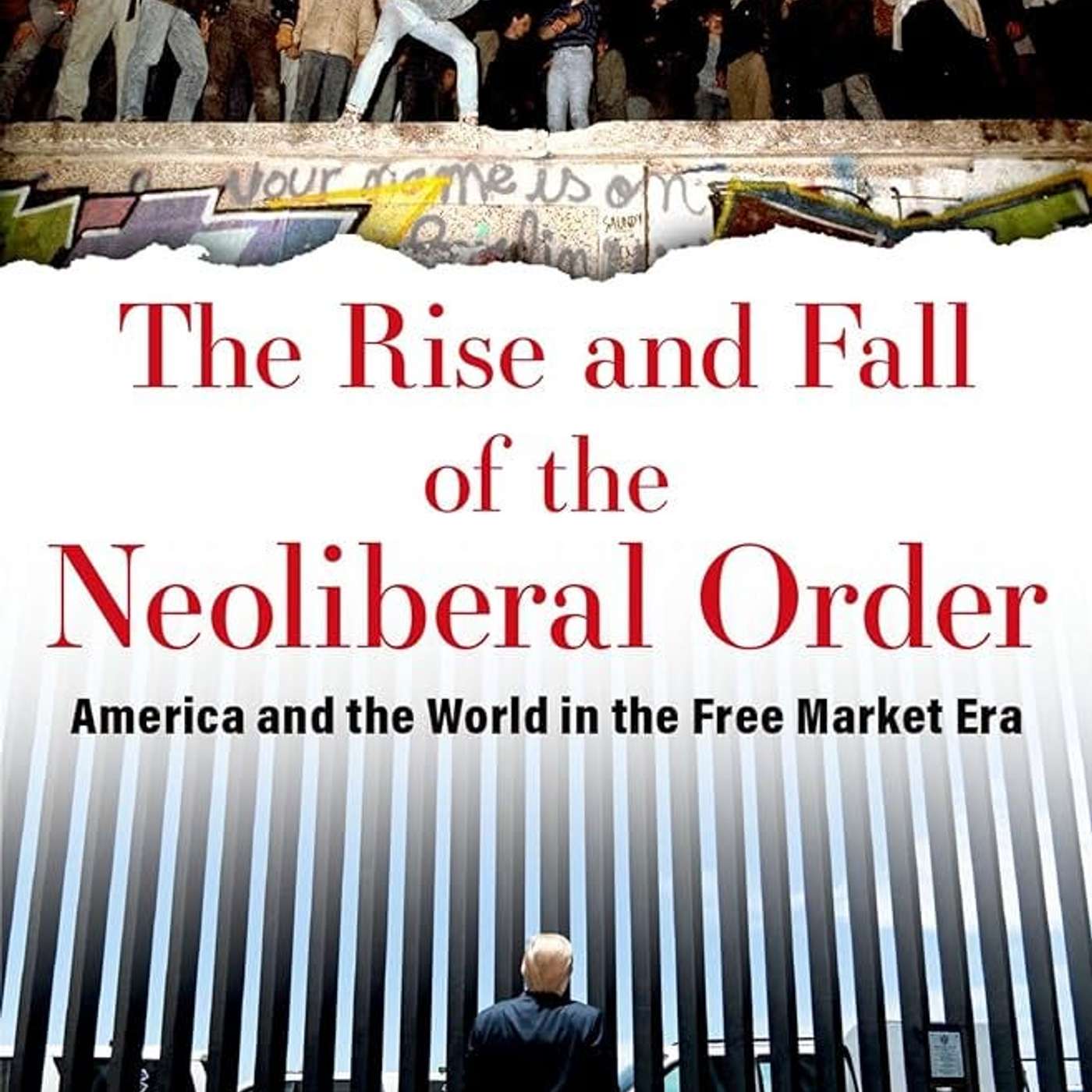
Episode 2242: Gary Gerstle identifies the outlines of our Post Neoliberal Age episode artwork

EPISODE · Nov 13, 2024 · 57 MIN

Episode 2242: Gary Gerstle identifies the outlines of our Post Neoliberal Age

from Keen On America · host Andrew Keen

As the author of The Rise and Fall of the Neoliberal Order, the Cambridge University historian Gary Gerstle was one of first people to recognize the collapse of neoliberalism. But today, the real question is not about the death of neoliberalism, but what comes after it. And, of course, when I sat down with Gerstle, I began by asking him what the Trump victory tells us about what comes after neoliberalism.Gary Gerstle is Paul Mellon Professor of American History Emeritus at the University of Cambridge. Gerstle received his BA from Brown University and his MA and PhD from Harvard University. He is the author, editor, and coeditor of more than ten books.  He is currently the Joy Foundation Fellow at the Harvard-Radcliffe Institute, Harvard University, where he is working on a new book, Politics in Our Time: Authoritarian Peril and Democratic Hope in the Twenty-First Century.  He resides in Cambridge, Massachusetts.Named as one of the "100 most pivoted men" by GQ magazine, Andrew Keen is amongst the world's most pivotal broadcasters and commentators. In addition to presenting KEEN ON, he is the host of the long-running How To Fix Democracy show. He is also the pivotal author of four prescient books about digital technology: CULT OF THE AMATEUR, DIGITAL VERTIGO, THE INTERNET IS NOT THE ANSWER and HOW TO FIX THE FUTURE. Andrew lives in San Francisco, is married to Cassandra Knight, Google's VP of Litigation & Discovery, and has two cats, both called Pivot.Keen On is a reader-supported publication. To receive new posts and support my work, consider becoming a free or paid subscriber. TRANSCRIPT“It's important to recognize that the neoliberal triumph carried within it not just the triumph of capitalism, but the triumph of freedom. And I think the that image of the wall coming down captures both. It's people wanting to claim their freedom, but it also paves the way for an unregulated form of capitalism to spread to every corner of the world.” -Gary GerstleAK: Hello everybody. As we try to make sense of the aftermath of the US election this week, there was an interesting headline today in the Financial Times. Donald Trump apparently has asked, and I'm quoting the F.T. here, the arch-protectionist Robert Lighthizer, to run U.S. trade policy. You never know with Trump, he may change his mind tomorrow. But nonetheless, it suggests, and it's not a great surprise, that protectionism will define the Trump, presidency or certainly the second Trump presidency. And it speaks of the structural shift in the nature of politics and economics in the United States, particularly given this Trump victory. One man who got this, I think before anyone else, is the Cambridge historian Gary Gerstle. He's been on the show a couple of times before. He's the author of a wonderful book, The Rise and Fall of the Neoliberal Order: America and the World in the Free Market Era. It's a profound book. It's had an enormous impact on everybody. And I'm thrilled and honored that Gary is back on the show. This is the third time he's been on the show. Gary, is that important news? Have we formally come to the end now of the neoliberal order? GARY GERSTLE: I think we have, although there's an element of neoliberalism which may revive in the Trump administration. But if we think of a political order as ordering political life so that all participants in that order have to accept its ideological principles, we have moved out of that order. I think we've been out of it for some time. The critical election in this case was 2016, and the critical move that both Donald Trump and Bernie Sanders made in 2016, the two most dynamic presidential candidates in that year, was to break with the orthodoxy of free markets, the orthodoxy of globalization, the orthodoxy of a world without borders where everything was free to move and the market was supreme. And the only role of government in the state was to ensure as full access to markets as was possible in the belief that if governments got out of the way of a private capitalist economy, this would spur the greatest growth for the greatest number of people everywhere in the world. This was governing orthodoxy, really from the time of Reagan until 2016. Trump broke it. Sanders broke it. Very significant in this regard that when Biden came into office, he moderated some of the Trump tariffs but kept the tariffs on China substantially in place. So there's been continuity for some time, and now we're going to see an intensification of the protectionist regime. Protectionism used to be a dirty word in American politics. If you uttered that word, you were excluded from serious political discourse. There will be other terms that are used, fair trade, not just because protectionism has a negative connotation to it, but we are living in an era where governments assert the right to shape markets as they wish to in the interests of their nation. So, yes, we are living in a different era, although it must be said, and we may get into a discussion of this at some point, there are sectors of the Trump coalition that want to intensify deregulation in the domestic market, that want to rollback government. And so I expect in the new Trump administration, there is going to be tussles between the protectionists on the one hand and those who want to, at least domestically, restore free trade. And by that I mean the free operation of private capital without government regulation. That's an issue that bears watching.AK: Is that a contradiction though, Gary? Can one, in this post-neoliberal order, can governments be hostile to regulation, a la Elon Musk and his association with Trump, and also be in favor of tariffs? I mean, do the two—can the to go together, and is that the outline of this foggy new order coming into place in the second quarter of the 21st century?GARY GERSTLE: They can go together in the sense that they have historically in the past gone together in the United States. In the late 19th century, the US had very high tariffs against foreign goods. And domestically, it was trying to create as free a domestic market as possible. What was known as the period of laissez-faire domestically went along with a commitment to high tariffs and protection of American laissez-faire against what we might call global laissez-faire. So it has been tried. It did work at that time. But I think the Republican party and the constituencies behind Donald Trump are divided on this question. As you noted, Elon Musk represents one pole of this. He certainly wants protection against Chinese imports of electric cars and is probably going to get that because of all the assistance he gave Trump in this election. But domestically, he wants no government interfering with his right to conduct his capitalist enterprises as he sees fit. So that's going to be one wing. But there's another wing of the Republican Party under Trump that is much more serious about industrial policy that says we cannot leave the market to its own devices. It produces too many human casualties. It produces too many regions of America left behind, and that we must use the government to help those people left behind. We must structure free enterprise industry in a way that helps the ordinary working-class man. And I use the word “man” deliberately in this context. Interestingly, JD Vance, the vice ...

As the author of The Rise and Fall of the Neoliberal Order, the Cambridge University historian Gary Gerstle was one of first people to recognize the collapse of neoliberalism. But today, the real question is not about the death of neoliberalism, but what comes after it. And, of course, when I sat down with Gerstle, I began by asking him what the Trump victory tells us about what comes after neoliberalism.Gary Gerstle is Paul Mellon Professor of American History Emeritus at the University of Cambridge. Gerstle received his BA from Brown University and his MA and PhD from Harvard University. He is the author, editor, and coeditor of more than ten books.  He is currently the Joy Foundation Fellow at the Harvard-Radcliffe Institute, Harvard University, where he is working on a new book, Politics in Our Time: Authoritarian Peril and Democratic Hope in the Twenty-First Century.  He resides in Cambridge, Massachusetts.Named as one of the "100 most pivoted men" by GQ magazine, Andrew Keen is amongst the world's most pivotal broadcasters and commentators. In addition to presenting KEEN ON, he is the host of the long-running How To Fix Democracy show. He is also the pivotal author of four prescient books about digital technology: CULT OF THE AMATEUR, DIGITAL VERTIGO, THE INTERNET IS NOT THE ANSWER and HOW TO FIX THE FUTURE. Andrew lives in San Francisco, is married to Cassandra Knight, Google's VP of Litigation & Discovery, and has two cats, both called Pivot.Keen On is a reader-supported publication. To receive new posts and support my work, consider becoming a free or paid subscriber. TRANSCRIPT“It's important to recognize that the neoliberal triumph carried within it not just the triumph of capitalism, but the triumph of freedom. And I think the that image of the wall coming down captures both. It's people wanting to claim their freedom, but it also paves the way for an unregulated form of capitalism to spread to every corner of the world.” -Gary GerstleAK: Hello everybody. As we try to make sense of the aftermath of the US election this week, there was an interesting headline today in the Financial Times. Donald Trump apparently has asked, and I'm quoting the F.T. here, the arch-protectionist Robert Lighthizer, to run U.S. trade policy. You never know with Trump, he may change his mind tomorrow. But nonetheless, it suggests, and it's not a great surprise, that protectionism will define the Trump, presidency or certainly the second Trump presidency. And it speaks of the structural shift in the nature of politics and economics in the United States, particularly given this Trump victory. One man who got this, I think before anyone else, is the Cambridge historian Gary Gerstle. He's been on the show a couple of times before. He's the author of a wonderful book, The Rise and Fall of the Neoliberal Order: America and the World in the Free Market Era. It's a profound book. It's had an enormous impact on everybody. And I'm thrilled and honored that Gary is back on the show. This is the third time he's been on the show. Gary, is that important news? Have we formally come to the end now of the neoliberal order? GARY GERSTLE: I think we have, although there's an element of neoliberalism which may revive in the Trump administration. But if we think of a political order as ordering political life so that all participants in that order have to accept its ideological principles, we have moved out of that order. I think we've been out of it for some time. The critical election in this case was 2016, and the critical move that both Donald Trump and Bernie Sanders made in 2016, the two most dynamic presidential candidates in that year, was to break with the orthodoxy of free markets, the orthodoxy of globalization, the orthodoxy of a world without borders where everything was free to move and the market was supreme. And the only role of government in the state was to ensure as full access to markets as was possible in the belief that if governments got out of the way of a private capitalist economy, this would spur the greatest growth for the greatest number of people everywhere in the world. This was governing orthodoxy, really from the time of Reagan until 2016. Trump broke it. Sanders broke it. Very significant in this regard that when Biden came into office, he moderated some of the Trump tariffs but kept the tariffs on China substantially in place. So there's been continuity for some time, and now we're going to see an intensification of the protectionist regime. Protectionism used to be a dirty word in American politics. If you uttered that word, you were excluded from serious political discourse. There will be other terms that are used, fair trade, not just because protectionism has a negative connotation to it, but we are living in an era where governments assert the right to shape markets as they wish to in the interests of their nation. So, yes, we are living in a different era, although it must be said, and we may get into a discussion of this at some point, there are sectors of the Trump coalition that want to intensify deregulation in the domestic market, that want to rollback government. And so I expect in the new Trump administration, there is going to be tussles between the protectionists on the one hand and those who want to, at least domestically, restore free trade. And by that I mean the free operation of private capital without government regulation. That's an issue that bears watching.AK: Is that a contradiction though, Gary? Can one, in this post-neoliberal order, can governments be hostile to regulation, a la Elon Musk and his association with Trump, and also be in favor of tariffs? I mean, do the two—can the to go together, and is that the outline of this foggy new order coming into place in the second quarter of the 21st century?GARY GERSTLE: They can go together in the sense that they have historically in the past gone together in the United States. In the late 19th century, the US had very high tariffs against foreign goods. And domestically, it was trying to create as free a domestic market as possible. What was known as the period of laissez-faire domestically went along with a commitment to high tariffs and protection of American laissez-faire against what we might call global laissez-faire. So it has been tried. It did work at that time. But I think the Republican party and the constituencies behind Donald Trump are divided on this question. As you noted, Elon Musk represents one pole of this. He certainly wants protection against Chinese imports of electric cars and is probably going to get that because of all the assistance he gave Trump in this election. But domestically, he wants no government interfering with his right to conduct his capitalist enterprises as he sees fit. So that's going to be one wing. But there's another wing of the Republican Party under Trump that is much more serious about industrial policy that says we cannot leave the market to its own devices. It produces too many human casualties. It produces too many regions of America left behind, and that we must use the government to help those people left behind. We must structure free enterprise industry in a way that helps the ordinary working-class man. And I use the word “man” deliberately in this context. Interestingly, JD Vance, the vice ...

NOW PLAYING

Episode 2242: Gary Gerstle identifies the outlines of our Post Neoliberal Age

0:00 57:22

No transcript for this episode yet

We transcribe on demand. Request one and we'll notify you when it's ready — usually under 10 minutes.

The Small Business Startup School – Business Notes | Financial Literacy | Retail Psychology – For Professionals & Entrepreneurs The Small Business Startup School Inc. Starting or buying a small business? While personal circumstances may vary, business patterns remain timeless. On The Small Business Startup School, we explore strategies, insights, and practical solutions to help entrepreneurs confidently navigate their journey.Hosted by Ola Williams—a retail entrepreneur, fintech founder, and financial coach with over two decades of experience—this podcast marries financial awareness and retail psychology with optimism to deliver actionable takeaways.Join us to learn, grow, and connect as we uncover the keys to business success.Let’s continue to learn together and be encouraged to keep on connecting! PodQuesting Dwight J Randolph- WolfShield Media PodQuesting: -By WolfShield Media and Dwight J RandolphJoin us on an exciting journey to master the world of fiction podcasting! At PodQuesting, we document our quest to improve and innovate, sharing valuable insights, strategies, and behind-the-scenes tips along the way. Whether you're an experienced podcaster or just starting your first show, our podcast is your go-to resource for everything podcasting.Discover practical advice, creative techniques, and lessons from our own experiences as we explore the ever-evolving podcasting landscape. Ready to level up your skills and embark on this adventure with us? Tune in and join the quest!Have questions or feedback? Reach out to us at [email protected] and visit our website:WolfShield.Media LIGHTS, CAMERA, SMILE! Creatives Club Media Lights, Camera, Smile, is a podcast for anyone with a dream to share something with the world, out of the overflow of themselves - be it their mind, their heart, their personalities, and much more. Each of us are alive in this moment in time, with an innate ability to have ideas and create various things to benefit both ourselves and the people around us for a reason, and here, you will find the encouragement, the inspiration, and the motivation to do just that. Hosted by Cicily, founder of Creatives Club, she dives into various topics surrounding creativity and business. Exploring entrepreneurship for creatives in a corporate reality, sharing tips and tricks in a media centered company, answering questions regarding what a creative actually is are just a few of the things discussed on this podcast. Be encouraged to create for yourself as Cicily gets vulnerable by pivoting the camera to herself for the first time.To submit questions for Cicily to answer, or have her address certain t Kaizen Blueprint Aldo Chandra "Kaizen" is a Japanese term for continuous improvement. This podcast provides a blueprint to learn about health, wealth, relationships and everything else in between. Through our podcast, we strive to inspire, educate, and motivate our audience to cultivate a mindset of lifelong learning, productivity, and personal development. By sharing insights, strategies, and practical tips, we aim to guide listeners on their journey towards realizing their fullest potential, fostering success, and creating lasting positive change.

Frequently Asked Questions

How long is this episode of Keen On America?

This episode is 57 minutes long.

When was this Keen On America episode published?

This episode was published on November 13, 2024.

What is this episode about?

As the author of The Rise and Fall of the Neoliberal Order, the Cambridge University historian Gary Gerstle was one of first people to recognize the collapse of neoliberalism. But today, the real question is not about the death of neoliberalism, but...

Can I download this Keen On America episode?

Yes, you can download this episode by clicking the download button on the episode player, or subscribe to the podcast in your preferred podcast app for automatic downloads.
URL copied to clipboard!