
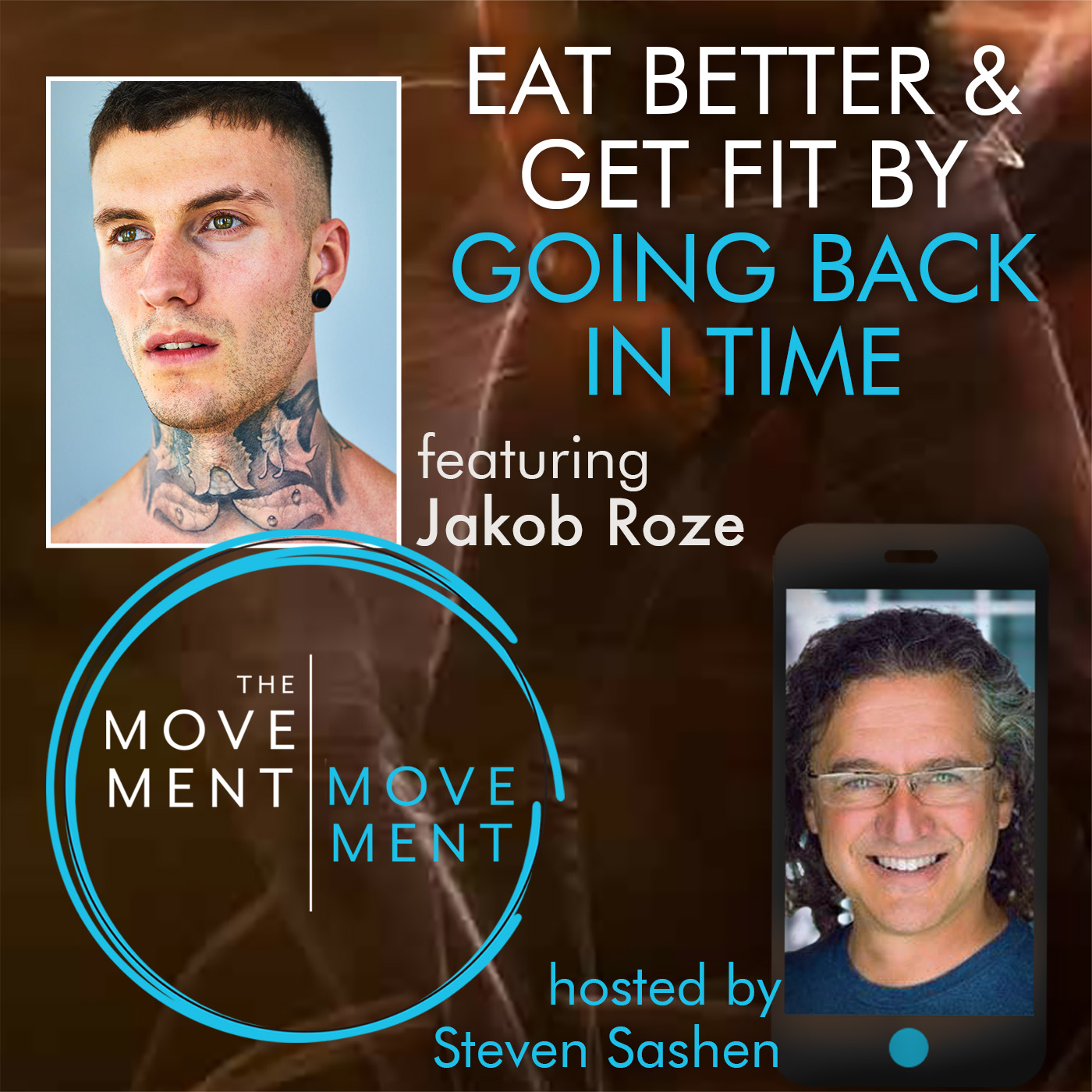
Technology is a wonderful thing. We grow, we learn, we improve things. I mean, it's amazing, isn't it? Yeah, okay, maybe not.
We're gonna take a look at that on today's episode of the movement, movement, the podcast for people who want to know the truth about what it takes to have a happy, healthy, strong body starting first, because you know, those things, they're your foundation. And we break down the propaganda, the mythology, sometimes the outright lies, you've been told, about what it takes to have a happy, healthy, strong body to more importantly, to play and run and walk and hike and do yoga and cross for whatever it is you like to do to do those things enjoyably, efficiently, effectively. Can I say enjoy it? I know I did.
It's a trick question, because look, if you're not having fun, do something different to you are, you're not going to keep it up if you're not enjoying it anyway. So I'm Stephen Sashan from zero issues.com, your host of the podcast, and we call it the movement movement because we are creating a movement that involves you. It's easy, it's free, it'll be natural about natural movement, having your body do what it's made to do. And there's a thing called the null hypothesis, which is basically you start with the way things already are, and if there's an intervention, the intervention has to prove itself first.
And so natural is the null hypothesis null hypothesis. Anyway, if you want to be part of this, it's really easy. Go. So moving about natural movement, movements about you, natural movement.
All right, I got it all go to www.join the, join the movement movement.com. I didn't get any sleep last night, so I'm having a hard time. You'll find previous episodes, the ways you can interact with podcasts, where you can find us on social media, on YouTube, on Facebook, etc. And the way you become part of the movement, just spread the word, share, like, leave reviews, give us a thumbs up, hit the bell icon on YouTube, you know how to do it in short, if you want to be part of the tribe, subscribe.
So let us jump in. I'll tell people who you are and why you're what you do. It's a pleasure to be here. Yes, my name is Yaka Rose, and I have a concierge personal training business.
And I simply put my mission is to help middle-aged individuals reclaim their metabolic health through cardiovascular movement and also strength training as well. So that's kind of what I do in my professional life. How did you become someone who focuses on middle-aged people as a not middle-aged person yourself? Interestingly, I think part of it had to do with the fact that when I grew up, I was actually mostly surrounded by adults.
And so I'm an only child. I never had siblings or I don't really have a large family to begin with. So there's not a lot of like people my age, so to speak, I didn't have a lot of millennial friends growing up, even though I am a millennial. So I think just simply because it was the type of people I was comfortable with most, which was kind of, I guess you could say atypical for a millennial, but not only that, but I also did notice over time that around your middle-aged years, specifically when we start to notice a lot of these metabolic health parameters, let's start to decline either high cholesterol levels, increased risk of cardiovascular disease, diabetes, people start to get out of shape.
They're not taking their health seriously anymore. So I thought, how can I contribute to this group of people who I spend a lot of time with around me and care about? And yeah, I just kind of went from there. Awesome.
The middle-aged thing, speaking of someone who's about to turn 60, there's a technical term for it. It blows. And what I mean is that there's things that you just have to adapt to that you can't change, and there's things that maybe you can, but you can't do it the same way you used to. I mean, for me, so as a competitive sprinter, I would love to have like about seven pounds less body fat, getting rid of that now whole different game than it was when I was your age where it was as good dinner once or twice, or I have one less slice of pizza.
And now my body does this weird thing where if I change my diet, it's like, oh, you're doing that now? And it just stays the same. It's really crazy. Or I'm really, I'm not responsive to dietary changes, but I'm responsive to activity.
But I just can't do as much activity as I used to because I can't recover as fast. So the recovery element, if you're absolutely, but I mean, to be fair, you really are turning 60. Yeah. Yeah.
Oh, wow. Okay. So I mean, you look really, really healthy for a second. Obviously you keep yourself in great shape and I think that's right.
You know, I don't know how much of a nature and nurture my mom when she was 40 came into my high school pick me up and someone stopped her and said, did you get your yearbook yet? So, it kind of runs in the family. But I will concede it's very entertaining to hang out with people my age and go, I don't look like that. That's funny.
I mean, I think it makes a big difference. And also, what is your current exercise routine? Like, how many days are you running at the track? I'm only on the track like one day a week because that's all in the rest of the time.
In the summer, sometimes I can get early and get two days in. But again, doing high speed work, I've only got one really serious speed day in a week and then I got a recovery. In fact, this will be an I'm gonna get back to you and say I was working on strength for sprinting, doing the Nordic hamstring curl, which for people who don't know, you kneel down, you have something or something or something or someone holding your feet down and you just try to slowly lower your shelf, your body to the ground. And I was trying to do that, like doing sets of that, I don't know, three times a week.
And it just wasn't progressing. And when I stopped and started doing that, and started doing that training once a week, doing five sets of five reps, however well I could do them. But only one day a week within a month, I could actually go all the way down, come all the way back. So that was a crazy adjustment.
But the other thing is lately, I've been riding my bike to and from work, so that's about 10 miles a day and has not made a look of a difference in anything I can identify other than I'm really enjoying it and I'm riding faster than when I started. Interesting. Okay. Yeah.
And it reminds me too, just the fact that you mentioned that you enjoy it. And I think like one of the biggest things that I noticed with people too is I think people, not everybody, people who are a lot of people think that exercise isn't enjoyable. And I think a lot of times it's just the fact that they haven't found the right thing that they enjoy because they think you know what I mean? I spent from the time I was 32 to 45 looking for something that I enjoyed doing that I could keep doing because there's things that I enjoyed.
I was a competitive jump rubber, I was doing some circus things and they were fun and I enjoyed them but not enough that I was going to keep going. And then I discovered that. Oh, and so what point in your life did you discover running? I was a sprinter when I was a kid, I stopped when I was 15 and then I picked up again at 45.
Okay, excellent. And I'm not carried before, obviously you had 15 years to continue on that journey and continue enjoying it, obviously. Yeah, it's still a master's all American, so fast, which is predominantly genetic. And but the thing about it that I love is it's a there's a goal competition is a goal.
There's crazy people who also do this thing as well. And you can't get it right. There's no way to do it perfectly. And that intermittent reinforcement of like, oh, my start was better this time, but my dry phase wasn't as good.
You know, there's all those little things at the end of a race where you go, I know I could do it better. And that's very literally addictive. Totally. It's a joke I have at the end of a race.
People say, how'd you do? I go, do what's what the number? Can I give you the excuse as well? That's great.
Oh my God. Yeah. No, I think and again, it's just a testament to the fact that you enjoy it. And I think for anybody listening, I encourage anybody to explore many modalities of exercise because obviously there are some that are from a physiological perspective, perhaps better than others by definition.
But I don't think that should discount or discredit anybody's enjoyment when it comes to getting out and just moving as a human should move. You know what I mean? Talking about track and field, there are dozens of different events and finding the one that you enjoy is critical. I mean, I know I run the 60 meters indoors, 100 meters outdoors, I run the two, I run the four, I run the distance, I don't know how the corners on tracks work, it's very confusing.
I'm a GPS watch, so I get lost. But you can find your thing. And then of course, there's limitations. I love pole vaulting and long jumping.
My back doesn't let me do that anymore. Absolutely. Yeah. And that's the thing as well.
I mean, there's just so many ways in which you can work around whatever your limitations are. I think a lot of times people get really into sort of a narrow mindset that they see somebody performing a specific type of exercise or especially in popular media that's updated, see somebody like squatting with really heavy weights and they think, oh my back would never be able to handle that. But you can progress and progress different movements down to pretty much anybody's individual level. So I don't think it's limiting at all.
And I think there's just a matter of looking at it in a creative way and sort of approaching it from where you're starting as opposed to kind of looking at what other people are doing. What you said is interesting because like squatting heavy or dead lifting heavy or two things that I really like doing, I've got to basically broken slide. So I can't do that. But to your point, finding the variations that are as close to status as close to equally satisfying because they won't be the same as you can one can, that's been interesting.
And there are other ways of even doing the same exercises without the same amount of weight or doing other exercises with what seems like a lot of weight. So there's, I think you're right of that mindset of experimentation is really important. Yeah, precisely. And it kind of made it something as well when we're talking about like how exercise should be enjoyable for us and foremost.
And something that's always been super inspiring to me has been, I was an anthropology undergrad major. So we look a lot at different indigenous cultures. And one of the things that I learned was specifically that indigenous cultures have no true real separation between sort of their like play life and work life, if you will, like it's, they're kind of one and the same and they don't necessarily formally exercise in the way that like you and I are, you know, have a very packed schedule. We have our day planned out to the hour and we set aside, you know, one hour to go to the gym or the track and not their like quote unquote exercise time.
But when you look at indigenous cultures, it's like they find ways to express movement in various ways that are enjoyable to them. And maybe it means, you know, chasing each other around or kids, you know, playing tag like games, whatever. And it's just kind of interesting that when we look to these people who arguably have some of the most optimal health, I mean, we have living examples of hunter-gatherer tribes that, you know, just exhibit pristine metabolic health. And so, you know, when we look to them, it's interesting to see that they, yeah, they approach exercise in a way that's like not so formal.
And in fact, like the benefits of it are just the very fact that they're doing what humans have always done for all evolutionary history, which is just express ourselves through movement in a way that's just natural and not very prescriptive or they don't really think about it much. If you know anything. Well, there's also something about having that lifestyle where you engage in activities, you know, this is gonna sound weird in a way that you can't really replicate. So for example, the difference between, I don't know, going to the gym versus walking down the river, picking up rocks, bringing them back and building a house, holding a whole different way, the difference between going for a run or even sprinting, very different than when you're trying to chase down food or being chased by some of the things your food.
And I like to say like, I can train as hard as I want on the track. Maybe I'll be a little sore the next day. I do one race where it's just form only different because of the adrenaline and the competition that 13 second run and I'm shot for four days. So you just can't fake some of these things.
You can come close, but it's not the same. Exactly. And I got to answer your earlier question in another way that's kind of relates to this. So we were talking before this started, we just got a dog.
And I mentioned I learned that I can sprint all out with no warm up at six in the morning, like roll out of bed and sprint. That's what the dog does. And it was actually shocking to me because when I go to the track, I spend 20 minutes warming up, I do all this stuff. And it's like, Oh, wait a minute.
Maybe there's more to how these bodies work than even I was thinking. Definitely. And it was just like an automated process and you didn't realize that you have to realize you have the capability that you never had to sort of like do it. No, well, I never had I never had the opportunity to or the reason to test it.
And it was just that. Exactly. And it's like, you know, I feel awake. I mean, let's just see how I feel.
And I only did a little tiny little bit like five seconds. It's like, what the hell that? And then, you know, now we still will do like maybe out of a 20 minute walk or so, I'll do a full out 100, maybe three times. For sure.
For sure. Interesting. Yeah, actually, funny to say that. I don't have that or dog specifically, but I experimented recently.
I also like warm up extensively before I do most of my sprint or high intensity training. But there's a couple of times where kind of going off of this concept of like, what it means to naturally move as a human and looking into indigenous cultures and, you know, hunter gatherers certainly aren't warming up for their daily tasks. They just kind of are doing them, right? And so I thought to myself, I was like, yeah, like, what would it be like to just like pretend like I was chasing an animal or like, like, just, you know, go from like literally inside on my computer to just going out and like sprinting.
And like, I was honestly like quite surprised at like how simple it really was. Like, I think I had this perception just, you know, growing up as like a runner and stuff. We always went through this methodical warm up and stretching. And it's not to discount those because of course, arguably, we know, you know, from the literature that these things do, in fact, improve performance.
But when you just, I think it's something about like letting go and just like letting your body like trusting your body and just letting go, and it's like, it's amazing. Like, what we can do when we're just like on autopilot, like, not like, let's just be human and just let it go, you know, you remind me, I used to do a thing in a house in my life. And I used to live in, I had a pull up bar, we had a second bedroom, it was our TV room. So we had, we had a sofa bed, we had a TV bathroom, and I put a pull up bar in the doorway between the room and the bathroom.
And every time I walked by, I did some Pulitzer channels. And I like that. No warm up, no thinking, no, whatever, just do as many as I wanted to. And it made significant differences, just having something to do without not overthinking it, just do it.
Exactly. Yeah, that's a fun way. So, you know, the intro to this thing, I was talking about technology and human advancements are wonderful. We're already starting to talk about indigenous cultures.
I love that you have an anthropological history, because the guy who really kicked off the whole barefoot running movement was Dan Liebermanman from Harvard, who is an anthropologist, was not a physiologist, was not a physical therapist or biomechanist, or any of those post-stunning indigenous cultures. So, so let's jump into that a little more, shall we? Yeah, definitely. So that's actually something I didn't know that.
I actually like, I'm definitely going to go look him up now and probably contact him. Well, he's mentioned, he's mentioned in Born and Run a couple times. And what kicked off the barefoot movement was a combination of Born and Run being out, but that book had been out for a while before it took off. What really kicked it in high gear was when Liebermanman's study came out, showing that running barefoot and landing midfoot put less force through your body than running a shoe is where you took some people in Africa who ran barefoot habitually, put them in shoes and they started overstrolling heel striking and putting more force into their joints.
And that was, I can never remember if that was in nature or science, but that was that got a lot of attention and really made things start to move. Interesting. Also too, I just heard the listener, anybody born to run it with what that's even and I were talking about before the show started and highly recommend anybody who wants to dive into barefoot running into the great place to start. Yeah, it's a great book too.
It's a great story. It's a great narrative. My wife who's not a runner found it just as fascinating as every runner that I know. Here's a little teaser.
I'm not even sure if I'm allowed to say this. Born to run to is coming out in about eight or nine months. You can know that. That's what they do.
That's so great. I just found that out. Wow. All right.
I'm very, very excited now. I think the idea of it is to be something more practical to get in because the reason I know is Chris and his partner, Eric, they reached out to me, not like partners like partner in the book, and said we're doing a section on footwear. Can we get some shoes to test? And I sent them pretty much one of everything we made.
That is super cool, man. And actually I'd love to just quick-fight dive into just some of the zero shoes stuff. So just give me a little bit of a background specifically as to like what your inspiration was. Was it also born to run specifically or like, how did that manifest for you?
It was the people who've heard me know the story, so I'm going to do a really short version. It was a combination of some friend of mine who's a world champion runner, anime, a copy of Born to Run, who's suggesting that if I took off my shoes and ran barefoot, maybe I would learn why I'd spent the last previous two years getting injured pretty much constantly. And I instantly figured out why I was getting injured. Actually, I take it back.
It was semi-instantly. My first barefoot run ended up with a super fun. Again, I'm a sprinter. I go very short distances.
I don't do anything longer than 100 meters. My first barefoot run, we were out there for like 40 minutes. We ran something like five or six K. I had never done that before in my life and I could have kept going.
We decided to stop. And it was amazing. I had a big, ended up with a big blister on the ball on my left foot. And I didn't think, oh, this is nonsense because I got a blister.
I thought, how am I right foot is fine? My second barefoot run a week later when I had this gaping hole on my left foot still, I thought, if I can find a way to run that isn't hurting that, I'm probably not doing the thing that caused it. And let's give it 10 minutes. If it doesn't work, I'll try again later.
Nine minutes and 30 seconds of agony later, something just changed. And my running got faster, easier, lighter. I could have kept going forever. It felt like.
And what changed is I stopped over striding. I stopped putting my foot out in front of my body and like any good sprinter, I was pointing my toes. Bad idea. So, and then it naturally, my gate naturally changed.
My injuries went away. I became faster, et cetera. So I wanted that natural experience, that barefoot like experience, but I didn't want to have to argue with people about whether it was legal for me to come to a restaurant. Oh my God.
So I made a pair of sandals based on this 10,000 old idea. And then the rest, as they say, is history. I can attest to the restaurant analogy. So when I first got interested in barefoot running, I was in high school.
And I don't remember what year the first models of the Vibram five-finger shoes came out. But I was, okay, 2006. So it was probably like, like, 2008 or so. Maybe I got my first car.
I was in high school at the time. And gosh, man, there were some visceral reactions from not only my classmates, but everybody, like anywhere I went back. And it just became like, I mean, I think over time has become more of a good conversation starter. And I think obviously people have warmed up to the idea of maybe, I don't know, maybe.
But certainly the visceral response was like the first thing I dealt with for the first five years of it. And I mean, it's great to see now that like, I mean, like, obviously, like, you brought this to the forefront really, and it's been amazing to watch the D'Arfa movement, you know, manifest in such a way that I think has been so much more, and it's more acceptable. And I think like we now understand like the benefits of it. It's just it's undeniable.
And it's, well, I agree, it's undeniable. The research could not be more clear. That doesn't mean that people have gotten, I mean, there's still a lot of pushback, especially from retail, because the big shoe companies have been very deliberately trying to obfuscate the story and basically spread propaganda and say that if you do this, you're gonna, you know, your kids won't get into college, your mortgage rate will go up, your car won't start in the morning, whatever it is. So but the interest is growing significantly.
When people say, oh, you know, there was a boom and then it busted. It's like, you know, everyone I know in this business, our business has grown year over year over year, faster than almost any other business. So I'm hoping and trying to make it happen that we had a critical mass where there are enough people who've had the experience, because that's what sells it. That we hit this critical mass point where even the doubters go, and let me give it a shot.
And when that happens, it's all over. I know. And I think the whole idea to me, I mean, even in the first place, it's sort of like quite backwards if you think about it, right? Like, obviously, like we're born barefoot like we just through evolutionary history have always, you know, operated in a barefoot fashion.
And it's interesting to me that like the idea of like not being barefoot is like sort of taboo if that makes sense. So you know what I mean? Well, you know, like I said at the beginning of this, the null hypothesis is start the way we're built and work from there. And there is, there's no evidence that modern footwear solves anything, frankly.
And the reason that we've come to believe these things like we need to use with our support and motion control, padded heels, etc. is because of admittedly brilliant marketing. And that and after 50 years of, you know, everyone hearing that story, then you tell a lot long enough becomes the truth. It's common.
That's where we are. So we're just we're just going back in time 50 years and to when what we were doing is normal. And the modern athletic should have been seen as ridiculous. Totally.
It's an interesting frame shift and kind of going back to what you said before, I think, yeah, I mean, it's just like you tell a lie long enough and it just becomes and if you think about it too, it's like the modern shoe really hasn't been around for that long relative to how long people have been walking bare. I mean, think about the times then, right? Like how long have people been walking bare? But no, no, no, it's even better.
We know that people have been wearing footwear of some sort, something to protect your foot, something to hold that to your foot for 40,000 years. So the modern athletic shoe is you know, 0.001% of human history. It's crazy. It's interesting.
And yet we still, in these companies, they're such an influence that we think that that is a standard. It's really quite it's even more like I said at the beginning, you know, we are in the West, we are prone to think that newer is better, the technology is solving problems. There are cultures that think that preserving the way it's been done is better. And often that's correct.
And we'll talk more about that. That's sort of the crazy part. And more even the new technology, none of it's really new. It's just variation on the theme, different kind of cushioning, different kind of varsity or different kind of motion control, again, where there's no evidence that any of those things are beneficial.
So it's like the boy who cried wolf, except it's the shoe company who cried cushioning. But in the original story, the villagers got smart. And in our story, every the villagers keep running to a shoe store every time someone says here's a new form of cushioning, even when it's proven that it's no better than what came before it. So it's really wild.
It's it's it's fascinating, intellectually, it's annoying as someone who's trying to change the world and and help people and make people better. So but blah, blah, blah, I know about me back to you. So, so same about the about your relationship with indigenous cultures, especially how that's how you're applying that into what you're doing with hate to use or middle age with people. Yeah, okay, for sure.
Yeah, I mean, I grew up originally in Upstate New York, which is a very rural environment. And one of the things that I became interested in just because kind of what we did as kids was going outside and being in the natural world. And so I got super interested in wild food foraging from around the time I was like around 12 or so. It started with just, you know, my family and I, we would pick blueberries up at these cliffs that we have near where we live.
And from there, as I got older and kind of more aware of nutrition, I started to learn well, there's quite a big benefit to a lot of these wild foods. And so from there, I think it kind of carried my interest in my early adolescent years into kind of diving deeper into that nutritional side of wild food to send it on. So I just I don't know, I think it was just a cool thing to be able to like walk outside and pick plants outside that I could consume as food. And then what alone, like, wow, these things are actually like really great and like come to find out there like, you know, lots of scientific studies that have shown that their nutrient profile is so much greater than that of our domesticated varieties.
That makes sense. What were some of those things you were picking? Give me a good wild forage meal? Yeah, so for sure.
So one of the most common, which I think people may or may not know is at least here in the northeast, every spring, there's a there's a fair guess, I'm sorry, you've everybody's familiar with this story. That's a wild species for one. And then full time blueberries. And then again, going back to spring, there was, I mean, so many like, at least here we have a plant species called trout lily, which is the spring ephemeral that it is a sort of a lily-like plant, but it comes with these two really, really great weeds that essentially look like what a trout looks like as a sort of like these rainbow colors and they make like a wonderful salad green.
I mean, you have them, the list goes on like mustard greens. I mean, they're just so much. And no matter what climate you're in, I think that's the coolest part that there's always wild species of plants that you can forage. And it's just fun, man.
Like it's a good way to get outside and press other people when you're like eating stuff off the floor and they're like, what the heck are you doing? And then like, so yeah, we were we were laying in our infantland for the World Master Strike and Field Championships about 13 years ago. And we were there, it was August, I guess early August, and wild blueberries, wild strawberries, wild raspberries and mushrooms everywhere. The rule is if it's on public land, it's for the public and circle.
You're literally just walking through downtown Helsinki and just lunch. It was awesome. That's amazing. Yeah.
And so I think kind of going back to your original question. So yeah, if I carried me forward into high school, I was trying to figure out what I wanted to do with my life from a career perspective. And so when I got to college, I knew that I was interested in these things and I initially wanted to become a botanist because that was kind of the interest that I had with these wild foods. I didn't get into the school choice that I wanted to, which was a forestry and environmental specific school.
So that was okay. So I got into a different school up north in Saratoga Springs, New York called Skidmore College, which was a great experience. And yeah, I was there that I took a couple anthropology classes and I was just super fascinated by the fact that this was an area of study. I mean, I think I loosely understood the idea of anthropology.
Like through that, the board of runbook, they referenced obviously some anthropologists in there, but I didn't really understand that there was like a formal career in which you could make out of exploring Indigenous cultures and their lifestyle practices. So that took me to take more of these classes and alongside with that, I was interested in exercise. So I did some exercise science and some biology and kind of tried to combine everything together. And then after I graduated, I decided, well, I don't know if I want to specifically study plants for the rest of my life.
At that time, during college, anybody grows a lot, they branch off and stuff. And I got like really, really fixated and interested on exercise and exercise performance. And prior to college, I've had no experience in the gym weightlifting. I know he's always been, you know, I'm 6'5", and gosh, in high school, I think I weighed like 125 pounds when I graduated.
And I was like, I weighed 5'5". Yeah, I know, so I gave the perspective, like I was at 3'0", and like it was out of control. And you know, I really did enjoy running. And I, you know, but I think I wanted to branch out and try something different because I was so used to my body just like kind of being on overdrive these long distances.
And so yes, I had a roommate still to say one of my best friends. And he was a professional power lifter. And so that kind of got me interested in weightlifting. And so he taught me a lot of these foundational things.
And from there, I just got obsessed with the progress that you could see on a, you know, on a physical level, like you would, especially in the beginning, you know, like you, the first couple of years that you weightlifting, you make exponential gains in your muscle mass. And if you've never listed before in your life, it was just, it was just so addicting. So I got super interested in that. And I was like, wow, like maybe I want to help people change their values in the same way because I had such a great experience with it.
And so then, yeah, I had an internship at a strength and conditioning facility in Theratoga Springs. And that led me to the idea of like, oh, wow, like there's actually a job in which you can, you know, help people professionally with their exercise and improve their health. And so that took me to a course personal training. And then yeah, so after I graduated, I moved to the city and worked at one of the bigger box gems called Equinox.
And yeah, that was great for a couple years. But then I realized that there's something a little bit just a little too corporate about it. And I wanted to kind of branch off and do my own thing in a more, I guess you could say like focus in concentrated way in which sales weren't the predominant focus if that makes sense. Like, you know, of course, Equinox is a very big company.
And they have to, you know, one of the main focuses is of course, retinew. And you know, I enjoyed part of this as anybody will know, but I really wanted to just have something that was like a little bit more focused and only have like a select group of people at a time that I could work with, but really spend, you know, quality hours with them improving their health, you know, from the inside out. And so that's what got me into it. And I started my own personal training business and that's where we are today.
So is there anything you're bringing into what you do with people that comes from your understanding of what indigenous people are doing? Yeah, so I mean, kind of going back to what we said in the beginning, it's figuring out a way in which people can exercise and also call it play. So it's, you know, obviously, like one of the main settings I train people in is either their houses or in a gem, which is the majority of it is what we do. But that being said, I often prescribe things with exercise links for them to do on their own.
And a lot of times I'm just prescribing them like, Hey, like, get on time and go for an hour long hike with your family, because that's not only going to be enjoyable, it's going to be your building social rapport with your family. It's fun. It's exciting. It's something to do.
And you're getting all the cardio protective benefits from the cardiovascular exercise that you're doing. And so yeah, so basically like going back to the indigenous culture thing, it's like finding a way in which I could prescribe exercise to people that would be fun, fit into their lifestyle, and then also take some of the principles from hunter-gatherer tribes, i.e., for example, not over-enquaging and carbohydrates. Like, obviously, we know that for the majority of human history, prior to agriculture, we didn't consume a ton of carbohydrates. And as a result, I think that's one contributing factor to why hunter-gatherer tribes specifically have superior metabolic health.
And so kind of taking a piece of that and bringing it into the modern modern day lifestyle of the CEO or whoever I am training and saying, look, like, if these are the principles that have worked for thousands of years, much like barefoot running, like, well, where did we go wrong? And why did we all of a sudden, like, create this new improved food pyramid? And I think people are just really confused about nutrition and exercise altogether, because there's just so much information in the modern world that we just really need to simplify things. We need to go back to those founding principles of evolutionary history of how how did our species operate prior to us being told, like, how we should live as humans, if that makes sense.
It does do a point. And I'll tell you why I say it that way. First of all, you're right about how we, some of the questions about how we got here. I don't know how this happened.
I was calling to cite major in college. And somehow, as a result of that, I got invited to be on a panel to evaluate the food pyramid before it became the food pyramid. And I said, if in fact, there's two interesting points. One is, if in fact, you want people to be focusing on grains as a primary thing, the pyramid is not the way people think.
The idea that that that's a base is not the way humans think. If it's more important, it has to be near the top. So just turn that side down. Oh, okay.
They went, uh, we can't do that. And the second thing was that when after our first round of feedback, they came back with some changes. And the biggest change is if you see the food pyramid, the top is fast and oils. And it's just like little white dots on a black background, which your brain just ignores and you go down to the next thing, because the most important visual spot on a pyramid other than the top is that two thirds away up.
Two thirds away up is meat and dairy. And they got featured the way they got featured was because of, let's call it quote on quote, input from the meat and dairy industries. Of course. They told us this explicitly.
Sorry, people in dairy people and they said it needs to look like this. Someone, oh, no. So yeah, that's partly how we get here is there are people with vested interests who are the ones responsible for how the information gets disseminated. So that's an interesting thing.
But my other, my semi disagreement with the thing you said is simply that while we want to look back, it's easy to make two erroneous assumptions. One is that everybody was the same. Because I mean, like my thing as a sprinter, I don't know one sprinter who isn't very carb happy. I've never met a sprinter who is low carb.
It just hasn't been the case. In fact, the one time I was working with a nutritionist and he had me go low carb at the end of two weeks, I called him and said, dude, I just did something at the end of a workout. I've never done before. He just went and said, fell on the ground and couldn't get up because I couldn't finish it.
And I'm like, so the idea that we're all the same seems to someone silly. And the other part is that I think some of the dietary stuff fits in with the activity things as well. And so if we're only changing our diet, but we're not changing activity to match what that diet is, that can become problematic. And actually, there's a woman named Denise Minger who's done some great writing on health and nutrition nutrition in particular diets in particular.
She wrote a book called Death by Food Pyramid, but her blog post after the book was the most interesting because she decided to look and see if there are, in fact, indigenous cultures and hunter-gatherers who eat completely differently from each other. And there are a couple of tribes that are on a super high carbohydrate diet. Some who are on a super high refined carbohydrate diet and metabolically, totally pine. And she's from her take, it was calories and activity.
In fact, she's said that she's going to no longer write about nutrition. And the way she said it, I have a sneaking suspicion. It's because she started researching nutrition and longevity and found no correlations. Interesting.
And yeah, I was going to mention specifically, so yeah, I guess not to fetishize low carbohydrate, because I certainly, as well as an athlete who doesn't want to wait for anything as well, like certainly do not consume modest amounts of carbohydrates. But yeah, specifically going to your point that we need to match the activity level to what people are consuming. Because, of course, if you're an athlete or somebody who is metabolically healthy, having carbohydrates to fuel your workouts is absolutely essential. And I don't think anybody would disagree with that.
And I think, yeah, so I think that's that was the key element there is like matching the exercise in which the exercise that somebody does with their diet specifically. Do you do work with people on, I mean, in the same way we talked about finding the activity that you enjoy and you want to do for whatever reason, do you work with people doing the similar thing for, I don't want to use the word diet per se, but basically deciding what they shouldn't be eating? Yeah, no, 100%. Because I think this, yeah, I mean, it's unfortunate.
Like, now, like somebody like everybody, I think has their own like tribe of like, you know, like low carbohydrate, high fat, like, you know, like, everything's like branched. But I think going off of what you were mentioning before is that like, I really do think me need to enter a paradigm where nutrition is individualized and you really do need to look at the individual. Because like you said, not everybody is created the same, just like not all indigenous cultures, eight, like low carb and whatever. I mean, I think the consistent theme is that we see that they're all metabolically healthy, but why they're metabolically healthy is the result, I think, of, you know, many different facets.
So I think when it comes to an individual's nutrition programming, I think 100% has to be individualized. So like, you know, obviously, I'm taking somebody who's severely insulin resistant and really overweight, like I'm not going to be like, here dude, 500 grams apart, like, let's go go ahead and track. But you know, conversely, if I'm working with a middle-aged individual who, you know, is metabolically healthy and they want to get stronger, of course, that will get to the carbohydrate intake that I would prescribe to them specifically. So I think, yeah, I really, I mean, that's a huge point.
Even like you said, like, we really need to individualize with stuff. And I think the one side fits all approach is really why we've created such such erroneous decisions around diet. It's, I think there's another part where we can take a weird thing. It's a combination of personal responsibility and totally advocating personal responsibility at the same time, which is that we're wired to try to look for simple solutions.
And if someone says I got a simple solution, then we, you know, we're white on rice, pun intended, a carbohydrate. And it's funny how we dismiss things or accept them. I remember reading a book or seeing a book at a bookstore that was going out of business. So this book was a dollar.
And it was about resistant starch, resistant carbohydrates, which for people who don't know, if you take a potato, for example, you cook it, the starches are very, very accessible for your digestive system. If you then let the potato get cold, the starches rearrange and the molecules rearrange. And it becomes partially, if not totally indigestible, not the whole thing, but certain amount. And if you heat it up again, cool again, even more resistant starch.
And I remember reading that thinking, that's the dumbest thing I've ever heard in my life. And I just put the book down. And it was like 10 years later, when I started when I bumped into it again, and found it was like, Oh my God, that's a real thing. Who knew?
And then even more, I met a guy, there's a guy that I had on the podcast named Peter Poffman, who's got a product called you can you see, and they developed a even more, it's it's resistant starch, you don't digest a developer, they call super starch, which is a super long chain digestible starch. That's the only carbohydrate you can eat and stay in ketosis. And because someone, one of the founders of the company, his kid has a metabolic disease where if he doesn't eat carbohydrates, like every couple hours, he would die. And they developed this carbohydrate that allowed him to sleep through the night when he ate it.
Wow. It's fascinating. And then I said him, Oh, and he says, all natural, I said, so you're taking carbohydrates, and then just heating them and cooling them and just, you know, selectively doing things with temperature and pressure to create these launching carbohydrates. He goes, yeah, how'd you figure that out?
Well, what else could it be? So, so it's super interesting. If you were gonna give people who are listening, if you're not working with them, so you can't get them explicit advice or specific advice, if you were going to give people some suggestions on what they might want to do to experiment and find the combo of things that work for them, can you think of something you would suggest? Yeah, specifically with regards to diet or exercise.
Let's do both. Okay, yeah. So like, let's start with the exercise piece. So I think, first and foremost, I think anything more than what you're doing now is going to be beneficial.
Because I think people often get into this mindset of, you know, I'm starting to work out, I have to go from not working out at all to hitting, you know, hitting a waist five days a week and hitting the track also in the afternoon. Like, I think there's just like all our non mentality that I think a lot of people have. And I think, honestly, like, we really need to be, I think, more conservative with our exercise programming, especially with people who haven't started. So I would say, especially if you are just starting off, I think one of the best things you can do is just do something just a little bit more than what you're doing now.
And even if that means, you know, you're going from completely sedentary to just literally making a commitment to walk for 30 minutes. I know a walk doesn't seem like it's really that beneficial, but it is relative to what you were doing. So as long as you're doing something more than what you're doing now, I think it has immense benefits. And I think one of the things that turns people off from exercising is that they think it's so grueling.
And it definitely can be as you go from, you know, not exercising at all to trying to run a 10 day, like, of course, I'm kind of stuck. That's going to be terrible if you're not trained in condition for it. So I think definitely starting slower is, you know, less is more, I think, is the real analogy here. I'm going to tell us in a suggestion, something that I've been doing in a similar vein, you know, I had the same thoughts like, what can I do to add a little something?
And so on the chair sitting next to me, I have jump rope and say and go jump forever, but like, literally, like just go do 30 seconds, you know, on the way to the bathroom, do 30 seconds. Exactly. Just do that a couple times a day. Totally.
I mean, and it's all you can do. Exactly. And something like that as well, like super simple, is that anybody can find, I mean, I know a lot of us like we have to be scheduled and it can be hard to set aside, like maybe a complete hour to go to the gym or to go outside for a run or whatever. But it's like, if you can start incorporating little things into your lifestyle, like you would be amazed at how beneficial something like that could be.
I mean, you can take that example almost in the opposite direction as well. Like, you know, you know, you get a candy bar and you know, you start off with one. Yeah, sure. It doesn't make a difference.
You do that every day. But then if you start doing that like five or six times a day, you're like, okay, maybe it's just starting to add up negatively to, you know, negatively. And so the same kind of applies with respect to like maybe you're doing jump rope and on the way to the bathroom or maybe you're doing a set of five push-ups. Like anything you can do that's more than what you're doing.
And how I think from a physiological perspective, it's going to benefit you. Let me recommend doing the jump rope after you leave the bathroom on the way to the bathroom. It can be problematic. I'm not saying I have experience to back that up, but you know, words of wisdom.
So what's the dietary analog? I mean, what you're just mentioning, if you notice you're having five calls a day, even if their diet call is like going to four or, you know, and so what else would you recommend on the diet side? Yeah, I mean, I think the same to start off, I mean, I think the same principle kind of applies to like people jump into dieting like the parlor on principle where it's like, okay, like I'm going from eating, you know, my regular diet to eating 500 calories or 1200 calories or the insane restricted being in the same restricted state. But of course, that's anybody can attest that that's not going to be sustainable.
So I think again, less is more, I think just by simply, even like I have a lot of people like before I even prescribe them anything in regards to their diet is I literally have them just do a food diary. And not for the simple fact, not for the fact that doing the food diary is going to be, you know, immensely beneficial to their metabolic health, but rather just the idea of being cognizant of what you're doing in turn, like that effect actually influences your choices. So it's like, I don't even have to tell you, you know, even I want you to eat 2,200 calories today. And while that may be a accurate, you know, prescription or not, I can just tell you if you haven't focused on your nutrition before, okay, for week one, all I want you to do is record every single meal that you ate today.
And at the end of that, let's, you know, come back to me and tell me what you ate. And a lot of times, people will come back and I know for a fact they weren't eating like that before, otherwise they wouldn't be in the metabolic shape that they're in, right, just by definition. But just by simply saying like, okay, like, I want to see what you ate at the end of the week. It's that sort of observer author and effectively that gets people to start thinking in a conscious level of what they're eating.
Because I think a lot of people intuitively know that, you know, eating that, you know, Snickers Bar, whatever it is back to our analogy before, like, isn't benefiting them. I don't think anybody thinks like, oh, yeah, this is like perfectly healthy habit, you know, so I think just like being more cognizant of like what I think we all know intuitively that we kind of need to do is isn't itself part of the nutrition prescription of that makeup. Oh, no, it totally does. I have this fantasy that someday there'll be an app where you can take a picture or scan of whatever's on your plate.
And it will give you a reasonable approximation of calories. Because I like that. Yeah, I remember there was someone who had something like that. It was kind of like a, like, it's almost like a mass spectrometer.
I don't think it ultimately worked because otherwise we'd all have one by now. That's another one. It's like not only deciding writing out what you eat. And in fact, I think that's a really interesting point.
And I never thought of this one of on the first like the first week, just literally write down what it is. Don't worry about the way you're trying to measure it. Don't whatever. Just put down what it is.
And later, you know, you may want to weigh some of it, the things that are the most calorie dense possibilities maybe just to see what that really is. That would be, I never thought to do that. Because I know when I tried to record what I'm eating, I've wanted to weigh everything too. And it became such pain in the ass that I never do it.
But again, like, I love this idea of a little bit something more or less depending on what you're doing every fillable length, let's call it week. And so just write it down the first week, take the biggest items or most calorie dense items. We'll weigh those just for the fun of it. And maybe only do it for one meal, you know, in the course of a day for a week, just to kind of get a sense of what it is.
And you see what reality looks like. I love what I love about that idea is fundamentally you're talking about the same instruction I get people for running barefoot. You do a little tiny bit and the feedback is the most important part. Yes, there it is.
It's the feedback 100% man. Yes, totally, totally. Very interesting. Well, I hate to say we have to wrap this up because I'm sneaking suspicion you and I could do this all day.
But but I'm kind of feeling like this is a good spot because those are both on the recommendation for adding activity and for attending to diet, getting the feedback from both. I think that's a that's a great place to kind of leave people to as soon as we shut up, they can go do a something. Yeah, right now what they were eating while they are listening to us or go to a couple of pushups or jumping japs or japs jumping japs. It is with my face today, it's just not getting words out correctly.
You know, and even that like finding the body weight things you like to do, same idea, like find out what you think is fun during COVID, I did a 21 day push up challenge. It was super, super fun because it's a different kind of pushups every day. And at the end of it, you know, I'd like double the number of pushups I could do. So I'm a competitive guy.
So I like that thing and it only took 10 minutes a day was brilliant. Like fit in perfectly. I would drop behind the conference from table and do come as awesome. So yeah, find what works for you.
And I want to hear it. So anything that people can, how can people get in touch with you if they want to engage with you in any way? Yeah, sure. So you can go to my website www dot roset.com.
And I also am under a spell it. Okay, yeah, that's true. That's important. So it's a www dot roset.com.
Not roset. Dot com. Rowsy, you're a Z fit. R-O-Z-E-F-I-Z.
Rowset.com. Yeah. There we go. Anything else that people should know?
I think that's about it. Well, this has been a total pleasure other than the part where I mispronounced your name. And again, really looking forward to us next time. I'm really hoping that people do try these little, do a little more experiments and report back on what happens as a result of doing that.
That could be life changing, not only for them, but for people hearing. It really can be that simple to get started and make a difference. Absolutely. People should not underestimate those incremental changes, even if it means a couple more, you know, a couple of stuff of push-ups in between things or whatever that's just getting started, both in commercial changes.
Yeah, I'm undeniably going to drop and do push-ups as soon as we're done with this. I like that sort of inspiration. So anyway, well, thank you so, so much. It's been a real real treat.
And for everybody else. I'd like to see you then. Oh, please. For everybody else.
Just a reminder, go to www dot join the movement movement dot com for all the previous episodes for all the places you can engage with us. And if you want to share anything, if you have any comments, any criticism, any recommendations of people we should chat with, people who might think I had completely at my butt because I've been diagnosed occasionally with the case of cranial reorientation syndrome. So I'm happy to, you know, engage with people and see what we can find because the most important thing is finding out what's true. And sometimes that happens by discovering that you've been wrong about something, which I get a kick out of.
So you can drop an email to move m-o-v-e at join the movement movement dot com. But most importantly, go out, have fun, and live life feet first.