
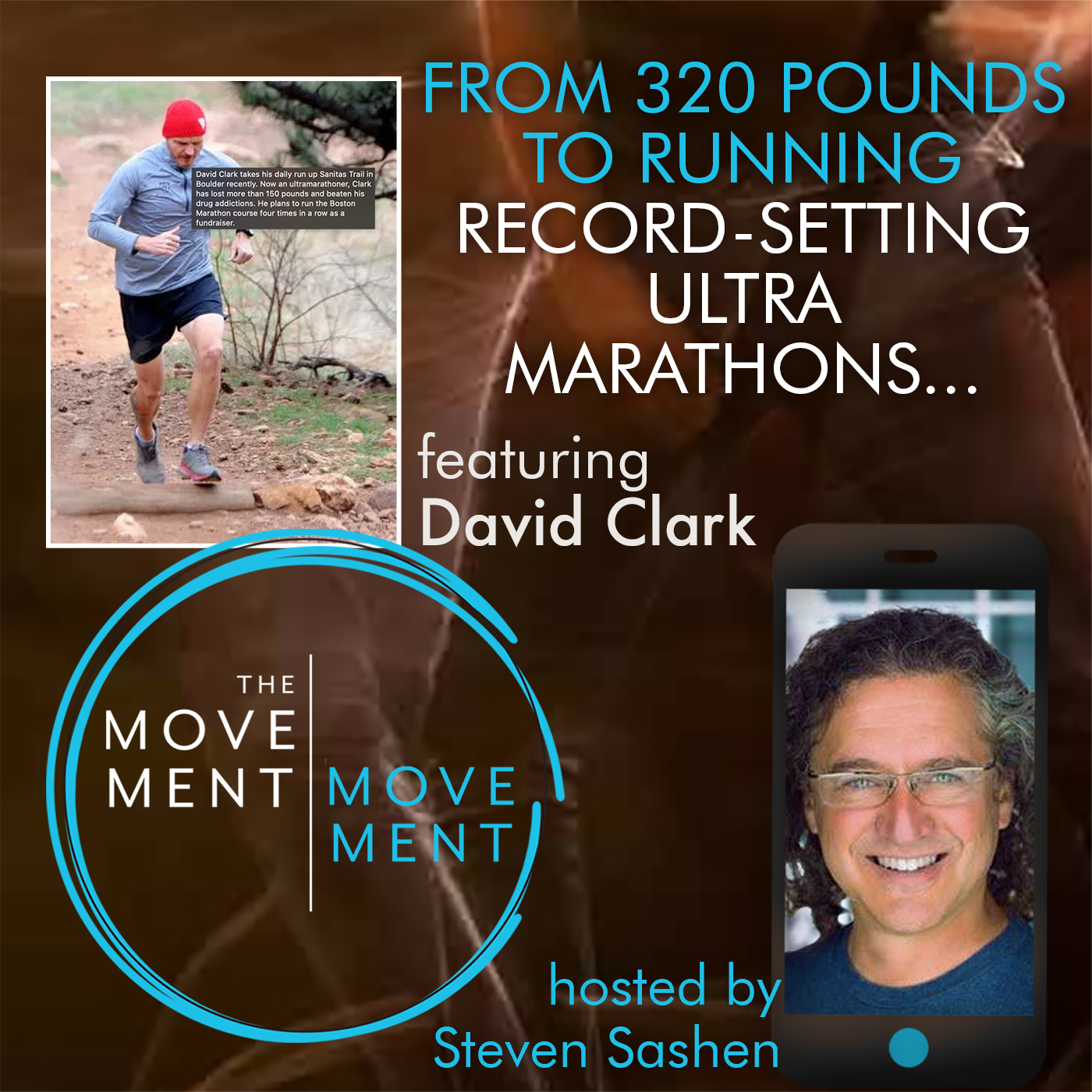
Do you think losing weight is about exercise or diet or both or maybe none of the above? Well, I'm sitting with someone who's going to answer that question in a way that you've probably never imagined. Welcome to the movement movement podcast. The podcast where people who want to know the truth about how to have a happy, healthy, strong body, we cut through the mythology that propaganda sometimes the outright lies about what it takes to run, jump, hike, do, crossfit yoga, whatever it is that you like to do, enjoyably, healthily and betterly.
That's my word of day. For those of you who've been part of the podcast, you might not recognize where we are. That's because I am at the home of my friend David Clark. We have a poster of what you can see of his legs.
And what's going on? No, that's just like a tag that you're on. Just a little weird. I'm in the middle of the London 100, man.
That's the iconic hope pass. Oh, sweet. Here, wait. I'll lift this up so you can see.
There he is. Ah, okay. You're a book clog. I love it.
On Amazon. Don't start pitching already. Oh, my God. Well, I believe I got to tell you because I thought you said this was going to be about the bowel movement.
No, no, no. That's a whole different movement movement. So before we jump in, just a reminder, if you're into what we're doing, obviously come to www.jointhemovementmovement.com. That's where you'll get pointers to everywhere you can find us and follow us and share and friend and review and blah, blah, blah.
You know the drill. I'm going to do a podcast which is called the we are superman. They can find where? Stitcher, a sound cloud, iTunes, anywhere with podcasts or my website, we are superman.com.
Perfect. And David has incredible story which we're going to tell in just a sec. But first we're going to do a movement. Now, one of the things that David is known for is fighting just randomly just picks strangers and just beats them up.
Why do you do that, man? It started on Black Friday. No. I was at Walmart.
I wanted that television. So as well, I heard I'm meeting Dom Herrera doing a thing about cabbage dolls and I can't repeat. But if you look up Dom Herrera, that is the cabbage patch. But that's not what Dom does when it comes to the cabbage patch.
So, we like to start with a movement and I asked David if he had a movement he wanted to share and what is the movement that you wanted to share. I said punching. Now, let's talk about punching from a perspective that isn't about the thing that most people think of which is violence, et cetera, because I know that's not the way you think of it. So talk about how you think of it and what people do, what you want to share with them.
Well, yeah, I mean obviously punching can have all kinds of different intentions. It can be just from keeping somebody away or inflicting damage or just competition, which is what I do. But there is a sign behind it, obviously. It's not as simple as just throwing your fist in someone else's direction.
In fact, that's usually the best way to get punched in the face yourself. It's just to start. Well, I think someone said to bar fight if someone starts with an overhand right. Yeah.
And those guys, they're not going to hurt each other. It'll end up on the ground. It'll get messy and very home ironic. So, why don't you do the world's fast punching something?
And punching is actually, I think it's very interesting because it really does activate pretty much every muscle you can think of from your navel up in ways that you're not. Well, if you're actually fighting fighting, it starts with the feet and goes through your hips and that's the end result. But it is a really powerful thing just to be doing in general, which I find really interesting. So, why don't you do the world's fast little punching something that people can do, even if they're maybe in their car, which will scare a lot of these things happen.
So, I think the thing that you want to just connect without getting to a whole mechanics of a punch, which you just start from the feet up, is to just make sure that your body's connected to your punching. So, when you start your hands up, protecting your jaw, you're going to rotate into it. And then as this one falls back, you have to move forward. And actually, it's a nuance, pro tip, that your fist starts out in the straight motion and actually rolls over at the point of contact.
This is the hardest part of your body. Right here is connected here to the elbow to the shoulder full extension. So, those punches. It's a very satisfying thing.
If you get, for people who want to into the quote, by all those part of it, it's just a really satisfying motion because it is one of those full body motions. Even the people that train at the gym where I train on, 99% of them are never going to get into a kid. They're never going to spar much less actually fight. But there's something very satisfying about the movement.
It's a flowy movement. It feels good. We listen to hip hop or heavy metal. We have a punching bag in our office that we got because I asked people what they wanted.
What's the name? No, no. We have actual punching bag. And one of our employees that did say, I know we're going to have a punching bag.
You've got to have me to work here for free. So, he just loves to, there's just something satisfying about that motion and making contact. And again, it's not even the violent thing. There's something about just contact that I think resonates with us.
I think that flows through our whole message, right? It connects us to something deep within our evolution. Like even running does, right? You might compete with running, you might be running away from a predator or a hunt.
Fighting the same thing is programming. We have to protect our families. We have to fend off our tribes. So, even if you're not actually fighting, there's something connecting you.
I've never been in a fight. I have gotten punched in the face once. So, I just, you can do well. No, I actually, I did really well.
I saw it happening. It was a really weird situation. I'll tell this story at another point. But I just had this weird feeling like if I just let this guy do his thing, it would all be over very quickly.
And he punches me in the face. And as I'm going down, I think it was louder than I thought it was. And then I got up and it was all over. It just felt like this weird, car-mixed something.
It just had to get itself resolved and we'd all be fine. But there was something you just said that reminded me, oh man, I had a funny thing that popped in my head and then it fell out. Maybe it'll come back. Anyway, let's chat about why we're here.
Why we're here is that David has one of the more amazing stories that I've ever heard. I'm not going to try and tell because I couldn't do it justice. And when you hear this, I guarantee I'm going to keep by the way moving towards the camera because I didn't bring power from my computer. I'm going to keep doing that to make sure it stays on.
It's one of these stories that if you see David now, you frankly probably won't believe it. So let's start with how would they see the before picture and then tell them what the going through and after story is. Yeah, it's a long journey. I started in many ways my real life, current iteration of life started in August 2005.
I woke up 320 pounds. You probably went to bed 320 pounds. You went to bed 300 pounds. It's not like you suddenly put it.
I have about 25 pounds of food in me. But it's not like you wait 150, then you woke up 320. It's not like a freaky Friday. It's not like a freaky Friday.
I woke up like it every morning. That's what I was going for. Like I said, 320 pounds. How tall are you?
I'm 6 feet tall. Yeah, that's a lot of David. Literally half. Half now.
160 pounds. And there's a host of other problems too that we're contributing to that. I was addicted to fast food and drugs and alcohol. And I had, I just bottomed down every possible thing.
I lost everything I had. I had a very successful company at one time. I thought that was going to make me happy. I didn't.
I had wife and kids and love in my life. That would make me happy. And it didn't. So I had all these great things that I was thankful for.
But yet there was still something missing. And I said in my book out there that I finally came to this conclusion that I wasn't a 320 pound alcoholic by accident. And all of these times I was trying to find the right diet plan, the right motivational book or whatever. Motivational book or workout plan or something to get leverage in myself.
But that moment was when I realized it was my thinking that needed to change. I always joke that you only have to change one thing. Yeah. So what when you say it was your thinking what specifically or can you identify some if you had to boil that down.
What was it that was the thing that was leading to all that. Yeah, I had to stop searching for happiness in my eyes open. Because I kept thinking it was out here. It was on the lot.
I could drive it off. I could buy the house. I could open up another retail store. Something was going to make me happy.
My grand account was growing and my happiness was shrinking. And I realized that wasn't that wasn't that wasn't by mistake. This is funny. It's an uncommon story that people have what seems like great hours success.
And then suddenly it hits them like, oh, this is not what I thought it was going to be. Why do you think you were struck with that realization or why didn't you recognize it along the way? Because that really is a problem. It's success.
There's nothing wrong with success. There's nothing wrong with having nice houses and cars and all these things. But the problem was that I placed my value on that. I grew up in some tough circumstances.
A hard time selling my family. I spent a lot of years homeless living in the back of my father's truck. Disenfranchised. Disconnected from reality.
And I always thought someday I was going to do this thing. And I went to college. I had to get a GED. Go to college.
Did well in college. Selling Mattresses part time. I'm going to buy this company that's failing and I'm going to turn it around. But all of these things were like, if I had a house, if I had a car, those were going to make me feel complete.
And that's the danger. It's not having the house in the cars. It's thinking that was going to be the solution. And it wasn't.
I used to say, wait a night and wonder towards the end, what is the secret of life that all these people seem to know? That I don't know. Because maybe it's not the secret of life, but it's definitely the secret to not drinking yourself to death. But see, that's the thing is so funny is that if you ask any of those people who you thought had the secret of life, if they thought they did, none of them would say they did.
And many of them would say the same thing. It's not working for me. I thought it would make me happy. I like to say that success is four times worse than failure because if you get there and you're not happy, you're not happy.
If you expect it to be happy, then your hopes were dashed. There's nowhere to go but down. And no one might like to hear a successful person whine. That's true.
Thank you. Good night. Yes. Good night.
That's it. So I bombed out and that's the beauty of rock bottom. I had tremendous amount of ego driving me to the old kind of ironic ego maniac with an inferiority complex. All of this is going to prove that I'm worth something deep inside.
I know I'm not. Well, that's not even ironic. That's the math. It's like when you think that's the problem.
The real option is to try to prove the opposite unless you investigate and discover that there's no there, therefore, and the whole thing falls apart. But let's move into the movement side of things. So you had this wake up call and then once that happened, then what happened? So I needed something to connect me to something deeper than all this external stuff.
I wondered who's the David Clark? It's not a business owner. It's not a father even. He's not a son.
He's just a raw human being. I figured that I might have a good chance at finding a little bit of that if I did something with my body, physical, and something that had a big emotional attachment to it. Something with the stakes for how the emotional stakes were happening. And so for me, I had no idea why but it just popped in my mind to run a marathon.
Which is such a common thing for someone who has 320 pounds to think. I didn't even know how far a marathon went. I had no idea. In fact, it's funny.
I thought when I researched it, and found out it was 26.2 miles, I figured no one else knew this information. This is surely lost to the ages. That's how they get you. I got like a little silicone bracelets made up.
It's a 26.2. I know what they're saying is this will be my own little thing. Obviously, I always had some tenuous relationship with reality. And this was before the days of Biggest Loser and stuff where now you see that a little bit like people I didn't know.
I assumed I went to my first race was a turkey trot at CU on Thanksgiving Day. And I assumed everyone there was going to be 145 pound elite athlete and that certainly I was going to be the only one. I think I lost some weight of 27 years. There are a lot of people who are there for the turkey.
Yes. I told you that I brought. So here's my favorite story about that. My friend Lorraine Mueller, who was a world champion marathoner.
She won the bronze and the Atlanta marathon. She went to one of the turkey trot races because she needed the turkey. And because she was an Olympian, they put her in front of the line. And right before the start, she looked to her left and right.
And there's four other Olympians who all were there because they wanted the turkey. It's better than it really is. So how did that race go? The turkey trot.
It was one of the most amazing days of my life. Really? It hurt, which is funny to me now. I'm 40 plus 100 miles.
But I never put myself in a situation like that before. I was moving my body, physically using my body to create an experience that I felt was missing from my life. And I ran every step of it. It occurred to me that I probably would have been faster than I had done Run Walk.
To me, I wanted to run every step. It was 40 minutes or 38 minutes or something like that. But I felt like a runner. I felt like a runner.
I felt like a runner. And then had the running evolve from there. And so actually I got asked this obvious question. What were you running in?
I was running an A6 gel nimbus. Big, thick, padded, motion control thing. So I'm going to cut to the end of the story-ish and say this is not where David ended. So what was the evolution?
And how did you run evolve and what happened to your body as you were doing this? So I had to obviously address the way I was eating too. So in that process I started eating whole foods and eventually that led me to being a plant-based guy. But I was feeding myself well.
I eventually got to the marathon and did that. It was the inaugural year of the Denver Marathon. I'd lost 140 pounds over that 15 months I think it was getting there. And I did that.
And that finish line was the starting line of a whole new way of living. I eventually did Ironman. And then I got hurt. Then I got hurt.
I had two herniated discs in my back which had probably been there for a while just being overweight and the running made it worse because I was running very poorly. How would you define poorly? Slamming my heels into the earth. And just being disconnected from the ground and not knowing when I was flopping the clown out there.
I had no idea. Which was your basic idea when you first started just getting to the end and weren't paying attention to how you were doing it? It was all about managing the pain and the stress of running. I never thought about running smoother.
It was just like can I be fit enough to move my body? It was very mechanical. And push yourself hard, which I was working on the gym. I do intervals on the treadmill and just trying to work my body to burn calories and lose the weight I wanted to lose.
But anyway, when I got hurt and I had to have spinal surgery eventually, that's when I was like something clicked. The stakes really changed for me. I was like, okay, I can walk away from this. I could go back to my old life and all these things.
I could if I want to do this, I've got to treat it like it's something I need to get good at. And I've played guitar and I did well in my business until I screwed it up with drugs and other. I did well whenever I applied myself to something I did well. So I became a student of it for lack of a better description.
Like literally student wars in an internal fair area on what to do. I start first thing I started reading everything I find. I read G running and I read every book I could find by Galloway and Hal Higdon. And then she married on training plans, running for the internet was around I think, but pretty new.
But you could search, you could find books. So I just bought books and just read. And that was part of the process for me too. So what did you get from the books or how much were you able to apply what you learned from books?
Yeah, I think she running actually did give me a picture. There were some descriptive terms in there. Eventually I found born to run too, which helped me tremendously. I think when I was the first stages, if you will of my since 2008, when I was just recovering from my back surgery.
And in 2009 when I started to apply everything I'd read and try to make it translate to moving my body. I was still using running shoes, quote unquote, night, whatever. And born to run actually gave me the picture of actually what would it be like if there was no shoe? What's the name of that book?
Right there. That's probably like Doug McChrispher. It's actually I'm going to put in a quick plug for people who don't know the book and there are people who don't. It's an amazing book by Chris McDougall.
And even if you're not a runner, it's just an incredible story. It's a great adventure story. There's a great science story woven into it. My wife, Laina, who is not a runner, I eventually talked when reading it and she like everyone just couldn't put it down.
So if you haven't yet, please do. You will not regret it. Yeah. And that book created that picture for me.
What do you move like as a human machine without anything? That was my changing. So I did start switching to running in very minimal footwear, but I had a sufficient amount of fear still built up. I didn't buy the whole thing yet, right?
So I had to stick a little toe in and so I started running once a week in minimal shoes. Right. And I spent a good year stretching that out. That's actually not a bad transition plan.
When people ask how do I make the transition first of like how to get started and then there's how do I if I've already got a running program, what do I do? I go, yeah, just inject a little something and then expand that slowly whether start the beginning of your run in something barefoot or zero shoes and then add a little more time or pick one day and then expand that. So there's a lot of ways of doing it, but whether that was intuitive or just figuring out that was the only way you could do it. So you could go to soon and go from wherever they are.
I'm just going to buy a pair of vibrams. Right. Just go run as a concrete as nature intended. But this is what I think people say we weren't involved in really concrete.
So if you ever go to the place where human beings evolve, exactly. So a lot of that hard packed dirt is practically concrete. But we're out there hurting themselves because they're trying to do too much. Yeah, they were just trying to make the switch immediately from doing 10 miles a day in big thick pad of shoes to 10 miles a day, essentially barefoot.
And some people are able to do that because that's the problem. There are a few people who had perfect form. They were really great and they were able to do that and they ruined it for the people who needed to learn a new pattern of running a new gate style, which does take a little bit of time to do that. And I was operating off of the database that I just created.
It took me a while to get to a marathon. So it's going to take me a while to get to running barefoot. The flip side, I was on a panel discussion when the barefoot thing was just taking off and there was a bunch of physical therapists who were all saying, well, it could take you like three years to develop the ability. And I finally said, how many people in this room have run at least a mile barefoot on concrete or a road?
And I raised my hand and no one else did. I said, you guys, you're making up a story that based on no information whatsoever, you don't even have any, you haven't even been doing this thing long enough. The whole barefoot thing hasn't been around long enough for you to have had anybody come through your clinic for two years or three years. So it's just this idea that they'd come up with that I have not, I've never met anyone who couldn't make a successful transition to at least being comfortable running barefoot or in something truly minimalist much, much quicker.
And then it can take time. It takes time to develop, but it's not, you're not going to be able to do it for two years. Right. Because the magic's not in it.
You have to learn to run differently. And I think a lot of people miss that somehow. Right. They just, they change shoes and still kept running the same.
Well, annoyingly in the very early days of the minimalist movement, that was the way it was positioned. My company's like Vibram even where people thought, well, let me say differently. The big shoe companies have basically trained people to think that it's all about the shoes. You get this new magic shoe and everything's going to be great.
Even though that's what we said three years ago and it wasn't true then, no one has ever, no shoe company has ever said, remember when we told you that shoe that we did three years ago was going to change your life? Sorry. We pulled that totally out of our butts. This one though, this one's a real deal.
Believe me this time. Yeah. So we're all programmed for that. So it's not surprising.
That's the way people took the whole minimalist game. Sure. And I was actually told that the correct way to run was to hit on your heel. Oh, really?
And then roll forward and then push off. Right. So I was told that by people in the running industry, the industry, whatever. Yeah.
But yeah, so I still had that in my brain. The running industrial conference. Right. But I've actually always been one of these people that's very willing to dispense with the common ideas of things, the gel motion.
But I don't want to do it from place of ignorance. I'm willing to let go, but I want to know what I'm letting go of. And so I felt it was somewhere in between. I didn't know what it was, but it was like it's somewhere in between.
So I'm just going to take it easy, be smart. And it was amazing. Like the way I felt, it didn't take me very long. I did spend that one year, but before I started transitioning onto the trails too.
And the first time I put on a pair of minimal shoes and ransanitas, which is a trail of a mountain in Boulder. Technical sharp rocks. Like I was, I don't know if I should do this, but I felt like an animal, like in a good way, like a primal. I was like, I don't want to run anything else again.
So I felt I thought I was running before, but now I really started doing it. This is the thing. It's funny. I always joke that you can always spot a barefoot runner from a mile away because they're smiling and because there's something so satisfying about feeling things.
And I took a, I went up to me just with a friend of mine, a woman named Jesse who does everything barefoot and we're running up to his barefoot and people were looking at us like we're crazy, but we were the ones having fun. Right. Yeah. And it's one of the, it's actually funny because as my running evolved and eventually I went on to do Leadville and 40 different, 100 mile a reason.
Okay. So here's the point to brags. I talked to you about that and things are done. Yeah.
So I've done, like I said, I've done lead, but I think eight times hard, bad water, some of the toughest races on the planet I wanted to challenge myself. And I started moving from the back up to the front of the pack and managed to pull down some winds, not against Scott, Jerick or Rob Crabbard, but some regional winds and some set of couple American records on treadmills. Almost like 12 hour treadmill runs and I even ran 40 hours on the treadmill. But anyway, I'm going to pause there.
Oh my God. This is something that I would enjoy less than running 40 miles on a treadmill. There's nothing. Yeah.
But nevertheless you would enjoy it in some way. Yeah. I would enjoy stopping. I would enjoy man.
But this crazy thing happened. Hold on. Hold on, hold on, hold on, hold on. What made you even think to run to do a 48 mile or 40 hour treadmill thing?
So you didn't know me long enough to know that this thing was not connected to anything really solid or, like seriously, because there had to have been a moment where you thought of this idea and thought, yeah, that could be interesting. And then you told someone and they had a response that the way normal people would respond and you justified it. Well, honestly, there was a part of me seeking out the things that my other, because you'd be because you'd be living in Boulder, Colorado. You'd be rubbing elbows with Olympians and ultra running royalty.
And I sought out the things no one wanted to do. You know what? People didn't want to be bad water. So they'd go bad water.
It's on the roads. It's 130 degrees. You're 50. So you're OK.
I'll do that. Like people are like, I can't run on the treadmill. But I lost all the weight running on the treadmill. So like the treadmill's there.
I'm like, you don't want to run the treadmill. I'm going to do it for 24 hours. And then that. So in 2015, my 10th year of sobriety, I wanted to do 10 epic events to celebrate that year.
And at the very end, I didn't have a 10th event. And I didn't know what to do. I'd run the Boston Marathon four times in one day. I'd done bad water.
I ran 343 laps around a high school track here. And so I had no idea what to do. And I was like sitting out there in the couch and literally I thought, I have a 40-hour treadmill. Oh, shit.
No, I've got a 40-hour treadmill. I was mad at myself for thinking that. But I love it. What I was going to say, honestly, is I started moving up the front pack.
It's a great thing happened. People would recognize me a little bit. And they'd go, so there's this expectation. And you can't run through an eight-station like this when people are expecting you not to.
So I would notice as I'm suffering, or eight miles in, whatever, and you're coming up on an eight-station. So I'd straighten up. And I'd start running because of the other people that instantly my body changed. I felt better.
I felt better. I was running. It was taking less energy to run faster. So it's just more and more reinforcement.
That helped me go to the next level. I wasn't letting my body break down. Your body is going to break down. But it didn't mean my form had to.
Or at least I could mitigate that somehow. It's interesting. I hadn't thought about this until you said that. But I watched a video of some guy who's run every day for the last 60 years or something.
And his form has gone to not good, let's say. And the people around him were running similarly. And when you do look at people running Ultra marathons, a lot of them, it looks like, yeah, they couldn't be having less of a good time. And I can imagine there is this unconscious thing where you get the idea of that's the way it's supposed to be.
Yes, you just accept it from the news. Right. And then to question that, I imagine it's a revelatory phenomenon. The best compliment I ever got, I ran across the country in 2016 with five friends who were all Ultra Runners.
We did this together for mental health awareness, which is ironic. But, and I was running with all these very accomplished athletes and runners, Ultra Runners. And I don't think there was a single person who didn't mention, you don't run like an Ultra Runner. Yeah.
That is the best compliment I've ever got. Very interesting. Yeah, I, it is a fascinating thing. Another thing that I've seen people do is, when they get into barefoot, I'm going to do that.
Get everything in. They get into barefoot or minimalist. And they have the idea, one idea they get is I'm supposed to land on my forefoot. And so what they do is they still reach out as if they're in shoes so they're going to overstrive, but then point their toes.
So they land on their forefoot, way in front of their body. But they also have the idea that it's supposed to be less stressed, so they bend their knees a little more. So they're running like groucho marks walking fast. And they're able to do this.
It works in that they're able to continue moving, but it's not running. And the first time I saw somebody do that, I went, how did you think to do that? You're supposed to land on your forefoot. I went, yeah, but not like that.
Right. That's, I don't know what that is. Irene Davis saw this in her lab. She had a, she set up a force plate on a treadmill and said, try and keep the force under this line, she had to basically monitor, keep the force under this line.
And she found it quite a few people would do the kind of groucho marks thing to try and catch the ground, rather than actually use your springs the way they're supposed to be used and apply less force by absorbing that with the muscles, ligaments, and tendons that are designed for that, not by doing things like this with your body. Yeah. Interesting. It's a tension before punch.
Oh, yeah. You don't want to get tense in advance. You don't want to, on the one hand, you've got to, you have to be aware of it, but you also don't want to anticipate and take more than is actually being thrown at you, which you see all the time. So it's like, you're ready to go when it wasn't even that hard of a punch.
Yeah. I've seen that in fights. Interesting. And interestingly, when I made the switch, I took a step back from ultra running a couple years ago and started doing some boxing MMA and I would do everything in the boxing gym in the floor and in the ring.
I was just going to say, talk about that connection. Yeah. And it is about connection between running and fighting, let's say in this case, and just the whole phenomenon of using your feet. Well, so it became, I'm really very fortunate that I've got to meet some really cool people.
And my first fighting MMA lesson was with a world champion, USC, five time USC champion, Pat Militichow, and shout out. And they can't just drilling it to me over and over again, how punching and striking starts in the feet. And it's just screwing your feet into the ground. You don't come up, you come down.
So I'm hearing footwork, footwork, I think, oh, I want my foot to be doing the work. You know what I mean? These boxing shoes, they have a tie all the way up to the knee. I want to be a sexy school girl.
And I kind of do. But now the boxing, right? That's like a bad idea. If you want to do sexy school girl, you got to really rethink the facial hair.
I'm not saying it, rid of it. I'm just saying it's a different kind of sexy school girl. But yeah, it's a good point. So I just started doing that.
And not just sparring, I wouldn't because people step on your feet. But most of my training, I do, therefore, including the conditioning drills and all that kind of stuff. And maybe feel more connected to my feet doing work. And so did that affect the way you were running as well?
Were you doing any running? No, I was still running what I call recreational. 40, 50 miles a week. I met Dean Karnassus.
And Dean is famous for being 50 marathons in 50 days. And he's famous, most importantly, actually for ordering a pizza while he was running and rolling it up like a burrito and eating it. And when I met Dean, I said, I'm the anti-dien Karnassus. He's what he mean.
Actually, it was fun. I went to introduce myself. He goes, I know who you are. So that was very sweet.
But then I said, I'm the anti-dien Karnassus. He goes, why? Well, when I say I'm going to go for a fun run, I'm going to go do like 50 meter repeats. And when you say I'm going to go for a fun run, it's like, I wonder where I'll be in three days.
Yeah. It's like a whole different world. Yeah, absolutely. Now he's a good dude.
He's very interested. And he introduced the world to ultra running in a real way. Yeah, yeah. Very interesting.
So if you were going to give someone, there are a lot of people, actually, I get a lot of emails from people who say, well, can I run barefoot or minimalist or can I run zero shoes because I weigh, fill in the blank. And usually their number is way less than where you started out. What would you say to them? Yeah, I would say to trust your body.
We have a lot of fear isn't always correct. And in fact, most of the time it's not. I think we mistake fear and common sense, right? I'm not afraid to run out into traffic every hour.
Right? That's just common sense. But I'm afraid to trust my body. I'm afraid to do these things that I might get injured.
But this machine is so powerful and so we'll just trust it a little bit. So you just evolved over all of this time, millions of years, hundreds of thousands of years, whatever you want to call it. So trust that. It's going to work for you.
It doesn't mean you have to go crazy and try to do whether you're running in shoes or not. You don't want to try to do too much too soon. So trust your body. Keep it small.
You can do it. You've been moving. Okay, so I'll back up one second. People used to say to me or people say to me now, aren't you worried about hurting your knees?
All that running? You're doing what you're doing? You're doing what you're doing? You're doing what you're doing.
You're doing what you're doing. You're doing what you're doing. You're doing what you're doing. Feel the ground, and get the feedback that your body is wired to receive is that if you take the time, you learn to listen to and respond to that feedback, and so your feet become a coach.
Actually, Linna says it's not selling anything magical. We're selling shoes that become a coach for you. If you're hearing too much noise, if you're getting too much friction, which means it's assuls wearing down too quickly, all of these are your coach telling you what you should do next, what you should try next. We're so wired to listen to something external and not someone trying to tell you what to do, rather than feel it internally.
In fact, the fastest way to change a movement pattern is to get real-time to do two things, first get real-time feedback. So you're either watching in a mirror, so you can do this in a treadmill, watch a mirror, if your knees are caving in, try and just point them out. Put a mirror in front of your treadmill, move your knees so they're out. Or if you're landing in some strange way, just give you something so you can actually see it in real time.
And then after you get used to doing that, then just get rid of some of the feedback. So put a curtain in front of the mirror for a few minutes and then just extend the amount of time that you have no feedback from the external situation so that you're starting to feel what was going on internally. So you just switch the external, let's see, the external does this while the internal does this. And that's the simple key to doing it.
Because it's all about getting that information and knowing what to do with it. It's like we jumped about, you can work with your coaches all the time, that's how you keep your hands up, move your head, you go sparring one time, start getting punched in the face, that problem is going to take care of itself. One way or the other. You're going to knock out.
Or you're going to run out. Oh, you mean, oh, up. I thought you made it up. But I think it's, yeah, right.
Oh, yeah. I think it's interesting the way my internal definitions of things have changed and rearranged. Because when I think of running now, it's so tied to minimal running. That's what running is to me.
Running is spiritual for one for me and it involves minimal movement. Just like food, when I used to think of food, I would think of bad food, there's good food, there's foods I have to stay away from. Food has changed from now. I have food, which is healthy, whole food, plant-based food.
And then I have junk and crab that I either don't eat or it has a different category. I won't eat it or I won't think of it as food. And when I talked about a lot of scrups, I actually say that. I said, there's no such thing as food addiction.
You just have a too broad definition of food. You allow all these things to exist under the umbrella of food and they're not. Do you have anything? Do you have anything to do broccoli and chicken breasts and no?
Not so much. I was in Costco yesterday. They had little mini pretzels covered in dark chocolate with caramel and I bought a bag. It's an open-me delivery mechanism.
It's okay. It's okay. It makes me extraordinary. No, I'm not that guy.
You look at my freezer, there's a thing of Ben and Jerry's. I just mean there's been there for three years. It's been in there so long as it's just Ben. Before Jerry came.
It's just Ben's ice cream. It has so much freezer burn that it's all freezer burn. I just want to taste something every now and then because that's something very pleasant. But it's not something where I find myself mindlessly doing because I don't find that enjoyable.
I'll go through a phase where for three weeks in a row I'll be thinking, I can really use the right piece of cake. I never can find it, it never shows up. And then either the whole thing goes away or on week three I go, oh I know where to get that. And I go have a piece of cake and I feel extremely happy and then that's it.
Whereas for me there was no such thing as the long cake. I get to tell you, here's my favorite cake story. When I was living in New York City I was going at least two that I can think of. No three actually off the top of my head.
But this is my favorite. So when I was living in New York City I was doing stand up comedy for a living. I'd be coming home one, two, three in the morning and I was always looking for just like a piece of chocolate cake. In part because I was on my bicycle for twenty, thirty miles a day just getting around town and I just needed calories.
So I was eating donuts and cake because I just needed calories. So I finally found this one corner deli place two blocks away from where I lived and right by this little thing is a cake wrapped up in a Saran wrap and they were a dollar a piece. And I went out with a hell of a try. It was my favorite.
It was incredible. And one day they didn't have any. And I said to the guy behind the counter where's the cake. He goes, oh he's over there.
And I went looking. I went, I'm not seeing it. He goes, yeah, right there over there. And I'm looking.
I go, I'm walking. I said, I don't see this. But I did. Over there.
And I go looking and I don't know why he spoke with that accent. He was from New York. No, it's not true. It's a Jewish girl.
Exactly. So he's pointing me over there and I'm standing there. And I'm not even thinking about it. I'm not, I just thought I'd get something done.
I'm not thinking about it. I'm not doing this. I'm not doing this. You've already decided to do it.
So who's surrendering acceptance? I've thought about it. But the thought is, I don't want to do that. But so you haven't thought of doing it.
You've not. I've not. I've spent a lot of time thinking about not doing distance. Hey, why the hell not?
Do I? If you're thinking about it, that's not the thing. If life's too short, you should be a sprinter. I get my running done.
I'm a much shorter period. It's really, I was running his life. What do you do for small increments of life or long? That is the most oppressing thing I've ever thought of and and actually right now I'm having some troubles of having spinal issues And it's so I can only get a little bit in before one of my legs goes wonky because my spine But my training partner said to me today She's I can't believe you still come out every week.
I want I have to do as much as I can because what else would I do? Yeah, so I really enjoy that and the fact that it's mild tweak in my spinal cord. It's like whatever I've got a different take man. I just think I think that inevitably I won't be able to run I'm like very aware of that.
So I enjoy it. I really take the time every time I go up there peak Which is my favorite run here in Boulder? I touch a little marker and I go it's not today nice Which makes because I just came off of a really bad injury to with my teary my Achilles and it made it peaceful You get through that because I was so present in all the times I could go up there It's hard to retroactively be grateful. That's true.
If you do it in the moment, it's a lot easier So I was like oh I can do other things like I can find happiness. Well moving my body I can go to gym I can do other things. No exactly in fact I have been thinking about it because there's a high probability that I'm gonna have to get my spine fused at some point And so I won't be able to run for a couple of years and think what am I gonna do? And I've actually started getting back into some things that I really enjoy other kinds of movement I've gotten back in archery which I find terribly entertaining because it's all about intermittent reinforcement It works great for a moment.
You can answer you can even go and I don't I can tell you when I go to the archery range You would not be the only one there. I can tell you no no actually I go to the range in Broomfield And I have to tell you it's one of my favorite places to go because the range of human beings that you see in an archery range Pun intended is incredible There's goth chicks and crazy hunters and not that all hundreds of crazy with these guys are crazy and everything between little kids All people it's the most eclectic group of human beings I've ever seen in this area and I love that I'm a port man and ten new jig that's really what it's like. It's like so much fun So I do think about that I think about I'm actually I've there are a couple guys that I know who are parablegic who are wheelchair racers And I get in your chair because that looks like that be really fun frankly, right? So they're all I know I'm the guy who walks if somebody's in a wheelchair and like an electric wheelchair I'm the guy who walks up and I can go I go give your cord out not to go out on a tangent on my podcast He's got he rolls wheelchair cross country.
Oh, I'm modified wheelchair. Just a regular. Wow. Oh, that's crazy That's really outrageous.
There are a couple of times going down the t-tones where that could have been a little hairy. Yes Okay, okay, that's a blast anyway, so advice so if you're thinking about doing it, you've already decided to do it Just yeah, I think just do it. What are you waiting for? It's we're so strong.
We're so capable It's we just got to believe in ourselves like a tiny little belief can turn into something Unimaginable Beautiful I'm flashing back I was at a talk that Tony Capitio did about Overrunning and some guys said I've run a 50 mile race and I want to run a hundred mile race What do I need to do to train and honey said nothing? It's all in your head. Absolutely. Yeah, yeah, sweet That's it anything else you want to leave our friends with?
No, that's it. No, that was easy. You're not a fine me We are Superman on all social media Twitter Instagram my website all we are Superman I'm not me too. We are sweet So thank you for being part of the movement movement podcast and being part of the movement because we are creating a movement for people who understand that Natural movement should be as obvious a thing as natural food is right now So join us at join the movement movement calm where you can find links to all the other places you can find us And if you have anything you want to share anybody think you should want to have on the podcast Or you want to be on the podcast send an email to move at join the movement movement calm And as I love to say if you want to be part of the tribe, please subscribe and live life be first