
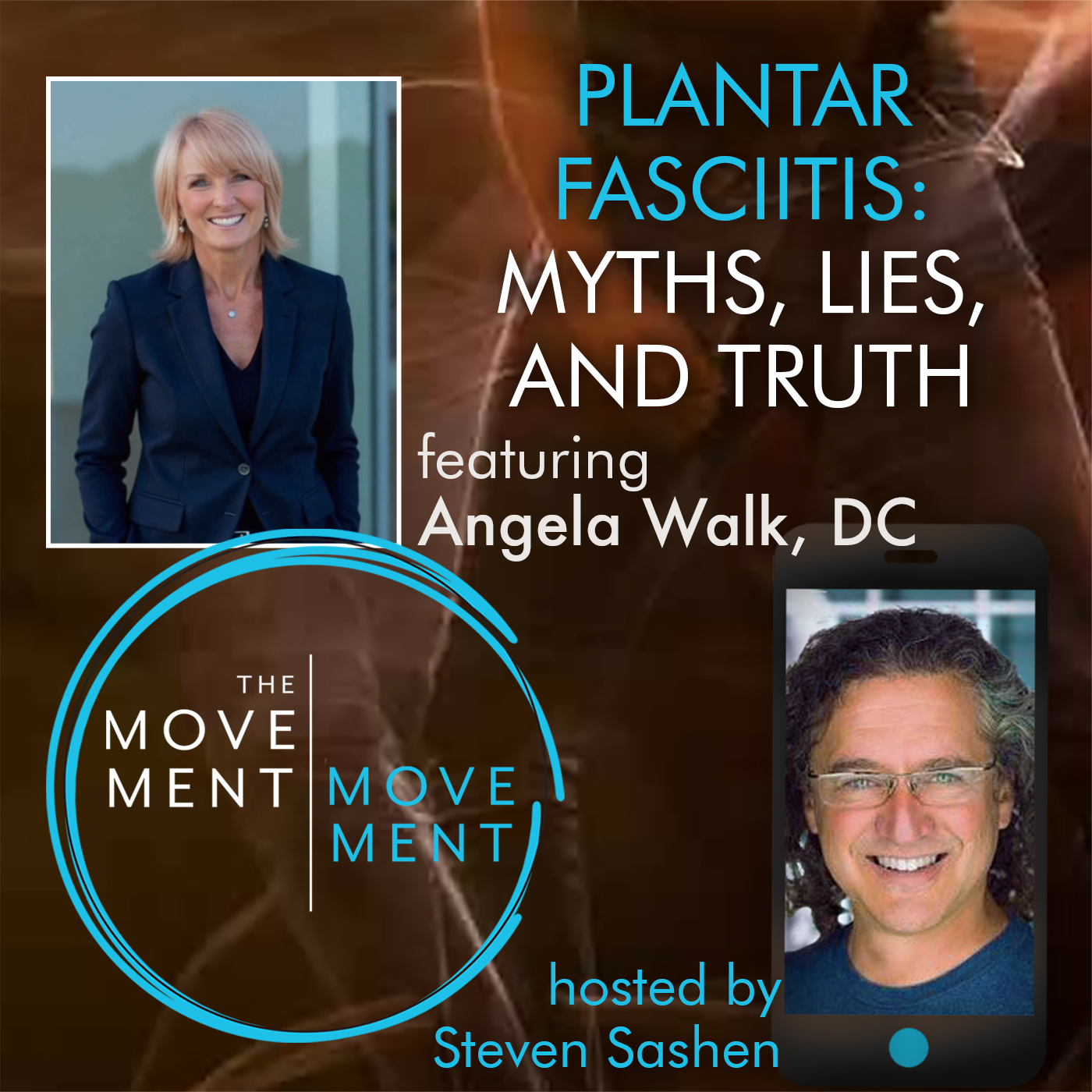
What if everything almost anyone has ever told you about plan or fashion? I guess what is causing it and what cures it is completely. I was going to say something more than wrong. Let's just get it wrong.
But this one really infuriates me for a bunch of reasons. We're going to find out more about that on today's episode of the Movement Movement, the podcast where people who want to know the truth about what it takes to have a happy, healthy, strong body starting feet versus, you know, those things at the end of your legs. And we break down the propaganda, the mythology and off and the outright lies you've been told about how to run, walk, hike, do yoga, cross-fit, play basketball, pickleball, tennis, you name it, whatever you like to do and do that enjoyably and efficiently and effectively and wait today. Say enjoyably, trick question.
I always say enjoyably. I know what I'm talking about. So because look, you're not having fun. You're not going to keep it up anyway.
So that's what we want to focus on. By the way, I'm Stephen Sashan, co-founder and chief barefoot officer here at Zero Shoes. And we call this the Movement Movement because we, including you, more about that in a second, no pressure. Don't worry.
We are creating a movement about movement, natural movement, letting your body do what is made to do and functionally, optimally, as a result. So the way you can help is really straightforward. Spread the word. Give us a good review.
Give us a thumbs up on YouTube or a thumbs up where you can thumbs up. Hit the bell icon on YouTube so you hear about these things when they come out. And if you want to be part of the drive, subscribe. You can do that at Zero Shoes.com.
Sorry. Join the movement movement.com, which is the website. There's nothing you do have to do there to actually join. It's just the place where you'll find previous episodes and a bunch of other information where you can find us online, et cetera, et cetera.
I think that's really all I need to say before we get started. And this will be fun. Dr. Angela Watt, a pleasure to have you here.
Do me a favor. Tell people who the hell you are and what the hell you're doing here. Thanks, Stephen. I appreciate you having me here so much.
I love having a platform to be able to share this information with people. Just like you said, plantar fasciitis. I don't know what it is about this condition, but nobody seems to know how to treat it effectively. My name is Dr.
Angela Watt. I am a sports chiropractor in Nashville, Tennessee in my 25th year of practice. I actually no longer have a physical practice and just have my online business specializing in plantar fasciitis. I created a six-step program to resolve plantar fasciitis at home.
Well, I'll pause there. I want to pause there. Let's just get into the conversation about what we're talking about, the confusion that people have about it, and then you can pitch to all, you know, whatever you do. But no need to do that.
Yeah. Let's get into the thing. Sure, sure. Well, hold on.
Let me interject. So someone who was listening to this podcast on a regular basis emailed me and said their wife was looking into issues about plantar fasciitis and found you. And then I looked at your content and went, we need to talk because I've been talking about this stuff for 16 years and I never heard anyone else talk about it similarly until I bumped into you. So let's start with, I'm trying, I'm tempted to start with one of two things.
One is the cause of plantar fasciitis, but the thing that makes me want to possibly move that a little bit later is the mythology about the cause of plantar fasciitis, which one of those do you want to tackle first? Well, I think the mythology. And there is just so much misinformation about plantar fasciitis. And, you know, if someone just like the person that you mentioned were to want to tackle this condition and they go online, the first things that they're going to see is let's possibly get an orthotic.
Let's consider a cortisone shot. Let's stretch your calf muscles with static stretching, wear walking boot, roll your foot on a frozen water bottle. I mean, these are just and get, and here's the one that you'll enjoy that you've heard the most and get a pair of these thick cushiony, so that you can see the most of the things that you've heard the most. These thick cushiony, super supportive, magic shoes, and this will fix your PF.
And what I had discovered that none of those measures actually work, and they're either short term bandays or they're ineffective, and they do not address the underlying cause. And so, you know, the number one cause of PF, in my opinion, and, you know, others will agree, is wearing the wrong shoes. And this is your jam, right? This is where we do.
It blows my mind, is that the thing that is the true cause, and we'll talk about why, because this is the kind of thing that people go with, my doctor said, well, ignore that for a moment, because everything that you and I are going to say, I'm confident, is going to have people going, oh, that makes sense. Yeah, that light goes off. The light bulb goes off in their head. And they're like, oh, you mean I need to wear shoes that are shaped like my feet?
We're not even there yet. The shape like your feet is a part of it. Let's just start with, you know, the shoes being a problem. The thing that blows my mind is when companies are selling a seeming solution that actually is the cause.
And we can get into biomechanics, but let's, so let's, oh boy, boy, let's just talk about the shoe thing. So from your perspective, and I'll shine in if I think I have anything to add, it'll be awesome if I don't. From your perspective, what specific things about what the shoes that most people are wearing is the actual cause of this problem. Okay.
And a moment ago, I alluded to my program, and the reason I did that is because I have this particular program, the first step is to transition to functional footwear. And so what exactly is functional footwear? And that is footwear that is widest of the toe, that allows your foot to function as it should, that allows your feet to spread your feet and toes to spread and splay as we walk and run. If your feet are unable to spread and splay as we walk and run, and we're cramming our feet into narrow toe boxes, it diminishes and robs your foot of its normal foot function.
It creates atrophy and weakness of your, the intrinsic muscles of the foot, which I like to call your foot core, and leads to many foot conditions, not just plantar fasciitis, but bunions or omus, hammer toes, anything in the foot, is the number one cause is the narrow toe box. So let's, since you mentioned the word orthotics before, and I'm not telling people not to wear them, there's a ton in place where we can discuss that. But for many people wearing orthotics on a long term basis can be another cause, can you explain why? Yes, so orthotics are typically one of the first lines of strategy for plantar fasciitis, and I believe they're, you know, they're over prescribed, number one.
There is a time and place, like you mentioned, but they're also used for way too long. It's often not an expiration date. It's like wear these orthotics and wear them for the rest of your life. So I believe in the early phase of plantar fasciitis, any of these measures that are helped to manage symptoms, that are designed to manage symptoms, is helpful.
And I'm okay with that, because it is an excruciating debilitating pain syndrome. Orthotics, however, those are my little puppy dogs in the background, sorry about that. Orthotics actually rob your feet of normal foot function. I believe there was some early research, and many foot practitioners kind of jumped on this research that showed that orthotics, that the cause of plantar fasciitis was excessive pronation.
So I think a lot of foot practitioners kind of jumped on that and said, well, if it's because of over an excessive pronation, then let's limit pronation. However, what it does, orthotics lift and brace and limit normal movement, and it weakens and atrophies the foot muscles. It creates lazy feet. Yeah, so I want to highlight this one.
So the way I like to say, I like to say, as people, you know, here's a question that's going to sound like a trick question. It's not. It's just a stupid question. And the question is, we are better than stronger.
And people go, no, I go cool. Let's talk about weaker. If I wanted to make my elbow joint weaker, what do I do? And they go, oh, don't use it.
I mean, people say that verbatim every time. I go, cool. Your arm and cast, all the muscles, leg, and tendons get weaker because the joint isn't moving. Guess what happens when you quote support, one of the 33 joints and 110 plus muscle, leg, and tendons in your feet.
Same thing. And when you try to then put those weekend things under strain, which you can be doing if you're walking, running, whatever else, then they're not able to handle that force. And that can create, well, and we'll talk about plantar fasciitis, we missed diagnosed later, but that can create actual plantar fasciitis. And while I didn't see that pronation study, but I guarantee it's flawed for a number of reasons.
But the one that I love, I posted this, God, literally probably 15 years ago, one of my favorite science writers, and I sent her an email the other day saying, she's one of my favorite science writers. Her name is Gina Kalata. And she did a whole bunch of research on orthotics and found that they just don't work. If they seem to work, it's for what you said, it's giving you some relief by not having to use that muscle mature at all and put it under strain.
But as we just pointed out, that makes a vicious cycle of making things weaker and weaker. And what people don't get, I'm going to add a thing to this and see if you agree with this. Hey, most shoes that people are buying already have our sport built in. So that's a problem.
I was going to make that point. It's not just orthotics. It's also the built in arch supports and anti pronation technology in most conventional footwear. And the anti pronation thing has never been proven to actually work.
And so that's a whole other conversation. But there's one that I've been talking about. And part of me, if I'm kind of jumping the gun to see whether you agree or not, and if you don't, until the cool that by the way, at the end of these, you'll hear me say, I'm always wanting someone to recommend someone who can bring the podcast. I think I'm completely full of shit because that'll be a really fun conversation.
It just hasn't happened yet. But anyway, so this is one, this is one theory of mine. You got a regular shoe with an elevated heel, which just naturally changes your gate to overstriting and heel striking landing with your foot to front of your body, your ankle landing in front of your knee when it does. By the time your foot comes down, it's basically already flat or flat as it's going to be because you're not able to use your muscles, documents, and tendons.
I'll say win less mechanism to be fun for anyone who knows. And if you don't worry about it, basically it's a way that if you use your foot properly to align so your bones correctly, it doesn't matter how your arch is lowered, everything gets aligned correctly. Then you've got your planter fashion in extended position at a point when you're supposed to be exerting the most force and they just can't handle it. And an analogy that I've come up with lately, I say to someone, if I ask you to do bodyweight squats for a minute, could you do it?
And they go, yeah, I go two minutes. They go, yeah, OK, now I want you to do a wall sit. Put your back up against the wall, feel about two feet in front of you, scooch down to your side or parallel around. Can you do that for a minute or two minutes?
And it was, no. I go, well, that's what you're asking your planter fashion to do when there's stretched and then put on your strain. So it's a whole different thing that happens when you're dynamically moving. Any thoughts on my current theory on another cause?
No, I like that. And I like that. That's exactly what is happening with the plantar fascia is that movement deficiencies that are occurring further up the kinetic chain are leading to this excessive pronation. And it's putting too much stress on the plantar fascia and it wasn't designed to withstand that type of pressure.
So we could use one of the most common findings that I see in most all of my patients when assessing my patients is short tight calf muscles. And so when we're seeing a tight calf muscle, we see if the calf muscle is too tight and I've got a little yorky in my lap. Sorry about that. She stays more quiet that way.
If the calf muscle is short and tight, it limits the amount of ankle mobility or ankle dorsiflexion. Dorsiflexion is the action of bringing the foot towards the shin. If the calf is too tight, it limits ankle dorsiflexion, which causes a collapsing or an over pronation of the foot, which is what you were talking about. Instead of the heel, on heel strike, the heel should evert.
And this causes these muscles to become more mobile and allows that pronation. But when we go to toe off, the calcaneus of the heel muscle should invert and cause a rigid lever. And that's what's not happening. So when we don't get the rigid lever, we get hypermobility in too much motion here.
And all of the stress is placed on that plantar plantar fascia, which again, doesn't have the capacity to deal with that type of stress. So, yes, agree. Yeah, yeah, they're not yet is the critical thing. There's, you know, since you mentioned it that way, my experience has been that more often than not, there's two things.
How can a tight calf can be so something further upstream can cause a problem downstream, causing problems in the foot. But I've also seen that more often than not, the tight calf is providing, is creating symptoms of plantar fascia. They're not plantar fasciaitis and are often misdiagnosed because people aren't paying attention to the calf. And I have my favorite story that I tell.
I said, I trade show a number of years ago. Guy comes up, big guy, like 6'5", 250", no body fat. He's a special forces guy. And he said, you know, we've all switched to these minimalist shoes and a lot of us got plantar fasciaitis.
And I just took one look at him, like, no, you didn't. He said, what? I said, your calves are like way too tight. And I could just see it from a mile away.
And I said, give me a favor. Can I stick my thumb on your calf? He goes, okay. And again, you know, I got an act for this.
I could see the spot. I didn't have to feel like it knew where it was. And I put my thumb on and I start to press and this giant dude falls to the ground. I just rubbed the crap out of his calf.
I was fine. Yeah, it was fun. I just rubbed the crap out of his calf for about 5 minutes. And I said, get up and see how that feels.
And he goes, oh my God, that's like 90% better. I said, cool. Go back to the base. Talk to your PT.
Have to do that to all you guys for about a week. And let me know what happens. And he bumped into a year later and he said, my plantar fasciaitis went away. I said, you never had plantar fasciaitis.
You had tight calves. You hadn't gotten to the point of having plantar fasciaitis because your feet were pretty strong. You were just having symptoms that looked like it and knew any better. And that's the one that I've seen people, even after I show that to them, because I look like this and I don't have the letters D.R.
period before my name, they still get surgery. Yeah. So, well, I, you know, the two most common causes of short-tight calf muscles that I have seen is number one is elevation in heel elevation and footwear. And so, you know, that we're not just talking about women's high heels.
We're talking about men's shoes and casual shoes and running shoes have a minimum of 5 millimeters, but often as much as 10 millimeters, which is the end of the day. And it's baffling to me why shoe manufacturers add heel elevation and footwear because there is no, there's no foundation for that. But you don't know how it happened? I can tell you.
It happened with a running shoe, correct? And I'd love to hear the story. Yeah. So, this is common knowledge among a small group of people.
And we all try to spread the word, but it doesn't go very far. So, way back when Bill Barriman and Nike, they're just getting started, they're sharing a building with some podiatrists and Barriman says, I'm getting these runners with Achilles tendonitis. What do you recommend? And the guy said, oh, clearly, there are Achilles of short-and-f're wearing high-heeled dress shoes.
So, put a wedge of foam in there to accommodate their short-and-a-kilies. Cut two, well, before I cut two, the footer industry is a bunch of copycats. They're terrified. They're not very creative very often.
So, something starts to sell really well. Everyone else is like on it like on rice because they're afraid they'll go out of business otherwise. If everyone gets into that whole elevator heel thing, we better do it or else we're going to be out of it. When the barefoot boom started in 2009, when it was literally about running barefoot, shoe companies are saying, oh my God, we got to do something otherwise.
People will never buy shoes again. They're freaking out. Okay. So, cut two 30 years later when a friend of mine who worked directly with Barriman at Nike was sitting at a track meet with one of these doctors.
And he said, and so again, probably I kind of skipped over. Once they did the elevator heel thing, everyone started doing it. It's been becoming a big list. So, my friend is sitting at a track meet with one of these doctors and he said, your idea became adopted by every major shoe company.
Everyone's been doing it for the last 50 years. What do you think about that? He said, it was the biggest mistake we ever made. At no evidence for the Achilles shortening.
I'll say something about that. We had no evidence or understanding of what the elevator heel would do to change people's gait to cause problems. And we were making prosthetics for everything. So, we just looked at this immediate problem as needing a prosthetic solution without having done the research.
And part of the research that I wish they had done would have been testing this whole thing about whether people's Achilles actually shortened or if like when you get your arm out of a cast, it takes your brain in a while to remember that it can move. It's like, arm can, you can move it, you can have someone move it passively and it's, it can be okay, but you can't necessarily move it because your brain has learned to protect it. And I see it in runners in my neighborhood. Even if they have a higher heel shoe, they're not even letting their Achilles stretch enough to let the heel come down to the ground in a higher heel shoe.
And then they put on something flat and they go, oh see, this is hurting my Achilles like, no, no, no. Your brain just hasn't given you the information that's safe to let it stretch or you haven't given the information to let it know that it's safe. Yeah. And I liked your terminology with micro dosing because people who are coming from, I read that in one of your blog posts or heard it on a podcast.
But that's so true. When people are coming from footwear with 10 or 12 millimeters of heel elevation to zero drop, it's got to be a slow roll because that calf in Achilles reacts to that. And when you were describing the runners that were going from, you know, traditional running shoes into the zero drop and having, you know, thinking that they had developed plantar fasciitis, I'm thinking, you know, your body has your foot and lower leg have not adapted to functioning. As I should, at the normal tension and strength of the Achilles and gastrocinsolias.
In fact, you know, something happened to me about a month ago that I hadn't really thought of in this context until just now that really highlights this because it's not only the ability to stretch, but the ability to do that under load and at certain speed. So I'm a competitor, I was in a track meet warming up, I'm running everything felt great. I mean, I really was really looking forward to this race. And I decided to get out of the blocks and wants just to do a start from the blocks and once before the race started.
Now, when I set my blocks, I set the angle at 45 degrees. The blocks that had this track meet had either 40 or 50. And for some reason, I decided, let's just set it to 50. And when I did my first start out of the blocks, the speed with which I got that little bit of extra strength was more than my brain was used to.
And it just seized my calf. I didn't pull anything. I didn't string it just seized up going, whoa, whoa, too much too soon too fast. Too much too soon too fast.
Exactly. I was really annoyed because I wanted to have that race. But it's a lesson like, and this is someone who's really used to a lot of Achilles stretch, a lot of Achilles force, but that little bit of extra at that speed, everyone in my brain, whoa, can't do that. Actually, there's a reflex art thing not even up to my brain.
But suffice to say, you know, you've got to, you can't now, there are ways of accelerating the process of getting used to having your Achilles move more, which is like Feldenkrais work and things where it basically tricks your brain into remembering that. Right. But even still, there's still take your time, get used to something that or et cetera. Yeah.
That first step in my program is to transition to functional footwear. And so I just want people to understand that number one, we need to get your, get you into shoes that allow your feet to function normally with a wide toe box and zero draw. And I know obviously a lot of your listeners know a lot about that. I have a ton about that, including you.
But I feel like if people were finding this podcast, I want them to understand that number one, you know, when you're wearing a shoe that's narrow at the toe and has a tremendous amount of elevation of the heel, the very shoe that you were told to get to resolve your PF is making your plantar fasciitis worse or hindering your recovery. Yeah. I mean, it could, again, immobility can feel good for time. But orthotics weren't made to be worn full time.
They were made for when you do have an actual tissue injury, the same way you've got your arm in a cast rather than put your foot in a cast. That's right. Listen to mobilize it as much as we can, not entirely. Yeah.
And I use the cast analogy. Yeah. For sure. I love that.
Because the cast is not, it's essential and necessary initially. But once you remove the cast, then you've got to start strengthening the muscles and the soft tissues that have been weak. And from the immobility and that have atrophy. And so, you know, when people first come into the program and they're wearing foot orthotics, I don't just have them ditch them immediately.
We slowly transition them out of it as they are actively working on strengthening the muscles in the feet and in the lower leg and mobilizing those ankle joints and getting greater flexibility. And when that and their pain begins to diminish and as that happens, then we start to say, Hey, take those out for 15 to 20 minutes and give yourself a go, you know, give it a go, then put them back in. And let's do that for a little while. And just like you said, a little micro dosing.
Don't do too much too fast too soon. And that's the way we deal with orthotic support. And, you know, because as we mentioned earlier, they've been wearing footwear with the built in art supports and they'll say, Hey, what about working socks? You know, it's the same sort of thing.
They are better. They do have a little bit wider toe box than most, but they still have the art support, you know, the built in art support. Yeah. Yeah.
One of the, one of the, in those 15 minute bouts, one thing I said, if you can find somewhere that has like P gravel, walk on that because the only way to do that, you can't, it's unpleasant to overstride and heal strike. So you end up putting your feet more underneath your center of mass and engaging those muscles in a point where they're already slightly strong to begin with. So it's not a way of strengthening that someone. And I've had some people who just gone out and bought a big, you know, 20 pound, 50 pound bag of P gravel and put it somewhere, put it like in a box so they can do it inside somewhere outside so they can do that.
So we've talked about causes and I hope people get that the fundamental thing we're talking about. Oh, and by the way, even people who are not necessarily barefoot shoe friendly and I know a few of them, we don't talk about that too much. But they're the first ones to say, look, if you thought about this, like going to physical therapy and the physical therapist said, Okay, great, I want you to wear these are thoughtings when you're at home. When you get back into PT, they're going to take those out and they're going to mobilize your foot into all the things you're talking about, strength, responsibility and dynamic motion.
They're just letting your foot rest when it needs to rest and then you work on it in the clinic and over time, they're going to have you wear it less and less. And even Ben O'Nig, who's not been a huge fan of barefoot things, will say the whole point of an orthotic is to get out of it and build up strength again. And if you build up strength, you'll never need them again. So that's the cause side of things.
And we did both the mythology and the reality of that. On the cure side of things, let's talk about some of the mythology and you alluded to one a couple times, which is static stretching. So that's the first one that makes my head explode. Okay.
Yeah, I mentioned earlier that, you know, when assessing most of my patients, they typically all have some degree of tightness in their calf muscles. And so when they're prescribed static stretching, oftentimes the remedy and what they hear is to stretch your calf muscles three times a day with static stretching and ice your foot three times a day. We can get back to why icing is not the best method. But static stretching has its place.
But for rehabilitation, strengthening is far superior to stretching. And even people will say, but my calf muscles are short. Yes, but I recommend active or dynamic stretching. And even strengthening techniques, if you strengthen a muscle, you can lengthen the muscle.
In my program, I recommend eccentric loading, which is a method of putting load on a muscle during the lengthening or slowly lowering part. And that also lengthens the muscle. So, static stretching, let me define that, would be like a yoga stretch, holding a stretch for 30 to 60 seconds. Active stretching incorporates movement or motion.
And if you're a runner, you are familiar with how we used to recommend static stretching for everything. And now it's kind of shifted to active stretching. You know, see, you're kind of rolling your eyes a little bit. But it's the same with rehabilitation efforts.
Strengthening has greater benefits for, you know, elongating and creating healthy muscle. So that is what we recommend. And again, static stretching has its place and people love it and it just feels good. But to get the biggest bang for your buck, focus on strengthening the muscles in the lower leg, the gastrocnemius, the soleus and the Achilles.
Yeah, and so an example for a eccentric, I'll do it outside of feet first because it'll be easy people understand, think about doing a curl. So the concentric is lifting up, the eccentric is lowering it down. And the interesting thing, many people confuse just lowering slowly with eccentric, which is not the case. The whole value about eccentric is that you're stronger in that lowering phase than you are in the lifting phase.
So imagine doing a curl and you're curling up 20 pounds, making up a number for the fun of it. What you can control on the way down could be 30 pounds, 40 pounds, I mean much, much more. And the evidence is that creates strength better as the muscle is lengthening. So it's training your brain that, oh, that lengthening thing is safe.
So a similar thing would be, and I'm going to ask you to do a correction for how people will take what I'm going to say, is if you were standing on a stair and elevating your toes, I mean elevating up, lifting your heels up, that's a concentric. Eccentric is the lowering down part. Now, if you're not ready for that, you got to do that just right. That's right.
But one example for doing eccentric strengthening for the calf. And in fact, one way of doing it would be go up on both feet and then just go down on one foot. But talk about how to deal with that in the real world if they're dealing with CMPF issues. Yeah.
And that's actually one of the exercises. Those two exercises that you mentioned, the first is the concentric, which is coming up on both toes and the eccentric. And I do recommend that just coming down on one leg because that increases the load, just as the example you were showing with the biceps. And yeah, we get great results with that.
That was easy. Are there anything so people would be cautious about if they're going to try that when they go home tonight? Yeah. And I typically, as I mentioned, it's a slow roll.
People often are very weak in their calf muscles. And so I do recommend just kind of starting with the calf raise, just a typical calf raise. I recommend squeezing the ball between your heels. This helps to activate the posterior tibialis tendon and the peroneal tendons.
And these are often a part of the complex of plantar fasciitis. And that's just, you know, having a ball, putting a ball between your heels and squeezing it as you're going up into a calf raise. I'll give a personal endorsement for going slow. Excuse me.
I don't remember how it happened, but I was doing some exercise program and it involved calf raises. And I did, I did until I got to failure, which basically was about 150. And it felt fine. I mean, really, no big deal until the next day.
Yeah, it was a while till I could walk like a human being. But so it is easy for some people I have found to really overdo it and really not know it until the next day. And you know, I joke that the problem with the idea of don't do too much too soon is you only know if you've done that when you did it. You've done too much too soon.
Yeah. So start small, like, you know, start small, see how you feel the next day, build up slowly because calves unlike any other, because we use them all the time. So they're built really to handle a lot of repetition in a way that, you know, your biceps or whatever else aren't. So you can get faked out by thinking that it's cool and that's so cool the next day.
So, okay. So other anything else on the mythology about the cures that people are usually offered. And by the way, when there was a skymall magazine, it used to completely make my head explode that there was at least 10 ads for different or similar products for basic plastic, static stretching for a plantar fashion. It is something, I mean, just crazy ideas.
Well, that, I mean, the two industry and these other types of devices, sleeves, braces, all of these different types of supports are making millions off of people with plantar fasciitis because it is so painful and debilitating. And people, and there's so much conflicting information. They're just not really which way to turn. And honestly, you know, these type of passive approaches do nothing to change your condition.
They do not improve strength. They do not improve tissue quality and they do not make your foot more resilient. So I have on a daily basis, 10, 15 emails. What do you think about this particular compressive, you know, compression sleeve or what do you think about this shoe and that shoe or this orthotic.
So, you know, people are just really lost and it's understandable because that's all the information that's out there. Yeah, by the way, just occurred to me. I want to back up way far to the beginning of our conversation. I don't know if this is true or not, but it occurred to me that it might be and I'm curious about what your opinion is.
Some people might end up getting, I mean, I brought up the idea before that type calves are mistaken for plantar fasciitis or type calves could cause plantar fasciitis. It's just something that you brought as well. I'm wondering how much type calves are actually an effect of an initial bit of strain on the plantar fascia. Basically trying to compensate for some, you know, like something before you even notice that you have something that will be plantar fasciitis.
We can talk about plantar fasciitis versus fasciaosis. We'll do that too. But maybe, you know, you get like a little strain in the profession and the calf tightens to try to protect that. And then there may be a bad feedback loop doing that.
So it may be that's actually a symptom as much as it is a cause or a faux cause, if you will. It's kind of chicken or the egg sort of thing, does it? It's pretty accurate. It's pretty accurate.
But it's just popping up. Yeah. And you know, what I have found too is that it's something like what you're talking about. It's compensations.
When we talk about compensations, we're talking about when one part of the body is failing or not functioning normally. Our body has to borrow an action from another part of the body to complete the action. And that other part of the body may not be designed or capable of handling that stress. So in other words, if one part of the body is not working as it should, there's a compensatory action.
You got to steal an action for over here. And then it puts too much stress on this place. And then there you have the breakdown. So it is kind of hard to determine, you know, did the breakdown occur here first and cause the calf muscles to react?
Or was it the tight calf muscles that cause the plantar fascia to react? Yeah. Ultimately academic because the important thing on the treatment is going to be the same. And actually, when you said it that way, I'm reframing my theory anyway to be that if you are wearing something that isn't orthotic or is something supporting the plantar fascia, that the fact that there is no, that there's that laxity in those tendons could make a calf try to take over.
Again, I hadn't thought of it that without working with a loop before. So, okay. Any other things on the mythology side for treatment? Well, I did.
We alluded to a moment ago regarding plantar fasciaitis versus plantar fasciaosis. And there's one that we didn't mention, ice for you mentioned what we didn't dive into. Let's talk about ice. That's right.
So that's what I'd like to get into. So any health condition that has the suffix at the NITIS indicates an inflammatory response. So in the case of plantar fasciaitis, following that rule, it would be an inflammation of the plantar fascia, which is the connective tissue on the bottom of the foot. However, about 20 years ago, there was some extensive studies by a prominent podiatrist.
His name was Harvey Lamont. He did a study on 50 patients with chronic PF. And in every case, he found no inflammation. And so this kind of flipped the script a little bit, right?
I mean, it was a discovery that no one had really thought about before. So if that's the case, and there's no inflammation in these plantar fasciaitis patients, and we're treating it with rolling your foot on a frozen water bottle with ice, getting cortisone shots, resting completely, racing it, then you're not treating the underlying cause. A more appropriate name would be plantar fasciosis, which indicates fasciotic tissue or cellular death. So what he discovered is that a particular muscle, some soft tissues, were encroaching on one of the primary arteries to the foot, mainly due to narrow toe-box shoes.
And it cut off the blood supply, so wherever beyond where that blood flow was being encroached, the cells were dying. That is called fasciotic tissue. So that was his discovery. And so it changed the way really that we think about plantar fascitis forever.
So, you know, treating, let me say this, with any injury, there's always an inflammatory response. Right, initially. Initially. And it may be just a few days, but if you have had plantar fasciaitis for longer than two to three weeks, inflammation is not your problem.
So that's big stuff because I can remember when I was first treating people with PF and I didn't really have some of this knowledge, we were all telling everybody to ice their foot three times a day. And this was only further restricting necessary circulation, but also prolonging healing. So, I mean, you know, and this was a big debate in the rehab world, and all of us now are coming around to that. You know, we all learned to put ice on any musculoskeletal injury within the first 24 to 48 hours and beyond.
You know, if you sprain your ankle, if you twist your knee, if you hurt your back, you put ice on it, and you keep putting ice on it. And we know now that is not the best method. It's often misrepresented. Like I had both of my shoulders put back together.
Thank you for being a gymnast where that went. And so, okay. So they had an ice machine that I had on practically 24 seven. Right.
But they were pretty clear. It's like, it's less about, let's say it's not so much about the information for what we just did to put you back together. It's for the information around everything else for what we did to get to where we had to put you together. But also for just dealing with the pain.
It's the area. Yeah. So that's another one of those things that I should say, hey, it just feels good and it hurts less. Right.
You know, it kind of going back to the orthotic issue. You know, if that's the case and we're just trying to get you through this to get out of pain or they'll come to me and say, doc, I've got to have some sort of something for pain. I just went and had a cortisone shot and I feel better. I know it's not helping anything.
But it could have some considerable side effects, but I feel better and I can get out of the bed without excruciating pain. So, you know, what do you say to that? Hey, do that. But let's get busy.
Let's get busy working on the strength of your foot and targeting what's causing your issues. Yeah. I mean, it is interesting the whole icing thing because even in my early gymnast days, so literally 50 years ago, because I'm old 50 years ago, we got an injury, which we did all the time. We didn't just do ice.
We did ice alternating with heat. So it was just about just enough ice until things got a little red and then heat to keep things moving. So it was about keeping the circulation going. And I want to highlight something you said that is huge and people don't really appreciate it because we don't have an experience of it.
And that is when you squeeze your toes together, when you basically invert that first big toe, we push that into the middle. It literally does shut down a bunch of circulation in your foot. Yeah. And that is, I mean, it's crazy town.
You would never do that to any other part of your body. And the problem is we just don't feel the effect of it fast enough to recognize that's what we did, especially if you're only in pointy toe shoes, you don't even have a choice or you don't think you have a choice. And so you wouldn't notice it anyway, because you kind of habituated to this thing that is going to be a cause of, like you said, that cellular death, that is plantar fasciitis, even though we call it fasciitis, whatever. No, I keep it simple and just I always just kind of refer to it as that, but I make a point and I'm very intentional about educating my patients on the difference.
Yeah. And then they can be obnoxious at dinner parties by going, no, I have plantar fasciitis. Then I have to change my name to the plantar fasciosis doc. Yeah, that would find you.
That's right. You know what? That's part of my thought process there. Well, you know, it's like people argue about, well, barefoot shoes, barefoot, you're in shoes.
I'm like, I didn't make out the search term. That's what people started looking for. If we're going to sell a product, we have to be in front of people and they're looking for you. Yeah.
Yeah. And so any else we can think of on sort of causes and treatment, because I think we've really nailed it unless I'm. Yeah, a couple of things. You mentioned barefoot walking and I wanted to talk a little bit about that because it's part of my program.
And when people in the early phase of PDF, whether in a ton of pain, even thinking about walking barefoot is excruciating. And however, walking barefoot is one of the healthiest things you can do for your feet and it naturally strengthens your foot and your foot core. And I also recommend toe spacers. And that is a tool that is designed to stretch and realign your toes to broaden the base of the foot from the damaging effects of narrow toe shoes.
But it also helps to activate the arch muscles and gives you art, natural art support. So I do recommend for people to slowly begin to introduce their feet to barefoot walking. Even, you know, sadly, I have such a great outreach now and I'm in contact with so many people with PF and they all, many of them will say I was told to never walk barefoot that before my feet even hit the floor, I need to put on my shoes. And the only time that I shouldn't wear shoes is in the shower.
And so, you know, they wear these foot coffins. And so I'm trying to just sort of completely flip that and say, hey, we want you to not wear shoes as much as you can. Start with five minutes, work up to 10 minutes, you know, work up to 15 minutes. But that's one of the healthiest things that you can do to strengthen your feet.
I agreed. And the research is very clear, even in a truly minimal issue. And I want to highlight something about that in a second. Just walking in a minimal issue, Bill's foot strength as much as doing an exercise program, which doesn't mean you don't need to or shouldn't do both because the study didn't have a cohort that did both to show the effects of that.
But, and this is not rocket science, it's a user to lose it. Like we said, support things they get used and they get stronger and use them more. They get stronger and more. The highlight I want to make is they're in the last, mostly five years, there have been more and more companies coming on with shoes that are calling minimal, barefoot that fundamentally often are not.
And the big thing that they're doing, I'll say incorrectly, or that violates the principle of a truly barefoot shoe is the soles are too thick and too much cushioning. And this is true back in 2010 when the big shoe companies were doing this and saying, hey, it's a barefoot shoe. It's like no, no, too much cushioning narrow, for example, as well. And the reason this is a problem is twofold.
We talked about it, but I'll highlight it one. Those things aren't as flexible. So you're not getting the motion that you need. And you're also not getting the feedback through that foam that your brain needs to know how to move things properly.
And it's on the one hand, more power to all of us for getting word out, but it does muddy the waters a bit in a way that is problematic. I mean, Irene Davis's research, which he was at Harvard, showed that what she called a partial minimal shoe to narrow, usually in the midfoot or too much cushioning is the worst thing for you because it's not enough cushioning to protect you from the bad form that you will still have because you're not getting the feedback from that shoe. So just wanted to highlight that. Yeah, and they call them a transitional shoe.
And it is a shoe that, you know, it's defined as a shoe that has the characteristics of a barefoot shoe, but with more cushioning. Yeah, they call it a transitional shoe because in fact, I think it was Adidas or again, if you're going to be obnoxious at a dinner party and say, plantar fasciosis double down on your obnoxiousness and call the company, Adi Dauskis. That's what it really is. Adi Dausler.
Anyway, they came up that term because they weren't going to go to a truly co-carefoot shoe. They actually said if you're starting at 10 mil, go from 10 to 7 to 5 to 3 as a way of selling more shoes that did not produce the benefits that they were claiming. Yeah. Yeah.
So it's, and there's a bunch of research that's come out lately. That's not great because a lot of this research is not looking at the right thing. And what I mean by that is what we're really talking about when I talk about footwear, we're talking about form more than footwear. It's that sort of footwear informs your form differently.
And very little of the research on this is actually looking at gate and looking at force production during the gate cycle. So there are some people saying, oh, transitional shoe, which they don't even define clearly can be helpful, but it's, I would argue, more than a single shoe. But it's, I would argue more helpful to just go called Turkey except in very short pouts again, like we talked about micro dosing. Like you're saying, orthotics, go barefoot for five minutes.
Same thing. You don't need to go lower, lower to go all the way down and just a little bit at a time building it up as you feel you're ready. Yeah. Yeah.
I mean, this is, you know, it's so funny. Like we don't even think about this in other contexts or more accurately, this all makes sense in other contexts. Like you go to the gym, you haven't been for a while, you don't throw 300 pounds on the bar and try to squat. You put, right, right.
You put something on the bar where you hope no one who knows you sees you because it's so embarrassing, like light and you do a few reps and you hope no one sees you especially somebody might think is attractive. And then you do one set and you get out of there before they know you were in a town. And then again, you build it up slowly as you can. It makes total sense in the gym.
Now, granted a bunch of pros go in there and load up what they were doing in college saying I can still do that. Okay. And I'm not opposed to a transitional shoe in the early phase of PF when they first come into the program and they're, they've been wearing a stack height of 30 millimeters or higher. Yeah.
You know, I mean, most of the shoes that, unfortunately, that most practitioners will recommend for plantarphyseitis have a minimum of 30 millimeters. And up to 38 millimeters of stack height. And so there are some brands and I don't know if I can mention those here, but like, ultra flux footwear. These are some transitional shoes.
I want to be clear about that because ultra has now started making super thick things as well. So let's be clear. They have. Yeah.
And so let's be clear. First one, we talked about. And I also added heel elevation to some of their footwear, which just broke my heart, but not as much as the founders who were friends of mine. I mean, they're very unhappy, but yeah, I can't do.
There was some changes that went down there, but yeah, but I, there are some altars that do have, you know, 20 millimeters, 23 millimeters of stack height and starting there is not terrible, but as you progress in my program, I recommend a full transition to barefoot or zero drop. But where or no little to no stack height. Yeah. And to be clear for people who don't know stack height, the easiest way to think of it is the distance between the ground and you and you're at the bottom.
Right. And this would be an example of a transitional shoe that it is zero drop and it does have a white toe box, but this is stack height. It is the amount material on the bottom of the sheet. And there was another point I was going to make about that, but I can't remember it.
So that's okay. I have some visual aids here and it kind of prompted me to remember. And one thing that I recommend for my patients to do is to try the shoe liner test for them to. I'm going to do with this one significantly.
Do it. Okay. I'm going to have an argument, but I'm going to point out the problem with this one. Well, okay.
But here's what I recommend. Here's what I recommend for people to do. Go take the top, the five shoes that you wear most often, lay the end so loud on the floor. And if your feet or toes extend over the shoe liner, then that is contributing to your plantar fasciitis.
And I only refer to the toe box. So what was your argument there? I'm curious. Well, my argument is that people are using that information differently.
They're using it to determine whether or not a barefoot shoe is going to fit. Oh, oh, I see. And that's the problem is that because people are looking at a two dimensional thing and the liner of the shoe is by definition more narrow than the shoe because it's fitting. It is right.
And secondly, your foot is a three dimensional thing and so is the shoe. So there are many shoes where the sole, especially a minimal shoe, can your foot can extend past the width of the sole appropriately. The shoe is designed for that and the shoe will fit. So people use this thing and even more, they'll put their foot on the insole and then spread their toes as much as they can go.
It's like, no, no, that's not what your foot ever really does. Right. Right. So my favorite story about this is not even someone coming in and putting their foot on the insole and saying, hey, it's not wide enough for me.
But someone came up to us at a trade show instead of a four double E, can I try on your shoes and we would, I don't know. Wow. Right. It's just a two dimensional measurement and your foot and the shoe with three dimensional.
So he said, we said, we don't know. He said, let me try. And he put on one of our shoes and it fit him perfectly because he had a wide foot two dimensionally, a lower volume foot three dimensionally. This circumference was smaller than somebody with a very high arch, for example.
So we've seen that often. So now I've got a patent for a way of solving this problem, but I can't say more than that at the moment. Okay. Well, I think the point that I like to use it to prove a point, the shoe liner test to say, hey, take the insole out of those Rolex and stand on it.
And you'll see or and then take the insole out of your zero shoes and compare the two. Right. Yeah. Well, I held up a shoe before and I just do the simple version.
I just hold up a pointy toe shoe and go, right. Is that the shape of your foot? Right. Sometimes with like a new balance, like, well, it's wide at the ball of my foot.
But then it's pointy. I go, if that's the shape of your foot, guess what? It ain't supposed to be. Right.
Right. I'll have patients will ask, I got a wide shoe. Is it that the same as a wide top box shoe? Well, no, a wide shoe is widest at the four foot and wider throughout the shoe, but not widest at the toe.
Well, I also, you can feel free to use this line if you like it. After I point their shoes and go, is that the shape of your foot? And they go, no, I go, cool. What problems might you have at the end of the day, the week or a year by shoving a foot shape thing called, you know, a foot, like you were foot into a non foot shape thing.
And I literally do this. I put my fingers like over there, too, and to emphasize it. And then they'll spend the next five minutes telling me about all the problems they had that they thought were just natural. It's like, no, they're not.
So I first wake up. Any other things to show and tell? You said you had other visual. Well, I another, I think critical part of my program is addressing the fashion system.
And that is a deeper conversation. But I do. But it's one of my favorite topics. It's something that I have been using and addressing in my practice for 25 years, very successfully.
And I use it. I teach people how to remove facial adhesions in their foot and lower leg using a fashion release tool on themselves. And plantar fasciitis is can be a repetitive strain in an overuse during reputting too much stress on your feet. And when that occurs, adhesions occur in the fascia.
And that's just an important part of my program is to release that. And people see significant, significant improvements because it is often the source of their pain and immobility. Often when people are experiencing tightness in their muscles, it's really restricted fascia. And for people who don't know, I'll do it the worst fastest version you can elaborate.
The fascia is basically, it's not only covering around the muscles, but around pretty much every working you have. But also, it goes through the muscles as well. Think of it like, I'll do the world's worst analogy. Think about it like a sausage casing.
And then just imagine that. Yeah, that works. Yeah. It's not bad.
And then just take a part of that sausage casing and make it extra tight for some reason. Just like a little piece of it. That's kind of what we're talking about. And for vegetarians out there, my apologies.
Yeah, I mean, fascia should glide smoothly. And when it adheres, it becomes rigid and tight and usually the source of restriction. So pretty important part of resolving plantar fasciaitis is to kind of dig into those adhesions and scar tissue that form from repetition and from wearing the wrong shoes and that sort of thing. Given what we've done in this conversation where I know I'm, I'm going to say not stepping on toes when I say this way, knowing that you are a smart human being, I know that you will, I'll put money on the fact that you're going to agree with me about this one.
That many people who've heard about, about fascia and have heard about facial release, they hear about it like, Oh, just roll over a lacrosse ball or some variation thereof. And that's what we're talking about. Yeah, the difference in rolling a lacrosse ball and using fascia release is it's a very specific or targeted technique where you locate the adhesions. And when you have adhesion development, it's usually very tender.
So let's take, for example, an elbow condition where you know, overuse issue of the elbow. When you have healthy tissue, it's usually very smooth. When it's unhealthy, it's rigid and bumpy and tender. So this technique using a stainless steel instrument versus like a lacrosse ball, we're actually targeting those adhesions and restoring that normal motion, which is why it's called instrument assisted, soft tissue, mobilization, you're mobilizing, mobilizing that tissue.
I also encourage movement and motion. So for example, you'd be going into this kind of hard to describe with that. You would be an easy one. So let's just do the motion part first.
We'll break it down. So one version is using again, a device like you're showing, which is just a big metal spoon for people who are listening. Just not really. Start.
So imagine that you're moving the spoon along your calf and you find a spot that feels tight and painful. So the motion part could be flexing a bit, pointing your toes and flexing your foot. And then if you add the movement part with that spoon, as you're moving the spoon back and forth along the calf at the same time, so you're getting this double whammy of trying to make things a little more flexible while you're going through a range of motion where it could impact what you're doing. Better resource mobility.
Yes. Exactly. Great. Just the way smart people are doing it.
There's a lot of people who are not that smart. So, yeah. No, no, no, no, no, no, no, no, no, no, no, no, no, no, no, no, no, no. No, no, no, no, no, no, no, I'm a sprinter, I'm not a runner, I'm not a runner, I'm a hunter.
I'm a six knee. I don't take turns. I don't know. Yeah, I don't have a GPS watch.
I don't even take turns on the track as the way I say it. I don't like getting lost. I go very short distance as fast as I can. Yeah, not a runner here.
I'm an avid pickleball player. And I want to ask you about some of your new machines for pickleball and maybe a different topic here. Well, here it's really easy. We released this basketball shoe that's being called the X1.
X1, that was my question for you. So we made it as a basketball shoe and people in the NBA and WNBA are wearing it and a lot more are going to be doing it by next season. We not surprisingly it's a great courtshoe. People are using it for tennis, they're using it for pickleball, they're using it for pretty much every single one.
Yeah, I noticed that it had a little bit more of the lateral stability and you know right now I play in the Kelso in the 360. I was going to say, those are both great shoes, the fours are great shoes. We've had people who play pickleball in the speed force which is our closest thing to barefoot shoe. It's one time I played and I have an allergy the one time I played I was in the speed force, it's totally fine.
It's just what you're comfortable with. I mean I mean I mean I typically play like I said probably the Kelso more than anything but I wanted to ask you about the X1 because it's new and I saw another pickleball player wearing them and he had the hot tops on and I thought well what is this and I come home and search and see and I like the white one so I think I'm going to give those a go for pickleball. It's impressive shoe and we're not aggressively promoting it, it's just an overall court shoe at the moment. It's about time.
It's so excited. Don't get me started. Anyway more importantly let's cut to the chase. For people who want to find out more about what you're doing and how you can be helpful if they want to find out more about your program or just follow you in general let them know how they can do that.
Okay my website is drangelawalk.com drangelawalk.com. I also have an Instagram account it's the Plantarfesciitis.doc. I'm also have a YouTube channel and it's the Plantarfesciitis.doc. Perfect.
Well Angela thank you so much as I expected this was a total pleasure not just because you have a giant agreement party but you know it's nice to hear someone who's really been exploring this and found found you know I don't want to say the right information but it's just you know if you really look at this stuff logically and question things it's you end up with the truth and that's what you've done so you know many many things for what you're doing. Anyway for everyone else please do check out Angela's web page and her Instagram or her social and etc etc. You're out of the program if you are having plantarfesciitis and let us both know what the effect of doing that is and just a reminder head over to www.jointhemovementmovement.com there's nothing you need to do to join it's not a club that's just the domain that I got but it's what you'll find previous episodes all the places you can find us on social media how you can engage with us if you have anyone you want to refer to me someone you think should be on the show and like I said if it's someone who thinks I have a case of cranial rectal reorientation syndrome I'm all game to have that conversation with them and drop me an email for that or any other reason at movemovie at jointhemovementmovement.com and most importantly until whatever's next go out have fun and live life feet first.