Episode 277.5 Deep Dive. Dark Matter and the IT Privacy and Security Weekly Update for the week ending February 3rd., 2026 episode artwork

EPISODE · Feb 5, 2026 · 16 MIN

Episode 277.5 Deep Dive. Dark Matter and the IT Privacy and Security Weekly Update for the week ending February 3rd., 2026

from The AI, Privacy, and Security Weekly Update · host R. Prescott Stearns Jr.

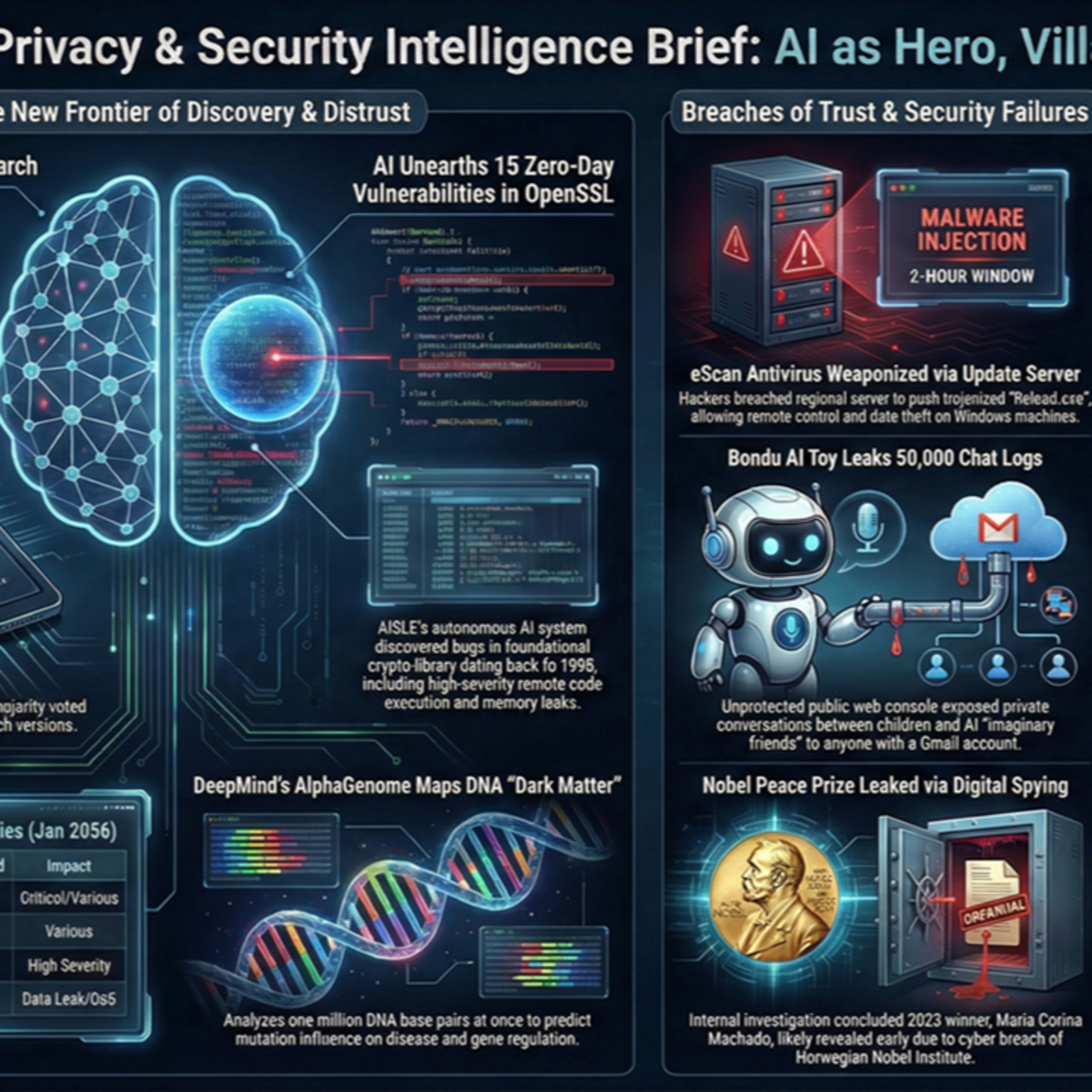
By early 2026, AI’s role has split into a clear paradox: consumers increasingly reject it in everyday search, while critical systems lean on it to uncover deep flaws and decode complex biology. AI is shunned as a source of noisy, untrusted summaries, yet embraced as an indispensable auditor of legacy code and genomic “dark matter,” where systems like AISLE and AlphaGenome expose decades-old vulnerabilities and illuminate non-coding DNA’s influence on disease.At the same time, trust in digital protectors and platforms is eroding as security tools and communication services themselves become vectors of risk. The eScan incident shows how a compromised update server can turn antivirus into malware distribution, while “Operation Sourced Encryption” suggests that end-to-end encryption can be weakened not by breaking cryptography, but by exploiting moderation workflows and access policies.Espionage now blends human and digital weaknesses, with the Nobel leak likely driven by poor institutional OpSec and Google’s insider theft case revealing how easily high-value AI IP can walk out the door when procedural safeguards lag. Both episodes underline that advanced technical controls mean little if basic governance, identity checks, and behavioral monitoring are neglected.Consumer-facing privacy illustrates an equally stark divide between negligent design and proactive protection. Bondu’s AI toy breach, exposing tens of thousands of children’s intimate chats via an essentially open portal, embodies “privacy as afterthought,” whereas Apple’s iOS location fuzzing shows “privacy by architecture,” making fine-grained tracking technically difficult rather than merely contractually prohibited.Taken together, these threads define 2026 as a pivot year: AI is maturing into a high-stakes auditing tool just as faith in trusted vendors collapses, pushing organizations toward Zero Trust models where security and privacy are enforced by design and cryptography instead of marketing, policies, or reputation.

By early 2026, AI’s role has split into a clear paradox: consumers increasingly reject it in everyday search, while critical systems lean on it to uncover deep flaws and decode complex biology. AI is shunned as a source of noisy, untrusted summaries, yet embraced as an indispensable auditor of legacy code and genomic “dark matter,” where systems like AISLE and AlphaGenome expose decades-old vulnerabilities and illuminate non-coding DNA’s influence on disease.At the same time, trust in digital protectors and platforms is eroding as security tools and communication services themselves become vectors of risk. The eScan incident shows how a compromised update server can turn antivirus into malware distribution, while “Operation Sourced Encryption” suggests that end-to-end encryption can be weakened not by breaking cryptography, but by exploiting moderation workflows and access policies.Espionage now blends human and digital weaknesses, with the Nobel leak likely driven by poor institutional OpSec and Google’s insider theft case revealing how easily high-value AI IP can walk out the door when procedural safeguards lag. Both episodes underline that advanced technical controls mean little if basic governance, identity checks, and behavioral monitoring are neglected.Consumer-facing privacy illustrates an equally stark divide between negligent design and proactive protection. Bondu’s AI toy breach, exposing tens of thousands of children’s intimate chats via an essentially open portal, embodies “privacy as afterthought,” whereas Apple’s iOS location fuzzing shows “privacy by architecture,” making fine-grained tracking technically difficult rather than merely contractually prohibited.Taken together, these threads define 2026 as a pivot year: AI is maturing into a high-stakes auditing tool just as faith in trusted vendors collapses, pushing organizations toward Zero Trust models where security and privacy are enforced by design and cryptography instead of marketing, policies, or reputation.

NOW PLAYING

Episode 277.5 Deep Dive. Dark Matter and the IT Privacy and Security Weekly Update for the week ending February 3rd., 2026

0:00 16:09

No transcript for this episode yet

We transcribe on demand. Request one and we'll notify you when it's ready — usually under 10 minutes.

Frequently Asked Questions

How long is this episode of The AI, Privacy, and Security Weekly Update?

This episode is 16 minutes long.

When was this The AI, Privacy, and Security Weekly Update episode published?

This episode was published on February 5, 2026.

What is this episode about?

By early 2026, AI’s role has split into a clear paradox: consumers increasingly reject it in everyday search, while critical systems lean on it to uncover deep flaws and decode complex biology. AI is shunned as a source of noisy, untrusted...

Can I download this The AI, Privacy, and Security Weekly Update episode?

Yes, you can download this episode by clicking the download button on the episode player, or subscribe to the podcast in your preferred podcast app for automatic downloads.
URL copied to clipboard!