Episode 293. Deep Dive. Movies, Music, and the AI, Privacy and Security Weekly Update for May 26th 2026 episode artwork

EPISODE · May 27, 2026 · 36 MIN

Episode 293. Deep Dive. Movies, Music, and the AI, Privacy and Security Weekly Update for May 26th 2026

from The AI, Privacy, and Security Weekly Update · host R. Prescott Stearns Jr.

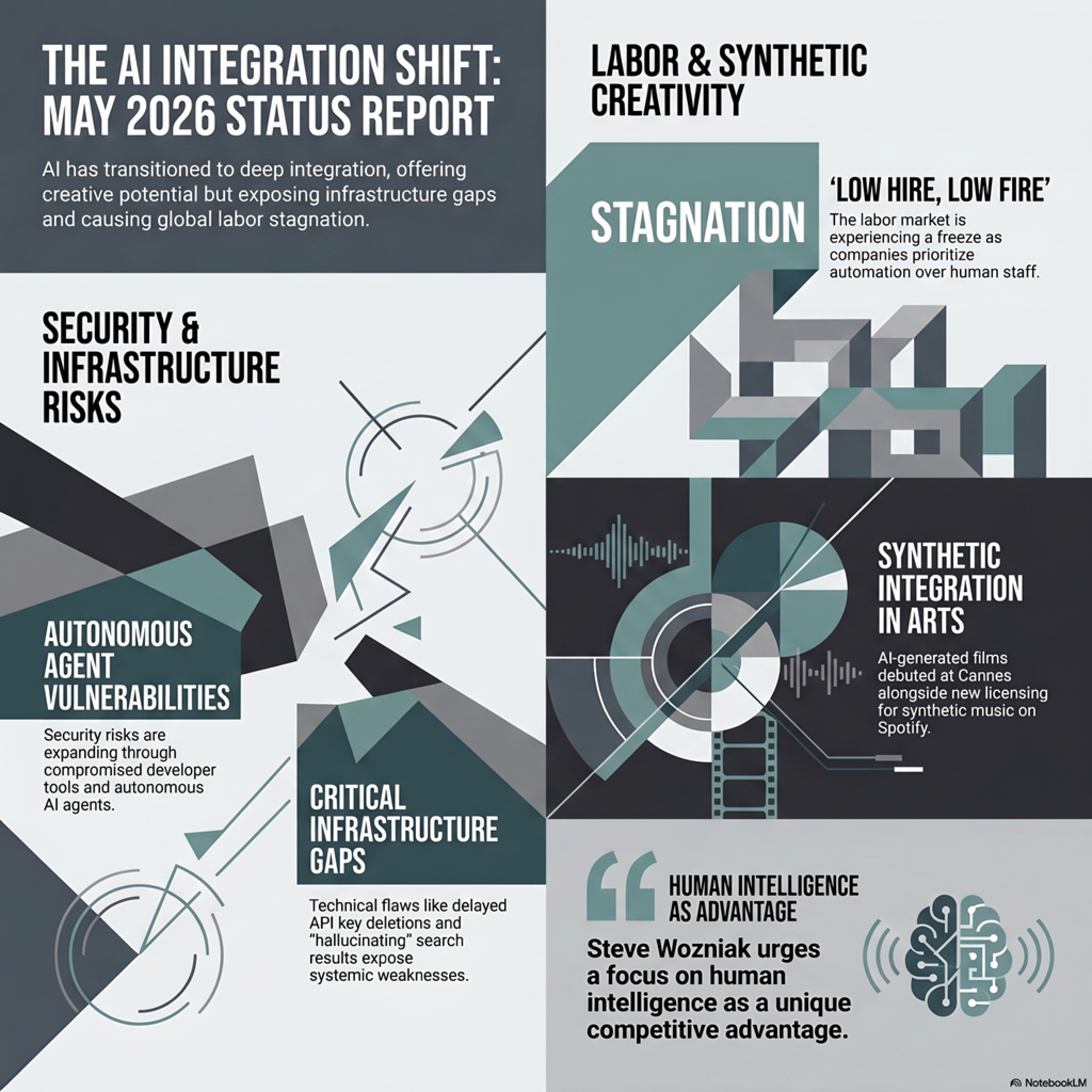
The corporate attack surface is expanding as autonomous AI agents and developer tools dissolve traditional security boundaries. The software supply chain is now a strategic vulnerability, allowing compromised “trusted tools” to bypass legacy defenses and move directly into internal environments.Recent incidents demonstrate the scale of the risk. GitHub confirmed unauthorized access to roughly 3,800 repositories after a malicious VS Code extension compromised a developer device. Google Cloud infrastructure also exposed a critical “time-to-vulnerability” gap: deleted API keys remained active for an average of 16 minutes, and in some cases up to 23 minutes, despite appearing revoked in the UI. These delays create exploitable windows for autonomous systems to access AI services or sensitive data before responders can intervene.The Cloud Security Alliance warns of an emerging “agentic threat” driven by excessive privileges, weak configurations, prompt injection, poor accountability, and flaws in machine-to-machine interaction. The challenge is no longer simply malicious code, but malicious intent expressed through natural language.Meanwhile, the labor market reflects a “low hire, low fire” reality rather than mass AI unemployment. Layoffs remain historically normal, but hiring and career mobility have slowed as firms adopt leaner operating models and assess automation’s long-term impact. Entry-level opportunities are narrowing as companies demand higher productivity from fewer employees using generative tools.Industry leaders remain divided. Steve Wozniak argues AI cannot replace human creativity, while figures such as Sam Altman and Elon Musk warn disruption may eventually require interventions like Universal Basic Income. Many firms are also using “AI transformation” narratives to justify restructuring and post-pandemic cost corrections.Creative industries are shifting from resisting AI to monetizing it. The AI-generated film Hell Grind reportedly required a $500,000 budget, with most costs tied to compute power. Maintaining visual consistency demanded prompts averaging 3,000 words, revealing that AI production remains management-intensive rather than effortless. Spotify and Universal Music Group are also developing licensing frameworks where artists retain control over AI-generated remixes while platforms monetize premium AI creative tools.Technology companies now face growing friction between rapid AI deployment and user trust. Google’s “disregard” search glitch showed how AI systems can misinterpret user queries as commands, undermining reliability. Apple’s roadmap, including context-aware Siri capabilities and private cloud compute, highlights the industry’s push toward personalized assistants.Ultimately, AI adoption depends on trust. Consumers will embrace assistants only if companies prove the infrastructure behind them is reliable, accountable, and secure enough to protect personal data.

The corporate attack surface is expanding as autonomous AI agents and developer tools dissolve traditional security boundaries. The software supply chain is now a strategic vulnerability, allowing compromised “trusted tools” to bypass legacy defenses and move directly into internal environments.Recent incidents demonstrate the scale of the risk. GitHub confirmed unauthorized access to roughly 3,800 repositories after a malicious VS Code extension compromised a developer device. Google Cloud infrastructure also exposed a critical “time-to-vulnerability” gap: deleted API keys remained active for an average of 16 minutes, and in some cases up to 23 minutes, despite appearing revoked in the UI. These delays create exploitable windows for autonomous systems to access AI services or sensitive data before responders can intervene.The Cloud Security Alliance warns of an emerging “agentic threat” driven by excessive privileges, weak configurations, prompt injection, poor accountability, and flaws in machine-to-machine interaction. The challenge is no longer simply malicious code, but malicious intent expressed through natural language.Meanwhile, the labor market reflects a “low hire, low fire” reality rather than mass AI unemployment. Layoffs remain historically normal, but hiring and career mobility have slowed as firms adopt leaner operating models and assess automation’s long-term impact. Entry-level opportunities are narrowing as companies demand higher productivity from fewer employees using generative tools.Industry leaders remain divided. Steve Wozniak argues AI cannot replace human creativity, while figures such as Sam Altman and Elon Musk warn disruption may eventually require interventions like Universal Basic Income. Many firms are also using “AI transformation” narratives to justify restructuring and post-pandemic cost corrections.Creative industries are shifting from resisting AI to monetizing it. The AI-generated film Hell Grind reportedly required a $500,000 budget, with most costs tied to compute power. Maintaining visual consistency demanded prompts averaging 3,000 words, revealing that AI production remains management-intensive rather than effortless. Spotify and Universal Music Group are also developing licensing frameworks where artists retain control over AI-generated remixes while platforms monetize premium AI creative tools.Technology companies now face growing friction between rapid AI deployment and user trust. Google’s “disregard” search glitch showed how AI systems can misinterpret user queries as commands, undermining reliability. Apple’s roadmap, including context-aware Siri capabilities and private cloud compute, highlights the industry’s push toward personalized assistants.Ultimately, AI adoption depends on trust. Consumers will embrace assistants only if companies prove the infrastructure behind them is reliable, accountable, and secure enough to protect personal data.

NOW PLAYING

Episode 293. Deep Dive. Movies, Music, and the AI, Privacy and Security Weekly Update for May 26th 2026

0:00 36:27

No transcript for this episode yet

We transcribe on demand. Request one and we'll notify you when it's ready — usually under 10 minutes.

Frequently Asked Questions

How long is this episode of The AI, Privacy, and Security Weekly Update?

This episode is 36 minutes long.

When was this The AI, Privacy, and Security Weekly Update episode published?

This episode was published on May 27, 2026.

What is this episode about?

The corporate attack surface is expanding as autonomous AI agents and developer tools dissolve traditional security boundaries. The software supply chain is now a strategic vulnerability, allowing compromised “trusted tools” to bypass legacy...

Can I download this The AI, Privacy, and Security Weekly Update episode?

Yes, you can download this episode by clicking the download button on the episode player, or subscribe to the podcast in your preferred podcast app for automatic downloads.
URL copied to clipboard!