
EPISODE · Dec 12, 2025 · 2H 42M
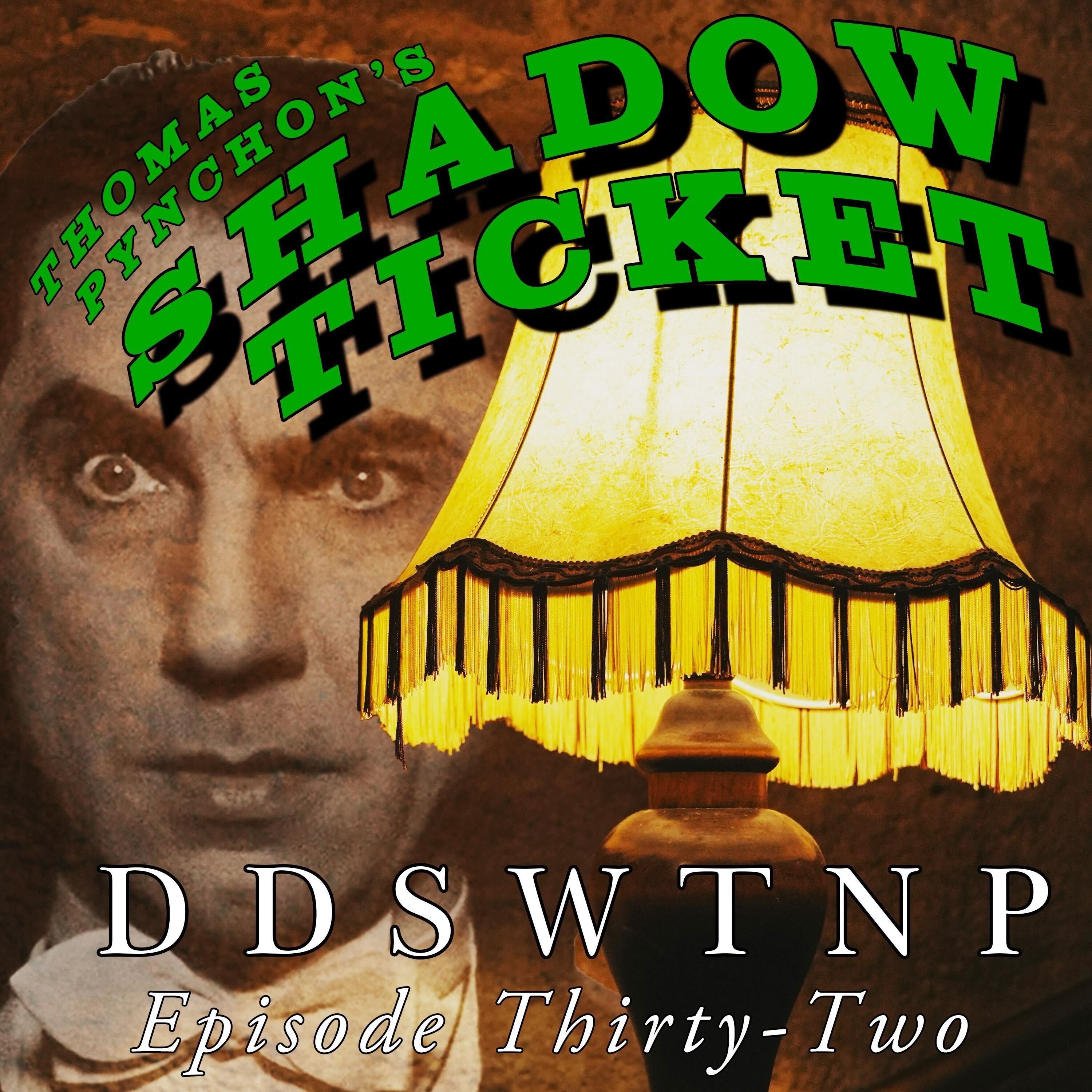
Episode 32: Thomas Pynchon's Shadow Ticket
from Don DeLillo Should Win the Nobel Prize · host Jeffrey Severs & Michael Streit
We do have our favorite but surely wouldn’t mind if Thomas Pynchon won the Nobel Prize too . . . and in Episode 32 we finish off 2025 by considering Shadow Ticket, the noir detective take on the 1930s by a writer who was surely a key influence on the early DeLillo (we read from an unpublished DeLillo letter summarizing that relationship) but who also seems to have been reading works like Running Dog over the years (or so we imagine in unpacking Shadow Ticket scenes invoking Chaplin and a “German Political Celebrity” named Hitler). We try to understand how Pynchon’s latest examination of historical and potential fascism works in its 1932 setting, ranging from Milwaukee to Hungary, where reluctant protagonist and “sentimental ape” and “sap” Hicks McTaggart keeps adding on to his P.I. “tickets” in a strange search for a Wisconsin heiress and her Jewish musician lover but also what might ultimately be justice (a far from simple thing). Shadow Ticket is loads of serious fun, where Pynchon manages to examine the direst of turning points amidst scenes of bowling alley and motorcycle lore, dairy strikes, Prohibition’s black markets, dance hall and speakeasy glamour, and something called “Radio-Cheez.” Bela Lugosi, vampires, a beautiful pig in a sidecar, and some of the most tasteless lamps in the world also play a role. The real content here for Hicks, though, is the prospect of spiritual and other forms of peace in a world where weapons from clubs to guns and submarines operate according to mysterious laws of “apport” and “asport,” occult material that interweaves with Hicks’s strike-breaking past and raises connections to Gravity’s Rainbow. Is Hicks’s fellow orphan and young protégé Skeet Wheeler the father of Vineland’s Zoyd, headed out to California as the novel ends? What’s the meaning of Hicks failing to return to his home country, and what does cheese gangster Bruno Airmont’s submarine fate have to do with Bleeding Edge? Are Hungary’s shifting borders a new kind of “Zone”? What’s going on in the novel’s many Statue of Liberty references and its anachronistic allusions to a “Face Tube” for flirtation in bars? And how does this always funny writer, now in his late eighties, keep coming up with all these absurd songs (we sing some) and hilarious mock-movies like the one featuring “Squeezita Thickly” swimming in soup pots (Shirley Temple, is that you?)? Teasing out many connections to Gravity’s Rainbow, Against the Day, and Vineland, this episode makes reference to just about all of Pynchon’s other works, including even V. and his earliest short stories. At the same time, you need come to it with nothing but an interest in Pynchon’s life and work. We doubt that we get every reference to history or previous Pynchon right or mount interpretations we won’t later want to revise, but on this brand-new and captivating late work from a masterful author, we hope in nearly three hours of deep conversation and laughter that we’ve made a good start on the many critical readings to come. A partial list of references and quotations that we mention or paraphrase in this episode . . . On “prefascist twilight”: “And other grandfolks could be heard arguing the perennial question of whether the United States still lingered in a prefascist twilight, or whether that darkness had fallen long stupefied years ago, and the light they thought they saw was coming only from millions of Tubes all showing the same bright-colored shadows. One by one, as other voices joined in, the names began, some shouted, some accompanied by spit, the old reliable names good for hours of contention, stomach distress, and insomnia – Hitler, Roosevelt, Kennedy, Nixon, Hoover, Mafia, CIA, Reagan, Kissinger, that collection of names and their tragic interweaving that stood not constellated above in any nightwide remoteness of light, but below, diminished to the last unfaceable American secret, to be pressed, each time deeper, again and again beneath the meanest of random soles, one blackly fermenting leaf on the forest floor that nobody wanted to turn over, because of all that lived, virulent, waiting, just beneath.” (Pynchon, Vineland (1990)) On “second sheep”: “Our common nightmare The Bomb is in there too. It was bad enough in ’59 and is much worse now, as the level of danger has continued to grow. There was never anything subliminal about it, then or now. Except for that succession of the criminally insane who have enjoyed power since 1945, including the power to do something about it, most of the rest of us poor sheep have always been stuck with simple, standard fear. I think we all have tried to deal with this slow escalation of our helplessness and terror in the few ways open to us, from not thinking about it to going crazy from it. Somewhere on this spectrum of impotence is writing fiction about it.” (Pynchon, “Introduction,” Slow Learner (1984)) The “Sloth essay paragraph” mentioned midway through: “In this century we have come to think of Sloth as primarily political, a failure of public will allowing the introduction of evil policies and the rise of evil regimes, the worldwide fascist ascendancy of the 1920's and 30's being perhaps Sloth's finest hour, though the Vietnam era and the Reagan-Bush years are not far behind. Fiction and nonfiction alike are full of characters who fail to do what they should because of the effort involved. How can we not recognize our world? Occasions for choosing good present themselves in public and private for us every day, and we pass them by. Acedia is the vernacular of everyday moral life.” (Pynchon, “Nearer, My Couch, To Thee” (1993)) Don DeLillo Papers, Harry Ransom Center, University of Texas-Austin The Motherland Calls statue, Volgograd: https://en.wikipedia.org/wiki/The_Motherland_Calls Pareidolia defined: https://en.wikipedia.org/wiki/Pareidolia
Embed this episode
What this episode covers
We do have our favorite but surely wouldn’t mind if Thomas Pynchon won the Nobel Prize too . . . and in Episode 32 we finish off 2025 by considering Shadow Ticket, the noir detective take on the 1930s by a writer who was surely a key influence on the early DeLillo (we read from an unpublished DeLillo letter summarizing that relationship) but who also seems to have been reading works like Running Dog over the years (or so we imagine in unpacking Shadow Ticket scenes invoking Chaplin and a “German Political Celebrity” named Hitler). We try to understand how Pynchon’s latest examination of historical and potential fascism works in its 1932 setting, ranging from Milwaukee to Hungary, where reluctant protagonist and “sentimental ape” and “sap” Hicks McTaggart keeps adding on to his P.I. “tickets” in a strange search for a Wisconsin heiress and her Jewish musician lover but also what might ultimately be justice (a far from simple thing). Shadow Ticket is loads of serious fun, where Pynchon manages to examine the direst of turning points amidst scenes of bowling alley and motorcycle lore, dairy strikes, Prohibition’s black markets, dance hall and speakeasy glamour, and something called “Radio-Cheez.” Bela Lugosi, vampires, a beautiful pig in a sidecar, and some of the most tasteless lamps in the world also play a role. The real content here for Hicks, though, is the prospect of spiritual and other forms of peace in a world where weapons from clubs to guns and submarines operate according to mysterious laws of “apport” and “asport,” occult material that interweaves with Hicks’s strike-breaking past and raises connections to Gravity’s Rainbow. Is Hicks’s fellow orphan and young protégé Skeet Wheeler the father of Vineland’s Zoyd, headed out to California as the novel ends? What’s the meaning of Hicks failing to return to his home country, and what does cheese gangster Bruno Airmont’s submarine fate have to do with Bleeding Edge? Are Hungary’s shifting borders a new kind of “Zone”? What’s going on in the novel’s many Statue of Liberty references and its anachronistic allusions to a “Face Tube” for flirtation in bars? And how does this always funny writer, now in his late eighties, keep coming up with all these absurd songs (we sing some) and hilarious mock-movies like the one featuring “Squeezita Thickly” swimming in soup pots (Shirley Temple, is that you?)? Teasing out many connections to Gravity’s Rainbow, Against the Day, and Vineland, this episode makes reference to just about all of Pynchon’s other works, including even V. and his earliest short stories. At the same time, you need come to it with nothing but an interest in Pynchon’s life and work. We doubt that we get every reference to history or previous Pynchon right or mount interpretations we won’t later want to revise, but on this brand-new and captivating late work from a masterful author, we hope in nearly three hours of deep conversation and laughter that we’ve made a good start on the many critical readings to come.
Ready to play
Episode 32: Thomas Pynchon's Shadow Ticket
No transcript for this episode yet
Similar Episodes
No similar episodes found.
Similar Podcasts
No similar podcasts found.