
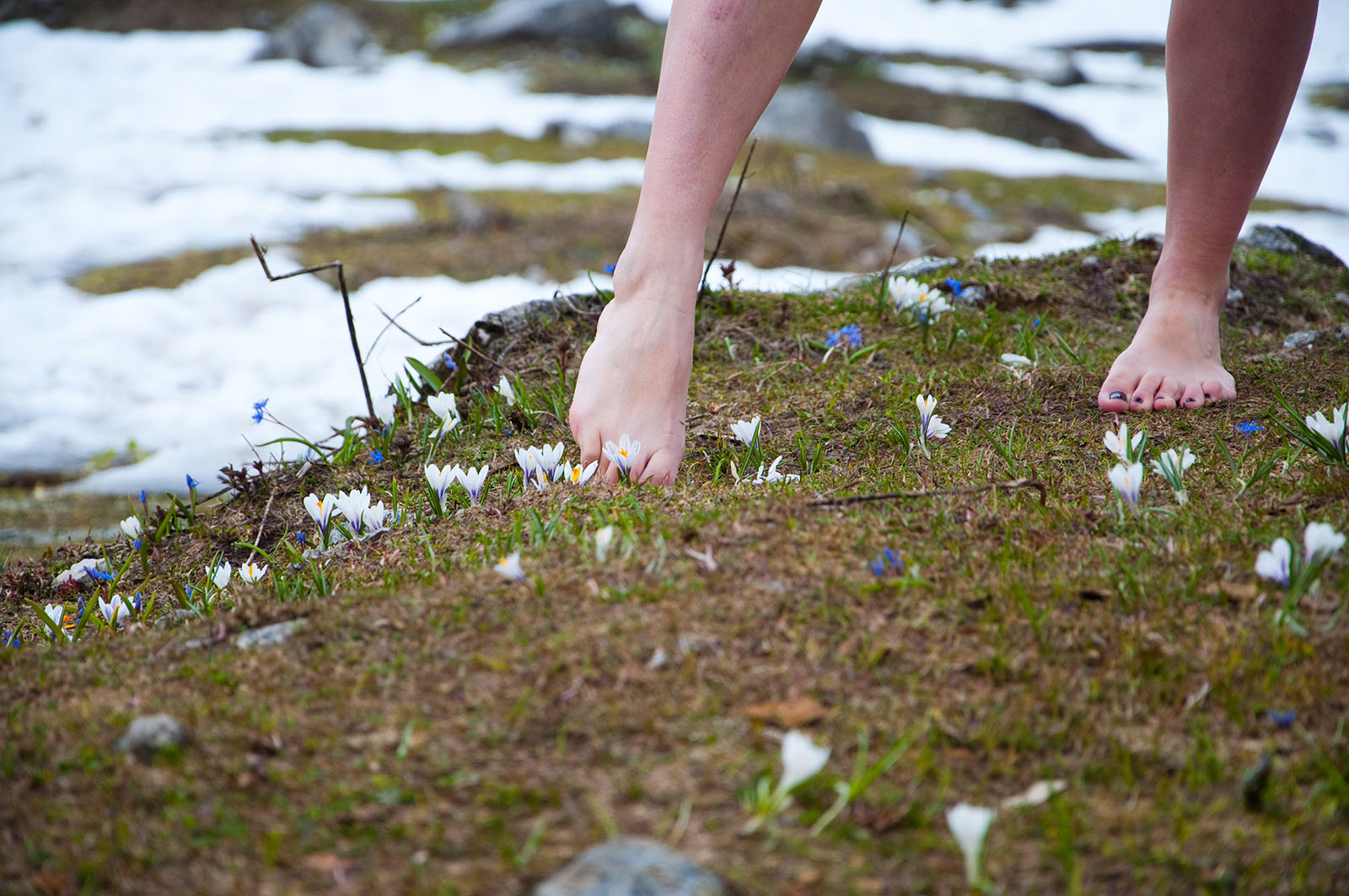
Welcome to the Movement Movement, the podcast for people who want the truth about having a healthy, happy, strong body. Remember your body was meant to move. Now here's your host, Stephen Sashin. If you're in the Northern Hemisphere, winter is coming, so you can't be barefoot anymore.
You're going to have to put on some big, thick, padded shoes with a whole lot of cushioning and things to keep you warm, etc., etc., right? Okay, maybe not. Well, we're going to talk about what to do when it's cold and you want to be barefoot here on today's episode of the Movement Movement. Podcast, the podcast for people who want to know the truth about what it takes to have happy, healthy, strong bodies starting with the feet first because those things are your foundation.
We're also breaking down the lies and mythology, the propaganda that you've been told about what it takes to run, walk, hike, dance, lift, do yoga, do crossfit, slackline, play dance dance, revolution, whatever it is, happily and enjoyably. I'm Stephen Sashin, your host for the Movement Movement podcast. I'm here I am on theceoze.com and just to start off, you know the drill. If you like what you're experiencing here, then like and subscribe and share and spread the word and click the little bell on YouTube so you hear when we have upcoming episodes of the podcast or when new episodes are released.
In short, if you want to be part of the tribe, please subscribe. And when I say part of the tribe, I mean that we're creating a movement movement. We are trying to make natural movement the obvious, better, healthy choice the way natural food currently is. And the only way that happens is from people like you spreading the word, experiencing the fun and benefits of natural movement and then sharing that with other people sometimes because they will stop you on the street saying, Hey, what are those things on your feet if you're wearing like a pair of shoes or how come you're barefoot if you're wearing nothing, which by the way, I do all the time.
And that brings us to what we're going to talk about today. Normally I have a movement thing that I share with people, but I honestly can't think of one that I want to do right now. So let's just talk about cold weather. This is the time of year where people start emailing me saying, I love I've been wearing your sandals all summer or I've been wearing like a pair of the speed floors that just came out over here that's super thin and lightweight.
But you know, what am I going to do when it gets cold now? So hiding behind me is the Mika that's M-I-K, the Mika and the Denver, which are cold weather-friendly boots that we've made. They're water-resistant canvas, they have a flannel lining, they have a heat reflective insol. But you know, if you really want that barefoot feeling, if you've been living a barefoot or wearing a pair of super thin sandals all summer, you know, what are you going to do in the winter?
Well, what I can tell you is what I've been doing for the last 10 years or actually almost 11 years or 12 years, I can't even remember anymore. I'm not suggesting that you do what I am going to tell you about. And I'm not even suggesting that you can do what I'm going to tell you about. I'm suggesting that it may be possible to do much more than you think.
And maybe in this case, I'm kind of a, not a canary in the coal mine, whatever the positive version of canary in a coal mine would be, an anti-canary in an anti- coal mine. And let me just tell you this simple thing. So about like 10 or 11 years ago, winter was upon us and I was just curious, I'd been barefoot all summer and I just wanted to know how long could I go until I felt like I needed to put on some shoes, which I still owned a pair at the time. I hadn't started zero shoes.
All I had was some old regular shoes that squeezed your toes together and elevated your heel and didn't let you feel anything or move anyway that was natural. And so I didn't really want to put them back on, but I didn't know when I would need something more. So I wasn't going to go look and buy a pair of boots or I just didn't want to buy anything new. So I didn't know what to do.
Next thing I did was march and I spent the whole winter barefoot. Now I'm not saying that I didn't change my life in any way to accomplish this. I did in ways that I'm going to tell you in just a few moments, but all I knew is I just made it through the winter either in a pair of sandals that were just four millimeters of rubber strapped to my foot or barefoot for the entire. And by the way, I live in Colorado, Colorado winter, a lot of snow, some super cold weather.
And then the next year I went, well, maybe that was a fluke. Let's try this again, just curiosity, just let's see what happens. How long can I go until I feel the need to put on some shoes. The next thing I know it was spring yet again.
And that went on year after year, after year, after year, after year. And in fact, I noticed that as the years progressed, it was easier and easier and easier and easier. So let me tell you what I did again. I'm not suggesting that you do it.
I'm just tossing this out there as maybe, you know, it'll inspire you to kind of push the limits a little bit to try something a little new to see what you can do that you didn't think you could do. And here we go. Although first, I'm going to quote my friend barefoot Kenbob, AKA Kenbob Saxon, whose line is numb feet are dumb feet. So this is one of the most important things you got to think about.
The goal is not to go out until you can't feel anything. Like the opposite. Feeling is the most important thing because that's what tells your brain what's going on with your feet and what's going on your feet, especially in the cold is possibly what's going on with the rest of your body. So numb feet are dumb feet.
You don't want to be dumb. Oh, by the way, I do want to tell you that when I go out now, after everyone years I've been doing this, if I'm in a pair of sandals or in bare feet, my feet will often, well, let me do it the other way. My hands and my head will often feel super cold and my feet feel totally fine. So what changed and how did I get there?
Let's talk about that how I got there part and then I'll throw out my speculation about what changed. It's really simple. I wasn't stupid. It's just something nice to not be sometimes.
Here's what I did. It was actually a snowy winter day. Oh, and if you go to zeroshoes.com slash cold, you'll see a video of what I'm about to describe. It was a cold snowy day and I had to clear the driveway and all I had was my sandals or some regular shoes and I just didn't want to wear those.
So the first thing I did is I just jog around inside until I felt like I had warmed up my body a little bit. I hadn't broken a sweat but definitely had the blood moving. Then I went outside and started shoveling and as soon as it started feeling like my feet were getting really cold, I came inside and I think it only took like two minutes, maybe a little less. So I came back inside and I just moved around.
I walked around until my feet felt like they had gotten warm again. I didn't want numb feet. I didn't want dumb feet. So I waited until they were warm again.
It took like, I don't know, five minutes maybe and then I went back outside and I did some more shoveling. And maybe this time I lasted for 30 seconds or a minute longer and then I came back inside and it took like a minute less for my feet to warm up. Then I went back out and I got like another minute or two out until I came back inside. And this time it only took like a minute or so until my feet warmed up and then I went back out and by like the fourth time or so I just stayed out for like 20 or 30 minutes just shoveling snow and my feet felt fine.
You can see there was, they were just nice and red, a lot of blood flowing into them and I didn't notice the cold at all. I hadn't gotten numb, hadn't made dumb feet. I just was fine. There was enough warmth, enough blood to keep everything totally cool, pun intended.
So that's basically the key is just modify what you're doing so you can get your blood flowing and keep going around and around in circles if you will until you're able to do what you need to do. You don't just plan on going out all day and just having your normal life. You adapt your behavior to the situation at hand. So if I'm going for a run again, I'm not a runner, I'm a sprinter.
But even when I was just going out for my opening warm up, I would do the same basic thing. I wouldn't go out for like a multi mile run. I'd go out for a little bit and make a loop and come back to somewhere where I could warm my feet up and then make a slightly bigger loop and come back so I could warm my feet up and a slightly bigger loop. Instead of maybe doing a five mile run, you do five runs that end up totaling five miles instead of just a single five mile run.
Get it? So like when I am running around barefoot in the winter and it's cold in some way and I'm going to Costco and I'm being in there barefoot, which I do most of the time, you may have heard I was in Costco in a pair of my shoes once and I got stopped by two employees asking if everything was okay because they'd never seen me in shoes before. So what I'll do is a make sure I'm parked somewhat near the door near the front door and if I can't do that, I just prepare to do the obvious thing. I run to get there.
I don't just stroll like I would be if I was in shoes. I adapt. I get in and as soon as I can, I get somewhere where I can warm up my feet, not rocket science. So that's the gist of what to do to if you want to explore being more barefoot, a little more natural in the cold.
Now what happened? What allowed this to occur and why has it gotten better over time? I don't have a definitive answer because I haven't gotten whatever tests I would need to get taken to prove what I'm about to say, but you'll probably come to the conclusion that what I'm about to say is perhaps accurate and the gist is that by getting my body this repetitive stimulation, it changed. I think the capitalization of my feet has changed.
I think I have more capillaries. I think I have developed more the potential for more blood flow in my feet than I've had before. I just realized something. It didn't occur to me to bring up at the very beginning.
If you're interested in this whole idea of cold and what bodies do, check out this guy Wim Hof or Wim Hof, W-I-M-H-O-F-F. I'm not saying that he's not nuts and I'm not saying that everything says is accurate, but if you want to see someone else who's done a lot of experimenting, both with himself and his students about dealing with the cold, that's a place to go. And maybe they've got some research that shows that continuous repetitive exposure to the cold will change, how your body's actually made. That you'll develop new capillaries.
You develop new blood flow. And this kind of makes sense if you think about what happens in terms of developing capillaries when you lift weights. If you're actually buying bicep curls, your bicep eventually gets more capillaries because it wants to move more blood and more nutrients into support the work that you're doing, the muscle you're doing. When you're a runner, you're developing more capillaries in the parts of your body, your legs, your hips that are being used more.
So just exposing yourself to the cold repeatedly is using your body in a very particular way, and it's not surprising that your body would find a way to adapt to handle that. I can't do something like walk on ice forever this morning when it was nice and cold and my driveway was wet. I made it out to the end of the driveway to get the paper and then I had to get back pretty quickly to warm up my feet. But again, if I had gone out and back and out and back a few times, I would have gotten warmed up enough where I could have gotten the paper in someone else's yard if I needed to do that for some reason that I can't imagine.
Anyway, all of this is to say that one of the things that I love about this whole natural movement idea, the whole movement movement is that what we're doing is ironically not trying to do something new but go back to the way that we did things for a long, long time. And the way we get there is by breaking out of our little comfort zone, our literal comfort zone. Sometimes that's our home or our car or our socks or our shoes to see what we can actually do that we didn't know we could do that if we went to certain parts of the third world, you'd find out they were already doing this and they would think that we don't think that we can. So give it a word.
See what happens. Keep me posted. Let me know what happens in your safe, not dumb, not numb cold experiment and share whatever you discover with that. Post it on Instagram or on Facebook or leave comments.
If you want to leave comments, just do that. You can leave comments wherever you can find us. And if you don't know where you can find us, go to jointhemovementmovement.com. Join TheMovementMovement.com.
If you have any questions or you want to just send me an email about this, you can send an email to move at jointhemovementmovement.com. If you know of anyone who should be on the show because what they're doing is supporting natural movement, pass on the word, have them drop me an email or you can drop me an email and tell me about them. Join TheMovementMovement.com and find us on iTunes and anywhere you can find a podcast and on Facebook and on Instagram and on our blog and on YouTube and all those other places. And you know what to do.
Like and share and subscribe and hit the bell on YouTube. If you want to be part of the tribe again, please subscribe. I just want to thank you for being part of the movement movement. As always, just go out, have fun and live life.
Feet First. You've been listening to TheMovementMovement.com with host Stephen Satchin. Remember to join the tribe and subscribe at jointhemovementmovement.com.